

 Download PDF
Market Overview
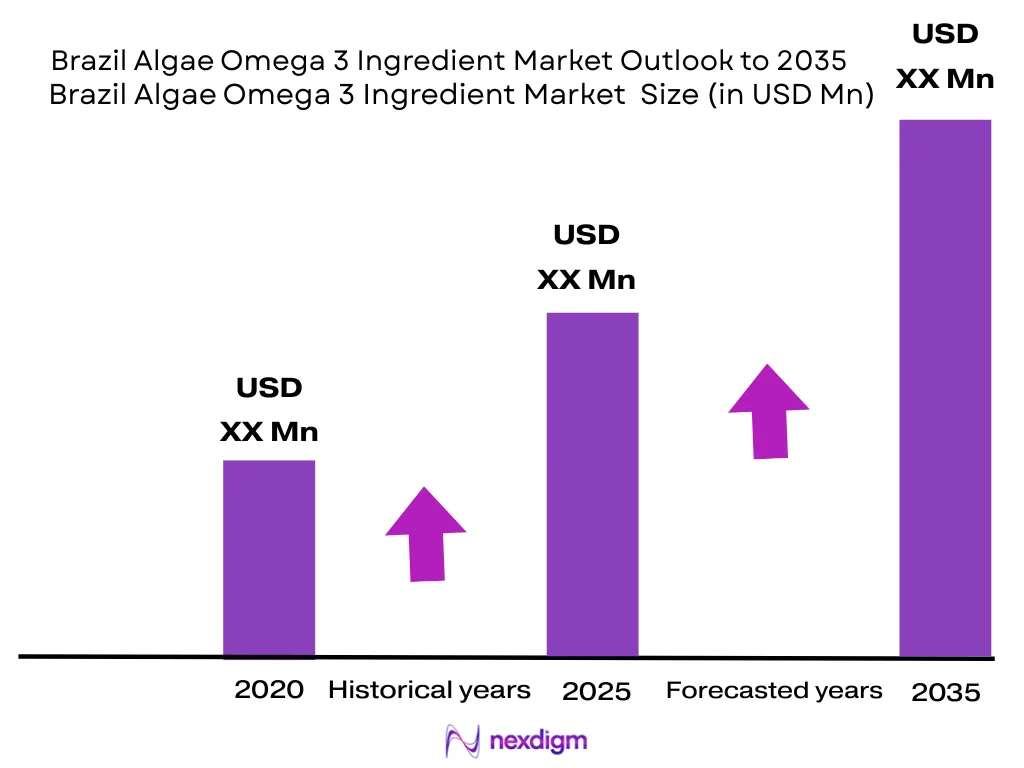
The Brazil Algae Omega 3 Ingredient Market is an emerging plant-based sub-segment within Brazil’s omega-3 ingredient ecosystem. Brazil’s omega-3 market generated USD ~ million in revenue in the latest country-level benchmark, while the global algae omega-3 ingredients market was valued at USD ~ billion in 2024. Demand is driven by dietary supplements, vegan DHA/EPA positioning, fish-free formulations, maternal nutrition, functional foods, and pet nutrition. The forecasted CAGR benchmark for Brazil EPA/DHA omega-3 ingredients is 4.9% for 2026–2036. São Paulo, Rio de Janeiro, Paraná, Santa Catarina, Minas Gerais, and the Northeast aquaculture belt dominate Brazil Algae Omega 3 Ingredient Market activity because they combine supplement manufacturing, pharmacy chains, nutraceutical importers, e-commerce wellness, pet nutrition and aquafeed demand. Brazil’s GDP reached USD 2.19 trillion, GDP per capita reached USD 10,310.5, and the population reached 212.6 million residents. São Paulo’s metropolitan region had 21.5 million residents and Rio de Janeiro had 12.9 million, supporting premium supplement and functional nutrition demand.
Market Segmentation
By Type
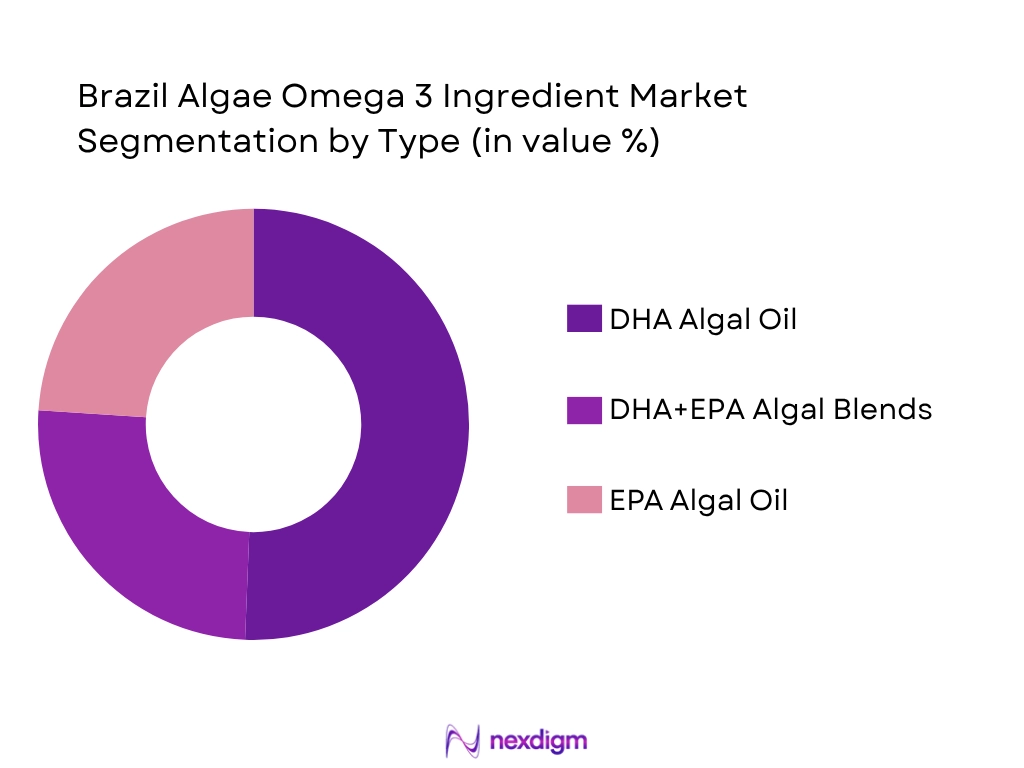
Brazil Algae Omega 3 Ingredient Market is segmented by type into DHA algal oil, DHA+EPA algal blends, EPA algal oil, and microencapsulated algal omega-3 powders. Recently, DHA algal oil has a dominant market share in Brazil under the segmentation type, due to its wider use in prenatal supplements, pediatric drops, brain-health capsules, eye-health formulations, infant nutrition and premium vegan supplements. DHA also benefits from stronger global commercialization than EPA-only algal oil because high-DHA strains such as Schizochytrium and Aurantiochytrium are already used in supplement and food applications. Brazil’s regulatory framework also requires clear declaration of polyunsaturated fats, omega-3, EPA and DHA where relevant, making DHA concentration and label substantiation important for importers and manufacturers. DHA+EPA blends are growing because they offer fish-oil-equivalent positioning, but DHA-only ingredients remain the anchor because supplement brands can communicate maternal, cognitive and retinal health positioning more easily.
By Application
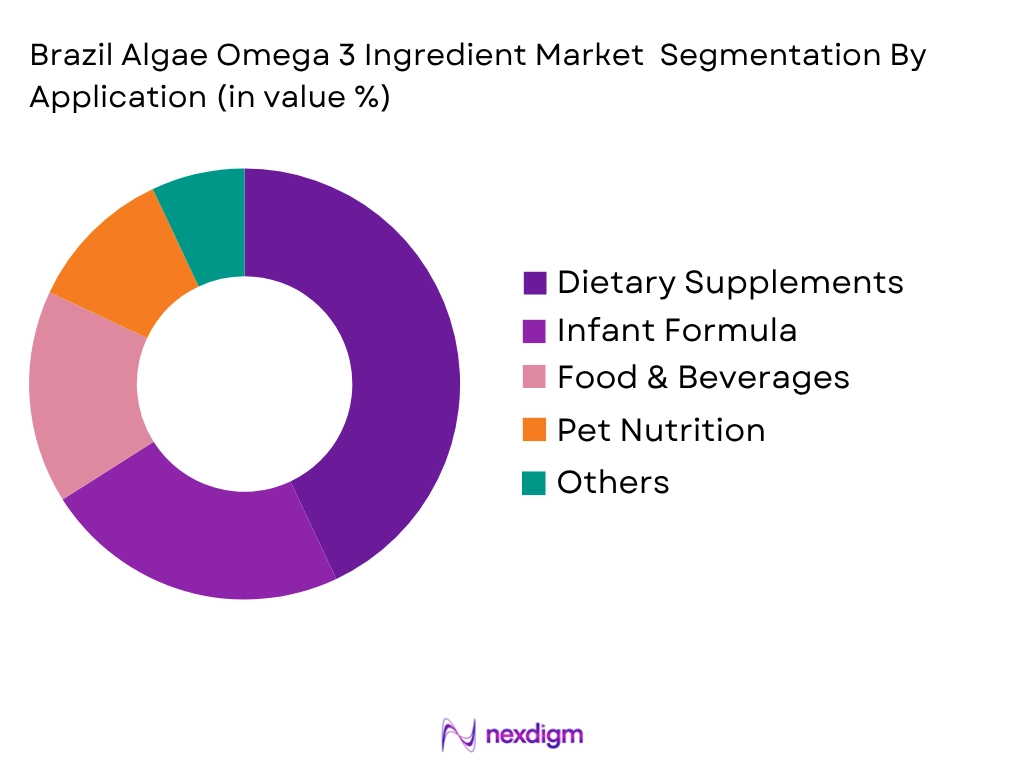
Brazil Algae Omega 3 Ingredient Market is segmented by application into dietary supplements, infant and maternal nutrition, functional food and beverages, pet nutrition, and aquafeed and animal nutrition. Recently, dietary supplements have a dominant market share in Brazil under the segmentation application, due to the strength of capsules, softgels, gummies, liquid drops and pharmacy-led nutrition products. The Brazil dietary supplements market was estimated at USD 4.62 billion in 2024, indicating a large downstream formulation base for omega-3 ingredients, including fish-free DHA and EPA. Supplements are easier to commercialize than beverages and fortified foods because active dosage, oxidation control, packaging, capsule fill, label claims and shelf-life are more manageable. Infant and maternal nutrition remain high-value applications, but qualification timelines and regulatory documentation are stricter. Pet nutrition and aquafeed create white-space demand as brands seek fish-free and sustainability-led lipid sources.
Competitive Landscape
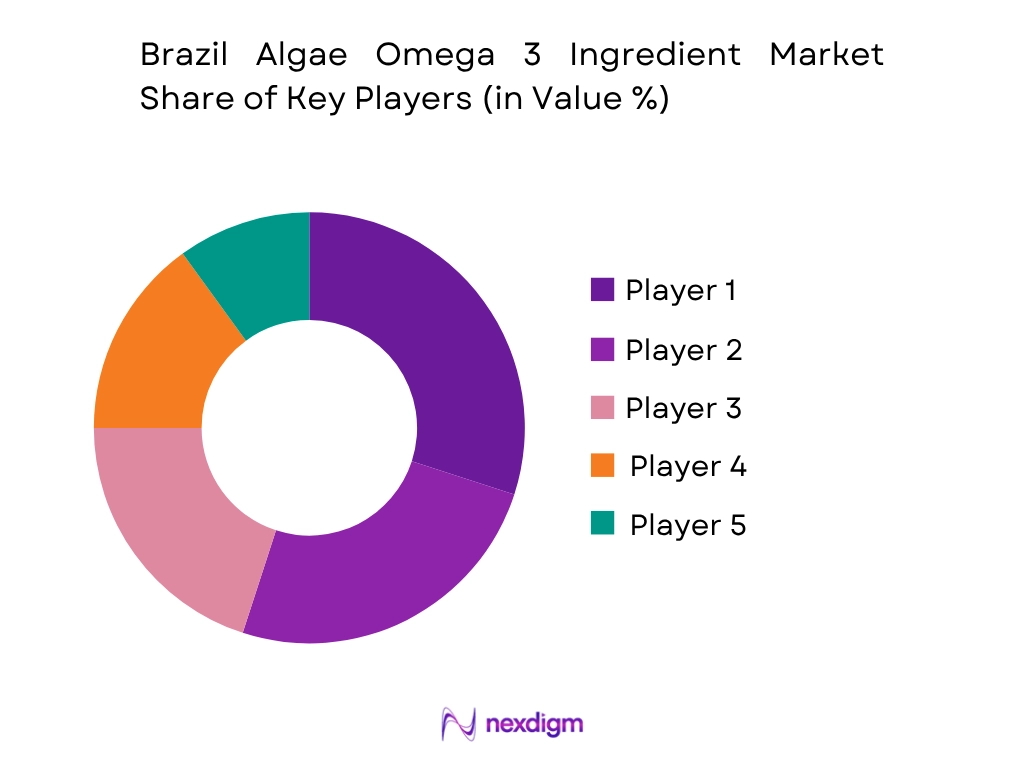
The Brazil Algae Omega 3 Ingredient Market is led by global ingredient suppliers and supported by Brazilian importers, nutraceutical distributors, softgel manufacturers, pharmacy private-label operators and pet nutrition formulators. The market remains import-led because large-scale commercial algal DHA/EPA production is concentrated outside Brazil. Competitive strength depends on ANVISA documentation readiness, DHA/EPA concentration, oxidation stability, softgel-fill compatibility, microencapsulation capability, distributor network, technical support and suitability for vegan, non-GMO and fish-free claims.
| Company | Establishment Year | Headquarters | Core Ingredient Focus | Production / Technology Platform | Key Applications | Brazil Commercial Route | Regulatory / Quality Strength | Market-Specific Differentiator |
| dsm-firmenich | 2023 | Kaiseraugst, Switzerland / Maastricht, Netherlands | ~ | ~ | ~ | ~ | ~ | ~ |
| Corbion | 1919 | Amsterdam, Netherlands | ~ | ~ | ~ | ~ | ~ | ~ |
| Fermentalg | 2009 | Libourne, France | ~ | ~ | ~ | ~ | ~ | ~ |
| DIC Corporation | 1908 | Tokyo, Japan | ~ | ~ | ~ | ~ | ~ | ~ |
| Evonik Health Care | 1847 | Essen, Germany | ~ | ~ | ~ | ~ | ~ | ~ |
Brazil Algae Omega 3 Ingredient Market Analysis
Growth Drivers
Large consumer economy supports premium supplement and functional nutrition demand
Brazil Algae Omega 3 Ingredient Market is supported by a large health-and-wellness consumer base, with World Bank reporting Brazil’s GDP at USD 2.19 trillion, GDP per capita at USD 10,310.5, and population at 212.6 million people. These macro indicators support demand for premium DHA and EPA ingredients used in vegan omega-3 capsules, prenatal DHA, eye-health supplements, cognition products, fortified foods, and pharmacy-led wellness formats. IBGE also reported 15 municipalities with more than 1 million residents, led by São Paulo with 11.9 million residents, creating concentrated urban demand for imported specialty nutrition ingredients.
Maternal, pediatric and aging nutrition create stable DHA application demand
Brazil Algae Omega 3 Ingredient Market benefits from maternal, pediatric and senior nutrition applications because algal DHA is used in prenatal supplements, infant-oriented nutrition, children’s drops, eye-health products and cognition-focused supplements. Brazil recorded 2.6 million births in the latest IBGE population projection reference, sustaining a large maternal and pediatric formulation base. World Bank reports Brazil’s population aged 65 and above at 23,424,113 people, while IBGE reported life expectancy of 76.6 years. These indicators support DHA/EPA positioning across pregnancy, early-life development, healthy aging, brain health and vision-related supplement formats.
Market Challenges
Regulatory classification and notification rules increase commercialization complexity
Brazil Algae Omega 3 Ingredient Market faces regulatory complexity because algae-derived DHA/EPA ingredients must fit ANVISA’s food and supplement compliance framework before being commercialized. ANVISA’s RDC 843/2024 and IN 281/2024 introduced 3 food regularization pathways: marketing authorization, notification to ANVISA, and communication to local health authorities. These rules apply to food, raw materials, bulk products and finished products, creating documentation needs for imported algal oils, powders and premixes. The challenge is relevant in a large economy with USD 2.19 trillion GDP and 212.6 million consumers, where incorrect classification can delay launches.
Label substantiation and product-quality scrutiny raise barriers for omega-3 suppliers
Brazil Algae Omega 3 Ingredient Market faces quality and labelling pressure because omega-3 claims require accurate EPA and DHA declaration, stability evidence and product traceability. ANVISA’s nutrition labelling rule requires declaration of polyunsaturated fats, omega-3, EPA and DHA when applicable, and defines omega-3 claim thresholds using 40 mg and 80 mg of combined EPA and DHA per reference serving. ANVISA also suspended 8 lots of an omega-3 supplement in 2025 after a validity declaration error, showing active enforcement. In a USD 2.19 trillion economy, compliance failures can damage importer, distributor and pharmacy-channel confidence.
Market Opportunities
Aquafeed and fish nutrition create a route for algae-based DHA substitution
Brazil Algae Omega 3 Ingredient Market has an opportunity in aquafeed because algal DHA can support fish-oil replacement, broodstock nutrition, tilapia feed and omega-3 enrichment. IBGE reported Brazilian fish production of 724,900 tonnes, with tilapia production reaching 499,400 tonnes. Paraná alone produced 190.5 million kilograms of tilapia, making southern Brazil an important feed-formulation corridor. This production base creates room for algae omega-3 ingredients in feed trials, especially where formulators seek consistent DHA supply and marine-resource reduction. The opportunity is reinforced by Brazil’s USD 2.19 trillion GDP and large agribusiness-linked manufacturing base.
Urban concentration supports premium vegan and fish-free omega-3 formats
Brazil Algae Omega 3 Ingredient Market has an opportunity in premium urban supplement formats because large cities concentrate pharmacies, e-commerce wellness brands, nutraceutical manufacturers and imported ingredient distributors. IBGE reported 42.7 million residents living in Brazil’s 15 municipalities with more than 1 million residents; São Paulo had 11.9 million residents, Rio de Janeiro had 6.7 million, and Brasília had 3.0 million. This urban concentration supports vegan DHA softgels, fish-free EPA/DHA blends, gummies, microencapsulated powders and maternal DHA products. World Bank’s USD 10,310.5 GDP per capita supports premium nutrition positioning in these metropolitan channels.
Future Outlook
Over the next decade, the Brazil Algae Omega 3 Ingredient Market is expected to grow steadily as supplement brands, pharmacy private labels, vegan wellness companies, maternal nutrition formulators, pet supplement companies and aquafeed producers increase adoption of fish-free DHA and EPA. The broader Brazil EPA/DHA omega-3 ingredient forecast benchmark indicates 4.9% CAGR across the long-term forecast period, while global algae omega-3 ingredient demand is supported by plant-based nutrition, contaminant-controlled sourcing and fish-oil substitution.
The strongest growth pockets will be high-DHA prenatal capsules, vegan softgels, DHA+EPA fish-oil alternatives, microencapsulated powders, children’s gummies, pet oils and aquafeed lipid replacement. ANVISA’s revised food framework establishes three market-access pathways: marketing authorization, notification, and communication to local health authorities. This creates a clearer route for compliant ingredient launches but also raises the importance of product classification, labelling, EPA/DHA declaration, COA validation and claims substantiation.
Major Players
- dsm-firmenich
- Corbion
- BASF
- Fermentalg
- DIC Corporation
- Qualitas Health / iwi
- SourceOne Global Partners
- Mara Renewables Corporation
- Algarithm Ingredients
- Nuseed Nutritional
- Polaris
- KD Pharma Group
- Croda International
- ADM
- Evonik Health Care
Key Target Audience
- Nutraceutical and dietary supplement manufacturers
- Softgel, capsule, gummy and powder contract manufacturers
- Infant and maternal nutrition product manufacturers
- Functional food and beverage manufacturers
- Pet nutrition and veterinary supplement companies
- Aquafeed and animal nutrition manufacturers
- Investments and venture capitalist firms
- Government and regulatory bodies — Agência Nacional de Vigilância Sanitária, Ministério da Agricultura e Pecuária, Ministério da Saúde, Instituto Nacional de Metrologia, Qualidade e Tecnologia, Receita Federal do Brasil
Research Methodology
Step 1: Identification of Key Variables
The initial phase involves constructing an ecosystem map for the Brazil Algae Omega 3 Ingredient Market, covering algal oil producers, specialty ingredient importers, nutraceutical distributors, supplement manufacturers, softgel producers, infant nutrition companies, pet nutrition brands and aquafeed formulators. Key variables include DHA/EPA concentration, product form, application type, ANVISA pathway, import dependency, formulation route and channel demand.
Step 2: Market Analysis and Construction
In this phase, historical and current data are compiled from omega-3 ingredient benchmarks, Brazil supplement demand, ANVISA food regulation, global algae DHA/EPA supplier portfolios, import-led specialty ingredient channels and application-level adoption. The market is constructed using top-down omega-3 ingredient demand and bottom-up formulation mapping across capsules, softgels, powders, gummies, pet oils and aquafeed.
Step 3: Hypothesis Validation and Expert Consultation
Market hypotheses are validated through interviews with ingredient importers, nutraceutical brands, contract manufacturers, regulatory specialists, pet nutrition formulators, aquafeed buyers, pharmacy private-label teams and supplement distributors. These discussions validate DHA dominance, supplement-led adoption, microencapsulation demand, fish-oil substitution barriers, buyer qualification cycles and ANVISA documentation requirements.
Step 4: Research Synthesis and Final Output
The final phase triangulates desk research, regulatory sources, supplier portfolios, expert interviews and application-level assumptions. The output delivers a validated view of Brazil Algae Omega 3 Ingredient Market, including market size context, segmentation, competitive landscape, future outlook, key target audience and methodology for business decision-making.

- Executive Summary
- Research Methodology (Market definitions and assumptions, ingredient inclusion criteria, algal oil versus fish oil exclusion logic, DHA/EPA active-content mapping, ANVISA regulatory validation, B2B ingredient route-to-market, supplement manufacturer procurement, food and beverage fortification mapping, pet nutrition and aquafeed application mapping, import dependency assessment, distributor triangulation, primary research approach, limitations and future conclusions)

- Definition and Scope
- Market Genesis and Evolution
- Timeline of Major Regulatory and Ingredient Developments
- Business Cycle and Commercialization Pathway
- Supply Chain and Value Chain Analysis

- Growth Drivers (Dietary supplement consumption, vegan and plant-based nutrition, prenatal DHA demand, senior brain-health positioning, pharmacy retail penetration, e-commerce supplement growth, contaminant concerns in fish oil, sustainability claims, pet wellness premiumization, aquaculture feed modernization)
- Market Challenges (Imported ingredient dependence, exchange-rate volatility, high production cost, ANVISA approval complexity, limited domestic algae omega-3 scale, sensory masking, oxidation stability, fish oil price competition, limited consumer awareness of algae omega-3, formulation compatibility issues)
- Opportunities (Premium vegan omega-3 supplements, high-DHA prenatal formulas, EPA+DHA fish-oil alternatives, pharmacy private labels, microencapsulated powders, gummies, functional beverages, pet supplements, aquafeed lipid replacement, local ingredient distribution partnerships)
- Market Trends (Vegan DHA/EPA, fish-free supplements, contaminant-controlled claims, non-GMO positioning, high-potency capsules, gummies and chewables, pharmacy private labels, premium prenatal DHA, e-commerce wellness, pet humanization, aquafeed sustainability, microencapsulated omega-3 powders)
- SWOT Analysis
- PESTLE Analysis
- Porter’s Five Forces

- By Value (2020-2025)
- By Volume (2020-2025)
- By Active DHA/EPA Content (2020-2025)

- By Fatty Acid Type (In Value %)
DHA-Only Algal Oil
EPA-Only Algal Oil
DHA+EPA Algal Blends
High-DHA Specialty Ingredients
Balanced EPA:DHA Algal Ingredients - By Product Form (In Value %)
Refined Algal Oil
Microencapsulated Powder
Water-Dispersible Emulsions
Beadlets and Encapsulated Actives
Algae Biomass and Concentrates - By Distribution Channel (In Value %)
Direct Supplier-to-Manufacturer Sales
Specialty Ingredient Importers
Nutraceutical Ingredient Distributors
Contract Manufacturer Procurement
Pharmacy and Retail Private-Label Procurement - By Region (In Value %)
São Paulo
Paraná and Santa Catarina
Rio de Janeiro
Northeast Brazil
Minas Gerais, Goiás and Mato Grosso

- Market Share of Major Players on the Basis of Value and Volume (Ingredient sales value, algal oil volume, active DHA/EPA tonnage, supplement customer contracts, application mix, imported supply contribution)
- Cross Comparison Parameters (DHA/EPA concentration, ANVISA documentation readiness, production technology, source organism, Brazilian importer/distributor network, product-form capability, oxidative stability and sensory performance, sustainability and traceability credentials)
- SWOT Analysis of Major Players
- Pricing Analysis by Ingredient SKU
- Detailed Profiles of Major Companies
dsm-firmenich
Corbion
BASF
Fermentalg
DIC Corporation
Qualitas Health / iwi
SourceOne Global Partners
Mara Renewables Corporation
Algarithm Ingredients
Nuseed Nutritional
Polaris
KD Pharma Group
Croda International
ADM
Evonik Health Care

- Nutraceutical Brand Demand and Utilization
- Contract Manufacturer and Softgel Producer Requirements
- Infant and Maternal Nutrition Buyer Needs
- Functional Food and Beverage Formulator Needs
- Pet Nutrition and Veterinary Channel Demand

- By Value (2026-2035)
- By Volume (2026-2035)
- By Active DHA/EPA Content (2026-2035)


 Request a Sample
 Ask for Customization
 Get a Quote
 Enquire Now