
 Download PDF
Market Overview
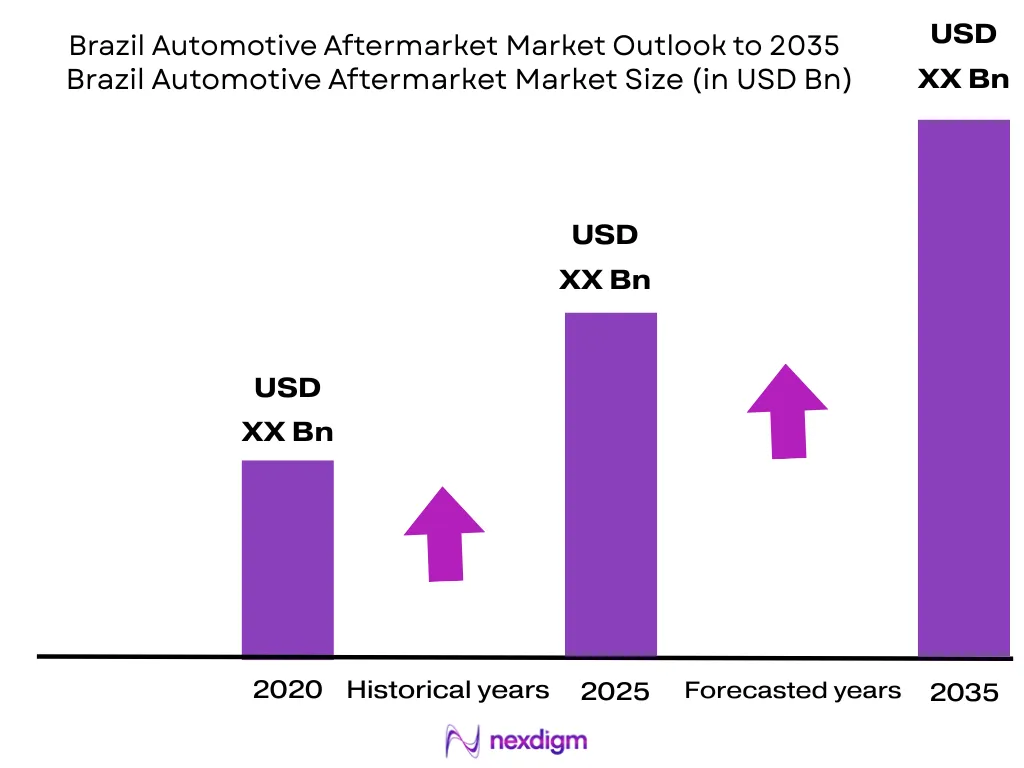
The Brazil Automotive Aftermarket Market is valued at approximately ~ billion, compared with ~ billion in the preceding reporting period. Demand is supported by vehicle production increasing from approximately 2.32 million units to 2.55 million units, while new registrations rose from about 2.31 million units to 2.63 million units. Brazil’s large legacy fleet, extensive flex-fuel parc and rising motorcycle usage sustain recurring parts replacement and workshop demand.
São Paulo, Minas Gerais, Rio de Janeiro, Paraná and Rio Grande do Sul dominate the Brazil Automotive Aftermarket Market because they concentrate vehicle registrations, component manufacturing, wholesale distribution, repair workshops and road-freight activity. São Paulo is the principal national procurement and warehousing hub, while southern states support major automotive supplier clusters. National motorcycle registrations reached 34.2 million units, including 27.7 million motorcycles, reinforcing service demand across metropolitan areas and interior municipalities.
The Brazil Automotive Aftermarket Market encompasses all products and services required after a vehicle enters operation. It includes replacement components, scheduled maintenance, mechanical repairs, tires, batteries, lubricants, vehicle electronics, collision repair, accessories, remanufacturing and digitally enabled diagnostic services.
Market Segmentation
By Aftermarket Offering
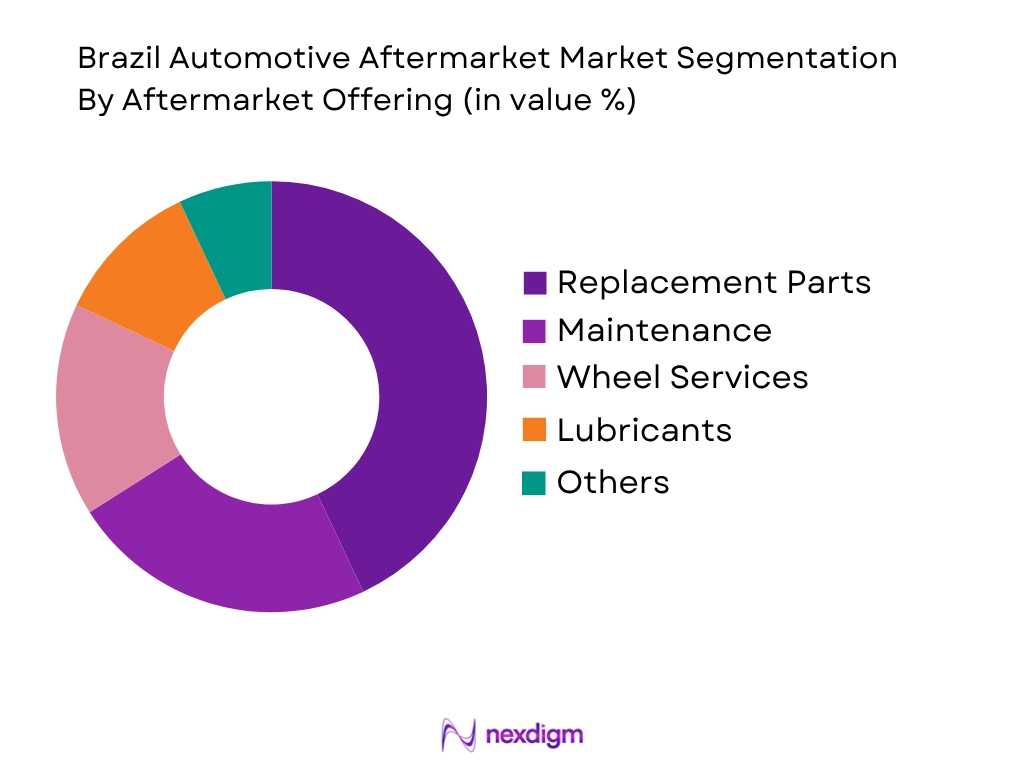
The Brazil Automotive Aftermarket Market is segmented into replacement parts, maintenance and mechanical repair, tires and wheel services, lubricants and fluids, batteries and electrical services, collision repair, accessories and customization, and car-care services. Replacement parts hold the dominant market share because almost every maintenance or repair transaction requires a component, consumable or wear item.
Brazil’s mature vehicle parc creates recurring replacement demand for filters, brakes, shock absorbers, bearings, belts, hoses, ignition products, fuel-injection components and cooling parts. The dominance of flex-fuel vehicles broadens demand for fuel-system sensors, pumps, injectors and ethanol-compatible rubber components. Motorcycles create additional high-volume requirements for tires, chains, sprockets, brake products and batteries. Independent repair workshops also provide several component-quality options, enabling customers to select products according to vehicle age, usage intensity and household budget. Domestic component production supports availability, while national and regional distributors connect manufacturing centers with workshops throughout Brazil’s interior.
By Vehicle Type
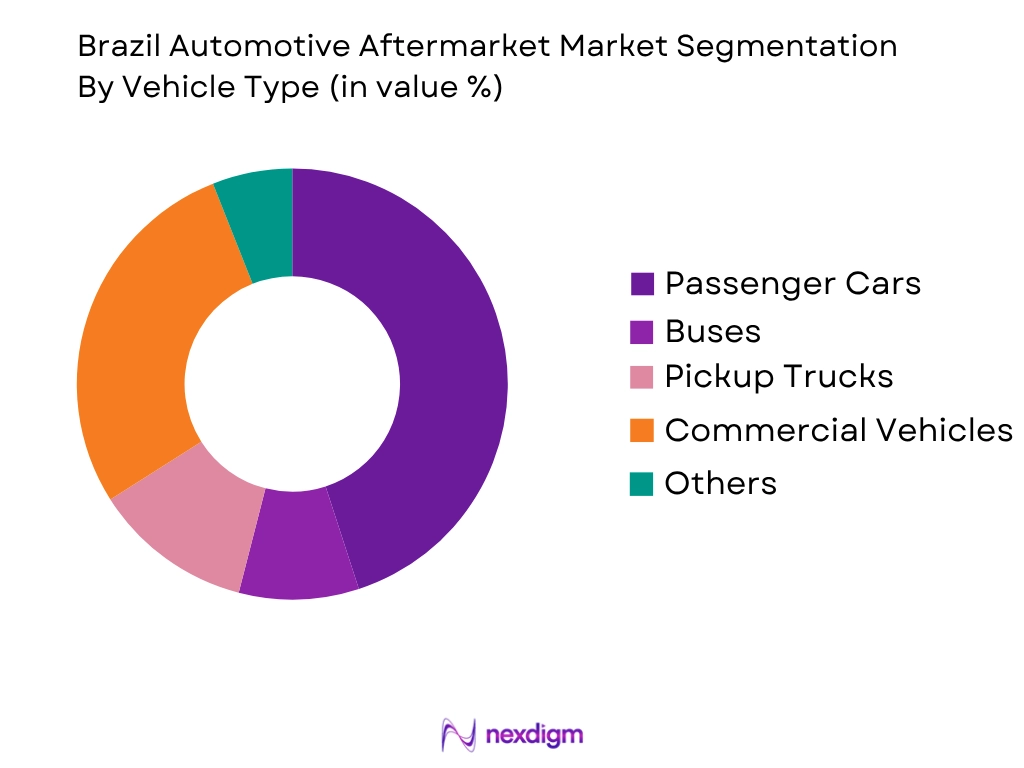
The Brazil Automotive Aftermarket Market is segmented into passenger cars, motorcycles and scooters, pickup trucks and utility vehicles, light commercial vehicles, heavy commercial vehicles, buses and specialized vehicles. Passenger cars hold the dominant revenue share, supported by Brazil’s large installed base of compact, mid-sized and sport utility vehicles and the widespread presence of flex-fuel powertrains.
Passenger cars require scheduled oil and filter changes, brake servicing, suspension repair, batteries, tires, ignition components and air-conditioning maintenance. Their relatively high component content and average repair invoice allow the category to generate more revenue than motorcycles, even though motorcycle service volumes are substantial. Vehicles retained beyond warranty frequently migrate from authorized dealerships to independent repairers, where customers can choose between original-equipment-supplier, branded aftermarket and economy products. Pickup trucks and light commercial vehicles form another important segment because they are heavily used in agriculture, construction, delivery and small-business transportation.
Competitive Landscape
The Brazil Automotive Aftermarket Market is fragmented across national parts distributors, component manufacturers, tire and service networks, automotive retailers and thousands of independent workshops. Grupo Comolatti and Fortbras possess broad distribution operations, while DPaschoal combines automotive services, product distribution and digital channels. Frasle Mobility and Bosch Brasil compete through extensive component portfolios. Competitive strength depends on SKU availability, warehouse reach, workshop relationships, trade credit, delivery frequency and technical support.
| Company | Establishment Year | Headquarters | Business Model | Core Aftermarket Offering | Distribution and Service Reach | Main Customer Base | Digital Capability | Market-Specific Strength |
| Grupo Comolatti | 1957 | São Paulo, Brazil | ~ | ~ | ~ | ~ | ~ | ~ |
| Fortbras Autopeças | 2006 group formation | São Paulo, Brazil | ~ | ~ | ~ | ~ | ~ | ~ |
| DPaschoal | 1949 | Campinas, Brazil | ~ | ~ | ~ | ~ | ~ | ~ |
| Frasle Mobility | 1954 | Caxias do Sul, Brazil | ~ | ~ | ~ | ~ | ~ | ~ |
| Bosch Brasil | 1954 | Campinas, Brazil | ~ | ~ | ~ | ~ | ~ | ~ |
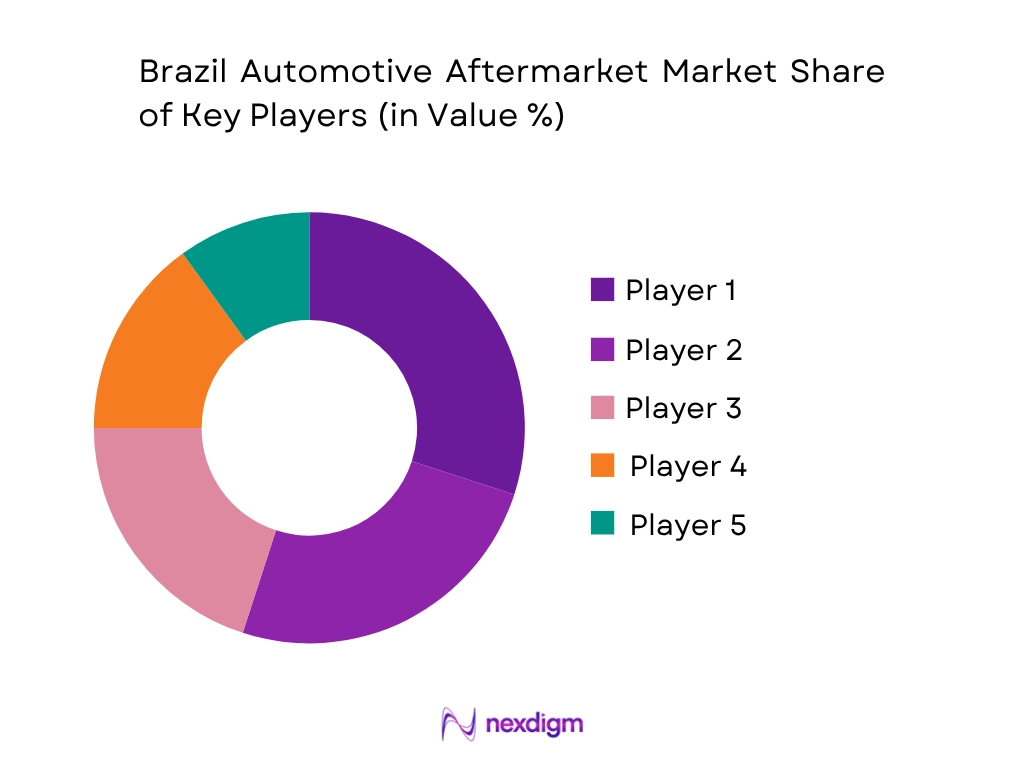
Brazil Automotive Aftermarket Market Analysis
Growth Drivers
Expanding and Aging Vehicle Fleet
Brazil’s large operating fleet creates recurring demand for filters, brake components, tires, batteries, suspension systems, lubricants, cooling components and electronic repairs. SENATRAN recorded approximately 111.4 million registered vehicles in the country, while the motorcycle category included 34.2 million motorcycles, scooters and mopeds, of which 27.7 million were motorcycles. This broad installed base supports aftermarket activity independently of annual new-vehicle demand because vehicles require maintenance throughout their operating lives. Domestic manufacturers produced 2.55 million vehicles in 2024, compared with 2.32 million in 2023, while registrations increased from approximately 2.31 million to 2.63 million vehicles. Each newly registered vehicle enlarges the future replacement pool, while older vehicles generate immediate demand after warranties and prepaid maintenance plans expire. Brazil’s extensive road dependence further accelerates wear, particularly among motorcycles, ride-hailing vehicles, delivery vans, pickup trucks and road-freight fleets operating for long hours. Macroeconomic conditions supported mobility and industrial activity, with national GDP reaching BRL 11.7 trillion and expanding by 3.4% in 2024. The IMF recorded growth moderating to 2.3% in 2025, while its 2026 assessment projected renewed expansion. Even under slower economic conditions, safety-related repairs and essential maintenance cannot be postponed indefinitely. Owners retaining vehicles for longer periods require more complex repairs involving transmissions, engines, suspension, electrical systems and air conditioning, strengthening demand across independent workshops, parts distributors and remanufacturers.
Domestic Automotive Production and Road-Freight Activity
Brazil’s established vehicle and component manufacturing ecosystem supports aftermarket growth by providing a local supply base for braking products, filters, bearings, suspension components, batteries, tires, lighting systems, fuel-injection parts and engine components. Vehicle production reached approximately 2.55 million units in 2024, an increase of about 230,000 units from the preceding year. This activity supports domestic tooling, technical expertise, supplier relationships and distribution capacity that can be extended from original-equipment production into independent replacement channels. New investment commitments reinforce this industrial foundation. Stellantis announced BRL 30 billion for its Brazilian operations, while Honda announced BRL 4.2 billion directed partly toward hybrid-flex technology and new vehicle development. These programs expand the future population of locally supported vehicle platforms and increase demand for compatible diagnostics, electronic components and replacement products. Brazil’s economy expanded by 3.4% in 2024, with services and industry contributing to growth, and GDP reached BRL 11.7 trillion. Freight, agriculture, construction and e-commerce activity convert this economic output into intensive vehicle use. Trucks, pickups, vans and motorcycles require frequent tire replacement, brake servicing, diesel and flex-fuel system maintenance, suspension repairs and preventive inspections. Brazil’s continental geography also requires extensive intercity road transportation, making vehicle availability critical for logistics operators. The combination of domestic manufacturing and high commercial utilization allows aftermarket companies to serve both traditional replacement demand and newer technology categories, while reducing dependence on fully assembled imported components.
Market Challenges
Increasing Technical Complexity of Electrified and Connected Vehicles
Brazil’s transition toward hybrid, plug-in hybrid and battery-electric vehicles is increasing workshop complexity and changing the aftermarket skills required. Sales of light electrified vehicles reached 177,358 units in 2024 and increased to 223,912 units in 2025. The December 2025 total alone reached 33,905 registrations, compared with 21,634 units in December 2024. This expanding fleet introduces high-voltage batteries, power electronics, electric compressors, thermal-management circuits, charging systems and software-dependent controls that differ significantly from conventional flex-fuel repairs. Independent workshops must invest in insulated tools, battery-isolation equipment, diagnostic subscriptions, protected work areas and technician safety procedures. Complexity also affects internal-combustion vehicles because cameras, radar units, electronic steering, networked sensors and advanced driver-assistance functions increasingly require calibration after windshield, bumper, suspension or wheel-alignment work. Brazil’s MOVER program, enacted through federal legislation in 2024, raises vehicle-efficiency and decarbonization requirements and encourages investment in new propulsion technologies. This policy supports industrial modernization but accelerates the technical transition confronting aftermarket operators. Brazil’s GDP expanded by 3.4% in 2024, before economic growth moderated to 2.3% in 2025 according to the IMF. Tighter financial conditions can make equipment upgrades more difficult for smaller garages, particularly outside major metropolitan areas. Workshops unable to support new technologies may outsource electronic and high-voltage work, increasing turnaround times and concentrating technically advanced repairs among dealerships, specialist centers and larger networks.
Fragmented Workshop Network and Specialized Technician Gap
Brazil’s highly fragmented repair network creates uneven technical capability, service quality and access to advanced diagnostics. The aftermarket includes national service chains, dealership workshops, independent multi-brand garages, motorcycle mechanics, diesel specialists, collision repairers and informal operators. This structure supports broad geographic access but makes standardized technician development difficult across a fleet of approximately 111.4 million registered vehicles. The technical workload extends from conventional flex-fuel engines and diesel commercial vehicles to at least 177,358 electrified vehicles sold in 2024 and 223,912 units sold in 2025. Technicians therefore need competencies in mechanical systems, electronics, fuel injection, emissions equipment, connected diagnostics, ADAS calibration and high-voltage safety. The scale of Brazil’s motorcycle parc adds another labor-intensive service category, with 34.2 million motorcycles, scooters and mopeds requiring localized maintenance across metropolitan and interior municipalities. Smaller workshops frequently operate with limited diagnostic databases, training budgets and formalized operating procedures. Economic conditions can reinforce these constraints. GDP reached BRL 11.7 trillion in 2024, but IMF analysis identified tight monetary and financial conditions during 2025, when economic growth moderated to 2.3%. Restricted credit and slower activity can delay workshop investment in scan tools, alignment systems, calibration equipment and technician certification. Regional inequality adds another dimension because specialist training and advanced repair infrastructure are concentrated around São Paulo and other major industrial centers. Without scalable vocational programs and shared technical-support systems, complex repairs may face longer lead times, repeated diagnostic work and greater dependence on authorized networks.
Market Opportunities
Hybrid-Flex, Electric-Vehicle and Advanced Diagnostic Services
Brazil’s current electrification and industrial-policy indicators create a strong opportunity for aftermarket businesses to establish hybrid-flex, EV and advanced electronic-repair capabilities before a larger volume of vehicles exits manufacturer warranty. Light electrified-vehicle sales reached 177,358 units in 2024, compared with 93,927 units in 2023, and increased to 223,912 units in 2025. These vehicles will require independent support for tires, suspension, air conditioning, low-voltage batteries, cooling circuits, charging components, body parts and electronic modules. The MOVER program became law in 2024 and introduced stronger requirements for vehicle efficiency, recyclability, safety and decarbonization. It also supports research and development, creating a pathway for more hybrid-flex and locally engineered powertrains. Announced automotive investments provide current evidence of this transition: Stellantis committed BRL 30 billion, while Honda announced BRL 4.2 billion for operations that include hybrid-flex development. Aftermarket operators can respond by establishing high-voltage bays, battery-health testing, ADAS calibration, thermal imaging and remote diagnostic support. Parts distributors can develop VIN-linked catalogues for cooling pumps, sensors, auxiliary batteries, charging ports and collision components. Brazil’s economy expanded by 3.4% in 2024, providing an industrial and consumer base for these services, while a population of approximately 205.3 million people supports a broad long-term mobility requirement. The opportunity is not limited to electric-only workshops; the strongest proposition is a multi-technology service model capable of handling flex-fuel, diesel, hybrid and electric vehicles within a single standardized network.
Interior Distribution, Motorcycle Service and Commercial-Fleet Maintenance
Brazil’s geographic scale and large motorcycle and commercial-vehicle populations create an opportunity for regional warehouse expansion, mobile servicing and contract-based fleet maintenance. SENATRAN recorded approximately 34.2 million motorcycles, scooters and mopeds, including 27.7 million motorcycles, demonstrating the importance of two-wheelers for commuting, app-based delivery and household transportation. These vehicles generate frequent requirements for tires, brake components, chains, sprockets, lubricants, spark plugs and batteries. Brazil’s broader registered fleet of approximately 111.4 million vehicles also includes large populations of pickups, vans, trucks, buses and municipal vehicles operating beyond major metropolitan centers. Aftermarket businesses can address these users through regional distribution hubs, overnight parts delivery, mobile tire and battery units, scheduled fleet servicing and partnerships with independent workshops. Current production and economic indicators support this strategy. Brazil manufactured 2.55 million vehicles in 2024, compared with 2.32 million in 2023, while GDP reached BRL 11.7 trillion and expanded by 3.4%. The country’s population was approximately 205.3 million, spread across an area of 8.5 million square kilometres, creating substantial differences in parts availability and service coverage between coastal metropolitan markets and interior municipalities. Digitized B2B catalogues can reduce component-selection errors, while regional inventory can shorten downtime for agricultural, construction and logistics fleets. Mobile technicians can serve delivery riders and commercial operators that cannot easily remove vehicles from operation. The opportunity arises from organizing existing maintenance demand through faster logistics, standardized service levels and stronger workshop-distributor integration.
Future Outlook
The Brazil Automotive Aftermarket Market is forecast to expand at approximately ~XX% CAGR during the forecast period. Growth will be supported by the country’s large active vehicle parc, extended vehicle retention, high motorcycle utilization and expanding commercial fleets. The market will remain predominantly driven by internal-combustion and flex-fuel vehicles, but hybrid and battery-electric models will introduce new diagnostic, thermal-management and electronic-service requirements. Brazil’s economy expanded by 3.4%, reaching BRL 11.7 trillion, supported by growth in services and industry. The IMF subsequently projected more moderate growth as monetary and financial conditions remained restrictive. Continued economic activity supports vehicle use, road freight, delivery services and household mobility, although consumer credit conditions may affect discretionary repairs. The aging fleet will remain the principal replacement-demand engine. Vehicle owners facing higher new-car financing requirements may retain existing vehicles longer, increasing expenditure on suspension, engine cooling, transmissions, electrical systems and collision repairs. Independent workshops will capture a large proportion of this activity because they offer wider price and parts-quality choices.
Major Players
- Grupo Comolatti
- Fortbras Autopeças
- DPaschoal
- AutoZone Brasil
- MercadoCar
- Rede PitStop
- Pacaembu Autopeças
- Frasle Mobility
- Nakata Automotiva
- Cofap
- MAHLE Metal Leve
- Bosch Brasil
- ZF Aftermarket Brasil
- Schaeffler Brasil
- Continental Brasil
Key Target Audience
- Automotive parts and component manufacturers
- Automotive parts importers, national distributors and regional wholesalers
- Independent workshop chains and automotive franchise operators
- Tire, battery, lubricant and automotive specialty retailers
- Fleet, leasing, logistics, agricultural and mobility operators
- Automotive e-commerce and workshop-technology providers
- Investments and venture capitalist firms
- Government and regulatory bodies (Ministry of Development, Industry, Trade and Services; SENATRAN; CONTRAN; INMETRO; IBAMA; National Petroleum, Natural Gas and Biofuels Agency)
Research Methodology
Step 1: Identification of Key Variables
The initial phase constructs an ecosystem map covering component manufacturers, importers, distributors, retailers, repair workshops, dealership service centers, fleets, insurers and online platforms. Critical variables include active vehicle parc, vehicle age, propulsion type, annual usage, replacement intervals, workshop throughput, parts prices and distribution margins.
Step 2: Market Analysis and Construction
Historical information on registrations, vehicle production, component output, parts trade and workshop activity is compiled. Top-down analysis reviews total automotive maintenance expenditure, while bottom-up analysis calculates demand using vehicle populations, service frequency, component replacement rates and average repair-order structures.
Step 3: Hypothesis Validation and Expert Consultation
Market hypotheses are validated through computer-assisted telephone interviews with parts manufacturers, distributors, workshop owners, technicians, fleet managers and digital sellers. These consultations examine parts turnover, workshop utilization, credit terms, product-tier preferences, regional availability and emerging hybrid and electric service requirements.
Step 4: Research Synthesis and Final Output
The final phase triangulates vehicle-parc modeling, company disclosures, government statistics and primary consultations. Conflicting observations are reviewed against workshop transactions and distributor sales, while double counting between parts revenue, installation services and dealership aftersales is removed before producing the final market assessment.

- Executive Summary
- Research Methodology (Market Definitions and Assumptions, Abbreviations, Automotive Aftermarket Boundary, Vehicle Parc–Based Market Modeling, Top-Down Analysis, Bottom-Up Analysis, Demand-Side Assessment, Supply-Side Assessment, Component Replacement-Rate Modeling, Workshop Throughput Assessment, Parts Production and Trade Analysis, Primary Industry Interviews, Data Triangulation, Forecasting Framework, Limitations and Future Conclusions)

- Definition and Scope
- Market Evolution and Industry Genesis
- Timeline of Major Industry Developments
- Automotive Aftermarket Business Cycle
- Brazilian Vehicle Parc and Replacement Demand Ecosystem
- Flex-Fuel, Gasoline, Diesel and Electrified Vehicle Aftermarket Structure

- Growth Drivers (Aging Vehicle Parc, High Vehicle Ownership, Flex-Fuel Vehicle Base, Commercial Fleet Utilization, Motorcycle Dependency, Used-Vehicle Retention)
- Market Challenges (Consumer Price Sensitivity, Technician Shortage, Counterfeit Parts, Vehicle Technology Complexity, Logistics Costs, Workshop Fragmentation)
- Market Opportunities (Hybrid-Flex Servicing, EV Repair, Fleet Contracts, Digital Procurement, Remanufacturing, Interior Market Expansion)
- Market Trends (Digitalization, Hybridization, Workshop Consolidation, Omnichannel Retailing, Private Labels, Parts Traceability)
- Government Regulations (INMETRO Certification, CONTRAN Requirements, Consumer Protection, Emission Compliance, Workshop Licensing, Environmental Management)
- SWOT Analysis
Porter’s Five Forces Analysis
PESTLE Analysis

- By Market Value (2020-2025)
- By Replacement Parts Revenue (2020-2025)
- By Maintenance and Repair Service Revenue (2020-2025)

- By Aftermarket Offering (In Value %)
Replacement Parts
Scheduled Maintenance Services
Mechanical Repair Services
Tires and Wheel Services
Batteries and Automotive Electrical Services
Lubricants and Fluid Replacement
Collision Repair and Bodywork - By Vehicle Type (In Value %)
Passenger Cars
Sports Utility Vehicles
Pickup Trucks and Utility Vehicles
Light Commercial Vehicles
Heavy Commercial Vehicles
Buses and Coaches - By Service Provider Type (In Value %)
Authorized Dealer Workshops
Independent Multi-Brand Workshop Chains
Independent Standalone Repair Workshops
Vehicle Brand–Specialist Workshops
Fast-Fit and Quick-Service Centers - By Geographic Region (In Value %)
Southeast Brazil
South Brazil
Northeast Brazil
Central-West Brazil
North Brazil

- Market Share of Major Players (By Aftermarket Revenue, Parts Revenue, Distribution Revenue, Service Revenue, Retail Reach)
- Cross Comparison Parameters (Automotive Parts SKU Portfolio Breadth, National Distribution and Warehouse Coverage, Independent Workshop and Retail Customer Reach, Passenger Car–Pickup–Truck–Motorcycle Vehicle Coverage, OEM–OES–Aftermarket–Private-Label Product Mix, Same-Day Delivery and Digital Ordering Capability, Flex-Fuel–Hybrid–EV–ADAS Technical Readiness, Inventory Fill Rate and Credit Support for Repair Workshops)
- SWOT Analysis of Major Players
- Pricing Analysis by SKU and Service Category
- Detailed Profiles of Major Companies
Grupo Comolatti
Fortbras Autopeças
DPaschoal
AutoZone Brasil
MercadoCar
Rede PitStop
Pacaembu Autopeças
Frasle Mobility
Nakata Automotiva
Cofap
MAHLE Metal Leve
Bosch Brasil
ZF Aftermarket Brasil
Schaeffler Brasil
Continental Brasil

- Individual Vehicle Owner Demand Analysis
- Passenger Car Owner Maintenance Behavior
- SUV and Pickup Owner Demand Analysis
- Motorcycle Owner Demand Analysis
- Corporate Fleet Demand Analysis

- By Market Value (2026-2035)
- By Replacement Parts Revenue (2026-2035)
- By Maintenance and Repair Service Revenue (2026-2035)


 Request a Sample
 Ask for Customization
 Get a Quote
 Enquire Now