
 Download PDF
Market Overview
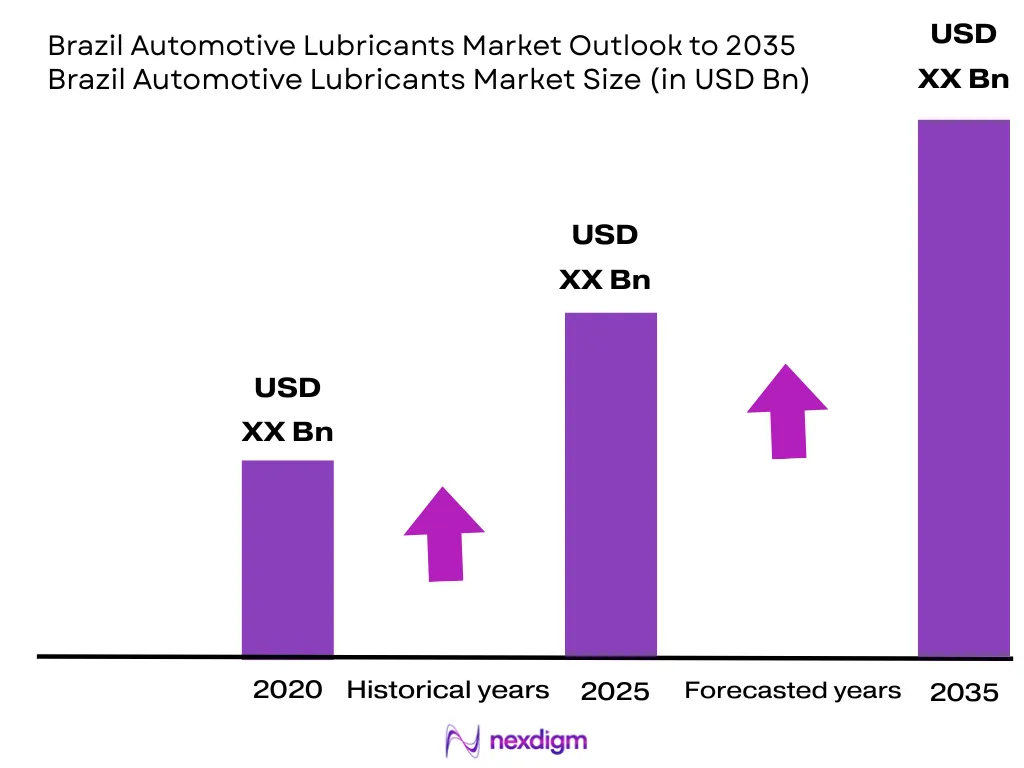
The Brazil Automotive Lubricants Market is valued at approximately ~ billion, compared with ~ billion in the preceding reporting cycle. Demand is supported by a large internal-combustion vehicle base and rising domestic automotive output, with vehicle production increasing from 2.325 million units to 2.554 million units. Passenger cars, light commercial vehicles, trucks and buses create recurring requirements for engine oils, transmission fluids, gear oils, greases and coolants. São Paulo, Rio de Janeiro, Minas Gerais, Paraná and the surrounding Southeast-South automotive corridor dominate the Brazil Automotive Lubricants Market because they combine vehicle density, automotive manufacturing, freight activity, lubricant blending, distributor networks and service infrastructure. National used-lubricant collection reached approximately 567,431 m³ across 4,346 municipalities, while automotive production subsequently reached 2.554 million vehicles, reinforcing lubricant circulation through workshops, fleets, dealerships, fuel stations, collectors and re-refiners concentrated around major industrial regions. The Brazil Automotive Lubricants Market includes passenger-car motor oils, heavy-duty diesel engine oils, motorcycle oils, transmission fluids, differential and axle lubricants, automotive greases, coolants, brake fluids, power-steering fluids and emerging electric-drive and battery thermal-management fluids. Market demand is generated through both factory-fill applications at vehicle manufacturing facilities and service-fill consumption throughout the operating life of Brazil’s vehicle parc.
Market Segmentation
By Product Type
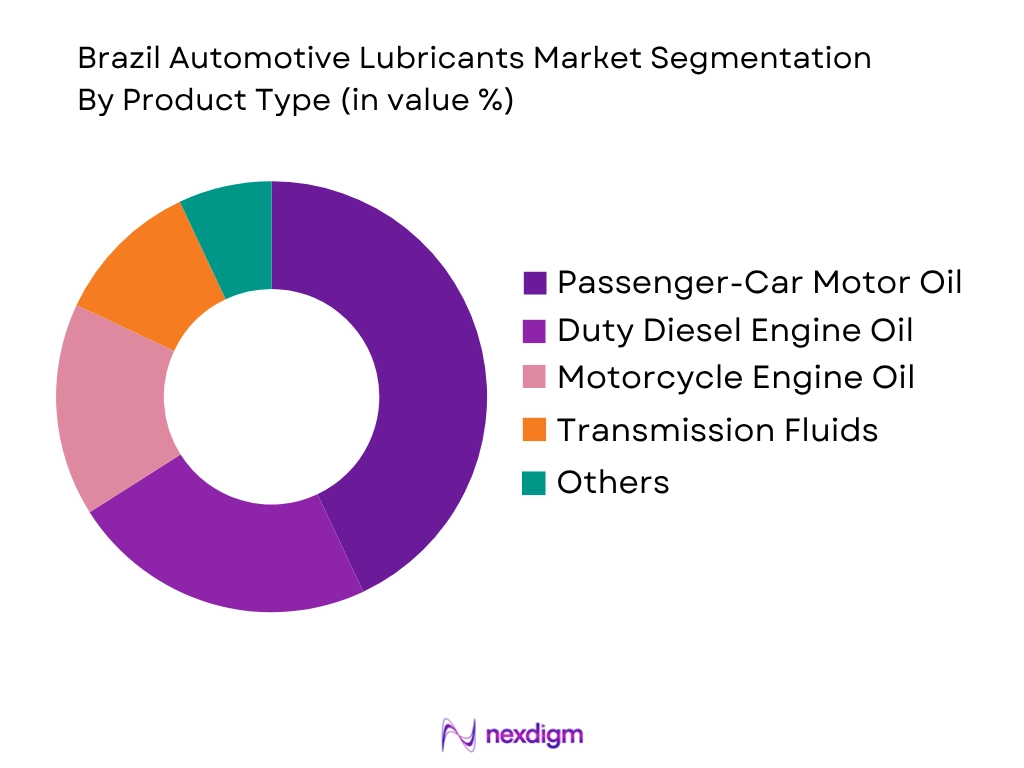
By product type, the Brazil Automotive Lubricants Market is segmented into passenger-car motor oil, heavy-duty diesel engine oil, motorcycle engine oil, transmission fluids, gear and axle oils, automotive greases, coolants and functional fluids, and emerging EV fluids. Passenger-car motor oil holds the dominant market share because Brazil operates a substantial fleet of passenger cars, SUVs, crossovers, pickup trucks and light commercial vehicles requiring periodic engine-oil replacement. The segment benefits from the widespread use of gasoline and flex-fuel engines and from extensive independent workshop, dealership, fuel-station and lubricant-service networks. Product differentiation is substantial, covering mineral, semi-synthetic and full-synthetic formulations as well as SAE 0W-20, 5W-30, 5W-40, 10W-40 and other grades. Older vehicles sustain demand for higher-viscosity and high-mileage products, while newer turbocharged and fuel-efficient engines encourage lower-viscosity synthetic lubricants. ANP registration requirements additionally reinforce formal product development, testing and traceability across established lubricant brands.
By Lubricant Technology
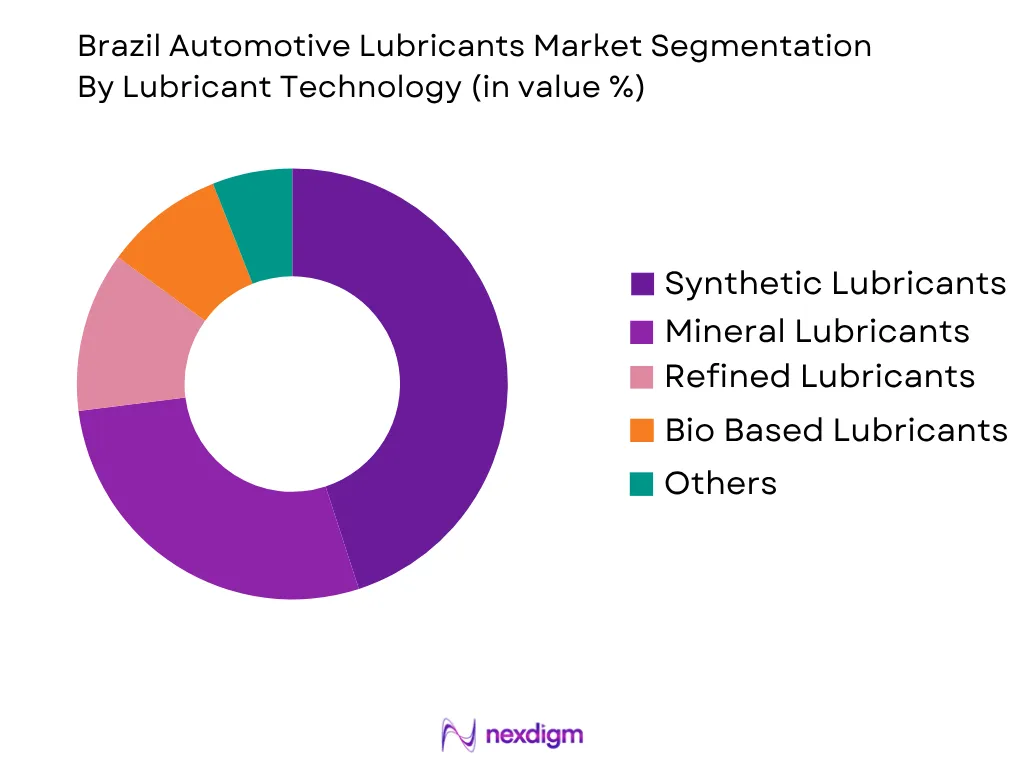
By lubricant technology, the Brazil Automotive Lubricants Market is segmented into mineral lubricants, semi-synthetic lubricants, full-synthetic lubricants, re-refined lubricants, bio-based products and specialised hybrid or EV formulations. Semi-synthetic lubricants currently hold the dominant market share because they provide a practical balance between engine protection, drain performance, availability and affordability across Brazil’s diverse vehicle population. Semi-synthetic oils are suitable for a broad range of flex-fuel, gasoline, light-commercial and motorcycle applications and allow lubricant companies to offer improved thermal stability, oxidation resistance and cold-flow performance without moving every consumer into the highest-priced full-synthetic tier. Their broad compatibility also makes inventory management easier for independent workshops and distributors serving vehicles of multiple ages. Full-synthetic lubricants are gaining strategic importance in modern turbocharged, direct-injection and hybrid applications, while mineral products retain relevance among older vehicles and price-sensitive users. Re-refined base oils are also significant because Brazil operates an established regulatory framework for collecting and rerrefining used lubricant oil.
Competitive Landscape
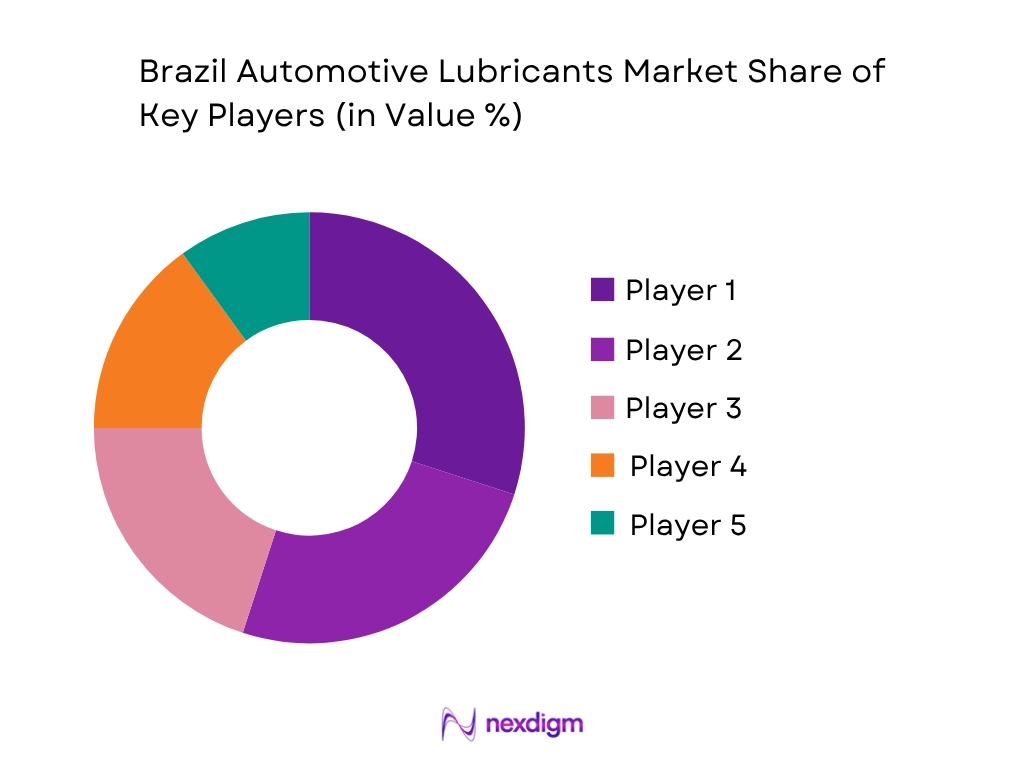
The Brazil Automotive Lubricants Market is led by a combination of domestic-scale lubricant businesses, global energy companies and specialised formulation companies. Lubrax, Mobil, Ipiranga, Texaco, PETRONAS, Castrol, TotalEnergies, Fuchs, Motul and other brands compete through ANP-registered portfolios, distributor reach, OEM relationships, workshop penetration, motorcycle and heavy-duty products, technical services and increasingly advanced synthetic and electrified-powertrain fluids. Competition extends beyond conventional engine oil. Suppliers are expanding transmission fluids, extended-life coolants, heavy-duty fleet oils, agricultural lubricants, high-mileage products and EV fluids. Distribution capability is particularly important because Brazil requires national coverage across dense metropolitan markets and geographically dispersed agricultural and freight corridors.
| Company | Establishment | Headquarters | Major Brands | Automotive Focus | Brazil Operating Footprint | Distribution Strength | EV/Hybrid Readiness | Circularity / Sustainability Position |
| Vibra Energia | 1971 heritage | Rio de Janeiro | ~ | ~ | ~ | ~ | ~ | ~ |
| Moove | 2008 | Brazil-based global platform | ~ | ~ | ~ | ~ | ~ | ~ |
| ICONIC Lubrificantes | Joint venture platform | Rio de Janeiro | Ipiranga, Texaco | ~ | ~ | ~ | ~ | ~ |
| PETRONAS Lubricants International | 2008 | Kuala Lumpur; Brazil operations in Minas Gerais | Syntium, Urania, Sprinta, Tutela | ~ | ~ | ~ | ~ | ~ |
| TotalEnergies | 1924 | Courbevoie, France | TotalEnergies, Quartz | ~ | ~ | ~ | ~ | ~ |
Brazil Automotive Lubricants Market Analysis
Growth Drivers
Expansion of Vehicle Production and the Installed Internal-Combustion Vehicle Base
Brazil’s large automotive manufacturing and operating ecosystem is a fundamental demand driver for automotive lubricants because every internal-combustion passenger car, light commercial vehicle, truck, bus and motorcycle entering service generates recurring requirements for engine oils, transmission fluids, axle oils, greases, coolants and other functional fluids. Brazil produced approximately 2.550 million motor vehicles in 2024, supported by renewed production activity across automotive clusters in São Paulo, Minas Gerais, Paraná, Rio de Janeiro, Bahia and other states. In August 2024 alone, Brazilian factories produced 259,613 vehicles, demonstrating the scale at which new factory-fill and subsequent service-fill lubricant demand is created. The Brazilian Development Bank reported R$3.6 billion of support for the automotive sector during 2024, while automotive manufacturers announced approximately R$130.27 billion of investments associated with industrial modernization, new models, electrification and manufacturing capacity. These investments support not only assembly plants but also engine, transmission, component, lubricant and maintenance ecosystems. Brazil’s macroeconomic scale reinforces this structural demand: World Bank data place national GDP at approximately USD 2.19 trillion in 2024, GDP per capita at USD 10,310.5, and population at 211,998,573 people. These figures indicate a large consumer and industrial base capable of supporting continued vehicle ownership, freight activity and automotive maintenance. The lubricant opportunity extends beyond first-fill products because vehicles consume lubricants throughout a service life that can extend for many years. Older vehicles can require higher-viscosity or high-mileage oils, while newer turbocharged and flex-fuel vehicles increasingly use lower-viscosity synthetic or semi-synthetic formulations. Brazil’s large road-freight sector further strengthens consumption of heavy-duty diesel engine oils, transmission fluids, differential lubricants and greases because commercial vehicles operate under high engine loads and prolonged duty cycles. The combination of 2.550 million vehicles manufactured, sizeable automotive investment and a USD 2.19 trillion economy therefore gives lubricant manufacturers a broad base for passenger, commercial, motorcycle, agricultural and off-highway product portfolios.
Synthetic Lubricant Migration and Modernization of Brazilian Powertrains
The modernization of Brazil’s vehicle architecture is increasing demand for higher-performance automotive lubricants designed for turbocharging, direct injection, flex-fuel operation, hybrid systems, tighter engine tolerances and advanced emission-control systems. Brazilian automotive manufacturing generated 2.550 million vehicles in 2024, while the federal government reported 154 automotive-sector qualifications under the Mover industrial program in the following implementation cycle, linked with approximately R$130.27 billion in announced investment. This capital commitment is relevant to automotive lubricants because new engines and transmissions generally require increasingly specialized fluid chemistry, including lower-viscosity passenger-car motor oils, advanced automatic transmission fluids, dual-clutch fluids, continuously variable transmission fluids and extended-life coolants. Brazil also has a distinctive flex-fuel technology base, meaning lubricant formulations must perform under gasoline, ethanol and mixed-fuel operation. Ethanol-rich operation can create moisture, corrosion, fuel-dilution and temperature-management considerations, increasing the value of oxidation stability, detergent-dispersant performance and additive compatibility. New hybrid-flex development adds another layer of technical complexity. In 2025, BNDES announced R$2.3 billion in financing for Volkswagen’s electrification and export-development program, while the manufacturer disclosed R$16 billion of investment in Brazil associated with new technologies and locally engineered hybrid-flex vehicles. Such projects demonstrate that combustion engines will continue evolving alongside electrification rather than disappearing immediately, creating a strong application for premium lubricants formulated for frequent engine starts, intermittent engine operation and lower operating temperatures. Macroeconomic conditions provide the scale to commercialize these advanced products. World Bank figures show Brazil generated USD 2.19 trillion in GDP during 2024 and supported a population of 211,998,573, while GDP per capita stood at USD 10,310.5. These indicators support a broad national aftermarket serving millions of private consumers, fleet operators, workshops, fuel stations and dealerships. For lubricant companies, the shift toward advanced powertrains increases the importance of formulation expertise, OEM approvals, ANP product registration, application databases and mechanic education. The principal growth mechanism is therefore not simply higher litres consumed; it is migration toward technically demanding synthetic, semi-synthetic, low-viscosity, hybrid-compatible and flex-fuel-optimized products carrying greater performance requirements across the Brazilian automotive ecosystem.
Market Challenges
Regulatory Compliance, Product Registration and Irregular Lubricant Distribution
Brazil’s automotive lubricant industry faces a significant challenge from strict product-registration obligations and the continued circulation of irregular or unregistered oils through fragmented aftermarket channels. The National Agency of Petroleum, Natural Gas and Biofuels requires lubricant products marketed in Brazil to comply with formal registration and technical requirements, while producers, importers, collectors and re-refiners operate within specific regulatory frameworks. Enforcement remains material because Brazil has thousands of automotive-parts stores, independent workshops, dealerships, service centers and digital sellers distributing lubricants across a geographically extensive market. ANP conducted 10,668 enforcement actions during the first half of 2024 across the wider fuels and regulated-products ecosystem, demonstrating the scale of regulatory supervision required. A targeted operation involving ANP and Procon Goiás in June 2024 inspected lubricant retailers in Goiânia, Anápolis and Aparecida de Goiânia and seized 3,929 units of automotive lubricating oil that lacked active ANP registration. The products were removed and samples were sent for laboratory assessment. In August 2024, ANP additionally conducted inspections across 15 Brazilian federal units, including lubricant-focused actions against non-regulated sellers in Bahia. These events illustrate a direct commercial challenge for compliant lubricant companies: formally registered products compete with unauthorized alternatives that can enter channels without equivalent technical validation, traceability or quality-control expenditure. The issue becomes more complex as the number of engine-oil grades, API categories, OEM requirements and transmission-fluid specifications expands. Distributors must ensure that product labels, registrations and claims remain compliant while workshops must select correct fluids for gasoline, flex-fuel, diesel, hybrid and imported vehicles. Brazil’s macroeconomic scale intensifies the logistical challenge rather than reducing it. World Bank data put the country’s population at 211,998,573 in 2024, spread across a territory of approximately 8.5 million square kilometres, while the economy generated USD 2.19 trillion. This requires national brands to maintain quality control across metropolitan centers, rural markets and long-distance distribution corridors. Regulatory compliance is therefore not merely an administrative requirement: it raises testing, registration, packaging, monitoring, distributor-audit and anti-counterfeit responsibilities throughout the automotive lubricant value chain.
Powertrain Diversification and Declining Conventional Lubricant Intensity
Brazil’s rapid diversification from conventional gasoline and diesel engines toward flex-fuel hybrids, plug-in hybrids and battery-electric vehicles creates a structural challenge for traditional automotive lubricant portfolios. Battery-electric vehicles remove the crankcase engine-oil requirement entirely and typically eliminate several service items associated with combustion powertrains, while hybrid systems retain engine lubrication but alter operating conditions through frequent start-stop cycles and periods in which the combustion engine remains inactive. This requires lubricant companies to manage two competing realities: continued demand from Brazil’s large combustion-vehicle population and accelerating investment in technologies that use substantially different fluid architectures. Government-backed automotive investment demonstrates the pace of this transition. In 2025, BNDES approved R$2.3 billion in financing linked to Volkswagen’s Brazilian electrification and export program, while the manufacturer announced R$16 billion of Brazilian investment encompassing mild hybrids, full hybrids and plug-in hybrids. Nissan’s Resende industrial complex simultaneously advanced a R$2.8 billion investment plan and installed 98 new robots, taking the site to 202 automated guided vehicles used in manufacturing processes. These investments show that vehicle technology and manufacturing complexity are increasing, forcing lubricant suppliers to invest in new formulations, testing systems and technical sales capabilities before emerging fluid categories reach the replacement frequency associated with conventional engine oil. Companies must support SAE engine oils, heavy-duty diesel products, automatic transmission fluids, CVT fluids, dual-clutch fluids, e-drive lubricants, dielectric coolants, electric-motor bearing greases and compressor oils at the same time. This increases SKU complexity, inventory requirements and technician-training needs for distributors and workshops. Brazil’s USD 2.19 trillion GDP and 211,998,573-person population provide significant automotive demand, but they also mean that technological migration happens across a vast and heterogeneous fleet rather than through a uniform transition. The industry therefore faces a prolonged period in which legacy vehicles, modern flex-fuel engines, hybrids and electric vehicles coexist, increasing formulation costs and supply-chain complexity while gradually reducing conventional crankcase-oil intensity in newer vehicle cohorts.
Market Opportunities
Expansion of Used-Oil Collection, Re-Refining and Circular Lubricant Programs
Brazil’s established regulatory architecture for used or contaminated lubricating oil creates one of the strongest future opportunities for companies capable of integrating lubricant sales with collection, re-refining and closed-loop fleet services. Automotive lubricants degrade through oxidation, thermal stress, contamination and additive depletion and must eventually be removed from engines and drivetrains. Under Brazilian regulation, used lubricating oil is directed toward controlled collection and re-refining so that contaminants and degradation products can be removed and the material can return to the lubricant manufacturing chain as base oil. The federal government has established collection obligations through CONAMA Resolution 362 and subsequent ANP rules governing producers, importers, collectors and re-refiners. Current infrastructure demonstrates that this is already an industrial-scale activity rather than a theoretical sustainability opportunity. Federal waste-management data report collection coverage across 4,346 municipalities, showing that the reverse-logistics network already reaches a broad national footprint. ANP’s lubricant-market platform tracks commercialization, production, collection, re-refining, authorized agents and facility locations, creating a regulatory and data framework capable of supporting more sophisticated circular business models. Brazil’s manufacturing and economic scale strengthens the opportunity. Vehicle production reached 2.550 million units in 2024, continually adding vehicles that will later require lubricant replacement, while the economy generated USD 2.19 trillion and supported 211,998,573 people. The next stage for lubricant companies is to connect new-oil supply with used-oil recovery. Large trucking fleets, bus depots, rental companies, agricultural operators, mines, dealerships and quick-service workshops can generate predictable streams of used engine oil and other fluids from centralized maintenance facilities. Suppliers can therefore offer bulk lubricant delivery, tank monitoring, used-oil pickup, laboratory oil analysis, documentation, traceability and re-refined lubricant supply under integrated contracts. Such arrangements increase customer retention while reducing dependence on virgin base oils and improving compliance. Re-refined base oils can also support synthetic and high-performance formulations where technical requirements are met. With thousands of municipalities already incorporated into collection networks and a national automotive manufacturing base exceeding 2.5 million vehicles, Brazil has the operating foundation to expand automotive lubricant circularity substantially during the outlook period without relying on speculative future market statistics.
Hybrid-Flex, Low-Viscosity and Electric-Drive Fluid Innovation
Brazil’s automotive technology transition creates a substantial future opportunity for lubricant companies that develop products specifically around the country’s distinctive combination of ethanol, flex-fuel engines and electrification. Unlike markets moving primarily from gasoline vehicles directly toward battery-electric models, Brazil is developing locally engineered hybrid-flex powertrains that combine electric propulsion with combustion engines capable of operating on ethanol and gasoline. This configuration generates new technical requirements involving oxidation stability, water management, corrosion resistance, cold-start protection, deposit control and compatibility with frequent engine start-stop operation. The current industrial investment base provides tangible justification for product development. BNDES announced R$2.3 billion in financing in 2025 for Volkswagen’s technology and electrification program, while the automaker disclosed R$16 billion of Brazilian investment associated with hybrid-flex development and other innovations. Nissan’s R$2.8 billion industrial program is modernizing its Resende operations, while government reporting identifies broader automotive investment announcements exceeding R$130 billion. These figures indicate that local vehicle engineering is being redesigned around efficiency, electrification and alternative fuels, creating an accompanying need for specialized fluids. Lubricant suppliers can address this transition through SAE 0W-20 and other lower-viscosity engine oils, hybrid-specific formulations, low-viscosity transmission fluids, electric reduction-gear oils, e-axle lubricants, battery coolants, electrically compatible compressor oils and specialized greases for electric motors. Hybrid-flex technology also preserves engine-oil demand while raising performance requirements, giving suppliers a transitional growth category before fully electric powertrains become dominant. Macroeconomic fundamentals provide an extensive addressable operating base: World Bank data place Brazil’s 2024 GDP at USD 2.19 trillion, GDP per capita at USD 10,310.5, and population at 211,998,573. In addition, domestic vehicle production of 2.550 million units demonstrates that new lubricant technologies can be incorporated through both factory-fill collaborations and subsequent aftermarket servicing. Companies that secure OEM approvals early, develop formulations suited to ethanol-containing fuels and build mechanic education programs can establish strong positions in future Brazilian service channels. The opportunity therefore lies not merely in replacing conventional oil sales, but in moving toward higher-technology fluids aligned with Brazil’s own industrial pathway of flex-fuel electrification, energy efficiency and locally engineered powertrain systems.
Future Outlook
The Brazil Automotive Lubricants Market is forecast to expand at approximately ~ CAGR during the forecast period. Over the coming decade, growth will increasingly shift from conventional lubricant volume toward synthetic products, high-mileage formulations, advanced heavy-duty lubricants, flex-fuel optimisation, hybrid-compatible oils and specialised electric-drive fluids. The evolution of the vehicle parc will create a two-speed market. Brazil’s large installed base of combustion and flex-fuel vehicles will sustain engine-oil demand, while newer vehicles will use lower-viscosity oils and longer service intervals. Lubricant companies will therefore compete increasingly on technology, approvals and product value rather than litres alone. Road freight will remain critical for heavy-duty lubrication. Trucks require diesel engine oils, transmission fluids, axle lubricants, chassis greases and coolants under high-load and long-distance conditions. Agricultural activity in states such as Mato Grosso, Goiás, Paraná and Rio Grande do Sul also supports demand for diesel lubricants, universal tractor transmission oils, hydraulic fluids and greases. Hybrid and electric vehicles will create smaller but technically attractive categories. Battery-electric vehicles remove crankcase oil but require e-axle fluids, electric-drive lubricants, motor-bearing greases, compressor oils and battery coolants.
Major Players
- Vibra Energia – Lubrax
- Moove – Mobil
- ICONIC Lubrificantes – Ipiranga
- ICONIC Lubrificantes – Texaco
- PETRONAS Lubrificantes Brasil
- Castrol Brasil
- TotalEnergies Lubrificantes do Brasil
- Fuchs Lubrificantes do Brasil
- Motul Brasil
- Gulf Oil Brasil
- YPF Brasil
- Ingrax
- Falex Lubrificantes
- Bardahl Brasil
- Valvoline Brasil
Key Target Audience
- Automotive lubricant manufacturers and blenders
- Base-oil producers and lubricant additive suppliers
- Automotive OEMs and vehicle dealership groups
- Automotive parts distributors, workshops and lubricant-service networks
- Passenger, trucking, motorcycle, agricultural and off-highway fleet operators
- Used-oil collectors, re-refiners and circular lubricant companies
- Investments and venture capitalist firms
- Government and regulatory bodies (Agência Nacional do Petróleo, Gás Natural e Biocombustíveis, Ministério de Minas e Energia, Ministério do Meio Ambiente e Mudança do Clima, IBAMA, SENATRAN and CONAMA)
Research Methodology
Step 1: Identification of Key Variables
The first phase develops an ecosystem map covering base-oil producers, additive suppliers, finished-lubricant blenders, importers, distributors, OEMs, workshops, dealerships, fleet operators, collectors and re-refiners. Key variables include vehicle parc, annual mileage, lubricant consumption, drain interval, viscosity mix, formulation technology, package size and distribution structure.
Step 2: Market Analysis and Construction
Historical automotive production, registrations, lubricant commercialization, factory-fill consumption and aftermarket service demand are compiled. Top-down analysis links vehicle activity with lubricant intensity, while bottom-up analysis evaluates product volumes by engine oil, transmission fluid, gear oil, grease, coolant and other functional-fluid categories.
Step 3: Supply-Side Assessment
Lubricant suppliers are compared through ANP-registered portfolios, production capabilities, base-oil sourcing, formulation technology, distribution networks, workshop relationships, OEM approvals, motorcycle and heavy-duty offerings, synthetic-product depth, EV-fluid readiness and used-oil circularity programs.
Step 4: Demand-Side Assessment
Individual motorists, trucking fleets, motorcycle users, agricultural operators, dealerships, workshops and quick-service locations are assessed through maintenance frequency, oil-change behavior, vehicle age, fuel type, annual utilization, viscosity selection, brand preference, package format and service-channel choice.

- Executive Summary
- Research Methodology (Market Definitions and Assumptions, Abbreviations, Market Sizing Approach, Top-Down Analysis, Bottom-Up Analysis, Vehicle Parc Mapping, Lubricant Consumption per Vehicle, Oil Change Frequency Assessment, Factory-Fill Assessment, Service-Fill Assessment, Demand-Side Assessment, Supply-Side Assessment, ANP Product Registration Mapping, Primary Industry Interviews, Distributor and Workshop Interviews, Data Triangulation, Forecasting Framework, Limitations and Future Conclusions)

- Definition and Scope
- Market Evolution and Industry Genesis
- Evolution of Mineral, Semi-Synthetic and Synthetic Automotive Lubricants
- Development of Flex-Fuel Compatible Lubricants
- Evolution of Heavy-Duty Diesel Lubrication Requirements

- Growth Drivers (Large Aging Vehicle Parc, Flex-Fuel Vehicle Base, Motorcycle Fleet Expansion, Road Freight Dependence, Agricultural Mechanization, Synthetic Lubricant Adoption)
- Market Challenges (Base Oil Volatility, Informal Distribution, Product Adulteration, Extended Drain Intervals, EV Substitution, Specification Complexity)
- Market Opportunities (EV Fluids, Flex-Fuel Oils, Re-Refined Lubricants, Heavy-Duty Fleet Solutions, Agricultural Lubricants, Digital Service Platforms)
- Market Trends (Synthetic Premiumization, Lower Viscosity, Flex-Fuel Formulation, Circular Lubricants, Digital Maintenance, Sustainable Packaging)
- Government Regulations (ANP Registration, Product Quality Monitoring, Used-Oil Collection, Re-Refining, Packaging Reverse Logistics, Environmental Compliance)
- SWOT Analysis
- Porter’s Five Forces Analysis
- PESTLE Analysis

- By Market Value (2020-2025)
- By Lubricant Consumption Volume (2020-2025)
- By Passenger Vehicle Lubricant Value (2020-2025)

- By Product Type (In Value %)
Passenger Car Motor Oil
Heavy-Duty Diesel Engine Oil
Motorcycle Engine Oil
Automatic Transmission Fluid
Manual Transmission Fluid - By Lubricant Technology (In Value %)
Mineral Lubricants
Semi-Synthetic Lubricants
Full-Synthetic Lubricants
High-Mileage Lubricants
Extended-Drain Lubricants - By Vehicle Type (In Value %)
Passenger Cars
Sport Utility Vehicles and Crossovers
Pickup Trucks
Light Commercial Vehicles
Medium-Duty Trucks - By Region (In Value %)
Southeast Brazil
South Brazil
Northeast Brazil
Central-West Brazil
North Brazil

- Market Share of Major Players (By Value, Volume, Product Category, Vehicle Type, Distribution Channel)
- Cross Comparison Parameters (ANP-Registered Automotive Lubricant Portfolio, Synthetic and Semi-Synthetic Product Breadth, Flex-Fuel and Motorcycle Lubricant Capability, Passenger–Heavy-Duty–Agricultural Vehicle Coverage, Distributor–Fuel Station–Workshop Channel Reach, OEM Approvals and Factory-Fill Relationships, Used-Oil Collection and Re-Refined Lubricant Integration, Hybrid–EV Fluid and Low-Viscosity Product Readiness)
- SWOT Analysis of Major Players
- Detailed Profiles of Major Companies
Vibra Energia – Lubrax
Moove – Mobil
Raízen – Shell Lubricants
Iconic Lubrificantes – Ipiranga and Texaco
Castrol Brasil
Petronas Lubrificantes Brasil
TotalEnergies Lubrificantes do Brasil
Fuchs Lubrificantes do Brasil
Valvoline Brasil
Motul Brasil
Gulf Oil Brasil
YPF Brasil
Ingrax
Falex Lubrificantes
Lubrificantes Bardahl Brasil

- Individual Vehicle Owner Analysis
- Passenger Vehicle Fleet Analysis
- Ride-Hailing Fleet Analysis
- Rental Vehicle Fleet Analysis
- Light Commercial Delivery Fleet Analysis

- By Market Value (2026-2035)
- By Lubricant Consumption Volume (2026-2035)
- By Passenger Car Motor Oil Value (2026-2035)


 Request a Sample
 Ask for Customization
 Get a Quote
 Enquire Now