
 Download PDF
Market Overview
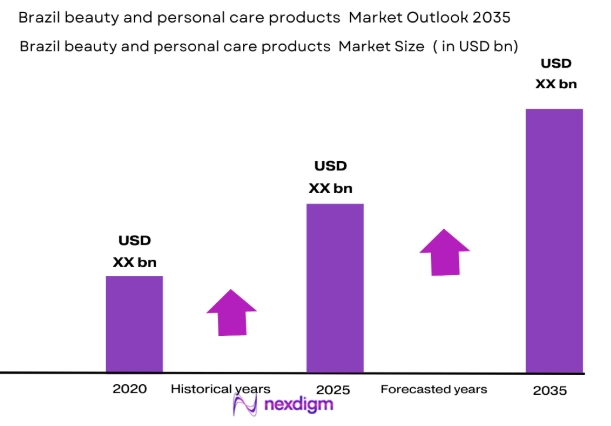
The Brazil Beauty and Personal Care Products Market is valued at USD ~ billion, based on Research and Markets’ published market sizing for the country. The market is driven by rising demand for skin, hair, hygiene, fragrance, and grooming products, supported by digital beauty awareness, pollution-related skin protection needs, and value-for-money “masstige” products. Brazil’s broader economy reached R$11.7 trillion, while per-capita GDP reached R$55,247.45, supporting household consumption.
São Paulo, Rio de Janeiro, Belo Horizonte, Brasília, Fortaleza, and Porto Alegre dominate Brazil Beauty and Personal Care Products Market demand because they concentrate population, retail infrastructure, pharmacies, direct-selling networks, salons, and e-commerce delivery capacity. São Paulo has 21.5 million metropolitan residents, followed by Rio de Janeiro with 12.9 million and Belo Horizonte with 6.0 million, creating stronger urban product availability and faster adoption of premium, natural, and social-media-led beauty trends.
Market Segmentation
By Product Type
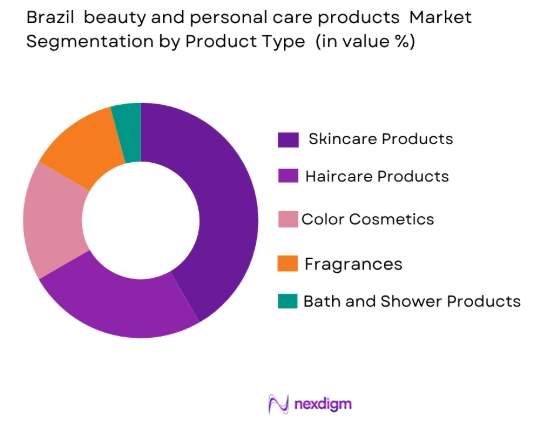
Brazil Beauty and Personal Care Products Market is segmented by product type into skin care products, hair care products, fragrances, and color cosmetics. Skin care products hold the dominant position in the market, supported by demand for facial care, sun protection, anti-aging solutions, moisturizers, and dermatologically tested products. Brazil’s tropical climate, strong outdoor lifestyle, pollution exposure in large cities, and rising consumer concern about appearance have strengthened the adoption of daily-use skin care. Grand View Research’s Horizon Databook states that skin care accounted for the largest revenue share at 35.9% in 2024, while demand is further supported by natural and organic formulations as consumers increasingly avoid harsh chemical ingredients.
By Distribution Channel
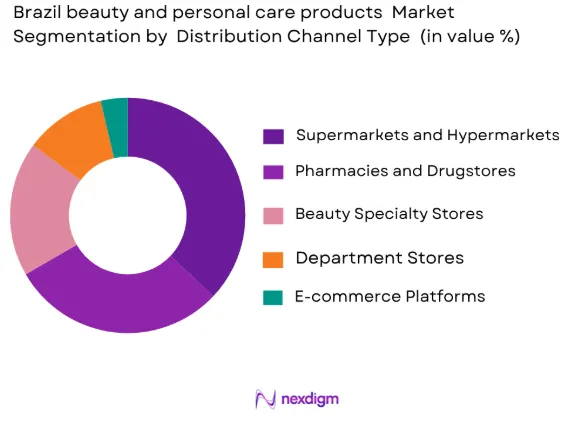
Brazil Beauty and Personal Care Products Market is segmented by distribution channel into specialty stores, supermarkets and hypermarkets, pharmacies and drugstores, online retail stores, direct selling, and salons and professional channels. Specialty stores dominate because Brazil has a strong organized beauty retail ecosystem, led by domestic chains and franchise-led formats that combine product discovery, fragrance testing, skin care consultation, and gifting purchases. Online retail is expanding quickly due to marketplace penetration, Pix payments, and social commerce, but offline channels remain critical for fragrances, cosmetics trials, and repeat replenishment purchases. Mordor Intelligence identifies specialty stores as the leading channel, while online retail is the fastest-growing route.
Competitive Landscape
The Brazil Beauty and Personal Care Products Market is moderately consolidated, with strong domestic leadership from Natura &Co and Grupo Boticário, alongside global multinationals such as L’Oréal, Unilever, Procter & Gamble, Beiersdorf, and Estée Lauder. Local companies benefit from deep knowledge of Brazilian fragrance, hair care, and direct-selling habits, while global brands compete through innovation, premium positioning, dermatology-led claims, and omnichannel distribution.
| Company | Establishment Year | Headquarters | Core Categories | Brazil Positioning | Distribution Strength | Sustainability Focus | Digital Presence | Product Innovation |
| Natura &Co | 1969 | São Paulo, Brazil | ~ | ~ | ~ | ~ | ~ | ~ |
| Grupo Boticário | 1977 | Paraná, Brazil | ~ | ~ | ~ | ~ | ~ | ~ |
| L’Oréal Group | 1909 | Clichy, France | ~ | ~ | ~ | ~ | ~ | ~ |
| Unilever | 1929 | London, UK | ~ | ~ | ~ | ~ | ~ | ~ |
| Procter & Gamble | 1837 | Cincinnati, USA | ~ | ~ | ~ | ~ | ~ | ~ |
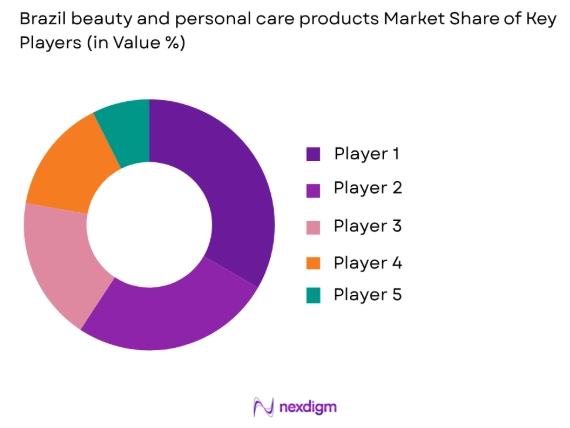
Brazil Beauty and Personal Care Products Market Analysis
Growth Drivers
Rising Consumer Spending on Personal Grooming
Brazil Beauty and Personal Care Products Market is supported by stronger household purchasing capacity and formal income recovery. IBGE reported that Brazil’s GDP reached R$11.7 trillion, while household consumption expenditure increased by 4.8 in 2024, supported by labor-market improvement, credit expansion, and income transfer programs. The employed population also strengthened, with 38.7 million people working with a formal contract and the real wage bill reaching R$328.6 billion. These indicators directly support spending on recurring personal care products such as shampoos, deodorants, fragrances, skin care, oral care, and bath products. The sector also generated 7.1 million work opportunities, showing its deep connection with retail, salons, direct selling, and franchise networks. Sources: IBGE and ABIHPEC.
Expansion of E-commerce and Digital Beauty Retail
Brazil Beauty and Personal Care Products Market is increasingly supported by digital retail access, social commerce, online product discovery, and mobile-first transactions. IBGE reported that 168.0 million people aged 10 and above used the internet in 2024, with mobile phones used by 98.8 of internet users. Buying or ordering goods and services online increased from 42.0 in 2022 to 48.1 in 2024, giving beauty brands stronger reach beyond physical stores. Digital payment infrastructure also supports online beauty purchases, as Brazil’s Pix system processed R$11 trillion in transactions in 2024, according to Banco Central do Brasil. These indicators strengthen beauty e-commerce, marketplace sales, influencer-led conversion, and direct-to-consumer launches for cosmetics, fragrance, and personal care brands. Sources: IBGE and Banco Central do Brasil.
Challenges
High Import Duties and Taxation
Brazil Beauty and Personal Care Products Market faces import-related pressure because foreign cosmetics, fragrances, packaging inputs, active ingredients, and finished personal care products are exposed to layered taxes and customs requirements. The U.S. International Trade Administration states that Brazil applies IPI tax rates generally ranging from 0 to 15, and for imports this tax is charged on CIF value plus import duty. For beauty brands, this raises the landed burden on imported fragrances, premium skin care, applicators, packaging components, and specialty ingredients. The challenge is sharper because ANVISA regulates personal hygiene products, cosmetics, and fragrances under RDC 907/2024, including labeling, packaging, microbiological control, classification, and regularization requirements. This creates compliance costs and longer product-launch preparation for foreign and domestic brands operating in regulated categories. Sources: International Trade Administration and ANVISA.
Price Sensitivity Among Consumers
Brazil Beauty and Personal Care Products Market remains exposed to consumer price sensitivity despite stronger employment and consumption. IBGE reported the annual real earnings value at R$3,225 in 2024, while 14.2 million people were employed without a formal contract and 26.0 million were self-employed. These labor-market figures indicate a large consumer base with variable income security, making frequent beauty purchases more dependent on promotions, smaller pack sizes, affordable brands, and pharmacy or supermarket discounts. Household consumption improved by 4.8 in 2024, but the same IBGE release attributes this partly to credit expansion and income transfer programs, showing that discretionary purchases still depend on income support and financing conditions. This affects premium cosmetics, imported fragrances, and dermatological skin care more than essential hygiene products. Sources: IBGE.
Opportunities
Clean Beauty and Sustainable Packaging
Brazil Beauty and Personal Care Products Market has a clear opportunity in clean formulations, recyclable packaging, refill formats, and reverse-logistics-ready product design. ANVISA defines personal hygiene products, cosmetics, and fragrances as products used for cleaning, perfuming, protecting, correcting body odors, or keeping the body in good condition, and RDC 907/2024 covers labeling, packaging, microbiological control, and regularization requirements. Sustainability is also becoming operationally important: Brazil’s circular economy initiatives reported more than 1.3 million tons of packaging recycled from 2013 to 2024, 199 partner cooperatives integrated into the program, and more than 5,500 waste pickers supported in 2024. These numbers support future demand for beauty products using recyclable packs, lower-waste formats, and verified reverse-logistics systems. Sources: ANVISA and MDIC.
Men’s Grooming Segment Expansion
Brazil Beauty and Personal Care Products Market has an opportunity in men’s grooming because the addressable male consumer base is large, digitally reachable, and increasingly connected to formal work and appearance-led consumption. World Bank data shows males accounted for 49.2 of Brazil’s population in 2024, while IBGE reported 188.5 million people aged 10 and above, including 168.0 million internet users. Internet use among men reached 88.4 in 2024, making online discovery, grooming content, marketplace retail, and influencer-led education relevant for male skin care, deodorants, beard care, hair care, fragrances, and shaving products. Employment conditions also support this category, with 38.7 million formal-contract workers and R$328.6 billion in real wage bill, strengthening routine grooming purchases among working consumers. Sources: World Bank and IBGE.
Future Outlook
Over the forecast period, Brazil Beauty and Personal Care Products Market is expected to expand steadily, supported by premiumization, wider e-commerce access, social-media-led product discovery, and growing interest in natural, vegan, dermatologically tested, and sustainable formulations. Research and Markets estimates the market at USD 33.14 billion and projects it to reach USD 44.03 billion by 2029, growing at a CAGR of 5.85%; extending the same growth trajectory implies continued expansion toward 2030.
Major Players
- Natura &Co
- Grupo Boticário
- L’Oréal Group
- Unilever
- Procter & Gamble
- Beiersdorf
- Avon Products
- Mary Kay
- Johnson & Johnson
- Colgate-Palmolive
- Coty Inc.
- Estée Lauder Companies
- Shiseido
- Henkel
- Haskell Cosméticos
Key Target Audience
- Beauty and personal care product manufacturers
- Cosmetics and fragrance brands
- Hair care and skin care companies
- Retail chains and pharmacy groups
- E-commerce and marketplace operators
- Salon and professional beauty product distributors
- Investments and venture capitalist firms
- Government and regulatory bodies
Research Methodology
Step 1: Identification of Key Variables
The initial phase involves constructing an ecosystem map covering manufacturers, importers, retailers, distributors, pharmacies, salons, e-commerce platforms, and regulatory bodies within Brazil Beauty and Personal Care Products Market. This step uses desk research, public databases, trade associations, and company disclosures to identify variables influencing demand, pricing, distribution, and product adoption.
Step 2: Market Analysis and Construction
The second phase compiles historical market data for Brazil Beauty and Personal Care Products Market, including product category sales, channel movement, urban demand concentration, and consumer spending indicators. The analysis evaluates category penetration, average selling prices, retail availability, and revenue generation across major beauty and personal care product groups.
Step 3: Hypothesis Validation and Expert Consultation
Market hypotheses are validated through interviews with industry experts, distributors, beauty retailers, salon-channel operators, brand managers, and category specialists. These consultations help verify product performance, channel preference, pricing trends, consumer behavior, and the operational realities of supplying beauty and personal care products across Brazil.
Step 4: Research Synthesis and Final Output
The final stage integrates secondary research, expert inputs, company-level information, and bottom-up category assessment to produce a validated market outlook. Data is cross-checked across credible sources to ensure consistency in market size, competitive positioning, segmentation, and future growth assumptions for Brazil Beauty and Personal Care Products Market.

- Executive Summary
- Research Methodology (Market Definitions & Scope, Primary & Secondary Data Sources, UAE Regulatory Framework Reference, Device Classification Standards, Market Sizing Approach , Price Benchmarking Method, Forecasting Model Logic, Data Confidence & Margin of Error)

- Definition and Industry Scope
- Consumer Usage and Value Chain
- Retail and Distribution Structure
- Product Category Overview
- Supply Chain Flow
- Regulatory Framework in Brazil

- Growth Drivers
Rising Consumer Spending on Personal Grooming
Growing Demand for Natural and Organic Beauty Products
Expansion of E-commerce and Digital Beauty Retail
Influence of Social Media and Beauty Trends - Challenges
High Import Duties and Taxation
Price Sensitivity Among Consumers
Counterfeit and Unregulated Products
Intense Competition - Opportunities
Clean Beauty and Sustainable Packaging
Men’s Grooming Segment Expansion
Premiumization Trends
Regional Market Expansion - Trends
Vegan and Cruelty-Free Products
Personalized Beauty Solutions
Hybrid Products
Inclusive Beauty Offerings - Government and Industry Regulations
- SWOT Analysis of Key Competitors
- Pricing and Procurement Analysis
- Porter’s Five Forces Analysis

- By Market Value, 2020-2025
- By Product Volume, 2020-2025
- By Average Selling Price, 2020-2025
- By Product Category, 2020-2025

- By Product Type (In Value %)
Skin Care Products
Hair Care Products
Color Cosmetics
Fragrances
Bath and Shower Products
- By Distribution Channel (In Value %)
Supermarkets and Hypermarkets
Pharmacies and Drugstores
Beauty Specialty Stores
Department Stores
E-commerce Platforms - By Price Segment (In Value %)
Mass Market Products
Premium Products
Luxury Products
Professional and Salon-Grade Products - By Gender (In Value %)
Women
Men
Unisex - By Age Group (In Value %)
Teenagers
Young Adults
Middle-Aged Consumers
Senior Consumers

- Market Structure
- Competitive Intensity and Entry Barriers
- Pricing Matrix by Product Category
- Product Portfolio Comparison
- Cross-Comparison Parameters (Company Overview, Regional Distribution Reach, Product Category Focus, Brand Positioning, Average Selling Price Bands, Distribution Channel Presence, Revenue from Brazil Operations, Marketing Strategy, Sustainability Initiatives, Customer Satisfaction Scores)
- Key Players
Natura &Co
Grupo Boticário
Unilever
L’Oréal Group
Procter & Gamble
Beiersdorf
Avon
Mary Kay
Johnson & Johnson
Colgate-Palmolive
Coty Inc.
Estée Lauder Companies
Shiseido
Henkel
Revlon

- Middle to upper-income, beauty-conscious consumers
- Preference for affordable and effective products
- Demand for natural and dermatologically tested products
- Social media-driven purchasing behavior
- Growing inclination toward premium brands

- By Market Value, 2026-2035
- By Product Volume, 2026-2035
- By Average Selling Price, 2026-2035
- By Product Category, 2026-2035


 Request a Sample
 Ask for Customization
 Get a Quote
 Enquire Now