
 Download PDF
Market Overview
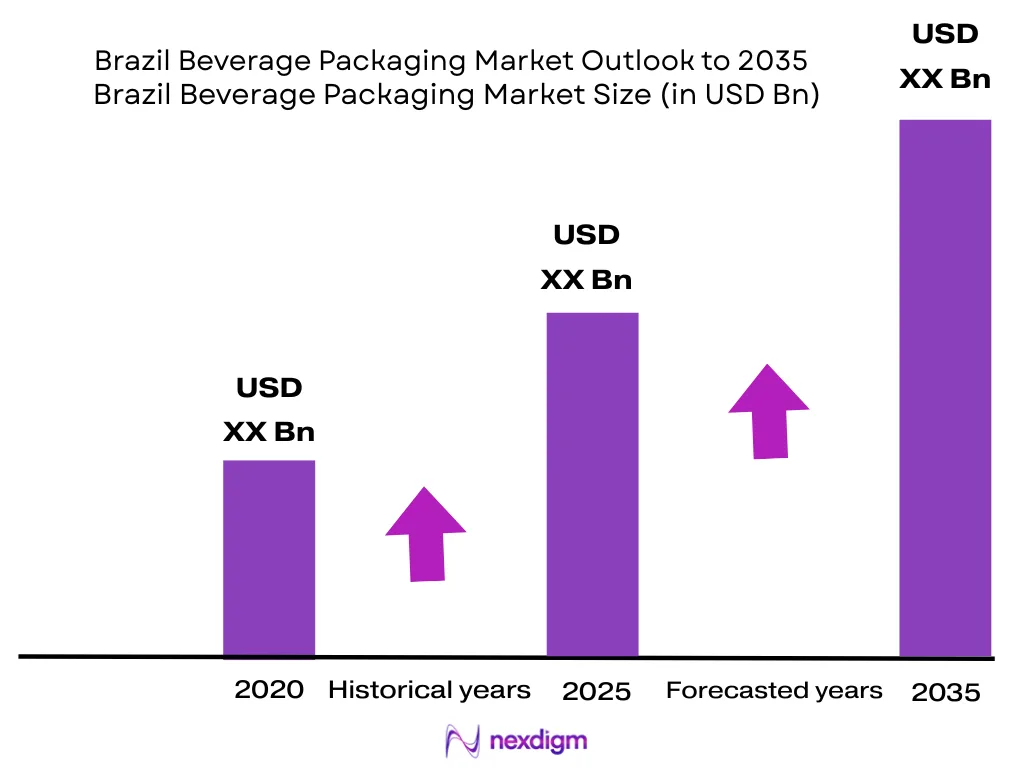
The Brazil Beverage Packaging Market is valued at approximately USD ~ billion and is forecast to expand at a CAGR of % during 2026–2035. National GDP increased from R$10.9 trillion to R$11.7 trillion, while the population reached 212.6 million residents. Beverage packaging demand is supported by carbonated soft drinks, bottled water, beer, dairy beverages, juice, energy drinks, coconut water, ready-to-drink alcohol, wine, cachaça, retail expansion, foodservice activity, and reverse-logistics investment. São Paulo, Rio de Janeiro, Minas Gerais, Paraná, Rio Grande do Sul, Bahia, Pernambuco, Ceará, Goiás, and Amazonas dominate the Brazil Beverage Packaging Market. São Paulo concentrates beverage headquarters, fillers, can plants, PET converters, glass manufacturing, retail distribution, and recyclers. Rio de Janeiro and Minas Gerais support brewing, dairy, water, and soft-drink operations. Southern states contain beer, wine, resin, paperboard, and machinery capabilities, while Bahia, Pernambuco, Ceará, Goiás, and Amazonas provide regional filling and packaging capacity.
Market Segmentation
By Packaging Material
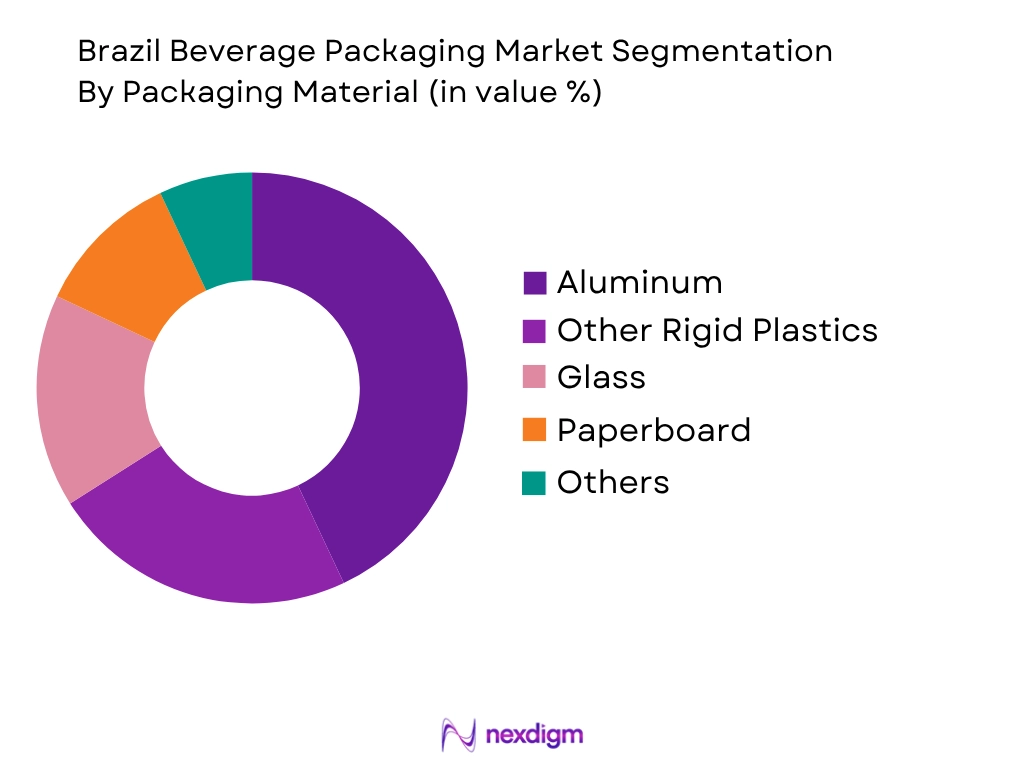
The Brazil Beverage Packaging Market is segmented into aluminum and steel, PET and other rigid plastics, glass, paperboard beverage cartons, and flexible or composite packaging. Metal packaging holds the dominant position because aluminum cans are extensively used for beer, carbonated soft drinks, energy drinks, sparkling water, ready-to-drink cocktails, juices, and emerging functional beverages. Brazil’s established can-making, rolling, collection, remelting, and recycling ecosystem reinforces this position. Approximately 397,200 tonnes of aluminum beverage cans were recycled from 408,300 tonnes placed on the market, producing a recycling rate of 97.3%. PET remains essential for bottled water, carbonated beverages, edible liquids, sports drinks, and family packs because it is lightweight, transparent, resealable, and compatible with high-speed filling. Glass remains important in beer, wine, cachaça, spirits, premium water, and returnable distribution systems. Cartons serve dairy, juice, coconut water, plant-based beverages, and shelf-stable products.
By Beverage Category
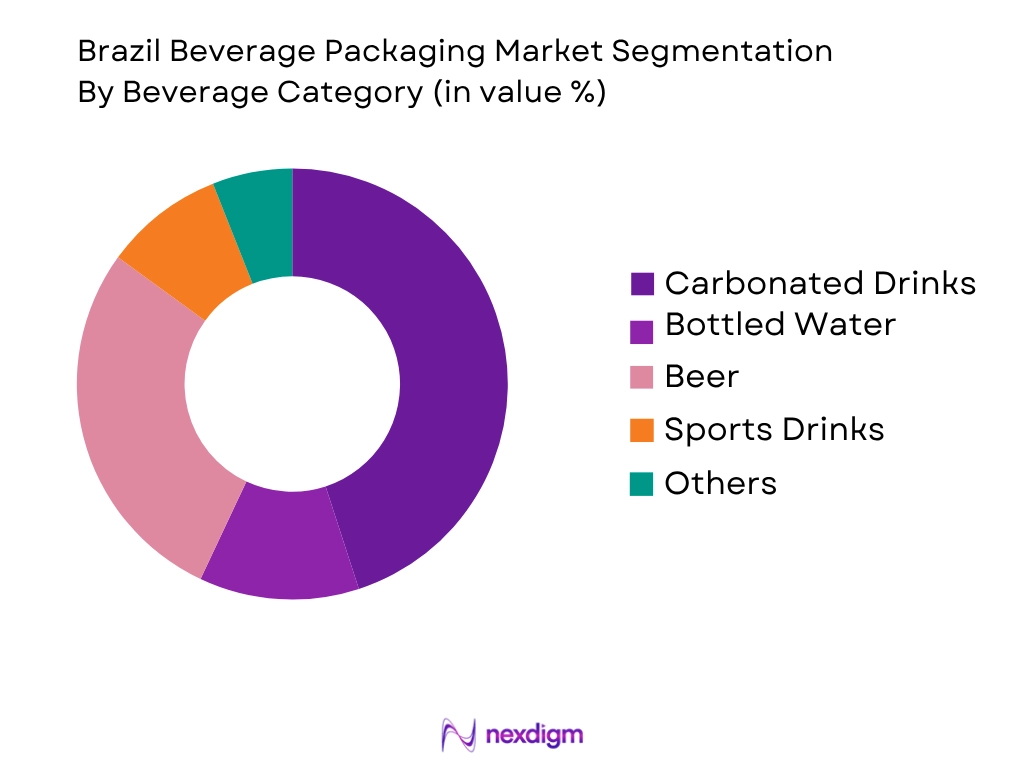
The Brazil Beverage Packaging Market is segmented into carbonated soft drinks, bottled water, beer and malt beverages, juice and coconut water, dairy and plant-based beverages, energy and sports drinks, ready-to-drink tea and coffee, wine and spirits, ready-to-drink alcohol, and functional beverages. Carbonated soft drinks hold the dominant position because they use a broad packaging mix across aluminum cans, one-way PET bottles, refillable PET bottles, returnable glass, multipacks, reusable crates, closures, labels, and bag-in-box fountain systems. Beer is another major packaging application, supporting aluminum cans, returnable glass bottles, one-way bottles, kegs, growlers, corrugated cases, and paperboard multipacks. Bottled water sustains demand for lightweight PET and large refillable containers, while juice, dairy, and coconut-water producers support aseptic-carton consumption. Ready-to-drink alcohol and energy beverages are expanding the use of sleek, slim, digitally decorated, and single-serve cans.
Competitive Landscape
The Brazil Beverage Packaging Market includes global aluminum-can manufacturers, domestic PET converters, multinational glass producers, aseptic-carton suppliers, closure companies, and flexible-packaging specialists. Competition is concentrated around access to beverage-filling clusters, manufacturing capacity, returnable-container expertise, food-grade recycled material, reverse-logistics support, filling-line compatibility, and rapid commercialization of new container sizes. Ball, Ardagh Metal Packaging, O-I Glass, ALPLA, and Tetra Pak represent major positions across metal, glass, plastic, and carton packaging.
| Company | Establishment Year | Headquarters | Core Beverage Portfolio | Material Capability | Principal Beverage Applications | Brazil Manufacturing Footprint | Circularity Capability | Strategic Differentiation |
| Ball Corporation | 1880 | Westminster, United States | ~ | ~ | ~ | ~ | ~ | ~ |
| Ardagh Metal Packaging Brasil | 1932 group heritage | Luxembourg | ~ | ~ | ~ | ~ | ~ | ~ |
| O-I Glass Brasil | 1903 | Perrysburg, United States | ~ | ~ | ~ | ~ | ~ | ~ |
| ALPLA Brasil | 1955 | Hard, Austria | ~ | ~ | ~ | ~ | ~ | ~ |
| Tetra Pak Brasil | 1951 | Pully, Switzerland | ~ | ~ | ~ | ~ | ~ | ~ |
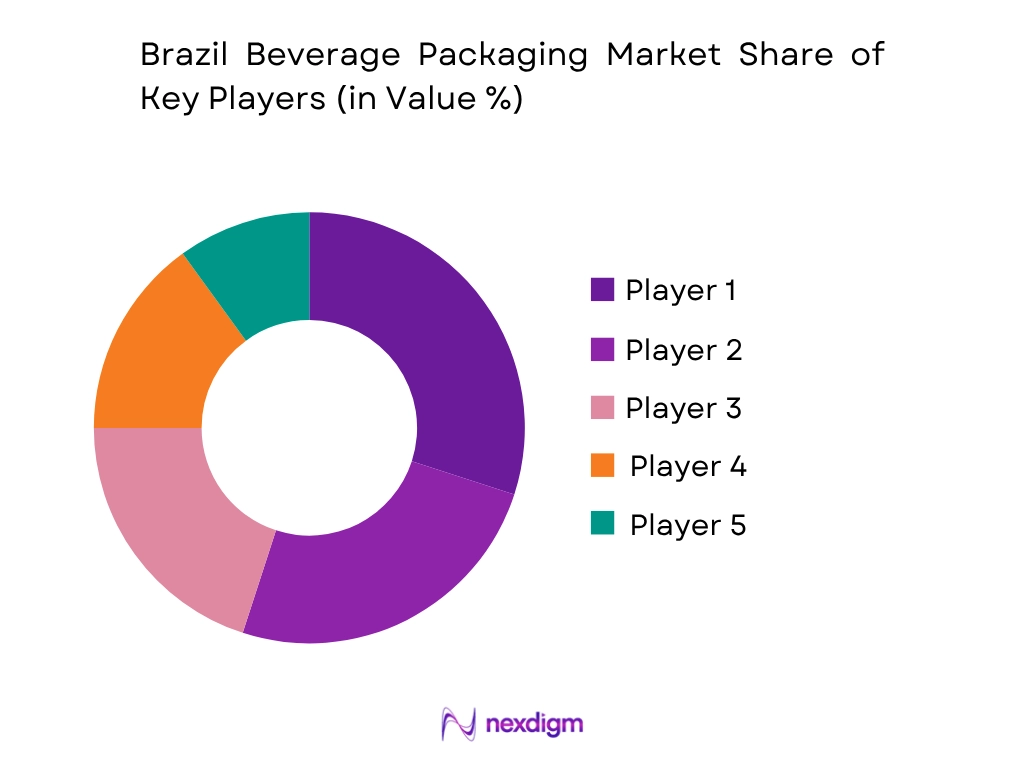
Brazil Beverage Packaging Market Analysis
Growth Drivers
Expansion of Packaged Beverage Consumption and Filling Activity
Brazil’s large consumer and manufacturing base supports recurring demand for aluminum cans, PET bottles, returnable glass, aseptic cartons, closures, labels, corrugated cases, beverage crates, kegs, and flexible dispensing systems. Brazil’s GDP reached R$11.7 trillion in 2024, compared with R$10.9 trillion in 2023, while industry and services expanded alongside household consumption. The country also had approximately 212.6 million residents, providing a broad consumption base for carbonated soft drinks, bottled water, beer, juice, dairy drinks, coconut water, energy drinks, ready-to-drink coffee, wine, cachaça, spirits, and functional beverages. These categories require different packaging specifications based on carbonation pressure, light exposure, oxygen sensitivity, filling temperature, product acidity, serving size, shelf life, and distribution environment. Carbonated drinks use cans, one-way PET, refillable PET, returnable glass, closures, labels, and multipacks. Beer supports aluminum cans, reusable bottles, one-way glass, kegs, crates, and paperboard carriers. Dairy, juice, coconut water, and plant-based products create demand for aseptic cartons, gable-top cartons, PET bottles, HDPE containers, and barrier closures. Brazil’s beverage-packaging demand is concentrated around São Paulo, Campinas, Jundiaí, Rio de Janeiro, Minas Gerais, Paraná, Rio Grande do Sul, Bahia, Pernambuco, Ceará, Goiás, and Amazonas, where beverage plants, packaging manufacturers, distribution centres, and retailers are clustered. Locating packaging plants near beverage fillers reduces the transport of empty containers, enables just-in-time supply, and provides technical assistance during high-speed line trials. Brazil’s aluminum-can industry sold approximately 34.8 billion cans in 2024, equivalent to 429,200 tonnes, following 32.3 billion units in 2023. This scale supports investments in specialty can dimensions, printing, can ends, inspection technology, and secondary packaging. The growth driver is therefore not only population size; it is the interaction between R$11.7 trillion in economic output, more than 212 million consumers, extensive beverage manufacturing, and a packaging mix that ranges from low-weight single-serve formats to reusable containers operating through controlled distributor networks. Sources: Brazilian Institute of Geography and Statistics and Abralatas.
Reverse-Logistics Regulation and Closed-Loop Material Recovery
Brazil’s environmental framework is strengthening demand for beverage packaging that can be collected, reused, recycled, and documented through formal reverse-logistics systems. Federal Decree 12,688, issued on 21 October 2025, established a national reverse-logistics system for plastic packaging and assigned responsibilities across manufacturers, importers, distributors, merchants, and consumers. The system covers the full packaging life cycle and reinforces requirements related to recovery, recycling, recycled-material use, reporting, and operational evidence. The regulation directly affects PET beverage bottles, closures, labels, shrink films, secondary plastic packaging, and other plastic components entering Brazilian distribution channels. Beverage companies must increasingly understand the material composition and weight of each package, identify responsible collection and recycling partners, and maintain traceable evidence that discarded packaging reaches appropriate processing systems. The policy complements Brazil’s existing National Solid Waste Policy, which requires packaging to be designed with materials that facilitate reuse or recycling. Aluminum beverage cans demonstrate how a closed-loop structure can influence package selection. Brazil recycled 97.3 out of every 100 aluminum beverage cans placed on the market in 2024, with 397,200 tonnes recovered from 429,200 tonnes sold. The collection and recycling system included 42 partner cooperatives across 10 states, 39 collection centres across 20 states, 49 recycling operations across 8 states, and 25 can factories across 13 states. It also supported more than 800,000 waste-picker families and approximately 17,000 direct and indirect jobs linked to the can industry. These figures show that beverage-packaging regulation is most effective when producer responsibility is connected to functioning collection networks, recognised material value, reprocessing capacity, and stable industrial demand. PET, cartons, and glass do not always achieve the same collection consistency, creating opportunities for beverage companies to finance sorting equipment, balers, collection vehicles, storage, digital weighing, and direct purchasing agreements with cooperatives. Regulatory pressure also favours clear PET bottles, compatible caps, smaller labels, washable adhesives, reusable crates, lightweight glass, and secondary packaging that avoids incompatible layers. Suppliers capable of providing package-weight data, recyclability assessments, reverse-logistics documentation, recycled-content verification, and cooperative partnerships can become more valuable to beverage producers than suppliers offering containers without a credible recovery pathway. Sources: Presidency of the Republic, Federal Government of Brazil, National Solid Waste Policy, and Abralatas.
Market Challenges
Regional Collection Gaps and Uneven Recycled Feedstock Quality
Brazil’s continental geography creates major differences in beverage-container collection, sorting, transportation, and recycled-feedstock availability. São Paulo, Rio de Janeiro, Minas Gerais, Paraná, Rio Grande do Sul, Bahia, Pernambuco, and other large industrial states contain beverage fillers, can plants, bottle manufacturers, glass furnaces, recyclers, and material aggregators. Smaller municipalities and remote regions may be located hundreds of kilometres from suitable processors. Transporting uncompacted PET bottles, mixed glass, low-density shrink film, or beverage cartons over long distances reduces recovery efficiency and increases the likelihood that potentially recyclable packaging enters landfill, uncontrolled disposal, or low-value applications. Aluminum cans perform comparatively well because they retain strong material value and can be compacted for transport. The sector recovered 397,200 tonnes in 2024, achieving a 97.3-part recovery level out of every 100 parts sold, but this performance does not automatically extend to all beverage-packaging materials. PET bottle bales may contain coloured containers, PVC, food residue, labels, caps, adhesives, moisture, and non-bottle plastics. These contaminants affect resin colour, intrinsic viscosity, odour, processing behaviour, and food-contact suitability. Glass recovery requires separation from ceramics, stones, metals, heat-resistant glass, and unsuitable colours. Beverage cartons require hydrapulping systems that can separate paper fibers from polymer and aluminum layers. Shrink films and flexible beverage liners may contain inks, adhesives, barrier polymers, and contamination that reduce their mechanical-recycling potential. Waste-picker cooperatives play a central role but operate with uneven access to covered storage, balers, forklifts, digital scales, washing systems, transport vehicles, safety equipment, and working capital. Abralatas reported cooperation with 42 cooperatives, yet Brazil has more than 5,500 municipalities, illustrating the scale of the geographic challenge. Beverage companies requiring food-grade rPET, consistent cullet, or high-quality recycled fiber may therefore face feedstock shortages even when large volumes of packaging are discarded nationally. The national economy’s R$11.7 trillion scale creates significant beverage throughput, but volume alone does not produce specification-grade secondary material. Recovery systems require source separation, material identification, quality standards, direct offtake, and regional aggregation. Future improvement depends on expanding cooperative infrastructure, locating compacting and sorting hubs closer to consumption centres, integrating distributor backhaul, and connecting collectors directly with bottle-to-bottle recyclers, glass plants, paper mills, and can-sheet producers. Sources: Brazilian Institute of Geography and Statistics, Abralatas, and the Federal Government’s reverse-logistics framework.
Food-Contact Compliance and Packaging Conversion Complexity
Beverage-packaging conversion in Brazil requires manufacturers to balance food safety, filling-line performance, shelf life, climate resistance, transport durability, recyclability, and consumer convenience. ANVISA’s RDC 843/2024 and IN 281/2024 created a revised framework for food and packaging regularization that entered into force on 1 September 2024. General food packaging may be exempt from prior product registration, but manufacturers remain responsible for notifying the start of manufacturing where applicable and complying with all technical food-contact requirements. This means that a recycled, lightweight, reusable, or alternative package must still meet migration, composition, hygiene, traceability, and intended-use requirements. A higher-rPET beverage bottle requires controlled input material, decontamination, extrusion, filtration, pellet quality, preform performance, blow-moulding validation, and confirmation that the resin is appropriate for food contact. Recycled PET can vary in colour, acetaldehyde, intrinsic viscosity, odour, and contamination. Lightweight bottles can lose top-load strength, deform during hot storage, or become unstable on pallets. Refillable PET must withstand repeated washing, inspection, carbonation pressure, scuffing, closure application, and distribution cycles. Glass lightweighting can reduce material use but must preserve thermal-shock performance, internal-pressure resistance, dimensional accuracy, and filling-line compatibility. Aluminum cans require appropriate coatings, seam integrity, can-end performance, and compatibility with acidic or carbonated products. Aseptic cartons require controlled barriers, sterile filling, seal integrity, and appropriate storage performance. Flexible bag-in-box or pouch systems must maintain tap, spout, and seal performance while protecting beverages from oxygen and light. Brazil’s beverage operations run at high throughput, meaning a minor dimensional or sealing deviation can stop filling lines and generate large quantities of rejected containers or beverage loss. Brazil sold 34.8 billion aluminum cans in 2024, demonstrating the scale at which quality control must operate in one material category alone. Packaging suppliers also need technical staff capable of migration assessment, package design, pressure testing, top-load testing, seam inspection, closure-torque measurement, shelf-life validation, and distribution simulation. Smaller regional beverage companies may depend heavily on converters and co-packers for this expertise. The challenge is not simply developing a package with lower material use; it is creating a package that meets ANVISA requirements, performs on existing filling lines, survives Brazil’s long distribution routes, protects the beverage, and enters an operational recycling or return system after use. Sources: ANVISA, Brazilian health-surveillance authorities, and Abralatas.
Market Opportunities
Food-Grade rPET and Integrated Bottle-to-Bottle Recycling
Brazil has a significant opportunity to expand food-grade recycled PET through controlled bottle collection, automated sorting, decontamination, traceability, preform manufacturing, and long-term beverage-brand procurement. PET is widely used for bottled water, carbonated soft drinks, juice, sports beverages, edible liquids, and family-size formats because it combines clarity, reclosure, low transport weight, and broad filling-line compatibility. The national population of approximately 212.6 million people and GDP of R$11.7 trillion in 2024 provide a substantial base of beverage consumption and post-consumer bottle generation. The opportunity is supported by the national plastic-packaging reverse-logistics system established through Decree 12,688/2025, which requires manufacturers, importers, distributors, and merchants to participate in packaging recovery across the full product life cycle. This framework can encourage beverage companies to enter multi-year agreements with cooperatives, aggregators, recyclers, and bottle manufacturers rather than relying on irregular secondary-material markets. A bottle-to-bottle system begins with packaging design. Clear PET, reduced pigmentation, smaller sleeve labels, compatible polyethylene or polypropylene closures, wash-off adhesives, and visible material identification improve sorting and recovery. Collection systems can use retail take-back, distributor backhaul, municipal selective collection, event recovery, schools, supermarkets, beverage depots, and cooperative networks. Automated near-infrared sorting and artificial-intelligence inspection can separate PET by colour and remove PVC, metals, non-bottle plastics, and other contaminants. Food-grade production then requires intensive washing, extrusion, melt filtration, decontamination, crystallization, pellet testing, and traceability. Beverage brands must validate recycled resin through preform injection, bottle blowing, filling trials, shelf-life analysis, and migration assessment. Digital systems can record the package producer, resin composition, package weight, collection point, bale supplier, recycler input, pellet output, preform producer, and final beverage application. Brazil’s successful can-recycling ecosystem provides a useful operating model: 42 cooperatives, 39 collection centres, 49 recyclers, and 25 manufacturing plants participate in a nationally distributed material chain. PET recovery can adapt similar principles while addressing the stricter contamination and food-contact requirements associated with bottle-to-bottle recycling. Current regulatory obligations and existing beverage throughput support future investment in regional super-clean recycling plants, cooperative equipment, bottle sorting, laboratory capability, and customer-specific closed loops. Sources: Brazilian Institute of Geography and Statistics, Presidency of the Republic, ANVISA, and Abralatas.
Specialty Aluminum Cans, Returnable Systems, and Digital Decoration
Brazil’s established beverage-can industry and returnable-bottle culture create an opportunity for specialty aluminum formats, digital decoration, small-batch filling, reusable crates, refillable PET, and optimized returnable glass systems. Aluminum-can sales reached 34.8 billion units in 2024, representing 429,200 tonnes and growth of 7.6 parts for every 100 parts sold in 2023. Brazil was identified as the world’s third-largest aluminum beverage-can market, supported by 25 manufacturing plants across 13 states and a national recycling ecosystem. The industry also recycled 97.3 out of every 100 cans placed on the market, saving approximately 5,000 gigawatt-hours of electricity annually compared with primary aluminum production and avoiding more than 5 million tonnes of carbon-dioxide-equivalent emissions, according to the sector’s reverse-logistics reporting. This existing scale supports future growth in sleek cans, slim cans, large-sharing formats, aluminum bottles, digitally printed cans, seasonal artwork, and product-specific shapes. Energy drinks, functional beverages, flavoured water, ready-to-drink cocktails, non-alcoholic beer, canned wine, and premium soft drinks increasingly require differentiated packages rather than only standard can formats. Digital printing and shrink-sleeve decoration allow smaller beverage companies to launch regional products and limited editions without maintaining large inventories of preprinted cans. Mobile canning and flexible co-packing can extend these capabilities to craft breweries, wineries, kombucha companies, coffee producers, and emerging functional-beverage brands. Returnable systems provide a parallel opportunity. Beer and soft-drink companies already use returnable glass bottles, refillable PET bottles, reusable crates, distributor backhaul, washing lines, inspection equipment, and deposit mechanisms. Technology can improve these systems through container identification, automated inspection, cycle tracking, crate pooling, route optimization, and retailer inventory management. Lightweight returnable bottles can reduce material and transport burdens, but they must maintain adequate cycle life and pressure resistance. Paperboard clip carriers, wraparound cartons, and molded-fiber multipacks can replace selected plastic rings or shrink film around cans and bottles. Brazil’s combination of 34.8 billion can sales, high recovery, more than 800,000 participating waste-picker families, and mature returnable distribution provides a current foundation for future investment in package differentiation, reusable logistics, digital traceability, and closed-loop systems. Sources: Abralatas and the Brazilian aluminum-can recycling chain.
Future Outlook
The Brazil Beverage Packaging Market is expected to expand through 2035 as beverage diversification, aluminum-can adoption, food-grade recycled PET, returnable packaging, reverse-logistics obligations, and advanced filling technologies reshape container demand. Development will vary by beverage category and distribution channel, with cans, refillable bottles, lightweight PET, aseptic cartons, premium glass, and fiber-based multipacks representing major areas of investment. Aluminum cans will remain strategically important because Brazil possesses one of the world’s most developed closed-loop beverage-can systems. The country recycled 97.3% of cans placed on the market, processing approximately 397,200 tonnes. This recovery performance provides can manufacturers and beverage companies with a well-established source of secondary aluminum and demonstrates the commercial role of waste pickers, cooperatives, scrap dealers, aggregators, remelters, rolling mills, and packaging plants.
Major Players
- Ball Corporation
- Crown Embalagens Metálicas da Amazônia
- Ardagh Metal Packaging Brasil
- CANPACK Brasil
- O-I Glass Brasil
- Verallia Brasil
- Nadir Figueiredo
- Plastipak Brasil
- ALPLA Brasil
- Valgroup
- Engepack Embalagens
- Amcor Brasil
- Tetra Pak Brasil
- SIG Combibloc Brasil
- Aptar Brasil
Key Target Audience
- Beverage-container and packaging-material manufacturers
- Soft-drink, water, beer, dairy, juice, wine, cachaça, and functional-beverage producers
- Contract beverage fillers and co-packaging companies
- Supermarkets, cash-and-carry wholesalers, distributors, and foodservice operators
- Waste-picker cooperatives, recyclers, aggregators, and reverse-logistics entities
- Investments and venture capitalist firms
- Private-equity and strategic packaging investors
- Government and regulatory bodies
Research Methodology
Step 1: Identification of Key Variables
The initial phase constructs an ecosystem map covering aluminum producers, resin companies, glass manufacturers, paperboard suppliers, packaging converters, closure producers, beverage fillers, co-packers, retailers, distributors, cooperatives, recyclers, and regulators. Critical variables include container units, beverage volume, material weight, recycled content, returnability, filling technology, package size, regional capacity, and reverse-logistics route.
Step 2: Market Analysis and Construction
Historical information is compiled by material, container format, beverage category, pack size, closure, filling process, returnability, distribution channel, and region. Bottom-up analysis evaluates plant capacity, container shipments, beverage filling volume, material consumption, recycling output, and company revenue. Top-down analysis reviews GDP, population, industrial production, beverage manufacturing, retail activity, packaging imports, and waste recovery.
Step 3: Hypothesis Validation and Expert Consultation
Market hypotheses are validated through computer-assisted telephone interviews with can manufacturers, bottle and preform producers, glass companies, carton suppliers, beverage brands, fillers, retailers, cooperatives, recyclers, and regulatory specialists. Interviews assess capacity utilization, filling-line compatibility, returnable-container cycles, recycled-feedstock quality, regional logistics, reverse-logistics compliance, and customer switching behaviour.
Step 4: Research Synthesis and Final Output
Supply-side and demand-side findings are triangulated to reconcile packaging production, beverage output, imports, container units, recycled-material supply, and returnable-packaging activity. Segment shares and forecasts are tested against plant footprints, package weights, filling capacity, reverse-logistics requirements, company disclosures, material-recovery data, and expert feedback.

- Executive Summary
- Research Methodology (Market Definitions and Assumptions, Beverage Packaging Inclusion and Exclusion Criteria, Abbreviations, Market Sizing Approach, Top-Down Analysis, Bottom-Up Analysis, Beverage Filling Volume Model, Container Unit Conversion Model, Packaging Material Tonnage Assessment, Domestic Production Analysis, Import and Export Assessment, Demand-Side Interviews, Supply-Side Interviews, Data Triangulation, Regulatory Scenario Modelling, Forecasting Framework, Limitations and Future Conclusions)

- Definition and Scope
- Market Evolution and Industry Genesis
- Evolution of Beverage Container Materials
- Development of the Aluminum Beverage Can Industry
- Expansion of PET Beverage Bottles

- Growth Drivers (Large Soft-Drink and Beer Base, Aluminum Can Adoption, Bottled-Water Consumption, Returnable Glass Culture, Ready-to-Drink Beverage Launches, Modern Retail, Foodservice and E-Commerce)
- Market Challenges (Resin and Aluminum Availability, Glass Freight Intensity, Regional Logistics, Food-Grade rPET Supply, Informal Collection Dependence, Flexible-Packaging Recovery and Regulatory Complexity)
- Market Opportunities (Food-Grade rPET, Specialty Can Formats, Lightweight Returnable Glass, Digital Can Printing, Fiber-Based Multipacks, Refillable PET, High-Barrier Cartons and Cooperative-Based Recovery)
- Market Trends (Can Premiumization, Sleek and Slim Formats, Lightweight PET, Recycled Content, Returnable Bottles, Carton Multipacks, Direct Printing, Variety Packs and Packaging Carbon Disclosure)
- SWOT Analysis
- Porter’s Five Forces Analysis
- PESTLE Analysis

- By Market Value (2020-2025)
- By Beverage Container Units (2020-2025)
- By Packaged Beverage Volume (2020-2025)

- By Packaging Material (In Value %)
Aluminum
Steel and Tinplate
PET
HDPE
Polypropylene
Glass
Paperboard - By Beverage Category (In Value %)
Carbonated Soft Drinks
Bottled Water
Flavoured and Enhanced Water
Energy Drinks
Sports and Isotonic Drinks - By Distribution Channel (In Value %)
Supermarkets and Hypermarkets
Cash-and-Carry Wholesalers
Neighbourhood Grocery Stores
Convenience Stores
Bakeries and Small Food Retailers - By Region (In Value %)
Southeast
South
Northeast
Central-West
North

- Market Share of Major Players
- Cross Comparison Parameters (Beverage Container Material and Format Breadth, Annual Beverage Container and Closure Manufacturing Capacity, Brazil Plant Footprint and Proximity to Filling Clusters, Recycled Content and Closed-Loop Material Capability, Returnable Bottle and Refill-System Expertise, Filling-Line Compatibility and High-Speed Technical Support, Beverage Category and Pack-Size Coverage, Reverse-Logistics Compliance and New-Format Commercialization Capability)
- SWOT Analysis of Major Players
- Detailed Profiles of Major Companies
Ball Corporation
Crown Embalagens Metálicas da Amazônia
Ardagh Metal Packaging Brasil
CANPACK Brasil
I Glass Brasil
Verallia Brasil
Nadir Figueiredo
Plastipak Brasil
ALPLA Brasil
Valgroup
Engepack Embalagens
Amcor Brasil
Tetra Pak Brasil
SIG Combibloc Brasil
Aptar Brasil

- Carbonated Soft Drink Producer Analysis
- Bottled-Water Producer Analysis
- Energy and Sports Drink Producer Analysis
- Juice and Coconut-Water Producer Analysis
- Dairy and Plant-Based Beverage Producer Analysis
- Brewer Analysis

- By Market Value (2026-2035)
- By Beverage Container Units (2026-2035)
- By Packaged Beverage Volume (2026-2035)


 Request a Sample
 Ask for Customization
 Get a Quote
 Enquire Now