
 Download PDF
Market Overview
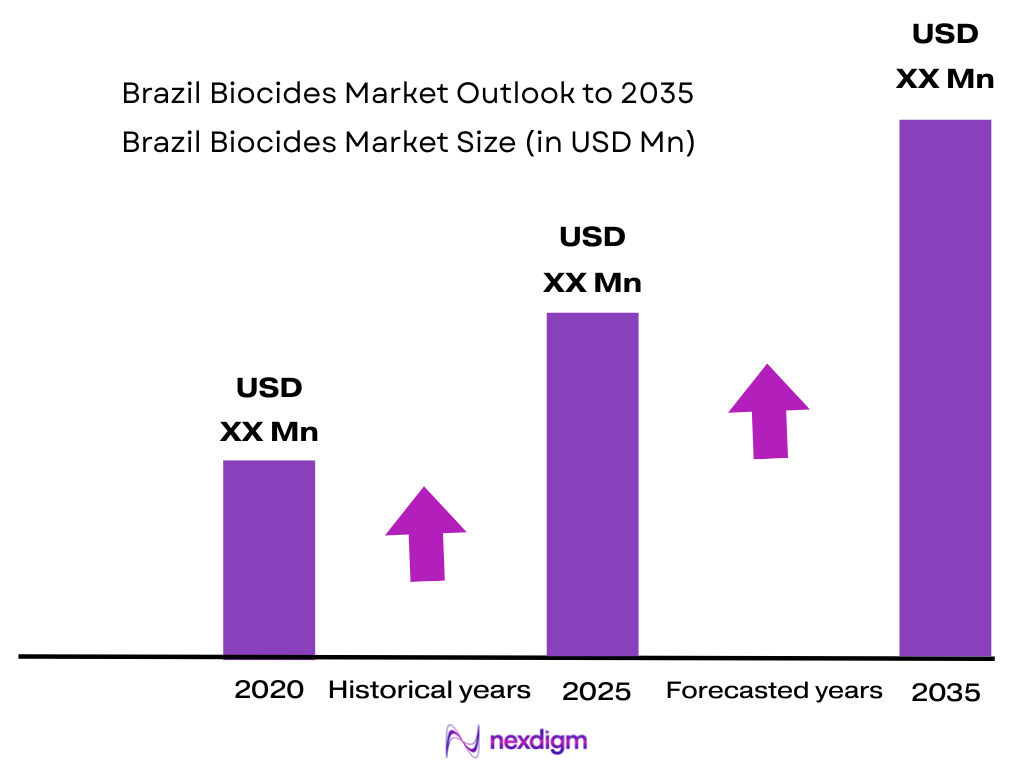
The Brazil Biocides Market is estimated at ~USD XX million in 2024, under the defined market scope covering oxidizing and non-oxidizing biocides, preservatives, disinfectants, antimicrobial additives and microbial-control agents used across industrial and institutional applications. Brazil’s nominal GDP reached approximately USD 2.19 trillion in the latest World Bank observation, while GDP growth reached 3.4. IBGE reported total GDP of R$11.7 trillion, with industry at R$2.5 trillion and services at R$7.0 trillion. These economic activities create a broad industrial base for microbial-control chemicals in water treatment, manufacturing, food processing, coatings, chemicals and other applications.
Brazil’s biocide demand is concentrated around major industrial and population centers, particularly São Paulo, Rio de Janeiro, Minas Gerais, Paraná, Santa Catarina, Bahia and Rio Grande do Sul. São Paulo combines a large manufacturing, food, chemical, pharmaceutical and services ecosystem, while Rio de Janeiro has strong oil, gas, petrochemical and marine activity. Minas Gerais adds mining, metallurgy, food processing and manufacturing demand, while Paraná and Santa Catarina have important food, poultry, pork, paper and industrial-processing clusters. Brazil’s population reached approximately 212 million, creating a substantial municipal, commercial and industrial sanitation base.
Market Segmentation
By Product Type
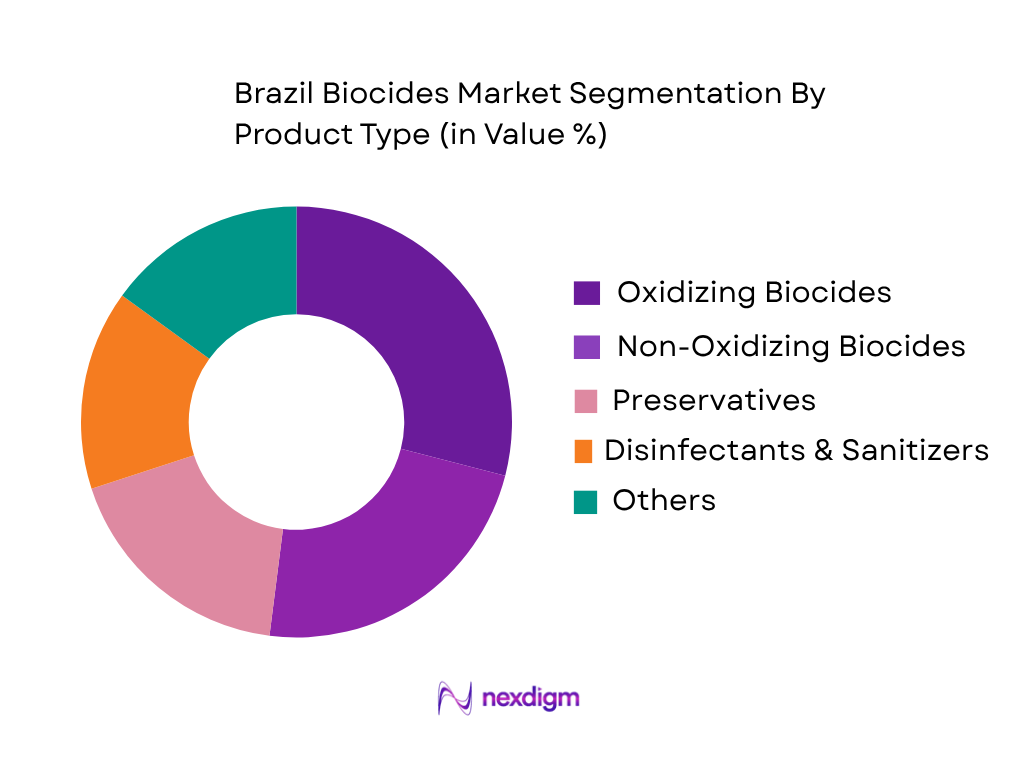
The Brazil Biocides Market is segmented by product type into oxidizing biocides, non-oxidizing biocides, preservatives, disinfectants and sanitizers, antimicrobial additives and other microbial-control agents. Oxidizing biocides are positioned as the dominant sub-segment under the defined scope, reflecting their broad applicability in water and wastewater treatment, cooling-water systems, industrial sanitation and microbial-control processes. Chlorine-based chemistry, chlorine dioxide, bromine chemistry, hydrogen peroxide and peracetic-acid systems can provide rapid microbial control and are relevant to high-throughput water-treatment environments. Non-oxidizing chemistries remain important where longer residual activity, material compatibility or targeted microbial control is required. Preservatives are particularly relevant to paints, coatings, adhesives, polymers and formulated products, while disinfectants and sanitizers serve food, healthcare and institutional environments. Antimicrobial additives address specialized material-protection applications. The market therefore combines high-volume water-treatment chemistries with higher-value specialty formulations, creating distinct competitive positions across industrial end users.
By Application
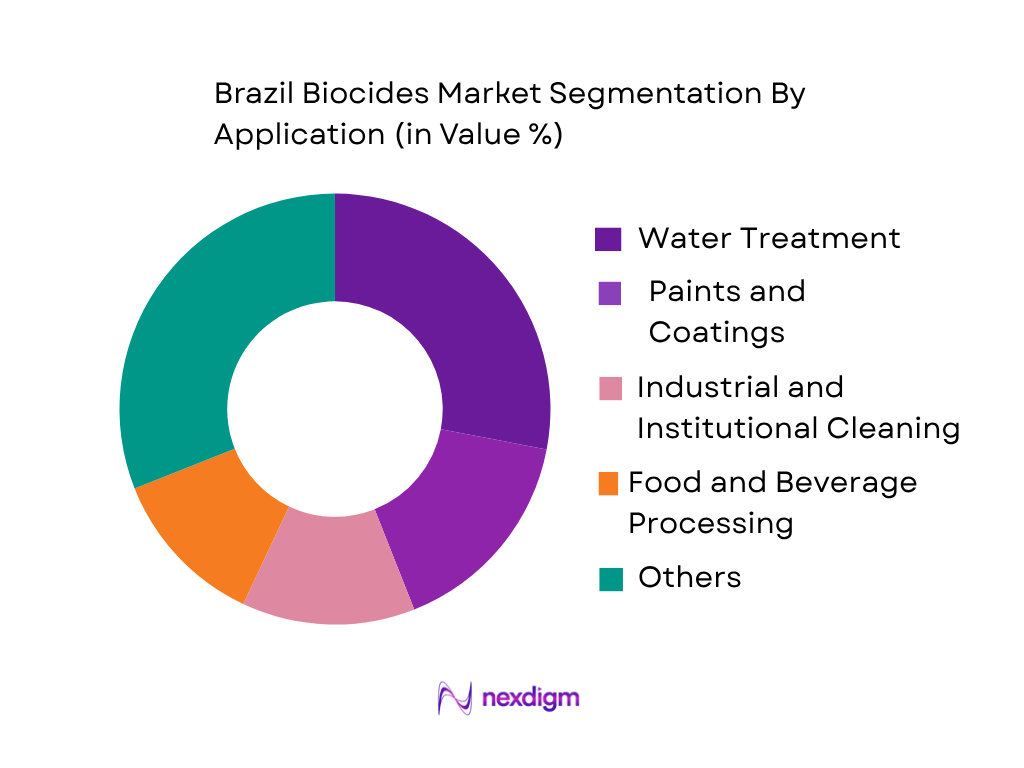
The Brazil Biocides Market is segmented by application into water treatment, paints and coatings, industrial and institutional cleaning, food and beverage processing, personal care and cosmetics, pulp and paper, oil and gas, textiles, wood preservation, aquaculture and other industrial applications. Water treatment is positioned as the dominant application because microbial control is integral to municipal water, industrial process water, cooling systems, wastewater and membrane-based treatment. Brazil’s sanitation infrastructure is monitored through national systems administered by the Ministry of Cities, while ANA established a 2024 reference standard covering operational indicators for public water-supply and wastewater services. Industrial applications extend demand into food processing, oil and gas, chemicals, pulp and paper and manufacturing. Paints and coatings require preservation against microbial spoilage, while aquaculture requires water-quality and pathogen-management solutions. This creates a diversified demand base spanning commodity-volume applications and technically specialized formulations.
Competitive Landscape
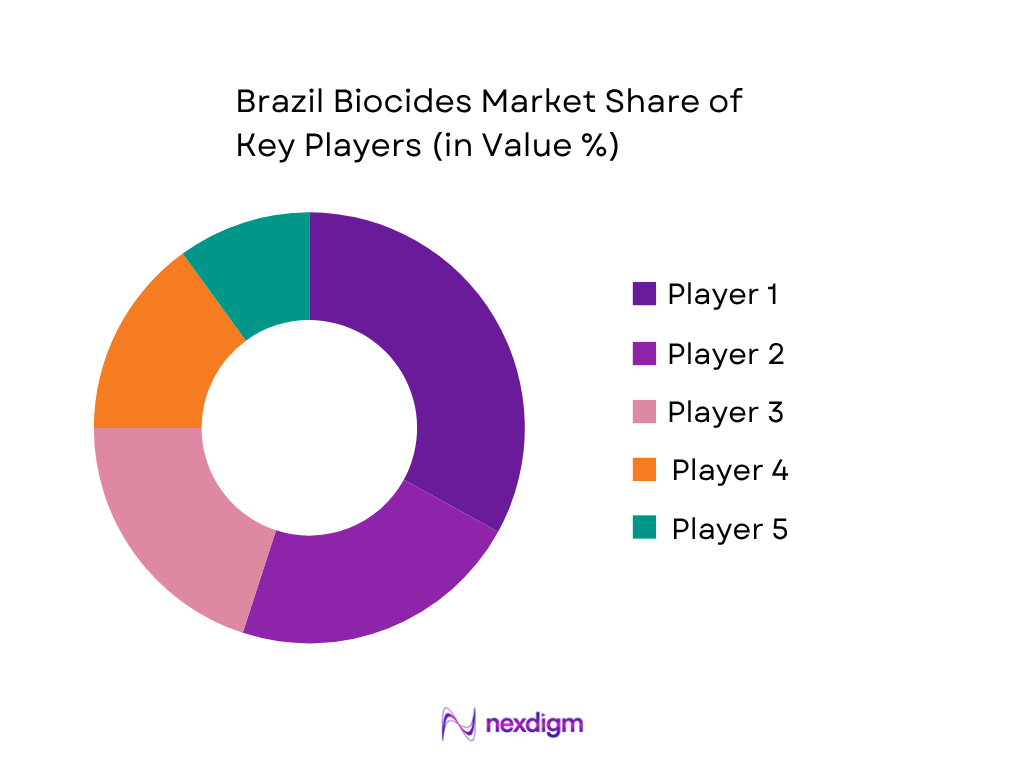
The Brazil Biocides Market contains a combination of multinational specialty-chemical producers, global water-treatment companies, industrial microbial-control specialists and locally established formulators. Competitive differentiation is increasingly determined by active-substance breadth, regulatory capabilities, formulation technology, industrial application expertise, local technical support and distribution reach. Brazil is particularly important as a formulation and application market because biocides are consumed across water treatment, coatings, food processing, oil and gas, pulp and paper, agriculture, aquaculture and industrial manufacturing.
| Company | Establishment | Headquarters | Key Biocide Focus | Major Brazilian Application | Active/Formulation Strength | Distribution / Technical Reach | Strategic Position |
| LANXESS | 1863 | Cologne, Germany | ~ | ~ | ~ | ~ | ~ |
| BASF | 1865 | Ludwigshafen, Germany | ~ | ~ | ~ | ~ | ~ |
| Ecolab | 1923 | St. Paul, USA | ~ | ~ | ~ | ~ | ~ |
| Arxada | 2011 | Basel, Switzerland | ~ | ~ | ~ | ~ | ~ |
| Solenis | 1907 | Wilmington, USA | ~ | ~ | ~ | ~ | ~ |
Brazil Biocides Market Analysis
Growth Drivers
Industrial Water Treatment Expansion
Brazil’s expanding industrial base supports recurring demand for biocides used in process water, cooling systems, wastewater treatment, membrane systems and microbial-control programs. National GDP reached R$11.7 trillion in 2024, while industrial value added reached R$2.5 trillion, creating a large base of manufacturing and process industries requiring controlled water environments. Industrial production increased during the year, with total industrial output reaching a higher level across 20 of 25 industrial branches. The industrial sector generated approximately R$5.3 trillion in net sales revenue across about 42,000 local industrial establishments, demonstrating the scale of facilities where microbial contamination can affect process efficiency, product quality and equipment reliability. Petroleum, chemicals, food products, pulp and paper, metal processing and other water-intensive industries are particularly relevant users of microbial-control chemistry. The food-products manufacturing industry alone employed approximately 2.1 million people, while manufacturing industries collectively employed 8.7 million people, indicating a substantial concentration of production activity requiring industrial sanitation and water management. These conditions support demand for oxidizing and non-oxidizing biocides, preservatives and biofilm-control formulations across Brazilian industrial water circuits.
Food and Beverage Processing
Brazil’s large food-processing base creates sustained requirements for disinfectants, sanitizers, preservatives and microbial-control products across slaughterhouses, dairies, beverage plants, meat processors and other food facilities. Official industrial statistics recorded approximately 2.1 million workers in food-product manufacturing in 2024, making it the largest industrial employer among manufacturing activities. Brazil also processed 39.27 million cattle, 6.46 billion chickens and 57.86 million pigs during the year, while raw-milk acquisition reached 25.38 billion liters and egg production reached 4.67 billion dozen. These production volumes translate into extensive processing, washing, sanitation and water-management requirements throughout the food supply chain. Industrial output also expanded across food manufacturing, with food products contributing to overall industrial growth. Biocides are relevant to equipment sanitation, processing-water management, surface disinfection, biofilm prevention and preservation of formulated food-related products. The scale of Brazil’s meat, dairy, poultry and beverage industries therefore creates multiple recurring consumption points rather than dependence on a single application. Growing industrial throughput also increases the importance of validated microbial-control programs capable of maintaining hygiene standards without compromising food-contact requirements.
Market Challenges
Regulatory Registration Requirements
Regulatory complexity represents a structural challenge for the Brazil Biocides Market because suppliers must align products, active substances, formulations and intended uses with the applicable Brazilian regulatory framework. The scale of the Brazilian chemical and industrial economy increases the number of application environments requiring differentiated compliance documentation. Brazil recorded approximately 34,800 industrial companies and more than 42,000 local industrial establishments in the latest detailed industrial census, while industrial activity generated approximately R$5.3 trillion in net sales revenue. This broad industrial ecosystem encompasses water treatment, food processing, coatings, chemicals, petroleum, pulp and paper and other applications where microbial-control products can fall under different regulatory and operational requirements. Product registration, active-substance documentation, labeling, environmental considerations and permitted-use conditions can therefore create additional technical work for manufacturers and importers. The challenge is particularly significant for suppliers introducing new active substances or specialized formulations because commercial deployment depends on maintaining regulatory alignment across the product lifecycle. Brazil’s federal institutional structure also distributes responsibilities among authorities according to product category and intended application. Consequently, suppliers must maintain regulatory expertise alongside formulation capabilities, while industrial users increasingly require documented compliance before approving microbial-control products for operational use.
Imported Specialty Active Substance Dependency
Dependence on international supply chains for specialized active substances and advanced microbial-control chemistry can expose Brazilian biocide formulators to logistics, currency and availability risks. Brazil’s industrial economy generated approximately R$5.3 trillion in industrial net sales revenue and relied on more than 42,000 local industrial establishments, creating a substantial requirement for consistent availability of specialty chemical inputs. The industrial structure includes sophisticated users in petroleum, chemicals, pharmaceuticals, food processing, electronics, coatings and pulp and paper, where product specifications can require particular active substances rather than interchangeable commodity chemicals. Brazil’s industrial production also expanded across 17 of 18 locations monitored by the national industrial survey, demonstrating the geographic breadth of manufacturing activity and the importance of reliable chemical distribution. The concentration of industrial revenue is also relevant: the Southeast accounted for approximately R$2.9 trillion of industrial net sales based on its reported share of national industrial revenue. Such concentration supports large consumption clusters but can simultaneously make supply continuity strategically important for formulators serving multiple regions. Disruptions affecting imported actives, intermediates or specialty additives can consequently influence formulation schedules, inventory planning and customer deliveries, particularly for technically differentiated biocides that cannot be readily substituted.
Market Opportunities
Advanced Water-Treatment Biocides
Advanced water-treatment biocides represent an important opportunity as Brazil combines a large industrial economy with substantial food, petroleum, chemical and manufacturing activity requiring reliable microbial management. Industrial value added reached approximately R$2.5 trillion in 2024, while industrial net sales revenue reached R$5.3 trillion across approximately 42,000 local establishments. These facilities create multiple opportunities for specialized microbial-control programs covering cooling water, process water, wastewater, membranes, storage systems and biofilm management. Petroleum remained Brazil’s leading industrial product, generating approximately R$278.2 billion in industrial sales revenue, while diesel generated R$149.8 billion, demonstrating the scale of petroleum-related industrial operations where microbial contamination can affect water systems and process infrastructure. Food manufacturing also employed approximately 2.1 million people, reinforcing the need for hygienic water and sanitation systems. The opportunity therefore extends beyond conventional municipal treatment into high-value industrial applications requiring controlled dosing, monitoring and targeted microbial management. Suppliers able to provide oxidizing and non-oxidizing chemistries, membrane-compatible formulations, biofilm-control technologies and application-specific treatment programs can address increasingly specialized requirements. Local technical support and formulation capabilities can further strengthen adoption by reducing dependence on standardized imported solutions.
Wastewater-Reuse Applications
Wastewater-reuse applications provide an opportunity for biocide suppliers because Brazil’s industrial and urban economic base requires increasingly sophisticated management of water resources across manufacturing, food processing, petroleum and other water-intensive activities. Brazil generated R$11.7 trillion of GDP in 2024, with industrial activity contributing approximately R$2.5 trillion, while services generated approximately R$7.0 trillion. The scale of these activities creates extensive wastewater streams requiring treatment before discharge, recycling or reuse. Industrial facilities represented approximately 42,000 local establishments, and the national industrial survey recorded production activity across 17 of 18 monitored locations. Such geographic breadth supports demand for treatment technologies that can maintain microbial control through repeated water cycles. Biocides can play a role in controlling microbial growth, biofilm formation and biological fouling in reuse systems, particularly where water is circulated through industrial equipment or membrane-based processes. The opportunity is particularly relevant for food, chemicals, petroleum, pulp and paper and other sectors where water quality directly affects operational reliability. Suppliers combining low-residual chemistry, targeted microbial control, monitoring and dosing technologies can position themselves for applications where wastewater is treated as a process resource rather than solely as a disposal stream.
Future Outlook
The Brazil Biocides Market is expected to benefit from continued investment in water and wastewater infrastructure, industrial production, food processing, oil and gas, coatings and specialized manufacturing. The country’s economic base provides multiple demand channels rather than dependence on a single application. Brazil’s industrial sector expanded 3.3, services expanded 3.7, and fixed-capital formation increased 7.3 in the latest full-year national-account comparison. Water treatment is expected to remain strategically important as sanitation modernization, wastewater management and industrial water reuse increase the need for controlled microbial environments. Brazil’s national sanitation information architecture covers water supply, wastewater, solid waste and urban drainage, while SINISA became operational as the successor to SNIS for national sanitation information.
Major Players
- LANXESS
- BASF
- Ecolab
- Arxada
- Solenis
- Clariant
- Evonik Industries
- Kemira
- Buckman
- Troy Corporation
- Thor Group
- Nouryon
- Dow
- Italmatch Chemicals
- IPEL
Key Target Audience
- Biocide manufacturers and specialty chemical producers
- Water and wastewater treatment operators
- Paints, coatings and construction-material manufacturers
- Food and beverage processing companies
- Oil, gas and petrochemical companies
- Pharmaceutical, healthcare and personal-care manufacturers
- Investments and venture capitalist firms
- Government and regulatory bodies (ANVISA, IBAMA, MAPA, ANA, Ministry of Cities, Ministry of Environment and Climate Change)
Research Methodology
Step 1: Identification of Key Variables
The initial phase establishes the Brazil Biocides Market ecosystem by mapping active-substance manufacturers, formulators, distributors and major consuming industries. Variables include product type, active chemistry, application, formulation, end-use industry, regulatory category, domestic production and import dependence. Particular attention is given to water treatment, industrial microbial control, coatings preservation, food sanitation, aquaculture and oilfield applications.
Step 2: Market Analysis and Construction
Historical market information is compiled through bottom-up assessment of biocide consumption across major Brazilian end-use industries. Application-level demand is evaluated using industrial production indicators, sanitation infrastructure, manufacturing activity, food processing, oil and gas operations and specialty-chemical consumption. National economic accounts are used as contextual validation rather than as direct substitutes for biocide demand measurements. IBGE reported R$11.7 trillion in national GDP and R$2.5 trillion in industrial value added in the latest full-year accounts.
Step 3: Hypothesis Validation and Expert Consultation
Market hypotheses are validated through discussions with biocide manufacturers, formulators, distributors, water-treatment specialists and industrial end users. Interviews focus on active-substance selection, formulation preferences, treatment frequency, regulatory requirements, import dependency, customer procurement criteria and application-specific microbial-control requirements. Regulatory information is cross-checked against Brazilian authorities including ANVISA, IBAMA, MAPA and ANA.
Step 4: Research Synthesis and Final Output
The final stage integrates demand-side and supply-side findings to construct a consistent Brazil Biocides Market database. Market estimates are reconciled across product type, application and end-use industry, while import structures, local manufacturing, formulation capacity and distribution networks are incorporated into the competitive assessment. Sanitation-related assumptions are validated against Brazil’s official SNIS/SINISA information systems and ANA regulatory framework.

- Executive Summary
- Research Methodology (Market Definition and Scope, Biocide Classification Framework, Active Substance Mapping, Market Sizing Architecture, Top-Down Analysis, Bottom-Up Analysis, Demand-Side Assessment, Supply-Side Assessment, Domestic Production Assessment, Import-Export Assessment, Primary Industry Interviews, Regulatory Validation, Data Triangulation, Forecasting Framework, Scenario Analysis, Assumptions and Limitations)

- Definition and Scope
- Brazil Biocides Industry Structure
- Biocidal Active Substance Ecosystem
- Biocide Formulation and Manufacturing Landscape
- Evolution of Microbial-Control Applications in Brazil

- Market Growth Drivers (Industrial Water Treatment Expansion, Food and Beverage Processing, Aquaculture Development, Agricultural Production, Oil and Gas Activity, Pharmaceutical Manufacturing, Paints and Coatings Production, Healthcare Hygiene Requirements)
- Market Challenges (Regulatory Registration Requirements, Imported Specialty Active Substance Dependency, Environmental and Aquatic Toxicity, Biocide Resistance, Hazardous Chemical Handling, Active Substance Restrictions, Product-Quality Variability, Supply-Chain Volatility)
- Market Opportunities (Advanced Water-Treatment Biocides, Wastewater-Reuse Applications, Cooling-Tower Microbial Control, Aquaculture Microbial Management, Food-Processing Sanitation, Oilfield Biocides, Low-Toxicity Formulations, Biofilm-Specific Technologies, Local Formulation and Regional Distribution)
- Market Trends (Low-Residual Biocide Adoption, Biofilm-Specific Treatment, Integrated Microbial Management, Automated Chemical Dosing, Industrial Water Recycling, Sustainable Biocide Chemistry, Advanced Disinfection, Membrane Protection, Microbial Monitoring, Localized Formulation)
- Brazil Biocide Product-Type Regulatory Analysis (Human Hygiene, Disinfectants and Algaecides, Veterinary Hygiene, Food and Feed Areas, Drinking Water, In-Can Preservation, Film Preservation, Wood Preservation, Fibre/Leather/Rubber/Polymer Preservation, Construction Material Preservation, Cooling and Processing Liquid Preservation, Slimicides, Working and Cutting Fluid Preservation, Rodenticides, Insecticides and Acaricides, Repellents and Attractants, Antifouling Products, Embalming and Taxidermy Fluids)
- SWOT Analysis
- Porter’s Five Forces Analysis
- PESTLE Analysis

- By Market Value (2020-2025)
- By Biocidal Active Substance Consumption Volume (2020-2025)
- By Formulated Biocide Consumption Volume (2020-2025)
- By Domestic Production (2020-2025)
- By Imports and Exports (2020-2025)
- By Application (2020-2025)
- By End-Use Industry (2020-2025)

- By Product Type (In Value %)
Oxidizing Biocides
Non-Oxidizing Biocides
Disinfectants and Sanitizers
Preservatives
Antimicrobial Additives
Algaecides
Fungicides
Biofilm-Control Agents
Antifouling Biocides
Rodenticides - By Active Substance (In Value %)
Chlorine-Based Biocides
Bromine-Based Biocides
Glutaraldehyde
Isothiazolinones
Quaternary Ammonium Compounds
DBNPA
Bronopol
Peracetic Acid
Hydrogen Peroxide
Copper-Based Biocides
Phenolic Compounds
Organic Acid-Based Biocides
Other Active Substances - By Application (In Value %)
Water Treatment
Wastewater Treatment
Cooling-Water Treatment
Industrial and Institutional Cleaning
Food and Beverage Processing
Personal Care and Cosmetics
Pulp and Paper
Textiles
Oil and Gas and Petrochemicals
Wood Preservation
Construction Materials
Agriculture and Animal Hygiene
Aquaculture - By End-Use Industry (In Value %)
Municipal Water and Wastewater|
Industrial Water Treatment
Food and Beverage Manufacturing
Pharmaceutical Manufacturing
Aquaculture and Fisheries
Oil and Gas and Petrochemicals
Paints and Coatings
Pulp and Paper - By Formulation Type (In Value %)
Liquid Biocides
Powder and Granular Biocides
Concentrated Formulations
Ready-to-Use Disinfectants
Water-Soluble Formulations
Emulsion and Dispersion Formulations
Controlled-Release Formulations - By Functional Requirement (In Value %)
Bacterial Control
Fungal Control
Algae Control
Biofilm Control
Preservation
Disinfection
Biofouling Prevention
Membrane Protection
Microbiologically Influenced Corrosion Control

- Market Share of Major Players (By Value, Volume, Product Type, Active Substance, Application, End-Use Industry, Distribution Channel)
- Cross Comparison Parameters (Active Substance Portfolio Breadth, Formulation Portfolio Breadth, Industrial Water-Treatment Capability, Paints and Coatings Preservation Capability, Food and Beverage Hygiene Capability, Aquaculture and Agricultural Microbial-Control Capability, Regulatory and Technical-Service Expertise, Local Manufacturing and Distribution Reach)
- SWOT Analysis of Major Players
- Detailed Profiles of Major Companies
LANXESS
BASF
Clariant
Evonik Industries
Arxada
Ecolab
Buckman
Solenis
Kemira
Thor Group
Troy Corporation
Nouryon
Dow
Italmatch Chemicals
IPEL

- Industrial Water-Treatment Demand Assessment
- Food and Beverage Customer Analysis
- Aquaculture Customer Analysis
- Agriculture and Animal-Production Customer Analysis
- Oil and Gas Customer Analysis
- Paints and Coatings Customer Analysis
- Pulp and Paper Customer Analysis

- By Market Value (2026-2035)
- By Biocidal Active Substance Consumption Volume (2026-2035)
- By Formulated Biocide Consumption Volume (2026-2035)
- By Domestic Production (2026-2035)
- By Imports and Exports (2026-2035)
- By Application (2026-2035)
- By End-Use Industry (2026-2035)


 Request a Sample
 Ask for Customization
 Get a Quote
 Enquire Now