

 Download PDF
 Download PDF
Market Overview
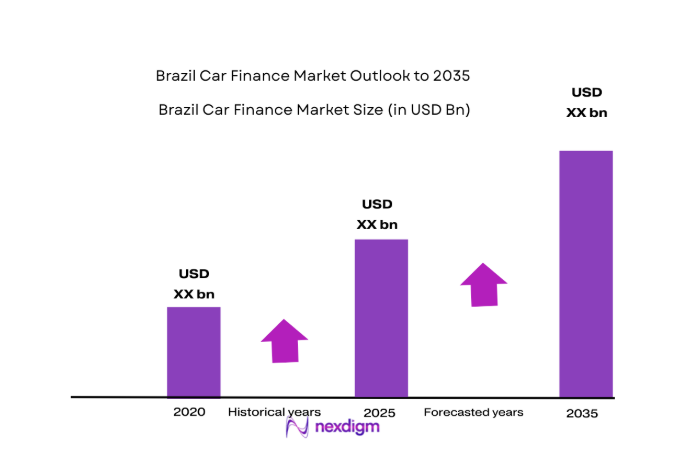
The Brazil car finance market is valued at USD ~ billion, driven by factors such as the rising demand for cars, strong consumer financing programs, and increasing income levels. Government policies that provide tax benefits and incentives for both consumers and financial institutions have further spurred growth. The market is supported by the evolving banking and financial services sectors, which offer competitive financing rates and products tailored for car purchases. These elements combined are anticipated to continue fueling the market’s expansion in the coming years.
Cities such as São Paulo and Rio de Janeiro dominate the Brazilian car finance market, primarily due to their economic activity, larger populations, and higher income levels. These urban centers are key financial hubs, where car dealerships and financial institutions are concentrated, allowing for easy access to car loans and financing options. In these regions, consumer confidence is high, and the demand for automobiles remains strong, making them central to the market’s performance.
Market Segmentation
By Product Type
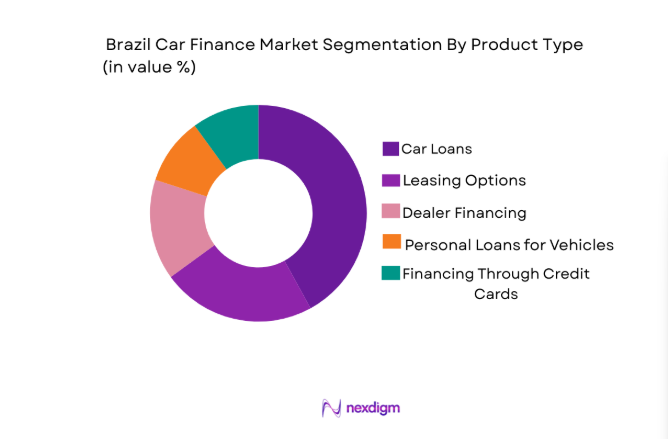
The Brazil car finance market is segmented by product type into car loans, leasing options, dealer financing, personal loans for vehicles, and financing through credit cards. Car loans dominate the market, offering flexible terms and competitive interest rates, making them the most preferred financing method for car buyers. Leasing options also have a significant share, particularly among consumers looking for low initial payments. Dealer financing has gained traction, providing direct financing options through automotive dealerships. Personal loans for vehicles are becoming increasingly popular as they offer an alternative to traditional car loans, while financing through credit cards is primarily used for lower-cost vehicles.
By Platform Type
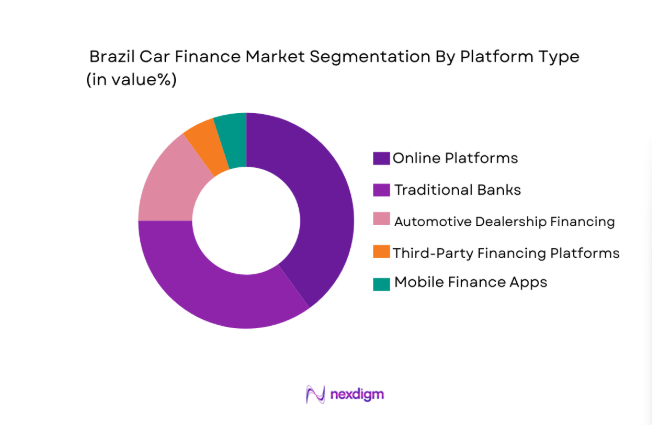
The Brazil car finance market is segmented by platform type into online platforms, banks, automotive dealerships, third-party financing platforms, and mobile finance apps. Online platforms have experienced rapid growth due to their convenience and accessibility, making them a popular choice for consumers looking to compare financing options. Banks continue to play a significant role, offering traditional car loans with competitive rates. Automotive dealerships provide financing directly to customers, streamlining the car purchase process. Third-party financing platforms facilitate loans through partnerships with various financial institutions, offering more flexible terms. Mobile finance apps are gaining traction, allowing consumers to apply for loans directly from their smartphones.
Competitive Landscape
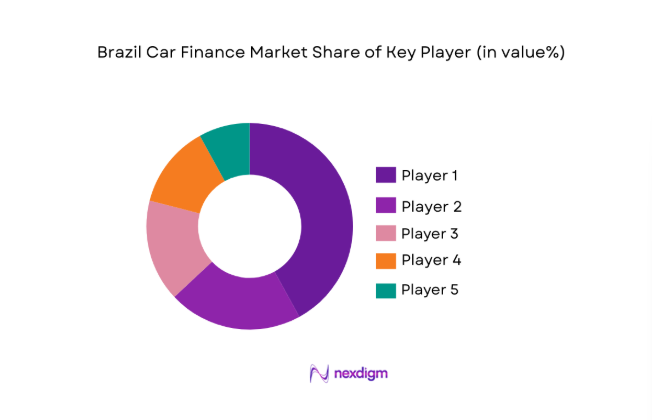
The Brazilian car finance market is highly competitive, with several key players competing for market share. The presence of both local and international banks, financial institutions, and online platforms intensifies the competition. Companies are focusing on enhancing their digital offerings, such as offering online loan applications and digital loan approvals, to cater to the growing demand for convenience and speed. Moreover, major dealerships have partnered with financial service providers to offer customized financing options to buyers, ensuring they stay competitive in the market.
| Company Name | Establishment Year | Headquarters | Technology Focus | Market Reach | Key Products | Revenue | Digital Loan Options |
| Banco do Brasil | 1808 | Brasília | ~ | ~ | ~ | ~ | ~ |
| Bradesco | 1943 | Osasco | ~ | ~ | ~ | ~ | ~ |
| Santander Brasil | 1982 | São Paulo | ~ | ~ | ~ | ~ | ~ |
| Caixa Econômica | 1861 | Brasília | ~ | ~ | ~ | ~ | ~ |
| BV Financeira | 1987 | São Paulo | ~ | ~ | ~ | ~ | ~ |
Brazil car finance Market Analysis
Growth Drivers
Government Incentives
Government policies such as subsidies, tax exemptions, and credit facilities have significantly contributed to the growth of the Brazilian car finance market. These policies make car ownership more accessible, allowing a larger segment of the population to purchase vehicles. With initiatives to reduce financial barriers to vehicle acquisition, consumers are encouraged to take advantage of favorable financing conditions. Furthermore, policies aimed at promoting the adoption of sustainable vehicles and energy-efficient automobiles provide long-term support to the market. As the government continues to align its policies with economic growth, the sector stands to benefit from an enhanced financing landscape, ensuring the market remains robust. Additionally, these financial incentives have increased consumer confidence, contributing to steady demand for vehicle financing. As a result, car loan providers and financial institutions benefit from favorable economic conditions and growing demand in urban areas.
Technological Advancements
The rapid digitalization of the car finance sector has played a pivotal role in shaping market dynamics. Technological advancements in mobile applications and online platforms allow consumers to apply for financing easily and securely from the comfort of their homes. The availability of online loan calculators and comparison tools enables buyers to make informed decisions, further fueling the market’s growth. Additionally, the rise of fintech companies offering digital lending options has made financing more accessible, particularly among tech-savvy millennials. These platforms have simplified the process of obtaining car loans, offering convenience and transparency, which appeals to a larger consumer base. As mobile technology continues to improve, it is expected that digital platforms will continue to dominate, driving the market forward and increasing competition among financial institutions.
Market Challenges
High Interest Rates
One of the main challenges in the Brazilian car finance market is the high interest rates imposed by financial institutions. These elevated rates often make it difficult for lower-income consumers to access car loans, especially in a country where inflation can fluctuate significantly. The disparity between interest rates and consumer purchasing power can create barriers to car ownership, limiting the potential market base. While there are some government-backed initiatives to reduce rates for low-income buyers, the overall cost of financing remains relatively high. This challenge is further exacerbated by Brazil’s complex financial regulations, which sometimes lead to delayed approvals and additional administrative costs. Despite efforts to regulate and manage interest rates, they continue to impact the affordability of car loans for many prospective buyers. In turn, this results in slower adoption rates for car financing, limiting the market’s expansion.
Economic Volatility
Brazil’s economic volatility remains a major challenge for the car finance market. Fluctuations in inflation, unemployment rates, and GDP growth significantly affect consumer confidence, which in turn impacts the willingness of consumers to take on financial commitments like car loans. When the economy experiences downturns, many consumers delay or forgo purchasing vehicles, opting for lower-cost alternatives or public transportation. Additionally, the ongoing political instability in the country can deter both domestic and foreign investment, which affects the growth of financial products and services, including car financing. This creates uncertainty in the market, making it difficult for financial institutions to forecast demand and offer suitable financing products. Consequently, the market remains vulnerable to macroeconomic shifts, making it susceptible to slowdowns in periods of economic distress.
Opportunities
Expansion of Digital Financing Solutions
The continued growth of digital financing platforms presents a key opportunity for the Brazilian car finance market. With more consumers turning to online channels to secure car loans, the market is poised for a shift toward fully digitalized financial products. Online platforms that offer instant loan approvals, low-interest rates, and a seamless user experience have become increasingly popular, especially in urban centers. The ease of access and the convenience of applying for loans through mobile apps and websites are driving demand for digital solutions. Financial institutions that adapt to this digital transformation and offer tech-driven car finance products will be well-positioned to capture the growing market share. Additionally, partnerships between car dealerships and fintech companies can facilitate easier access to financing for consumers, streamlining the car purchasing process and making it more attractive. With the increasing penetration of smartphones and internet access in Brazil, the market for digital financing will continue to expand, bringing in new opportunities for growth and innovation in the sector.
Emerging Middle Class Demand
The growth of Brazil’s emerging middle class offers a significant opportunity for the car finance market. With rising disposable incomes and increasing consumer confidence, more Brazilians are entering the middle-income bracket and are now in a better position to afford car loans. As the purchasing power of the middle class expands, the demand for consumer vehicles will increase, driving the need for accessible car finance products. Additionally, the younger generation, who are more inclined to explore car ownership, is expected to contribute significantly to the market’s expansion. Financial institutions can tailor their offerings to appeal to this new segment by providing flexible loan terms, low down payments, and innovative financing options. This demographic shift is expected to create a long-term boost to the car finance market as a new wave of consumers looks to purchase vehicles with the help of financing.
Future Outlook
The Brazilian car finance market is expected to witness steady growth over the next few years. Increasing consumer demand, fueled by favorable government policies and an expanding middle class, will continue to support the market. Technological advancements in digital platforms and mobile applications will also play a significant role in driving market adoption. Regulatory support is anticipated to remain strong, with continued government initiatives aimed at making car ownership more affordable. As the market continues to evolve, new opportunities will arise for financial institutions that adapt to changing consumer preferences and digital trends.
Major Players
- Banco do Brasil
- Bradesco
- Santander Brasil
- Caixa Econômica
- BV Financeira
- Itaú Unibanco
- Banco Safra
- Banco Santander
- Honda Finance
- Volkswagen Financial Services
- Ford Credit
- Nissan Finance
- Scania Financial Services
- Toyota Financial Services
- Mercedes-Benz Financial Services
Key Target Audience
- Investments and venture capitalist firms
- Government and regulatory bodies
- Banks and financial institutions
- Automotive dealerships
- Car rental services
- Leasing companies
- Online lending platforms
- Automobile manufacturers
Research Methodology
Step 1: Identification of Key Variables
Key market variables like financing terms, interest rates, and consumer preferences are identified for the analysis.
Step 2: Market Analysis and Construction
Detailed segmentation of the market based on product types, platform types, and consumer behavior patterns is conducted.
Step 3: Hypothesis Validation and Expert Consultation
Expert insights and industry reports are consulted to validate hypotheses and refine market models.
Step 4: Research Synthesis and Final Output
Final market analysis is synthesized and prepared for publication, ensuring all findings are accurate and comprehensive.

- Executive Summary
- Research Methodology (Definitions, Scope, Industry Assumptions, Market Sizing Approach, Primary & Secondary Research Framework, Data Collection & Verification Protocol, Analytic Models & Forecast Methodology, Limitations & Research Validity Checks)

- Market Definition and Scope
- Value Chain & Stakeholder Ecosystem
- Regulatory / Certification Landscape
- Sector Dynamics Affecting Demand
- Strategic Initiatives & Infrastructure Growth

- Growth Drivers
Increase in Car Ownership Rates
Government Incentives for Green Vehicles
Rising Middle-Class Population
Growing Affordability of Financing Options
Improved Access to Credit - Market Challenges
High-Interest Rates
Economic Instability in Brazil
Lack of Consumer Credit History
Limited Awareness of Financing Options
Regulatory Barriers and Compliance - Market Opportunities
Emerging FinTech Solutions
Partnerships with Dealerships and Banks
Growth of Sustainable Car Financing Options - Trends
Shift Towards Electric Vehicle Financing
Adoption of AI in Loan Underwriting
Increase in Digital Car Financing Platforms
Rising Popularity of Used Car Financing
Integration of Blockchain in Transactions - Government Regulations & Defense Policy
Regulatory Reforms to Support Car Finance
Environmental Policies Favoring EV Financing
Consumer Protection Regulations - SWOT Analysis
- Stakeholder and Ecosystem Analysis
- Porter’s Five Forces Analysis
- Competition Intensity and Ecosystem Mapping

- By Market Value, 2020-2025
- By Installed Units, 2020-2025
- By Average System Price, 2020-2025
- By System Complexity Tier, 2020-2025

- By System Type (In Value%)
Auto Loans
Leasing Services
Personal Finance
Installment Plans
Insurance Financing - By Platform Type (In Value%)
Digital Platforms
Traditional Dealership Financing
Online Direct Lenders
Peer-to-Peer Financing
Fintech Solutions - By Fitment Type (In Value%)
New Car Financing
Used Car Financing
Refinancing Options
Government-Supported Programs
Corporate Fleet Financing - By End User Segment (In Value%)
Retail Consumers
Corporate Buyers
Dealerships
Financial Institutions
Insurance Companies - By Procurement Channel (In Value%)
Direct Procurement
Online Platforms
Dealerships
Banks and Financial Institutions
Brokerage Firms

- Market structure and competitive positioning
Market share snapshot of major players - Cross Comparison Parameters (System Type, Platform Type, EndUser Segment, Fitment Type, Procurement Channel, Material/Technology, Pricing, Customer Acquisition, Technology Adoption, Geographic Reach)
- SWOT Analysis of Key Competitors
- Pricing & Procurement Analysis
- Key Players
Banco do Brasil
Bradesco
Itaú Unibanco
Santander Brasil
CAIXA Econômica Federal
XP Investimentos
Banco Safra
Volkswagen Financial Services
GM Financial
BMW Financial Services
Mercedes-Benz Financial Services
Ford Credit Brasil
Toyota Financial Services
Volkswagen Bank
Banrisul

- Retail Consumers Demand Flexibility in Financing
- Dealerships Increasing Financing Options for Customers
- Banks and Lenders Focusing on Customizable Loan Solutions
- Corporate Fleet Buyers Looking for Cost-Effective Financing

- Forecast Market Value, 2026-2035
- Forecast Installed Units, 2026-2035
- Price Forecast by System Tier, 2026-2035
- Future Demand by Platform, 2026-2035


 Request a Sample
 Ask for Customization
 Get a Quote
 Enquire Now