

 Download PDF
 Download PDF
Market Overview
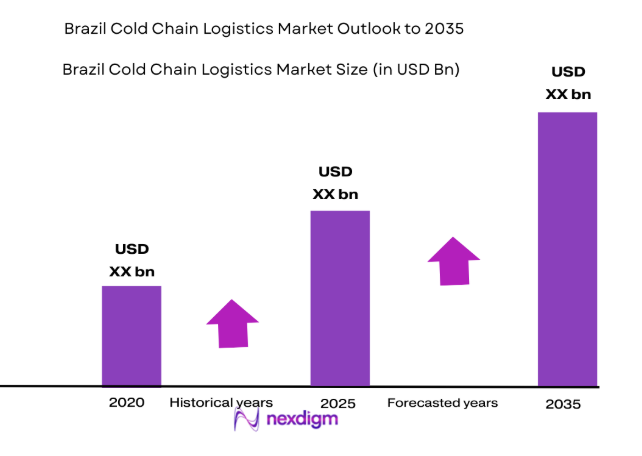
Brazil Cold Chain Logistics Market has developed as a critical component of the country’s food distribution and pharmaceutical supply infrastructure. Based on a recent historical assessment, the market value reached approximately USD ~ billion according to logistics industry analyses published by organizations including Mordor Intelligence and national logistics associations. Demand is driven by expansion of frozen food consumption, pharmaceutical distribution networks, vaccine transportation requirements, and the need for temperature-controlled infrastructure supporting agricultural exports such as meat, seafood, dairy products, and processed food items.
Major logistics activity is concentrated in industrial and population centers including São Paulo, Rio de Janeiro, Campinas, Curitiba, and Porto Alegre where distribution infrastructure, food processing clusters, and pharmaceutical manufacturing facilities are heavily concentrated. These metropolitan regions benefit from advanced transport corridors, port connectivity, and extensive refrigerated warehouse networks. Export oriented agricultural states including Paraná, Mato Grosso, and Rio Grande do Sul also influence cold chain logistics demand due to strong meat processing and food export operations requiring reliable temperature controlled transportation systems.
Market Segmentation
By Product Type
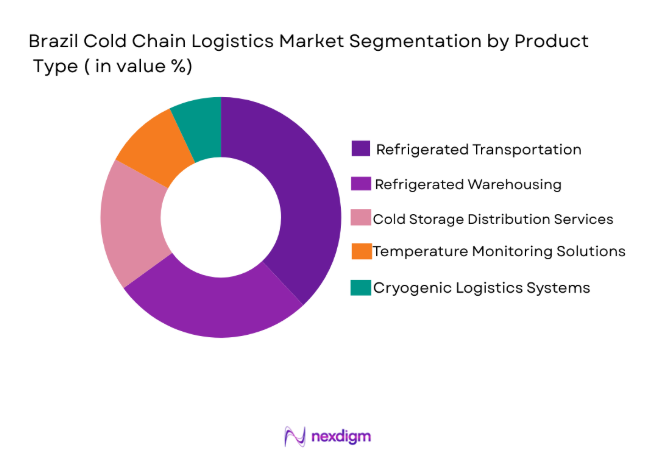
Brazil Cold Chain Logistics Market is segmented by product type into refrigerated transportation, refrigerated warehousing, cold storage distribution services, temperature monitoring solutions, and cryogenic logistics systems. Recently, refrigerated transportation has a dominant market share due to the country’s large geographic size and the need to transport temperature sensitive goods across long distances between production zones and major consumption centers. Extensive food export activities, large scale meat processing industries, and pharmaceutical distribution requirements further strengthen demand for refrigerated trucking fleets. Logistics operators therefore invest heavily in temperature controlled vehicles capable of maintaining strict temperature ranges across national highways. Continuous growth in frozen food consumption and pharmaceutical distribution networks further reinforces the dominance of refrigerated transportation services within the cold chain ecosystem.
By Platform Type
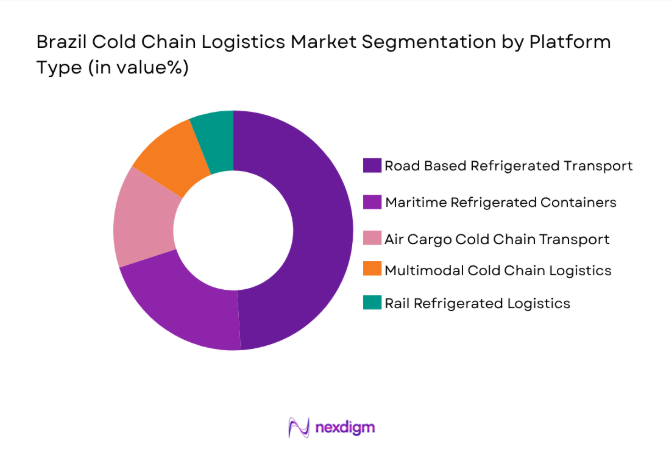
Brazil Cold Chain Logistics Market is segmented by platform type into road based refrigerated transport, rail refrigerated logistics, air cargo cold chain transport, maritime refrigerated containers, and multimodal cold chain logistics. Recently, road based refrigerated transport has a dominant market share due to the extensive national highway network and the country’s reliance on trucking for domestic freight movement. Most agricultural production zones and food processing facilities depend on truck based logistics to connect farms, processing plants, warehouses, and urban retail markets. The flexibility of road transportation enables logistics providers to deliver temperature sensitive goods directly to distribution centers and supermarkets. Expansion of meat exports and pharmaceutical distribution also strengthens demand for reliable refrigerated truck fleets across the national logistics network.
Competitive Landscape
Brazil Cold Chain Logistics Market demonstrates a moderately consolidated structure where international logistics providers operate alongside regional cold storage specialists. Global companies leverage advanced technologies, extensive transportation networks, and pharmaceutical compliance capabilities to secure contracts with multinational food and pharmaceutical companies. Domestic operators maintain strong regional distribution networks supporting agricultural exports and food distribution. Strategic investments in automated cold storage warehouses, digital temperature monitoring systems, and integrated transportation fleets are strengthening competitive positioning across the industry.
| Company Name | Establishment Year | Headquarters | Technology Focus | Market Reach | Key Products | Revenue | Cold Storage Capacity |
| Lineage Logistics | 2008<span data-ccp-props=”{“134233117″:false,”134233118″:false,”335559738″:0,”335559739”:0}”% |

- Executive Summary
- Research Methodology (Definitions, Scope, Industry Assumptions, Market Sizing Approach, Primary & Secondary Research Framework, Data Collection & Verification Protocol, Analytic Models & Forecast Methodology, Limitations & Research Validity Checks)

- Market Definition and Scope
- Value Chain & Stakeholder Ecosystem
- Regulatory / Certification Landscape
- Sector Dynamics Affecting Demand
- Strategic Initiatives & Infrastructure Growth

- Growth Drivers
Expansion of Pharmaceutical Distribution and Biopharmaceutical Supply Chains
Growth of Frozen Food Consumption and Modern Food Retail Networks
Rising Agricultural and Seafood Export Logistics Requirements - Market Challenges
High Capital Investment Required for Temperature Controlled Infrastructure
Logistics Inefficiencies Across Long Distance Transportation Networks
Energy Costs Associated with Refrigeration and Cold Storage Operations - Market Opportunities
Expansion of Pharmaceutical Manufacturing and Vaccine Distribution Logistics
Increasing International Food Export Logistics from Agricultural Regions
Development of Advanced Temperature Monitoring and Digital Cold Chain Systems - Trends
Adoption of IoT Enabled Temperature Monitoring Across Cold Supply Chains
Growth of Automated Refrigerated Warehousing Facilities - Government Regulations
- SWOT Analysis
- Porter’s Five Forces

- By Market Value, 2020-2025
- By Installed Units, 2020-2025
- By Average System Price, 2020-2025
- By System Complexity Tier, 2020-2025

- By System Type (In Value%)
Refrigerated Warehousing
Refrigerated Transportation
Temperature Monitoring Systems
Cold Storage Distribution Centers
Cryogenic Logistics Solutions - By Platform Type (In Value%)
Road Based Refrigerated Transport
Rail Based Refrigerated Transport
Air Cargo Cold Chain Transport
Maritime Refrigerated Containers
Intermodal Temperature Controlled Logistics - By Fitment Type (In Value%)
Built-in Refrigeration Units
Retrofit Refrigeration Systems
Modular Cold Storage Installations
Portable Refrigerated Containers - By End User Segment (In Value%)
Pharmaceutical and Healthcare Companies
Food and Beverage Producers
Agriculture and Seafood Exporters

- Market Share Analysis
- Cross Comparison Parameters (Service Portfolio Breadth, Refrigerated Fleet Size, Cold Storage Capacity, Temperature Monitoring Technology, Geographic Distribution Network, Pharmaceutical Compliance Certification, Integrated Logistics Capabilities)
- SWOT Analysis of Key Competitors
- Pricing & Procurement Analysis
- Key Players
Lineage Logistics
Americold Logistics
Nichirei Logistics Group
Kuehne + Nagel
DHL Supply Chain
DB Schenker
Maersk Logistics & Services
Agility Logistics
Frialsa Frigorificos
SuperFrio Logistica Frigorificada
Brasfrigo
Qualicold Transportes Refrigerados
Grupo GPS Logistica
Tegma Gestao Logistica
Seafrigo Group

- Pharmaceutical manufacturers require validated temperature controlled distribution systems for biologic drugs and vaccines
- Food processing companies depend on refrigerated storage and transport for frozen and chilled food distribution
- Agricultural exporters rely on cold chain logistics for seafood, meat, and fresh produce shipments
- Retail supermarket chains require temperature controlled logistics to maintain food safety compliance

- Forecast Market Value, 2026-2035
- Forecast Installed Units, 2026-2035
- Price Forecast by System Tier, 2026-2035
- Future Demand by Platform, 2026-2035


 Request a Sample
 Ask for Customization
 Get a Quote
 Enquire Now