
 Download PDF
Market Overview
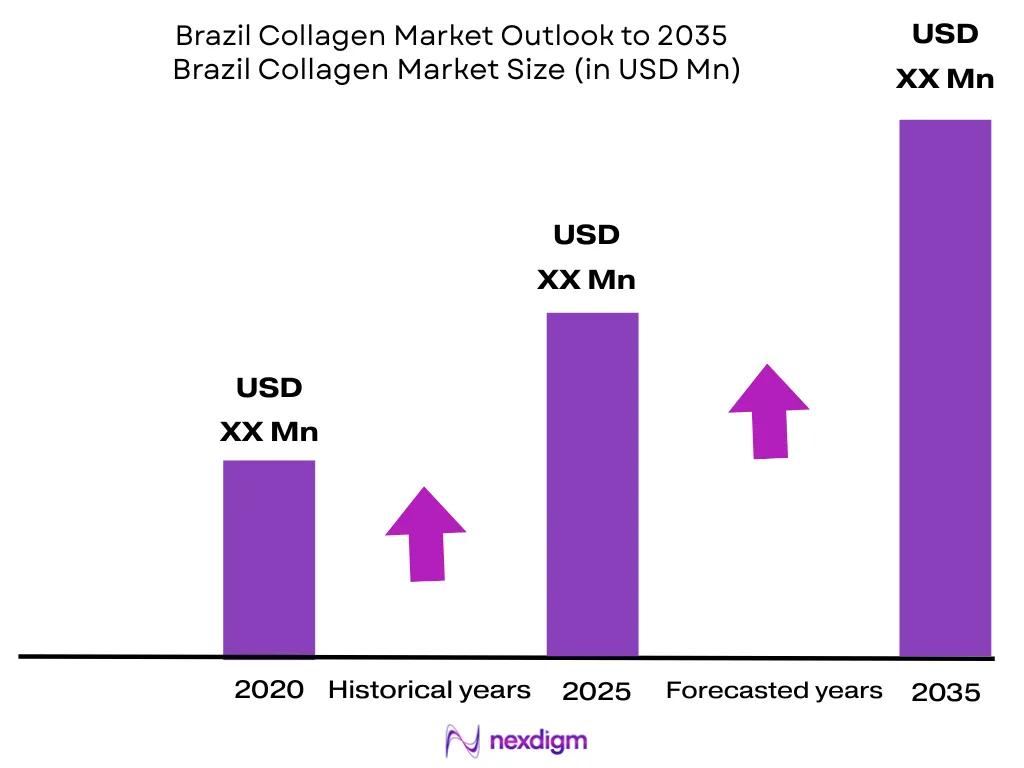
The Brazil collagen market is valued at USD ~ million, based on a five-year historical analysis, and is forecast to expand at 11.7% CAGR in the published forecast period. Gelatin is the largest product category, while hydrolyzed collagen is the fastest-growing product category, supported by food, healthcare, nutricosmetics and dietary supplement applications. Brazil’s GDP reached R$ 11.7 trillion, while GDP growth reached 3.4, supporting stronger wellness and functional nutrition demand. São Paulo, Minas Gerais, Rio de Janeiro, Paraná, Santa Catarina and Rio Grande do Sul dominate Brazil collagen demand and supply. São Paulo has 46.0 million residents, Minas Gerais has 21.3 million, and Rio de Janeiro has 17.2 million, creating the largest pharmacy, beauty, supplement and healthcare consumption clusters. Southern and Midwestern states are important because Brazil’s cattle, meat processing, gelatin and animal by-product chains support bovine collagen and gelatin feedstock availability.
Market Segmentation
By Product Type
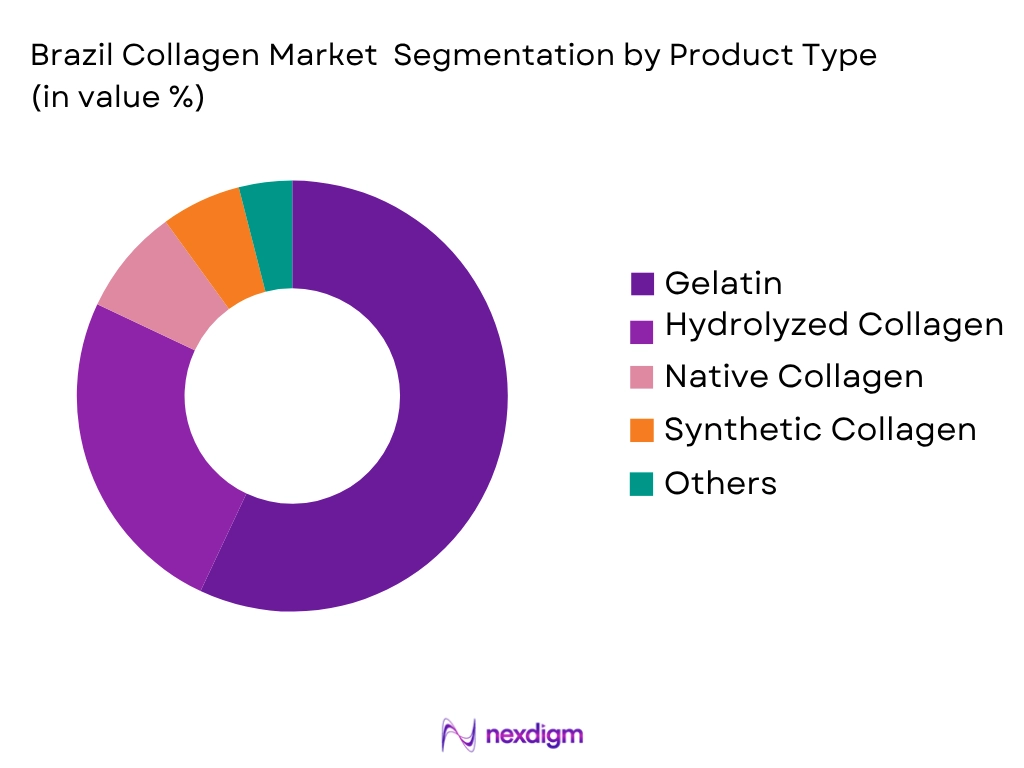
Brazil collagen market is segmented by product type into gelatin, hydrolyzed collagen, native collagen, synthetic collagen and other collagen products. Recently, gelatin has a dominant market share in Brazil under product type, primarily because it is used across food processing, confectionery, dairy desserts, gummies, pharmaceutical capsules, meat processing and technical applications. Brazil’s animal protein ecosystem provides a strong base for gelatin production, as bovine and porcine raw materials are available through slaughtering, rendering and meat-processing chains. Gelatin also benefits from its dual positioning as both a functional food ingredient and a pharmaceutical excipient. Its gelling, binding, stabilizing and film-forming properties make it more broadly used than premium collagen peptides, which are concentrated mainly in beauty, wellness and joint-health supplements. Grand View Research identifies gelatin as the largest revenue-generating product segment in Brazil collagen market.
By Source
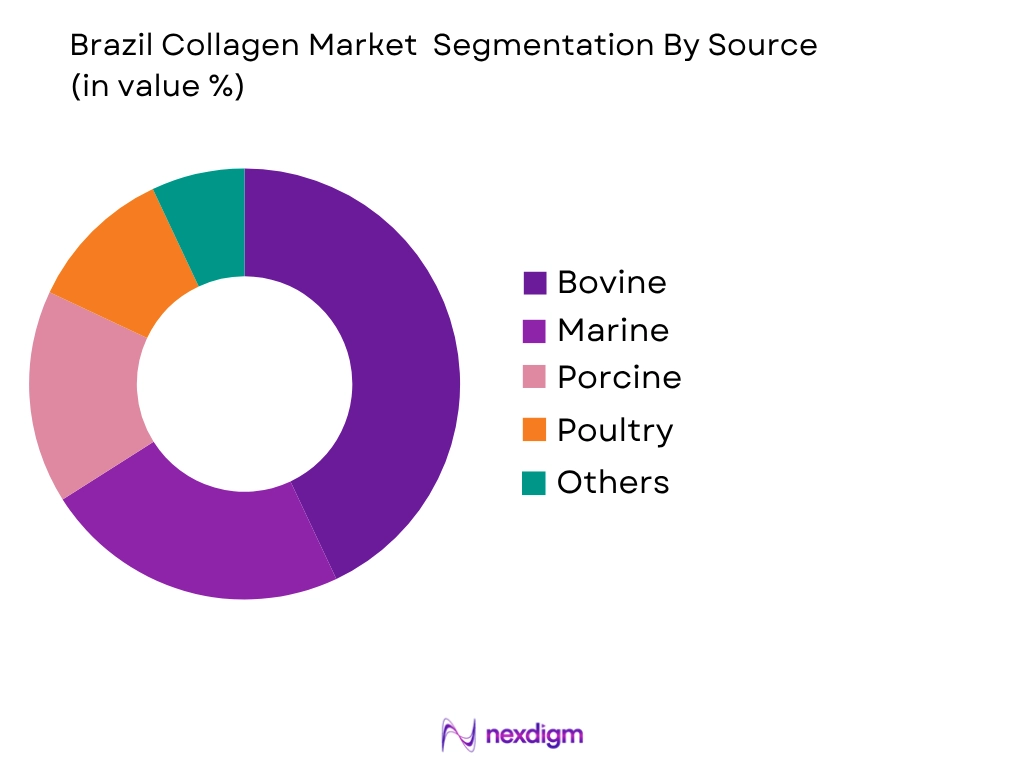
Brazil collagen market is segmented by source into bovine, porcine, marine, poultry and other sources. Recently, bovine collagen has a dominant market share in Brazil under source segmentation because the country has one of the world’s largest cattle and beef-processing bases, giving collagen producers access to hides, bones, cartilage and connective tissue streams. USDA’s Brazil livestock reporting estimated the beginning cattle herd at 192.57 million head, while the following period forecast was 186.87 million head, showing the scale of cattle-linked feedstock available to animal by-product processors. Bovine collagen is widely used in gelatin, hydrolyzed collagen peptides, beauty supplements, joint-health products, gummies, capsules and food fortification. It is also cost-effective compared with marine collagen and more scalable for mass-market powder and sachet formats sold through pharmacies, supermarkets and e-commerce platforms.
Competitive Landscape
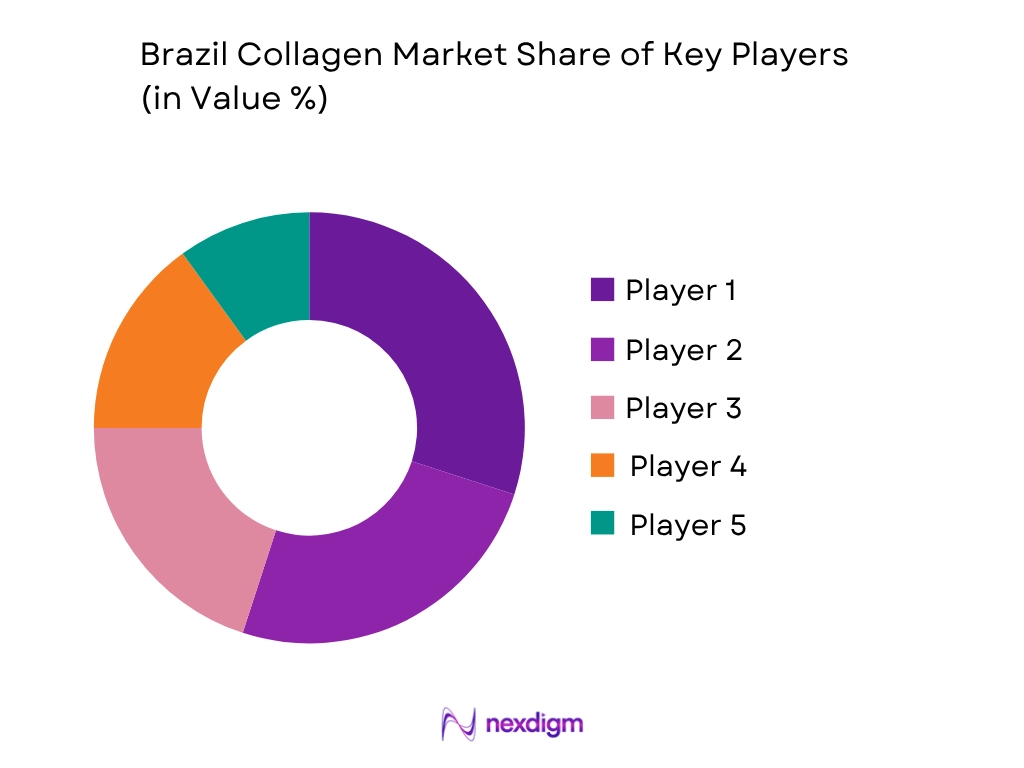
The Brazil collagen market is influenced by a mix of domestic gelatin producers, global collagen ingredient suppliers and local consumer wellness brands. Ingredient-level competition is led by companies with gelatin, hydrolyzed collagen peptide and animal by-product processing capabilities, while branded supplement competition is driven by pharmacy reach, sachet formats, nutricosmetic claims and e-commerce visibility. Darling Ingredients’ acquisition of Gelnex strengthened the industrial collagen supply base by adding six facilities and 46,000 metric tons of annual gelatin and collagen product capacity.
| Company | Establishment Year | Headquarters | Collagen Portfolio | Main Source Focus | Application Coverage | Brazil Presence | Distribution Model | Strategic Strength |
| Gelnex / Darling Ingredients | 1998 | Itá, Santa Catarina, Brazil | ~ | ~ | ~ | ~ | ~ | ~ |
| Rousselot / Darling Ingredients | 1891 | Son, Netherlands / Irving, Texas | ~ | ~ | ~ | ~ | ~ | ~ |
| GELITA AG | 1875 | Eberbach, Germany | ~ | ~ | ~ | ~ | ~ | ~ |
| PB Leiner / Tessenderlo Group | 1870s | Vilvoorde, Belgium | ~ | ~ | ~ | ~ | ~ | ~ |
| Nitta Gelatin | 1918 | Osaka, Japan | ~ | ~ | ~ | ~ | ~ | ~ |
Brazil Collagen Market Analysis
Growth Drivers
Strong Bovine Feedstock Base Supporting Gelatin and Collagen Peptide Production
Brazil collagen market is supported by a large bovine raw material base, which directly benefits gelatin, bovine collagen peptides, capsule shells, gummies and functional food applications. USDA FAS reports Brazil’s beginning cattle herd at 192.57 million head in 2024, while the calf crop is estimated at 47.5 million head for 2024. IBGE reports 39.27 million cattle head slaughtered under sanitary inspection in 2024, creating large volumes of hides, bones and connective tissues for collagen extraction. This feedstock advantage is supported by Brazil’s macroeconomic base, with World Bank reporting GDP at USD 2.19 trillion in 2024.
Large Consumer Economy Supporting Beauty, Joint Health and Supplement Demand
Brazil collagen market benefits from a large consumer base for beauty-from-within, joint mobility, sports recovery and healthy-aging products. IBGE reports Brazil’s population at 212.6 million residents in 2024, with 15 municipalities above 1 million residents, creating concentrated pharmacy, supermarket, beauty retail and e-commerce demand clusters. São Paulo alone has 11,895,578 residents, while Rio de Janeiro has 6,729,894 residents, supporting urban premium wellness consumption. World Bank reports Brazil’s GDP per capita at USD 10,310.5 in 2024, strengthening the consumer base for collagen powders, sachets, capsules and nutricosmetic formats.
Market Challenges
Cattle Cycle Volatility Affecting Bovine Collagen Feedstock Planning
Brazil collagen market faces feedstock planning challenges because bovine collagen depends on cattle-cycle stability, slaughter flows and animal by-product availability. USDA FAS reports Brazil’s beginning cattle herd at 192.57 million head in 2024 and forecasts 186.87 million head for 2025, indicating tighter livestock inventory conditions for processors. IBGE reports cattle slaughter at 39.27 million head in 2024 and 42.94 million head in 2025, showing high processing activity that can alter hide, bone and cartilage availability across cycles. With Brazil’s GDP at USD 2.19 trillion, collagen processors must balance domestic supplement demand, gelatin exports and raw material procurement.
ANVISA Notification and Documentation Burden for Supplement Brands
Brazil collagen market faces a regulatory challenge because collagen supplements must comply with ANVISA’s updated food supplement framework. ANVISA states that RDC 843/2024 and IN 281/2024 changed food supplement regularization procedures from 1 September 2024, and all food supplements became subject to notification with ANVISA under the transition framework. ANVISA also states that products meeting RDC 843/2024 notification requirements may be regularized automatically but can still be evaluated by the agency at any time. In a USD 2.19 trillion economy, this creates higher compliance needs for collagen powder, capsule, sachet and gummy brands.
Market Opportunities
Functional Food and Beverage Expansion Through Gelatin and Collagen Ingredients
Brazil collagen market has an opportunity in functional foods, beverages, gummies, dairy desserts, confectionery and fortified snacks because collagen and gelatin support texture, protein positioning and convenience-based nutrition formats. World Bank identifies Brazil’s final consumption expenditure data series through 2024 and reports the indicator from official national accounts sources. IBGE reports 6.46 billion chicken head, 57.86 million hogs and pigs, 25.38 billion liters of raw milk acquired and 4.67 billion dozen hen eggs produced in 2024, confirming a large food-processing ecosystem where gelatin and collagen can be used as functional ingredients.
Urban Pharmacy and E-Commerce Penetration for Nutricosmetic Collagen Products
Brazil collagen market has an opportunity in pharmacy-led and e-commerce-led nutricosmetic formats because demand is concentrated in large cities with high retail density and digital access. IBGE reports 42.7 million residents living in Brazil’s 15 municipalities with more than 1 million residents, creating concentrated demand for collagen sachets, powders, capsules, gummies and beauty supplement bundles. São Paulo has 11,895,578 residents, Rio de Janeiro has 6,729,894 residents, and Brasília has 2,982,818 residents, supporting large urban wellness channels. World Bank reports GDP per capita at USD 10,310.5 in 2024, supporting premium beauty and health-positioned collagen products.
Future Outlook
Brazil collagen market is expected to expand steadily, supported by beauty-from-within products, pharmacy-led supplement distribution, functional food fortification, pharmaceutical gelatin usage and bovine raw material availability. The market is forecast to reach USD 370.5 million by the published forecast endpoint, with Brazil expected to remain the leading collagen market in Latin America. Over the long-term outlook period, growth will be driven by hydrolyzed collagen peptides, sachet-based powder formats, marine collagen beauty products, Type II joint-health products, gelatin-based gummies and pharmaceutical capsule demand. Since publicly available Brazil-specific 2035 forecasts are limited, the longer-term outlook can be benchmarked against global collagen market expectations of 11.2% CAGR through 2035, while the Brazil-specific published CAGR is 11.7% in the available country forecast.
Brazil’s future opportunity is also linked to its cattle-processing base. Collagen producers can benefit from animal by-product valorization, traceable bovine inputs, gelatin exports and localized production of supplement-grade collagen peptides. Demand will remain concentrated in São Paulo, Rio de Janeiro, Minas Gerais and Southern states because these regions combine large urban populations, pharmacy chains, supplement manufacturers, cosmetic brands, food-processing units and healthcare infrastructure. The market will also see higher competition from imported hydrolyzed collagen peptides, marine collagen products and premium multi-collagen formulations. Brands that can combine ANVISA-compliant claims, clinical substantiation, neutral taste, clean-label positioning, heavy metal testing and convenient sachet packaging are likely to gain stronger visibility among beauty, active aging and joint-health consumers.
Major Players
- Gelnex / Darling Ingredients
- Rousselot / Darling Ingredients
- GELITA do Brasil
- PB Leiner / Tessenderlo Group
- Nitta Gelatin
- JBS
- BRF Ingredients
- Minerva Foods
- Marfrig
- Sanavita
- Equaliv
- Puravida / Nestlé Health Science
- Essential Nutrition
- Vitafor
- Nutrify
Key Target Audience
- Collagen ingredient manufacturers
- Gelatin manufacturers
- Dietary supplement and nutraceutical brands
- Functional food and beverage manufacturers
- Pharmaceutical capsule and excipient manufacturers
- Cosmetic and nutricosmetic brands
- Investments and venture capitalist firms
- Government and regulatory bodies Agência Nacional de Vigilância Sanitária, Ministério da Agricultura e Pecuária, Instituto Brasileiro de Geografia e Estatística, Secretaria de Comércio Exterior
Research Methodology
Step 1: Identification of Key Variables
The initial phase involves constructing an ecosystem map of Brazil collagen market, covering cattle processors, gelatin manufacturers, collagen peptide suppliers, supplement brands, pharmacies, food manufacturers, cosmetic companies, importers and regulators. The objective is to identify source, product type, application, grade, channel, pricing, form factor and regulatory variables influencing market demand.
Step 2: Market Analysis and Construction
In this phase, historical and current data is compiled across collagen revenue, gelatin demand, hydrolyzed collagen consumption, animal by-product availability, supplement distribution and import-linked ingredient flows. The analysis includes product-level segmentation, pharmacy and marketplace presence, food-processing demand and application-level use in beauty, health, pharma and functional foods.
Step 3: Hypothesis Validation and Expert Consultation
Market hypotheses are validated through computer-assisted interviews with collagen ingredient suppliers, supplement manufacturers, contract manufacturers, distributors, pharmacy channel specialists, food technologists and cosmetic product developers. These consultations help validate assumptions around bovine dominance, gelatin usage, imported peptide reliance, sachet demand and channel-specific growth.
Step 4: Research Synthesis and Final Output
The final phase includes synthesis of top-down macroeconomic and industry indicators with bottom-up company, SKU and channel-level checks. This approach validates Brazil collagen market size, segmentation, competition, demand outlook and risks, producing a structured market view for investors, manufacturers, distributors and consumer-health companies.

- Executive Summary
- Research Methodology (Market Definitions and Assumptions, Abbreviations, Market Sizing Approach, Top-Down Validation, Bottom-Up Validation, Import-Export Review, Primary Interviews, Distributor Checks, SKU Benchmarking, Regulatory Review, Forecast Model, Research Limitations)

- Definition and Scope
- Market Genesis and Evolution
- Timeline of Major Players
- Business Cycle and Consumption Seasonality
- Brazil Collagen Supply Chain and Value Chain Analysis

- Growth Drivers (Bovine Raw Material Base, Aging Population, Beauty Supplement Adoption, Functional Food Demand, Pharmacy Retail Expansion, E-Commerce Penetration, Sports Nutrition Growth)
- Market Challenges(Regulatory Claims Scrutiny, Imported Peptide Dependency, Raw Material Traceability, Marine Allergen Concerns, Price Pressure, Informal Marketplace Sales)
- Market Opportunities (Premium Marine Collagen, ANVISA-Approved Claims, Collagen Beverages, Clinical Joint Formulas, Pet Collagen, Medical Biomaterials, Export-Oriented Gelatin)
- Market Trends (Multi-Collagen Blends, Sachet Packaging, Clean Label, Halal and Kosher Certification, Beauty Gummies, Influencer-Led Brands, Third-Party Testing)
- SWOT Analysis
- Porter’s Five Forces
- PESTLE Analysis

- By Value (2020-2025)
- By Volume (2020-2025)
- By Average Selling Price (2020-2025)

- By Product Type (In Value %)
Gelatin
Hydrolyzed Collagen Peptides
Native Collagen
Undenatured Type II Collagen - By Application (In Value %)
Dietary Supplements
Food and Beverage
Cosmetics and Nutricosmetics
Pharmaceuticals
Biomedical Devices - By Distribution Channel (In Value %)
B2B Ingredient Supply
Contract Manufacturing and Private Label
Pharmacies and Drugstores
Supermarkets and Hypermarkets
Specialty Health Stores - By Region (In Value %)
Southeast
South
Midwest
Northeast
North

- Market Share of Major Players on the Basis of Value and Volume
- Cross Comparison Parameters (Collagen Source Portfolio, Product Format Portfolio, Application Coverage, ANVISA Regulatory Readiness, Brazil Manufacturing Footprint, Distribution Channel Reach, Certification and Traceability, Innovation and Clinical Claims Support)
- SWOT Analysis of Major Players
- Pricing Analysis Basis SKUs for Major Players
- Detailed Profiles of Major Companies
Gelnex / Darling Ingredients
Rousselot / Darling Ingredients
GELITA do Brasil
PB Leiner
Nitta Gelatin
JBS
BRF Ingredients
Minerva Foods
Marfrig
Sanavita
Equaliv
Puravida / Nestlé Health Science
Essential Nutrition
Vitafor
Nutrify

- Dietary Supplement Brand Demand
- Food and Beverage Manufacturer Demand
- Pharmaceutical Manufacturer Demand
- Cosmetic and Nutricosmetic Brand Demand
- Medical Device Buyer Demand

- By Value (2026-2035)
- By Volume (2026-2035)
- By Average Selling Price (2026-2035)


 Request a Sample
 Ask for Customization
 Get a Quote
 Enquire Now