
 Download PDF
Market Overview
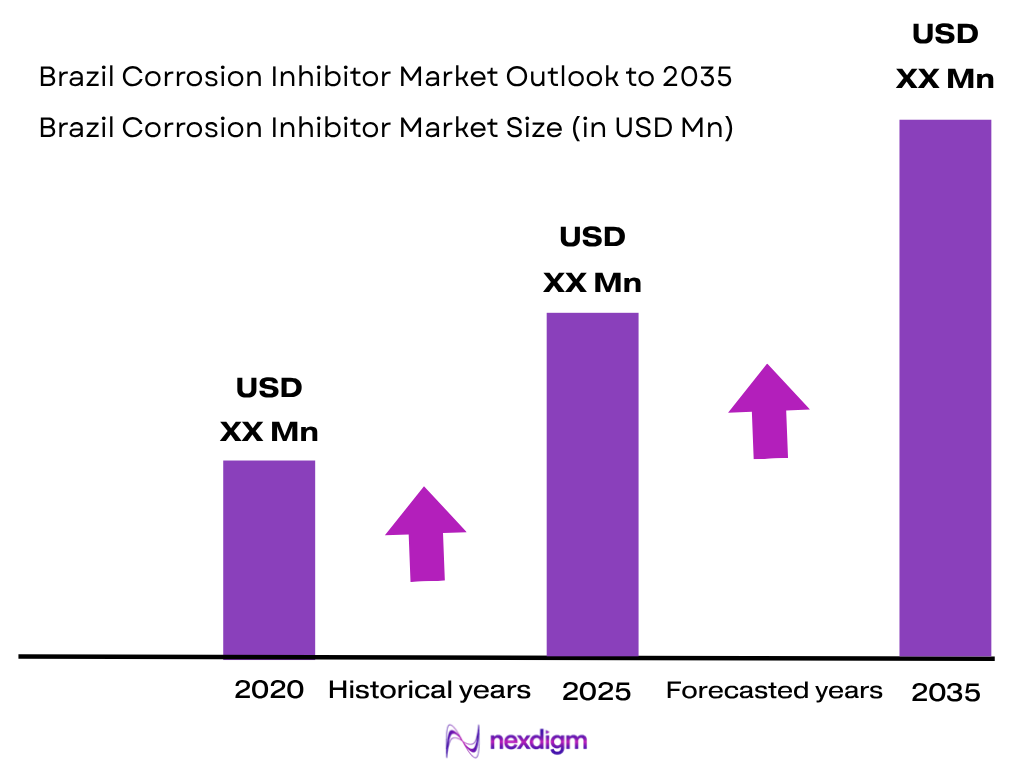
The Brazil Corrosion Inhibitor Market is valued at approximately USD ~X.X million, based on historical top-down and bottom-up assessment. Demand is anchored in offshore oil and gas, refining, industrial water treatment, pulp and paper, mining and power-intensive manufacturing. Petrobras produced 2.70 million boed in the latest full period versus 2.782 million boed previously, while industrial electricity consumption increased from 188,653 GWh to 197,871 GWh, sustaining corrosion-control requirements across pipelines, cooling systems, boilers and process equipment.
Rio de Janeiro, São Paulo, Espírito Santo and Minas Gerais are the dominant demand centers in the Brazil Corrosion Inhibitor Market because they concentrate offshore production, refineries, petrochemical complexes, steel plants, mining operations, pulp facilities and industrial utilities. Petrobras’ pre-salt production reached 2.2 million boed, while operated pre-salt output reached 3.2 million boed; Brazil’s metallic-mineral and graphite production was valued at BRL 220.5 billion, reinforcing corrosion-intensive demand across offshore, mining and process-industry assets.
Market Segmentation
By Product Chemistry
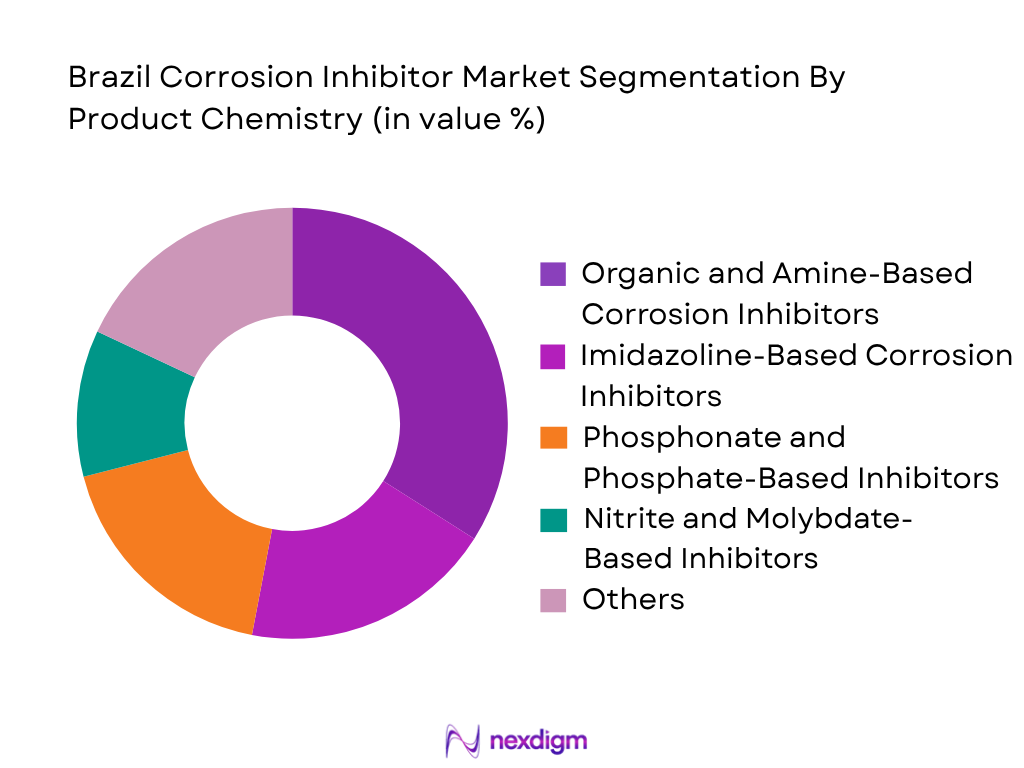
The Brazil Corrosion Inhibitor Market is segmented into organic and amine-based inhibitors, imidazoline-based inhibitors, phosphonate and phosphate inhibitors, nitrite and molybdate inhibitors, azole-based inhibitors, and other inorganic and multifunctional formulations. Organic and amine-based corrosion inhibitors hold the dominant position because Brazil’s largest corrosion-intensive applications occur in oil and gas production, refining, boilers, condensate systems and industrial cooling loops. Film-forming amines and related organic chemistries are particularly suited to protecting carbon steel in hydrocarbon-processing and steam systems, while imidazoline derivatives are widely aligned with CO₂- and H₂S-related oilfield corrosion control. Petrobras alone produced 2.70 million boed of oil and gas, with pre-salt own production reaching 2.2 million boed, creating extensive subsea, FPSO and pipeline surfaces requiring continuous chemical protection. Industrial electricity consumption of 197,871 GWh further indicates the scale of utility systems using cooling-water and boiler-treatment chemistry.
By End-Use Industry
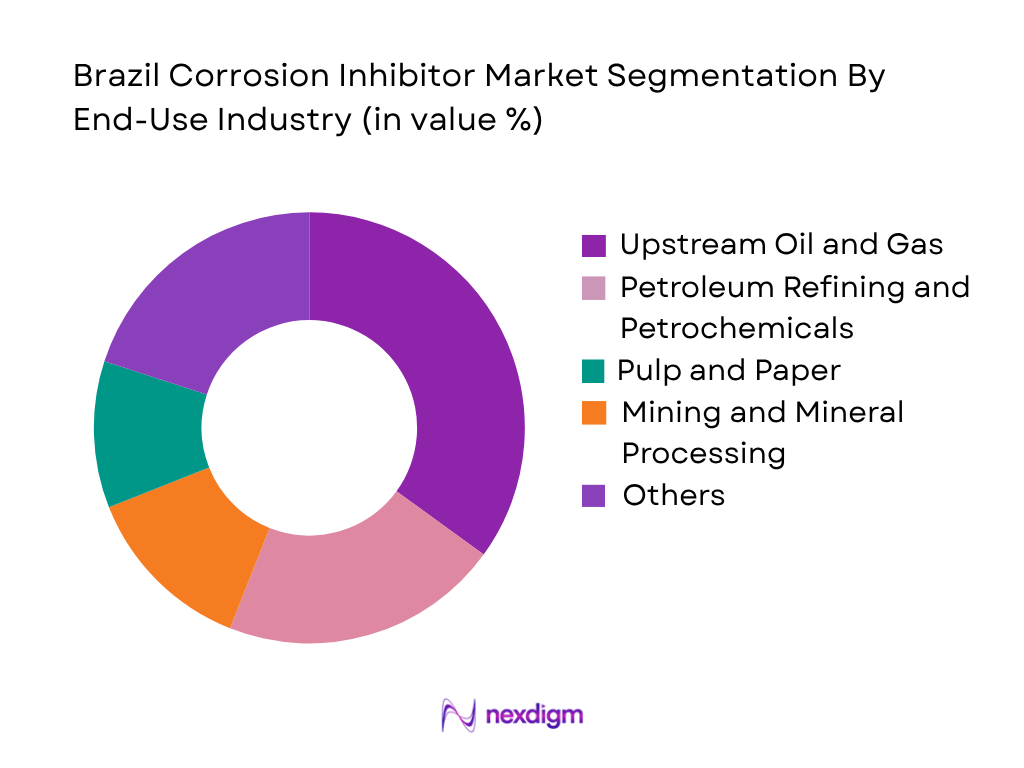
The Brazil Corrosion Inhibitor Market is segmented into upstream oil and gas, petroleum refining and petrochemicals, pulp and paper, mining and mineral processing, power and utilities, and other industrial applications. Upstream oil and gas dominates the market because Brazil operates one of the world’s most technically demanding deepwater production systems, particularly across the Santos and Campos basins. Pre-salt reservoirs extend across approximately 150,000 km², and production infrastructure can operate at total depths reaching 7,000 metres, increasing exposure to high pressure, saline fluids, CO₂, produced water and complex chemical-injection requirements. Petrobras’ total oil and gas production reached 2.70 million boed, while operated pre-salt production reached 3.2 million boed. Refining also remains significant, with petroleum-product output reaching 1.78 million barrels/day, supporting inhibitor consumption in refinery overheads, cooling towers, transfer systems and heat exchangers.
Competitive Landscape
The Brazil Corrosion Inhibitor Market combines major global oilfield-chemical companies, industrial water-treatment specialists and locally embedded chemical-service providers. Competition is particularly intense in offshore production chemistry, refinery process treatment, cooling-water treatment and pulp-industry applications. Global suppliers differentiate through deepwater qualification, CO₂/H₂S corrosion expertise, digital monitoring and application laboratories, while local formulation, field service, inventory availability and technical response are important for customers operating remote offshore, mining, pulp and industrial sites.
| Company | Establishment Year | Headquarters | Offshore/Oilfield Capability | Cooling & Boiler Capability | Refinery/Petrochemical Exposure | Pulp/Mining Exposure | Digital Monitoring | Brazil/Regional Technical Footprint |
| Nalco Water / Ecolab | 1923 | St. Paul, USA | ~ | ~ | ~ | ~ | ~ | ~ |
| Kurita | 1949 | Tokyo, Japan | ~ | ~ | ~ | ~ | ~ | ~ |
| Solenis | 2014 | Wilmington, USA | ~ | ~ | ~ | ~ | ~ | ~ |
| Baker Hughes | 1907 heritage | Houston, USA | ~ | ~ | ~ | ~ | ~ | ~ |
| SLB / ChampionX | 1926 heritage | Houston, USA | ~ | ~ | ~ | ~ | ~ | ~ |
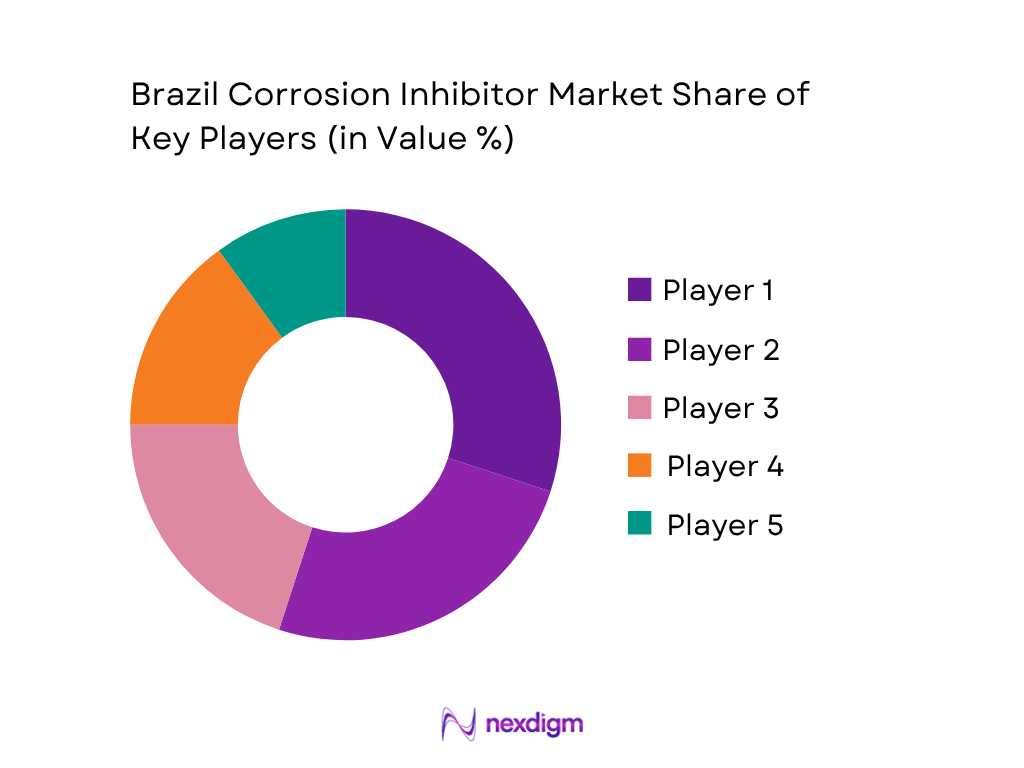
Brazil Corrosion Inhibitor Market Analysis
Growth Drivers
Expansion of Offshore Oil, Pre-Salt Production and Refinery Operations
Brazil’s corrosion inhibitor demand is strongly driven by its offshore hydrocarbon infrastructure, where carbon steel flowlines, FPSO processing systems, produced-water networks, injection lines and refinery units operate under saline, high-pressure and CO₂/H₂S-exposed conditions. Petrobras produced 2.7 million barrels of oil equivalent per day in 2024, including 2.2 million barrels of oil per day, while its own pre-salt production reached 2.2 million boe/d and operated pre-salt production reached 3.2 million boe/d. Two production systems, FPSO Maria Quitéria and FPSO Marechal Duque de Caxias, also entered operation during 2024, enlarging the offshore equipment base requiring continuous chemical injection and corrosion monitoring. Refinery petroleum-product output reached 1.78 million barrels/day, including 420,000 barrels/day of gasoline and 452,000 barrels/day of S-10 diesel, sustaining inhibitor consumption in overhead systems, heat exchangers, condensers and utility water circuits. In June 2026, national oil and gas output reached 5.842 million boe/d, including 4.475 million barrels/day of crude oil. Brazil’s 2024 GDP was USD 2.186 trillion, according to the World Bank, providing the macroeconomic scale supporting continued hydrocarbon investment.
Large Industrial Water, Mining and Process-Manufacturing Base
Brazil’s broad process-industry base creates recurring demand for corrosion inhibitors across cooling towers, boilers, condensate systems, heat exchangers, process-water circuits and closed-loop utilities. Industrial electricity consumption reached 197,871 GWh in 2024, compared with 188,653 GWh in 2023, demonstrating the operating scale of electricity-intensive manufacturing and processing assets. Total national electricity consumption reached 561,566 GWh in 2024, while thermal power generation amounted to 151.2 TWh, reinforcing the installed base of steam, cooling and heat-transfer equipment requiring chemical protection. Mining is another important demand center: production of metallic minerals and graphite generated BRL 220.5 billion in 2024, creating extensive exposure across concentrators, slurry systems, water-reuse facilities, pumps and mineral-processing utilities. Brazil’s pulp sector further increases treatment intensity, with national pulp production reaching 29.4 million tonnes in 2025, while paper production stood at 11.3 million tonnes. These industries operate substantial water and steam infrastructure where corrosion control is integrated with scale and microbiological management. At the macroeconomic level, World Bank data show Brazil’s 2024 GDP at USD 2.186 trillion and GDP per capita at USD 10,310.5, supporting large-scale industrial maintenance and asset-reliability expenditure.
Market Challenges
Severe Offshore Operating Conditions and Complex Chemical Qualification
Brazil’s corrosion inhibitor suppliers face technically demanding operating environments because offshore and pre-salt assets must manage high salinity, dissolved gases, pressure, temperature, produced water and long subsea transport distances simultaneously. Petrobras’ pre-salt systems handled 2.2 million boe/d of own production and 3.2 million boe/d of operated production in 2024, illustrating the scale of assets where inhibitor failure can affect flowlines, risers, separators and water-injection systems. National production complexity increased further in June 2026, when Brazil produced 5.842 million boe/d of oil and gas, including 217.35 million cubic metres/day of natural gas; pre-salt production alone reached 4.788 million boe/d. Chemical formulations therefore require compatibility with production fluids, injection equipment and downstream separation while maintaining stable protective films on metal surfaces. Refining adds another demanding environment, with Petrobras processing sufficient crude to produce 1.78 million barrels/day of petroleum products in 2024. Qualification requirements can consequently be lengthy because suppliers must demonstrate corrosion protection without compromising emulsion breaking, water treatment or product quality. Brazil’s USD 2.186 trillion GDP in 2024 highlights the economic importance of maintaining reliability across these capital-intensive energy assets.
Wide Geographic Dispersion and Variable Industrial Water Conditions
Brazil’s large geography creates a structural challenge for corrosion-inhibitor suppliers because demand is distributed across offshore basins, refinery corridors, Minas Gerais mining operations, São Paulo industrial clusters, pulp-producing regions and sugar-and-ethanol facilities. Industrial electricity consumption reached 197,871 GWh in 2024, confirming the scale of distributed industrial operations requiring reliable water-treatment support. Mining alone generated BRL 220.5 billion from metallic minerals and graphite, while the 2024/25 sugarcane crop totaled 676.96 million tonnes, with the Southeast producing 439.6 million tonnes and the Center-West producing 145.3 million tonnes. Ethanol production from the same crop reached 37.2 billion litres, creating extensive boiler, cooling-water and process-water treatment requirements across mills located far from major chemical-production centers. These sites can differ materially in makeup-water hardness, chloride concentration, temperature, metallurgy and recycling intensity, making standardized inhibitor programs difficult. Suppliers therefore need regional inventories, dosing equipment, laboratory support and on-site technical teams to manage varying conditions. Brazil’s World Bank-reported GDP of USD 2.186 trillion in 2024 reflects a large industrial economy, but its geographic dispersion raises logistical complexity for specialized corrosion-control chemicals and field services.
Market Opportunities
Advanced Corrosion Chemistry for Expanding Pre-Salt and Offshore Production Systems
Brazil’s expanding offshore production platform creates a significant opportunity for high-performance corrosion inhibitors designed for subsea flowlines, FPSOs, produced-water systems, gas-processing equipment and chemical-injection networks. Petrobras’ pre-salt operations already produced 2.2 million boe/d on an own-production basis and 3.2 million boe/d on an operated basis in 2024, while the company brought 2 additional FPSOs into operation during the same period. National offshore activity continued expanding, with Brazil producing 5.842 million boe/d of oil and gas in June 2026 and pre-salt fields accounting for 4.788 million boe/d. Crude oil production alone reached 4.475 million barrels/day, increasing the volume of fluids moving through corrosion-sensitive wells, risers, separators and pipelines. These current operating levels support future demand for imidazoline-based inhibitors, film-forming organic chemistries, sour-service formulations, continuous injection systems and digital residual monitoring. The opportunity is particularly strong for suppliers that can demonstrate compatibility with high-pressure deepwater systems and integrate chemistry with asset-integrity services. Brazil’s 2024 GDP of USD 2.186 trillion and GDP per capita of USD 10,310.5 provide the macroeconomic foundation for continued development of complex energy infrastructure and supporting specialty-chemical capabilities.
Specialized Industrial Water Treatment for Pulp, Mining and Bioenergy Facilities
Brazil’s large pulp, mining and bioenergy industries create an opportunity for corrosion-inhibitor suppliers to expand beyond oil and gas into specialized cooling-water, boiler, condensate and recycled-water treatment. National pulp production reached 29.4 million tonnes in 2025, while paper production totaled 11.3 million tonnes, supporting extensive chemical-recovery boilers, steam networks and cooling systems. Metallic-mineral and graphite production generated BRL 220.5 billion in 2024, indicating a major installed base of mineral-processing equipment exposed to abrasive slurries, process water and corrosive operating conditions. The sugar-and-ethanol sector adds another substantial treatment platform: the 2024/25 sugarcane harvest totaled 676.96 million tonnes, sugar output reached 44.1 million tonnes, and ethanol production reached 37.2 billion litres. These current operating volumes create future opportunities for film-forming amines, phosphorus-reduced cooling-water programs, closed-loop inhibitors, corrosion-scale combination products and automated dosing systems. Industrial electricity consumption of 197,871 GWh in 2024 further demonstrates the breadth of process-intensive activity requiring water-system reliability. Against Brazil’s USD 2.186 trillion GDP, these industries provide sufficient scale for suppliers to develop dedicated application laboratories, regional blending, monitoring services and performance-based treatment programs.
Future Outlook
The Brazil Corrosion Inhibitor Market is projected to expand at approximately ~X.X% CAGR during 2026-2035, supported by pre-salt production, FPSO deployment, refinery modernization, pulp and paper processing, mining activity and industrial water-management requirements. Future demand is expected to shift toward high-performance organic formulations, deepwater-compatible chemistries, phosphorus-reduced cooling-water programs and digitally monitored dosing systems.
Brazil’s offshore operating base will remain central to future demand. Petrobras’ pre-salt own production reached 2.2 million boed, operated pre-salt output reached 3.2 million boed, and the company brought two additional FPSOs into operation during the latest full reporting period. Its Boaventura Energy Complex also started a gas-processing module capable of handling 10.5 million cubic metres/day, expanding corrosion-sensitive gas-treatment infrastructure.
Major Players
- Nalco Water / Ecolab Brazil
- Kurita do Brasil|
- Solenis Brazil
- Veolia Water Technologies Brazil
- Clariant Oil Services
- SLB / ChampionX Production Chemicals
- Baker Hughes
- Italmatch Chemicals / Alcolina
- Buckman
- Dorf Ketal
- FINEAMIN do Brasil
- O3 Brasil Indústria Química
- Águaviva Tecnologia
- Química Zew
- Water Meyer
Key Target Audience
- Corrosion Inhibitor and Specialty Industrial Chemical Manufacturers
- Offshore Oil, Gas and FPSO Operators
- Refinery, Petrochemical and Chemical Process Operators
- Pulp, Paper, Mining and Metals Companies
- Industrial Water-Treatment and Utility Operators
- Investments and Venture Capitalist Firms
- Private Equity Firms and Strategic Industrial Investors
- Government and Regulatory Bodies (Agência Nacional do Petróleo, Gás Natural e Biocombustíveis, Agência Nacional de Águas e Saneamento Básico, Instituto Brasileiro do Meio Ambiente e dos Recursos Naturais Renováveis, Agência Nacional de Mineração, Empresa de Pesquisa Energética, Ministério de Minas e Energia)
Research Methodology
Step 1: Identification of Key Variables
The first stage establishes a complete Brazil Corrosion Inhibitor Market ecosystem covering oilfield chemical suppliers, water-treatment companies, domestic blenders, distributors, refineries, FPSOs, pulp mills, mines and industrial utilities. Critical variables include production throughput, installed cooling and boiler equipment, water volumes, corrosion severity, dosage rates, inhibitor chemistry, import dependence, domestic formulation and regional industrial concentration.
Step 2: Market Analysis and Construction
Historical demand is assessed through both top-down and bottom-up approaches. Top-down analysis maps corrosion-inhibitor intensity across offshore production, refining, pulp and paper, mining, power and manufacturing. Bottom-up analysis evaluates supplier revenues, chemical volumes, treatment frequency, production assets, injection rates, industrial water throughput and application-level consumption to develop market value and volume estimates.
Step 3: Hypothesis Validation and Expert Consultation
Initial market hypotheses are validated through structured discussions with corrosion engineers, production-chemical specialists, refinery personnel, industrial water-treatment professionals, chemical distributors, utility engineers and procurement teams. These interactions are used to verify treatment practices, inhibitor selection, qualification requirements, offshore compatibility, dosage patterns, local sourcing, service expectations and competitive positioning across major end-use industries.
Step 4: Research Synthesis and Final Output
Primary insights are triangulated with data from ANP, EPE, ANM, Petrobras, regulatory agencies, company disclosures and international macroeconomic databases. Top-down industry demand is reconciled with bottom-up supplier and application calculations. The resulting framework determines market size, segmentation, competitive structure, regional concentration, chemistry trends, end-use demand and future opportunity areas within the Brazil Corrosion Inhibitor Market.

- Executive Summary
- Research Methodology (Market Definition and Scope, Brazil Corrosion Inhibitor Market Classification, Offshore Oil and Gas Corrosion Inhibitor Demand Assessment, Refinery and Petrochemical Corrosion Inhibitor Consumption Mapping, Industrial Cooling Water Treatment Demand Assessment, Boiler and Condensate Corrosion Control Assessment, Pulp and Paper Chemical Demand Assessment, Mining and Mineral Processing Water Treatment Assessment, Domestic Corrosion Inhibitor Formulation and Blending Capacity Assessment, Import Dependency Analysis, Amine Imidazoline Phosphonate Phosphate Azole Nitrite Molybdate Silicate and Carboxylate Chemistry Assessment)

- Definition and Scope
- Brazil Corrosion Inhibitor Industry Evolution and Development of Offshore Production Chemicals, Refinery Process Corrosion Control, Industrial Cooling Water Treatment, Boiler Water Treatment, Pulp and Paper Process Protection and Engineered Asset-Integrity Ecosystem
- Organic Corrosion Inhibitor, Inorganic Corrosion Inhibitor, Imidazoline-Based Corrosion Inhibitor, Film-Forming Amine, Neutralizing Amine, Phosphonate, Phosphate, Nitrite, Molybdate, Azole, Silicate and Vapor-Phase Corrosion Inhibitor Industry Structure
- Brazil Corrosion Inhibitor Value Chain Analysis
- Brazil Corrosion Inhibitor Supply Chain Analysis
- Specialty Chemical Feedstock Supplier, Active Ingredient Manufacturer, Local Chemical Formulator, Oilfield Chemical Supplier, Industrial Water Treatment Company, Toll Blender, Chemical Distributor, Injection Equipment Provider, Corrosion Monitoring Provider, EPC

- Growth Drivers (Large Pre-Salt Oil and Gas Production Base, Increasing FPSO and Subsea Equipment Installed Base, Offshore Pipeline Asset-Integrity Requirements, Refinery Process Corrosion Management, High Industrial Cooling Water Consumption, Expansion of Pulp Production Capacity, Mining and Mineral Processing Water Treatment Demand, Sugar and Ethanol Utility Treatment Requirements)
- Market Challenges (High H2S CO2 and Chloride Exposure in Offshore Operations, Deepwater Chemical Delivery Complexity, Long Qualification Cycles for Production Chemicals, Variable Produced-Water Chemistry, Dependence on Specialty Active Ingredients, High-Salinity Cooling Water Conditions, Mixed-Metallurgy Industrial Systems)
- Market Opportunities (Pre-Salt Subsea Corrosion Inhibition, FPSO Production Chemical Programs, Umbilical-Compatible Deepwater Chemistry, Refinery Overhead Corrosion Control, Offshore Pipeline Asset Integrity, Pulp Mill Cooling and Boiler Treatment, Mining Slurry and Process Water Corrosion Control, Sugar and Ethanol Phosphorus-Free Cooling Treatment, Film-Forming Amine Boiler Programs)
- Market Trends (Deepwater Production Chemistry, Imidazoline-Based Oilfield Inhibitors, Umbilical-Compatible Formulations, Film-Forming Amine Adoption, Phosphorus-Free Cooling Treatment, Multifunctional Corrosion-Scale Chemistry, Online Corrosion Monitoring, Automated Chemical Injection)
- Regulatory and Standards Landscape (ANP Oil and Gas Requirements, Petrobras Technical Qualification Requirements, IBAMA Environmental Licensing Requirements, CONAMA Industrial Effluent Requirements, ANA Water Resource Requirements, NR Chemical Handling Requirements, ABNT Technical Standards, API Oilfield Production Chemistry Practices, AMPP Corrosion Control Practices, ISO Corrosion Testing Requirements)
- SWOT Analysis
- Porter’s Five Forces Analysis
- PESTLE Analysis
- Stakeholder Ecosystem
- Competition Ecosystem

- By Market Value (2020-2025)
- By Corrosion Inhibitor Consumption Volume (2020-2025)
- By Oilfield and Production Corrosion Inhibitor Consumption Volume (2020-2025)
- By Cooling Water Corrosion Inhibitor Consumption Volume (2020-2025)
- By Boiler and Condensate Corrosion Inhibitor Consumption Volume (2020-2025)
- By Refinery and Petrochemical Corrosion Inhibitor Consumption Volume (2020-2025)
- By Domestic Corrosion Inhibitor Formulation and Blending Volume (2020-2025)
- By Corrosion Inhibitor Import Value (2020-2025)
- By Average Selling Price (2020-2025)

- By Product Chemistry (In Value %)
Organic Corrosion Inhibitors
Amine-Based Corrosion Inhibitors
Imidazoline-Based Corrosion Inhibitors
Film-Forming Amines and Polyamines
Neutralizing Amines
Phosphonate-Based Corrosion Inhibitors
Phosphate-Based Corrosion Inhibitors
Nitrite-Based Corrosion Inhibitors
Molybdate-Based Corrosion Inhibitors
Azole-Based Copper and Yellow-Metal Inhibitors
Silicate-Based Corrosion Inhibitors
Zinc-Based Corrosion Inhibitors
Carboxylate-Based Corrosion Inhibitors
Volatile and Vapor-Phase Corrosion Inhibitors
Multifunctional Corrosion and Scale Inhibitors - By Corrosion Inhibition Mechanism (In Value %)
Anodic Corrosion Inhibitors
Cathodic Corrosion Inhibitors
Mixed Corrosion Inhibitors
Film-Forming Corrosion Inhibitors
Passivating Corrosion Inhibitors
Neutralizing Corrosion Inhibitors
Adsorption-Based Organic Corrosion Inhibitors
Oxygen-Scavenging Corrosion Control Programs
Volatile Corrosion Inhibitors
Combined Corrosion-Scale-Microbiological Treatment Programs - By Application System (In Value %)
Oil and Gas Production Wells
Subsea Production Systems
Offshore Multiphase Flowlines
Crude Oil and Gas Pipelines
Water Injection Systems
Produced Water Systems
Refinery Process Units
Petrochemical Process Systems
Open Recirculating Cooling Towers
Closed Cooling Water Systems
Industrial Heat Exchangers
Boiler Feedwater Systems
Steam and Condensate Networks
Pulp and Paper Process Systems
Mining Process Water Systems
Hydrostatic Testing and Equipment Preservation - By End-Use Industry (In Value %)
Upstream Oil and Gas
Midstream Pipelines and Terminals
Petroleum Refining
Petrochemicals and Chemicals
Pulp and Paper
Mining and Mineral Processing
Iron and Steel
Power Generation
Sugar and Ethanol
Food and Beverage Processing
Automotive and Auto Components
Industrial Water Treatment
Marine and Offshore Support
Pharmaceutical Manufacturing
General Manufacturing - By Oil and Gas Application Stage (In Value %)
Drilling and Well Construction
Well Completion
Production Operations
Subsea Flow Assurance
Water Injection
Produced Water Handling
Gathering and Multiphase Transportation
Crude Oil Pipelines
Gas Pipelines
FPSO Process Systems
Terminal and Storage Operations
Refinery Feed and Transfer Systems

- Market Share of Major Players (By Brazil Revenue, Oilfield Corrosion Inhibitor Sales Volume, Industrial Water Corrosion Inhibitor Sales Volume, Product Chemistry, Application System, End-Use Industry, Brazil Manufacturing and Blending Footprint, Technical Service Coverage)
- Cross Comparison Parameters (Brazil Corrosion Inhibitor Revenue, Offshore-Oilfield-Refinery-Industrial Water Portfolio Breadth, CO2-H2S-High-Chloride and Deepwater Chemistry Capability, Petrobras-Pre-Salt and Major Industrial Customer Exposure, Brazil Manufacturing Formulation and Chemical Blending Capability, Pulp-Mining-Sugar and Ethanol Industrial Water Treatment Exposure, Digital Chemical Injection Corrosion Monitoring and Automation Capability, Brazil Laboratory Distribution and Field Technical Support Footprint)
- SWOT Analysis of Major Players
- Competitive Positioning Matrix
- Corrosion Inhibitor Product and Chemistry Portfolio Benchmarking
- Pricing and Corrosion Inhibitor Category Benchmarking
- Chemical Formulation, Blending and Injection Technology Assessment
- End-Use Industry and Critical Application Exposure Assessment
- Domestic Formulation Versus Imported Corrosion Inhibitor Supply Positioning
- Detailed Profiles of Major Companies
Nalco Water / Ecolab Brazil
Kurita do Brasil
Solenis Brazil
Veolia Water Technologies Brazil
Clariant Oil Services
SLB / ChampionX Production Chemicals
Baker Hughes
Italmatch Chemicals / Alcolina
Buckman
Dorf Ketal
FINEAMIN do Brasil
O3 Brasil Indústria Química
Águaviva Tecnologia
Química Zew
Water Meyer

- Offshore Oil and Gas Operator Production Chemical Procurement Assessment
- FPSO Operator Corrosion Inhibitor Requirement Analysis
- Pipeline and Terminal Asset-Integrity Chemical Procurement Assessment
- Refinery Corrosion Inhibitor Requirement Analysis
- Petrochemical and Chemical Plant Treatment Requirement Assessment
- Pulp and Paper Mill Corrosion Control Procurement Analysis
- Mining and Mineral Processing Utility Treatment Assessment
- Steel Plant Cooling and Process Water Treatment Assessment
- Power Generation Boiler and Cooling Treatment Procurement Analysis
- Sugar and Ethanol Mill Water Treatment Requirement Assessment

- By Market Value (2026-2035)
- By Corrosion Inhibitor Consumption Volume (2026-2035)
- By Oilfield and Production Corrosion Inhibitor Consumption Volume (2026-2035)
- By Cooling Water Corrosion Inhibitor Consumption Volume (2026-2035)
- By Boiler and Condensate Corrosion Inhibitor Consumption Volume (2026-2035)
- By Refinery and Petrochemical Corrosion Inhibitor Consumption Volume (2026-2035)
- By Domestic Corrosion Inhibitor Formulation and Blending Volume (2026-2035)
- By Corrosion Inhibitor Import Value (2026-2035)
- By Average Selling Price (2026-2035)


 Request a Sample
 Ask for Customization
 Get a Quote
 Enquire Now