

 Download PDF
Market Overview
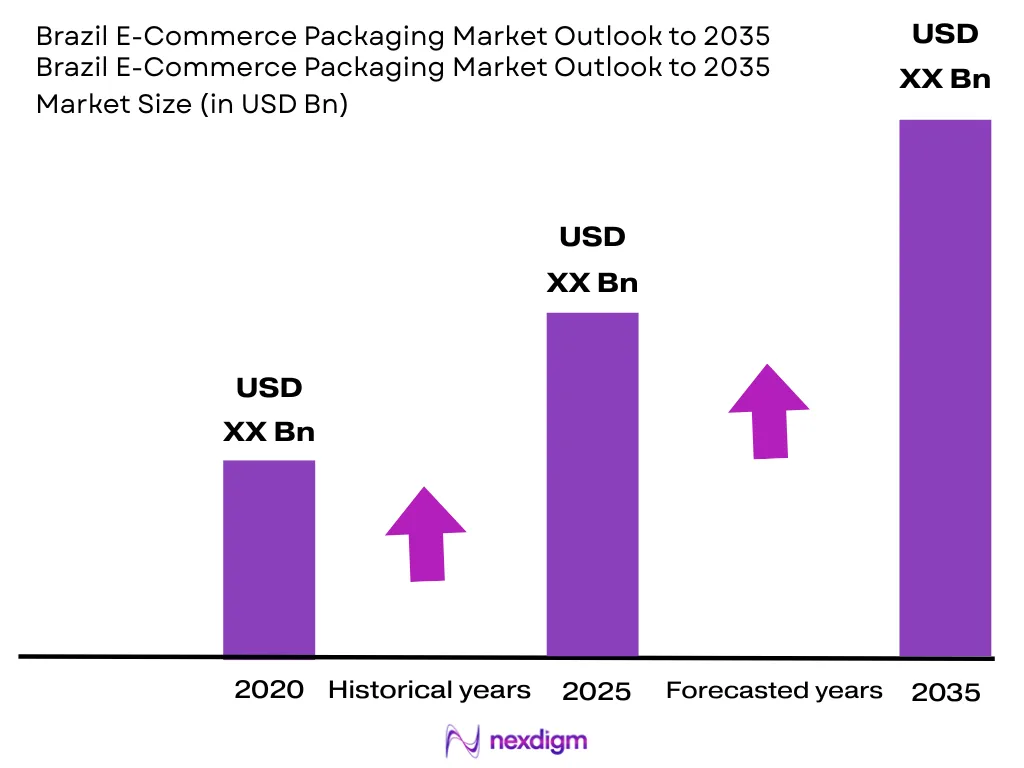
The Brazil E-Commerce Packaging Market was valued at USD ~ Billion in 2024 and is anticipated to expand at a CAGR of ~% during 2026-2035, tracking the growth of Brazil’s underlying e-commerce sector, which reached approximately USD ~ billion in 2024 and is projected to grow to approximately USD ~ billion in 2025 and USD ~ billion by 2029. The market is directly shaped by aggressive logistics investment from Brazil’s leading marketplaces, with MercadoLibre committing approximately USD 5.8 to 6.8 billion toward logistics infrastructure in 2025 alone, half of which is funding warehouse duplication to shorten delivery windows. Brazil’s corrugated boxes segment, the dominant packaging material for e-commerce shipments, was valued at approximately USD ~ billion in 2025 and is projected to reach approximately USD ~ billion by 2031, reflecting a compound annual growth rate of approximately 9.7%, driven substantially by the exponential rise of e-commerce parcel volumes across Mercado Livre, Amazon Brasil, and Shopee.
Market Segmentation
By Material Type
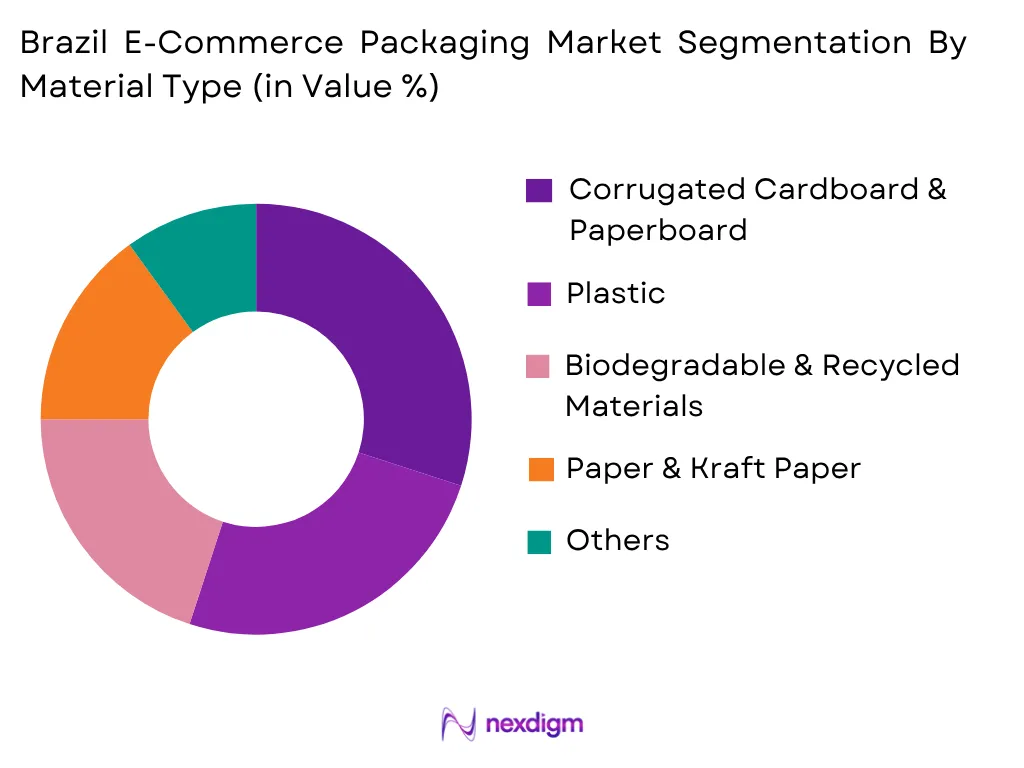
Corrugated Cardboard & Paperboard dominates the Brazil E-Commerce Packaging Market, supported by Brazil’s substantial domestic containerboard production capacity, with the country generating approximately 52.37% of South America’s corrugated packaging revenue in 2025 and producing approximately 6.1 million tons of corrugated material, underpinned by approximately 85% recycled fiber content that secures local supply balance. Klabin’s Piracicaba II recycled containerboard unit, which came online in April 2026, added approximately 300,000 tons of capacity specifically targeting e-commerce and food shippers, reinforcing the material’s continued dominance. Plastic materials, primarily used in poly mailers and bubble wrap protective packaging, retain an important role for lightweight apparel and soft goods shipments where corrugated boxes would add unnecessary weight and cost. Biodegradable and recycled materials represent the fastest-growing material category, exemplified by Mondi Group’s introduction of corrugated boxes made from 100% post-consumer recycled content in Brazil specifically targeting sustainability-focused brands.
By Product Type
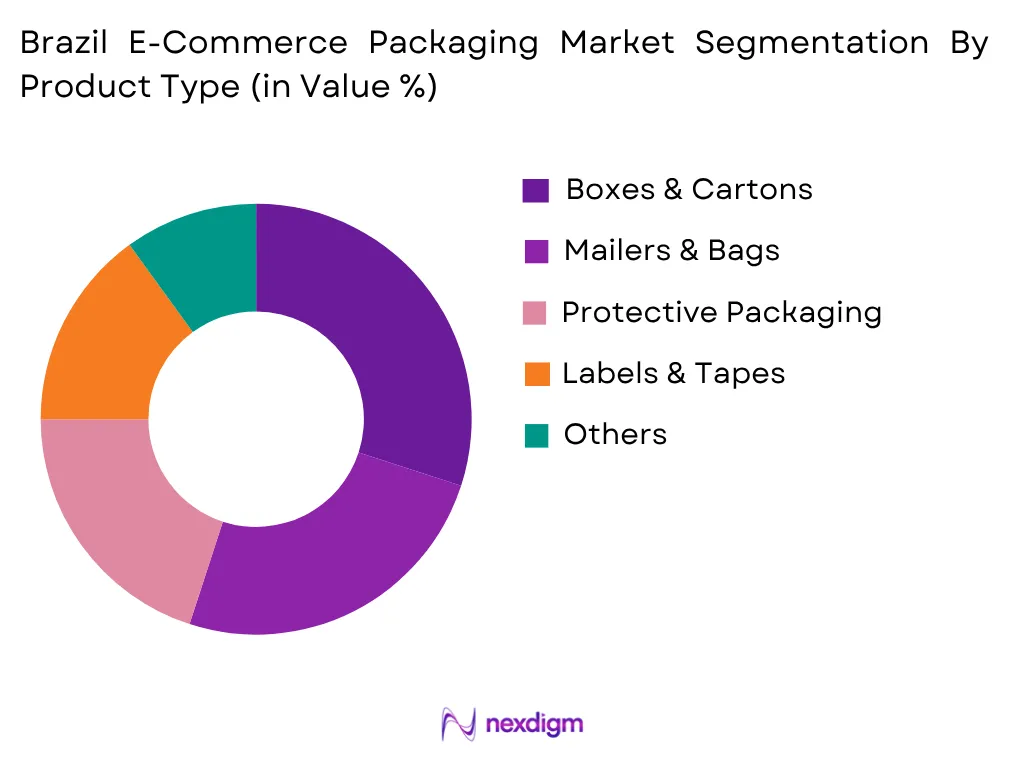
Boxes & Cartons represent the largest product-type segment in the Brazil E-Commerce Packaging Market, directly reflecting the dominance of corrugated packaging across the country’s rapidly expanding parcel volumes. WestRock Brazil’s February 2024 introduction of lightweight corrugated solutions tailored for large e-commerce fulfillment centers operating in Rio de Janeiro and Belo Horizonte illustrates the pace of product innovation directed at this segment, alongside the company’s separate launch of lightweight boxes with increased strength-to-weight ratios specifically engineered for electronics shipping. Mailers & Bags represent a fast-growing segment supporting Brazil’s large apparel and fashion e-commerce category, favored for their reduced material usage and lower shipping weight relative to rigid boxes. Protective Packaging, including bubble wrap and air pillows, continues to expand alongside growth in electronics and fragile goods shipments, while Tape & Labels demand grows in tandem with overall parcel volume across all product categories, particularly during peak shopping seasons such as Black Friday.
Competitive Landscape
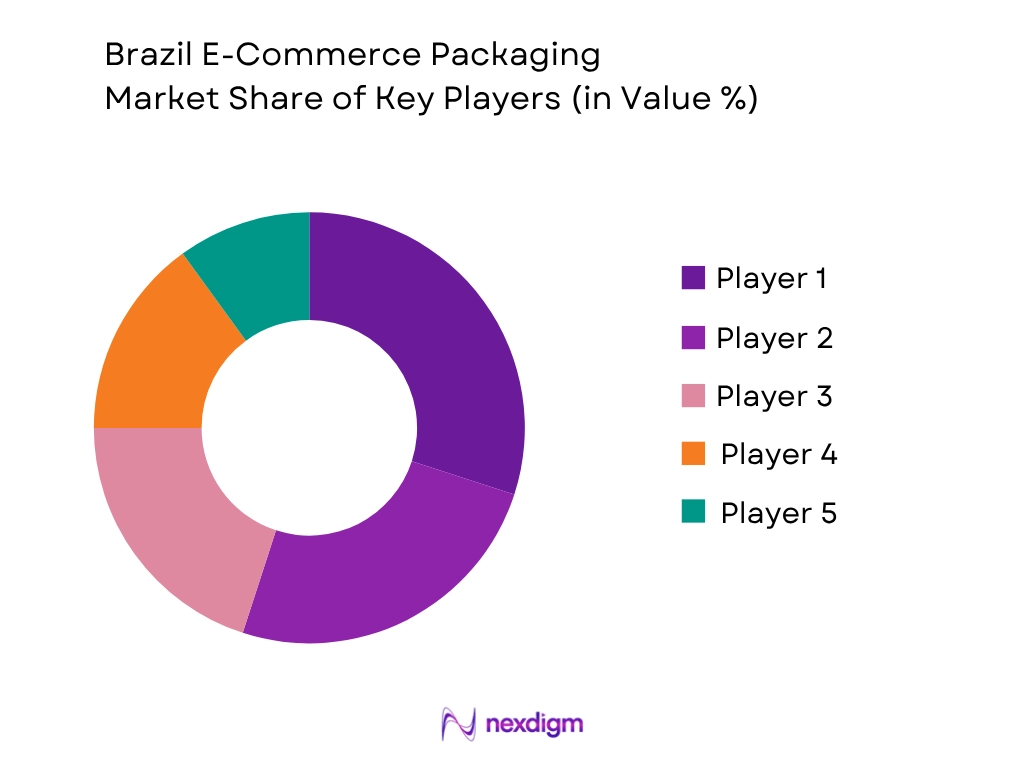
The Brazil E-Commerce Packaging Market is moderately consolidated at the upper end, with global paper and packaging majors competing alongside strong domestic producers for e-commerce fulfillment contracts. Klabin S.A., Brazil’s largest paper producer, maintains a dominant domestic position reinforced by continued capacity investment, including the April 2026 startup of its Piracicaba II recycled containerboard facility adding 300,000 tons of capacity targeting e-commerce shippers. Smurfit Westrock, formed through the 2024 merger of Smurfit Kappa and WestRock, continues to invest heavily in Brazil, including a BRL 205 million (USD 41 million) commitment to install HP digital presses and expand corrugator speeds, positioning the company as a technology leader within the South American corrugated packaging market. International Paper redirected proceeds from its cellulose fibers divestiture toward higher-margin containerboard assets in Brazil and Chile following its acquisition of DS Smith in January 2025, while regional independents including Cartones América, Papelsa, and Carvajal Empaques compete for niche export contracts leveraging micro-flute versatility and digital printing capability.
| Company | Established | Headquarters | Primary Product Portfolio | Natural Color Portfolio | Manufacturing Presence | Major End-Use Industries | Key Strategic Focus | Certifications & Compliance |
| Smurfit WestRock | 2024 | ~ | ~ | ~ | ~ | ~ | ~ | ~ |
| Klabin S.A. | 1899 | ~ | ~ | ~ | ~ | ~ | ~ | ~ |
| International Paper Company | 1898 | ~ | ~ | ~ | ~ | ~ | ~ | ~ |
| Mondi Group | 1967 | ~ | ~ | ~ | ~ | ~ | ~ | ~ |
| Sonoco Products Company | 1899 | ~ | ~ | ~ | ~ | ~ | ~ | ~ |
Brazil E-Commerce Packaging Market Analysis
Growth Drivers
Explosive E-Commerce GMV Growth and Marketplace Logistics Investment
The Brazil e-commerce packaging market is experiencing sustained growth due to the rapid expansion of the country’s underlying e-commerce sector, which grew at a compound annual growth rate of approximately 17.8% between 2020 and 2024 and is projected to continue growing at approximately 8.6% annually from 2025 to 2029, reaching approximately USD 89.18 billion by the end of the forecast period. Mercado Livre, Amazon Brasil, and Shopee collectively account for approximately 55 to 65% of total e-commerce gross merchandise value in 2025, with millions of transactions generated daily, all requiring fulfillment and protective packaging for last-mile delivery. MercadoLibre has committed approximately USD 5.8 to 6.8 billion toward logistics infrastructure in 2025, with roughly half allocated to warehouse duplication aimed at shortening delivery windows and reducing shipping costs by up to 55%. In mid-2025, Mercado Livre dropped its free-shipping threshold in Brazil to just R$19, covering almost its entire product catalog, explicitly to counter competitive pressure from Shopee and Temu in low-ticket merchandise categories, a strategic shift that further increases per-order packaging volume as smaller, lower-value purchases increasingly qualify for individual fulfillment and protective packaging.
Corrugated Capacity Expansion by Major Paper Producers
Substantial capacity investment from Brazil’s leading paper and packaging producers continues to directly expand the country’s e-commerce packaging supply base. Klabin inaugurated its Piracicaba II recycled containerboard unit in April 2026, adding approximately 300,000 tons of capacity specifically targeting e-commerce and food shippers, while continuing its broader Puma II expansion program. Smurfit Kappa announced an approximately USD 33 million investment in January 2023 to boost plant capacity in Fortaleza, Brazil, specifically to meet rising demand for sustainable packaging, while WestRock Brazil introduced lightweight corrugated solutions in February 2024 tailored for large e-commerce fulfillment centers operating in Rio de Janeiro and Belo Horizonte. Brazil produced approximately 6.1 million tons of corrugated packaging in 2025, representing approximately 52.37% of South America’s total corrugated packaging revenue, underpinned by approximately 85% recycled fiber content that secures the country’s domestic fiber balance and reduces dependence on imported containerboard. This sustained capacity investment ensures Brazil’s packaging supply base can continue scaling alongside the country’s rapidly growing e-commerce parcel volumes.
Market Challenges
Logistics Infrastructure Gaps Outside Major Metropolitan Areas
Brazil’s e-commerce packaging market continues to face structural challenges from the country’s vast geography and uneven logistics infrastructure, which creates a persistent paradox in which urban hubs such as São Paulo and Rio de Janeiro remain highly saturated with fulfillment capacity while reaching remote regions in the North and Northeast remains cost-prohibitive. Brazil’s Courier, Express, and Parcel market structure is characterized by significant infrastructure gaps, particularly inadequate road networks and warehouse facilities outside major metropolitan areas, complicating last-mile delivery and, by extension, the packaging specifications required to protect goods across longer, more variable transit times. FedEx’s withdrawal from certain Brazilian operations in January 2026 underscored how global integrators face structural cost disadvantages without localized micro-fulfillment capability, highlighting the operational difficulty of serving Brazil’s geographically dispersed consumer base. These infrastructure gaps particularly affect packaging suppliers and e-commerce sellers seeking to serve Brazil’s underserved regions, where extended transit times and handling variability increase the protective packaging specifications required relative to shipments within concentrated urban corridors.
Pulp and Input Cost Volatility Squeezing SME Packaging Access
The Brazilian corrugated packaging industry faces ongoing cost pressures due to volatility in pulp prices, kraft paper inputs, and fuel-driven logistics expenses, creating persistent margin pressure across the packaging value chain. Frequent fluctuations in the price of recovered paper and energy costs add to production costs, making corrugated packaging comparatively more expensive for small and medium-sized enterprises and local retailers relative to larger e-commerce sellers with greater purchasing power and long-term supply agreements. This cost volatility particularly disadvantages smaller sellers operating on Brazil’s major marketplaces, who often lack the negotiating leverage to secure the same favorable packaging pricing and terms available to large-volume shippers such as Mercado Livre, Amazon, and Shopee. As Brazil’s 2025 tax reform continues to reshape logistics cost structures alongside already inadequate road infrastructure in secondary regions, packaging suppliers and e-commerce sellers alike must navigate a complex and evolving cost environment that complicates long-term pricing and capacity planning decisions.
Market Opportunities
Growth in Sustainable and Recycled E-Commerce Packaging
Growing brand and consumer demand for sustainable packaging creates substantial opportunity for converters serving the Brazil E-Commerce Packaging Market. Mondi Group’s introduction of corrugated boxes made from 100% post-consumer recycled content in Brazil, specifically targeting sustainability-focused brands, illustrates the type of verified environmental credential increasingly demanded by e-commerce sellers and their end consumers. International Paper has signed a partnership with a logistics firm in Brazil specifically to deliver eco-friendly last-mile packaging solutions, reflecting growing industry recognition that sustainability credentials are becoming a meaningful competitive differentiator rather than a secondary consideration. Brazil’s domestic corrugated production already benefits from a strong recycled fiber base, with the country’s containerboard output underpinned by approximately 85% recycled content, providing a structural sustainability advantage relative to packaging markets more dependent on virgin fiber. As Brazil’s National Solid Waste Policy continues to reinforce reverse logistics obligations for packaging producers, converters that can demonstrate credible, verified recycled content and circular economy participation are increasingly well positioned to capture premium contract positioning from e-commerce brands prioritizing sustainability.
Northeast and North Fulfillment Center Decentralization
Brazil’s logistics real estate market in the Northeast region is growing at approximately 9.3% annually, driven by e-commerce players decentralizing inventory to reduce costs and transit times, creating substantial new demand for regionally distributed packaging supply chains. Mercado Livre, Amazon, and Shopee collectively occupy more than 775,000 square meters of warehouse space in the region, with Mercado Livre specifically aiming to cut shipping costs by up to 55% through this decentralization strategy. Developer Log is investing heavily in the Northeast region, with major fulfillment center projects underway in Fortaleza and João Pessoa targeting high pre-lease occupancy from major e-commerce tenants. The North region is emerging as the fastest-growing area for last-mile delivery infrastructure, expanding at approximately 6.51% CAGR through 2031, fueled by strategic infrastructure investments and continued decentralization of fulfillment centers away from the traditionally dominant Southeast corridor. Packaging suppliers capable of establishing regional production or distribution capacity to serve these emerging Northeast and North fulfillment hubs are well positioned to capture demand as major marketplaces continue shifting inventory closer to previously underserved consumer populations.
Future Outlook
The Brazil E-Commerce Packaging Market is expected to witness robust expansion over the forecast period, supported by continued double-digit e-commerce GMV growth, sustained marketplace logistics investment from Mercado Livre, Amazon, and Shopee, and ongoing corrugated capacity expansion from major domestic and international paper producers. Continued decentralization of fulfillment infrastructure toward Brazil’s Northeast and North regions will further reshape packaging demand patterns, creating new opportunities for regionally distributed supply chains. The market is also likely to benefit from growing sustainability-driven packaging innovation, as Brazil’s already strong recycled fiber base positions domestic converters favorably relative to global peers navigating stricter environmental packaging requirements across e-commerce supply chains.
Major Players
- Klabin S.A.
- Smurfit Westrock plc
- International Paper Company
- Mondi Group
- Sonoco Products Company
- Iggesund Paperboard
- DS Smith plc
- Cartones América
- Papelsa
- Carvajal Empaques
- Amcor plc
- Stora Enso Oyj
- Sealed Air Corporation
- Uline Inc.
- H.B. Fuller Company
Key Target Audience
- E-Commerce Packaging Manufacturers
- E-Commerce Marketplaces & Online Retailers
- Direct-to-Consumer Retail Brands
- Third-Party Logistics Providers
- Food & Grocery Delivery Platforms
- Investment and Venture Capitalist Firms
- Government and Regulatory Bodies (Ministry of Environment and Climate Change, National Solid Waste Policy (PNRS) Administrators, National Health Surveillance Agency (ANVISA))
- Raw Material Suppliers and Paper Producers
Research Methodology
Step 1: Identification of Key Variables
The research process begins with identifying the complete ecosystem of the Brazil E-Commerce Packaging Market, including raw material suppliers, packaging converters, printing technology providers, e-commerce marketplaces, logistics providers, and regulatory authorities. Extensive secondary research is conducted using company annual reports, government publications, trade associations, customs statistics, industry journals, and proprietary databases to determine the variables influencing market demand, pricing, production, consumption, and technological developments.
Step 2: Market Analysis and Construction
Historical market information is collected and analyzed to estimate market size, production volumes, import-export activity, application-wise demand, and pricing trends. A combination of top-down and bottom-up approaches is used to estimate market revenues and validate segment-level performance. Consumption patterns across fashion, electronics, food and beverage, and personal care e-commerce packaging are evaluated to establish an accurate representation of the industry.
Step 3: Hypothesis Validation and Expert Consultation
The preliminary findings are validated through Computer-Assisted Telephone Interviews (CATIs) and structured discussions with e-commerce packaging converters, procurement managers, distributors, packaging engineers, logistics executives, and senior executives operating within the Brazilian e-commerce and packaging industries. These interviews help verify market assumptions, competitive developments, technology adoption trends, pricing dynamics, and future investment opportunities while refining the overall market estimates.
Step 4: Research Synthesis and Final Output
The final stage integrates insights obtained from primary interviews with quantitative information collected through secondary sources. Data triangulation techniques are applied to reconcile differences between supply-side and demand-side estimates, ensuring robust market forecasting. The report is then reviewed through multiple quality assurance checkpoints to deliver a comprehensive analysis covering market size, segmentation, competitive landscape, future outlook, and strategic recommendations for industry stakeholders.

- Executive Summary
- Research Methodology (Market Definitions and Assumptions, Abbreviations, Market Sizing Approach, Top-Down Analysis, Bottom-Up Analysis, Demand-Side Assessment, Supply-Side Assessment, Primary Industry Interviews, Secondary Research Validation, Data Triangulation, Forecasting Framework, Limitations and Future Conclusions)

- Definition and Scope
- Market Evolution and Industry Genesis
- Timeline of Major Industry Developments
- E-Commerce Packaging Industry Value Chain Analysis
- Supply Chain Analysis

- Growth Drivers (Explosive E-Commerce GMV Growth, Marketplace Logistics Investment, Corrugated Capacity Expansion by Major Paper Producers, Rising Cross-Border Platform Competition, Growth of Pix-Enabled Digital Payments, Expansion of Quick-Commerce & Food Delivery)
- Market Challenges (Logistics Infrastructure Gaps Outside Major Metros, Pulp & Input Cost Volatility, SME Access to Affordable Packaging, Vast Geography & Last-Mile Cost Pressure, Recovered Paper Price Fluctuations, Import Dependency for Specialty Films)
- Market Opportunities (Growth in Sustainable & Recycled Packaging, Northeast & North Fulfillment Center Decentralization, Digital & Short-Run Printing for Branded Unboxing, Nearshoring-Driven Export-Compliant Packaging, Reverse Logistics & Circular Packaging Programs, Micro-Fulfillment-Optimized Packaging Formats)
- Market Trends (Growth in Lightweight & Right-Sized Packaging, Post-Consumer Recycled Content Adoption, Branded Unboxing Experience Design, Warehouse Decentralization Toward Consumer Proximity, AI-Enabled Routing & Fulfillment Technology, Digital Printing for Mass Customization)
- Government Regulations (National Solid Waste Policy (PNRS) Reverse Logistics Requirements, State-Level Packaging Recycling Registration, ANVISA Requirements for Food & Personal Care Shipments, 2025 Tax Reform Impact on Logistics, Import Compliance for Cross-Border Sellers, Extended Producer Responsibility Obligations)
- Import and Export Analysis (Trade Volume, Major Import Sources, Export Destinations, HS Code Analysis, Trade Balance)
- Raw Material Availability Analysis (Domestic Kraft Linerboard & Pulp, Recovered Paper & Recycled Fiber, Polyethylene Film for Mailers, Adhesives & Tape Substrates, Bio-Based & Compostable Materials)
- Technology Landscape (Automated Box-Making & Corrugation Technologies, Digital & HP Indigo Printing Systems, AI-Enabled Fulfillment & Routing Software, Right-Sizing & On-Demand Packaging Machines, Recycled Content Processing Technologies)
- Sustainability Assessment (Post-Consumer Recycled Content Adoption, Reverse Logistics Program Participation, Lightweighting & Material Reduction, Renewable Energy Manufacturing Integration, Circular Economy Partnerships)
- PESTLE Analysis
- SWOT Analysis
- Porter’s Five Forces Analysis
- Stakeholder Ecosystem
- Competition Ecosystem

- By Market Value (2020-2025)
- By Volume Consumption (2020-2025)
- By Average Selling Price (2020-2025)

- By Material Type (In Value %)
Corrugated Cardboard & Paperboard
Plastic (Poly Mailers & Bubble Wrap)
Paper & Kraft Paper
Protective & Void-Fill Materials
Biodegradable & Recycled Materials - By Product Type (In Value %)
Boxes & Cartons
Mailers & Bags
Protective Packaging (Bubble Wrap & Air Pillows)
Tape & Labels
Void-Fill Materials - By Application (In Value %)
Fashion & Apparel
Electronics & Electricals
Food & Beverage
Personal Care & Beauty
Home & Furniture
Books & Media
Others - By End User (In Value %)
E-Commerce Marketplaces
Direct-to-Consumer Retail Brands
Third-Party Logistics Providers
Food & Grocery Delivery Platforms
Fashion & Apparel Retailers - By Region (In Value %)
Southeast Brazil
South Brazil
Northeast Brazil
Center-West Brazil
North Brazil

- Market Share of Major Players (By Value, Volume, Material Type, Application, Product Category)
- Cross Comparison Parameters (Product Portfolio Breadth, Recycled-Content Capability, Automation & Digital Printing Capacity, Application Technical Support, Manufacturing Capacity, Regulatory Compliance & Certifications, Marketplace Customer Base, Innovation & New Product Launch Frequency)
- SWOT Analysis of Major Players
- Pricing Analysis by Product Category and Format
- Production Capacity Analysis
- Manufacturing Footprint Analysis
- Distribution Network Analysis
- Innovation Benchmarking
- Detailed Profiles of Major Companies
Klabin S.A.
Smurfit Westrock plc
International Paper Company
Mondi Group
Sonoco Products Company
Iggesund Paperboard
DS Smith plc
Cartones América
Papelsa
Carvajal Empaques
Amcor plc
Stora Enso Oyj
Sealed Air Corporation
Uline Inc.
H.B. Fuller Company

- Consumption Pattern Analysis (Order Volume, Batch Size, Product Category Penetration, Peak Season Demand (Black Friday), Fulfillment Model Activity)
- Purchasing Criteria (Cost per Shipment, Protective Performance, Recyclability, Brand Presentation, Lead Time, Right-Sizing Efficiency)
- Procurement and Supplier Selection Analysis
- Recycled-Content Adoption Assessment
- Marketplace-Fulfilled vs Seller-Fulfilled Packaging Demand
- Product Attribute Preference Analysis (Damage Protection, Tamper-Evidence, Print & Branding Quality, Recyclability, Weight Efficiency, Unboxing Experience)
- Sustainability & Cost Efficiency Influence on Packaging Investment
- Pain Point Analysis
- Decision-Making Process

- By Market Value (2026-2035)
- By Volume Consumption (2026-2035)
- By Average Selling Price (2026-2035)


 Request a Sample
 Ask for Customization
 Get a Quote
 Enquire Now