
 Download PDF
Market Overview
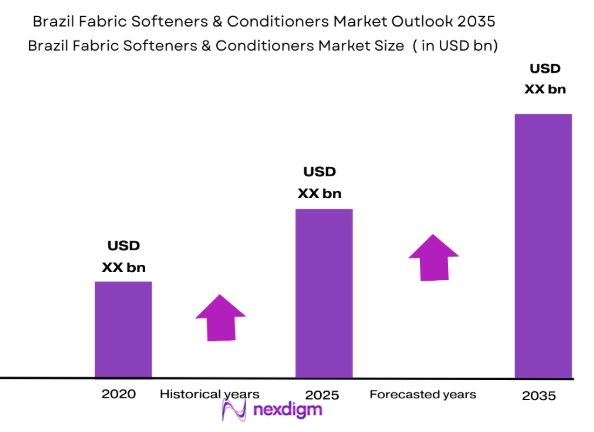
The Brazil Fabric Softeners & Conditioners market is valued at approximately USD ~ billion based on a recent historical assessment supported by industry sources such as Euromonitor and Statista, driven by increasing household consumption of laundry care products and rising preference for fragrance-enhancing solutions. Growth is further supported by urbanization, expansion of retail distribution, and consumer inclination toward premium and concentrated formulations that offer long-lasting freshness and fabric protection, making these products a routine necessity across Brazilian households.
Major urban centers such as São Paulo, Rio de Janeiro, and Belo Horizonte dominate the Brazil Fabric Softeners & Conditioners market due to higher population density, strong retail infrastructure, and greater consumer purchasing power. These cities benefit from widespread supermarket chains and e-commerce penetration, enabling easy product availability, while higher awareness of fabric care and lifestyle preferences drives adoption. Additionally, southern and southeastern regions lead due to better economic development and access to premium product variants.
Market Segmentation
By Product Type
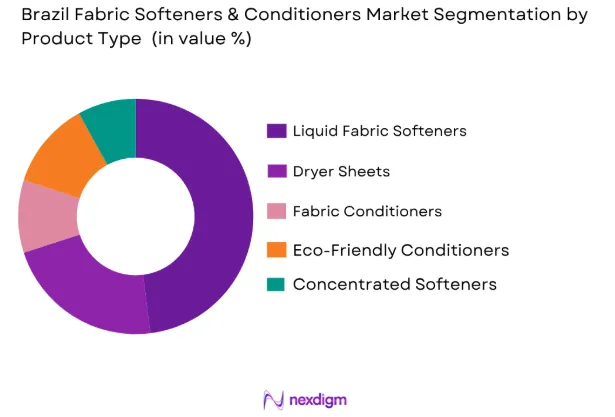
Brazil Fabric Softeners & Conditioners market is segmented by product type into liquid fabric softeners, fabric conditioners, dryer sheets, eco-friendly softeners, and concentrated softeners. Recently, liquid fabric softeners have a dominant market share due to factors such as widespread consumer familiarity, ease of use, strong brand presence, and compatibility with both handwashing and machine washing. Brazilian consumers prefer liquid formats for their fragrance retention and fabric softness benefits, while major brands continue to innovate with improved formulations and packaging, strengthening their dominance across both urban and semi-urban markets.
By Distribution Channel
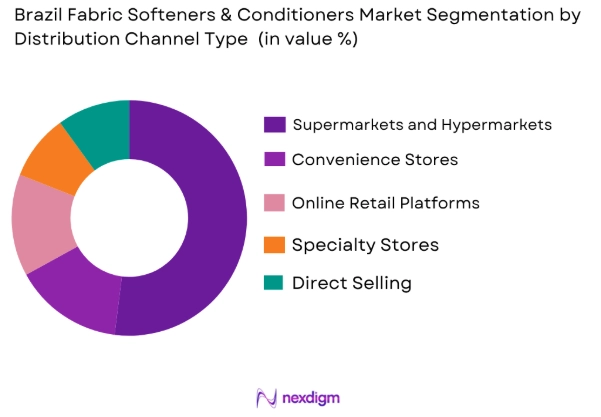
Brazil Fabric Softeners & Conditioners market is segmented by distribution channel into supermarkets and hypermarkets, convenience stores, online retail, specialty stores, and direct selling. Recently, supermarkets and hypermarkets have a dominant market share due to factors such as extensive product variety, promotional pricing, strong supply chains, and consumer trust. These retail formats provide easy accessibility and bulk purchasing options, making them the preferred choice for middle-income households, while also enabling brands to showcase premium and new product lines effectively.
Competitive Landscape
The Brazil Fabric Softeners & Conditioners market is moderately consolidated, with multinational corporations and strong domestic brands competing through product innovation, pricing strategies, and distribution reach. Leading players dominate shelf space in organized retail while investing in eco-friendly and premium product lines to capture evolving consumer demand.
| Company Name | Establishment Year | Headquarters | Technology Focus | Market Reach | Key Products | Revenue | Distribution Strength |
| Unilever | 1929 | UK | ~ | ~ | ~ | ~ | ~ |
| P&G | 1837 | USA | ~ | ~ | ~ | ~ | ~ |
| Reckitt | 1999 | UK | ~ | ~ | ~ | ~ | ~ |
| Ypê | 1950 | Brazil | ~ | ~ | ~ | ~ | ~ |
| Bombril | 1948 | Brazil | ~ | ~ | ~ | ~ | ~ |
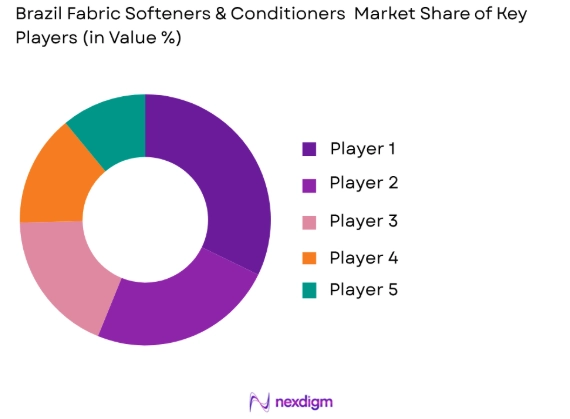
Brazil Fabric Softeners & Conditioners Market Analysis
Growth Drivers
Increasing Awareness of Fabric Care and Hygiene
Rising awareness around hygiene and fabric care in Brazil is strongly supported by macroeconomic and public health indicators, which directly influence demand for fabric softeners and conditioners. According to the World Bank, Brazil’s urban population reached approximately 187 million people, reflecting a highly urbanized society where hygiene practices are more structured and product-driven. Additionally, the Brazilian Institute of Geography and Statistics reports that over 72 million households exist in the country, indicating a large consumer base for laundry care products. Access to improved water sources exceeded 97 million urban households, supporting frequent washing habits. The World Health Organization highlights that hygiene awareness campaigns post-pandemic have significantly influenced cleaning behaviors globally, including in Brazil. Increased literacy levels, with over 93 million literate adults, further enable awareness of product benefits through advertising and labeling. These factors collectively strengthen the role of hygiene awareness as a key driver of consistent product usage.
Rising Disposable Income and Urbanization
Economic growth and rising disposable income levels are significantly contributing to increased consumption of value-added household products such as fabric softeners in Brazil. The World Bank reports Brazil’s GDP at approximately USD 2.17 trillion, indicating strong economic activity supporting consumer spending. Household final consumption expenditure exceeded USD 1.3 trillion, reflecting robust domestic demand. The International Monetary Fund notes that Brazil’s per capita income surpassed USD 10,000, improving purchasing power among middle-income households. Additionally, urban population numbers continue to rise, exceeding 187 million people, creating concentrated demand centers for consumer goods. The IBGE further highlights that over 85 million individuals are employed, supporting steady income flow and spending capacity. Expansion of organized retail in urban areas enhances product accessibility. These economic and demographic factors collectively drive higher adoption of premium and branded fabric conditioners across the country.
Challenges
Price Sensitivity in Mass Market Segments
Price sensitivity remains a major challenge in Brazil’s fabric softeners and conditioners market due to income inequality and varying purchasing power across regions. According to the World Bank, Brazil’s Gini index stands at around 0.53, indicating significant income disparity. Over 62 million individuals fall under lower-income categories, limiting their ability to spend on non-essential household products. The IBGE reports that average monthly household income in several regions remains below USD 500, constraining discretionary spending. Inflation levels recorded by the International Monetary Fund exceeded 4 currency units per year in recent assessments, impacting purchasing power. Additionally, over 11 million unemployed individuals create further financial pressure on households. These macroeconomic conditions encourage consumers to opt for low-cost alternatives or reduce usage frequency, directly affecting demand for premium fabric care products.
Volatility in Raw Material Costs
Fluctuations in raw material costs significantly impact the production and pricing strategies of fabric softeners and conditioners in Brazil. The World Bank commodity price data shows that crude oil prices fluctuated between USD 70 and USD 95 per barrel, affecting petrochemical derivatives used in softener production. Brazil imported chemical inputs worth over USD 60 billion, reflecting dependence on global supply chains. The Brazil Ministry of Economy highlights that currency exchange rates crossed 5 units per USD, increasing import costs for manufacturers. Additionally, global supply chain disruptions have increased freight costs, further raising production expenses. The International Monetary Fund notes persistent global inflationary pressures impacting industrial inputs. These cost fluctuations reduce profit margins and create pricing challenges for manufacturers, limiting their ability to maintain competitive pricing while ensuring product quality.
Opportunities
Growth of Sustainable and Biodegradable Fabric Softeners
The increasing focus on sustainability and environmental protection presents strong growth opportunities for eco-friendly fabric softeners in Brazil. The World Bank reports that Brazil generated over 79 million tons of solid waste annually, driving the need for biodegradable products. The IBGE indicates that over 100 million urban residents are exposed to environmental awareness campaigns promoting sustainable consumption. Additionally, Brazil’s renewable energy production exceeds 600 terawatt-hours, reflecting national emphasis on sustainability. Government regulations under environmental policies encourage reduced chemical usage and improved waste management. The United Nations Environment Programme highlights growing global adoption of eco-friendly household products, influencing Brazilian consumer behavior. Increasing literacy and digital penetration, with over 160 million internet users, enable awareness of green products. These factors collectively create a favorable environment for the expansion of biodegradable and plant-based fabric softeners.
Expansion in Rural and Untapped Regions
Rural market expansion offers significant opportunities for fabric softener manufacturers in Brazil due to improving infrastructure and rising income levels in non-urban areas. The World Bank reports that over 25 million people reside in rural regions, representing a substantial untapped consumer base. Government programs have improved electricity access to over 99 million households, enabling appliance usage such as washing machines. The IBGE indicates that rural employment exceeds 15 million individuals, supporting gradual income growth. Additionally, road infrastructure expansion exceeding 1.7 million kilometers enhances product distribution networks. The International Monetary Fund notes increasing rural consumption trends driven by agricultural income stability. Digital penetration is also expanding, with over 130 million mobile internet users, enabling e-commerce reach. These developments create strong opportunities for market penetration and product adoption in underserved regions.
Future Outlook
The Brazil Fabric Softeners & Conditioners market is expected to witness steady growth over the next five years, driven by increasing urbanization, product innovation, and expanding retail channels. Technological advancements in fragrance retention and eco-friendly formulations will shape product development. Regulatory support for sustainable practices will encourage green product adoption. Rising disposable income and evolving consumer preferences will further boost demand. Digital transformation and e-commerce growth will enhance market accessibility and penetration.
Major Players
- Unilever
- Procter & Gamble
- Reckitt
- Ypê
- Bombril
- Brilux
- Minuano
- Girando Sol
- Casa KM
- Flora
- Urca
- Amazon H2O
- Química Amparo
- Limppano
- Start Química
Key Target Audience
- Consumer goods manufacturers
- Retail chains and supermarket groups
- E-commerce platforms
- Investments and venture capitalist firms
- Government and regulatory bodies
- Chemical suppliers
- Packaging companies
- FMCG distributors
Research Methodology
Step 1: Identification of Key Variables
Key variables such as product categories, pricing, consumer demographics, and distribution channels were identified to define the scope of the Brazil Fabric Softeners & Conditioners market. Secondary data sources were reviewed to establish baseline assumptions.
Step 2: Market Analysis and Construction
Comprehensive analysis was conducted using industry reports, trade data, and company disclosures to construct market size and segmentation. Data triangulation ensured consistency across multiple sources.
Step 3: Hypothesis Validation and Expert Consultation
Findings were validated through expert opinions, including industry professionals and supply chain participants, ensuring accuracy and reliability of insights and assumptions.
Step 4: Research Synthesis and Final Output
All data points were synthesized into a structured report format, integrating qualitative and quantitative insights to deliver a comprehensive market outlook.

- Executive Summary
- Research Methodology (Market Definitions and Assumptions, Abbreviations and Terminology, Data Sources and Validation Approach, Brazil Fabric Softeners & Conditioners Market Sizing Methodology, Primary and Secondary Research Benchmarks, Market Reliability and Confidence Intervals)

- Industry Definition and Scope
- Market Genesis and Evolution in Brazil
- Consumer Usage and Laundry Care Habits
- Market Value Chain and Distribution Architecture
- Import and Export Dynamics

- Growth Drivers
Increasing Awareness of Fabric Care and Hygiene
Rising Disposable Income and Urbanization
Growing Demand for Fragrance and Long-Lasting Freshness
Expansion of Modern Retail and E-commerce Channels
Innovation in Eco-Friendly and Skin-Safe Products - Challenge
Price Sensitivity in Mass Market Segments
Volatility in Raw Material Costs
Competition from Low-Cost and Local Brands
Environmental Concerns Regarding Chemical Ingredients
Limited Awareness in Rural and Low-Income Segments - Opportunities
Growth of Sustainable and Biodegradable Fabric Softeners
Expansion in Rural and Untapped Regions
Product Innovation with Multi-Functional Benefits
Rising Demand for Premium and Luxury Fragrance Variants
Increasing Penetration of Online and Subscription-Based Sale
- Trends
Shift Toward Eco-Friendly and Plant-Based Ingredients
Growth in Concentrated and Water-Saving Products
Rising Popularity of Premium Fragrance Collections
Packaging Innovations and Sustainability Initiatives
Increasing Adoption of E-commerce and Direct-to-Consumer Models - Government Regulations
Regulations on Chemical Ingredients and Safety Standards
Environmental Policies and Sustainability Compliance
Labeling and Consumer Protection Laws
Import Regulations for Raw Materials and Finished Products
Guidelines for Packaging and Waste Management
- SWOT Analysis
- Porter’s Five Forces

- By Market Value, 2020-2025
- By Volume Consumption, 2020-2025
- By Average Price per Unit, 2020-2025
- By Product Category Revenue Contribution, 2020-2025

- By Product Type (In Value %)
Liquid Fabric Softeners
Fabric Conditioners
Dryer Sheets
Eco-Friendly / Organic Softeners
Concentrated Softeners - By Distribution Channel (In Value %)
Supermarkets and Hypermarkets
Convenience Stores
Online Retail and E-commerce Platforms
Specialty Stores
Direct Selling Channels - By Consumer Demographic (In Value %)
Urban Households
Rural Households
Middle-Income Consumers
Premium Consumers
Environmentally Conscious Consumers - By Price Tier (In Value %)
Economy / Low-Cost
Mid-Range
Premium
Ultra-Premium / Specialty Products - By Region (In Value %)
Southeast Brazil
South Brazil
Northeast Brazil
Central-West Brazil
North Brazil

- Market Share by Product Category
- Volume Sales by Major Brands
- Cross Comparison Parameters (Company Overview, Product Portfolio Strength, Distribution Network, Pricing Strategy, Innovation Capability, Brand Equity, Consumer Preference Score, Annual Revenue, and Growth Trajectory)
- Company Profiles
Unilever (Comfort)
Procter & Gamble (Downy)
Reckitt Benckiser
Bombril
Ypê (Química Amparo)
Brilux
Minuano
Girando Sol
Casa KM
Flora (Assim / Mat Inset Group)
Amazon H2O (Eco Brands)
Urca

- Buying Decision Drivers
- Brand Preference and Loyalty Patterns
- Purchase Frequency and Consumption Behavior
- Preferred Retail Channels and Payment Modes
- Pain Points in Product Usage and Satisfaction Levels

- By Market Value, 2026-2035
- By Volume Consumption, 2026-2035
- By Average Price per Unit, 2026-2035
- By Product Category Revenue Contribution, 2026-2035


 Request a Sample
 Ask for Customization
 Get a Quote
 Enquire Now