
 Download PDF
Market Overview
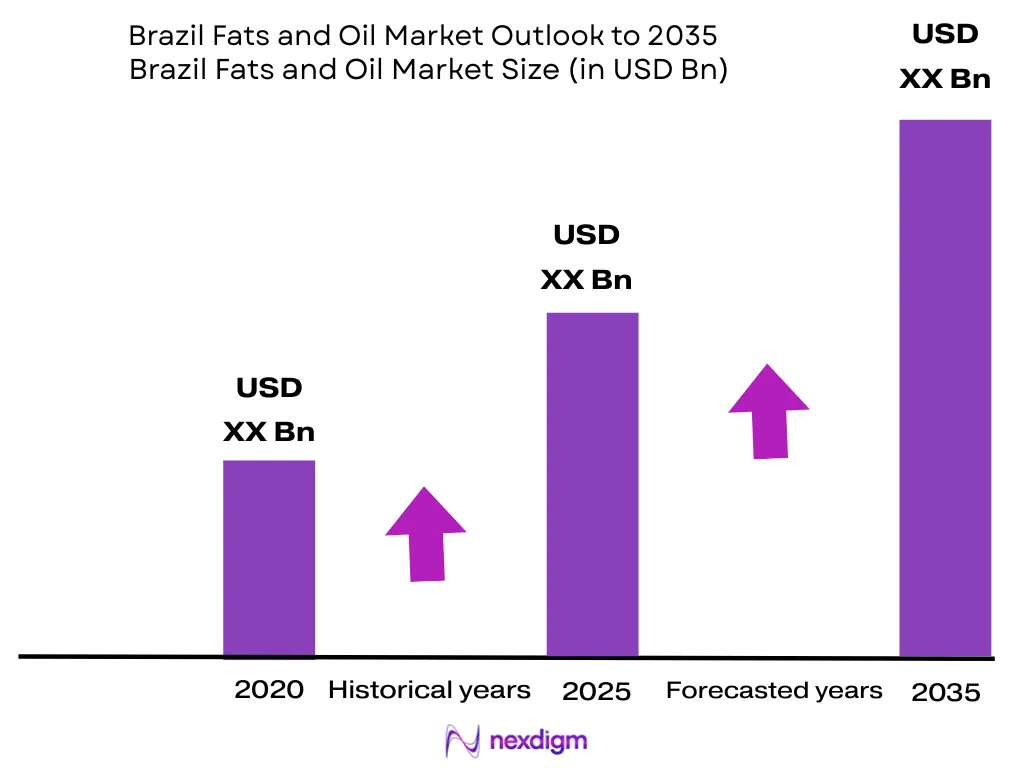
Brazil Fats and Oil Market is valued at USD ~ billion, based on a five-year historical analysis, and is forecasted to grow at a CAGR of ~% during the forecast period. Demand is driven by soybean oil, palm oil, animal fats, retail cooking oils, bakery fats, foodservice frying oils, and biodiesel feedstock. Brazil’s soybean oil output was estimated at 11.1 MMT in the latest completed cycle, while domestic soy oil consumption for biodiesel reached 5.9 MMT. Mato Grosso, Paraná, Rio Grande do Sul, Goiás, São Paulo, Bahia, and Pará dominate the Brazil Fats and Oil Market due to soybean production, crushing assets, retail consumption density, biodiesel plants, ports, palm oil cultivation, food manufacturing, and animal rendering. Mato Grosso is Brazil’s largest soybean producer, with IMEA estimating 44.1 MMT of soybeans for the latest crop cycle. Rio Grande do Sul remains important for biodiesel, with nine plants and 3 million liters of nameplate capacity.
Market Segmentation
By Product Type
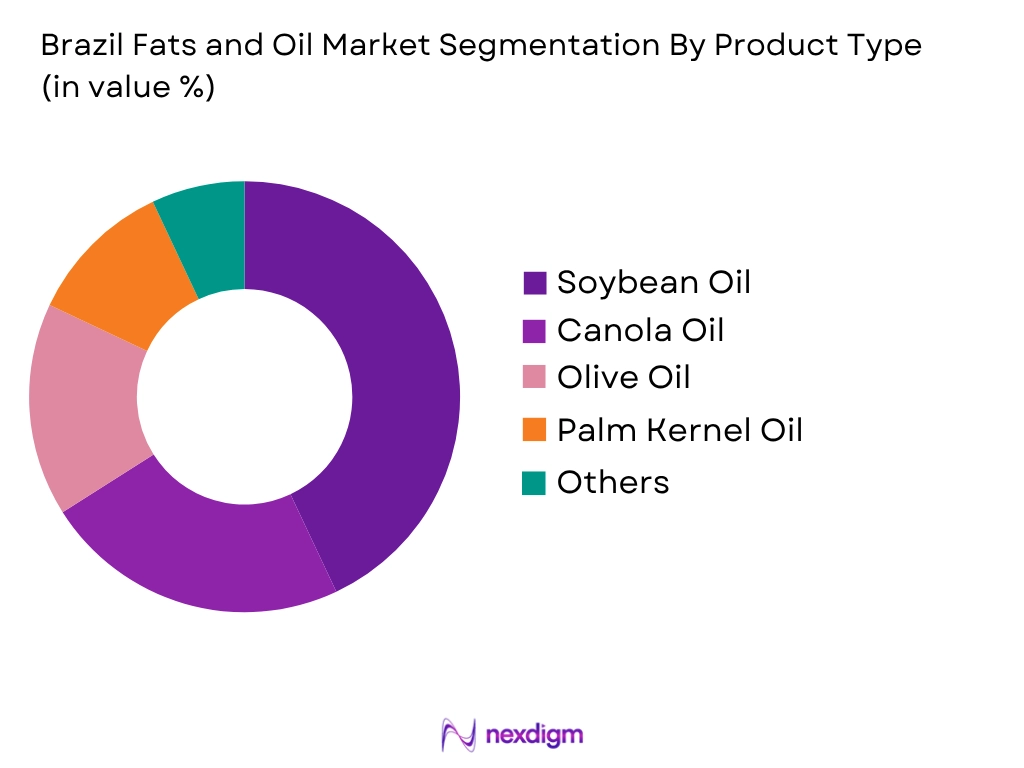
Brazil Fats and Oil Market is segmented by product type into soybean oil, palm oil, palm kernel oil, sunflower oil, canola oil, corn oil, cottonseed oil, olive oil, coconut oil, butter, lard, beef tallow, poultry fat, shortening, margarine, and specialty fats. Recently, soybean oil has had the dominant market share under the product type segmentation due to Brazil’s large soybean crop, established crushing industry, domestic refining base, and strong linkage with biodiesel blending mandates. Soybean oil is also widely used in household cooking, foodservice frying, packaged foods, margarine, bakery applications, and industrial food manufacturing. Palm oil is important in specialty fats and oleochemicals, while tallow is rising in biodiesel and circular feedstock applications. However, soybean oil remains the market anchor because it connects agriculture, retail cooking oil, food manufacturing, animal feed co-products, export trade, and renewable fuel demand in one integrated value chain.
By Application
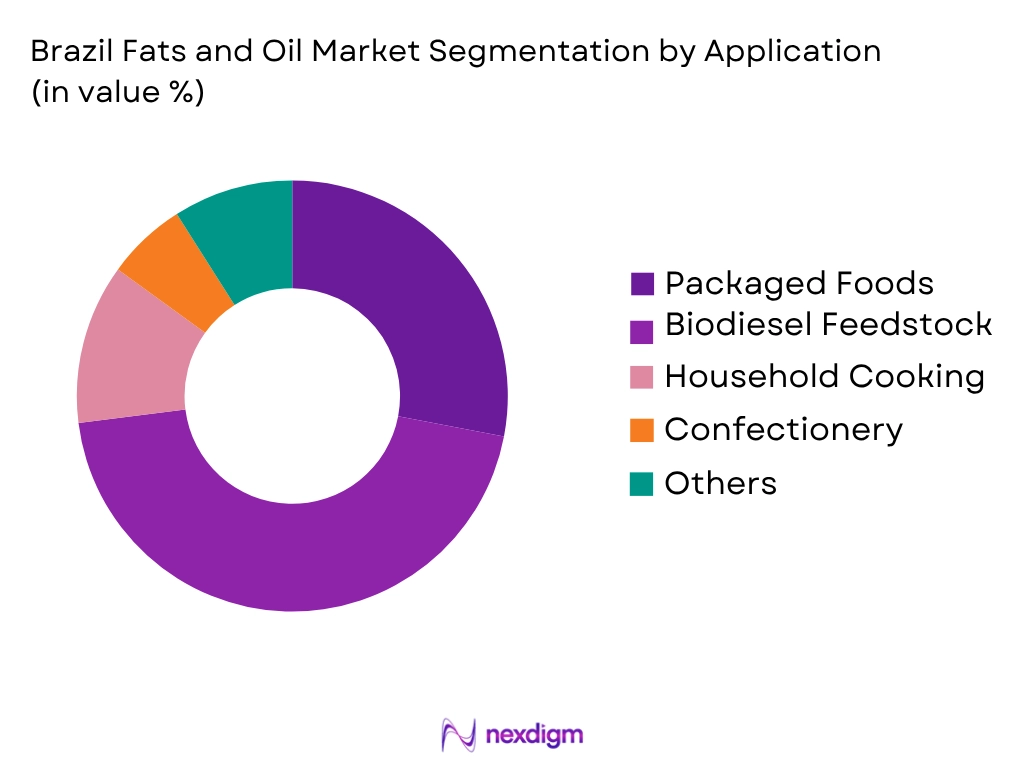
Brazil Fats and Oil Market is segmented by application into household cooking, foodservice frying, bakery and confectionery, snack food processing, packaged food manufacturing, meat processing, margarine and spread manufacturing, animal feed, oleochemicals, cosmetics and personal care, and biodiesel feedstock. Recently, biodiesel feedstock has had a dominant market share under the application segmentation because Brazil’s biodiesel mandate has created a large structural demand base for soybean oil and other lipid feedstocks. USDA FAS reported that slightly more than half of domestic soy oil consumption, or 5.9 MMT, was used in the biodiesel industry, while CNPE moved the blend rate from B12 to B14 and toward B15. This makes biodiesel a direct demand center for crushers, refiners, renderers, and palm oil producers. Food applications remain broad, but mandated fuel blending has made biodiesel one of the most influential applications for market direction.
Competitive Landscape
Brazil Fats and Oil Market is dominated by integrated agribusiness companies, soybean crushers, cooperatives, biodiesel-linked processors, palm oil producers, animal protein companies, and retail cooking oil brands. Bunge Brasil, Cargill Brasil, ADM Brasil, Louis Dreyfus Company Brasil, and Caramuru Alimentos hold strong positions due to origination scale, soybean crushing capacity, refining capability, export logistics, biodiesel feedstock exposure, and established industrial customer relationships. Competition is shaped by access to oilseed supply, crushing margins, refinery utilization, domestic consumption, foodservice reach, retail branding, and sustainability compliance.
| Company | Establishment Year | Headquarters | Core Portfolio | Processing Strength | Key End Users | Channel Strength | Sustainability Focus | Market-Specific Advantage |
| Bunge Brasil | 1905 in Brazil | São Paulo, Brazil | ~ | ~ | ~ | ~ | ~ | ~ |
| Cargill Brasil | 1965 in Brazil | São Paulo, Brazil | ~ | ~ | ~ | ~ | ~ | ~ |
| ADM Brasil | 1997 in Brazil | São Paulo, Brazil | ~ | ~ | ~ | ~ | ~ | ~ |
| Louis Dreyfus Company Brasil | 1942 in Brazil | São Paulo, Brazil | ~ | ~ | ~ | ~ | ~ | ~ |
| Caramuru Alimentos | 1964 | Itumbiara, Goiás, Brazil | ~ | ~ | ~ | ~ | ~ | ~ |
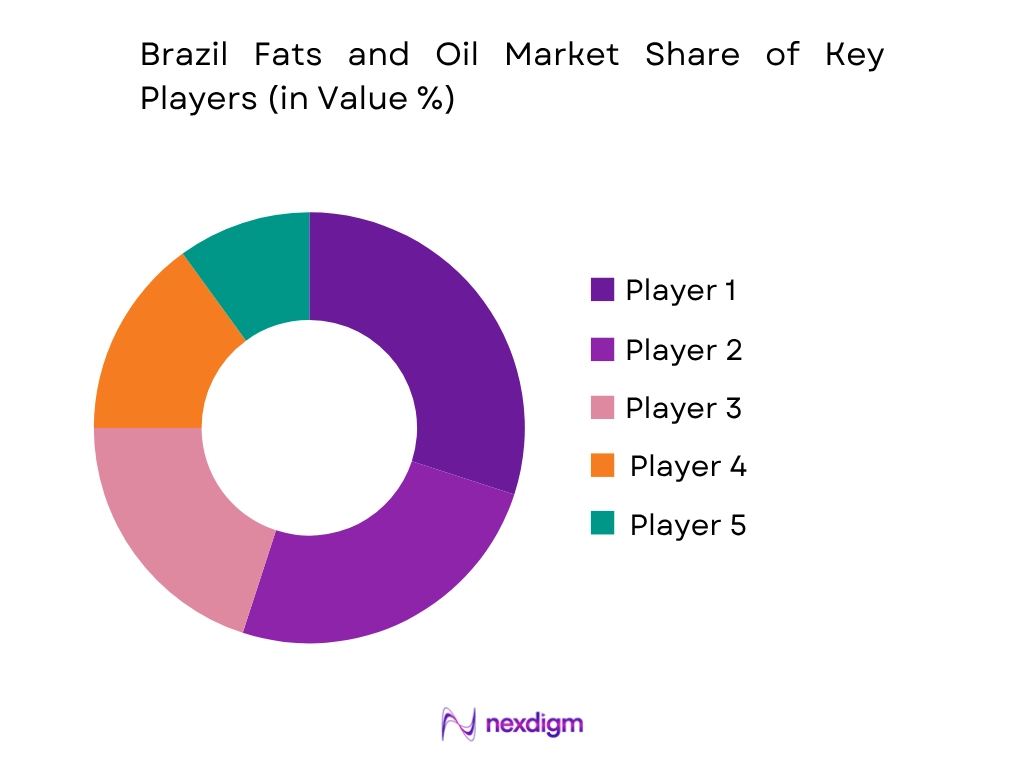
Brazil Fats and Oil Market Analysis
Growth Drivers
Soybean Crushing and Domestic Oil Availability
Brazil’s fats and oil market is driven by the scale of domestic soybean output, crushing activity, and refined oil availability, which support household cooking oil, food processing, margarine, frying oil, animal feed co-products, and biodiesel feedstock. USDA FAS reported Brazil soybean production at 153.0 million metric tons for the completed crop cycle and forecast soybean production at 169.0 million metric tons for the following cycle, giving crushers a large raw material base for soybean oil extraction. The same source reported soybean processing at 54.5 million metric tons and projected processing at 56.0 million metric tons, while soybean oil production was estimated at 11.1 million metric tons and forecast at 12.0 million metric tons. This supply depth is supported by Brazil’s macroeconomic base, with the World Bank reporting GDP of USD 2.186 trillion, GDP per capita of USD 10,310.5, and GDP growth of 3.4. Together, large oilseed availability and economic scale strengthen demand for edible oil refining, bulk oil logistics, private-label retail packs, foodservice frying oils, and industrial ingredient oils.
Biodiesel Mandate and Industrial Demand Pull
Biodiesel demand is a major growth driver for the Brazil fats and oil market because soybean oil, beef tallow, palm oil, used cooking oil, cottonseed oil, chicken fat, pork fat, corn oil, and other lipid streams are directly used as fuel feedstocks. USDA FAS reported Brazil biodiesel production at 7.5 billion liters and projected production at 8.9 billion liters, reflecting a larger offtake base for oils and fats. The same report stated that Brazil had 60 licensed biodiesel plants, with 30 plants located in Mato Grosso, Mato Grosso do Sul, and Goiás, and authorized industrial capacity of 14.8 billion liters per year. Biodiesel production reached 4.2 billion liters from January through June, compared with 3.3 billion liters in the same prior period, creating strong demand for refined soybean oil and rendered fats. The macroeconomic context supports industrial scale, with IMF reporting Brazil GDP at USD 2.64 trillion for 2026 and country population at 214.083 million, reinforcing the size of fuel, food, logistics, and industrial lipid consumption.
Market Challenges
Climate and Oilseed Supply Volatility
Climate-linked crop volatility is a key challenge for the Brazil fats and oil market because soybean oil availability depends on planted area, yields, harvest timing, logistics, and regional weather conditions across Mato Grosso, Paraná, Rio Grande do Sul, Goiás, Bahia, and other producing states. USDA FAS reported soybean production at 153.0 million metric tons for the completed cycle and then forecast 169.0 million metric tons for the following cycle, showing how supply assumptions can move by 16.0 million metric tons across crop cycles. Such variation affects crushing schedules, crude soybean oil output, refinery utilization, export commitments, biodiesel supply, and food-industry procurement. World Bank data places Brazil’s GDP at USD 2.186 trillion and population at 211.140 million, meaning edible oil and fuel-linked demand must be served across a large consumer and industrial base despite agricultural volatility. The challenge is market specific because soybean oil is not only a household cooking staple; it is also a key input for margarine, packaged foods, frying oils, biodiesel, meal-linked crushing economics, and export-oriented commodity flows.
Logistics, Processing, and Feedstock Competition
Logistics and feedstock competition restrain the Brazil fats and oil market because soybean oil, tallow, palm oil, used cooking oil, and other fats must move between farms, crushers, refineries, ports, food manufacturers, biodiesel plants, retailers, and foodservice distributors. USDA FAS reported soybean processing at 54.5 million metric tons and projected processing at 56.0 million metric tons, while soybean oil output was estimated at 11.1 million metric tons and projected at 12.0 million metric tons, requiring high-capacity crushing, refining, storage, and bulk transport systems. Biodiesel adds pressure because USDA FAS reported 60 licensed plants and 14.8 billion liters of authorized capacity, creating competition between edible oil users and fuel-sector buyers. Brazil’s geography compounds this challenge because production is concentrated inland while consumption, refining, export terminals, and food manufacturing are distributed across regions. World Bank data records Brazil’s urban population at 186,592,664 and total GDP at USD 2.186 trillion, creating large downstream demand centers that require reliable supply. This makes transport bottlenecks, port access, tank storage, feedstock allocation, and quality control central market constraints.
Market Opportunities
Expansion of Biodiesel Feedstock Diversification
Feedstock diversification creates a future growth opportunity for the Brazil fats and oil market because biodiesel producers are already using soybean oil alongside beef tallow, palm oil, poultry fat, pork fat, cottonseed oil, used cooking oil, corn oil, and other residual lipid streams. USDA FAS reported 4.2 billion liters of biodiesel output from January through June, compared with 3.3 billion liters in the same earlier period, showing a larger operating base for lipid procurement and processing. The report also recorded 60 licensed biodiesel plants and 14.8 billion liters of authorized capacity, indicating existing infrastructure that can absorb diversified oils and fats. This creates demand for renderers, palm oil producers, used cooking oil collectors, refiners, pretreatment units, feedstock traders, and traceability providers. Brazil’s macroeconomic scale reinforces the opportunity, with World Bank GDP at USD 2.186 trillion and IMF-reported population at 214.083 million. The opportunity is market specific because diversified feedstock use reduces dependence on soybean oil alone while expanding value capture from animal fats, residual oils, palm-based oils, and circular feedstock systems.
Premium, Traceable, and Application-Specific Oils
Premium, traceable, and application-specific oils create an opportunity in the Brazil fats and oil market because food manufacturers, foodservice operators, retailers, exporters, and biodiesel buyers increasingly require differentiated oils rather than undifferentiated commodity supply. USDA FAS reported soybean oil production at 11.1 million metric tons and a forecast of 12.0 million metric tons, providing a large base for refined, degummed, high-stability, frying, bakery, margarine, and industrial oil solutions. World Bank data records GDP per capita at USD 10,310.5, household consumption supported by a population of 211.140 million, and an urban population of 186,592,664, creating demand for branded cooking oils, premium olive oils, foodservice packs, and industrial ingredient systems across supermarkets, cash-and-carry outlets, restaurants, and packaged food plants. Traceability is also a commercial opportunity because soybean, palm oil, and beef-linked supply chains face stronger buyer requirements for origin documentation and sustainability compliance. This creates space for certified palm oil, traceable soybean oil, low-carbon biodiesel feedstocks, clean-label shortenings, and application-specific blends tailored to frying life, texture, oxidative stability, and formulation performance.
Future Outlook
Brazil Fats and Oil Market is expected to show steady growth during the forecast period, supported by soybean crop scale, biodiesel blending mandates, food processing demand, foodservice recovery, and rising use of animal fats and residual oils in renewable fuel applications. Soybean oil will remain the structural backbone because Brazil has one of the world’s largest soybean production and crushing ecosystems. Biodiesel demand will continue to influence domestic availability, refinery utilization, and feedstock competition. The transition from B14 to B15 will increase demand for soybean oil, tallow, palm oil, used cooking oil, and other lipid streams. As a result, crushers and renderers are expected to strengthen procurement systems, feedstock traceability, and contracts with biodiesel producers.
Retail and foodservice demand will remain important because soybean oil is a staple cooking oil across Brazilian households and restaurants. Cash-and-carry retailers, supermarkets, foodservice distributors, and industrial ingredient suppliers will continue to shape packaged oil and bulk oil movement. Price-sensitive households will support mainstream soybean oil, while premium consumers will sustain olive oil, canola oil, sunflower oil, and specialty oil demand. Sustainability will become more important across soy, palm, beef tallow, and biodiesel feedstocks. Buyers will place greater emphasis on traceability, deforestation-risk management, certified palm sourcing, low-carbon feedstock documentation, and compliance with food and fuel regulations. Companies with integrated origination, crushing, refining, biodiesel linkages, and export logistics will be best positioned.
Major Players
- Bunge Brasil
- Cargill Brasil
- ADM Brasil
- Louis Dreyfus Company Brasil
- COFCO International Brasil
- Amaggi
- Caramuru Alimentos
- Coamo Agroindustrial Cooperativa
- Oleoplan
- Imcopa
- Brejeiro
- Seara Alimentos
- BRF
- Agropalma
- JBS
Key Target Audience
- Edible Oil Manufacturers
- Oilseed Crushers and Refiners
- Biodiesel Producers
- Food Processing Companies
- Foodservice and QSR Operators
- Retail Chains and Cash-and-Carry Buyers
- Investments and Venture Capitalist Firms
- Government and Regulatory Bodies (ANVISA, MAPA, ANP, Conselho Nacional de Política Energética, Ministério de Minas e Energia)
Research Methodology
Step 1: Identification of Key Variables
The initial phase involves constructing an ecosystem map encompassing all major stakeholders within the Brazil Fats and Oil Market. This includes soybean farmers, cooperatives, oilseed crushers, refiners, palm oil producers, renderers, biodiesel producers, food manufacturers, foodservice distributors, retailers, importers, exporters, and regulatory bodies. The objective is to identify the variables that influence product demand, feedstock availability, application mix, and route-to-market structure.
Step 2: Market Analysis and Construction
In this phase, historical data is compiled and analyzed for the Brazil Fats and Oil Market. The assessment covers vegetable oil production, soybean crush, crude and refined oil output, biodiesel feedstock use, retail cooking oil availability, import flows, export flows, animal fat utilization, and regional production concentration. Top-down estimates are validated through crop, trade, and energy datasets, while bottom-up analysis uses channel and SKU-level checks.
Step 3: Hypothesis Validation and Expert Consultation
Market hypotheses are developed and validated through interviews with crushers, refiners, biodiesel producers, retail category managers, food ingredient buyers, foodservice distributors, traders, and animal rendering companies. These consultations provide operational and financial insights into crush margins, product substitution, biodiesel demand, industrial procurement, traceability requirements, and regional supply constraints. The process strengthens the reliability of segmentation and competitive conclusions.
Step 4: Research Synthesis and Final Output
The final phase integrates desk research, primary interviews, trade mapping, pricing review, supply-chain analysis, and demand-side assessment into a consolidated market model. Manufacturer and distributor inputs are compared with observed retail availability, bulk oil movement, biodiesel demand, and export data. The final output provides a validated view of market size, segmentation, competition, future outlook, and strategic implications for the Brazil Fats and Oil Market.

- Executive Summary
- Research Methodology (Market Definitions and Assumptions, Abbreviations, Edible Fats and Oils Classification, Vegetable Oil and Animal Fat Inclusion Criteria, Soybean Oil Supply-Use Mapping, Palm Oil and Specialty Fat Inclusion Criteria, Retail vs Foodservice vs Industrial Demand Mapping, Market Sizing Approach, Top-Down Analysis, Bottom-Up Analysis, Demand-Side Assessment, Supply-Side Assessment, ABIOVE Soybean Complex Validation, CONAB Oilseed Crop Assessment, ANP Biodiesel Feedstock Mapping, Refinery and Crushing Capacity Checks, Distributor and Foodservice Channel Interviews, Retail SKU Audits, Import and Export Assessment, Primary Industry Interviews, Data Triangulation, Forecasting Framework, Limitations and Future Conclusions)

- Definition and Scope
- Market Evolution and Industry Genesis
- Timeline of Major Industry Developments
- Business Cycle and Seasonal Demand Pattern
- Oilseed Crushing and Refining Value Chain Analysis

- Growth Drivers (Soybean Crop Scale, Domestic Crushing Capacity, Food Processing Demand, Household Cooking Oil Consumption, Foodservice Recovery, Biodiesel Mandate Linkage, Palm Oil Production in Pará, Export Demand for Soybean Complex, Retail Private Label Expansion)
- Market Challenges (Soybean Price Volatility, Climate Risk Across Cerrado and Southern States, Deforestation and Traceability Pressure, Biodiesel Feedstock Competition, Import Dependence for Olive Oil, Palm Oil Sustainability Scrutiny, Logistics Bottlenecks from Inland Farms to Ports, Currency Exposure for Imported Oils)
- Market Opportunities (High-Oleic Soybean Oil Expansion, Traceable Soybean Oil Supply Chains, Sustainable Palm Oil Certification, Used Cooking Oil Collection, Clean Label Bakery Fats, Premium Olive Oil and Specialty Oil Retail Growth, Biodiesel Feedstock Integration, Foodservice Frying Oil Management Services)
- Market Trends (Shift Toward Traceable Soy, Biodiesel Pull on Vegetable Oils, Premiumization in Retail Oils, Growth of Cash-and-Carry Retail, Reformulation of Bakery Fats, Sustainable Palm and Palm Kernel Sourcing, Private Label Cooking Oil Expansion, Digital B2B Commodity Procurement)
- SWOT Analysis
- Porter’s Five Forces Analysis
- PESTLE Analysis

- By Market Value (2020-2025)
- By Volume Consumption (2020-2025)
- By Average Selling Price (2020-2025)

- By Product Type (In Value %)
Soybean Oil
Palm Oil
Palm Kernel Oil
Sunflower Oil
Canola Oil - By Source Type (In Value %)
Vegetable Oils
Animal-Based Fats
Dairy-Based Fats
Blended Oils and Fats - By Distribution Channel (In Value %)
Supermarkets and Hypermarkets
Cash-and-Carry Retailers
Neighborhood Grocery Stores
Wholesale Distributors
Online Retail and Direct-to-Consumer
Foodservice Distributors - By Region (In Value %)
Southeast Brazil
South Brazil
Central-West Brazil
Northeast Brazil
North Brazil

- Market Share of Major Players (By Value, Volume, Product Type, Application, Channel, Source Type)
- Competitive Positioning Matrix (Soybean Origination Scale, Crushing Capacity, Refining Capability, Retail Brand Strength, Foodservice Penetration, Industrial Ingredient Capability, Biodiesel Feedstock Exposure, Sustainability Credentials)
- Cross Comparison Parameters (Soybean Crushing Capacity, Refining and RBD Capability, Biodiesel Feedstock Integration, Retail Cooking Oil Brand Strength, Foodservice Frying Oil Portfolio, Palm Oil and Specialty Fat Capability, Traceable Soy and Sustainability Programs, Export and Port Logistics Network)
- SWOT Analysis of Major Players
- Detailed Profiles of Major Companies
Bunge Brasil
Cargill Brasil
ADM Brasil
Louis Dreyfus Company Brasil
COFCO International Brasil
Amaggi
Caramuru Alimentos
Coamo Agroindustrial Cooperativa
Oleoplan
Imcopa
Brejeiro
Seara Alimentos
BRF
Agropalma
JBS

- Household Consumption Behavior Assessment
- Foodservice Demand Assessment
- Industrial Food Manufacturer Demand Assessment
- Health and Wellness Influence on Purchase Decisions
- Purchasing Power and Trade-Down Analysis
- Product Attribute Preference Analysis
- Consumer Pain Point Analysis

- By Market Value (2026-2035)
- By Volume Consumption (2026-2035)
- By Average Selling Price (2026-2035)


 Request a Sample
 Ask for Customization
 Get a Quote
 Enquire Now