
 Download PDF
Market Overview
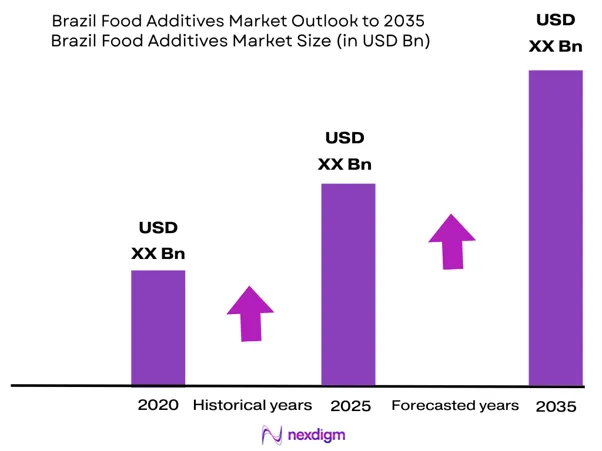
Brazil Food Additives Market is valued at USD ~ billion, based on a five-year historical analysis, and is forecasted to grow at a CAGR of ~% during the forecast period. Demand is driven by flavors, sweeteners, preservatives, colors, emulsifiers, stabilizers, enzymes, acidulants and texturizers used across beverages, meat processing, bakery, dairy, confectionery and snacks. Brazil’s food industry revenue reached BRL 1.277 trillion after BRL 1.161 trillion, while GDP reached USD 2.19 trillion. São Paulo, Paraná, Santa Catarina, Rio Grande do Sul, Minas Gerais, Rio de Janeiro, Goiás, Mato Grosso, Bahia and Pernambuco dominate Brazil Food Additives Market because of food and beverage manufacturing, meat processing, dairy, bakery, confectionery, citrus ingredients, starches, sugarcane derivatives and beverage formulation clusters. Food manufacturing demand is supported by processed food exports reaching 80.3 million tons and USD 66.3 billion, while Brazil’s GDP per capita reached USD 10,310.5.
Market Segmentation
By Additive Function
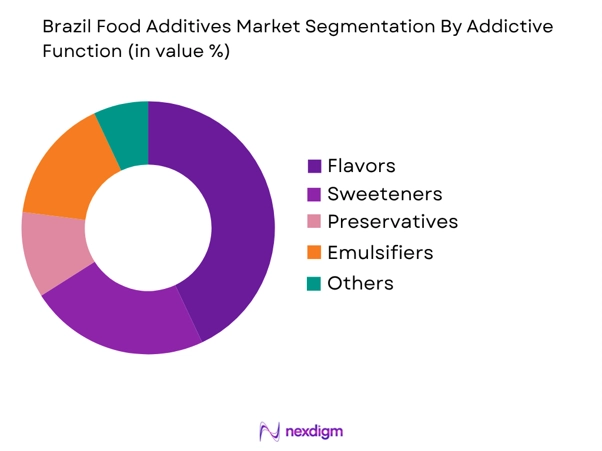
Brazil Food Additives Market is segmented by additive function into flavors and flavor enhancers, sweeteners, preservatives, colors, emulsifiers, stabilizers, thickeners, acidity regulators, antioxidants, enzymes, humectants, anti-caking agents, leavening agents, nutrient additives and processing aids. Recently, flavors and flavor enhancers have had a dominant market share under the additive function segmentation due to Brazil’s large beverage, confectionery, dairy, bakery, meat snack, sauce and processed food base. Tropical fruit flavors, citrus flavors, savory systems, yeast extracts and masking flavors are widely used to support product differentiation and reformulation. Beverage manufacturers use flavor systems for carbonated drinks, juices, energy drinks, dairy beverages, powdered drinks and functional beverages. Sweeteners, preservatives and texture systems remain important, but flavors dominate because Brazilian packaged food companies compete heavily on taste, regional preference, sensory identity and repeat purchase.
By Application
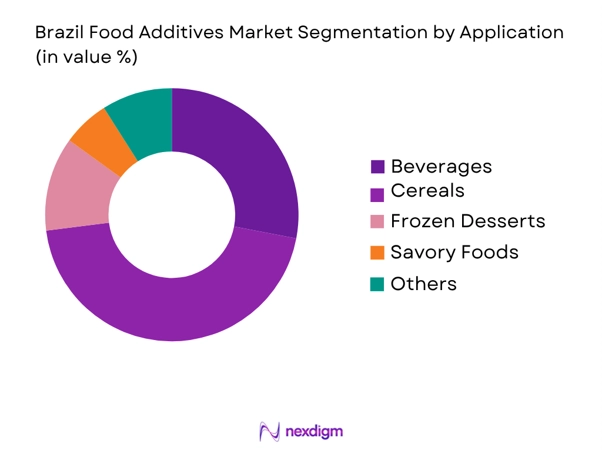
Brazil Food Additives Market is segmented by application into beverages, bakery and cereals, dairy and frozen desserts, confectionery, meat, poultry and seafood processing, snacks and savory foods, sauces, dressings and condiments, ready meals, frozen foods, plant-based foods, functional foods, fortified foods and foodservice ingredients. Recently, beverages have had a dominant market share under the application segmentation because the category requires flavors, sweeteners, acidulants, colors, preservatives, emulsifiers, clouding agents, stabilizers and functional ingredient systems. Brazil’s beverage sector is broad, covering soft drinks, juices, powdered drinks, energy drinks, dairy beverages, beer-adjacent mixers and functional drinks. Beverage formulas change frequently because companies adjust sweetness, acidity, color stability, mouthfeel and flavor profile for different consumer occasions. Meat processing, bakery, dairy and confectionery also use additives heavily, but beverages dominate due to high innovation frequency, large volume formats and the need for stable sensory performance across distribution conditions.
Competitive Landscape
Brazil Food Additives Market is led by global ingredient companies, domestic flavor houses, starch and sweetener producers, natural color suppliers, enzyme companies and specialty distributors. Cargill Brazil, ADM Brazil, Ingredion Brazil, Kerry Brazil and IFF Brazil are major players due to broad additive portfolios, application labs, formulation support, regulatory documentation, ingredient sourcing and direct relationships with food manufacturers. Competition is shaped by ANVISA compliance, clean-label reformulation, tropical flavor expertise, sugar reduction, natural colors, starch systems, enzyme solutions and supply reliability. ANVISA’s regulatory pathways for food and packaging include marketing authorization, notification and local health authority communication, making regulatory support a key differentiator.
| Company | Establishment Year | Headquarters | Core Portfolio | Technical Capability | Key End Users | Channel Strength | Regulatory / Clean Label Focus | Market-Specific Advantage |
| Cargill Brazil | 1965 | São Paulo, Brazil | ~ | ~ | ~ | ~ | ~ | ~ |
| ADM Brazil | 1997 | São Paulo, Brazil | ~ | ~ | ~ | ~ | ~ | ~ |
| Ingredion Brazil | 1925 legacy operations | São Paulo, Brazil | ~ | ~ | ~ | ~ | ~ | ~ |
| Kerry Brazil | 1994 operating base | Campinas, Brazil | ~ | ~ | ~ | ~ | ~ | ~ |
| International Flavors & Fragrances Brazil | 1929 global origin | São Paulo, Brazil | ~ | ~ | ~ | ~ | ~ | ~ |
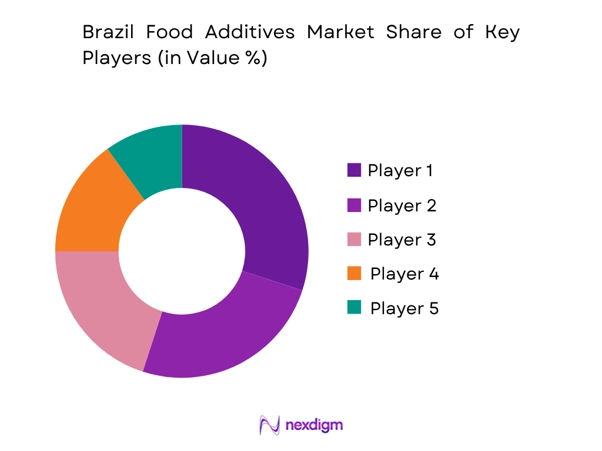
Brazil Food Additives Market Analysis
Growth Drivers
Processed Food Manufacturing Scale and Additive Usage Intensity
Brazil’s processed food manufacturing base is a core growth driver for the Brazil Food Additives Market because flavors, sweeteners, preservatives, colors, emulsifiers, stabilizers, enzymes, acidulants and texturizers are embedded across beverages, meat products, bakery, dairy, confectionery, snacks, sauces and ready meals. Agência Brasil, citing ABIA, reported Brazil food industry revenue of BRL 1.277 trillion, compared with BRL 1.161 trillion earlier, indicating a broad industrial demand base for additive systems used in shelf-life extension, color standardization, taste optimization, texture control and processing stability. World Bank data records Brazil GDP at USD 2.19 trillion, GDP per capita at USD 10,310.5 and GDP growth at 3.4, supporting consumer demand for packaged and processed foods. USDA FAS also reported food processing industry sales of BRL 1.161 trillion and USD 231 billion in the prior food processing cycle, confirming the depth of Brazil’s food manufacturing platform. This driver is market specific because additive suppliers serve beverage formulators, meat processors, dairy manufacturers, bakery companies, confectionery producers, co-packers and private-label food manufacturers that require consistent sensory and technical performance.
Beverage, Meat Processing and Export-Oriented Formulation Demand
Beverage and meat processing demand are major growth drivers for the Brazil Food Additives Market because these categories require complex additive systems for flavor stability, acidity control, color retention, preservation, protein functionality, moisture control, oxidation management and shelf-life performance. Brazil’s processed food exports reached 80.3 million tons and USD 66.3 billion, supporting demand for internationally compliant additive systems in meat, poultry, confectionery, beverages, sauces and shelf-stable products. World Bank data records Brazil’s population at 205.3 million and real GDP per capita at USD 10,616, showing a large domestic consumer base alongside export-driven food manufacturing. IMF lists Brazil’s 2026 population at 214.083 million and projected real GDP change at 1.9, reinforcing continued food consumption and industrial processing scale. This driver is market specific because beverage manufacturers require flavors, sweeteners, colors, stabilizers and acidulants, while meat and poultry processors require phosphates, antioxidants, preservatives, color stabilizers and functional blends to meet domestic retail, foodservice and export specifications.
Market Challenges
ANVISA Compliance, Additive Use Limits and Reformulation Burden
ANVISA compliance is a key challenge for the Brazil Food Additives Market because additive suppliers and food manufacturers must align products with authorized additive lists, permitted food categories, maximum use limits, labeling rules, nutrition disclosure and processing-aid requirements. ANVISA states that RDC 843/2024 establishes three regulatory pathways for food and packaging: marketing authorization with ANVISA, notification to ANVISA and communication to the competent local health authority before manufacturing or importation. This affects additive-heavy categories such as beverages, dairy products, bakery, confectionery, processed meats, sauces, snacks and frozen foods. World Bank records Brazil GDP at USD 2.19 trillion and GDP growth at 3.4, while Agência Brasil reported food industry revenue of BRL 1.277 trillion, indicating the large number of formulations exposed to compliance review and documentation requirements. This challenge is market specific because each reformulation may require ingredient verification, stability testing, label updates, supplier documentation, technical justification and category-specific review, especially for sweeteners, colorants, preservatives, emulsifiers, stabilizers, enzymes and novel functional ingredients.
Natural Ingredient Stability, Cost-in-Use and Supply Chain Complexity
Natural ingredient stability and supply chain complexity restrain the Brazil Food Additives Market because clean-label alternatives do not always match the performance of conventional synthetic additives across heat, light, pH, oxygen exposure, long distribution routes and varied storage conditions. Natural colors such as annatto, turmeric, beet, anthocyanins, carotenoids and spirulina can face shade drift, flavor interaction or oxidation challenges in beverages, confectionery, dairy desserts and sauces. Clean-label stabilizers such as cassava starch, citrus fiber, gums and fermentation-derived preservatives require careful validation in bakery, meat, dairy, plant-based and ready-meal applications. World Bank data records Brazil GDP per capita at USD 10,310.5 and GDP growth at 3.4, while IMF projects consumer price change at 4.0 for 2026, indicating operating pressure on manufacturers balancing affordability with reformulation. USDA FAS reported Brazil food processing industry sales of BRL 1.161 trillion and USD 231 billion in the prior cycle, showing the scale of manufacturing affected by ingredient substitution. This challenge is market specific because additive replacement requires application testing, sensory validation, supplier qualification and processing-line adjustment.
Market Opportunities
Natural Colors, Tropical Flavors and Clean-Label Reformulation
Natural colors, tropical flavors and clean-label reformulation create a future growth opportunity for the Brazil Food Additives Market because food manufacturers are under pressure to simplify labels while preserving taste, appearance, shelf life and texture. Brazil has domestic relevance in citrus, sugarcane, cassava, soy, annatto and tropical fruit ingredients, creating a platform for localized natural colors, fruit flavors, clean-label texturizers, starch systems and bio-based formulation inputs. Agência Brasil reported food industry revenue of BRL 1.277 trillion, compared with BRL 1.161 trillion earlier, showing a large downstream base for reformulation. World Bank records Brazil GDP at USD 2.19 trillion and population at 205.3 million, while IMF lists Brazil’s 2026 population at 214.083 million, supporting both retail food demand and industrial innovation. This opportunity is market specific because beverage companies can use tropical fruit flavors and natural colors, bakery companies can use enzyme systems and starches, dairy companies can use stabilizers and colors, and meat processors can adopt antioxidants, clean-label preservatives and flavor systems for differentiated domestic and export products.
Sugar Reduction, Functional Foods and Bio-Based Ingredient Platforms
Sugar reduction, functional foods and bio-based ingredient platforms create a future growth opportunity for the Brazil Food Additives Market because beverage, dairy, bakery, confectionery, snack and nutrition companies require sweetener blends, bulking agents, flavor maskers, acidity systems, stabilizers, fibers, enzymes and fortified ingredient systems. Brazil’s food manufacturing base is large enough to support specialized formulation platforms, with food industry revenue of BRL 1.277 trillion reported by Agência Brasil and processed food export activity reaching 80.3 million tons and USD 66.3 billion. World Bank data records Brazil GDP per capita at USD 10,310.5 and GDP growth at 3.4, supporting continued packaged food consumption, while IMF lists 2026 real GDP change at 1.9 and population at 214.083 million. This opportunity is market specific because sugar-reduced beverages need sweetener systems and taste modulation, dairy and plant-based foods need texture and mouthfeel solutions, bakery products need enzymes and moisture control, and functional foods need nutrient delivery, flavor masking and stability support. Suppliers with application labs, ANVISA documentation and local feedstock linkages can move from commodity additives into customized ingredient systems.
Future Outlook
Brazil Food Additives Market is expected to expand steadily during the forecast period, supported by processed food demand, beverage innovation, meat exports, bakery growth, confectionery consumption, clean-label reformulation, natural color adoption and functional food development.
Regulatory compliance will remain a central strategic factor. ANVISA’s framework for food and packaging includes marketing authorization, notification and local health authority communication, while additive and processing aid updates continue to affect product approval, maximum-use limits and category-specific requirements.
Natural and clean-label additives will gain relevance. Food manufacturers will increasingly use natural flavors, natural colors, citrus fiber, cassava starch, fermentation-derived preservatives, clean-label hydrocolloids and enzyme-based processing aids to respond to label scrutiny and front-of-pack nutrition communication.
Brazil’s agro-industrial feedstock base will support local ingredient innovation. Sugarcane derivatives, corn starch, cassava starch, citrus ingredients, soy lecithin, annatto, turmeric, tropical fruit extracts and fermentation substrates can support differentiated additive development for beverages, bakery, dairy, meat, snacks and plant-based foods.
Export-oriented meat, poultry, beverage and processed food manufacturers will require consistent additive systems that comply with domestic and international requirements. Suppliers with application labs, regulatory teams, traceability documentation and formulation support will be better positioned than commodity ingredient sellers.
Major Players
- Cargill Brazil
- ADM Brazil
- Ingredion Brazil
- Kerry Brazil
- International Flavors & Fragrances Brazil
- Givaudan Brazil
- DSM-Firmenich Brazil
- Symrise Brazil
- Duas Rodas
- Tate & Lyle Brazil
- Corbion Brazil
- Sensient Technologies Brazil
- Kemin Industries Brazil
- Biorigin
- Vogler Ingredients
Key Target Audience
- Food Additive Manufacturers
- Flavor and Fragrance Companies
- Packaged Food Manufacturers
- Beverage Manufacturers
- Meat, Bakery, Dairy and Snack Processors
- Foodservice Ingredient Buyers and Chain Restaurant Procurement Teams
- Investments and Venture Capitalist Firms
- Government and Regulatory Bodies (Agência Nacional de Vigilância Sanitária, Ministério da Agricultura e Pecuária, Instituto Nacional de Metrologia Qualidade e Tecnologia, Conselho Administrativo de Defesa Econômica, Receita Federal do Brasil)
Research Methodology
Step 1: Identification of Key Variables
The initial phase involves constructing an ecosystem map encompassing all major stakeholders within the Brazil Food Additives Market. This includes additive manufacturers, flavor houses, ingredient distributors, packaged food companies, beverage companies, meat processors, bakery manufacturers, co-packers, testing laboratories and regulatory agencies. The objective is to define variables such as additive function, origin, application, regulatory status, form, sales channel and clean-label positioning.
Step 2: Market Analysis and Construction
In this phase, historical data is compiled and analyzed for the Brazil Food Additives Market. The assessment covers flavors, sweeteners, preservatives, colors, emulsifiers, stabilizers, thickeners, enzymes, acidulants, antioxidants, processing aids and nutrient additives. Top-down validation uses food industry, macroeconomic and regulatory datasets, while bottom-up validation uses product-label audits, application mapping and manufacturer interviews.
Step 3: Hypothesis Validation and Expert Consultation
Market hypotheses are developed and validated through computer-assisted telephone interviews with additive suppliers, flavor houses, beverage formulators, bakery ingredient buyers, dairy processors, meat processors, snack manufacturers, co-packers and regulatory professionals. These consultations provide insights into additive selection, reformulation triggers, cost-in-use, clean-label substitution, supplier qualification, ANVISA documentation and application performance.
Step 4: Research Synthesis and Final Output
The final phase integrates desk research, primary interviews, label audits, application benchmarking, regulatory mapping and competitive assessment into a consolidated market model. Supplier inputs are compared with observed product launches, food manufacturing demand, processed food export requirements and clean-label reformulation activity. The final output provides a validated view of market size, segmentation, competition, future outlook and strategic implications.

- Executive Summary
- Research Methodology (Market Definitions and Assumptions, Abbreviations, Food Additive and Technological Adjuvant Classification, Direct vs Indirect Additive Inclusion Criteria, Synthetic vs Natural Additive Inclusion Criteria, ANVISA Authorized Additive Mapping, RDC and Normative Instruction Compliance Assessment, Clean Label vs Conventional Formulation Scope, Processed Food Demand Mapping, Beverage and Meat Processing Additive Usage Assessment, Market Sizing Approach, Top-Down Analysis, Bottom-Up Analysis, Demand-Side Assessment, Supply-Side Assessment, ANVISA Ingredient Validation, Retail Packaged Food Label Audit, Food Processor Interviews, Flavor House and Ingredient Distributor Interviews, Primary Industry Interviews, Data Triangulation, Forecasting Framework, Limitations and Future Conclusions)

- Definition and Scope
- Market Evolution and Industry Genesis
- Timeline of Major Industry Developments
- Business Cycle and Reformulation Cycle
- ANVISA Food Additive Approval and Compliance Pathway

- Growth Drivers (Large Processed Food Industry Base, Beverage Manufacturing Scale, Sugar and Sweetener Feedstock Availability, Meat Processing and Export Demand, Bakery and Confectionery Consumption, Clean Label Reformulation, Natural Flavor and Color Adoption, Functional Food and Fortified Product Demand, Foodservice Chain Standardization, Private Label Product Development)
- Market Challenges (ANVISA Regulatory Updates, Additive Use Limit Compliance, Labeling and Nutrition Disclosure Complexity, Consumer Concern Over Ultra-Processed Foods, Natural Ingredient Cost and Stability Issues, Synthetic Color and Preservative Scrutiny, Supply Dependence for Specialty Hydrocolloids and Enzymes, Reformulation Validation Costs, Regional Distribution Complexity)
- Market Opportunities (Natural Color Systems, Sugar Reduction Technologies, Fermentation-Derived Preservatives, Clean Label Texturizers, Bio-Based Acidulants, Cassava and Citrus Ingredient Valorization, Plant-Based Food Texture Systems, Meat Processing Shelf-Life Solutions, Enzyme-Based Bakery Improvers, Functional Beverage Additive Platforms)
- Market Trends (Shift Toward Natural Flavors, Natural Color Replacement, Clean Label Hydrocolloids, Sugar Reduction in Beverages, Sodium Reduction in Processed Foods, Plant-Based Stabilizer Demand, Fermentation Ingredient Adoption, Ingredient Simplification, Fortification and Functional Claims, Sustainability-Led Sourcing)
- SWOT Analysis
- Porter’s Five Forces Analysis
- PESTLE Analysis

- By Market Value (2020-2025)
- By Volume Consumption (2020-2025)
- By Average Selling Price (2020-2025)

- By Additive Function (In Value %)
Flavors and Flavor Enhancers
Sweeteners
Preservatives
Colors
Emulsifiers
Stabilizers and Thickeners - By Ingredient Origin (In Value %)
Synthetic Additives
Nature-Identical Additives
Natural Additives
Plant-Derived Additives
Fermentation-Derived Additives - By Distribution and Sales Channel (In Value %)
Direct Sales to Food Manufacturers
Ingredient Distributors
Specialty Chemical Distributors
Flavor Houses
Foodservice Ingredient Suppliers - By Region (In Value %)
Southeast Brazil
South Brazil
Northeast Brazil
Central-West Brazil
North Brazil

- Market Share of Major Players (By Value, Volume, Additive Function, Application, Ingredient Origin, Sales Channel)
- Competitive Positioning Matrix (Functionality Breadth, Application Lab Network, ANVISA Regulatory Support Capability, Clean Label Portfolio, Natural Ingredient Pipeline, Customer Co-Development Capability, Supply Chain Security, Brazil Manufacturing and Distribution Footprint)
- Cross Comparison Parameters (Food Additive Portfolio Breadth, ANVISA Regulatory Support Capability, Application Lab and Technical Service Network, Clean Label Reformulation Strength, Natural Colors and Tropical Flavors Portfolio, Sweetener and Sugar-Reduction System Capability, Enzyme and Texturizer Innovation Pipeline, Brazil Manufacturing and Distribution Footprint)
- SWOT Analysis of Major Players
- Detailed Profiles of Major Companies
Cargill Brazil
ADM Brazil
Ingredion Brazil
Kerry Brazil
International Flavors & Fragrances Brazil
Givaudan Brazil
DSM-Firmenich Brazil
Symrise Brazil
Duas Rodas
Tate & Lyle Brazil
Corbion Brazil
Sensient Technologies Brazil
Kemin Industries Brazil
Biorigin
Vogler Ingredients

- Food Manufacturer Demand Assessment
- Packaged Food Buyer Behavior Assessment
- Beverage Formulation Demand Assessment
- Bakery and Cereal Additive Demand Assessment
- Dairy and Frozen Dessert Additive Demand Assessment

- By Market Value (2026-2035)
- By Volume Consumption (2026-2035)
- By Average Selling Price (2026-2035)


 Request a Sample
 Ask for Customization
 Get a Quote
 Enquire Now