
 Download PDF
Market Overview
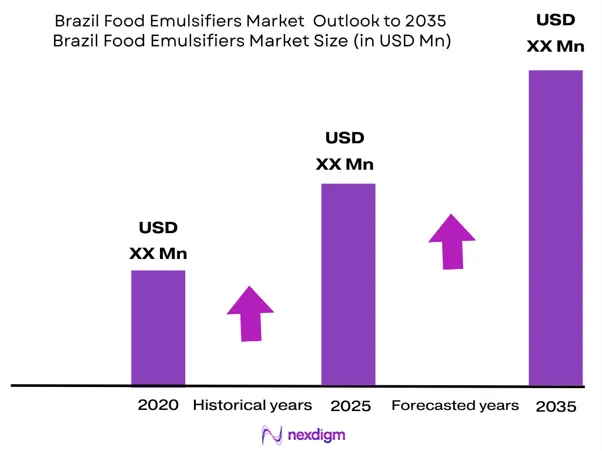
The Brazil Food Emulsifiers Market is valued at USD ~ million, based on a five-year historical analysis, and is forecast to grow at % CAGR during the forecast period. Demand is driven by industrial bakery, confectionery, chocolate, dairy, frozen desserts, spreads, sauces, beverages, snacks and plant-based foods. Brazil’s food industry revenue reached BRL 1.277 trillion, while food processing revenues were reported at USD 231 billion earlier, creating a large industrial base for emulsifier usage. The Brazil Food Emulsifiers Market is dominated by São Paulo, Greater São Paulo, Paraná, Rio Grande do Sul, Minas Gerais, Santa Catarina, Rio de Janeiro, Goiás, Mato Grosso, Bahia and Pernambuco. São Paulo dominates through bakery, confectionery, ingredient trading and FMCG concentration, while Paraná and Rio Grande do Sul dominate soybean processing and lecithin supply. Minas Gerais supports dairy demand, and Santa Catarina-Paraná strengthen meat and frozen food applications. Brazil’s bakery revenue reached BRL 153.3 billion, reinforcing bakery-led emulsifier consumption.
Market Segmentation
By Emulsifier Type
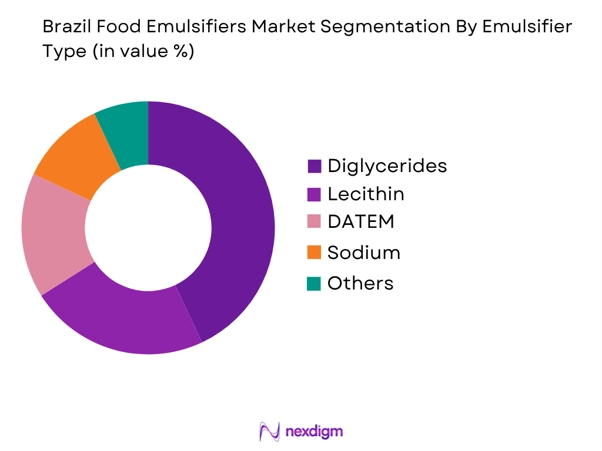
Brazil Food Emulsifiers Market is segmented by emulsifier type into mono- and diglycerides, lecithin, DATEM, sodium stearoyl lactylate, calcium stearoyl lactylate, polysorbates, sorbitan esters, PGPR, sucrose esters, polyglycerol esters and customized emulsifier blends. Recently, mono- and diglycerides have a dominant market share in Brazil under the emulsifier type segmentation due to their broad usage in bread, cakes, biscuits, margarine, spreads, whipped toppings, frozen desserts and convenience foods. Their dominance is linked to cost-in-use efficiency, compatibility with vegetable oils and fats, and ability to deliver multiple functional benefits including dough conditioning, aeration, fat dispersion, crumb softness, anti-staling and emulsion stability. Brazilian manufacturers prefer these emulsifiers because they can be scaled across industrial bakeries, private label foods and foodservice premixes without major formulation complexity. Their use is further supported by Brazil’s large bakery and packaged food manufacturing base.
By Application
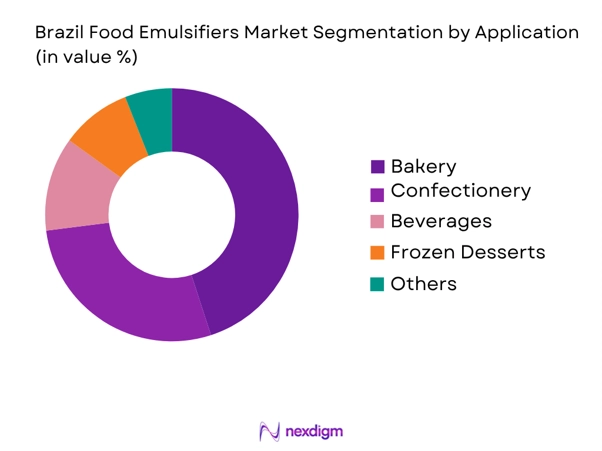
Brazil Food Emulsifiers Market is segmented by application into bakery products, confectionery and chocolate, dairy and frozen desserts, sauces, dressings, margarine, spreads, beverages, RTD drinks, meat products, plant-based foods, powdered mixes, nutritional products and foodservice premixes. Recently, bakery products have a dominant market share in Brazil under the application segmentation because industrial and artisanal bakery products require emulsifiers for dough tolerance, softness, volume, anti-staling, moisture retention and consistent texture. Bread, cakes, biscuits, sweet baked goods, packaged bakery products and frozen bakery formats use mono- and diglycerides, DATEM, SSL, CSL, lecithin and enzyme-emulsifier systems. Brazil’s bakery sector reached BRL 153.3 billion, and independent bakeries remain a high-frequency foodservice channel. This makes bakery the most structurally important application because it uses emulsifiers not as optional additives but as process-critical ingredients for quality stability, product freshness and large-scale distribution.
Competitive Landscape
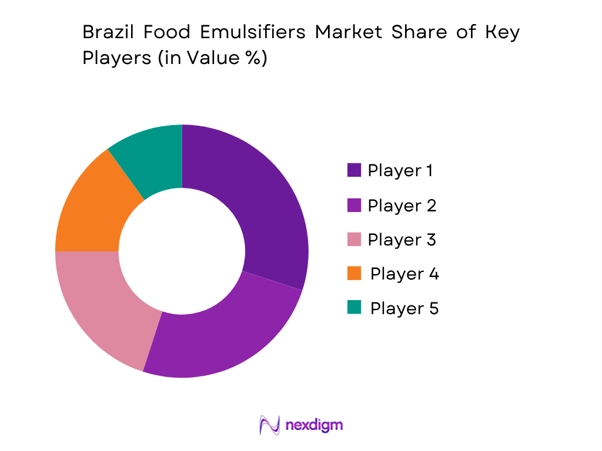
Brazil Food Emulsifiers Market is served by integrated agribusiness companies, specialty emulsifier manufacturers, lecithin suppliers, bakery ingredient specialists, dairy formulation companies, confectionery ingredient suppliers and regional distributors. The competitive structure is shaped by Brazil’s soybean base, large bakery sector, strong dairy and frozen dessert demand, confectionery processing, and ANVISA-regulated food additive environment. Large food manufacturers prefer suppliers that combine ANVISA documentation, Mercosur-compatible regulatory support, local warehousing, application troubleshooting, clean-label options and reliable supply across São Paulo, Paraná, Minas Gerais, Rio Grande do Sul and Santa Catarina.
| Company | Establishment Year | Headquarters | Core Emulsifier Focus | Brazil Market Role | Key Applications | Distribution Strength | Compliance Capability | Market-Specific Capability |
| ADM do Brasil | 1902 | Chicago, USA | ~ | ~ | ~ | ~ | ~ | ~ |
| Cargill Agrícola S.A. | 1865 | Wayzata, USA | ~ | ~ | ~ | ~ | ~ | ~ |
| Bunge Alimentos | 1818 | St. Louis, USA | ~ | ~ | ~ | ~ | ~ | ~ |
| Corbion Brasil | 1919 | Amsterdam, Netherlands | ~ | ~ | ~ | ~ | ~ | ~ |
| Palsgaard Brasil | 1917 | Juelsminde, Denmark | ~ | ~ | ~ | ~ | ~ | ~ |
Brazil Food Emulsifiers Market Analysis
Growth Drivers
Industrial bakery, food processing and packaged food manufacturing scale
Brazil Food Emulsifiers Market is driven by the scale of industrial bakery, confectionery, dairy, spreads, sauces, snacks and processed food manufacturing, where mono- and diglycerides, lecithin, DATEM, SSL, CSL, PGPR, polysorbates and sorbitan esters are used for dough conditioning, anti-staling, aeration, fat dispersion, emulsion stability, viscosity control and mouthfeel improvement. Brazil’s food industry revenue reached BRL 1.277 trillion in 2024, while ABIA data reported by USDA FAS placed Brazil’s food processing industry sales at BRL 1.161 trillion in 2023. IBGE also reported that Brazil’s GDP closed 2024 at BRL 11.7 trillion, after BRL 10.9 trillion in 2023, showing a larger macroeconomic base for industrial consumption. Bakery is a direct emulsifier demand anchor because Agência Brasil reported sector revenue of BRL 153.3 billion in 2024. These figures support emulsifier use because industrial bakeries, chocolate processors, frozen dessert manufacturers, margarine producers and private label food suppliers need repeatable texture, longer freshness and processing efficiency across Brazil’s large retail and foodservice networks.
Soybean feedstock base and lecithin-linked emulsifier availability
Brazil Food Emulsifiers Market benefits from Brazil’s large oilseed and soybean processing ecosystem, which supports soy lecithin availability for chocolate, bakery, beverages, sauces, nutritional powders and plant-based food formulations. CONAB-linked reporting placed Brazil’s soybean crop at 171.481 million tons for 2025, while Reuters reported USDA’s 2024/25 Brazil soybean projection at 169 million tons and CONAB’s projection at 166 million tons. This is directly market-specific because lecithin is one of the most important food emulsifiers, while oilseed and fatty-acid streams support mono- and diglycerides and other emulsifier inputs used in bakery, spreads, confectionery and frozen desserts. World Bank states Brazil had 205.3 million people and real GDP per capita of USD 10,616 in 2024, confirming the scale of domestic food consumption behind this ingredient base. The feedstock advantage gives Brazil an important structural position in soy-based emulsifiers, but it also creates room for source-differentiated lecithin, including non-GMO, sunflower and clean-label systems for export-oriented food manufacturers.
Market Challenges
ANVISA positive-list compliance and application-specific documentation
Brazil Food Emulsifiers Market faces a major regulatory challenge because emulsifiers must comply with ANVISA’s food additive and processing aid framework, including permitted technological functions, maximum limits and product-category conditions. ANVISA’s consolidated framework includes RDC 778/2023, which sets general principles, technological functions and use conditions for food additives and processing aids, and IN 211/2023, which establishes technological functions, maximum limits and use conditions for authorized additives and processing aids. This matters directly for emulsifiers because mono- and diglycerides, lecithin, DATEM, SSL, CSL, polysorbates, sorbitan esters and PGPR are not evaluated only by ingredient name; they must match the finished food category and declared technological purpose. The compliance burden affects a large industrial base, as Brazil’s food industry revenue reached BRL 1.277 trillion in 2024 and USDA FAS recorded food processing sales of BRL 1.161 trillion in 2023. Manufacturers must manage formulation files, labels, supplier specifications, certificates of analysis and sanitary documentation before scaling bakery, dairy, chocolate, sauce or plant-based formulations.
Clean-label reformulation pressure, feedstock volatility and technical validation burden
Brazil Food Emulsifiers Market is constrained by clean-label reformulation pressure and the technical risk of replacing conventional emulsifiers. Mono- and diglycerides, DATEM, SSL, CSL and polysorbates provide essential functionality in bakery, dairy, chocolate, sauces, spreads and frozen desserts, but manufacturers increasingly evaluate shorter ingredient lists, non-GMO claims, palm-free positioning, allergen declarations and sustainable sourcing. Brazil’s food industry revenue reached BRL 1.277 trillion in 2024, while bakery sector revenue reached BRL 153.3 billion, meaning reformulation affects high-volume categories where product failure can disrupt large retail and foodservice channels. The technical burden is material: changing an emulsifier can affect dough strength, crumb softness, aeration, chocolate viscosity, fat bloom, frozen dessert meltdown, sauce separation and plant-based texture. IBGE reported GDP of BRL 11.7 trillion in 2024 and BRL 10.9 trillion in 2023, indicating a large but cost-sensitive economy. Suppliers must therefore validate clean-label alternatives through pilot trials, sensory checks, shelf-life studies, heat-processing tests and ANVISA-aligned documentation before commercial launch.
Market Opportunities
Value-added soy lecithin, non-GMO lecithin and source-differentiated emulsifiers
Brazil Food Emulsifiers Market has a clear opportunity in value-added lecithin and source-differentiated emulsifier systems because the country combines major soybean availability with a large processed food base. CONAB-linked reporting placed Brazil’s soybean crop at 171.481 million tons in 2025, while Reuters reported Brazil soybean projections of 169 million tons from USDA and 166 million tons from CONAB for 2024/25. This feedstock base supports soy lecithin use in chocolate, bakery, beverages, nutritional powders, sauces and plant-based foods. However, premium opportunities sit in refined, hydrolyzed, de-oiled, non-GMO and sunflower lecithin systems, as manufacturers seek label-friendly emulsification with traceability and consistent performance. Brazil’s food industry revenue reached BRL 1.277 trillion in 2024, and USDA FAS recorded food processing industry sales of BRL 1.161 trillion in 2023, creating a large installed base for differentiated emulsifier adoption. Suppliers can target chocolate viscosity control, bakery softness, powdered beverage instantization, plant-based mouthfeel and export-grade clean-label formulations with documented source origin and ANVISA-ready specifications.
Application-specific bakery, dairy, chocolate and plant-based emulsifier systems
Brazil Food Emulsifiers Market has a forward growth opportunity in application-specific emulsifier systems because Brazilian food manufacturers need more than commodity ingredients; they need technical systems that solve texture, shelf-life, processing and label challenges. Bakery is the clearest opportunity, with sector revenue at BRL 153.3 billion in 2024, supporting demand for enzyme-emulsifier blends, anti-staling systems, dough conditioners and softness improvers. Dairy and frozen desserts also provide high-value opportunities because USDA FAS estimated Brazil’s milk production at 25 million metric tons, while IBGE reported milk production value at BRL 87.5 billion, supporting emulsifier use in ice cream, whipped toppings, dairy beverages and cream products. Brazil’s GDP reached BRL 11.7 trillion in 2024 and BRL 10.9 trillion in 2023, indicating a consumption base large enough for premium and mass-market formulation needs. Suppliers can use current demand to build bakery premixes, chocolate lecithin-PGPR solutions, dairy aeration systems, sauce stabilizing blends and plant-based texture systems with ANVISA documentation and pilot-trial support.
Future Outlook
Over the forecast period, the Brazil Food Emulsifiers Market is expected to grow steadily through industrial bakery expansion, packaged food consumption, dairy and frozen dessert innovation, chocolate processing optimization, sauces and dressings, spreads, nutritional products and plant-based food formulation. Emulsifiers will remain critical for emulsion stability, dough conditioning, aeration, fat dispersion, anti-staling, moisture retention, crystal control, viscosity management and mouthfeel enhancement.
Bakery will remain the largest demand anchor because bread, biscuits, cakes, sweet baked goods and frozen bakery formats require emulsifier systems for softness, volume, machinability and longer freshness. Enzyme-emulsifier blends will gain relevance as manufacturers seek shorter ingredient lists while maintaining performance in high-speed bakery lines.
Lecithin will continue to be strategically important because Brazil has a large soybean base. Soy lecithin will remain central for chocolate, bakery, beverages, powdered mixes, nutritional foods and plant-based formulations, while sunflower and non-GMO lecithin will gain traction where manufacturers need cleaner positioning or export-compatible claims.
Confectionery and chocolate will support demand for lecithin and PGPR because manufacturers need viscosity control, fat dispersion, flow optimization, bloom control and processing efficiency. Brazil’s confectionery industry and export-oriented snack participation create opportunities for specialty emulsifier solutions.
Dairy and frozen desserts will remain a high-value application area. Ice cream, frozen novelties, whipped toppings, dairy drinks, cream products and plant-based dairy alternatives require emulsifiers to manage aeration, fat destabilization, smoothness, freeze-thaw stability and mouthfeel.
Clean-label reformulation will influence future competition. Natural-origin emulsifiers, palm-free systems, non-GMO lecithin, enzyme-led replacements and organic-compatible emulsifier blends will gain relevance as food manufacturers respond to health, sustainability and ingredient declaration expectations.
Major Players
- ADM do Brasil
- Cargill Agrícola S.A.
- Bunge Alimentos
- Corbion Brasil
- Palsgaard Brasil
- BASF Brasil
- Kerry do Brasil
- Ingredion Brasil
- International Flavors & Fragrances Brasil
- AAK Brasil
- Sternchemie Brasil
- Lasenor Brasil
- Lecico Brasil
- Riken Vitamin Brazil
- Saporiti do Brasil
Key Target Audience
- Food emulsifier manufacturers
- Bakery, confectionery and chocolate manufacturers
- Dairy, frozen dessert and beverage manufacturers
- Plant-based food and alternative dairy manufacturers
- Sauce, dressing, margarine and spread manufacturers
- Ingredient distributors and specialty ingredient suppliers
- Investments and venture capitalist firms
- Government and regulatory bodies (Agência Nacional de Vigilância Sanitária, Ministério da Agricultura e Pecuária, Ministério da Saúde, Receita Federal do Brasil, state sanitary surveillance agencies)
Research Methodology
Step 1: Identification of Key Variables
The initial phase involves constructing an ecosystem map covering emulsifier manufacturers, soybean processors, lecithin suppliers, bakery ingredient companies, dairy ingredient suppliers, distributors, food processors and private label manufacturers. This step uses desk research, regulatory review, trade indicators and company-level mapping. The objective is to define variables such as emulsifier type, source, form, functionality, application, end user and distribution channel.
Step 2: Market Analysis and Construction
In this phase, historical data is compiled across food industry revenue, bakery demand, soybean feedstock, dairy production, confectionery demand, foodservice activity and ingredient procurement. The top-down approach evaluates national food-sector and macro indicators, while the bottom-up approach assesses emulsifier usage in bakery, confectionery, dairy, sauces, spreads, beverages and plant-based foods. This supports value, volume and segment-level modelling.
Step 3: Hypothesis Validation and Expert Consultation
Market hypotheses are validated through computer-assisted telephone interviews with emulsifier suppliers, lecithin producers, bakery technologists, dairy formulators, confectionery specialists, plant-based food developers and ingredient distributors. These consultations help verify mono- and diglycerides dominance, lecithin demand, clean-label substitution, ANVISA compliance needs and application-level usage. Expert inputs refine segmentation, competitive positioning and future outlook.
Step 4: Research Synthesis and Final Output
The final phase integrates secondary research, ANVISA regulatory review, company benchmarking, feedstock analysis, distributor checks and expert consultations into a consolidated market model. Data triangulation is applied across manufacturer demand, distributor movement, application usage and functional requirements. The final output includes market size, segmentation, competitive landscape, future outlook and strategic recommendations for Brazil Food Emulsifiers Market participants.

- Executive Summary
- Research Methodology (Market Definitions and Assumptions, Abbreviations, ANVISA Food Additive Mapping, RDC and IN Positive List Mapping, Mercosur Additive Alignment, Emulsifier Functional Class Mapping, HS Code Mapping, Market Sizing Approach, Top-Down Analysis, Bottom-Up Analysis, Demand-Side Assessment, Supply-Side Assessment, Import-Export Assessment, Food Processor Procurement Checks, Bakery and Dairy Formulator Interviews, Ingredient Distributor Interviews, Primary Industry Interviews, Data Triangulation, Forecasting Framework, Limitations and Future Conclusions)

- Definition and Scope
- Market Evolution and Industry Genesis
- Timeline of Major Industry Developments
- Role of Emulsifiers in Brazil Packaged Food Manufacturing

- Growth Drivers (Expansion of Industrial Bakery and Packaged Foods, Large Soybean and Lecithin Feedstock Base, Confectionery and Chocolate Processing Demand, Dairy and Frozen Dessert Innovation, Margarine and Spread Production, Foodservice and Private Label Expansion, Convenience Food Consumption, Texture and Shelf-Life Requirements in Tropical Distribution)
- Market Challenges (ANVISA Regulatory Compliance Complexity, Clean-Label Pressure on Synthetic Emulsifiers, Soy GMO and Allergen Sensitivity, Raw Material Volatility in Soybean and Vegetable Oils, Palm-Based Emulsifier Sustainability Concerns, Reformulation Performance Risk, Import Dependence for Specialty Emulsifiers, Application-Specific Technical Validation Requirements)
- Market Opportunities (Soy Lecithin Value Addition, Sunflower and Non-GMO Lecithin Expansion, Natural-Origin Emulsifier Systems, Enzyme-Based Bakery Emulsifier Replacement, Plant-Based Dairy and Meat Texture Systems, Chocolate Viscosity Optimization, Customized Bakery Anti-Staling Blends, Regional Mercosur Export-Ready Emulsifier Systems)
- Market Trends (Shift from Commodity Emulsifiers to Customized Blends, Clean-Label Replacement of Synthetic Emulsifiers, Increased Use of Enzyme-Based Dough Systems, Growth of Plant-Based Texture Solutions, Demand for Allergen-Friendly Emulsifiers, Sustainable Palm-Free Emulsifier Development, Lecithin Source Differentiation, Technical Service-Led Ingredient Selling)
- SWOT Analysis
- Porter’s Five Forces Analysis
- PESTLE Analysis

- By Market Value (2020-2025)
- By Consumption Volume (2020-2025)
- By Domestic Production Demand (2020-2025)

- By Emulsifier Type (In Value %)
Mono- and Diglycerides
Lecithin
DATEM
Sodium Stearoyl Lactylate
Calcium Stearoyl Lactylate
Polysorbates - By Source Type (In Value %)
Soy-Based Emulsifiers
Sunflower-Based Emulsifiers
Egg-Based Emulsifiers
Palm-Based Emulsifiers
Canola/Rapeseed-Based Emulsifiers - By Distribution Channel (In Value %)
Direct Sales to Food Manufacturers
Ingredient Distributors
Specialty Chemical Distributors
Bakery Ingredient Suppliers
Dairy Ingredient Suppliers
Confectionery Ingredient Suppliers - By Region (In Value %)
Southeast Brazil
South Brazil
Northeast Brazil
Central-West Brazil
North Brazil

- Market Share of Major Players (By Value, Volume, Emulsifier Type, Source Type, Application, End User, Region, Distribution Channel, Domestic vs Imported Portfolio)
- Cross Comparison Parameters (Emulsifier Portfolio Breadth, Lecithin Source Diversity, ANVISA Documentation Strength, Clean-Label and Non-GMO Product Range, Bakery and Confectionery Application Expertise, Plant-Based Formulation Capability, Brazil Manufacturing and Warehousing Footprint, Technical Support and Pilot Trial Capability)
- SWOT Analysis of Major Players
- Detailed Profiles of Major Companies
ADM do Brasil
Cargill Agrícola S.A.
Bunge Alimentos
Corbion Brasil
Palsgaard Brasil
BASF Brasil
Kerry do Brasil
Ingredion Brasil
IFF Brasil
AAK Brasil
Sternchemie Brasil
Lasenor Brasil
Lecico Brasil
Riken Vitamin Brazil
Saporiti do Brasil

- Industrial Bakery Manufacturer Analysis
- Confectionery and Chocolate Manufacturer Analysis
- Dairy and Frozen Dessert Processor Analysis
- Beverage Manufacturer Analysis
- Sauce, Dressing and Spread Manufacturer Analysis

- By Market Value (2026-2035)
- By Consumption Volume (2026-2035)
- By Domestic Production Demand (2026-2035)


 Request a Sample
 Ask for Customization
 Get a Quote
 Enquire Now