
 Download PDF
Market Overview
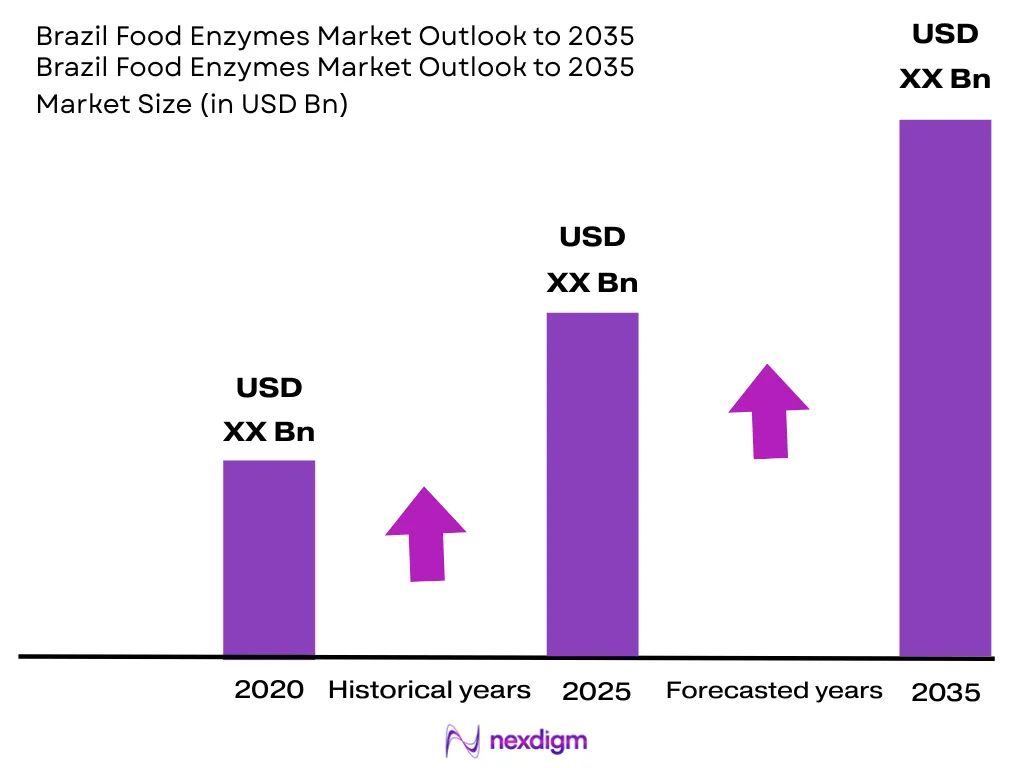
The Brazil Food Enzymes Market was valued at USD ~ Billion in 2024 and is anticipated to expand at a CAGR of ~% during 2026–2035. The market is primarily driven by Brazil’s large-scale food and beverage processing industry, its position as one of the world’s largest sugarcane and ethanol producers, and growing adoption of enzymatic processing aids across bakery, dairy, and beverage applications. According to Verified Market Research, the Brazil food enzymes market was valued at approximately USD 520 million in 2024 and is projected to reach USD 850 million by 2031, expanding at a CAGR of 6.5%. The Brazilian Association of Food Industries (ABIA) reports that food processing has grown at a consistent pace of approximately 4.5% per year, while Brazil’s Ministry of Agriculture, Livestock, and Supply (MAPA) noted that agribusiness accounted for 26.6% of national GDP in 2022. Brazil’s brewing industry alone produced over 14 billion liters of beer in 2023, according to industry association data, underscoring the scale of enzymatic demand across fermentation, clarification, and processing applications spanning bakery, dairy, beverages, animal feed, and processed food manufacturing.
Market Segmentation
By Type
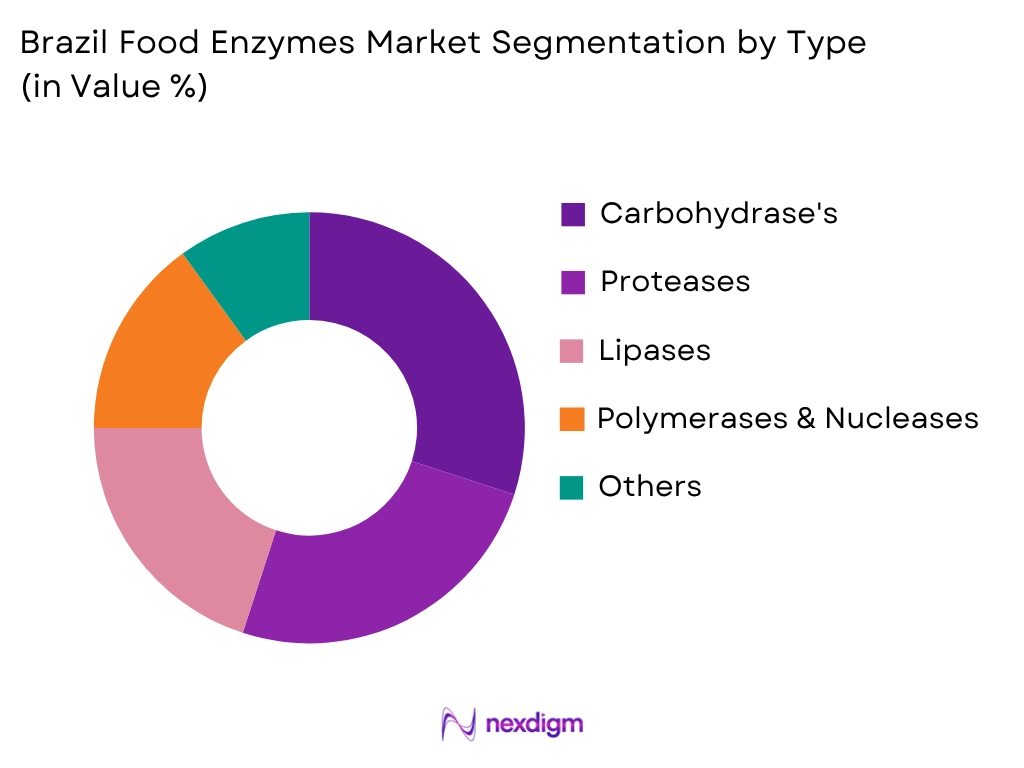
Among these, Carbohydrases, including amylases and cellulases, dominate the Brazil Food Enzymes Market owing to their extensive use in starch hydrolysis, sugar production, baking, and brewing applications closely tied to Brazil’s massive sugarcane, corn, and cassava processing industries. Brazil’s position as one of the world’s leading sugarcane and ethanol producers has created substantial demand for amylases and cellulases used in starch conversion and fermentation processes, further reinforced by Novozymes’ establishment of a regional innovation center in São Paulo in February 2024 dedicated to developing enzyme solutions tailored to Latin American raw materials such as sugarcane and cassava. Proteases represent a significant secondary segment, driven by cheese-making, meat processing, and protein hydrolysis applications, while Brazil’s native fruit resources, including papaya and pineapple, support a growing plant-derived protease segment used to produce papain and bromelain. Multinational and domestic enzyme manufacturers operating in Brazil continue to expand localized production and research capabilities to serve the country’s large-scale fermentation, dairy, and bakery processing industries.
By Application
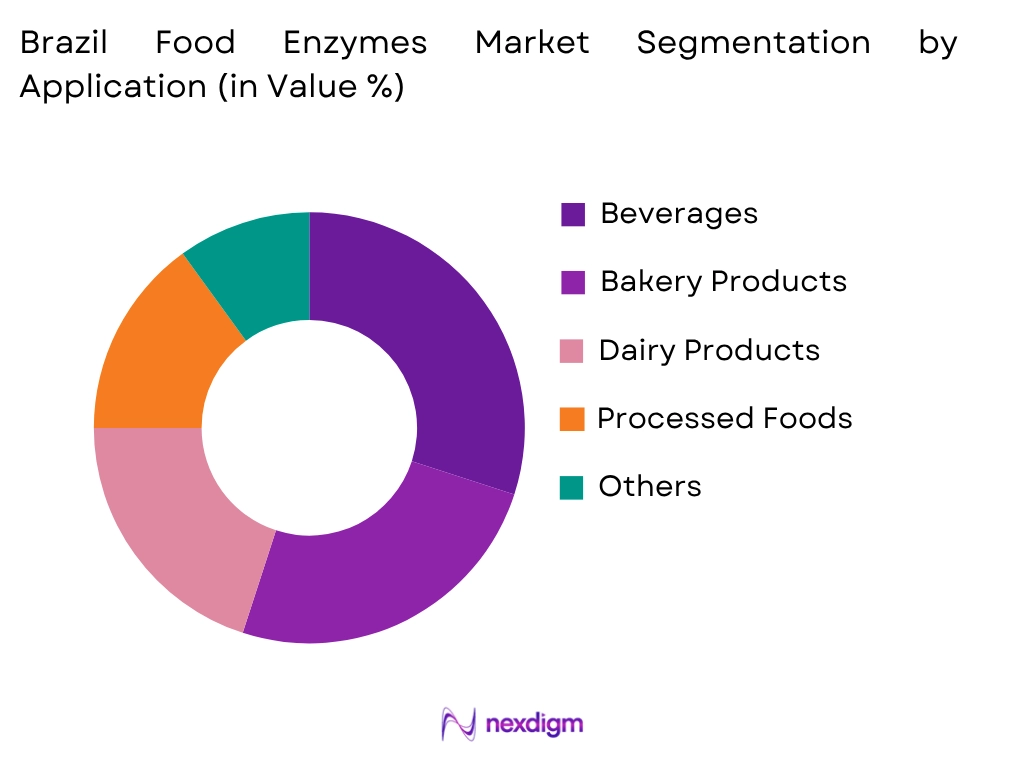
The Beverages segment, encompassing brewing, wine, and juice processing, holds the largest share owing to Brazil’s position as one of the world’s largest beer-producing nations, with production exceeding 14 billion liters in 2023. Enzymes such as glucanases, amylases, and pectinases are essential for improving filtration, clarity, fermentation efficiency, and overall yield in beer, wine, and fruit juice production. Brazil’s large fruit juice and nectar industry relies heavily on pectinolytic enzymes for efficient extraction and clarification, while the country’s growing health-conscious population has fueled demand for probiotic-rich beverages and fermented dairy products requiring specialized enzymatic processing. Continued expansion of Brazil’s brewing and beverage manufacturing capacity, supported by both multinational bottlers and domestic producers, is expected to sustain strong demand for enzymatic processing aids offering high specificity and consistent performance under Brazil’s diverse fermentation conditions.
Competitive Landscape
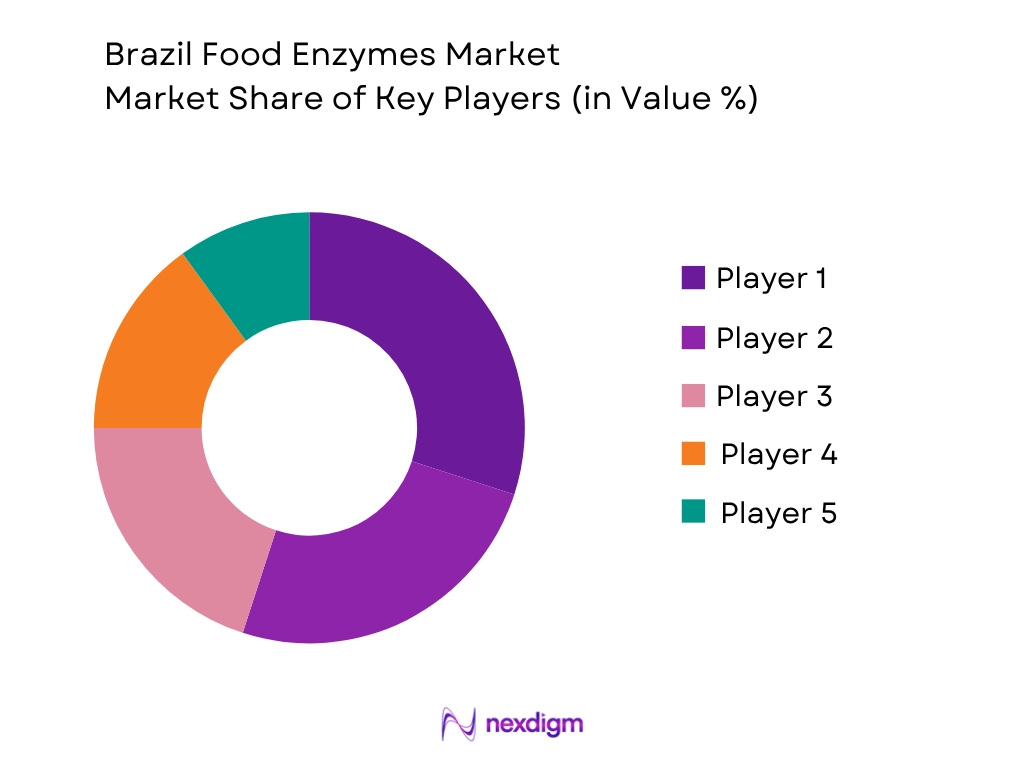
The Brazil Food Enzymes Market is moderately consolidated, with multinational biotechnology and ingredient manufacturers operating alongside established domestic enzyme specialists. Competition is primarily based on enzyme portfolio breadth, technical application support, regulatory compliance with ANVISA’s evolving food additive framework, pricing, and the ability to provide tailored solutions for Brazil’s sugarcane, dairy, brewing, and bakery processing industries. Companies are increasingly investing in localized research and development, exemplified by Novozymes’ 2024 innovation center in São Paulo focused on Latin American raw materials. Strategic collaborations with food and beverage manufacturers, expansion of domestic fermentation capacity, and continued innovation in plant-derived and microbial enzyme technologies have become key competitive differentiators across the Brazilian market.
| Company | Establishment Year | Headquarters | Primary Product Portfolio | Enzyme Portfolio
|
Manufacturing Presence | Major End-Use Industries | Key Strategic Focus | Certifications & Compliance |
| DSM-Firmenich | 2023 | ~ | ~ | ~ | ~ | ~ | ~ | ~ |
| Novozymes (Novonesis) | 1925 | ~ | ~ | ~ | ~ | ~ | ~ | ~ |
| IFF (International Flavors & Fragrances) | 1889 | ~ | ~ | ~ | ~ | ~ | ~ | ~ |
| BASF | 1865 | ~ | ~ | ~ | ~ | ~ | ~ | ~ |
| Prozyn Biosolutions | 1991 | ~ | ~ | ~ | ~ | ~ | ~ | ~ |
Brazil Confectionary Market Analysis
Growth Drivers
Large-Scale Fermentation Industry Anchored in Sugarcane and Ethanol Production
The Brazil Food Enzymes Market is experiencing sustained growth due to the country’s position as one of the world’s largest sugarcane growers and ethanol producers, an industry that relies extensively on amylases, cellulases, and other carbohydrate-active enzymes for starch conversion and fermentation efficiency. In February 2024, Novozymes launched a regional innovation center in São Paulo specifically aimed at accelerating the development of enzyme solutions tailored for Latin American raw materials such as sugarcane and cassava, reflecting the strategic importance multinational enzyme manufacturers place on the Brazilian market. Brazil’s large-scale agribusiness sector, which the Ministry of Agriculture, Livestock, and Supply (MAPA) reported accounted for 26.6% of national GDP in 2022, provides an extensive and diversified raw material base spanning sugarcane, corn, cassava, and soybean processing. This robust agricultural and fermentation infrastructure continues to create substantial and diversified demand for enzymatic processing aids across both food-grade and industrial fermentation applications.
Expansion of Brewing, Dairy, and Bakery Processing
Continued growth in Brazil’s brewing, dairy, and bakery processing sectors remains a major driver of enzyme consumption nationwide. According to industry association data, Brazil produced over 14 billion liters of beer in 2023, representing a 4.5% year-on-year increase, driving substantial demand for glucanases, amylases, and pectinases used to improve filtration, clarity, and fermentation yield. The Brazilian Association of Food Industries (ABIA) reported that food processing in the country has grown at a consistent pace of approximately 4.5% per year, supporting rising enzyme use in bakery applications for dough conditioning and shelf-life extension, as well as in dairy processing, where microbial proteases are increasingly preferred for cheese-making due to their ability to accelerate ripening while maintaining consistent flavor profiles. Rising disposable incomes and continued urbanization across Brazil have further increased demand for premium bakery, dairy, and beverage products that rely on enzymatic processing to enhance quality, yield, and consistency.
Market Challenges
New Regulatory Framework and Compliance Complexity
Brazil’s food enzymes market faces increased regulatory complexity following the implementation of a new food regulatory framework under RDC No. 843/2024 and Normative Instruction No. 281/2024, which took effect on September 1, 2024. These regulations introduced updated risk-based pre-market control mechanisms, distinguishing between products requiring registration, notification, or communication with health surveillance authorities, and specifically identify food supplements containing enzymes or probiotics as requiring mandatory notification with ANVISA. Enzyme manufacturers and food processors must navigate this evolving classification system, ensuring accurate technical documentation and timely compliance with revised labeling and safety requirements. The differing regulatory treatment of enzymes depending on their use as processing aids versus functional ingredients in food supplements adds further complexity for companies operating across multiple product categories in the Brazilian market.
Limited Manufacturer Awareness and Higher Adoption Costs
A significant challenge facing the Brazil Food Enzymes Market is the limited awareness and understanding of enzyme technology benefits among smaller food producers who continue to rely on traditional processing methods. Many manufacturers remain hesitant to adopt enzymatic solutions due to a lack of familiarity with their efficiency, cost-effectiveness, and technical benefits, particularly in markets where consumers and producers alike favor familiar, conventional processing techniques. This is compounded by the relatively higher upfront costs associated with enzyme technologies compared with traditional processing aids, as well as regulatory approval timelines that can delay market entry for new enzyme products. These factors collectively slow adoption rates among small and mid-sized food processors, even as larger multinational and industrial-scale manufacturers continue to expand enzyme usage across their operations.
Market Opportunities
Native Fruit-Based Plant Enzyme Innovation
Brazil’s extensive cultivation of native and tropical fruits, including papaya, pineapple, and passionfruit, presents substantial opportunities for plant-derived enzyme innovation. Plant-derived enzymes represent the fastest-growing segment within the broader Latin American food enzymes market, registering a projected CAGR of approximately 11.5%, driven by increasing consumer demand for natural, clean-label ingredients and regulatory support for plant-based additives. Brazil is well positioned to lead this expansion given its abundant supply of papain- and bromelain-yielding crops, creating opportunities for domestic and multinational manufacturers to develop specialized plant-based proteolytic enzyme portfolios for meat tenderization, beverage clarification, and dietary supplement applications, while reducing reliance on imported specialty enzymes.
Rising Functional Food and Nutraceutical Demand
Growing consumer interest in functional foods and nutraceuticals presents a meaningful opportunity for enzyme manufacturers in Brazil. The Brazilian Association of Food Industries (ABIA) projected that the functional food market would grow by 12.3% in 2021 as consumers increasingly sought food products with enhanced nutritional profiles, a trend that has continued to support demand for enzyme-enhanced products offering improved digestibility and health benefits. ANVISA’s regulatory framework explicitly recognizes enzymes as a permitted constituent of food supplements alongside nutrients, bioactive substances, and probiotics, providing a defined regulatory pathway for enzyme-based functional food innovation. This growing intersection between enzyme technology and Brazil’s expanding health-conscious consumer base creates long-term opportunities for manufacturers developing digestive enzyme supplements, fortified foods, and enzyme-assisted functional beverages.
Future Outlook
The Brazil Food Enzymes Market is expected to witness sustained expansion over the forecast period, supported by continued growth in the country’s sugarcane, brewing, dairy, and bakery processing industries, along with rising adoption of plant-derived and microbial enzyme technologies. Growing investment in localized research and development, exemplified by multinational enzyme manufacturers establishing innovation centers tailored to Brazilian raw materials, is expected to further strengthen the market’s technical capabilities. The market is also likely to benefit from continued regulatory clarity under ANVISA’s updated food additive framework and growing functional food demand, supporting long-term growth across bakery, beverages, dairy, animal feed, and processed food applications.
Major Players
- Novozymes (Novonesis)
- DSM-Firmenich
- IFF (International Flavors & Fragrances)
- BASF
- Prozyn Biosolutions
- Chr. Hansen
- AB Enzymes
- Amano Enzyme
- Kerry Group
- Advanced Enzyme Technologies
- Novus International
- DuPont
- Enzybel
- Lallemand
- Puratos
Key Target Audience
- Food Enzyme Manufacturers
- Food & Beverage Processing Companies
- Bakery and Confectionery Manufacturers
- Dairy Product Manufacturers
- Brewing, Wine & Beverage Manufacturers
- Animal Feed Manufacturers
- Nutraceutical and Functional Food Manufacturers
- Investment and Venture Capitalist Firms
- Government and Regulatory Bodies (Agência Nacional de Vigilância Sanitária (ANVISA), Ministry of Agriculture, Livestock, and Supply (MAPA), Brazilian Association of Food Industries (ABIA))
- Food Ingredient Distributors and Industrial Raw Material Suppliers
Research Methodology
Step 1: Identification of Key Variables
The research process begins with identifying the complete ecosystem of the Brazil Food Enzymes Market, including raw material suppliers, enzyme manufacturers, ingredient distributors, food processors, retailers, and regulatory authorities. Extensive secondary research is conducted using company annual reports, government publications, trade associations, customs statistics, industry journals, and proprietary databases to determine the variables influencing market demand, pricing, production, consumption, and technological developments.
Step 2: Market Analysis and Construction
Historical market information is collected and analyzed to estimate market size, production volumes, import-export activity, application-wise demand, and pricing trends. A combination of top-down and bottom-up approaches is used to estimate market revenues and validate segment-level performance. Consumption patterns across bakery, dairy, beverages, animal feed, processed foods, and nutraceuticals are evaluated to establish an accurate representation of the industry.
Step 3: Hypothesis Validation and Expert Consultation
The preliminary findings are validated through Computer-Assisted Telephone Interviews (CATIs) and structured discussions with enzyme manufacturers, procurement managers, distributors, food technologists, regulatory experts, and senior executives operating within the Brazilian food industry. These interviews help verify market assumptions, competitive developments, technology adoption trends, pricing dynamics, and future investment opportunities while refining the overall market estimates.
Step 4: Research Synthesis and Final Output
The final stage integrates insights obtained from primary interviews with quantitative information collected through secondary sources. Data triangulation techniques are applied to reconcile differences between supply-side and demand-side estimates, ensuring robust market forecasting. The report is then reviewed through multiple quality assurance checkpoints to deliver a comprehensive analysis covering market size, segmentation, competitive landscape, future outlook, and strategic recommendations for industry stakeholders.

- Executive Summary
- Research Methodology (Market Definitions and Assumptions, Abbreviations, Market Sizing Approach, Top-Down Analysis, Bottom-Up Analysis, Demand-Side Assessment, Supply-Side Assessment, Primary Industry Interviews, Secondary Research Validation, Data Triangulation, Forecasting Framework, Limitations and Future Conclusions)

- Definition and Scope
- Market Evolution and Industry Genesis
- Timeline of Major Industry Developments
- Food Enzymes Industry Value Chain Analysis
- Supply Chain Analysis

- Growth Drivers (Large-Scale Sugarcane and Ethanol Fermentation Industry, Expansion of Brewing and Beverage Production, Growth in Bakery and Dairy Processing, Increasing Demand for Clean-Label Processing Aids, Growth in Animal Feed Enzyme Adoption, Premiumization of Food Products)
- Market Challenges (High Research and Production Costs, Enzyme Stability and Cold Chain Issues, Regulatory Compliance Complexity, Limited Manufacturer Awareness, Raw Material Price Volatility, Import Dependency for Specialty Enzymes)
- Market Opportunities (Native Fruit-Based Plant Enzyme Innovation, Novel Enzyme Discovery via Biotechnology, Expansion in Animal Feed and Nutraceuticals, Local Manufacturing and R&D Investment, Export-Oriented Enzyme Manufacturing)
- Market Trends (Growth of Microbial Fermentation Technologies, Plant-Derived Enzyme Adoption, Precision Biotechnology and Enzyme Engineering, Localized R&D Investment, Clean Label Processing Aid Development, Multi-Functional Enzyme Blends)
- Government Regulations (ANVISA Food Additive and Processing Aid Regulations, RDC No. 843/2024 and IN No. 281/2024 Framework, Food Supplement Enzyme Notification Requirements, Labeling Requirements, Import Compliance)
- Import and Export Analysis (Trade Volume, Major Import Sources, Export Destinations, HS Code Analysis, Trade Balance)
- Raw Material Availability Analysis (Sugarcane, Corn, Cassava, Soybean, Papaya & Pineapple, Microbial Fermentation Substrates)
- Technology Landscape (Fermentation Technologies, Enzyme Immobilization, Protein Engineering, Precision Biotechnology, Stability Enhancement Technologies)
- Sustainability Assessment (Renewable Feedstocks, Carbon Footprint Reduction, Sustainable Agricultural Practices, Waste Valorization, Eco-Friendly Processing)
- PESTLE Analysis
- SWOT Analysis
- Porter’s Five Forces Analysis
- Stakeholder Ecosystem
- Competition Ecosystem

- By Market Value (2020-2025)
- By Volume Consumption (2020-2025)
- By Average Selling Price (2020-2025)

- By Type (In Value %)
Carbohydrase’s
Proteases
Lipases
Polymerases & Nucleases
Other Enzymes - By Application (In Value %)
Bakery Products
Beverages (Brewing, Wine & Juice)
Dairy Products
Processed Foods
Starch & Sweeteners
Animal Feed
Protein Specialty Applications
Nutraceuticals & Functional Foods - By Distribution Channel (In Value %)
Direct Sales to Food Manufacturers
Ingredient Distributors
Industrial Ingredient Suppliers
Online B2B Ingredient Platforms
Specialty Ingredient Suppliers - By End User (In Value %)
Food Processing Companies
Beverage Manufacturers
Bakery Manufacturers
Dairy Processors
Animal Feed Manufacturers
Nutraceutical Manufacturers
Foodservice Manufacturers - By Region (In Value %)
Southeast Brazil
South Brazil
Northeast Brazil
Central-West Brazil
North Brazil

- Market Share of Major Players (By Value, Volume, Enzyme Type, Application Industry, Product Category)
- Cross Comparison Parameters (Enzyme Portfolio Breadth, Microbial Strain Library, Application Technical Support Capability, Manufacturing Capacity, Regulatory Compliance & Certifications, Food & Beverage Customer Base, Innovation & New Product Launch Frequency)
- SWOT Analysis of Major Players
- Pricing Analysis by Product Category and SKU
- Production Capacity Analysis
- Manufacturing Footprint Analysis
- Distribution Network Analysis
- Innovation Benchmarking
- Detailed Profiles of Major Companies
Novozymes (Novonesis)
DSM-Firmenich
IFF (International Flavors & Fragrances)
BASF
Prozyn Biosolutions
Chr. Hansen
AB Enzymes
Amano Enzyme
Kerry Group
Advanced Enzyme Technologies
Novus International
DuPont
Enzybel
Lallemand
Puratos

- Consumption Pattern Analysis (Industrial Usage, Batch Size, Product Category Penetration, Seasonal Demand, Reformulation Activity)
- Purchasing Criteria (Enzyme Activity, Regulatory Compliance, Cost Efficiency, Thermal Stability, pH Stability, Shelf Life)
- Procurement and Supplier Selection Analysis
- Clean Label Adoption Assessment
- Premium vs Conventional Product Demand
- Product Attribute Preference Analysis (Activity Consistency, Dosage Efficiency, Thermal Stability, Solubility, Natural Origin, Label Friendliness)
- Consumer Health & Wellness Influence on Product Development
- Pain Point Analysis
- Decision-Making Process

- By Market Value (2026-2035)
- By Volume Consumption (2026-2035)
- By Average Selling Price (2026-2035)


 Request a Sample
 Ask for Customization
 Get a Quote
 Enquire Now