
 Download PDF
Market Overview
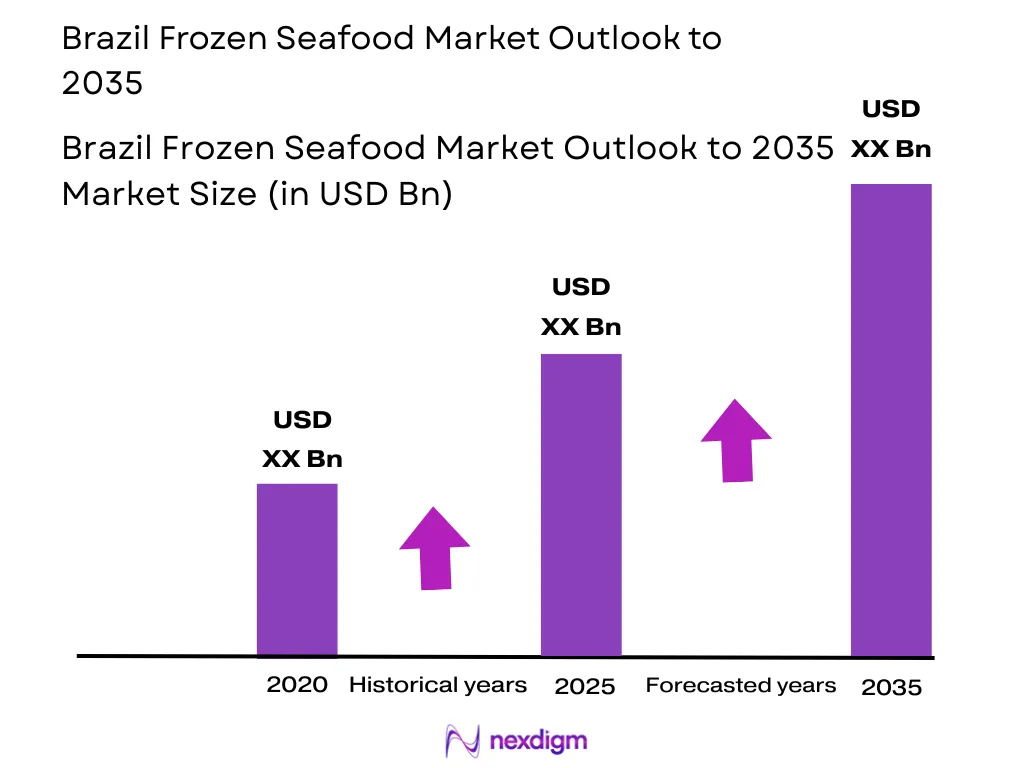
Brazil frozen seafood market is valued at USD ~ billion, based on a five-year historical analysis of the Brazil seafood market, with frozen seafood demand supported by aquaculture scale, supermarket freezer expansion and export-oriented processing. Brazil’s farmed fish production reached 968,745 tons, while tilapia production reached 662,230 tons, creating a strong raw-material base for frozen fillets, IQF portions, shrimp packs and foodservice frozen seafood products.
The Brazil frozen seafood market is forecast to grow at a 4.3% CAGR during 2026-2035, supported by domestic aquaculture expansion, tilapia exports, frozen seafood retail penetration, foodservice demand and greater use of processed seafood formats. The broader Brazil seafood market is projected by Deep Market Insights to expand from USD ~ billion to USD ~ billion, with fresh seafood remaining the largest condition segment but frozen seafood gaining relevance through convenience and tradeability.
Market Segmentation
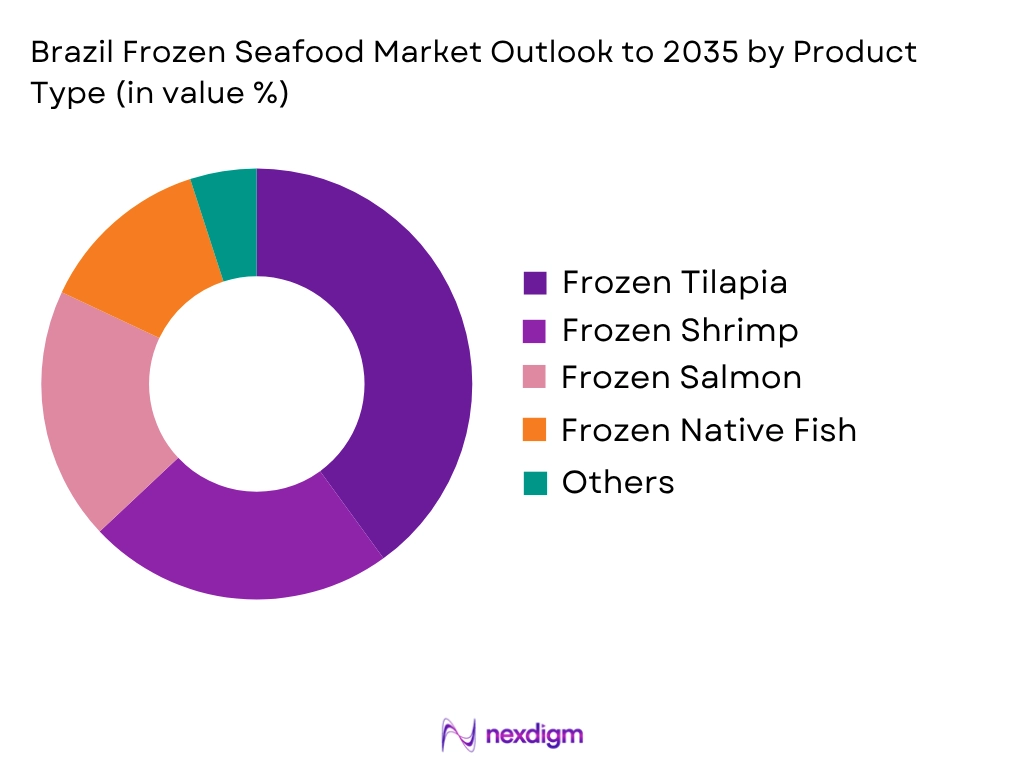
By Product Type
Brazil frozen seafood market is segmented by product type into frozen tilapia, frozen shrimp, frozen salmon, frozen native fish, frozen sardines and small pelagics, frozen mollusks and cephalopods, and frozen lobster, tuna and premium marine fish. Frozen tilapia holds the dominant market share because Brazil has built a large aquaculture base around tilapia farming, filleting and export-ready processing. Peixe BR data shows Brazil cultivated 662,230 tons of tilapia, compared with 579,080 tons earlier, confirming the species’ industrial scale and processing relevance. Tilapia is also easier to standardize into frozen fillets, skinless portions, IQF cuts and private-label packs than many wild-caught species. Paraná, São Paulo and Minas Gerais remain important production clusters, while processors such as Copacol, C.Vale and GeneSeas support frozen tilapia supply for domestic retail, foodservice and export buyers.
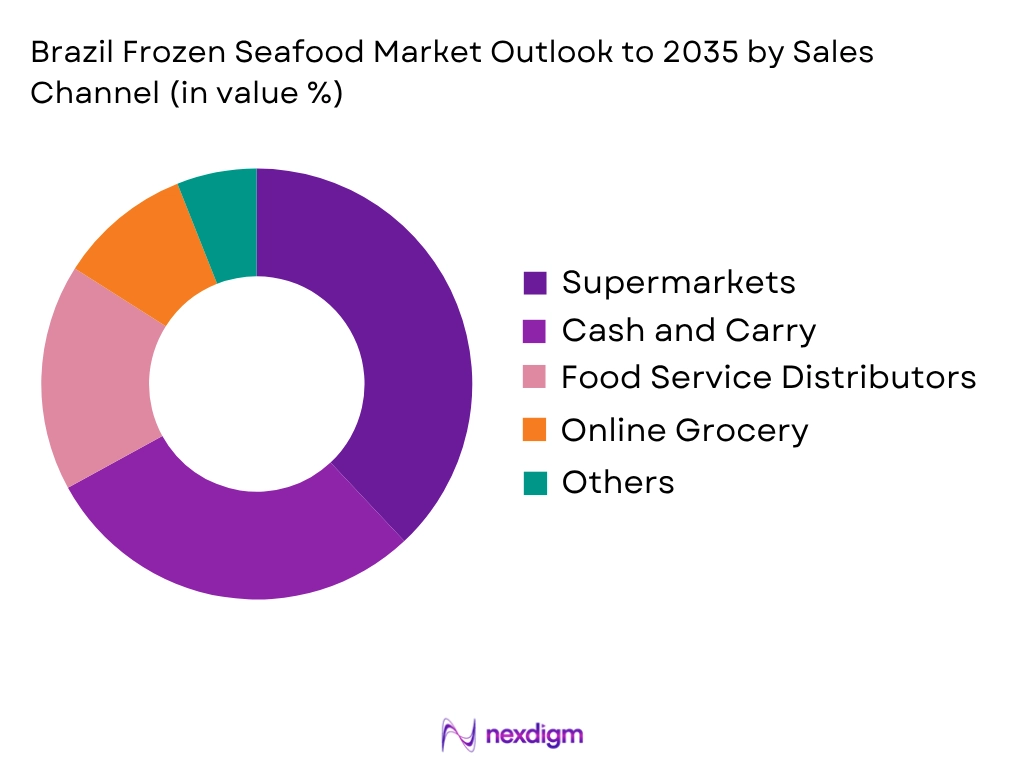
By Sales Channel
Brazil frozen seafood market is segmented by sales channel into supermarkets and hypermarkets, cash-and-carry/atacarejo, foodservice distributors, fishmongers and municipal fish markets, online grocery and DTC frozen delivery, export distribution channels and institutional buyers. Supermarkets and hypermarkets hold the dominant market share because they provide freezer visibility, branded seafood packs, private-label seafood, weekly promotions and access to urban middle-income consumers. São Paulo and Rio de Janeiro are especially important because the municipalities have 11.9 million and 6.7 million people, respectively, supporting high-volume grocery traffic and modern retail density. Frozen seafood also benefits from modern retail’s ability to handle temperature-controlled inventory, label compliance, pack-size variety and convenience formats such as tilapia fillets, salmon portions, shrimp bags, breaded seafood and seafood mixes. Cash-and-carry is growing fast, but supermarkets remain stronger for branded and premium frozen seafood assortments.
Competitive Landscape
Brazil frozen seafood market is led by domestic aquaculture processors, import-oriented seafood distributors, export seafood companies and retail seafood brands. Copacol, C.Vale, GeneSeas, Netuno and Frescatto hold significant positions because they combine species specialization, cold-chain distribution, processing capacity, retail access and export know-how. Competition is shaped by tilapia fillet scale, shrimp and lobster sourcing, salmon import distribution, SIF-approved processing, frozen packaging capability and access to São Paulo, Paraná, Santa Catarina, Rio de Janeiro and Northeast coastal demand clusters.
| Company | Establishment Year | Headquarters | Core Frozen Seafood Portfolio | Source Strength | Processing Capability | Channel Strength | Export Orientation | Market Positioning |
| Copacol | 1963 | Cafelândia, Paraná | ~ | ~ | ~ | ~ | ~ | ~ |
| C.Vale | 1963 | Palotina, Paraná | ~ | ~ | ~ | ~ | ~ | ~ |
| GeneSeas Aquacultura | 2001 | São Paulo / Mato Grosso do Sul | ~ | ~ | ~ | ~ | ~ | ~ |
| Netuno Pescados | 1989 | Recife, Pernambuco | ~ | ~ | ~ | ~ | ~ | ~ |
| Frescatto Company | 1944 | Duque de Caxias, Rio de Janeiro | ~ | ~ | ~ | ~ | ~ | ~ |
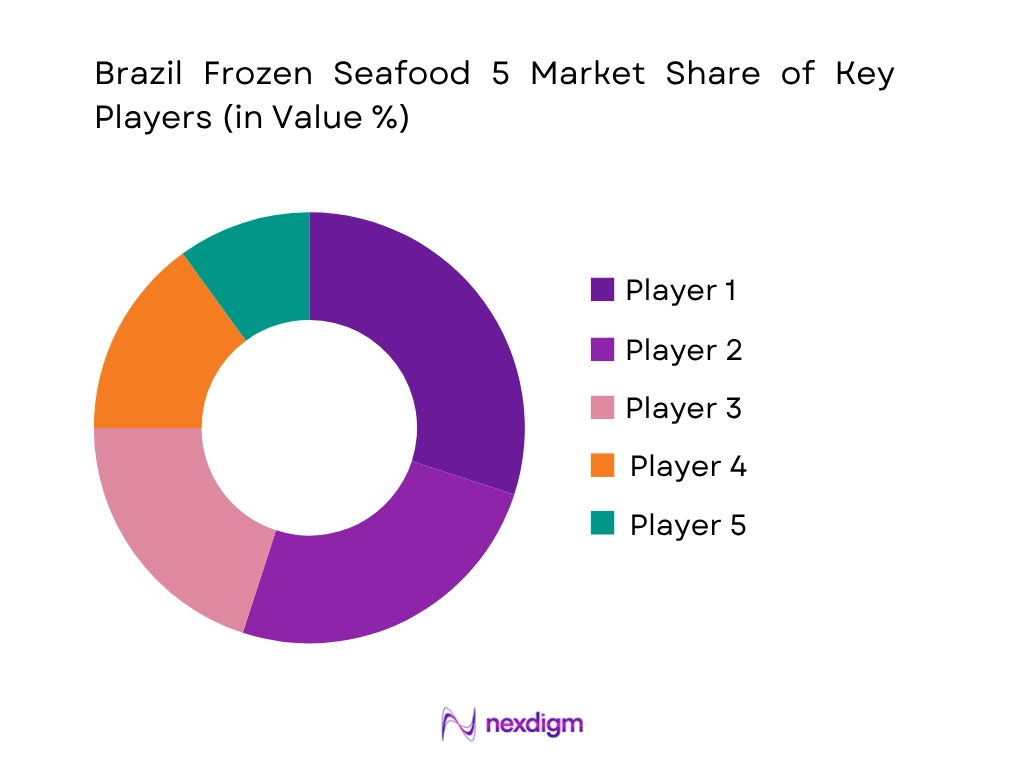
Brazil Frozen Seafood Market Outlook to 2035
Growth Drivers
Aquaculture Production Base Supporting Frozen Tilapia, Shrimp and Native Fish Processing
Brazil Frozen Seafood Market is strongly supported by the expansion of domestic aquaculture, which gives processors a reliable raw-material base for frozen tilapia fillets, shrimp packs, tambaqui portions, pirarucu cuts and value-added seafood products. The Ministry of Fisheries and Aquaculture reported that Brazil’s aquaculture in federal waters produced 148,564.71 tons of fishery products, compared with 123,803.53 tons in the previous annual reference, while the same official program recorded 1,422 active aquaculture concessions and 4,126 direct jobs. This matters for frozen seafood because aquaculture products are easier to standardize into fillets, IQF cuts, vacuum packs, breaded formats and retail freezer SKUs than highly fragmented wild-caught supply. The macroeconomic base also supports domestic processing scale, with the World Bank reporting Brazil’s GDP at USD 2.19 trillion, GDP per capita at USD 10,310.5, and population at 211,998,573 people. Together, these figures support a large consumer and processing ecosystem for frozen fish and shrimp.
Large Domestic Consumer Base and Modern Retail Reach Supporting Frozen Seafood Purchases
Brazil Frozen Seafood Market benefits from a large national consumer base and rising formal retail penetration, particularly for frozen tilapia, salmon, shrimp, sardines, seafood mixes and breaded fish sold through supermarkets, cash-and-carry outlets and foodservice distributors. The World Bank records Brazil’s population at 211,998,573 people, GDP at USD 2.19 trillion, and GDP per capita at USD 10,310.5, creating a broad addressable base for packaged frozen seafood, especially in large urban states with developed cold-chain and retail infrastructure. The sector’s supply-side relevance is reinforced by the Ministry of Fisheries and Aquaculture, which reported national fishery and aquaculture production of more than 1 million tons in the official statistical bulletin and reported aquaculture output in federal waters at 148,564.71 tons. Frozen seafood benefits because it reduces spoilage, extends shelf life, supports long-distance movement from producing states to urban retail centers, and allows retailers to sell standardized portions instead of highly variable fresh fish formats.
Market Challenges
Traceability and Inspection Burden Across a Fragmented Aquaculture and Seafood Supply Chain
Brazil Frozen Seafood Market faces a structural challenge from traceability, inspection and documentation requirements across fish farms, marine catch, processing plants, cold stores and retail distribution. The Ministry of Fisheries and Aquaculture reported 1,422 active aquaculture concessions in federal waters, 148,564.71 tons of aquaculture production, and 4,126 direct jobs connected to these concessions. It also recorded 588 inspected concession contracts during the policy implementation cycle, showing the administrative burden needed to monitor production sites and verify compliance. For frozen seafood companies, these requirements affect lot coding, farm-origin documentation, SIF/SIE/SIM inspection routes, glazing declarations, storage records and export paperwork. The macroeconomic context increases the scale of this challenge because Brazil serves 211,998,573 people and operates within a USD 2.19 trillion economy, according to the World Bank. As frozen seafood moves across multiple states and retail channels, traceability gaps can affect recall management, retailer onboarding, export eligibility and consumer confidence in packaged frozen fish and shrimp.
Cold-Chain and Regional Distribution Pressure Outside Core Production and Consumption Clusters
Brazil Frozen Seafood Market is challenged by the need to move frozen tilapia, shrimp, salmon, tambaqui, squid and seafood mixes across a geographically large country with uneven processing, cold-storage and retail infrastructure. The World Bank records Brazil’s population at 211,998,573 people and GDP at USD 2.19 trillion, while the IMF lists Brazil’s country population at 214.083 million, showing the scale of national demand that must be served through reliable refrigerated logistics. Official sector data shows that aquaculture in federal waters produced 148,564.71 tons, while broader aquaculture activity in federal waters involved 1,422 active concessions. These production points must connect to processing plants, ports, supermarkets, cash-and-carry outlets and foodservice distributors without breaking temperature control. Frozen seafood is more logistics-sensitive than shelf-stable seafood because value depends on uninterrupted freezing, accurate glazing, controlled storage and freezer-ready delivery. Distribution becomes harder outside São Paulo, Paraná, Santa Catarina, Rio de Janeiro and Northeast coastal corridors, where modern cold-chain assets are more concentrated.
Market Opportunities
Value-Added Frozen Seafood Formats Built Around Tilapia, Shrimp and Native Species
Brazil Frozen Seafood Market has a strong opportunity in value-added formats such as IQF tilapia fillets, shrimp packs, tambaqui portions, pirarucu cuts, breaded fish, seafood meal kits and moqueca-ready frozen packs. The Ministry of Fisheries and Aquaculture reported that total aquaculture output included approximately 724,900 tons of fish and 146,800 tons of shrimp, giving processors a large domestic raw-material base for standardized frozen seafood products. The opportunity is supported by Brazil’s macroeconomic scale, with the World Bank reporting GDP of USD 2.19 trillion, GDP per capita of USD 10,310.5, and a population of 211,998,573 people. Frozen formats allow companies to convert domestic aquaculture output into higher-control SKUs that fit supermarkets, cash-and-carry outlets, institutional procurement and foodservice menus. This is particularly relevant for tilapia and shrimp because they can be portioned, glazed, vacuum-packed, breaded or seasoned more consistently than many wild-caught species. Processors that invest in filleting, IQF lines and retail packaging can deepen domestic penetration.
Export-Ready Frozen Seafood and Market Diversification Through Documented Supply Chains
Brazil Frozen Seafood Market has an opportunity to expand export-ready frozen seafood through SIF-approved plants, documented aquaculture supply, traceability systems and species diversification across tilapia, shrimp, tuna, lobster, pargo and native fish. The Ministry of Fisheries and Aquaculture reported that Brazil had more than 100 open international markets for national fishery products and participated in major seafood trade events in Boston, Barcelona and Qingdao to support commercial access. The same ministry recorded 1,422 active aquaculture concessions and 148,564.71 tons of aquaculture production in federal waters, creating a stronger base for traceable frozen products. The macroeconomic case is also supported by the World Bank’s USD 2.19 trillion GDP and 211,998,573 population, while the IMF lists Brazil’s population at 214.083 million, indicating national scale for both production and domestic absorption. Export-ready frozen seafood can reduce dependence on fresh distribution, extend shipping reach, and help Brazilian processors target importers requiring consistent portions, origin records, inspection certificates and frozen-container reliability.
Future Outlook
Over the forecast period, Brazil frozen seafood market is expected to expand through aquaculture scale, stronger frozen retail penetration, value-added seafood processing and export diversification. Tilapia will remain the anchor species because it has the most structured domestic production base and can be converted into fillets, IQF portions, breaded products and branded retail packs. Shrimp, salmon, native fish, mollusks and premium marine species will support portfolio diversification.
Frozen seafood processors are expected to invest in cold-chain reliability, SIF-compliant plants, vacuum packing, IQF lines and export documentation systems. Domestic demand will be supported by large urban markets such as São Paulo and Rio de Janeiro, while production growth will continue to be linked to Paraná, São Paulo, Minas Gerais, Santa Catarina, Ceará and Rio Grande do Norte. Foodservice distributors will continue adopting frozen seafood because it reduces spoilage, improves portion control and supports consistent restaurant menus.
Export-oriented growth will be influenced by access to the United States, Latin America, Asia and the Middle East. Reuters reported that Brazilian seafood exports to the United States are worth nearly USD 400 million annually, while the United States accounts for about 70% of the sector’s annual fish export market, highlighting the strategic importance of export-market diversification.
Major Players
- Copacol
- C.Vale
- GeneSeas Aquacultura
- Netuno Pescados
- Frescatto Company
- Costa Sul Pescados
- Leardini Pescados
- Noronha Pescados
- Gomes da Costa
- Camil Alimentos
- Royal Fish
- Bom Peixe
- Pescados DellMare
- Maris Pescados
- Brasmar Brasil
Key Target Audience
- Frozen seafood processors and value-added seafood manufacturers
- Seafood importers, exporters and trading companies
- Supermarket, hypermarket and cash-and-carry procurement teams
- Foodservice distributors and institutional seafood buyers
- Cold-chain logistics, reefer transport and frozen warehousing companies
- Investments and venture capitalist firms
- Aquaculture producers and marine seafood operators
- Government and regulatory bodies
Research Methodology
Step 1: Identification of Key Variables
The initial phase involves constructing an ecosystem map of the Brazil frozen seafood market, covering fish farmers, marine fisheries, importers, processors, distributors, retailers, foodservice operators and export buyers. Key variables include species mix, frozen format, aquaculture supply, cold-chain infrastructure, retail penetration, foodservice procurement and export dependency.
Step 2: Market Analysis and Construction
In this phase, historical data is compiled and analyzed across aquaculture production, seafood trade, frozen product formats, retail availability and company portfolios. The market model reconciles top-down seafood expenditure indicators with bottom-up production, import, export and processor-channel mapping to estimate frozen seafood demand.
Step 3: Hypothesis Validation and Expert Consultation
Market hypotheses are validated through computer-assisted telephone interviews with seafood processors, aquaculture companies, frozen food distributors, retail category managers and foodservice procurement teams. These consultations support validation of species dominance, channel structure, frozen-pack formats, cold-chain bottlenecks and competitive positioning.
Step 4: Research Synthesis and Final Output
The final phase involves integrating secondary data, company benchmarking, expert interviews and channel checks into a structured market assessment. The output includes market size, segmentation, competitive landscape, future outlook, major players, target audience and strategic insights specific to the Brazil frozen seafood market.

- Executive Summary
- Research Methodology (Market Definitions and Assumptions, Abbreviations, Frozen Seafood Inclusion and Exclusion, Species Mapping, HS Code Mapping, Top-to-Bottom Market Sizing, Bottom-to-Top Market Sizing, Import-Export Reconciliation, Aquaculture Production Mapping, Wild-Catch Landing Assessment, Retail Channel Checks, Foodservice Procurement Validation, Cold Chain Capacity Review, Primary Interviews with Processors/Importers/Distributors/Retail Buyers/Foodservice Operators, Limitations and Forecasting Assumptions)

- Definition and Scope
- Market Genesis and Evolution
- Brazil Seafood Consumption Landscape
- Frozen Seafood Business Cycle
- Aquaculture and Wild-Catch Linkage
- Supply Chain and Value Chain Analysis

- Growth Drivers (Aquaculture Scale-Up, Tilapia Processing Growth, Shrimp Farming Recovery, Urban Retail Expansion, Foodservice Seafood Usage)
- Growth of Cash-and-Carry Retail (Atacarejo Channel, Bulk Packs, Low-Price Seafood, Frozen Category Visibility)
- Foodservice and Tourism-Led Seafood Consumption (Restaurants, Coastal Hotels, Resorts, Institutional Kitchens, Shrimp and Fish Portions)
- Market Challenges (Cold Chain Gaps, Import Volatility, Informal Fish Trade, Glazing Compliance, Export Barrier Risk)
- Market Opportunities (Premiumization, Value Addition, Export Diversification, Private Label Expansion, Regional Species Commercialization)
- Trends (Species Premiumization, Retail Private Label, Traceability, Sustainable Aquaculture, Convenience Seafood)
- Government Regulation (MAPA Oversight, Ministry of Fisheries and Aquaculture, SIF/SIE/SIM Inspection, Import Licensing, Export Certification)
- Supply Chain Risk Analysis (Port Dependency, Reefer Availability, Cold Storage Nodes, Energy Reliability, Regional Road Logistics)
- SWOT Analysis
- Porter’s Five Forces
- Stakeholder Ecosystem

- By Value (2020-2025)
- By Volume (2020-2025)
- By Average Realization Price (2020-2025)

- By Product Form (In Value %)
Raw Frozen Seafood
Cooked Frozen Seafood
Breaded and Battered Frozen Seafood
Marinated and Seasoned Frozen Seafood - By Sales Channel (In Value %)
Supermarkets and Hypermarkets
Cash-and-Carry and Wholesale Retail
Fishmongers and Municipal Fish Markets
Foodservice Distributors - By End User (In Value %)
Household Consumers
Restaurants and QSR Chains
Hotels, Resorts and Catering
Institutional Buyers - By Region (In Value %)
Southeast Brazil
South Brazil
Northeast Brazil
North Brazil

- Cross Comparison Parameters (Species Portfolio Depth, SIF-Approved Processing Capacity, Frozen SKU Architecture, Retail and Atacarejo Distribution Reach, Export Market Access, Cold Chain and Reefer Network, Aquaculture or Wild-Catch Sourcing Control, Certification and Traceability Readiness)
- Competitive Benchmarking by Channel (Modern Retail, Cash-and-Carry, Fish Markets, Foodservice, Institutional, Export)
- Pricing Analysis of Major Players (Retail Price per Kilogram, Bulk Pack Price, Import Landed Price, Export Unit Value, Value-Added Price Premium)
- SWOT Analysis of Major Players
- Detailed Profiles of Major Companies
Copacol
C.Vale
GeneSeas Aquacultura
Netuno Pescados
Frescatto Company
Costa Sul Pescados
Leardini Pescados
Noronha Pescados
Gomes da Costa
Camil Alimentos
Royal Fish
Bom Peixe
Pescados DellMare
Maris Pescados
Noronha Pescados / Brasmar Brasil

- Household Consumer Demand Analysis
- Grocery Retail Buyer Analysis
- Cash-and-Carry Buyer Analysis
- Foodservice Operator Analysis
- Export Buyer Analysis
- Willingness-to-Pay Analysis

- By Value (2026-2035)
- By Volume (2026-2035)
- By Average Realization Price (2026-2035)


 Request a Sample
 Ask for Customization
 Get a Quote
 Enquire Now