
 Download PDF
Market Overview
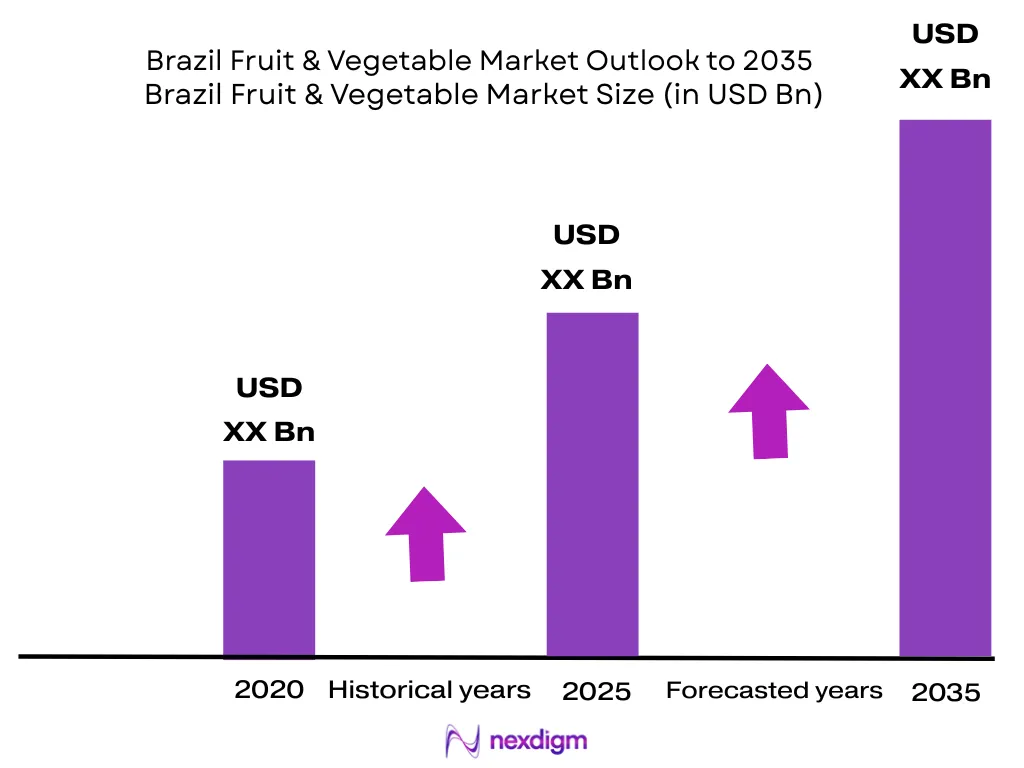
The Brazil Fruit and Vegetable Market generated USD ~ billion in revenue in 2025, supported by domestic fresh consumption, fruit processing, CEASA wholesale movement, supermarket hortifruti formats and export-grade fruit packing. The market is forecast to grow at 5.0% CAGR across the 2026-2035 outlook period, using the available Brazil forecast benchmark for 2026-2033. Brazil’s fruits and vegetables category is supported by the country’s large agricultural base and diversified production across tropical, citrus, root and leafy crops. Brazil’s fruit and vegetable production is concentrated around São Paulo, Minas Gerais, Bahia, Pernambuco, Ceará, Rio Grande do Norte, Rio Grande do Sul and Santa Catarina because these states combine crop suitability, irrigation systems, packhouses, export corridors, processing units and wholesale connectivity. São Paulo and Minas Gerais dominate citrus and potato belts; Bahia and Pernambuco lead irrigated mango and grape clusters; Ceará and Rio Grande do Norte support melon exports; the South supports apple and grape production. IBGE reported Brazil’s agricultural production value at R$783.2 billion after covering 64 surveyed crops.
Market Segmentation
By Product Type
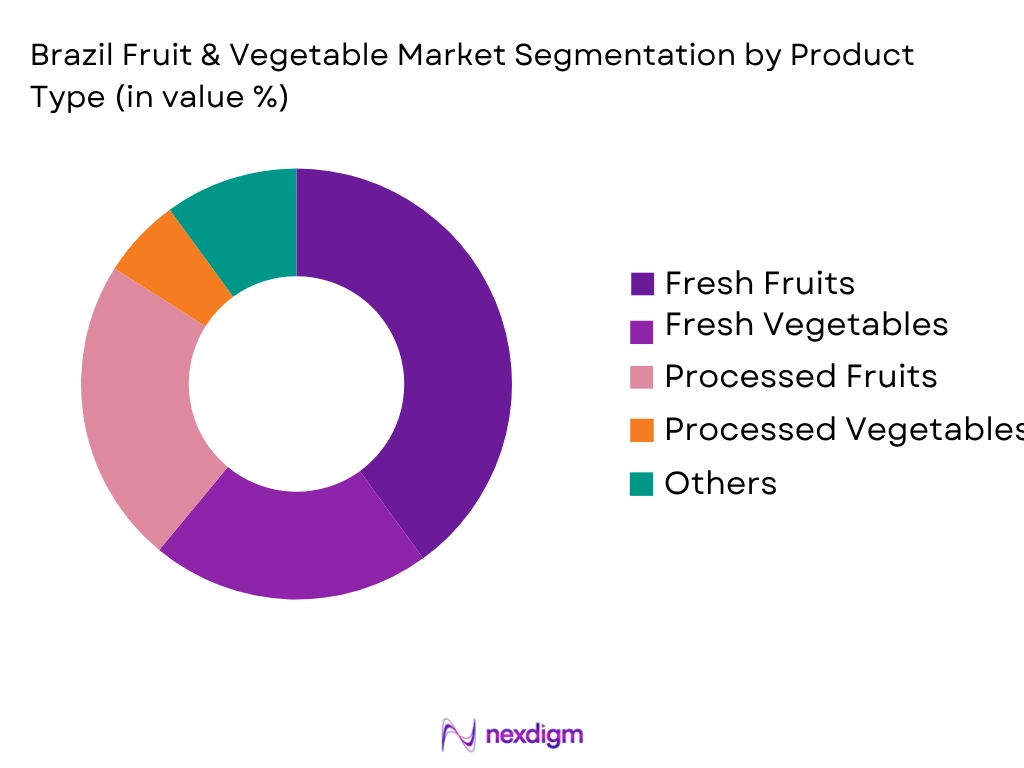
The Brazil Fruit and Vegetable Market is segmented by product type into fresh vegetables, fresh fruits, processed fruits, processed vegetables, and frozen, dried and value-added produce. Fresh vegetables hold the dominant market share because they are deeply embedded in household cooking, open-air market purchases, supermarket baskets, institutional foodservice and daily meal preparation. Tomato, potato, onion, carrot, lettuce, cassava and leafy vegetables remain high-frequency categories across Brazilian households and foodservice kitchens. IBGE’s harvest reporting placed potato output at 4.3 million tonnes, with São Paulo alone expected to produce 999.5 thousand tonnes, showing the importance of staple vegetables in domestic supply. Vegetables also benefit from short replenishment cycles, strong CEASA movement, urban demand in São Paulo and Rio de Janeiro, and increasing packaged fresh produce adoption by modern retailers.
By Distribution Channel
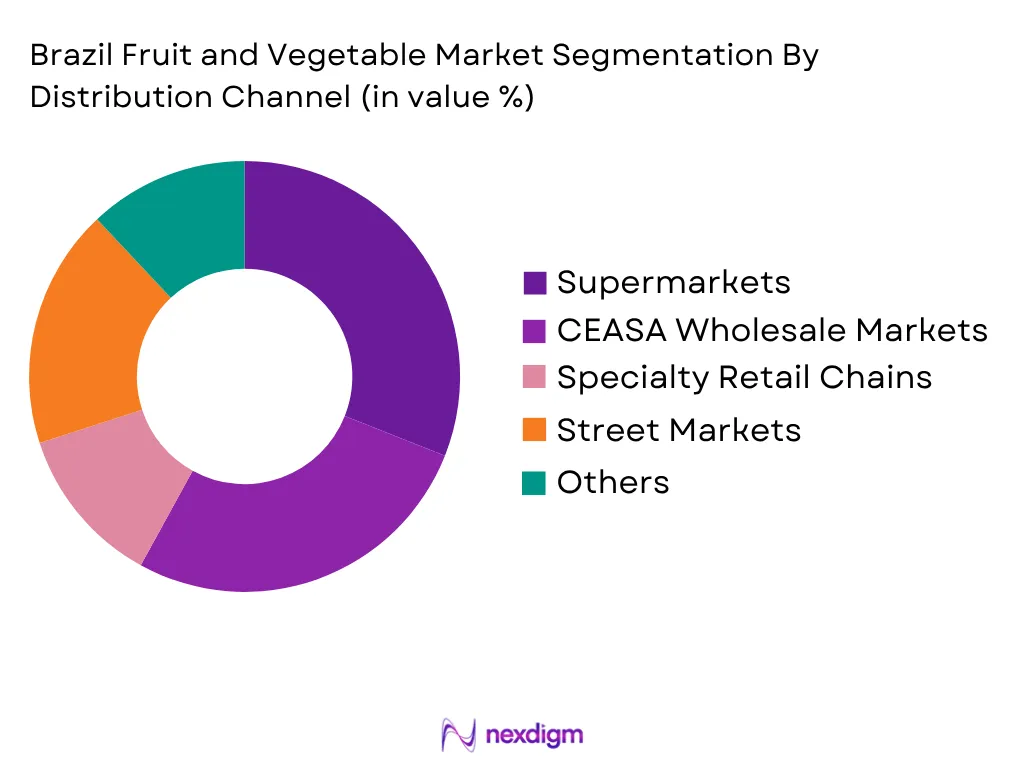
The Brazil Fruit and Vegetable Market is segmented by distribution channel into CEASA wholesale markets, supermarkets and hypermarkets, hortifruti specialty retail chains, street markets and open-air fairs, and foodservice/exporter/processor/online channels. CEASA wholesale markets hold the dominant market share because they remain the core aggregation and redistribution system for fresh fruits and vegetables across Brazilian cities. They connect smallholder farms, commercial growers, regional traders, retailers, restaurants and institutional buyers through daily physical trading. CEASA channels are particularly important for short shelf-life commodities such as lettuce, tomato, banana, papaya, potato, onion and leafy greens. Their role is reinforced by Brazil’s fragmented producer base and the need for daily price discovery, bulk sorting, grade differentiation, inter-state movement and rapid urban replenishment. Supermarkets are gaining ground, but CEASA remains central for wholesale liquidity and regional availability.
Competitive Landscape
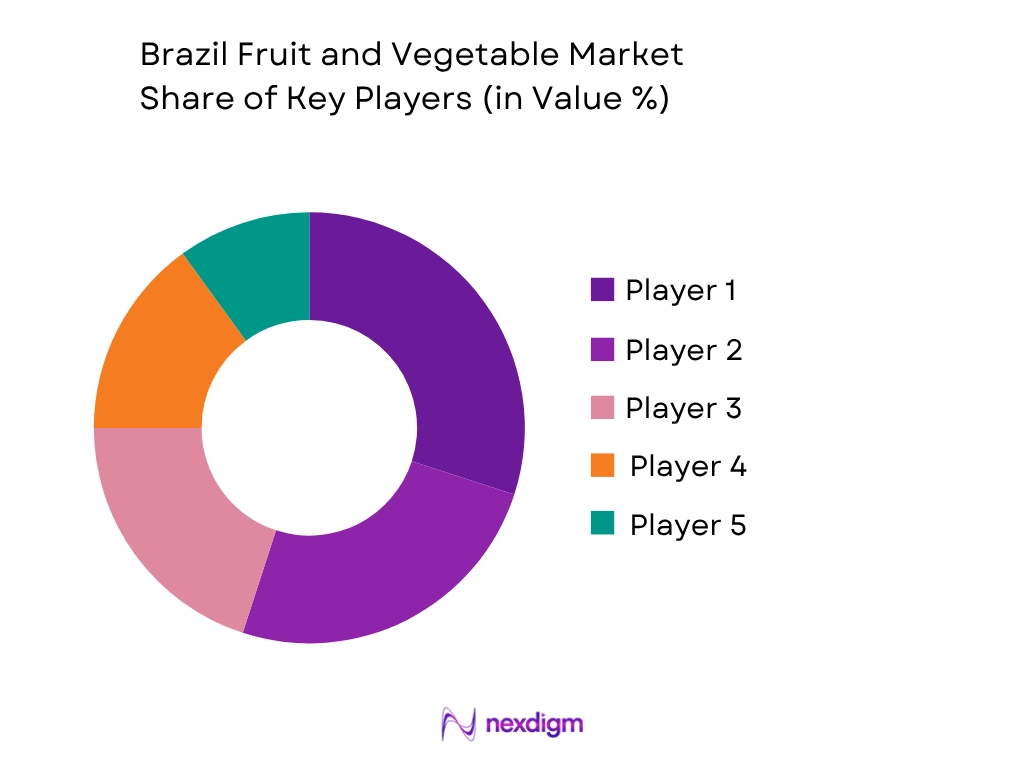
The Brazil Fruit and Vegetable Market is fragmented at farm level but more consolidated in citrus processing, export fruit packing, hortifruti retail and large-scale distribution. Major players such as Citrosuco, Cutrale, Louis Dreyfus Company Brazil, Agrícola Famosa and Special Fruit have influence due to export relationships, processing capacity, cold-chain systems, certification readiness and concentration in high-value categories such as orange juice, mango, grape, melon and papaya. Competition is shaped by crop specialization, compliance, logistics and ability to supply both domestic and export buyers.
| Company | Establishment Year | Headquarters | Key Categories | Business Model | Key Channel | Production / Sourcing Footprint | Processing / Packhouse Capability | Market-Specific Advantage |
| Citrosuco | 1963 | Matão, São Paulo | ~ | ~ | ~ | ~ | ~ | ~ |
| Cutrale | 1967 | Araraquara, São Paulo | ~ | ~ | ~ | ~ | ~ | ~ |
| Louis Dreyfus Company Brazil | 1942 | São Paulo | ~ | ~ | ~ | ~ | ~ | ~ |
| Agrícola Famosa | 1995 | Icapuí, Ceará | ~ | ~ | ~ | ~ | ~ | ~ |
| Special Fruit | 1982 | Juazeiro, Bahia | ~ | ~ | ~ | ~ | ~ | ~ |
Brazil Fruit and Vegetable Market Analysis
Growth Drivers
Large Consumer Economy Supporting Daily Fresh Produce Consumption
Brazil Fruit and Vegetable Market is supported by a large domestic consumption base, with Brazil home to 205.3 million people and real GDP per capita of USD 10,616 in 2024, according to the World Bank. This supports recurring demand for bananas, oranges, tomatoes, potatoes, onions, cassava, leafy vegetables and fresh-cut produce across supermarkets, CEASA markets and neighborhood retailers. IBGE recorded planted area across 64 crops at 97.3 million hectares in 2024, showing a large agricultural production base. Fruits generated R$91.5 billion in agricultural production value in 2024, led by oranges, bananas and grapes.
Strong Wholesale Infrastructure Enabling High-Volume Produce Movement
Brazil Fruit and Vegetable Market is driven by its wholesale distribution structure, especially CEASA-linked movement of fruits, legumes and vegetables into urban retail and foodservice channels. CEAGESP’s São Paulo terminal traded 3,084,290 tonnes of products in 2024, compared with 3,062,888 tonnes in 2023, showing continued throughput expansion in Brazil’s largest fresh-produce hub. The terminal processed 828,942 invoices from 1,482 municipalities, 24 states and 26 countries, highlighting its role as a national aggregation platform. Brazil’s macro base reinforces this movement, with World Bank data showing GDP of USD 2.19 trillion in 2024.
Market Challenges
Citrus Crop Stress Affecting Brazil’s Fruit Processing and Fresh Citrus Base
Brazil Fruit and Vegetable Market faces production risk from citrus disease and weather stress, especially in São Paulo and Minas Gerais. Fundecitrus projected the 2024/25 orange crop at 232.38 million boxes of 40.8 kg, against 307.22 million boxes in the previous cycle, reflecting severe pressure on the citrus belt. The season closed at 230.87 million boxes of 40.8 kg, according to Fundecitrus. This matters because Brazil is a major orange and orange-juice producer, while the country also operates within a large economy of USD 2.19 trillion GDP.
Post-Harvest and Logistics Pressure Across Fragmented Fresh Produce Supply
Brazil Fruit and Vegetable Market faces structural pressure because fruits and vegetables move across long domestic distances through farms, traders, CEASA terminals, retail distribution centers and foodservice buyers. CEAGESP’s São Paulo terminal alone handled products from 1,482 municipalities, 24 states and 26 countries in 2024, showing the scale and complexity of sourcing. The same terminal closed 2024 with 3,084,290 tonnes traded, creating daily pressure on sorting, handling, cold-chain discipline and dispatch capacity. World Bank data places Brazil’s population at 205.3 million people, increasing the need for consistent urban supply.
Market Opportunities
Export-Oriented Fruit Expansion Through Mango, Melon, Lime and Grape Corridors
Brazil Fruit and Vegetable Market has strong export opportunity because fruit shipments are expanding through AgroStat/MAPA-tracked channels. Between January and November 2025, Brazil exported about 1.176 million tonnes of fruits, according to AgroStat data cited by CEASA-RJ. First-half 2025 shipments exceeded 546 thousand tonnes, with melon above 118 thousand tonnes, lemons around 107 thousand tonnes and mango near 88 thousand tonnes. These volumes show export momentum in tropical and counter-seasonal fruits. Brazil’s macro backdrop supports scale, with World Bank reporting GDP per capita of USD 10,310.5 in 2024.
Value-Added and Premium Produce Opportunity Through Urban Retail Modernization
Brazil Fruit and Vegetable Market has opportunity in washed vegetables, pre-packed fruits, hydroponic leafy greens, organic produce, fruit cups and ready-to-cook formats because urban wholesale and retail channels already move large volumes. CEAGESP’s São Paulo terminal issued 146 price bulletins and processed 828,942 invoices in 2024, indicating deep formal transaction visibility for produce buyers. Fruit exports also show premium category breadth: papaya reached 27.4 thousand tonnes, avocado 19.5 thousand tonnes, apple 13.1 thousand tonnes and grapes 10.3 thousand tonnes in first-half 2025. Brazil’s 205.3 million population supports wider retail adoption.
Future Outlook
Over the next outlook period, the Brazil Fruit and Vegetable Market is expected to grow steadily due to rising urban food demand, modern retail expansion, export-grade fruit production, irrigation-led farming and increasing use of value-added produce formats. The forecasted CAGR for 2026-2035 is positioned at 5.0%, aligned with Brazil’s available fruit and vegetable outlook benchmark. Fresh vegetables will remain essential because of their role in everyday meals, school feeding, restaurants and household cooking. Fresh fruits will gain from premium tropical exports, citrus processing, fruit pulp, fresh-cut packs and health-oriented snacking. Mango, melon, lime, grape, papaya, banana, orange, potato, onion, tomato and leafy vegetables will remain central to volume movement.
The export corridor from the São Francisco Valley and Northeast ports will remain important for mangoes, grapes, melons and papayas. Brazil’s orange juice position will continue to be strategically important, although citrus greening, heat stress and drought are expected to pressure orchard productivity. Fundecitrus projected the São Paulo and Minas Gerais orange belt at 232.38 million boxes of 40.8 kg in the 2024/25 season, showing the scale of the citrus crop even during a difficult production cycle. Modern retail will increase demand for graded, washed, packed, traceable and shelf-stable produce. Hortifruti chains and premium supermarkets will push growth in organic produce, hydroponic lettuce, packaged herbs, salad greens, fruit cups and ready-to-cook vegetables. At the same time, CEASA wholesale markets will remain important for price discovery and daily supply movement, particularly for fragmented smallholder crops.
Major Players
- Citrosuco
- Cutrale
- Louis Dreyfus Company Brazil
- Agrícola Famosa
- Itaueira Agropecuária
- Special Fruit
- Labrunier
- Grupo JD
- Brazil Melon
- Fischer S.A. Agroindústria
- Pomifrutas
- Cooperativa Agrícola de Cotia
- Hortifruti Natural da Terra
- Oba Hortifruti
- Benassi
Key Target Audience
- Fruit growers and vegetable producers
- Export-oriented fruit packers and trading companies
- Supermarkets, hypermarkets and hortifruti retail chains
- CEASA wholesalers and fresh produce distributors
- Fruit juice, pulp and vegetable processing companies
- Cold-chain logistics, reefer transport and packhouse operators
- Investments and venture capitalist firms
- Government and regulatory bodies (MAPA, ANVISA, IBGE, CEAGESP, CEASA, EMBRAPA, SECEX, Ministry of Agriculture and Livestock)
Research Methodology
Step 1: Identification of Key Variables
The initial phase involves constructing an ecosystem map of the Brazil Fruit and Vegetable Market. This includes growers, CEASA traders, exporters, supermarkets, hortifruti retailers, processors, cold-chain operators and government agencies. Key variables include crop type, cultivated region, production volume, channel mix, export orientation, processing use, packhouse capacity and post-harvest handling.
Step 2: Market Analysis and Construction
Historical data is compiled across crop production, domestic consumption, trade flows, retail movement, wholesale distribution and processing demand. The market is assessed using top-down market revenue analysis and bottom-up crop-level production mapping. Specific attention is given to citrus, banana, mango, grape, melon, potato, tomato, onion, cassava and leafy vegetable categories.
Step 3: Hypothesis Validation and Expert Consultation
Market hypotheses are validated through interviews with growers, exporters, wholesalers, retail buyers, foodservice distributors, processors and logistics providers. These consultations are used to test assumptions around channel dominance, production clusters, buyer preferences, grade standards, export compliance, procurement cycles and price realization patterns.
Step 4: Research Synthesis and Final Output
The final output combines secondary research, trade analysis, production mapping and expert validation. The report synthesizes market size, segmentation, competitive landscape, future outlook and strategic recommendations. This approach ensures the Brazil Fruit and Vegetable Market analysis reflects both macro-level market movement and ground-level operational realities.

- Executive Summary
- Research Methodology (Market Definitions and Assumptions, Product Classification, Fresh and Processed Produce Inclusion, Farm-Gate and Retail Valuation, Volume Estimation Approach, Import-Export Mapping, CEASA Price and Volume Tracking, IBGE and MAPA Data Triangulation, Bottom-Up Crop Production Model, Top-Down Consumption Expenditure Model, Primary Interviews with Growers, Exporters, CEASA Traders, Retail Buyers and Food Processors, Limitations and Forecast Assumptions)

- Definition and Scope
- Market Genesis and Evolution
- Brazil Fruit and Vegetable Production Landscape
- Domestic Consumption and Food Basket Relevance

- Growth Drivers (Rising Urban Food Demand, Health-Based Diet Shift, Expansion of Hortifruti Retail, Export Demand for Tropical Fruits, Growth in Fruit Pulp and Juice Processing, Supermarket Fresh Category Expansion, Irrigated Fruit Belt Development, Foodservice Demand Recovery)
- Market Challenges (Post-Harvest Losses, Cold-Chain Deficit, Road Freight Dependence, Climate Volatility, Pest and Disease Pressure, Informal Wholesale Trade, Price Volatility, Smallholder Fragmentation)
- Market Opportunities (Export Market Diversification, Cold-Chain Investment, Organic Produce, Protected Cultivation, Digital Wholesale Platforms, Food Processing, Regional Branding, Traceability Systems)
- Trends (Premiumization, Branded Fresh Produce, Regional Fruit Origin Claims, Retail Packaged Produce, Traceability, Sustainable Packaging, Digital Procurement, Export Market Access)
- SWOT Analysis
- Porter’s Five Forces

- By Value (2020-2025)
- By Volume (2020-2025)
- By Average Realization (2020-2025)

- By Product Category (In Value %)
Fresh Fruits
Fresh Vegetables
Processed Fruits
Processed Vegetables
Value-Added Produce
- By Fruit Type (In Value %)
Citrus Fruits
Tropical Fruits
Temperate Fruits
Melons and Watermelons
Export-Oriented Fruits - By Distribution Channel (In Value %)
CEASA Wholesale Markets
Supermarkets and Hypermarkets
Hortifruti Specialty Chains
Street Markets
Open-Air Fairs - By Geography (In Value %)
Southeast
South
Northeast
Center-West
North

- Market Share of Major Players (Value Share, Volume Share, Export Share, Processing Share, Retail Channel Share)
- Cross Comparison Parameters (Commodity Portfolio Depth, Regional Production and Sourcing Footprint, Export Market Access, Packhouse and Processing Capacity, Cold-Chain and Logistics Reach, CEASA/Retail/Foodservice Channel Penetration, Certification and Traceability Infrastructure, Sustainability and Water Management Capability)
- SWOT Analysis of Major Players
- Pricing and SKU Benchmarking of Major Players
- Detailed Profiles of Major Companies
Citrosuco
Cutrale
Louis Dreyfus Company Brazil
Agrícola Famosa
Itaueira Agropecuária
Special Fruit
Labrunier
Grupo JD
Brazil Melon
Fischer S.A. Agroindústria
Pomifrutas
Cooperativa Agrícola de Cotia
Hortifruti Natural da Terra
Oba Hortifruti
Benassi

- Household Consumers
- Supermarkets and Hypermarkets
- Hortifruti Specialty Retailers
- CEASA Buyers and Wholesale Traders
- Foodservice Operators

- By Value (2026-2035)
- By Volume (2026-2035)
- By Average Realization (2026-2035)


 Request a Sample
 Ask for Customization
 Get a Quote
 Enquire Now