
 Download PDF
Market Overview
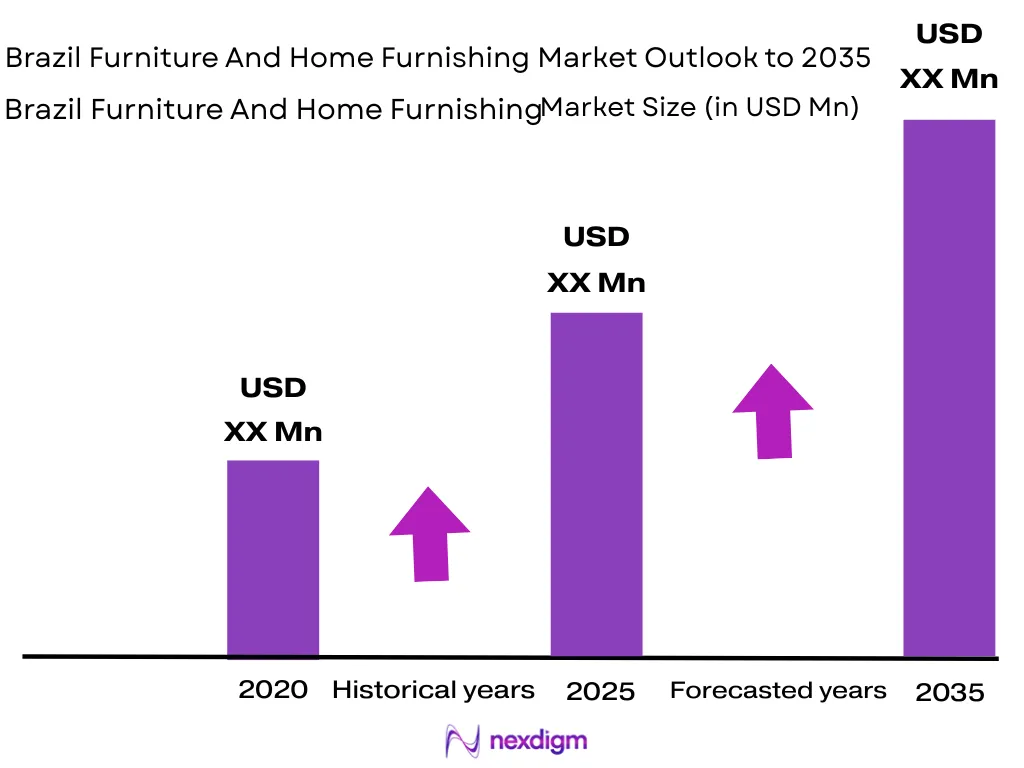
The Brazil Furniture And Home Furnishing Market is valued at USD ~ million, supported by furniture, indoor furnishing, outdoor furnishing, textiles, floor coverings and décor-led categories. The Brazil furniture market also attained USD 18.65 billion, while Brazil home décor generated USD ~ million. Demand is driven by urban housing, apartment furnishing, renovation, planned furniture, modular kitchens, mattress replacement, e-commerce penetration and credit-led household purchases across residential and commercial space. Brazil dominates the Latin American furniture and home furnishing landscape because of its large consumer base, domestic wood-based manufacturing ecosystem and mature retail network. Brazil has 212.6 million residents, with 42.7 million residents living in 15 municipalities above 1 million people. São Paulo, Rio de Janeiro, Brasília, Fortaleza and Salvador dominate demand because they concentrate high population density, retail stores, apartment construction, design services, distribution centers, commercial buyers and higher-value residential furnishing consumption.
Market Segmentation
By Product Type
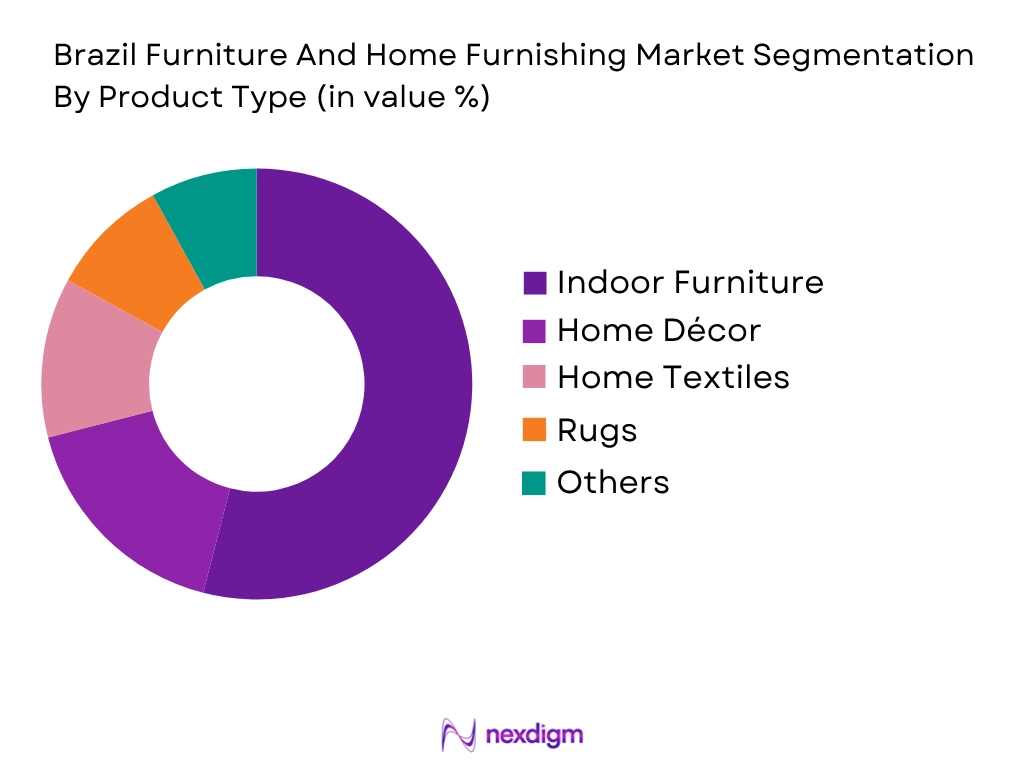
Brazil Furniture And Home Furnishing Market is segmented by product type into indoor furniture and furnishings, home décor and accessories, home textiles, floor coverings and rugs, outdoor and balcony furniture, and lighting and decorative fixtures. Indoor furniture and furnishings hold the dominant market share because Brazilian residential demand is concentrated around living room furniture, bedroom furniture, wardrobes, beds, sofas, modular kitchens, dining sets and storage systems. The segment benefits from apartment living, household formation, urban relocation and renovation-led replacement. MDF and MDP-based products are widely used in wardrobes, kitchen cabinets, shelves and ready-to-assemble furniture because they suit Brazil’s mass-market production structure. Manufacturers in clusters such as Bento Gonçalves, Arapongas, Ubá and São Bento do Sul support consistent supply. Retailers also use indoor furniture as the anchor category for attachment sales in rugs, curtains, lighting, mattresses and décor.
By End User
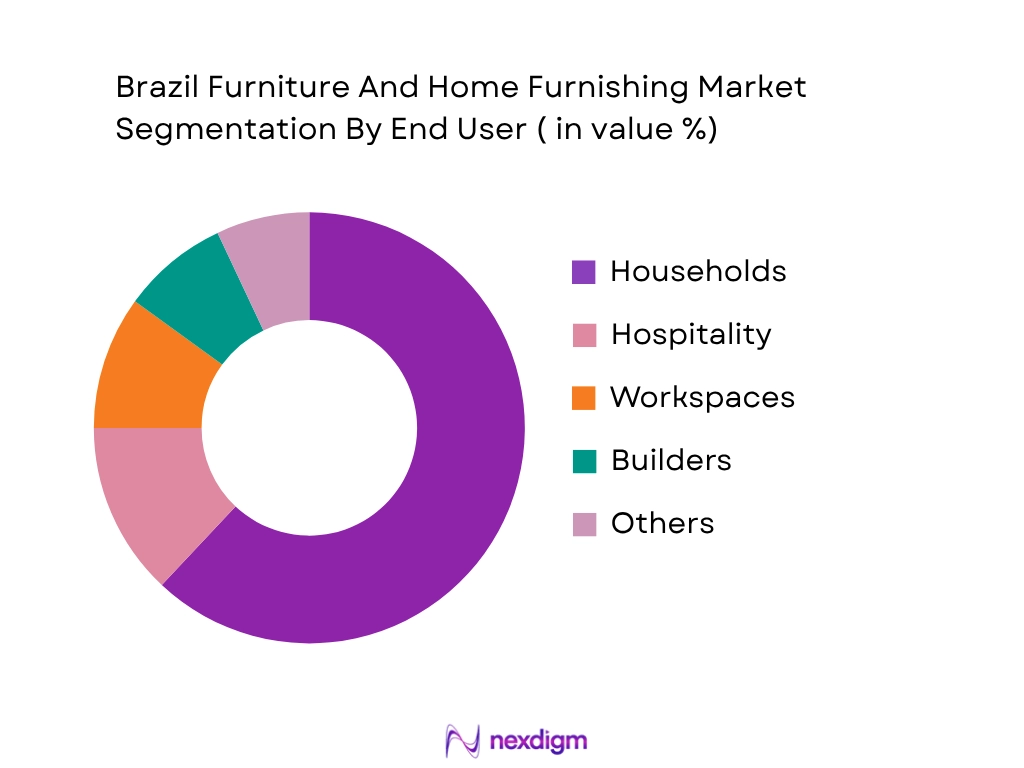
Brazil Furniture And Home Furnishing Market is segmented by end user into residential households, commercial offices and workspaces, hospitality and foodservice spaces, real estate developers and builders, institutional and public sector buyers, and interior designers and project buyers. Residential households dominate the market because most furniture and furnishing purchases are linked to homes, apartments, rental units, household formation, family expansion and home improvement. Brazilian consumers purchase sofas, wardrobes, beds, mattresses, modular kitchens, dining sets, rugs, curtains and lighting as essential household products rather than purely discretionary goods. Installment-based retail and marketplace financing also support residential purchases, especially for value and mid-market products. The dominance of residential households is further reinforced by urban living patterns, compact apartment demand and the popularity of planned furniture for kitchens, bedrooms and storage areas.
Competitive Landscape
The Brazil Furniture And Home Furnishing Market is fragmented but led by a mix of omnichannel retailers, digital-first platforms, planned furniture brands, department-store groups and premium design-led manufacturers. Companies such as Tok & Stok, Mobly, Madeira Madeira, Magazine Luiza and Casas Bahia influence the market through product breadth, store networks, online reach, installment payment options, delivery capability and category depth across furniture, décor, mattresses, home textiles and modular furnishings.
| Company | Establishment Year | Headquarters | Core Positioning | Product Strength | Sales Channel | Fulfillment Model | Price Tier | Market-Specific Capability |
| Tok&Stok | 1978 | São Paulo | ~ | ~ | ~ | ~ | ~ | ~ |
| Mobly | 2011 | São Paulo | ~ | ~ | ~ | ~ | ~ | ~ |
| MadeiraMadeira | 2009 | Curitiba | ~ | ~ | ~ | ~ | ~ | ~ |
| Magazine Luiza | 1957 | Franca, São Paulo | ~ | ~ | ~ | ~ | ~ | ~ |
| Casas Bahia | 1952 | São Caetano do Sul | ~ | ~ | ~ | ~ | ~ | ~ |
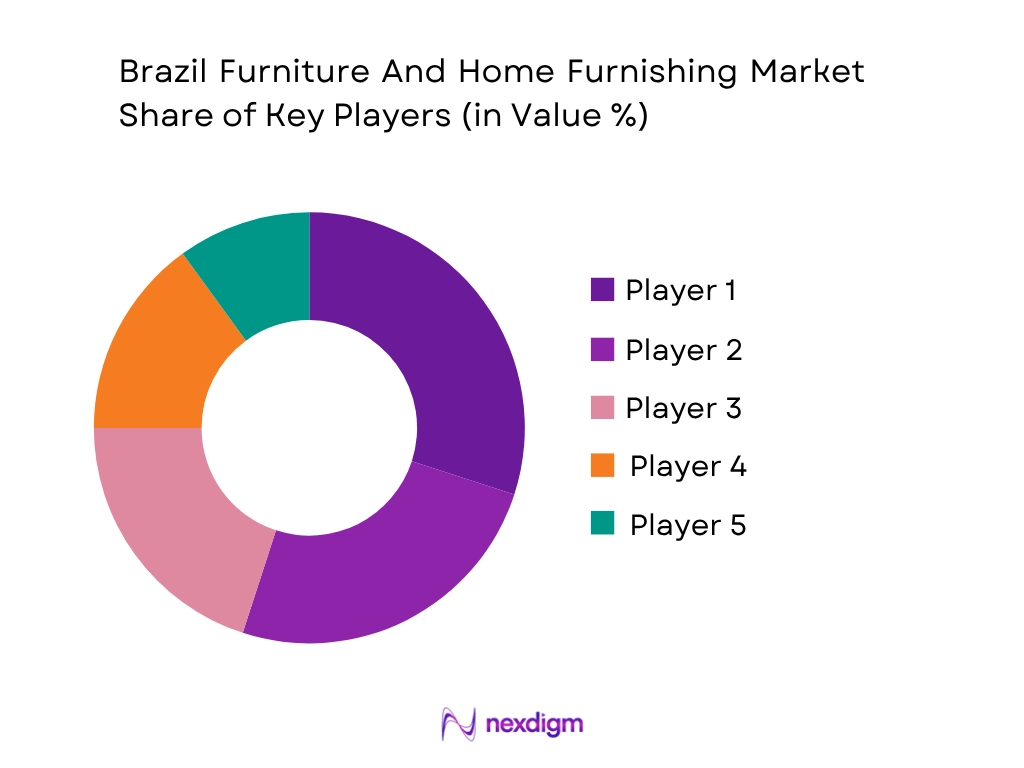
Brazil Furniture And Home Furnishing Market Analysis
Growth Drivers
Residential Construction Pipeline Supporting Furniture and Furnishing Demand
Brazil Furniture And Home Furnishing Market is supported by active residential construction and social-housing delivery, creating demand for beds, wardrobes, modular kitchens, sofas, mattresses, tables, storage units and lighting. The Ministry of Cities reported that Minha Casa, Minha Vida reached 1.26 million contracted housing units between its relaunch and 31 December 2024, with more than 43,000 homes delivered and works resumed for more than 38,900 homes. IBGE also reported Brazil’s GDP at R$11.7 trillion in 2024, while construction activity expanded by 4.3%, supporting furniture demand linked to new homes, renovations and post-occupancy furnishing.
Large Urban Consumer Base Creating Recurring Household Furnishing Demand
Brazil Furniture And Home Furnishing Market benefits from a large urban household base requiring living room furniture, bedroom sets, kitchen storage, mattresses, home textiles, lighting and décor. IBGE estimated Brazil’s population at 212.6 million residents in 2024, with 42.7 million residents concentrated in 15 municipalities having more than 1 million people. São Paulo alone had 11.9 million residents, followed by Rio de Janeiro with 6.7 million and Brasília with 3.0 million. The World Bank also recorded Brazil’s GDP per capita at USD 10,310.5 and GDP at USD 2.19 trillion in 2024, supporting a large consumption base for household furnishing categories.
Market Challenges
High Interest Rate Environment Affecting Credit-Led Furniture Purchases
Brazil Furniture And Home Furnishing Market is challenged by tight monetary conditions because household furniture, planned kitchens, mattresses and home appliances are frequently bought through installment payments and consumer credit. The Central Bank of Brazil identifies the Selic as the benchmark rate influencing loans, financing and investments, while IMF commentary noted Brazil’s basic rate at 15% in 2025. This directly pressures big-ticket household purchases such as wardrobes, sofas, modular kitchens and bedroom sets. IBGE reported GDP growth moderation to 2.3% in 2025, after stronger activity in 2024, indicating a cooler macro environment for discretionary and credit-sensitive furnishing purchases.
Geographic Scale and Regional Dispersion Increasing Furniture Fulfillment Complexity
Brazil Furniture And Home Furnishing Market faces operational challenges because bulky goods require long-distance distribution, local warehousing, careful handling and assembly networks. IBGE reported Brazil’s population at 212.6 million residents spread across 5,570 municipalities in 2024, while 66.5 million people lived in 48 municipalities with more than 500,000 residents. This concentration creates strong demand clusters, but the remaining population is spread across a vast national geography, making delivery of sofas, wardrobes, beds, mattresses and modular kitchens complex outside major metros. For retailers and manufacturers, the challenge is balancing stock availability in São Paulo, Rio de Janeiro and Brasília with serviceability in secondary cities.
Market Opportunities
Urban Concentration Creating Opportunity for Compact and Modular Furniture
Brazil Furniture And Home Furnishing Market has a clear growth opportunity in compact, modular and planned furniture because large urban municipalities require space-efficient solutions for apartments and smaller homes. IBGE reported 42.7 million residents living in Brazil’s 15 municipalities with more than 1 million people in 2024. São Paulo had 11.9 million residents, Rio de Janeiro had 6.7 million, Brasília had 3.0 million, Fortaleza had 2.6 million and Salvador had 2.6 million. This population concentration supports demand for modular kitchens, wall-mounted storage, compact wardrobes, sofa beds, foldable tables and balcony furniture, especially among urban households seeking space optimization and faster delivery.
Social Housing and Income Expansion Supporting Entry-Level Furnishing Demand
Brazil Furniture And Home Furnishing Market has a future growth opportunity in value furniture, mattresses, wardrobes, kitchen cabinets and ready-to-assemble products because new social-housing units require essential household furnishing after delivery. The federal government reported 1.26 million Minha Casa, Minha Vida homes contracted by 31 December 2024, with more than 43,000 homes delivered and more than 38,900 stalled housing works resumed. IBGE also reported Brazil’s per capita household earnings at R$2,069 in 2024, while total monthly household earnings reached R$438.3 billion. These indicators support future demand for affordable furniture bundles, modular storage, entry-level sofas, mattresses and kitchen furnishing among newly housed families.
Future Outlook
Over the next decade, Brazil Furniture And Home Furnishing Market is expected to expand through urban housing demand, modular furniture adoption, e-commerce penetration, planned kitchen installations and stronger interest in compact living solutions. The Brazil furniture market is forecast to grow at a CAGR of 4.20% during the forecast period. Growth will be supported by household replacement cycles, apartment-led demand, domestic panel-board availability and retailer investment in digital catalogues, logistics and omnichannel stores. Furniture retailers are expected to compete increasingly through delivery reliability, assembly service, installment terms and digital product discovery. Consumers will continue to compare products online before buying sofas, wardrobes, dining sets, beds, mattresses, rugs and décor. Marketplace-led assortment expansion will remain important, but stores and showrooms will continue to support large-ticket decisions where customers need to check comfort, finish, size and material quality. Planned and modular furniture will remain a major opportunity in Brazil because urban apartments require space-efficient kitchens, wardrobes, home offices and storage systems. MDF and MDP products will continue to support affordability, scalability and variety, while premium buyers will seek custom finishes, certified wood, solid wood furniture and designer-led solutions.
Major Players
- Tok&Stok
- Mobly
- MadeiraMadeira
- Magazine Luiza
- Casas Bahia
- Móveis Bartira
- Havan
- Lojas Colombo
- Madesa Móveis
- Grupo Herval
- Todeschini
- Dell Anno
- Florense
- Sierra Móveis
- Saccaro
Key Target Audience
- Furniture manufacturers and modular furniture producers
- Home furnishing retailers and omnichannel store chains
- Online furniture marketplaces and digital home platforms
- Real estate developers, builders and property managers
- Hospitality operators and contract furnishing buyers
- Investments and venture capitalist firms
- Government and regulatory bodies
- Logistics, warehousing, last-mile delivery and furniture assembly service providers
Research Methodology
Step 1: Identification of Key Variables
The initial phase involves constructing an ecosystem map of Brazil Furniture And Home Furnishing Market, covering manufacturers, retailers, marketplaces, suppliers, logistics companies, designers, builders and end users. Key variables include product category demand, regional furniture clusters, retail formats, online penetration, material usage, import-export movement and consumer financing behavior.
Step 2: Market Analysis and Construction
In this phase, historical and current information is compiled across furniture, home décor, textiles, lighting, floor coverings, mattresses and modular furniture. Market construction is undertaken through top-down assessment of national demand and bottom-up mapping of manufacturers, retailers, digital platforms, planned furniture brands and regional distribution networks.
Step 3: Hypothesis Validation and Expert Consultation
Market hypotheses are validated through computer-assisted interviews with furniture manufacturers, MDF/MDP suppliers, retailers, marketplace operators, distributors, interior designers and project contractors. These discussions support validation of product mix, channel performance, regional demand, delivery economics, assembly requirements, financing behavior and planned furniture adoption.
Step 4: Research Synthesis and Final Output
The final phase combines secondary research, primary validation, company-level benchmarking and segmentation analysis into a structured market model. Insights are synthesized to assess market size, forecast outlook, competitive positioning, growth drivers, consumer behavior, supply chain structure and strategic opportunities in Brazil Furniture And Home Furnishing Market.

- Executive Summary
- Research Methodology (Market Definitions and Assumptions, Abbreviations, Market Sizing Approach, Top-Down Demand Estimation, Bottom-Up Manufacturer Revenue Mapping, Retail Channel Triangulation, E-Commerce GMV Assessment, Import-Export Mapping, Primary Interviews with Manufacturers/Retailers/Distributors/Designers, Cluster-Level Validation, Limitations and Future Conclusions)

- Definition and Scope
- Overview Genesis
- Evolution of Brazil’s Furniture Manufacturing Base
- Timeline of Major Players and Retail Formats
- Business Cycle
- Supply Chain and Value Chain Analysis

- Growth Drivers (Housing Programs, Urban Apartment Demand, Modular Kitchen Adoption, E-Commerce Expansion, Middle-Income Consumption, Export Promotion, Renovation Activity)
- Market Challenges (Interest Rates, Consumer Credit Risk, Raw Material Volatility, Informal Manufacturing, Logistics Bottlenecks, Tax Complexity, Import Competition)
- Market Opportunities (Planned Furniture, Sustainable Materials, Export-Oriented Design, Regional Fulfillment, Compact Furniture, B2B Furnishing)
- Market Trends (Omnichannel Retail, Flat-Pack Furniture, MDF/MDP Dominance, Installment Payments, Design Personalization, Social Commerce, Quick Delivery)
- SWOT Analysis
- Porter’s Five Forces
- PESTLE Analysis

- By Value (2020-2025)
- By Volume (2020-2025)
- By Average Selling Price (2020-2025)

- By Product Category (In Value %)
Living Room Furniture
Bedroom Furniture
Kitchen and Dining Furniture
Home Office Furniture
Mattresses and Sleep Products - By Sales Channel (In Value %)
Furniture Specialty Stores
Home Improvement and Construction Material Stores
Department Stores and Mass Retailers
Online Marketplaces
DTC Furniture Websites - By End User (In Value %)
Residential Households
Real Estate Developers and Builders
Hospitality Sector
Corporate Offices and Commercial Spaces
- By Region (In Value %)
Southeast Brazil
South Brazil
Northeast Brazil
Central-West Brazil
North Brazil

- Market Share of Major Players (Value Share, Volume Share, Channel Share, Regional Presence, Category Presence)
- Cross Comparison Parameters (Store Footprint, Online Sales Capability, Planned Furniture Portfolio, MDF/MDP Manufacturing Strength, Delivery and Assembly Network, Installment Financing Availability, Regional Cluster Presence, Export Readiness)
- SWOT Analysis of Major Players
- Pricing Analysis by Key SKUs
- Detailed Profiles of Major Companies
Tok&Stok
Mobly
MadeiraMadeira
Magazine Luiza
Casas Bahia
Móveis Bartira
Havan
Lojas Colombo
Madesa Móveis
Grupo Herval
Todeschini
Dell Anno
Florense
Sierra Móveis
Saccaro

- Residential Consumer Demand Analysis
- Commercial Buyer Demand Analysis
- Builder and Developer Demand Analysis
- Interior Designer and Architect Demand Analysis
- Customer Purchasing Power and Financing Behavior

- By Value (2026-2035)
- By Volume (2026-2035)
- By Average Selling Price (2026-2035)


 Request a Sample
 Ask for Customization
 Get a Quote
 Enquire Now