
 Download PDF
Market Overview
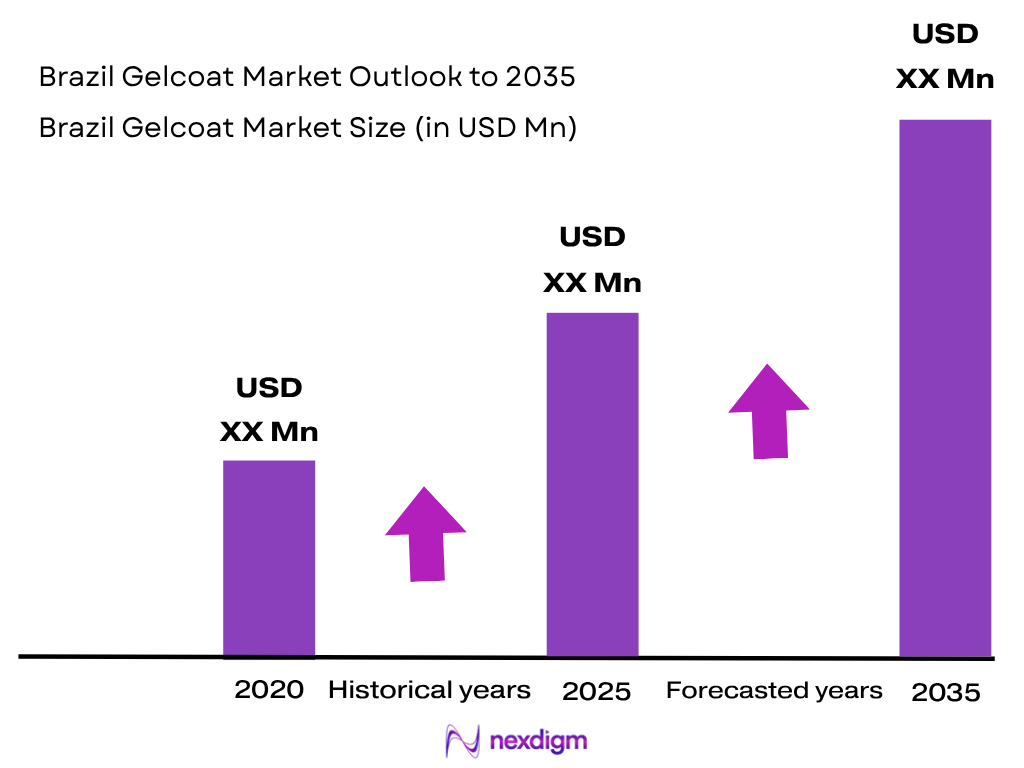
The Brazil Gelcoat Market is valued at ~USD XX million, supported by the country’s established fiberglass-reinforced plastic ecosystem and demand from marine, wind energy, construction, transportation and industrial applications. Brazil’s passenger-vehicle production reached approximately 2.55 million units, while installed wind-power capacity exceeded 30 GW, creating sustained requirements for lightweight composite structures and durable surface-protection systems. The country’s large coastline, expanding renewable-energy infrastructure and industrial base further support consumption of polyester, vinyl ester and specialty gelcoat formulations.
Brazil’s gelcoat demand is concentrated around industrial and manufacturing clusters with strong composite-processing activity. São Paulo, Santa Catarina, Paraná, Rio de Janeiro, Bahia and Ceará are important markets because of their concentration of automotive manufacturing, shipbuilding, industrial fabrication, wind-energy projects and construction activity. Brazil’s installed wind capacity exceeded 30 GW, while domestic automotive production remained above 2.5 million vehicles, reinforcing demand for FRP components, protective coatings and composite surface systems across transportation, renewable-energy and industrial applications.
Market Segmentation
By Resin Type
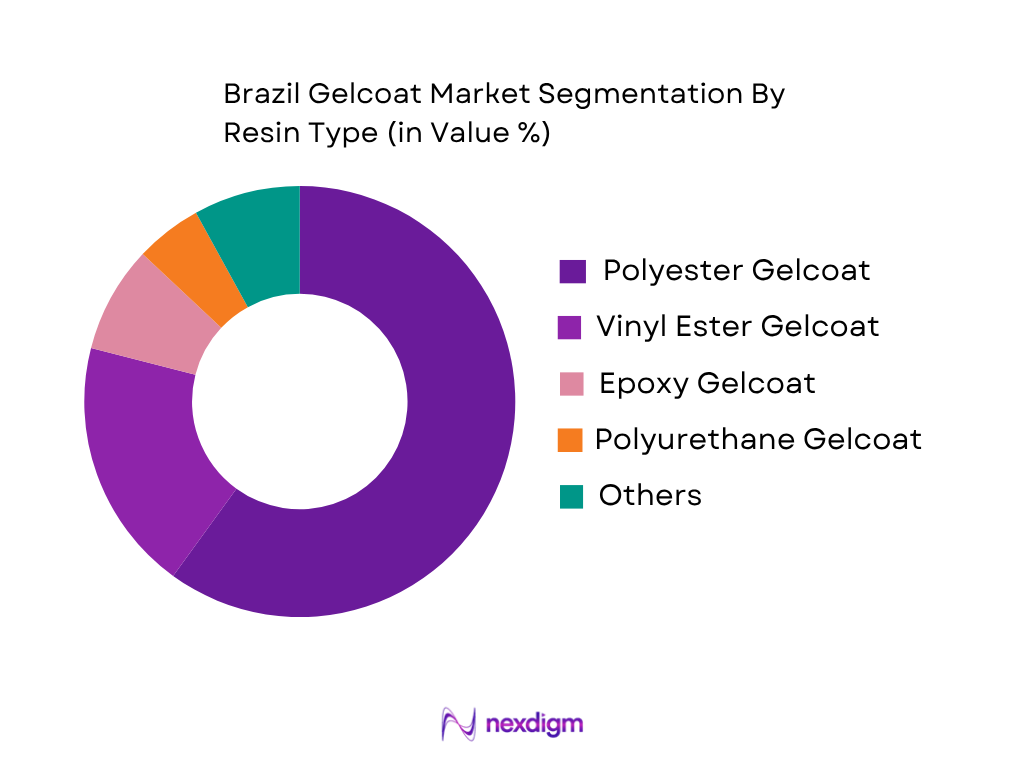
Brazil Gelcoat Market is segmented into polyester, vinyl ester, epoxy, polyurethane, and hybrid and specialty resin gelcoats. Polyester gelcoat represents the dominant sub-segment, supported by its extensive use across Brazilian FRP manufacturing, recreational boats, marine components, sanitaryware, construction products, industrial equipment and transportation applications. Polyester systems offer a practical combination of surface finish, processing flexibility, weather resistance and compatibility with established open-mould and spray-based composite manufacturing techniques. Brazil’s sizeable marine industry, wind-energy ecosystem and industrial fiberglass fabrication base further support polyester consumption. The relatively broad availability of polyester resin technology and established processing knowledge among composite fabricators also reinforces its position. Vinyl ester remains important for applications requiring improved chemical resistance and mechanical performance, while epoxy, polyurethane and specialty systems address more technically demanding applications.
By Product Type
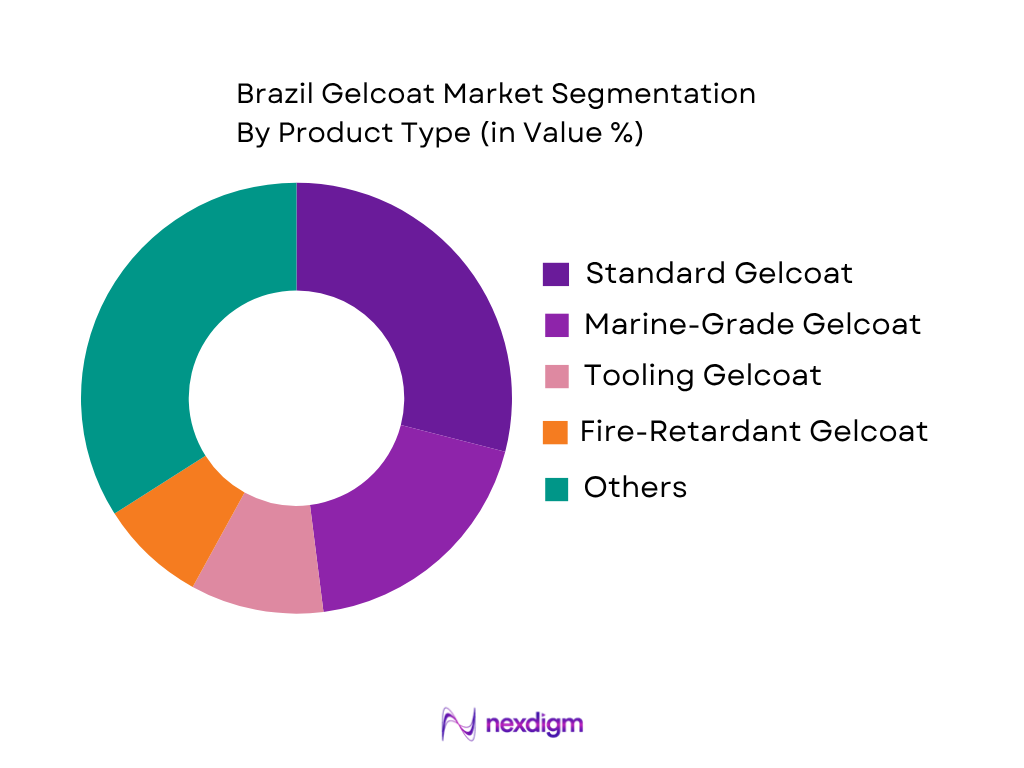
Brazil Gelcoat Market is segmented into standard, marine-grade, tooling, fire-retardant, UV-resistant, chemical-resistant, low-styrene and high-performance gelcoats. Standard gelcoat represents the leading product category because it addresses the broadest range of conventional FRP manufacturing requirements. Its application spans boat components, construction products, industrial housings, transportation components, sanitaryware and general-purpose composite structures. Brazil’s large installed base of composite fabricators and widespread use of hand lay-up, spray-up and other conventional processes support continued demand for standard formulations. Marine-grade gelcoats also represent an important category because of Brazil’s extensive coastline and recreational and commercial boating activity. UV-resistant and chemical-resistant systems are increasingly relevant for outdoor infrastructure, industrial equipment and demanding environmental conditions, while low-styrene, fire-retardant and high-performance products provide opportunities in specialized applications requiring enhanced environmental and technical performance.
Competitive Landscape
The Brazil Gelcoat Market includes global composite-material and specialty-chemical manufacturers alongside suppliers serving Brazil’s established FRP fabrication industry. International participants such as Scott Bader, Polynt, AOC, BÜFA Composite Systems and INEOS Composites compete through resin technology, gelcoat formulation breadth, technical support and distribution capabilities. Competition is particularly relevant across marine, wind-energy, industrial, transportation and construction applications, where manufacturers increasingly require application-specific surface protection, improved durability and specialized formulations.
| Company | Establishment | Headquarters | Gelcoat Portfolio | Marine Systems | Wind-Energy Applications | Industrial Applications | Technical Support |
| Scott Bader Company Limited | 1921 | Wollaston, UK | ~ | ~ | ~ | ~ | ~ |
| Polynt Group | 1955 | Scanzorosciate, Italy | ~ | ~ | ~ | ~ | ~ |
| AOC | 1960 | Collierville, USA | ~ | ~ | ~ | ~ | ~ |
| BÜFA Composite Systems | 1883 | Rastede, Germany | ~ | ~ | ~ | ~ | ~ |
| INEOS Composites | 1953 | Columbus, Ohio, USA | ~ | ~ | ~ | ~ |

Brazil Gelcoat Market Analysis
Growth Drivers
Expansion of Wind Energy Composite Manufacturing
Brazil’s wind-energy industry is creating a substantial downstream requirement for fiberglass-reinforced plastic components and protective surface systems, directly supporting demand for gelcoats used on nacelles, housings, covers and other composite structures. EPE reported 29,550 MW of installed wind capacity and 107.7 TWh of wind generation in 2024, with generation increasing by 12.4% from the previous year. The country’s broader industrial base also strengthened, with real GDP expanding by 3.4% in 2024 and industrial activity increasing by 3.3%, according to IBGE and the World Bank. Wind-turbine composite manufacturing requires durable surfaces capable of resisting ultraviolet exposure, moisture, erosion and repeated mechanical stresses, creating demand for UV-resistant, weather-resistant and high-performance gelcoat formulations. Industrial electricity consumption also increased by 1.4% in 2024, according to EPE, reinforcing the scale of Brazil’s industrial operating environment. The combination of renewable-energy expansion, composite component manufacturing and industrial investment supports continued consumption of gelcoats in wind applications. It also creates opportunities for specialized formulations designed for larger composite structures, automated application processes and demanding outdoor operating conditions. Sources: Empresa de Pesquisa Energética (EPE), IBGE, World Bank.
Marine and Recreational Boat Production
Brazil’s extensive coastline, established recreational boating ecosystem and renewed investment in shipbuilding create a strong application base for marine-grade gelcoats. The Ministry of Ports and Airports reported R$30.8 billion in approved investments for more than 430 naval and port projects during 2024, including vessel construction, repairs, dry-docking, modernization and shipyard expansion. The wider economy also recorded real GDP growth of 3.4% in 2024, while industry increased by 3.3%, according to IBGE, supporting industrial purchasing activity across composite manufacturing. Marine gelcoats are particularly relevant for boat hulls, decks, cabins and recreational craft because they provide a finished surface while helping protect FRP structures from water exposure, ultraviolet radiation, abrasion and weathering. Demand extends beyond new vessel construction to repair and refurbishment, where colour matching, surface restoration and localized gelcoat application are important requirements. The combination of naval investment, recreational boating activity and Brazil’s mature fiberglass fabrication base supports continued demand for polyester and vinyl ester marine gelcoats. Suppliers able to provide UV-resistant, water-resistant and repair-compatible systems can address both original-equipment manufacturing and aftermarket requirements.
Market Challenges
Dependence on Specialty Resin Feedstocks
Brazil’s gelcoat industry remains exposed to the availability and continuity of specialty resin, monomer and chemical feedstocks required to formulate polyester, vinyl ester, epoxy and other performance-oriented systems. The challenge is particularly relevant for applications requiring tightly controlled formulations, such as wind-turbine components, marine structures, chemical-resistant equipment and tooling surfaces. Brazil recorded US$2.19 trillion in GDP in 2024 and goods and services imports equivalent to 17.6% of GDP, according to World Bank data, illustrating the scale of the country’s integration with international supply chains. Industrial activity represented 20.9% of GDP when including construction, creating a large manufacturing base that competes for chemical and industrial inputs. Brazil’s industrial energy consumption also increased by 1.4% in 2024, according to EPE, indicating continued operating requirements across processing industries. Feedstock disruptions can therefore affect formulation availability, production scheduling and inventory requirements for gelcoat suppliers. Specialty grades may face greater exposure because they require narrower raw-material specifications than standard formulations. Manufacturers and distributors can mitigate this challenge through diversified sourcing, localized formulation capability, strategic inventories and alternative resin systems that maintain required mechanical, chemical and surface-performance characteristics.
Styrene and VOC Compliance Requirements
Environmental and occupational requirements surrounding styrene and volatile organic compound emissions represent an important technical challenge for Brazilian gelcoat manufacturers and composite fabricators. Gelcoat application can involve resin systems containing reactive monomers, making ventilation, worker protection, process control and formulation selection important considerations, particularly in enclosed manufacturing environments. Brazil’s industrial sector generated approximately R$2.5 trillion of value added in 2024, while construction generated R$522.5 billion in total value from developments, works and services, according to IBGE, demonstrating the scale of industrial and construction activity in which composite materials can be used. The country’s real GDP increased by 3.4% in 2024, while gross fixed capital formation reached 17.0% of GDP, indicating continued investment activity. As composite production expands, manufacturers may face stronger requirements for emission control, workplace safety, waste handling and documented chemical compliance. This can increase formulation-development requirements for low-styrene and low-emission products and encourage investment in controlled application equipment. Suppliers that can combine surface quality with reduced emissions, reliable curing and application consistency are better positioned to address regulatory and operational requirements without compromising composite production efficiency.
Market Opportunities
Low-Styrene and Low-Emission Gelcoats
The transition toward lower-emission composite manufacturing creates an opportunity for Brazilian gelcoat suppliers to develop formulations that reduce styrene and VOC exposure while maintaining surface finish, curing performance and weather resistance. Brazil’s industrial sector generated approximately R$2.5 trillion in value added in 2024, while construction activity generated R$522.5 billion in developments, works and services, according to IBGE, providing a broad industrial customer base for improved composite-processing technologies. Wind-energy activity also reached 29,550 MW of installed capacity and 107.7 TWh of generation in 2024, according to EPE, creating continuing requirements for large FRP components manufactured under increasingly controlled production conditions. Low-emission gelcoats can be particularly relevant for enclosed factories, marine workshops, automotive component plants and industrial composite facilities where worker exposure and ventilation requirements influence process design. Opportunity areas include low-styrene polyester systems, optimized spray formulations, improved curing packages and formulations compatible with automated application. Local formulation and technical-support capabilities can further improve adoption by allowing manufacturers to tailor products to Brazilian climate conditions and fabrication practices. These developments position low-emission gelcoats as a route toward improving occupational conditions while retaining the protective and aesthetic functions required in composite manufacturing.
Wind Energy Grade Surface Systems
Brazil’s expanding wind-energy infrastructure creates an opportunity for specialized gelcoat systems engineered for large composite components exposed to ultraviolet radiation, moisture, temperature variation, erosion and mechanical fatigue. EPE recorded 29,550 MW of installed wind capacity and 107.7 TWh of wind generation in 2024, while wind generation increased by 12.4% from the preceding year. Brazil’s overall economy also expanded by 3.4% in 2024, and industrial activity increased by 3.3%, according to the World Bank and IBGE, supporting continued industrial demand. Specialized wind-energy gelcoats can address requirements beyond conventional surface finishing by emphasizing UV stability, weather resistance, adhesion, low porosity and compatibility with composite repair systems. The opportunity extends across nacelle covers, hubs, housings and other fiberglass-reinforced structures, as well as maintenance and refurbishment activities. Suppliers can differentiate through formulations designed for large-scale spray application, faster processing, colour stability and improved resistance to environmental degradation. Brazil’s established wind-generation base also creates an installed fleet requiring maintenance over its operating life, supporting opportunities beyond new equipment manufacturing.
Future Outlook
Over the forecast period, the Brazil Gelcoat Market is expected to benefit from continued composite-material adoption across wind energy, marine manufacturing, transportation, construction and industrial applications. Demand is likely to increasingly shift toward low-styrene, low-emission, UV-resistant, fire-retardant and chemical-resistant formulations. Brazil’s expanding renewable-energy infrastructure and established FRP manufacturing base provide opportunities for specialized gelcoat systems. Marine production, industrial corrosion protection and composite repair applications are also expected to remain important demand areas.
Major Players
- BÜFA Composite Systems
- Scott Bader Company Limited
- Polynt Group
- AOC
- INEOS Composites
- Interplastic Corporation
- Allnex
- Gurit
- Mäder Group
- Ashland
- Sika AG
- Reichhold Industries
- Westlake Corporation
- Owens Corning
- Covestro
Key Target Audience
- Gelcoat and Composite Material Manufacturers
- FRP and Composite Component Manufacturers
- Marine, Yacht and Recreational Boat Manufacturers
- Wind Turbine Component Manufacturers
- Automotive and Transportation Component Manufacturers
- Industrial Equipment and Chemical-Processing Manufacturers
- Investments and Venture Capitalist Firms
- Government and Regulatory Bodies (Ministry of Development, Industry, Foreign Trade and Services; Ministry of Environment and Climate Change; Brazilian Institute of Environment and Renewable Natural Resources)
Research Methodology
Step 1: Identification of Key Variables
The initial phase establishes the Brazil Gelcoat Market ecosystem covering resin producers, gelcoat manufacturers, composite fabricators, distributors and end-use industries. Resin chemistry, product category, application method, composite process, consumption volume and domestic-versus-imported supply are identified as core variables.
Step 2: Market Analysis and Construction
Historical market information is compiled using top-down and bottom-up approaches covering resin consumption, gelcoat utilization, composite production and end-use demand. Automotive production, wind-energy installations, marine manufacturing, construction activity and industrial FRP applications are incorporated into the market assessment.
Step 3: Hypothesis Validation and Expert Consultation
Market hypotheses are validated through consultations with gelcoat manufacturers, composite fabricators, distributors, marine manufacturers, wind-energy suppliers and industrial users. Discussions focus on formulation preferences, application technologies, purchasing criteria, product qualification, technical requirements and changing environmental standards.
Step 4: Research Synthesis and Final Output
The final stage triangulates manufacturer information, industrial statistics, trade data and end-user insights. Bottom-up consumption calculations are reconciled with supply-side information to develop a validated assessment of Brazil’s gelcoat demand, competitive structure, segmentation and future development.

- Executive Summary
- Research Methodology (Market Definition and Scope, Product Boundary, Market Sizing Framework, Top-Down Market Assessment, Bottom-Up Market Assessment, Demand-Side Analysis, Supply-Side Analysis, Import-Export Reconciliation, Resin Consumption Mapping, Composite Fabricator Interviews, Distributor Interviews, Marine Industry Interviews, Wind Energy Validation, Data Triangulation, Forecasting Framework, Scenario Analysis, Research Limitations)

- Definition and Scope
- Gelcoat Chemistry, Functional Properties and Surface-Protection Role in FRP Composites
- Brazil Gelcoat Industry Evolution and Manufacturing Development
- Brazil Composite Materials Industry Structure
- Gelcoat Industry Value Chain
- Brazil Gelcoat Supply Chain Architecture

- Growth Drivers (Expansion of Wind Energy Composite Manufacturing, Marine and Recreational Boat Production, Growth of FRP Construction Components, Automotive Lightweighting, Industrial Corrosion-Resistant Equipment Demand, Infrastructure Modernization, Expansion of Composite Manufacturing Capacity, Increasing Requirement for Durable Surface Finishes)
- Market Challenges (Dependence on Specialty Resin Feedstocks, Raw Material Supply Volatility, Styrene and VOC Compliance Requirements, Imported Specialty Chemical Exposure, Skilled Composite Workforce Requirements, Energy-Intensive Composite Processing, Product Qualification Requirements, Fragmented Distribution and Technical Support)
- Market Opportunities (Low-Styrene and Low-Emission Gelcoats, Wind Energy Grade Surface Systems, High-Performance Marine Gelcoats, Advanced Tooling Gelcoats, Fire-Retardant Composite Surfaces, Sustainable Resin-Based Gelcoats, Local Colour-Matching and Formulation, Composite Repair and Refurbishment, Regional Export-Oriented Production)
- Market Trends (Low-VOC Gelcoat Adoption, Sustainable Composite Materials, Premium Marine Finishes, Spray Application Growth, Lightweight FRP Structures, Wind Blade Composite Development, UV-Resistant Formulations, Fire-Retardant Surface Systems, Advanced Tooling Technologies)
- Government Regulations and Standards (Chemical Substance Controls, Environmental Licensing, VOC and Styrene Requirements, Waste Management Obligations, Industrial Chemical Handling, Occupational Exposure Controls, Product Safety Requirements, Composite Manufacturing Standards)
- SWOT Analysis
- Porter’s Five Forces Analysis
- PESTLE Analysis

- By Market Value (2020-2025)
- By Consumption Volume (2020-2025)
- By Domestic Production Volume (2020-2025)
- By Imported Gelcoat Volume (2020-2025)
- By Resin Consumption Volume (2020-2025)
- By Domestic vs Imported Supply (2020-2025)

- By Resin Type (In Value %)
Polyester Gelcoat
Vinyl Ester Gelcoat
Epoxy Gelcoat
Polyurethane Gelcoat
Hybrid and Specialty Resin Gelcoat - By Product Type (In Value %)
Standard Gelcoat
Marine-Grade Gelcoat
Tooling Gelcoat
Fire-Retardant Gelcoat
UV-Resistant Gelcoat
Chemical-Resistant Gelcoat - Low-Styrene Gelcoat
- By Application Method (In Value %)
Brush Application
Roller Application
Spray Application
Hand Application
In-Mould Application - By End-Use Industry (In Value %)
Marine and Shipbuilding
Construction and Infrastructure
Wind Energy
Automotive and Transportation
Industrial Equipment
Chemical Processing
Oil & Gas and Offshore - By Application (In Value %)
Boat Hulls and Decks
Fishing and Passenger Boats
Yachts and Recreational Boats
Ship Repair and Refurbishment
Wind Turbine Blades and Components
Automotive Composite Components
Architectural and Construction Components
Industrial Tanks and Vessels - By Composite Manufacturing Process (In Value %)
Hand Lay-Up
Spray-Up
Vacuum Infusion
Resin Transfer Molding
Light Resin Transfer Molding
Compression Molding
Filament Winding
Other Composite Manufacturing Processes

- Market Share Analysis of Major Players (By Resin Type, Product Type, Application Method, End-Use Industry, Application, Domestic Supply, Imported Supply)
- Cross Comparison Parameters (Gelcoat Product Portfolio Breadth, Polyester and Vinyl Ester Formulation Capability, Marine-Grade Gelcoat Coverage, Wind Energy Gelcoat Capability, Low-Styrene and Low-VOC Product Availability, Fire-Retardant Formulation Capability, Technical Application Support, Brazil and Latin America Distribution Reach)
- SWOT Analysis of Major Players
- Detailed Profiles of Major Companies and Market Participants
Scott Bader Company Limited
Polynt Group
AOC
Interplastic Corporation
BÜFA Composite Systems
Allnex
Gurit
Mäder Group
INEOS Composites
Sika AG
Ashland
Reichhold Industries
Novapol Plásticos / Grupo IMSA
Fiberglass Brasil
Redelease

- End-User Consumption Behavior
- Composite Fabricator Requirements
- Marine Industry Demand Assessment
- Wind Energy Demand Assessment
- Industrial Composite Demand Assessment
- Purchase Decision Factors

- By Market Value (2026-2035)
- By Consumption Volume (2026-2035)
- By Domestic Production Volume (2026-2035)
- By Imported Gelcoat Volume (2026-2035)
- By Resin Consumption Volume (2026-2035)
- By Domestic vs Imported Supply (2026-2035)


 Request a Sample
 Ask for Customization
 Get a Quote
 Enquire Now