
 Download PDF
Market Overview
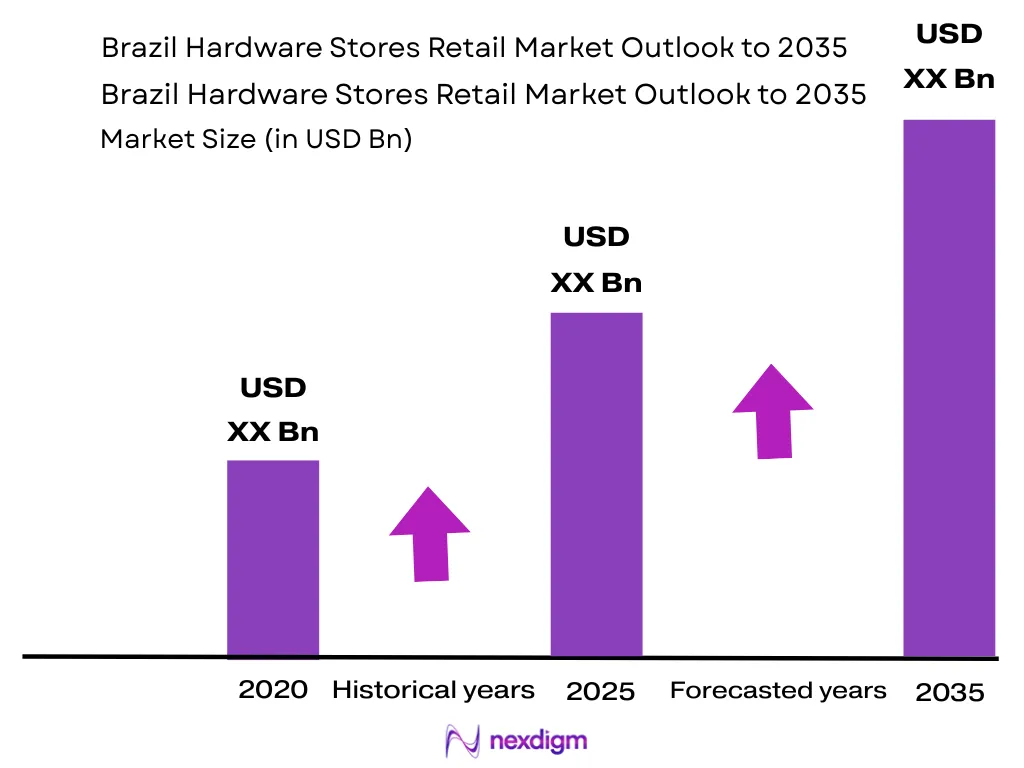
The Brazil Hardware Stores Retail Market is valued at ~ billion, based on a five-year historical assessment of material de construção retail. The market is driven by reforma residencial, small repairs, Pro contractor purchases, construction materials, paints, tools, hydraulic products, electrical products and finishing materials. Retail momentum is supported by construction-material sales growth and the large store base serving homeowners, pedreiros, electricians, plumbers, contractors and condominium maintenance buyers. São Paulo, Rio de Janeiro, Belo Horizonte, Curitiba, Porto Alegre, Recife, Salvador, Fortaleza and Brasília dominate the Brazil Hardware Stores Retail Market because these cities combine dense housing, high reforma demand, stronger formal retail chains, contractor networks, logistics access and higher purchasing power. The Southeast dominates due to São Paulo, Rio de Janeiro and Minas Gerais, while the South has strong regional chains and the Northeast benefits from urban expansion and home center penetration.
Market Segmentation
By Product Category
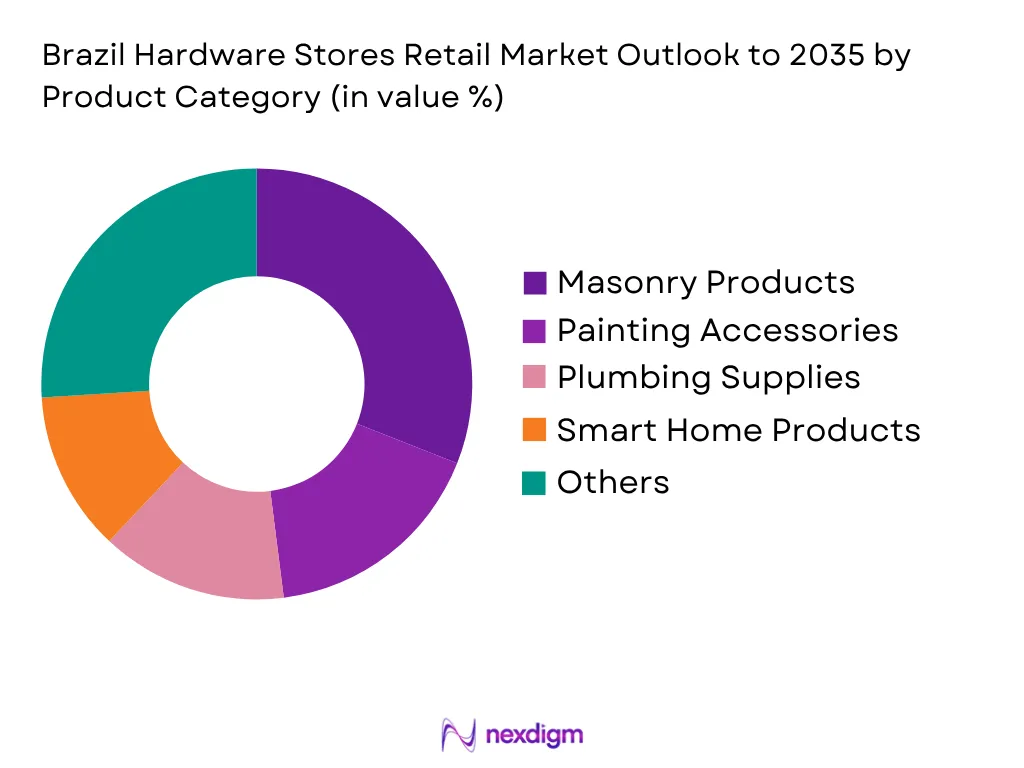
Brazil Hardware Stores Retail Market is segmented by product category into construction materials and masonry products, paints and coatings, hydraulic supplies, electrical products, tools, ferragens and garden products. Recently, construction materials and masonry products have a dominant market share in Brazil under product category, due to their direct connection with obra, reforma, residential repairs, informal construction and professional contractor demand. Cement, mortar, bricks, blocks, sand, steel, drywall and roofing products generate large transaction baskets and create strong attachment sales for tools, fasteners, pipes, wires, safety products, adhesives and paints. This segment dominates because Brazil’s hardware retail structure is closely tied to lojas de material de construção rather than narrow tool-only hardware stores. Homeowners and pedreiros often purchase bulk materials and repair items from the same store, making construction materials the anchor category.
By Store Format
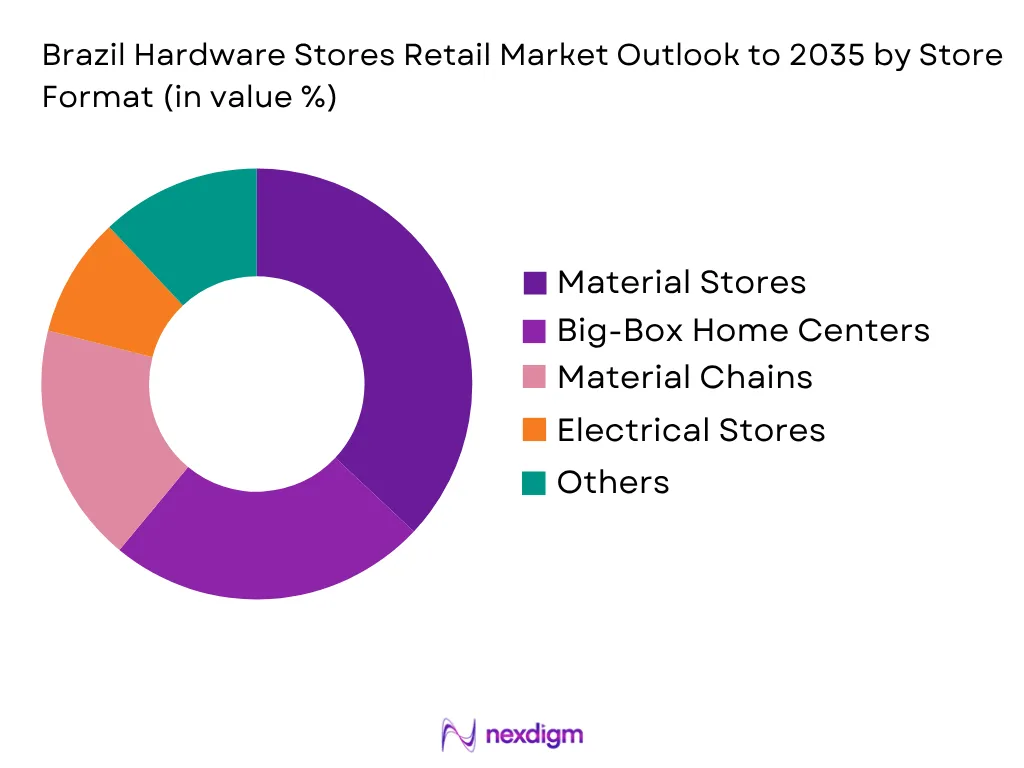
Brazil Hardware Stores Retail Market is segmented by store format into independent neighborhood material stores, big-box home centers, regional chains, specialist stores, online hardware retail and rural hardware retailers. Recently, independent neighborhood material stores have a dominant market share in Brazil under store format, due to proximity, local credit relationships, urgent repair purchases, WhatsApp quotation, quick delivery and direct relationships with pedreiros, plumbers and electricians. Brazil’s construction-material retail base is highly fragmented, and many consumers still rely on nearby lojas de bairro for small repairs, emergency purchases and reforma replenishment. Big-box home centers such as Leroy Merlin, Sodimac, Telhanorte, Ferreira Costa and Obramax dominate organized retail visibility, but neighborhood stores remain critical because hardware and construction products are bulky, time-sensitive and technically specific. Local stores also offer informal advice, small-ticket access, delivery flexibility and trust-based payment arrangements.
Competitive Landscape
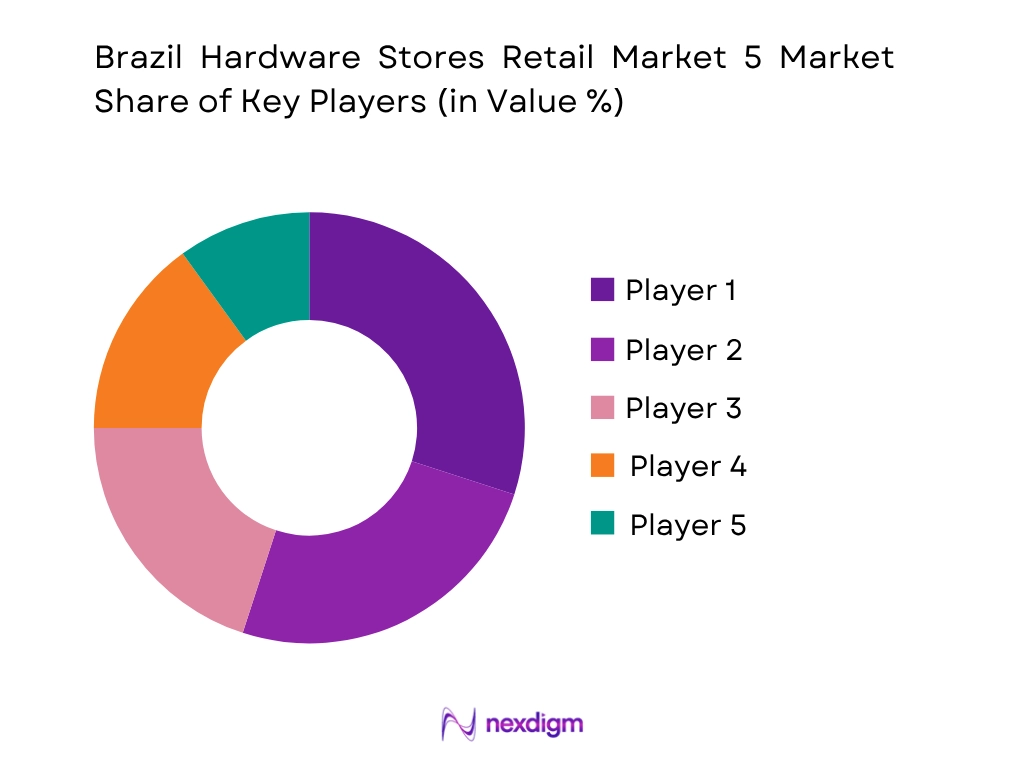
The Brazil Hardware Stores Retail Market is fragmented, with organized leaders competing against thousands of independent lojas de material de construção. Leroy Merlin leads the national retail ranking, followed by Saint-Gobain’s Telhanorte/Tumelero, Sodimac Brasil, Ferreira Costa and Obramax. Competition is shaped by store footprint, regional density, product breadth, contractor relationships, delivery capability, digital commerce, financing, PIX acceptance, private-label development and ability to serve both DIY reforma consumers and professional trade buyers.
| Company | Establishment Year | Headquarters | Core Categories | Brazil Retail Format | Customer Focus | Digital Capability | Regional Strength | Competitive Position |
| Leroy Merlin Brasil | 1923 global origin | Lezennes, France / São Paulo operations | ~ | ~ | ~ | ~ | ~ | ~ |
| Telhanorte / Tumelero | 1976 Telhanorte origin | São Paulo, Brazil | ~ | ~ | ~ | ~ | ~ | ~ |
| Sodimac Brasil | 1952 global origin | Santiago, Chile / São Paulo operations | ~ | ~ | ~ | ~ | ~ | ~ |
| Ferreira Costa | 1884 | Recife, Brazil | ~ | ~ | ~ | ~ | ~ | ~ |
| Obramax | 2018 | São Paulo, Brazil | ~ | ~ | ~ | ~ | ~ | ~ |
Brazil Hardware Stores Retail Market
Growth Drivers
Large Housing Base and Construction Workforce Supporting Repair and Reforma Demand
Brazil Hardware Stores Retail Market is supported by a large installed housing base that creates recurring demand for ferragens, paints, hydraulic fittings, electrical items, tools, sealants, locks and masonry products. IBGE recorded 77.3 million housing units in 2024, including 68.5 million urban housing units and 8.9 million rural housing units, giving hardware retailers a broad customer base across metro, interior and rural catchments. Construction also employed 7.8 million persons in 2024, adding 406 thousand workers compared with 2023, which supports frequent purchases by pedreiros, plumbers, electricians, painters and small contractors. The macro base remains large, with World Bank reporting Brazil GDP of USD 2.19 trillion, GDP per capita of USD 10,310.5, and population of 205.3 million people in 2024.
Digital Payments and Online Household Access Supporting Omnichannel Hardware Retail
Brazil Hardware Stores Retail Market benefits from digital retail adoption because consumers and tradespeople increasingly use WhatsApp quotes, PIX payments, online catalogues, marketplace listings, click-and-collect and local delivery for tools, fasteners, paints, plumbing parts and electrical items. IBGE reported 74.9 million households with internet in 2024, creating a large base for digital SKU discovery and store-assisted commerce. Banco Central do Brasil reported 63 billion Pix transactions and BRL 26.4 trillion in Pix transaction value in 2024, while daily Pix records reached 252.13 million transactions on December 20, 2024. This supports hardware retail because local stores can close small-ticket and urgent purchases quickly without depending only on cash or card terminals. World Bank’s USD 2.19 trillion GDP and 205.3 million population provide macro scale for digital retail formalization.
Market Challenges
Construction-Cycle Volatility Affecting Pro Purchases and Large Reforma Baskets
Brazil Hardware Stores Retail Market faces demand volatility because large purchase baskets are linked to construction activity, financing conditions, household income and contractor workload. IBGE reported Brazil’s GDP at BRL 11.7 trillion in 2024, with investment rate at 17.0 of GDP, while the construction sector stood out in 2024 due to employment, inputs and credit expansion. However, the same market remains exposed to project postponement when credit tightens or household budgets weaken. Construction employed 7.8 million persons in 2024, meaning a slowdown directly affects repeat purchases of cement, mortar, tools, fasteners, PVC pipes, wiring, PPE and finishing products by trade workers. The challenge is material for hardware retailers because Pro customers buy frequently and expect immediate product availability. Brazil’s macro scale, with World Bank GDP of USD 2.19 trillion, does not remove construction-cycle sensitivity. Sources: IBGE, World Bank.
Import Exposure in Tools, Fasteners and Hardware Components
Brazil Hardware Stores Retail Market faces imported-input exposure in several high-velocity hardware categories, especially fasteners, clamps, torches, hydraulic components and tool accessories. WITS/World Bank trade data shows Brazil imported 22,727,100 kg of self-tapping iron or steel screws in 2024, including 17,600,300 kg from China. Brazil also imported 1,598,370 kg of vices and clamps in 2024, including 1,457,340 kg from China, and 7,887,130 kg of parts for hydraulic, pneumatic and other power engines. This matters for retailers because imported hardware SKUs are often mission-critical, small-ticket, and needed immediately by contractors and DIY consumers. Exchange-rate shifts, customs delays and supplier concentration can affect assortment availability. Brazil’s macro context is significant, with World Bank GDP per capita of USD 10,310.5 in 2024, but store-level inventory resilience remains exposed to external supply chains.
Market Opportunities
Affordable Housing and New-Unit Contracting Supporting Construction-Material Retail Demand
Brazil Hardware Stores Retail Market has an opportunity to grow through affordable housing-linked construction, finishing and repair demand. The federal government reported Minha Casa, Minha Vida closed 2024 with 1.26 million housing units contracted since the program’s restart, while the program had already delivered more than 41 thousand new units and resumed works on more than 44 thousand additional units. In 2025, the MCMV-Entidades cycle added 21,282 new urban housing units, and the MCMV-FAR cycle provided for 110 thousand new urban housing units. These current commitments support demand for cement, mortar, wiring, switches, hydraulic items, locks, paints, tiles, sanitaryware and tools across builders, regional retailers and local stores. The macro base reinforces investment capacity: IBGE reported GDP of BRL 11.7 trillion in 2024, while World Bank reported USD 2.19 trillion GDP.
Interior, Rural and Secondary-City Expansion Through Housing and Internet Penetration
Brazil Hardware Stores Retail Market has a future growth opportunity in interior cities, rural towns and secondary urban clusters where neighborhood material stores, regional chains and agro-hardware retailers can serve local repairs, irrigation, fencing, pumps, masonry, roofing and household maintenance. IBGE recorded 77.3 million housing units in 2024, including 8.9 million rural housing units, while direct waste collection remained much lower in rural areas, showing infrastructure gaps that often require local hardware and construction-material purchases. Digital access also supports interior retail modernization: IBGE recorded 74.9 million households with internet in 2024, and Banco Central recorded 63 billion Pix transactions in 2024. This enables WhatsApp-based quotations, Pix payments, remote product confirmation and store delivery even outside large metros. Brazil’s scale—205.3 million people and USD 2.19 trillion GDP in 2024.
Future Outlook
The Brazil Hardware Stores Retail Market is expected to grow steadily through the forecast period, supported by residential renovation, affordable housing activity, urban repair demand, contractor-led procurement, PIX-enabled transactions, e-commerce penetration and formalization of fragmented retail. Growth will be strongest in construction materials, paints, hydraulic products, electrical products, tools, fasteners, adhesives, tiles and home-finishing categories. Organized home centers will continue expanding omnichannel, delivery and Pro-service capabilities, while independent stores will remain relevant through proximity, credit relationships and local service. Regional chains will consolidate share in interior cities and underserved states. Digital tools such as WhatsApp quotations, online catalogues, click-and-collect, marketplace storefronts and inventory visibility will reshape how consumers and tradespeople buy hardware products. The strongest retailers will combine broad assortment, technical advice, delivery reliability, credit flexibility and regionalized inventory.
Major Players
- Leroy Merlin Brasil
- Sodimac Brasil / Dicico
- Telhanorte / Tumelero
- Ferreira Costa
- C&C Casa e Construção
- Quero-Quero Casa e Construção
- Cassol Centerlar
- Balaroti
- Carajás Home Center
- Todimo Materiais para Construção
- Joli Materiais para Construção
- Redemac
- Obramax
- Palácio da Ferramenta
- Mercado Livre
Key Target Audience
- Home center chains and construction-material retailers
- Independent hardware and material de construção store owners
- Construction material, paint, tool, hydraulic and electrical manufacturers
- Professional contractor supply and jobsite fulfilment operators
- Construction-material distributors and wholesale buying groups
- Marketplace, e-commerce and WhatsApp commerce platforms
- Investments and venture capitalist firms
- Government and regulatory bodies
Research Methodology
Step 1: Identification of Key Variables
The initial phase involves constructing an ecosystem map encompassing all major stakeholders within the Brazil Hardware Stores Retail Market. This includes home centers, regional chains, independent stores, cooperatives, distributors, manufacturers, pedreiros, electricians, plumbers, contractors and digital platforms. The objective is to identify variables such as product category mix, store format, Pro demand, reforma demand, credit usage and regional growth.
Step 2: Market Analysis and Construction
In this phase, historical data is compiled and analyzed for the Brazil Hardware Stores Retail Market. This includes construction-material retail revenue, store-count base, competitor rankings, regional chain presence, product assortment, customer cohorts and omnichannel behaviour. Market construction is validated through top-down revenue sizing and bottom-up category, format, region and buyer-cohort mapping.
Step 3: Hypothesis Validation and Expert Consultation
Market hypotheses are developed and validated through computer-assisted telephone interviews with retailers, store managers, distributors, manufacturers, contractors, pedreiros, electricians, plumbers and category managers. These consultations provide insights into basket composition, SKU velocity, delivery needs, credit use, WhatsApp selling, price sensitivity and regional assortment gaps.
Step 4: Research Synthesis and Final Output
The final phase involves synthesizing secondary data, store benchmarking, competitor mapping, product-category analysis and expert inputs. Direct engagement with retailers and suppliers validates segmentation, competitive positioning, growth drivers and operational constraints. The final output provides structured analysis on market size, segmentation, competition, future outlook, target audiences and recommendations.

- Executive Summary
- Research Methodology (Market definitions and assumptions, abbreviations, CNAE and retail classification, hardware and material de construção scope, home center overlap treatment, independent store mapping, distributor and atacarejo interface, market sizing approach, top-down validation, bottom-up store audit, SKU basket benchmarking, Pro customer interviews, consumer reforma interviews, distributor and wholesaler validation, limitations and future conclusions)

- Definition and Scope
- Overview Genesis
- Timeline of Major Players
- Business Cycle
- Supply Chain and Value Chain Analysis

- Growth Drivers (Urban housing base, residential renovation, Minha Casa Minha Vida, Pro trade demand, credit installment culture, PIX adoption, regional expansion)
- Market Challenges (Tax complexity, logistics cost, informal competition, credit risk, import exposure, inflation pressure, SKU fragmentation)
- Opportunities (Digital procurement, Pro loyalty, private labels, technical services, rural hardware, energy-efficiency products, localized logistics)
- Market Trends (Reforma over new build, digital catalogues, PIX checkout, marketplace penetration, category specialization, sustainability products)
- Government Regulation (ABNT standards, INMETRO certification, ICMS tax rules, labour rules, consumer protection, environmental rules, product safety)
- SWOT Analysis
- Stakeholder Ecosystem
- Porter’s Five Forces

- By Retail Sales Value (2020-2025)
- By Store Count (2020-2025)
- By Average Sales Per Store (2020-2025)

- By Product Category (In Value %)
Ferragens, Fixadores and Rough Hardware
Tools and Power Tools
Paints, Coatings and Painting Accessories
Hydraulic and Plumbing Supplies
Electrical, Lighting and Smart Home - By Customer Type (In Value %)
DIY Homeowners and Reforma Consumers
Pedreiros, Electricians and Plumbers
Professional Contractors and Builders
Renovation and Finishing Professionals
Property Managers and Condominium Maintenance Buyers - By Sales Channel (In Value %)
In-Store Walk-In Retail
Click-and-Collect / Retire na Loja
Ship-to-Home E-Commerce
Local Delivery From Store
Pro Account and Credit-Based Purchasing - By Region (In Value %)
Southeast
South
Northeast
Center-West
North

- Market Share of Major Players (Retail sales value, store count, regional footprint, category contribution, Pro customer contribution, online sales contribution)
- Cross Comparison Parameters (Store footprint, regional coverage, Pro contractor program strength, SKU assortment breadth, private-label and exclusive brand portfolio, e-commerce and click-and-collect capability, delivery and logistics network, credit and installment offering)
- SWOT Analysis of Major Players
- Pricing Analysis Basis SKUs (Cordless drill, cement bag, paint gallon, PVC pipe, electrical outlet, faucet, porcelain tile, screw box, LED bulb, tool rental)
- Detailed Profiles of Major Companies
Leroy Merlin Brasil
Sodimac Brasil / Dicico
Telhanorte / Tumelero
Ferreira Costa
C&C Casa e Construção
Quero-Quero Casa e Construção
Cassol Centerlar
Balaroti
Carajás Home Center
Todimo Materiais para Construção
Joli Materiais para Construção
Redemac
Obramax
Palácio da Ferramenta
Mercado Livre

- DIY Homeowner and Reforma Consumer Analysis
- Professional Trade Customer Analysis
- Contractor and Builder Analysis
- Renovation and Finishing Professional Analysis
- Condominium and Facility Maintenance Buyer Analysis

- By Retail Sales Value (2026-2035)
- By Store Count (2026-2035)
- By Average Sales Per Store (2026-2035)


 Request a Sample
 Ask for Customization
 Get a Quote
 Enquire Now