

 Download PDF
Market Overview
The Brazil Health & Fitness Club Market is assessed at USD ~ billion in 2024, based on triangulated historical analysis using health club membership, number of fitness facilities, subscription pricing, gym chain expansion, urban wellness spending, and South America health and fitness club benchmarks. Brazil is one of the largest fitness markets globally by club count and membership base, with the Health & Fitness Association referencing more than 31,000 clubs and 7.9 million club members in Brazil.
The market is also supported by Brazil’s broader fitness culture, growth of budget gym networks, rising demand for strength training, and preventive health awareness. Industry sources also indicate that global fitness facilities and memberships continued recovering in 2024, with average facility count and membership growth across comparable markets.
Market Segmentation
By Club Type
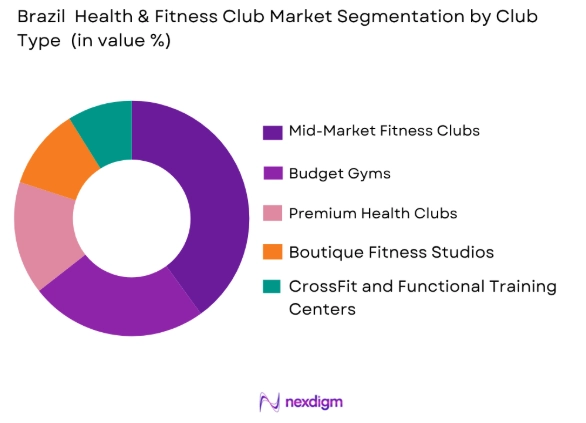
Brazil Health & Fitness Club Market is segmented by club type into budget gyms, mid-market fitness clubs, premium health clubs, boutique fitness studios, CrossFit and functional training centers, women-only fitness clubs, franchise fitness chains, and independent gyms. Recently, budget gyms have a dominant market share in Brazil under the segmentation club type, due to their strong affordability, dense urban expansion, standardized operating model, app-enabled access, and ability to attract price-sensitive working professionals and students. Budget gym chains also benefit from high-volume membership models, lower staffing intensity, compact real estate formats, and digital onboarding. Premium clubs and boutique studios remain important in affluent neighborhoods, but budget gyms dominate the market because they serve the largest addressable base and can scale rapidly through owned and franchised expansion.
By Revenue Stream
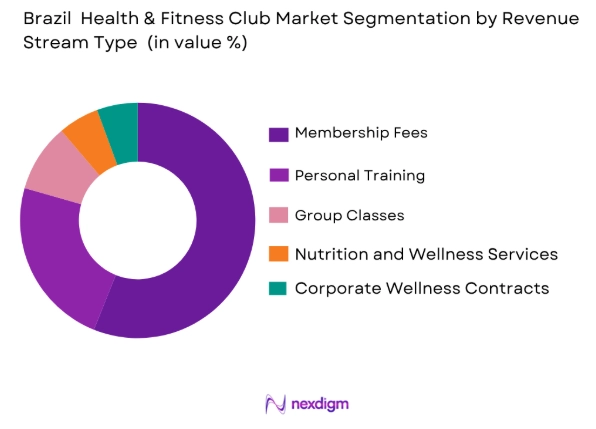
Brazil Health & Fitness Club Market is segmented by revenue stream into membership fees, personal training, group classes, nutrition and wellness services, merchandise and supplements, digital fitness add-ons, corporate wellness contracts, and other ancillary services. Recently, membership fees have a dominant market share in Brazil under the segmentation revenue stream, as recurring subscriptions remain the core revenue base for health and fitness clubs. Membership revenue is supported by monthly plans, annual plans, family memberships, corporate plans, and flexible subscription models. Personal training has strong monetization potential in premium and mid-market gyms, while group classes help retain members and differentiate operators. However, membership fees dominate because they create predictable recurring income and scale across budget, mid-market, and premium formats.
Competitive Landscape
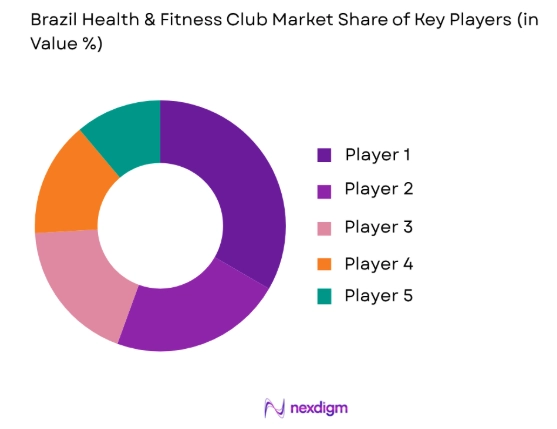
The Brazil Health & Fitness Club Market is moderately consolidated at the chain level but fragmented at the total club level, with large organized chains competing against thousands of independent gyms, boutique studios, CrossFit affiliates, Pilates studios, and neighborhood fitness centers. Smart Fit, Bluefit, Bio Ritmo, Bodytech, Selfit, Cia Athletica, Pratique Fitness, Panobianco, and other regional operators compete through pricing, club density, app experience, class portfolio, equipment quality, trainer availability, and brand positioning. Brazil’s large base of clubs and members makes scale a major competitive advantage, especially for budget chains that can negotiate equipment procurement, leases, marketing, and digital systems more efficiently. At the same time, boutique studios and premium clubs compete through specialized training, community experience, personal coaching, and wellness add-ons.
| Company | Establishment Year | Headquarters | Key Club Format | Main Channel Strength | Price Positioning | Franchise Presence | Digital Availability | Market Positioning |
| Smart Fit | 2009 | São Paulo, Brazil | ~ | ~ | ~ | ~ | ~ | ~ |
| Bluefit | 2015 | São Paulo, Brazil | ~ | ~ | ~ | ~ | ~ | ~ |
| Bio Ritmo | 1996 | São Paulo, Brazil | ~ | ~ | ~ | ~ | ~ | ~ |
| Bodytech | 1994 | Rio de Janeiro, Brazil | ~ | ~ | ~ | ~ | ~ | ~ |
| Selfit Academias | 2012 | Recife, Brazil | ~ | ~ | ~ | ~ | ~ | ~ |
| Cia Athletica | 1985 | São Paulo, Brazil | ~ | ~ | ~ | ~ | ~ | ~ |
| Pratique Fitness | 2009 | Minas Gerais, Brazil | ~ | ~ | ~ | ~ | ~ | ~ |
| Panobianco Academia | 2009 | São Paulo, Brazil | ~ | ~ | ~ | ~ | ~ | ~ |
Brazil Health & Fitness Club Market Analysis
Growth Drivers
Rising Health Awareness and Preventive Wellness Adoption
The Brazil Health & Fitness Club Market is supported by increasing consumer focus on preventive health, weight management, physical conditioning, and lifestyle disease prevention. Gyms and fitness clubs are increasingly viewed as wellness destinations rather than only exercise facilities. Consumers are using fitness clubs for strength training, cardio workouts, functional training, group classes, nutrition support, and body-composition monitoring. Rising awareness of obesity, diabetes, cardiovascular risks, and mental well-being is encouraging regular physical activity among urban consumers. This shift is strengthening demand for structured fitness memberships, personal training, and wellness-oriented club services across Brazil’s major cities.
Expansion of Budget Gym Chains and Franchise Models
The Brazil Health & Fitness Club Market is benefiting from the rapid expansion of budget gym chains and franchise-based fitness formats. These operators make gym access more affordable by offering low monthly fees, flexible memberships, standardized equipment layouts, and app-based member onboarding. Budget gyms are especially attractive to students, young professionals, and middle-income consumers seeking convenient access to strength and cardio equipment. Franchise models also allow faster expansion into dense urban neighborhoods and emerging cities. This is helping organized gym chains increase penetration beyond premium locations and capture first-time fitness users across Brazil.
Market Challenges
High Member Churn and Seasonal Demand Fluctuation
The Brazil Health & Fitness Club Market faces high member churn because many consumers discontinue memberships after short periods of low usage or financial pressure. Demand often increases in January, before summer, and during promotional campaigns, but retention weakens when members fail to build consistent workout habits. Budget gyms are particularly exposed because customers can easily switch between competing low-cost clubs based on price, location, or discounts. This forces operators to invest continuously in engagement, app reminders, personal training upselling, loyalty programs, and group classes to improve retention and stabilize recurring membership revenue.
High Rental, Labor, and Equipment Maintenance Costs
The Brazil Health & Fitness Club Market faces cost pressure from commercial rent, electricity, air conditioning, fitness equipment, trainer staffing, cleaning, and facility maintenance. Premium and full-service clubs face higher operating intensity because they offer larger workout areas, swimming pools, wellness zones, locker rooms, group class studios, and broader service staff. Independent gyms are more vulnerable because they usually lack procurement scale, strong digital systems, and national brand recognition. Rising operating expenses can reduce margins, especially when intense price competition limits the ability to increase membership fees.
Opportunities
Expansion of Low-Cost Gyms in Underserved Cities
The Brazil Health & Fitness Club Market has an opportunity to expand affordable gyms across tier-2 and tier-3 cities, smaller urban centers, and peripheral metropolitan neighborhoods. Large cities already have strong competition, but many secondary markets remain underpenetrated by organized fitness chains. Low-cost operators can attract first-time gym users through basic equipment access, flexible monthly pricing, long operating hours, and app-based membership management. Franchise-led expansion can help brands enter new locations faster while keeping operating models standardized. This creates strong potential for membership growth outside Brazil’s most saturated premium urban districts.
Corporate Wellness Partnerships
The Brazil Health & Fitness Club Market has an opportunity in corporate wellness programs as employers increasingly focus on employee health, productivity, absenteeism reduction, and workplace benefits. Fitness clubs can offer discounted memberships, corporate plans, wellness challenges, health assessments, personal training packages, and hybrid digital fitness access to companies. These partnerships create recurring B2B revenue and reduce dependence on individual walk-in memberships. Corporate clients also help clubs improve utilization during non-peak hours and strengthen brand visibility among working professionals. This opportunity is especially relevant in São Paulo, Rio de Janeiro, Brasília, and other major office markets.
Future Outlook
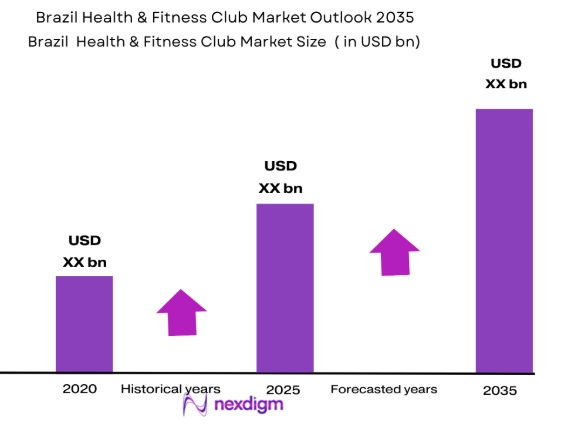
The Brazil Health & Fitness Club Market is expected to grow steadily through 2035, supported by health awareness, urbanization, franchise expansion, budget gym penetration, corporate wellness programs, personal training demand, and hybrid digital-physical fitness models. South America’s health and fitness club market is projected to grow from USD 4.63 billion in 2024 to USD 7.54 billion by 2029, indicating strong regional growth potential. Over the next decade, demand will shift from basic gym access toward integrated wellness services. Growth will be driven by budget gym expansion, boutique studios, Pilates and functional training, women-focused fitness, senior fitness, nutrition add-ons, app-enabled subscriptions, and corporate wellness partnerships. Large gym chains will continue to benefit from scale, while boutique and premium operators will differentiate through coaching quality, community, specialized formats, and high-touch service.
Major Players
- Smart Fit
- Bluefit
- Bio Ritmo
- Bodytech
- Selfit Academias
- Cia Athletica
- Les Cinq Gym
- Competition Training Gym
- CrossFit Affiliates Brazil
- A! BodyTech
- Pratique Fitness
- Panobianco Academia
- Academia Gaviões
- Runner Academia
- Local Independent Gyms and Boutique Studios
Key Target Audience
- Health and fitness club operators
- Gym chains and franchise owners
- Independent gym owners
- Boutique fitness studios
- Personal training companies
- Corporate wellness providers
- Fitness equipment manufacturers and distributors
- Digital fitness and fitness app companies
- Real estate developers and mall operators
- Investments and venture capitalist firms
- Government and regulatory bodies such as Ministry of Health Brazil,
- CONFEF, CREFs, and municipal licensing authorities
- Research and consulting firms
Research Methodology
Step 1: Identification of Key Variables
The initial phase involves constructing an ecosystem map for the Brazil Health & Fitness Club Market, covering gym chains, independent clubs, franchise operators, boutique studios, personal trainers, corporate wellness buyers, equipment suppliers, digital fitness platforms, and regulatory stakeholders. The key variables include club type, membership price, number of clubs, active member base, churn rate, personal training uptake, group class participation, franchise expansion, and regional fitness penetration.
Step 2: Market Analysis and Construction
In this phase, historical demand is assessed using fitness club count, membership indicators, South America health and fitness club benchmarks, urban population concentration, gym pricing, organized chain expansion, and wellness participation trends. Revenue construction follows a bottom-up approach by mapping monthly membership revenue, personal training revenue, group class revenue, corporate membership revenue, and ancillary wellness services across major cities and emerging markets.
Step 3: Hypothesis Validation and Expert Consultation
Market hypotheses are validated through structured discussions with gym operators, franchise managers, personal trainers, equipment suppliers, corporate wellness buyers, and fitness technology providers. These interviews help test assumptions around budget gym dominance, premium club retention, membership churn, corporate wellness demand, personal training monetization, and digital fitness adoption. Expert inputs are used to refine segmentation shares and forecast assumptions.
Step 4: Research Synthesis and Final Output
The final phase consolidates secondary data, club network mapping, pricing checks, expert inputs, and competitive benchmarking into a unified market model. The synthesis validates market size, segmentation, competitive positioning, and forecast trajectory. The output is reviewed for consistency with macro indicators such as income levels, urbanization, wellness spending, health awareness, and chain expansion patterns.

- Executive Summary
- Research Methodology (Market Definitions and Assumptions, Abbreviations, Market Sizing Approach, Bottom-Up Revenue Mapping, Membership Mapping, Club Footfall Mapping, Demand-Side and Supply-Side Triangulation, Primary Interviews with Gym Chains, Independent Clubs, Franchise Operators, Equipment Suppliers, Fitness Trainers, Corporate Wellness Buyers, and Digital Fitness Platforms, Regulatory Mapping Framework, Data Validation Models, Limitations and Future Assumptions)

- Definition and Scope
- Evolution of Health & Fitness Club Market in Brazil
- Healthcare, Lifestyle, and Wellness Linkages with Fitness Club Demand
- Business Cycle and Membership Seasonality
- Supply Chain and Fitness Services Value Chain
- Role of Government, Public Health Policies, and Physical Activity Promotion
- Franchise, Independent Gym, Boutique Studio, and Digital Fitness Landscape

- Growth Drivers
Rising Health Awareness and Preventive Wellness Adoption
Expansion of Budget Gym Chains and Franchise Models
Increasing Urban Middle-Class Fitness Participation
Growth of Corporate Wellness and Employee Health Programs
Rising Demand for Personal Training and Group Classes
Expansion of Digital, App-Based, and Hybrid Fitness Models
Strong Fitness Culture Across Major Brazilian Cities - Market Challenges
High Member Churn and Seasonal Demand Fluctuation
Intense Price Competition Among Budget and Mid-Market Gyms
High Rental, Labor, and Equipment Maintenance Costs
Economic Sensitivity of Discretionary Fitness Spending
Competition from Outdoor Fitness, Home Fitness, and Digital Apps
Regulatory Compliance for Physical Education Professionals
Operational Pressure on Independent Gyms - Opportunities
Expansion of Low-Cost Gyms in Underserved Cities
Premiumization Through Boutique Studios and Specialized Classes
Corporate Wellness Partnerships with Employers and Insurers
Women-Focused and Senior-Focused Fitness Formats
Hybrid Fitness Memberships and Digital Coaching
Nutrition, Recovery, Physiotherapy, and Wellness Add-Ons
Franchise Expansion in Tier-2 and Tier-3 Markets - Trends
Growth of App-Based Gym Access and Self-Service Models
Rising Popularity of Functional Training and Strength Workouts
Increased Use of Wearables and Performance Tracking
Boutique Formats Focused on Pilates, Yoga, HIIT, and Cycling
Hybrid Online-Offline Fitness Memberships
Demand for Flexible, No-Contract, and Monthly Plans
Fitness Clubs Positioning as Wellness Ecosystems - Regulatory Landscape
- SWOT Analysis
- Stakeholder Ecosystem
- Porter’s Five Forces
- Competitive Landscape Structure

- By Value, 2020–2025
- By Number of Clubs, 2020–2025
- By Number of Members, 2020–2025
- By Average Revenue per Member, 2020–2025
- By Membership Fees vs Personal Training vs Other Services Contribution, 2020–2025

- By Club Type / Business Model (in Value %)
Budget Gyms
Mid-Market Fitness Clubs
Premium Health Clubs
Boutique Fitness Studios
CrossFit and Functional Training Centers
Women-Only Fitness Clubs
Franchise Fitness Chains
Independent Gyms - By Revenue Stream (in Value %)
Membership Fees
Personal Training
Group Classes
Nutrition and Wellness Services
Merchandise and Supplements
Digital Fitness Add-Ons
Corporate Wellness Contracts
Other Ancillary Services - By End User (in Value %)
Men
Women
Young Adults
Working Professionals
Students
Senior Citizens
Corporate Employees
High-Income Urban Consumers
Health-Rehabilitation and Preventive Wellness Users - By Distribution / Membership Acquisition Channel (in Value %)
Walk-In Membership Sales
Online Membership Sales
Mobile App-Based Subscription
Corporate Tie-Ups
Aggregator and Marketplace Platforms
Social Media-Led Lead Generation
Referral and Loyalty Programs
Franchise Network Sales - By Price Segment (in Value %)
Low-Cost Segment
Mid-Priced Segment
Premium Segment
Luxury and Boutique Segment
Corporate Membership Segment - By Service Type (in Value %)
Gym Floor Access
Personal Training
Group Fitness Classes
Functional Training
Strength and Conditioning
Pilates and Yoga
Swimming and Aquatic Fitness
Combat Sports and Martial Arts
Digital / Hybrid Fitness Services - By Customer Demographics (in Value %)
Urban Consumers
Semi-Urban Consumers
High-Income Consumers
Middle-Income Consumers
Young Professionals
Students
Women-Focused Fitness Users
Senior Fitness Users
Fitness Enthusiasts and Athletes - By Region (in Value %)
São Paulo
Rio de Janeiro
Minas Gerais
Paraná
Rio Grande do Sul
Bahia
Federal District
Northeast Urban Centers
Emerging Tier-2 and Tier-3 Cities

- Market Share Analysis
- Cross Comparison Parameters(Revenue by Club Format, Number of Clubs, Membership Base, Average Monthly Fee, Geographic Reach, Franchise Model, Digital App Strength, Personal Training Revenue Contribution %, Group Class Portfolio, Brand Positioning, Corporate Wellness Presence)
- SWOT Analysis of Key Players
- Pricing Benchmarking
- Company Profiles
Smart Fit
Bluefit
Bio Ritmo
Bodytech
Selfit Academias
Cia Athletica
Les Cinq Gym
Competition Training Gym
CrossFit Affiliates Brazil
A! BodyTech
Pratique Fitness
Panobianco Academia
Academia Gaviões
Runner Academia
Local Independent Gyms and Boutique Studios

- Demand Patterns and Membership Behavior
- Monthly Membership Retention Patterns
- Corporate Membership Behavior
- Brand Loyalty and Switching Patterns
- Purchase Decision Factors
- Price Sensitivity Analysis
- Customer Journey Mapping
- Pain Points and Unmet Needs

- By Value, 2026–2035
- By Number of Clubs, 2026–2035
- By Number of Members, 2026–2035
- By Average Revenue per Member, 2026–2035
- By Membership Fees vs Personal Training vs Other Services Contribution, 2026–2035


 Request a Sample
 Ask for Customization
 Get a Quote
 Enquire Now