
 Download PDF
Market Overview
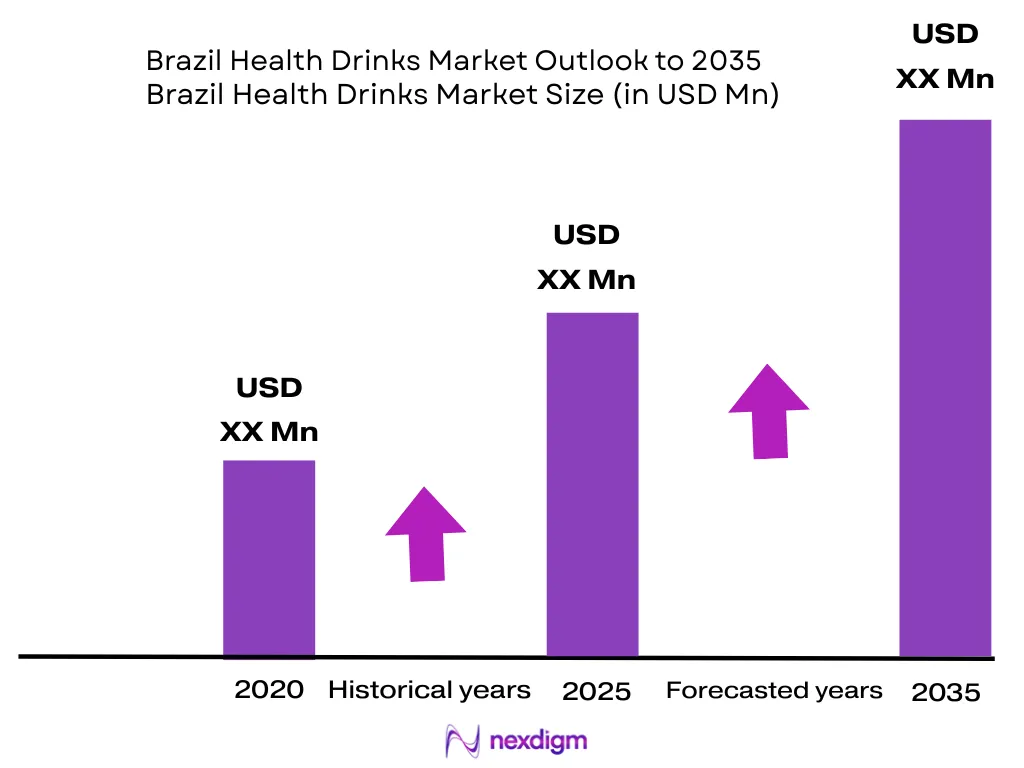
The Brazil Health Drinks Market is valued at USD ~ million in the 2024 base year and is forecast to reach USD ~ million, with a disclosed long-range CAGR of 7.76%. The market is driven by functional beverages positioned around energy, hydration, fortified nutrition, digestive wellness, and convenience. The broader functional beverages market is also reported at USD ~ billion, indicating wider category depth across health-oriented drinks. São Paulo, Rio de Janeiro, Belo Horizonte, Brasília, Fortaleza, Porto Alegre, Recife, Curitiba, and Salvador dominate the Brazil Health Drinks Market due to dense urban populations, stronger supermarket penetration, pharmacy retail, gyms, and chilled beverage infrastructure. São Paulo’s metropolitan area has 21,518,955 residents, followed by Rio de Janeiro with 12,936,629, Belo Horizonte with 5,997,565, Brasília and surroundings with 4,732,087, and Fortaleza with 4,137,255, supporting high-frequency beverage consumption.
Market Segmentation
By Product Type
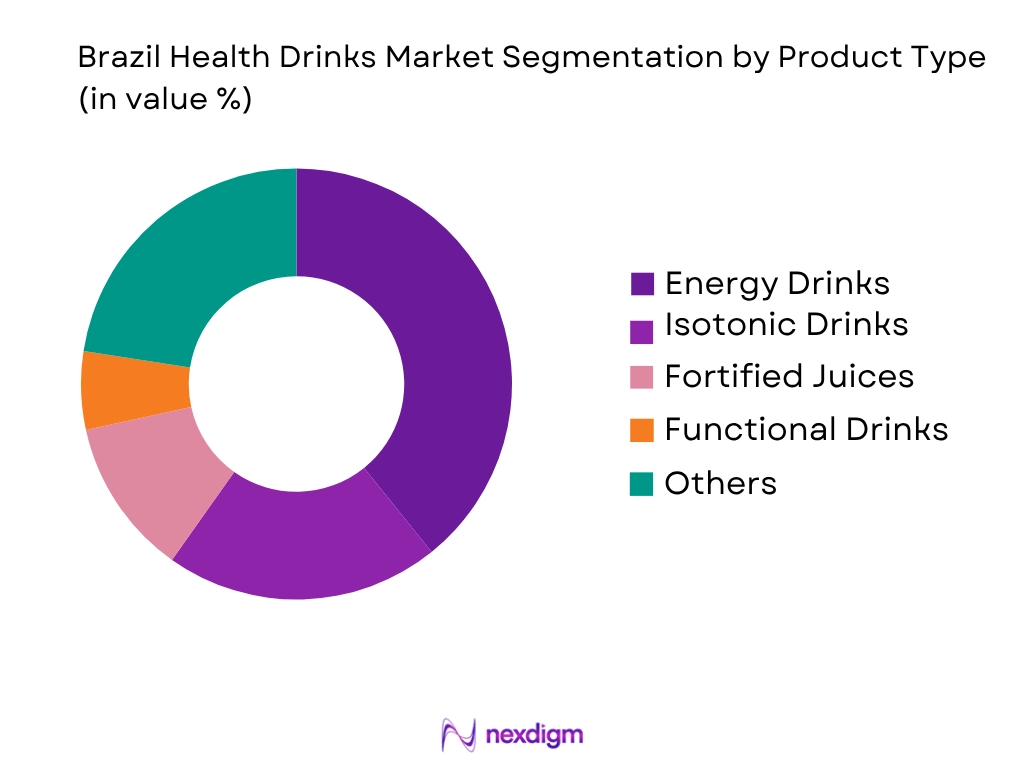
Brazil Health Drinks Market is segmented by product type into energy drinks, sports and isotonic drinks, fortified juices, dairy-based functional drinks, functional water, probiotic drinks, plant-based wellness drinks, and kombucha. Energy drinks hold the dominant market share under this segmentation due to their strong presence in convenience stores, supermarkets, petrol stations, nightlife channels, and youth-oriented consumption occasions. Brazil’s local energy drink culture is also supported by guarana-based formulations, caffeine-based beverages, sugar-free variants, and mass-market brands such as Red Bull, Monster, TNT, Fusion, and Baly. The category benefits from impulse purchase behavior, single-serve cans, on-the-go consumption, and strong visibility in football, music, gaming, and urban lifestyle marketing. Functional energy positioning also makes energy drinks more scalable than smaller probiotic, kombucha, and premium plant-based formats. Energy drinks are identified as the largest segment in Brazil’s functional beverages market.
By Distribution Channel
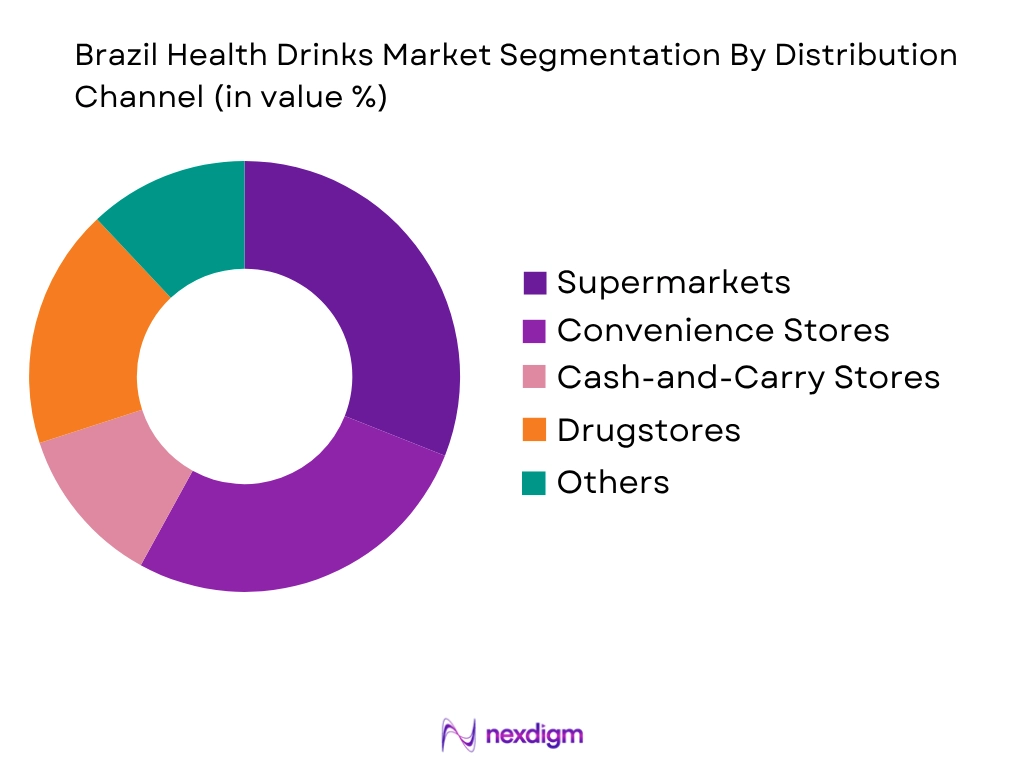
Brazil Health Drinks Market is segmented by distribution channel into supermarkets and hypermarkets, convenience stores and gas stations, cash-and-carry stores, pharmacies, online marketplaces, natural retail, gyms, foodservice, juice bars, cafes, and vending. Supermarkets and hypermarkets dominate this segmentation because they provide the widest assortment of health drinks across energy drinks, sports drinks, fortified juices, plant-based beverages, dairy-based drinks, kombucha, and functional water. These outlets also provide chilled shelves, multipack formats, promotional visibility, nutrition-led aisle placement, and family-basket purchase frequency. Brazil’s modern retail chains are especially important for category building because consumers compare flavors, claims, price tiers, pack sizes, and sugar profiles in one location. Cash-and-carry is gaining importance for value-seeking households, while pharmacies are becoming relevant for protein, probiotic, vitamin, and digestive wellness drinks.
Competitive Landscape
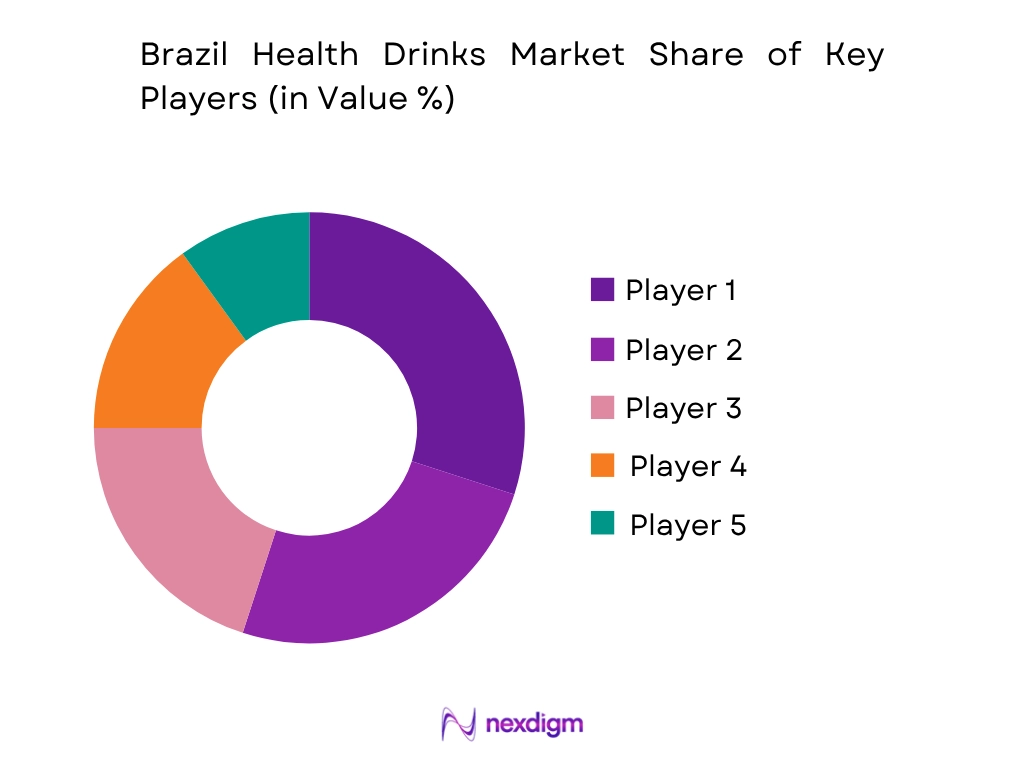
The Brazil Health Drinks Market is led by multinational beverage companies, local beverage manufacturers, dairy nutrition players, probiotic specialists, and emerging clean-label wellness brands. Coca-Cola Brasil, Ambev, PepsiCo Brasil, Red Bull Brasil, Monster Energy Brasil, Grupo Petrópolis, Danone Brasil, Nestlé Brasil, Yakult do Brasil, Natural One, and plant-based specialists compete through differentiated portfolios. Competition is shaped by cold-vault access, guarana-based energy formulations, isotonic drink penetration, pharmacy-led wellness positioning, and premium natural juice innovation.
| Company | Establishment Year | Headquarters | Key Health Drink Brands | Dominant Category | Brazil-Specific Channel Strength | Functional Positioning | Packaging Strength | Strategic Advantage |
| Ambev S.A. | 1999 | São Paulo, Brazil | ~ | ~ | ~ | ~ | ~ | ~ |
| The Coca-Cola Company Brasil | 1942 | Rio de Janeiro / São Paulo, Brazil | ~ | ~ | ~ | ~ | ~ | ~ |
| PepsiCo Brasil | 1953 | São Paulo, Brazil | ~ | ~ | ~ | ~ | ~ | ~ |
| Red Bull Brasil | 2001 | São Paulo, Brazil | ~ | ~ | ~ | ~ | ~ | ~ |
| Monster Energy Brasil | 2010 | São Paulo, Brazil | ~ | ~ | ~ | ~ | ~ | ~ |
Brazil Health Drinks Market Analysis
Growth Drivers
Urban Consumer Concentration Supporting On-the-Go Health Drink Consumption
Brazil Health Drinks Market demand is strongly supported by dense urban consumption clusters where supermarkets, hypermarkets, pharmacies, gyms, petrol stations, and convenience stores can support refrigerated and single-serve beverage sales. IBGE estimates Brazil’s population at 212,583,750 residents in 2024, while 42,766,437 residents live in the country’s 15 municipalities with more than 1 million residents. São Paulo alone has 11,895,578 residents, followed by Rio de Janeiro with 6,729,894 residents, Brasília with 2,982,818 residents, Fortaleza with 2,574,412 residents, and Salvador with 2,568,928 residents. This concentration is market-specific because health drinks depend on repeat urban occasions such as commuting, gym attendance, workday energy, hydration during hot weather, and impulse purchases through chilled retail formats. IBGE also reports 103,095,167 residents across 30 metropolitan areas and urban clusters with more than 1 million residents, including São Paulo metropolitan area with 21,518,955 residents and Rio de Janeiro metropolitan area with 12,936,629 residents. These cities create the strongest launch markets for energy drinks, isotonic beverages, functional water, probiotic dairy drinks, plant-based beverages, and fortified juices.
Large Economic Base and Digital Reach Supporting Functional Beverage Discovery
Brazil Health Drinks Market growth is supported by the country’s large consumer economy and expanding digital discovery channels for health-led beverage brands. World Bank data records Brazil’s GDP at USD 2.19 trillion in 2024 and GDP per capita at USD 10,310.5 in 2024, providing a broad consumption base for mainstream and premium products such as energy drinks, sports hydration, functional juices, probiotic drinks, kombucha, and plant-based beverages. World Bank also records 84 internet users per 100 people in Brazil in 2024, which is directly relevant for digital-first beverage launches, marketplace bundles, influencer-led trial, subscription formats, and retail-media conversion. The country also recorded a 2024 life expectancy of 76 years, which supports positioning around preventive wellness, digestive health, reduced-sugar drinks, protein nutrition, and vitamin-fortified beverages for adults and older consumers. For health drink companies, these macro indicators support a dual route-to-market model: mass retail for affordability and scale, and digital channels for premium functional SKUs, new flavor launches, clean-label claims, and niche consumer communities.
Market Challenges
Nutrition Labeling and Functional Claim Compliance
Brazil Health Drinks Market participants face a compliance-heavy environment because functional beverages frequently use claims linked to energy, hydration, immunity, digestion, protein, weight management, and wellness. ANVISA states that the food and packaging authorization framework under RDC 843/2024 and IN 281/2024 entered into force on September 1, 2024, creating 3 regulatory pathways: marketing authorization with ANVISA, notification to ANVISA, and communication to the local health authority before manufacturing or importation. ANVISA also lists foods with functional and health claims under RDC 19/1999 and food supplements under RDC 243/2018 within the notification framework, making regulatory classification important for health drinks positioned between conventional beverages, fortified foods, and supplement-like products. Nutrition labeling also affects beverages with sugar, sodium, or saturated fat content. ANVISA’s IN 75/2020, active in the current labeling environment, sets liquid-food front-label thresholds at 7.5 g added sugars per 100 ml, 3 g saturated fat per 100 ml, and 300 mg sodium per 100 ml. These thresholds create reformulation pressure for sweetened sports drinks, fortified juice drinks, dairy-based functional drinks, and energy drinks.
Macroeconomic Pressure on Premium Health Drink Adoption
Brazil Health Drinks Market faces a challenge from household affordability pressure, especially for premium products such as kombucha, plant-based beverages, protein RTDs, imported energy drinks, cold-pressed juices, and probiotic drinks. World Bank data records Brazil’s GDP per capita at USD 10,310.5 in 2024, which is materially lower than developed functional beverage markets and makes price-tier architecture important for national scaling. Inflation also remained relevant, with World Bank reporting consumer price inflation at 4.4 in 2024, while unemployment is reported at 6.0 in 2025. IMF’s Brazil profile shows GDP per capita at USD 12.31 thousand in 2026 and real GDP growth at 1.9 in 2026, indicating a market where consumption can grow but premiumization must remain carefully targeted. For health drinks, this means brands cannot rely only on super-premium wellness positioning. Large-pack affordability, mainstream PET formats, local sourcing, cash-and-carry penetration, and pharmacy bundles become important because consumers may trade between regular juices, soft drinks, low-cost powdered drinks, isotonic beverages, and functional waters depending on disposable income.
Market Opportunities
Local Superfruit and Functional Ingredient Innovation
Brazil Health Drinks Market has a strong product-development opportunity around domestic ingredients such as açaí, acerola, orange, guarana, coconut water, coffee, and mate, because these ingredients allow brands to combine functional positioning with Brazilian identity. IBGE reports that Brazil’s planted area across 64 surveyed crops totaled 97.3 million hectares in 2024, supporting a large raw-material base for beverage formulation. Fruits generated R$91.5 billion in agricultural production value in 2024, with oranges, bananas, and grapes highlighted as the highest-value fruit categories. Brazil’s orange output totaled 15.7 million tonnes in 2024, preserving the relevance of citrus-based functional juices, vitamin-C drinks, fortified nectars, and immunity-positioned beverages. Açaí is also relevant for functional beverage innovation: Embrapa, citing IBGE data, states Brazil produced around 1.74 million tonnes of açaí in 2024, while USDA/FAS reports Pará produced 1.6 million tonnes and Amazonas produced 91,345 tonnes in 2024. These current supply indicators support future growth through locally differentiated health drinks using antioxidant, energy, hydration, and clean-label narratives.
Omnichannel Expansion Across Metro Retail, Pharmacies, and Digital Platforms
Brazil Health Drinks Market has a strong opportunity to scale through omnichannel distribution because the country has concentrated city demand, high digital access, and large modern retail catchments. IBGE reports 65.7 million persons living in 48 municipalities with more than 500,000 residents, while 58.0 million persons live in 339 municipalities with populations between 100,000 and 500,000 residents. This creates multiple launch corridors for functional water, isotonic drinks, zero-sugar energy, fortified juices, probiotic drinks, protein RTDs, and plant-based beverages beyond São Paulo and Rio de Janeiro. World Bank data also records 84 internet users per 100 people in 2024, supporting marketplace sales, product education, health-claim communication, subscriptions, and influencer-led trial. The same World Bank dataset reports 211,998,573 people in 2024, confirming that scale can be built through both metropolitan and secondary-city expansion. For brands, the opportunity is to connect supermarket shelves, pharmacy health aisles, gyms, delivery apps, and e-commerce storefronts into one repeat-purchase ecosystem rather than treating online and offline channels separately.
Future Outlook
The Brazil Health Drinks Market is expected to expand steadily as functional beverages move from niche wellness products into mainstream consumption. Growth will be supported by energy drinks, isotonic hydration, fortified juices, probiotic dairy drinks, plant-based beverages, kombucha, and functional water. Category development will be strongest in urban Brazil, where consumers have higher access to supermarkets, pharmacies, gyms, e-commerce, and refrigerated formats. Over the forecast period, brands will compete through reduced-sugar recipes, local functional ingredients such as guarana, açaí, acerola, coconut water, and mate, and stronger evidence-backed claims. ANVISA regulation will remain central because foods with functional and health claims are regulated under Brazil’s food framework, and probiotics in food require prior evaluation. This will favor brands with better regulatory capabilities, ingredient documentation, and label governance. Future demand will also be shaped by Brazil’s large consumer base and economic scale. The World Bank reports Brazil’s GDP at USD 2.19 trillion and GDP per capita at USD 10,310.5, creating a sizeable consumption base for both mainstream and premium functional drinks. Urban density, pharmacy retail, tropical climate, gym culture, and demand for convenience nutrition will keep health drinks relevant across energy, hydration, protein, digestive wellness, and immunity-led use cases.
Major Players
- Ambev S.A.
- The Coca-Cola Company Brasil
- PepsiCo Brasil
- Red Bull Brasil
- Monster Energy Brasil
- Grupo Petrópolis
- Danone Brasil
- Nestlé Brasil
- Yakult do Brasil
- Natural One
- Liv Up
- Vida Veg
- A Tal da Castanha
- Campo Largo
- Greenpeople
Key Target Audience
- Functional beverage manufacturers
- Energy drink and isotonic drink companies
- Dairy-based functional beverage producers
- Plant-based beverage manufacturers
- Supermarket, hypermarket, cash-and-carry, and pharmacy retail chains
- Beverage ingredient suppliers and co-packers
- Investments and venture capitalist firms
- Government and regulatory bodies (ANVISA, Ministério da Saúde, Ministério da Agricultura e Pecuária, CADE, Receita Federal do Brasil)
Research Methodology
Step 1: Identification of Key Variables
The initial phase involves constructing an ecosystem map for the Brazil Health Drinks Market across manufacturers, retailers, distributors, ingredient suppliers, co-packers, gyms, pharmacies, and regulatory bodies. Key variables include product type, functional claim, packaging, sugar profile, retail channel, regional concentration, price tier, and consumer use occasion.
Step 2: Market Analysis and Construction
This phase compiles historical and current category data for energy drinks, sports drinks, fortified juices, functional water, probiotic beverages, dairy-based drinks, plant-based drinks, and kombucha. The analysis uses a top-down market framework and bottom-up SKU mapping across key retail channels to construct category revenue and segmentation.
Step 3: Hypothesis Validation and Expert Consultation
Market hypotheses are validated through structured interviews with beverage manufacturers, distributors, retailers, category managers, packaging suppliers, and functional ingredient companies. These consultations help verify channel behavior, product velocity, cold-chain requirements, regulatory barriers, promotional intensity, and the role of local ingredients such as guarana, açaí, and acerola.
Step 4: Research Synthesis and Final Output
The final phase integrates secondary research, primary interviews, competitor benchmarking, and segmentation validation. Output is synthesized through top-down and bottom-up approaches to ensure consistency across market size, competitive landscape, product segmentation, distribution structure, consumer targeting, and forecast assumptions for Brazil Health Drinks Market.

- Executive Summary
- Research Methodology (Market Definitions and Assumptions, Functional Drink Taxonomy, ANVISA Classification Mapping, Abbreviations, Market Sizing Approach, Top-Down Assessment, Bottom-Up SKU Mapping, Retail Audit Approach, Distributor Interviews, Primary Research Approach, Secondary Research Sources, Trade Channel Validation, Limitations and Future Conclusions)

- Definition and Scope
- Overview Genesis
- Evolution of Functional Beverage Consumption
- Timeline of Major Players
- Business Cycle
- Supply Chain and Value Chain Analysis

- Growth Drivers (Urbanization, Health Awareness, Fitness Culture, Tropical Climate, Functional Claims, Retail Modernization, Digital Commerce)
- Market Challenges (Regulatory Compliance, Functional Claim Approval, Sugar Labeling, High Logistics Cost, Refrigerated Distribution, Price Sensitivity)
- Opportunities (Amazonian Ingredients, Functional Hydration, Plant-Based Drinks, Probiotic Drinks, Protein RTD, Pharmacy Channel, E-Commerce, Premiumization)
- Trends (Zero Sugar, Natural Caffeine, Kombucha, Plant-Based, Immunity, Proteinization, Clean Label, Functional Waters)
- SWOT Analysis
- Porter’s Five Forces

- By Value (2020-2025)
- By Volume (2020-2025)
- By Average Retail Price (2020-2025)

- By Product Category (In Value %)
Energy Drinks
Sports and Isotonic Drinks
Functional and Flavored Water
Fortified Juices and Nectar-Based Health Drinks
Dairy-Based Functional Drinks - By Ingredient Platform (In Value %)
Caffeine and Guarana-Based Formulations
Electrolyte-Based Formulations
Probiotic and Fermented Culture Formulations
Vitamin and Mineral Fortification
Protein-Based Formulations - By Distribution Channel (In Value %)
Supermarkets and Hypermarkets
Cash-and-Carry Stores
Convenience Stores and Gas Stations
Pharmacies and Drugstores
Natural and Specialty Food Retail
Gyms, Fitness Studios, and Sports Clubs - By Region (In Value %)
Southeast Brazil
South Brazil
Northeast Brazil
Central-West Brazil
North Brazil

- Market Share of Major Players on the Basis of Value and Volume (Energy Drinks, Sports Drinks, Functional Water, Fortified Juices, Probiotic Drinks, Plant-Based Beverages)
- Cross Comparison Parameters (Functional Claim Portfolio, Brazil Retail Distribution Reach, Regional Manufacturing and Bottling Footprint, Sugar and Calorie Profile, Local Ingredient Integration, Cold Chain Capability, Price Tier and Pack Architecture, ANVISA Claim and Label Compliance)
- SWOT Analysis of Major Players
- Pricing Analysis Basis SKUs for Major Players
- Detailed Profiles of Major Companies
Ambev S.A.
The Coca-Cola Company Brasil
PepsiCo Brasil
Red Bull Brasil
Monster Energy Brasil
Grupo Petrópolis
Danone Brasil
Nestlé Brasil
Yakult do Brasil
Natural One
Liv Up
Vida Veg
A Tal da Castanha
Campo Largo
Greenpeople

- Market Demand and Utilization
- Purchasing Power and Budget Allocation
- Needs, Desires, and Pain Point Analysis
- Decision-Making Process
- Consumption Occasion Analysis

- By Value (2026-2035)
- By Volume (2026-2035)
- By Average Retail Price (2026-2035)


 Request a Sample
 Ask for Customization
 Get a Quote
 Enquire Now