
 Download PDF
Market Overview
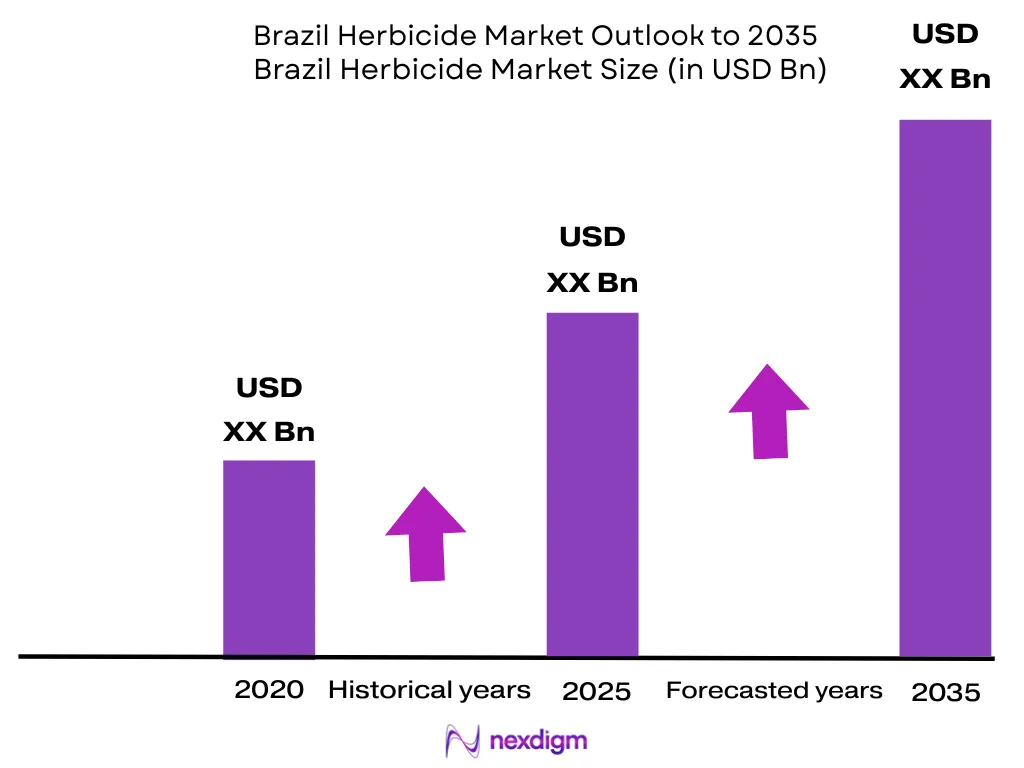
The Brazil Herbicide Market is valued at USD ~ billion, calculated from Grand View Research’s Brazil herbicide revenue base of USD ~ million and its published growth path to USD ~ million. The market is driven by soybean, corn, sugarcane, cotton and rice cultivation, supported by Conab’s grain output of 350.2 million tonnes versus 301.1 million tonnes in the previous cycle. Glyphosate remained the leading pesticide active ingredient, with 231.9 thousand tonnes commercialized. Mato Grosso, Goiás, Paraná, Rio Grande do Sul, São Paulo and Bahia dominate demand because they concentrate soybean-corn rotations, sugarcane plantations, cotton acreage, rice production and agro-dealer networks. Conab reported soybean production of 171.5 million tonnes, corn production of 139.7 million tonnes, cotton lint production of 4.1 million tonnes, and rice production of 12.8 million tonnes. Center-West productivity recovered strongly, while Mato Grosso remained important due to large-scale mechanized soybean and second-crop corn systems.
Market Segmentation
By Crop Type
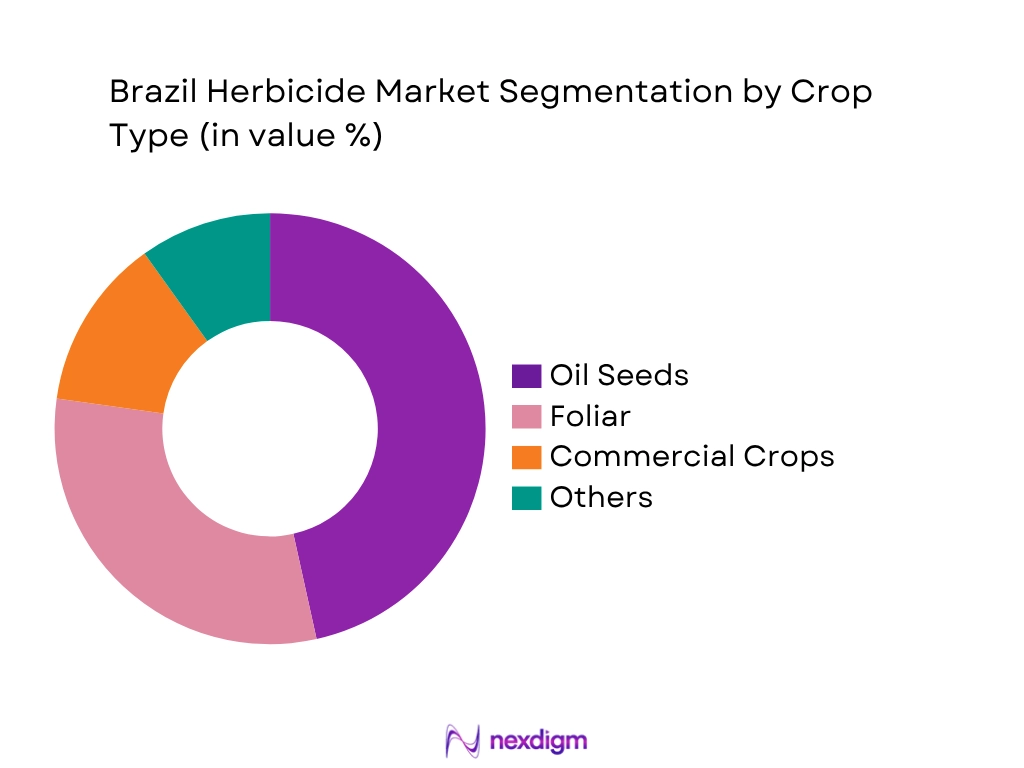
Brazil Herbicide Market is segmented by crop type into oilseeds and pulses, cereals and grains, sugarcane and commercial crops, fruits and vegetables, and pasture, forestry and non-crop use. Recently, oilseeds and pulses have a dominant market share in Brazil under the crop type segmentation, mainly because soybean remains the country’s largest herbicide-consuming crop and is heavily linked with glyphosate, 2,4-D, glufosinate, clethodim, PPO inhibitors and residual herbicide programs. Conab reported soybean output at 171.5 million tonnes, supported by improved productivity of 3,621 kg per hectare, which increases the operational need for pre-plant burndown and post-emergence weed control. Soybean systems in Mato Grosso, Goiás, Paraná, Bahia and MATOPIBA also support double-cropping with corn, making herbicide programs more intensive across successive planting windows.
By Application Mode
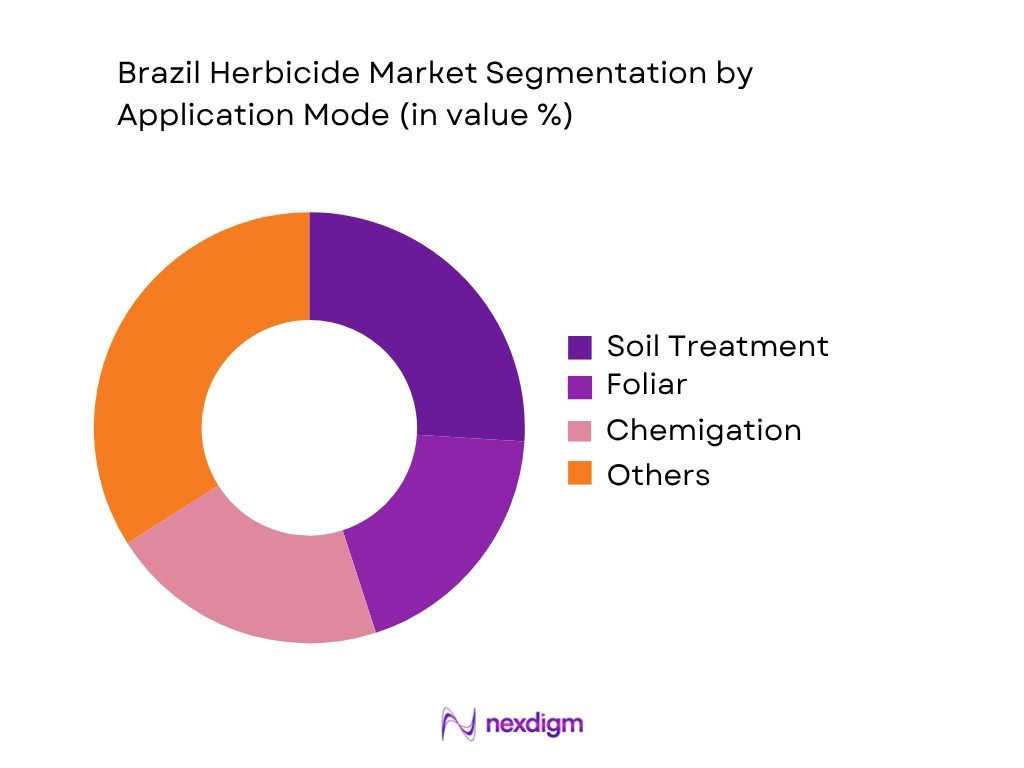
Brazil Herbicide Market is segmented by application mode into soil treatment, foliar application, chemigation, fumigation, and precision spot spraying or drone application. Recently, soil treatment has a dominant market share in Brazil under the application mode segmentation because soybean, corn, sugarcane and cotton growers use residual herbicides to manage weeds before crop emergence. South America herbicide benchmarks show soil treatment commanding 49.6% share, which reflects the practical importance of pre-emergence and residual programs in large-scale Brazilian agriculture. Soil-applied products are preferred where sourgrass, fleabane, ryegrass, volunteer corn and broadleaf weeds threaten crop establishment. The segment is also supported by second-crop corn systems, where planting windows are tight and growers need early weed suppression to protect crop stands and reduce rescue sprays.
Competitive Landscape
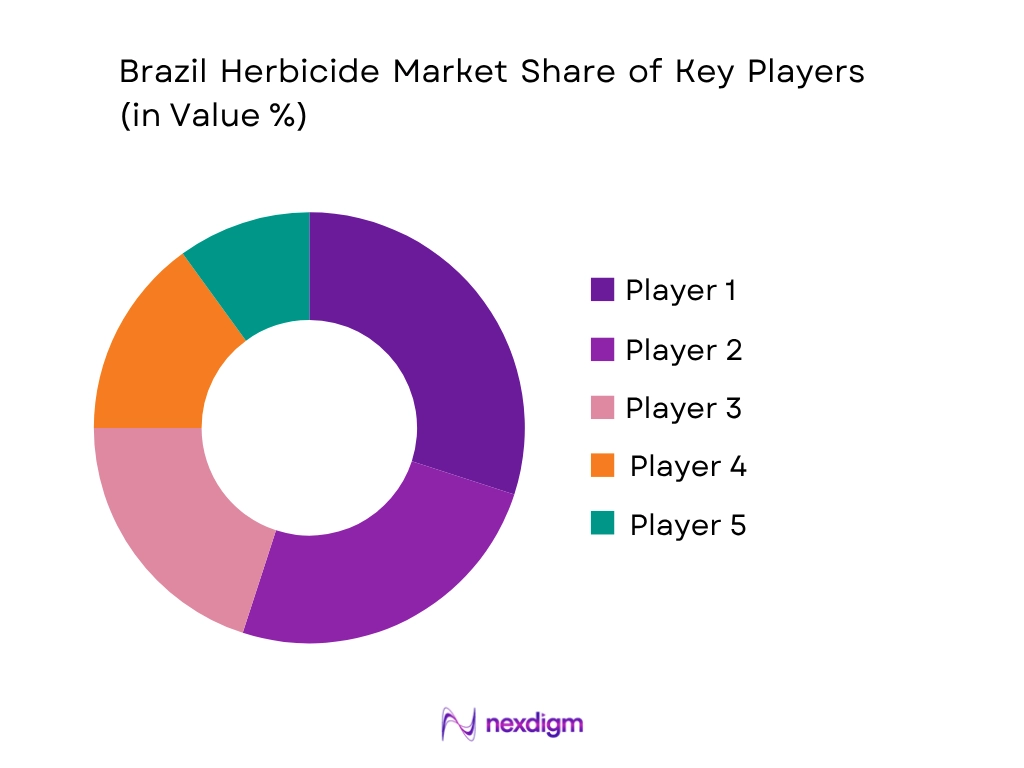
The Brazil Herbicide Market is led by multinational crop protection companies and large off-patent suppliers, including Syngenta, Bayer, BASF, Corteva and UPL. The competitive structure is shaped by glyphosate volume, glufosinate growth, 2,4-D and atrazine demand, soybean-corn herbicide programs, sugarcane residual products and agro-dealer distribution. Competition is also influenced by generic imports, as IndexBox reported Brazil herbicide imports of USD 1.80 billion, with China at USD 1.047 billion and the United States at USD 374 million.
| Company | Establishment Year | Headquarters | Key Brazil Herbicide Portfolio | Crop Focus | Channel Strength | Registration Position | Resistance-Management Role | Strategic Position |
| Syngenta Crop Protection | 2000 | Basel, Switzerland | ~ | ~ | ~ | ~ | ~ | ~ |
| Bayer CropScience | 1863 | Leverkusen, Germany | ~ | ~ | ~ | ~ | ~ | ~ |
| BASF Agricultural Solutions | 1865 | Ludwigshafen, Germany | ~ | ~ | ~ | ~ | ~ | ~ |
| Corteva Agriscience | 2019 | Indianapolis, USA | ~ | ~ | ~ | ~ | ~ | ~ |
| UPL Limited | 1969 | Mumbai, India | ~ | ~ | ~ | ~ | ~ | ~ |
Brazil Herbicide Market Analysis
Growth Drivers
Large Soybean–Corn Crop Base Supporting Herbicide Application Intensity
Brazil Herbicide Market demand is structurally supported by the country’s large soybean and corn production base, where pre-plant burndown, pre-emergence residuals, and post-emergence applications are central to weed-control programs. Conab reported soybean production of 171.5 million tonnes and national soybean productivity of 3,621 kg per hectare, while corn production across the three crop cycles reached 139.7 million tonnes with average productivity of 6,391 kg per hectare. These figures directly support demand for glyphosate, 2,4-D, glufosinate, atrazine, clethodim, PPO inhibitors, and residual grass herbicides used in soybean-corn rotations. The macroeconomic base also supports input adoption: World Bank data records Brazil’s GDP at USD 2.19 trillion and GDP per capita at USD 10,310.5, reflecting a large agricultural economy able to sustain mechanized crop-protection demand. Herbicides remain essential because large-scale Cerrado and southern grain systems depend on timely weed suppression before planting, during crop establishment, and after canopy closure.
Glyphosate Leadership and High Registered Product Base
Brazil Herbicide Market growth is supported by a large commercial base of registered crop-protection products and sustained field demand for herbicide active ingredients. Ibama reported 7,358 self-declared pesticide commercialization reports, submitted by 289 registration-holding companies and referencing 6,100 different commercial brands. The same Ibama release identified glyphosate and its salts as the leading active ingredient, with 231.9 thousand tonnes commercialized. This confirms the central role of glyphosate in Brazil’s no-till systems, soybean burndown, corn desiccation, cover-crop termination, and plantation weed management. Ibama also stated that glufosinate-ammonium moved from eighth to sixth position among leading active ingredients, while clethodim entered tenth position, indicating stronger demand for post-glyphosate resistance-management tools. The macroeconomic environment supports the scale of this market activity, with World Bank reporting Brazil’s GDP at USD 2.19 trillion and GDP per capita at USD 10,310.5. These data points justify the continuing relevance of herbicides within Brazil’s large, mechanized, export-oriented agricultural system.
Market Challenges
Regulatory Scrutiny and Product Portfolio Rationalization
Brazil Herbicide Market participants face stronger regulatory scrutiny as authorities tighten registration, review, and enforcement mechanisms across the agrochemical portfolio. MAPA reported 912 pesticide and related product registrations granted in 2025, including 323 technical products, but also clarified that registrations do not necessarily translate into field use. The ministry further reported that 34 pesticide registrations were suspended under a precautionary measure after technical and documentary review actions. These suspensions included review actions covering glyphosate, 2,4-D, glufosinate, and atrazine, all of which are relevant to Brazil’s herbicide portfolio. MAPA also reported 1,946 liters of illegal pesticides seized during enforcement actions, showing the compliance burden faced by legitimate suppliers. This regulatory complexity sits within a large macroeconomic setting, with World Bank reporting Brazil’s GDP at USD 2.19 trillion and GDP per capita at USD 10,310.5. For manufacturers and distributors, the challenge is maintaining registration compliance, documentation quality, supply continuity, and stewardship standards while serving large soybean, corn, sugarcane, cotton, and pasture systems.
Climate Stress Affecting Herbicide Timing in Sugarcane and Row Crops
Brazil Herbicide Market demand is challenged by irregular weather, which can disrupt spray windows, reduce crop establishment quality, delay field entry, and alter weed emergence patterns. Conab reported sugarcane production at 668.8 million tonnes and harvested area at 8.85 million hectares, while national productivity was estimated at 75,575 kg per hectare, compared with 77,223 kg per hectare in the previous cycle. Conab also stated that unfavorable conditions during ratoon regrowth and crop development, including drought, high temperatures, fires, and water irregularity in the Center-South, affected the crop. São Paulo alone was expected to harvest 337.9 million tonnes, around 15.65 million tonnes below the previous crop, which is relevant because sugarcane uses residual herbicides such as diuron, tebuthiuron, ametryn, and hexazinone for plantation weed control. World Bank macro data records Brazil’s GDP at USD 2.19 trillion and GDP per capita at USD 10,310.5, but field-level climate volatility can still weaken herbicide planning, inventory allocation, and application efficiency.
Market Opportunities
Expansion of Resistance-Management Herbicide Portfolios
Brazil Herbicide Market suppliers have an opportunity to expand resistance-management portfolios around glufosinate, clethodim, PPO inhibitors, residual products, and structured tank-mix programs. Ibama reported glyphosate and its salts at 231.9 thousand tonnes commercialized, confirming the continued dominance of glyphosate-based systems. However, the same Ibama release stated that glufosinate-ammonium rose from eighth to sixth position and clethodim entered tenth position among leading active ingredients, indicating field demand for alternatives used against glyphosate-tolerant or difficult-to-control weeds such as sourgrass, fleabane, ryegrass, and volunteer corn. This creates future opportunity for herbicide manufacturers to position multi-mode-of-action programs in soybean, corn, cotton, and pasture systems. MAPA’s 2025 registration data further supports portfolio renewal, with 6 new technical products based on new active ingredients and 19 formulated products based on new active ingredients registered. The macroeconomic base remains supportive, with World Bank reporting Brazil’s GDP at USD 2.19 trillion and GDP per capita at USD 10,310.5, enabling investment in higher-value agronomy programs.
Sugarcane, Cotton, Rice and Bioinput-Linked Weed Management
Brazil Herbicide Market has an opportunity in crop-specific weed-control programs beyond soybean and corn, particularly sugarcane, cotton, rice, pasture, and low-impact formulations compatible with biological input adoption. Conab reported cotton lint production of 4.1 million tonnes and rice production of 12.8 million tonnes, while sugarcane production reached 668.8 million tonnes across 8.85 million hectares. These crops require tailored herbicides: sugarcane needs residual plantation programs, cotton needs pre-plant and post-emergence weed control, and rice requires selective management of aquatic and grass weeds. MAPA also reported 162 bioinput registrations in 2025, the highest number in its historical series, alongside 912 total registrations, showing that the crop-protection portfolio is broadening toward integrated systems. This supports opportunity for herbicide companies to develop stewardship-compatible products, selective formulations, tank-mix guidance, and residue-conscious programs for high-value crops. World Bank reports Brazil’s GDP at USD 2.19 trillion and GDP per capita at USD 10,310.5, supporting adoption of advanced crop-protection packages across commercial farming regions.
Future Outlook
The Brazil Herbicide Market is expected to record a forecasted CAGR of 4.3% during 2026-2035, aligned with the Brazil country growth view in the herbicides outlook published for the 2026-2036 forecast window. Growth will be supported by soybean and corn area intensity, resistant weed pressure, glufosinate adoption, residual herbicide programs and new active ingredient approvals. Over the next decade, the market will move from volume-led glyphosate dependence toward higher-value premixes, trait-compatible programs, and low-drift formulations. Brazil’s regulatory modernization and bioinput adoption will not replace herbicides, but they will reshape product positioning. Manufacturers will need to combine chemical weed control, resistance stewardship, application technology, digital agronomy and local dealer financing to defend margins in a market exposed to imported generics.
Major Players
- Syngenta Crop Protection
- Bayer CropScience
- BASF Agricultural Solutions
- Corteva Agriscience
- FMC Corporation
- UPL Limited
- ADAMA Brasil
- Nufarm Brasil
- Albaugh Brasil
- Rainbow Agro Brasil
- Iharabras
- Sumitomo Chemical Brasil
- Helm do Brasil
- Ourofino Agrociência
- Nortox
Key Target Audience
- Herbicide manufacturers and formulators
- Agrochemical importers and technical ingredient suppliers
- Agricultural cooperatives and agro-dealers
- Large soybean, corn, cotton and sugarcane producers
- Sugarcane mills and plantation operators
- Precision spraying, drone application and digital agronomy companies
- Investments and venture capitalist firms
- Government and regulatory bodies
Research Methodology
Step 1: Identification of Key Variables
The initial phase involves constructing an ecosystem map for the Brazil Herbicide Market, covering manufacturers, importers, formulators, distributors, cooperatives, agro-dealers, farmers, sugarcane mills and regulators. Key variables include active ingredient demand, treated hectares, crop type, application timing, resistance pressure, import dependence, and registration status.
Step 2: Market Analysis and Construction
In this phase, historical herbicide revenue, trade flows, crop production, planted area, active ingredient commercialization and channel structure are compiled. The analysis uses public databases from IBAMA, MAPA, CONAB, customs-linked trade sources, company disclosures and verified industry publications to construct market estimates.
Step 3: Hypothesis Validation and Expert Consultation
Market hypotheses are validated through interviews with agro-dealers, distributors, crop protection managers, agronomists, large growers, cooperative procurement heads and formulation specialists. These consultations test assumptions on glyphosate demand, glufosinate adoption, residual herbicide usage, regulatory pressure, pricing behavior and dealer financing.
Step 4: Research Synthesis and Final Output
The final stage synthesizes desk research, primary consultation and bottom-up crop-level calculations into a validated market report. The output includes market sizing, segmentation, competitive benchmarking, growth drivers, challenges, opportunities, future outlook and strategic recommendations for manufacturers, distributors, investors and regulatory stakeholders.

- Executive Summary
- Research Methodology (Market Definitions and Assumptions, Abbreviations, Market Sizing Approach, Crop-Acreage Normalization, Treated Area Mapping, Active Ingredient Demand Modeling, Import and Domestic Formulation Assessment, Distributor and Agro-Dealer Interviews, Farmer Purchase Journey, Primary Research Approach, Secondary Research Sources, Bottom-Up and Top-Down Triangulation, Limitations and Future Conclusions)

- Definition and Scope
- Overview Genesis
- Evolution of Herbicide Use in Brazilian Agriculture
- Business Cycle
- Crop Protection Value Chain and Supply Chain Analysis

- Growth Drivers (Large-Scale Soybean Cultivation, Safrinha Corn Expansion, No-Till Farming, Resistant Weed Management, Herbicide-Tolerant Seed Adoption, Agrochemical Credit Availability)
- Market Challenges (Regulatory Complexity, Import Reliance, Currency Volatility, Generic Price Pressure, Resistance Build-Up, Environmental Scrutiny, Counterfeit Products)
- Market Opportunities (New Mode-of-Action Herbicides, Premium Premixes, Bio-Herbicides, Digital Spraying, MATOPIBA Expansion, Sugarcane Residual Programs)
- Market Trends (Tank-Mix Complexity, Genericization, Agro-Dealer Consolidation, Digital Agronomy, Herbicide-Tolerant Seed Bundling, Sustainability Labeling)
- SWOT Analysis
- Porter’s Five Forces

- By Value (2020-2025)
- By Volume (2020-2025)
- By Treated Area (2020-2025)

- By Active Ingredient (In Value %)
Glyphosate
Atrazine
Paraquat
Diuron - By Crop Type (In Value %)
Soybean
Corn
Sugarcane
Cotton
Coffee - By Distribution Channel (In Value %)
Agricultural Cooperatives
Agro-Dealers and Revendas
National and Regional Distributors
Direct Manufacturer Sales
Barter and Input Financing Channels - By Region (In Value %)
Mato Grosso
Paraná
Rio Grande do Sul
Goiás
São Paulo

- Market Share of Major Players (Value Share, Volume Share, Branded Share, Generic Share, Treated Area Influence)
- Cross Comparison Parameters (Active Ingredient Portfolio Breadth, Brazil Registration Strength, Soybean-Corn-Sugarcane Crop Coverage, Agro-Dealer and Cooperative Network, Import and Formulation Footprint, Herbicide-Tolerant Trait Linkage, Resistance Management Portfolio, Barter and Farmer Financing Capability)
- SWOT Analysis of Major Players
- Detailed Profiles of Major Companies
Syngenta Crop Protection
Bayer CropScience
BASF Agricultural Solutions
Corteva Agriscience
FMC Corporation
UPL Limited
ADAMA Brasil
Nufarm Brasil
Albaugh Brasil
Rainbow Agro Brasil
Iharabras
SumitomoChemical Brasil
Helm do Brasil
Ourofino Agrociência
Nortox

- Market Demand and Utilization
- Farm Input Budget Allocation
- Purchasing Power and Financing Behavior
- Regulatory and Compliance Requirements
- Needs, Desires and Pain Point Analysis

- By Value (2026-2035)
- By Volume (2026-2035)
- By Treated Area (2026-2035)


 Request a Sample
 Ask for Customization
 Get a Quote
 Enquire Now