
 Download PDF
Market Overview
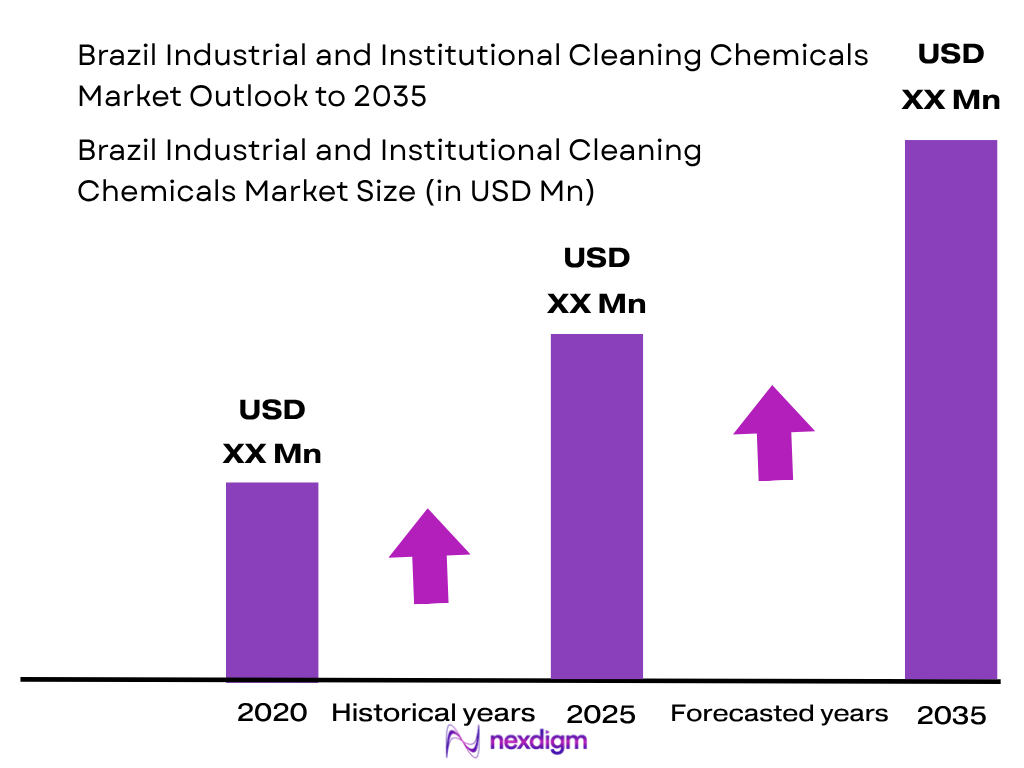
The Brazil Industrial and Institutional Cleaning Chemicals Market is valued at approximately USD ~ billion in 2024, expanding from approximately USD ~ billion in 2023 due to increasing demand for professional hygiene solutions across manufacturing facilities, healthcare institutions, food processing plants, hospitality establishments, and commercial buildings. The market growth is supported by rising adoption of specialized cleaning formulations, stricter hygiene protocols, increased outsourcing of facility management services, and growing demand for concentrated and sustainable cleaning chemicals. Industry data from chemical manufacturers, trade associations, regulatory databases, and company disclosures indicate continued investment in advanced cleaning solutions.
The Brazil Industrial and Institutional Cleaning Chemicals Market is concentrated across major industrial and commercial regions including São Paulo, Rio de Janeiro, Minas Gerais, Paraná, Santa Catarina, and Rio Grande do Sul. São Paulo remains a leading market center due to its extensive manufacturing ecosystem, healthcare infrastructure, commercial facilities, food processing operations, and high concentration of industrial consumers. Southern states demonstrate strong demand due to food processing, automotive manufacturing, agricultural industries, and export-oriented production facilities. Rio de Janeiro contributes through hospitality, healthcare, energy, and commercial sectors requiring institutional cleaning solutions.
Market Segmentation
By Product Type
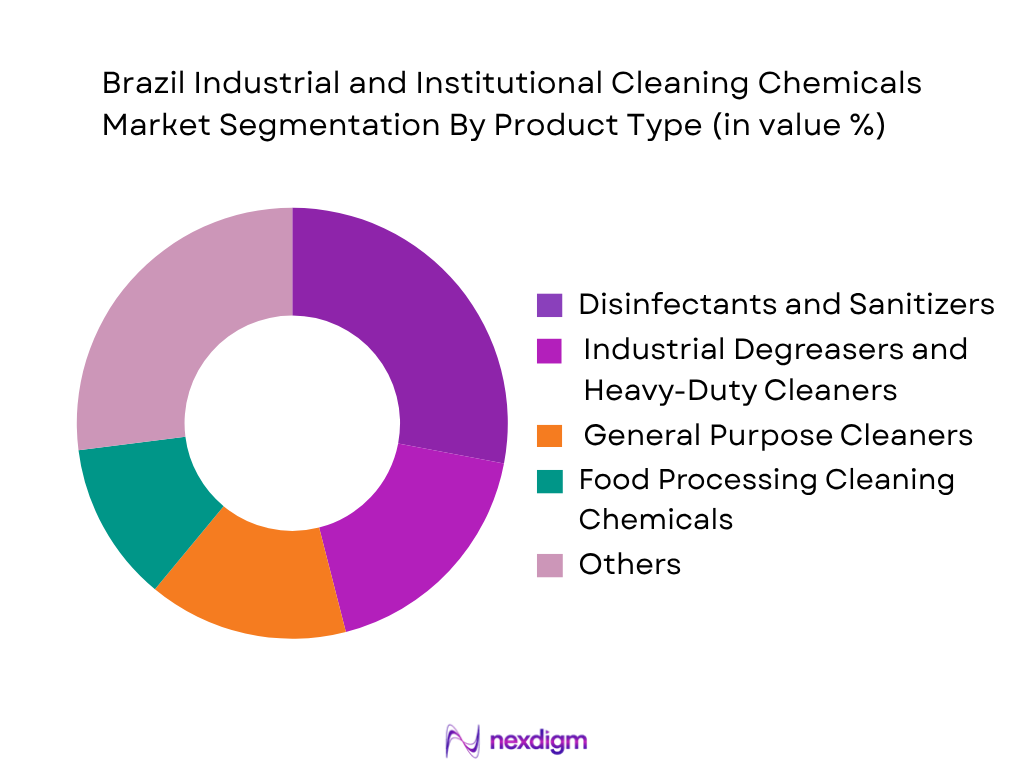
The Brazil Industrial and Institutional Cleaning Chemicals Market is segmented by product type into general purpose cleaners, disinfectants and sanitizers, industrial degreasers and heavy-duty cleaners, floor care chemicals, laundry care chemicals, food processing cleaning chemicals, healthcare cleaning chemicals, specialty industrial cleaners, and surface cleaning chemicals. Among these categories, disinfectants and sanitizers represent the dominant product segment in the Brazil Industrial and Institutional Cleaning Chemicals Market due to increasing hygiene compliance requirements across healthcare, food processing, hospitality, and institutional facilities. The segment benefits from continuous demand for infection prevention solutions, workplace sanitation standards, and regulatory requirements related to public health and facility cleanliness. Industrial users increasingly prefer high-performance disinfectant formulations that offer efficient microbial control, reduced application time, and compatibility with automated dispensing systems. Healthcare facilities, restaurants, hotels, and commercial buildings remain key consumers supporting segment dominance.
By End-Use Industry
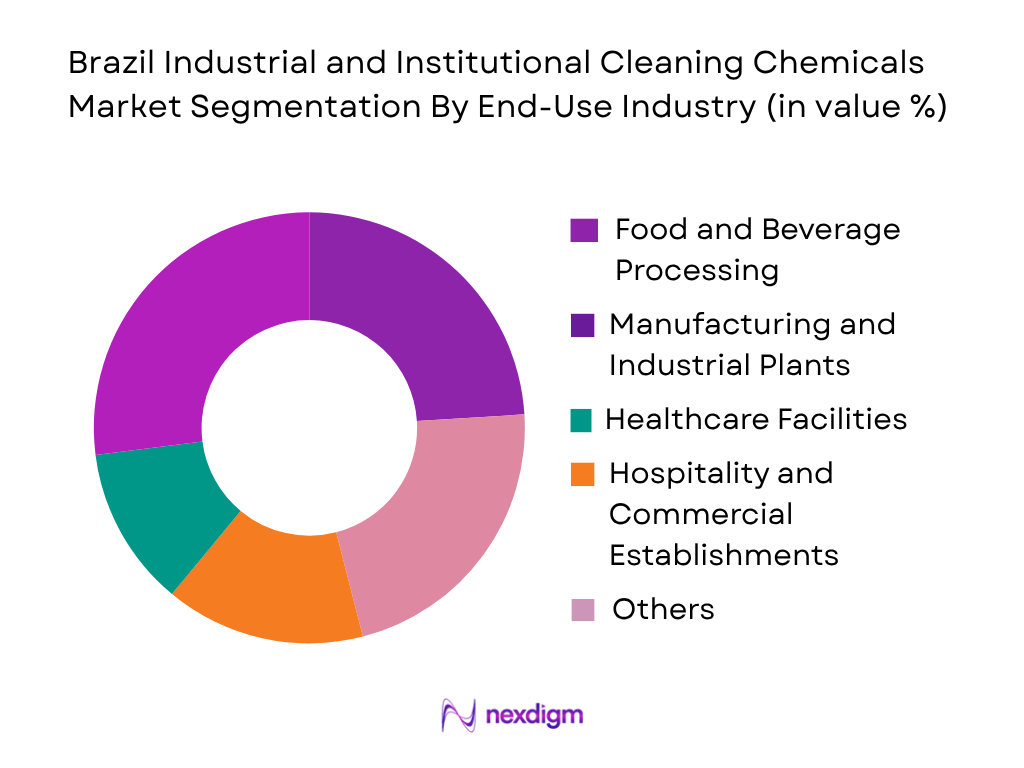
The Brazil Industrial and Institutional Cleaning Chemicals Market is segmented by end-use industry into food and beverage processing, manufacturing and industrial plants, healthcare facilities, hospitality establishments, commercial buildings, pharmaceutical manufacturing, educational institutions, retail facilities, mining operations, and energy facilities. Among these industries, food and beverage processing represents the dominant end-use segment in the Brazil Industrial and Institutional Cleaning Chemicals Market due to the country’s large-scale food production ecosystem and strict sanitation requirements. Meat processing, dairy manufacturing, beverage production, and agricultural processing facilities require frequent cleaning cycles to maintain product quality, prevent contamination, and comply with food safety regulations. The adoption of automated cleaning systems, clean-in-place technologies, and specialized industrial detergents further supports demand from food processing facilities. The segment continues to benefit from Brazil’s position as a major global agricultural and food exporter.
Competitive Landscape
The Brazil Industrial and Institutional Cleaning Chemicals Market is characterized by the presence of multinational hygiene solution providers, domestic chemical manufacturers, and specialty cleaning solution companies. The market includes companies competing through broad product portfolios, technical service capabilities, distribution networks, customized cleaning programs, and sustainable formulation development. Global companies maintain strong positions through advanced industrial hygiene technologies and large enterprise relationships, while domestic manufacturers compete through regional availability, cost-effective formulations, and localized customer support.
| Company | Establishment Year | Headquarters | Industrial Cleaning Portfolio | Institutional Cleaning Solutions | Distribution Network | Sustainability Focus | Technical Support Capability | Key Market Strength |
| Ecolab | 1923 | United States | ~ | ~ | ~ | ~ | ~ | ~ |
| Diversey | 1923 | United States | ~ | ~ | ~ | ~ | ~ | ~ |
| Henkel | 1876 | Germany | ~ | ~ | ~ | ~ | ~ | ~ |
| Oleak | 1979 | Brazil | ~ | ~ | ~ | ~ | ~ | ~ |
| AudaxCo | 1987 | Brazil | ~ | ~ | ~ | ~ | ~ | ~ |
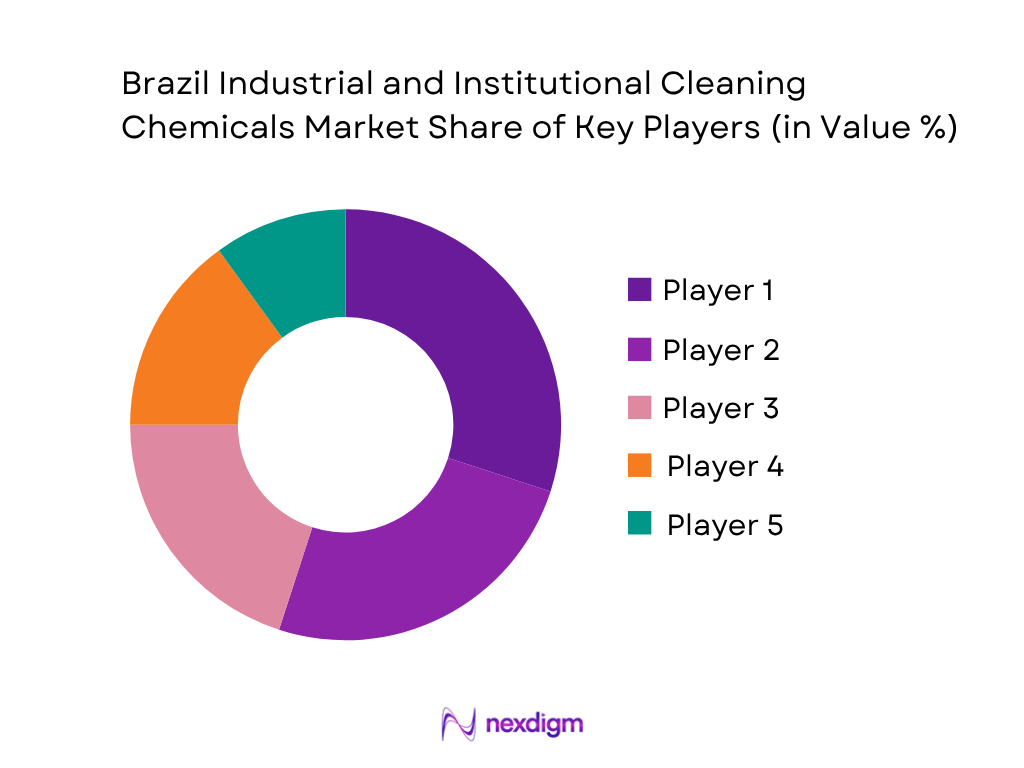
Brazil Industrial and Institutional Cleaning Chemicals Market Analysis
Growth Drivers
Expansion of Industrial Manufacturing and Processing Activities
The Brazil Industrial and Institutional Cleaning Chemicals Market is supported by the country’s large industrial base, which generates consistent demand for cleaning agents, degreasers, disinfectants, and specialized hygiene chemicals across manufacturing facilities. According to the World Bank, Brazil’s GDP reached approximately USD 2.18 trillion in 2024, reflecting continued economic activity across manufacturing, services, agriculture, and industrial sectors. The industrial sector remains a significant contributor to economic output, with Brazil maintaining strong production capabilities in food processing, automotive manufacturing, chemicals, mining, and energy-related industries. According to Brazil’s Ministry of Development, Industry, Trade and Services (MDIC), Brazil recorded more than USD 337 billion in exports in 2024, highlighting the scale of export-oriented production sectors requiring industrial sanitation and process cleaning solutions. The Brazilian food and beverage processing industry, one of the largest industrial consumers of cleaning chemicals, continues to require advanced sanitation products for production lines, equipment cleaning, and contamination control. The growth of industrial facilities increases the requirement for high-performance cleaning chemicals designed for operational efficiency, worker safety compliance, and hygiene maintenance.
Increasing Healthcare Infrastructure and Hygiene Compliance Requirements
The Brazil Industrial and Institutional Cleaning Chemicals Market benefits from increasing demand for infection control products and sanitation chemicals across hospitals, clinics, laboratories, and healthcare facilities. According to the World Bank, Brazil’s population reached approximately 212 million people in 2024, creating continuous demand for healthcare services and supporting expansion of institutional hygiene requirements. Data from Brazil’s Ministry of Health indicates that the country operates more than 7,000 hospitals and thousands of healthcare establishments, requiring regular consumption of disinfectants, surface cleaners, and specialized sanitation products. The healthcare sector’s increasing focus on infection prevention, sterilization procedures, and regulatory hygiene standards supports demand for institutional cleaning chemicals. According to Brazil’s National Health Surveillance Agency (ANVISA), regulated sanitation practices require healthcare facilities to follow strict protocols for cleaning and disinfection processes. Rising healthcare utilization, expansion of private healthcare networks, and increasing investment in medical infrastructure are encouraging hospitals and healthcare operators to adopt professional-grade cleaning chemicals with improved efficacy and safety characteristics.
Market Challenges
Dependence on Imported Specialty Chemical Raw Materials
The Brazil Industrial and Institutional Cleaning Chemicals Market faces challenges due to dependence on imported specialty chemical inputs used in advanced cleaning formulations, including surfactants, specialty solvents, enzymes, and performance additives. According to Brazil’s Ministry of Development, Industry, Trade and Services (MDIC), Brazil imported approximately USD 243 billion worth of goods in 2024, reflecting continued dependence on international supply chains for industrial inputs and specialized materials. The chemical industry relies on global sourcing networks for several high-performance raw materials that are not fully produced domestically at competitive scale. According to Brazil’s National Chemical Industry Association (Abiquim), the chemical sector remains one of the country’s major industrial importers due to gaps in domestic production capacity for certain specialty chemicals. Currency fluctuations, international logistics disruptions, and dependence on overseas suppliers can influence raw material availability for cleaning chemical manufacturers. This creates operational challenges for producers developing advanced institutional and industrial cleaning formulations requiring consistent quality and supply reliability.
Regulatory Compliance and Environmental Requirements
The Brazil Industrial and Institutional Cleaning Chemicals Market faces increasing complexity due to regulatory requirements related to chemical safety, environmental protection, and sustainable product development. Cleaning chemical manufacturers must comply with regulations established by agencies including ANVISA and Brazil’s environmental authorities regarding product registration, labeling, chemical handling, and waste management. According to Brazil’s Ministry of Environment and Climate Change, the country generated approximately 80 million tonnes of municipal solid waste annually, increasing focus on sustainable chemical usage, responsible disposal practices, and environmentally safer formulations. Industrial and institutional users are increasingly required to adopt cleaning solutions that minimize environmental impact while maintaining hygiene performance. Additionally, Brazil’s regulatory framework requires manufacturers to ensure compliance with safety standards for chemical exposure and workplace handling. These requirements increase operational complexity for producers, particularly smaller manufacturers that need to invest in formulation improvements, documentation processes, and environmentally compliant product development.
Market Opportunities
Adoption of Sustainable and Bio-Based Cleaning Solutions
The Brazil Industrial and Institutional Cleaning Chemicals Market has significant opportunities through increasing adoption of sustainable, biodegradable, and environmentally responsible cleaning formulations. According to Brazil’s Ministry of Environment and Climate Change, sustainability initiatives are becoming increasingly important across industrial sectors as Brazil advances environmental management practices. Brazil generated approximately 175 million tonnes of agricultural production in major crop categories in 2024, creating opportunities for development of bio-based chemical ingredients derived from renewable resources. Industrial and institutional buyers are increasingly seeking cleaning products that reduce environmental impact, improve workplace safety, and support corporate sustainability objectives. Demand is emerging for enzyme-based cleaners, biodegradable surfactants, low-impact disinfectants, and concentrated formulations that reduce chemical consumption during operations. Food processing companies, healthcare operators, and multinational industrial organizations are particularly focused on sustainable hygiene solutions due to environmental compliance requirements and operational efficiency goals. These trends create opportunities for manufacturers to develop innovative cleaning chemistry aligned with sustainability objectives.
Growth of Automated Cleaning Technologies and Professional Hygiene Systems
The Brazil Industrial and Institutional Cleaning Chemicals Market presents opportunities through increasing adoption of automated dispensing systems, digital chemical management platforms, and professional hygiene solutions across industrial and commercial facilities. According to the International Labour Organization (ILO), Brazil’s employed population exceeded 100 million workers in 2024, supporting demand for improved workplace safety standards and efficient industrial operations. Large manufacturing facilities, healthcare institutions, hospitality operators, and food processing companies are increasingly adopting technology-enabled cleaning systems to improve chemical utilization, reduce operational errors, and maintain consistent hygiene standards. According to Brazil’s Ministry of Agriculture and Livestock, Brazil remains one of the world’s largest agricultural and food exporting countries, with agricultural exports exceeding USD 164 billion in 2024, requiring advanced sanitation practices throughout processing and production environments. Automated chemical dispensing technologies and customized hygiene management programs provide opportunities for cleaning chemical manufacturers to offer integrated solutions rather than standalone products, supporting stronger customer relationships and long-term adoption across industrial and institutional sectors.
Future Outlook
Over the next decade, the Brazil Industrial and Institutional Cleaning Chemicals Market is expected to witness sustained growth driven by increasing industrial hygiene requirements, expansion of food processing and healthcare facilities, rising adoption of sustainable formulations, and growing demand for outsourced facility management services. The market is expected to shift toward concentrated chemicals, automated dispensing technologies, environmentally compliant formulations, and customized cleaning programs. Increasing focus on operational efficiency and reduced chemical consumption will further encourage adoption of advanced cleaning solutions.
The Brazil Industrial and Institutional Cleaning Chemicals Market is projected to grow at a CAGR of ~5.3% during 2026-2035, supported by increasing demand from industrial users, institutional buyers, and professional cleaning service providers. The market is expected to expand from approximately USD ~ billion in 2026 to approximately USD ~ billion by 2035, driven by modernization of industrial facilities, stronger hygiene regulations, and sustainability-focused chemical innovation.
Major Players
- Ecolab
- Diversey
- Unilever
- Reckitt
- Bombril
- 3M
- BASF
- Dow
- Henkel
- Procter & Gamble
- Kimberly-Clark
- Stepan Company
- The Clorox Company
- Univar Solutions
- Química Amparo
Key Target Audience
- Industrial Chemical Manufacturers and Formulators
- Professional Cleaning Solution Providers and Facility Management Companies
- Food and Beverage Processing Companies
- Healthcare Institutions and Hospital Networks
- Investments and Venture Capitalist Firms
- Government and Regulatory Bodies
- Industrial Manufacturing Companies
- Chemical Distribution and Supply Chain Companies
Research Methodology
Step 1: Identification of Key Variables
The initial phase involves developing an ecosystem map covering major stakeholders operating within the Brazil Industrial and Institutional Cleaning Chemicals Market. This process includes extensive secondary research using industry databases, regulatory sources, trade publications, company reports, and chemical industry information platforms. The objective is to identify major market variables including product categories, application industries, raw material trends, distribution channels, and demand drivers.
Step 2: Market Analysis and Construction
In this phase, historical market information related to Brazil Industrial and Institutional Cleaning Chemicals is compiled and analyzed. The assessment includes evaluation of chemical consumption patterns, industrial application areas, institutional demand, manufacturing capabilities, import dependency, pricing structures, and distribution networks. Revenue estimation is developed through analysis of market participants, consumption volumes, and industry-level operational indicators.
Step 3: Hypothesis Validation and Expert Consultation
Market hypotheses are developed and validated through primary interviews with manufacturers, distributors, facility management companies, industrial buyers, and institutional end users. These consultations provide insights into purchasing behaviour, product preferences, competitive positioning, formulation trends, and future demand patterns. Industry feedback is incorporated to validate market assumptions and refine analysis accuracy.
Step 4: Research Synthesis and Final Output
The final stage involves direct engagement with industry participants to validate findings related to product segments, chemical consumption patterns, competitive landscape, and market opportunities. Information collected through primary and secondary research is triangulated to ensure consistency and reliability. The final report integrates market sizing, segmentation analysis, competitive benchmarking, and future growth assessment for the Brazil Industrial and Institutional Cleaning Chemicals Market.

- Executive Summary
- Research Methodology (Market Definition and Scope, Brazil Industrial and Institutional Cleaning Chemicals Taxonomy, Industrial Cleaning Chemical Classification, Institutional Cleaning Chemical Classification, Professional Hygiene Solution Mapping, Cleaning Chemical Application Framework, Raw Material Assessment, Sustainable Cleaning Chemistry Evaluation, Market Sizing Framework, Top-Down Analysis, Bottom-Up Analysis, Domestic Manufacturing Assessment, Import Dependency Assessment, Demand-Side Assessment, Supply-Side Assessment, Industrial Consumption Mapping, Institutional Usage Assessment, Primary Industry Interviews, Manufacturer Validation, Distributor Network Assessment, Trade Flow Analysis, Data Triangulation, Forecasting Framework, Scenario Analysis, Assumptions and Limitations)

- Definition and Scope
- Brazil Industrial and Institutional Cleaning Chemicals Industry Evolution and Professional Hygiene Development
- Industrial and Institutional Cleaning Chemicals Manufacturing and Formulation Process
- Cleaning Chemicals Value Chain Analysis
- Brazil Industrial and Institutional Cleaning Chemicals Supply Chain Analysis
- Cleaning Chemical Raw Material Ecosystem Analysis
- Brazil Cleaning Chemicals Import Dependency and Localization Assessment
- Industrial Cleaning Application Architecture and Institutional Hygiene Solution Framework

- Growth Drivers (Expansion of Manufacturing Sector, Increasing Hygiene Standards in Healthcare Facilities, Growth of Food Processing Industry, Rising Demand for Professional Cleaning Services, Increasing Adoption of Sustainable Cleaning Solutions, Growth of Commercial Infrastructure, Workplace Hygiene Requirements, Demand for Concentrated Cleaning Formulations)
- Market Challenges (Raw Material Price Volatility, Dependence on Imported Specialty Chemicals, Fragmented Distribution Structure, High Cost of Advanced Cleaning Formulations, Limited Awareness of Sustainable Solutions, Regulatory Compliance Costs, Price Competition from Regional Manufacturers, Skilled Cleaning Workforce Limitations)
- Market Opportunities (Bio-Based Cleaning Chemicals, Green Certification Adoption, Smart Chemical Dispensing Systems, Digital Cleaning Management Platforms, Customized Industrial Cleaning Programs, Sustainable Institutional Hygiene Solutions, Enzyme-Based Cleaning Technologies, Expansion of Facility Management Services)
- Market Trends (Low-VOC Cleaning Chemicals, Concentrated Product Adoption, Eco-Friendly Formulations, Automated Dosing Systems, Water-Efficient Cleaning Technologies, Premium Disinfection Solutions, Sustainable Packaging, Advanced Hygiene Monitoring Systems)
- Regulatory and Standards Landscape (ANVISA Regulations, Brazilian Health Surveillance Requirements, Environmental Protection Standards, Chemical Registration Requirements, Workplace Safety Regulations, Hazardous Chemical Handling Guidelines, Waste Disposal Compliance, Industrial Hygiene Standards)
- SWOT Analysis
- Porter’s Five Forces Analysis
- PESTLE Analysis
- Stakeholder Ecosystem
- Competition Ecosystem

- By Market Value (2020-2025)
- By Cleaning Chemical Consumption Volume (2020-2025)
- By Domestic Production Volume (2020-2025)
- By Import Volume (2020-2025)
- By Export Volume (2020-2025)
- By Average Selling Price (2020-2025)
- By Industrial Facility Chemical Consumption Intensity (2020-2025)
- By Institutional Facility Chemical Consumption Intensity (2020-2025)

- By Product Type (In Value %)
General Purpose Cleaners
Disinfectants and Sanitizers
Industrial Degreasers and Heavy-Duty Cleaners
Warewashing and Dishwashing Chemicals
Laundry Care Chemicals
Floor Care Chemicals
Vehicle Wash Chemicals
Food Processing Cleaning Chemicals
Healthcare Cleaning Chemicals
Specialty Industrial Cleaning Chemicals
Surface and Glass Cleaning Chemicals - By Raw Material Type (In Value %)
Surfactants
Chlor-Alkali Chemicals
Solvents
Biocides
Phosphates
Enzymes
Acids and Alkalis
Chelating Agents
Fragrances and Preservatives
Bio-Based Raw Materials - By End-Use Industry (In Value %)
Food and Beverage Processing
Healthcare Facilities
Manufacturing and Industrial Plants
Hospitality and Commercial Establishments
Educational Institutions
Retail Facilities
Transportation and Logistics Facilities
Pharmaceutical Manufacturing
Mining and Energy Facilities
Government and Public Institutions - By Distribution Channel (In Value %)
Direct Manufacturer Sales
Industrial Chemical Distributors
Professional Cleaning Product Distributors
Facility Management Companies
Janitorial Supply Providers
B2B Digital Platforms
Institutional Procurement Contracts
Specialty Hygiene Solution Providers - By Region (In Value %)
Southeast Brazil
São Paulo
Rio de Janeiro
Minas Gerais
Espírito Santo
South Brazil

- Market Share of Major Players (By Revenue, Volume, Product Category, Raw Material Type, End-Use Industry, Market Type, Distribution Channel)
- Cross Comparison Parameters (Product Portfolio Breadth, Industrial Cleaning Chemical Capability, Institutional Hygiene Solution Coverage, Manufacturing and Blending Capacity, Distribution Network Reach, Sustainable Cleaning Technology Capability, Technical Service Support Strength, Formulation Innovation Capability)
- SWOT Analysis of Major Players
- Competitive Positioning Matrix
- Product and Technology Portfolio Benchmarking
- Pricing and Distribution Network Benchmarking
- Market Entry Strategy Assessment
- Detailed Profiles of Major Companies
Ecolab Brasil
Diversey Brasil
Reckitt Benckiser Brasil
Unilever Professional Brasil
Henkel Brasil
3M do Brasil
BASF Brasil
Dow Brasil
Kersia Brasil
Spartan Brasil Produtos Químicos
Betco Corporation
Oleak Indústria e Comércio
AudaxCo
Renko Química
Quimisa

- Buyer Segmentation
- Procurement Behaviour
- Supplier Selection Criteria
- Buyer Pain Points
- Technology Adoption Assessment
- Replacement and Repurchase Behaviour

- By Market Value (2026-2035)
- By Cleaning Chemical Consumption Volume (2026-2035)
- By Domestic Production Volume (2026-2035)
- By Import Volume (2026-2035)
- By Export Volume (2026-2035)
- By Average Selling Price (2026-2035)
- By Industrial Facility Chemical Consumption Intensity (2026-2035)
- By Institutional Facility Chemical Consumption Intensity (2026-2035)


 Request a Sample
 Ask for Customization
 Get a Quote
 Enquire Now