

 Download PDF
Market Overview
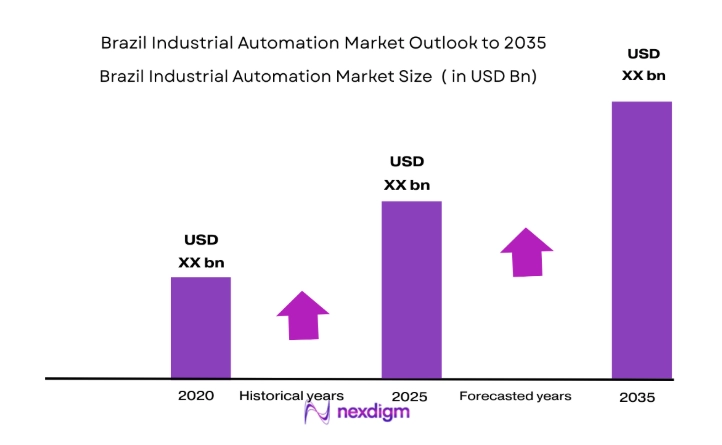
The Brazil Industrial Automation market is growing rapidly, driven by increasing demand for efficient production systems and technological advancements. The market size, valued at USD ~ billion, is primarily propelled by the manufacturing sector’s need for automation solutions that improve productivity, reduce costs, and optimize operational efficiency. This growth is supported by the adoption of technologies such as robotics, industrial IoT, and AI-powered systems, which help industries enhance their competitive edge. Brazil’s strategic investments in industrial automation are a crucial factor in maintaining this positive market trend.
Brazil dominates the Industrial Automation market due to its large industrial base, particularly in sectors like automotive, food and beverage, and mining. Major cities such as São Paulo, Rio de Janeiro, and Campinas drive demand by hosting a variety of manufacturing plants and technological innovation hubs. The availability of skilled labor, supportive government policies, and a growing interest in sustainable and efficient production processes contribute to Brazil’s leadership in the region. Moreover, Brazil’s proximity to key international markets further bolsters its competitive position within the Latin American automation landscape.
Market Segmentation
By Product Type:
Brazil Industrial Automation market is segmented by product type into robotics, PLC systems, SCADA systems, DCS systems, and industrial sensors. Recently, robotics has captured the dominant market share due to factors such as increasing demand for precision, reduced operational costs, and improved efficiency across several sectors, including automotive and consumer electronics. Robotics’ adoption is significantly driven by its potential to streamline manufacturing processes, reduce human error, and provide higher consistency in production lines. Brazil’s automotive industry, which is one of the largest in Latin America, heavily relies on robotics for assembly lines, positioning it as the leader in product type segmentation.

By Platform Type:
Brazil Industrial Automation market is segmented by platform type into cloud-based platforms, edge computing platforms, on-premise solutions, hybrid platforms, and integrated platforms. Recently, cloud-based platforms have secured a significant share due to their scalability, remote access capabilities, and cost-effectiveness. Cloud computing in automation offers flexibility for real-time data processing and monitoring, which is increasingly valued in industries such as oil and gas, automotive, and energy. Brazil’s large-scale industrial plants are progressively turning to cloud-based solutions for enhanced operational oversight and to improve predictive maintenance capabilities.

Competitive Landscape
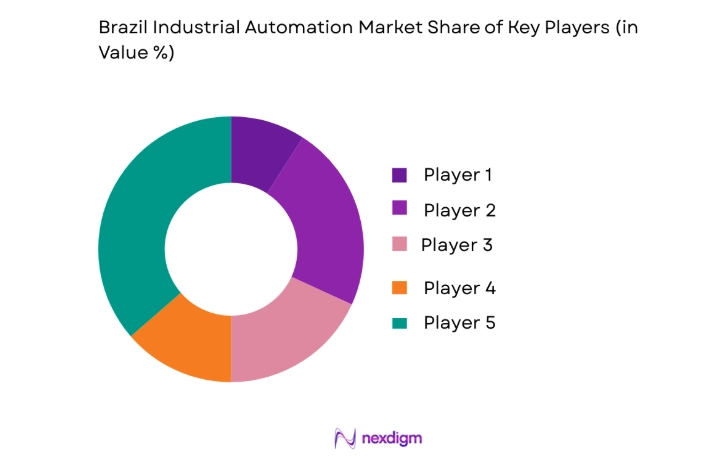
The competitive landscape of the Brazil Industrial Automation market is marked by significant consolidation and a strong presence of global players. Major companies in the market are focused on expanding their product portfolios, advancing technological capabilities, and forming strategic alliances to strengthen their market position. These companies have established research and development centers in Brazil to cater to local industry demands, focusing on customization and localization of their automation solutions.
| Company Name | Establishment Year | Headquarters | Technology Focus | Market Reach | Key Products | Revenue (USD) | Key Market-Specific Parameter |
| Siemens | 1847 | Munich, Germany | ~ | ~ | ~ | ~ | ~ |
| Schneider Electric | 1836 | Rueil-Malmaison, France | ~ | ~ | ~ | ~ | ~ |
| ABB | 1988 | Zurich, Switzerland | ~ | ~ | ~ | ~ | ~ |
| Rockwell Automation | 1903 | Milwaukee, USA | ~ | ~ | ~ | ~ | ~ |
| Emerson Electric | 1890 | St. Louis, USA | ~ | ~ | ~ | ~ | ~ |
Brazil Industrial Automation Market Analysis
Growth Drivers
Technological Advancements in Industrial IoT:
The rapid advancements in industrial IoT (IIoT) are transforming the way industrial operations are managed. IIoT technologies enable real-time data collection, predictive maintenance, and process optimization, driving significant growth in the automation market. In Brazil, industries like automotive manufacturing and energy are adopting IIoT systems to improve efficiency and reduce operational costs. IIoT adoption is especially high in Brazil’s manufacturing hubs, where production lines are increasingly integrated with smart technologies. These advancements provide industries with the capability to monitor production processes remotely, reducing downtime and improving supply chain management. IIoT solutions are helping Brazilian companies to stay competitive in the global market by offering higher flexibility and operational control. Furthermore, Brazilian businesses are investing in cloud computing platforms that support IIoT, facilitating seamless data sharing across multiple locations. As industries aim for higher productivity, reduced maintenance costs, and energy efficiency, the demand for IIoT-driven automation systems is expected to grow exponentially.
Government Support for Automation Technologies:
Brazilian government initiatives are playing a key role in promoting industrial automation. The government has introduced various policies and incentives to accelerate the adoption of advanced manufacturing technologies. This includes tax breaks and funding programs aimed at enhancing the automation capabilities of local industries. Additionally, Brazil’s industrial sector is benefiting from the country’s participation in international trade agreements that focus on technology exchange and investment in automation. The Brazilian government has recognized the importance of automation in driving industrial growth, and as a result, there is increasing focus on fostering local research and development in automation technologies. Several state-run programs offer subsidies for automation technology adoption, especially in critical sectors such as oil and gas, automotive, and energy. This support is encouraging both local and international companies to invest in Brazil’s automation industry. Furthermore, Brazil’s push towards Industry 4.0, alongside its efforts to reduce carbon emissions through automation, is expected to propel the market’s growth further.
Market Challenges
High Initial Investment Costs:
One of the significant challenges facing the Brazil Industrial Automation market is the high initial investment required for automation systems. Although the long-term benefits of automation, such as improved efficiency, lower labor costs, and higher productivity, are clear, the upfront costs for installing automation equipment can be prohibitive for small and medium-sized enterprises (SMEs). In Brazil, many companies, particularly in the manufacturing sector, struggle to secure the necessary capital to implement large-scale automation systems. This challenge is particularly evident in industries with smaller profit margins, where companies must balance automation costs with their ability to remain competitive in both domestic and international markets. Additionally, Brazilian companies may face challenges in obtaining financing for automation investments, as financial institutions can be hesitant to provide loans for new technologies with long payback periods. Overcoming this hurdle requires collaboration between the government, financial institutions, and industries to create financing solutions that make automation more accessible to a wider range of companies.
Skilled Labor Shortage:
The shortage of skilled workers in Brazil is another major challenge facing the industrial automation market. While automation technology offers significant operational advantages, it also requires a highly skilled workforce to install, operate, and maintain complex systems. In Brazil, there is a growing gap between the demand for skilled professionals in automation and the availability of qualified workers. This gap is particularly evident in sectors such as robotics and industrial IoT, where expertise in machine learning, programming, and system integration is required. Companies are often forced to invest significant resources in training or hiring foreign talent to fill critical positions. The lack of a sufficiently skilled workforce is hindering the full-scale adoption of automation technologies, particularly in sectors that rely heavily on advanced robotics and AI systems. Addressing this challenge requires a concerted effort to improve STEM education in Brazil and create specialized training programs to equip workers with the skills needed to operate and maintain advanced automation systems.
Opportunities
Expanding Adoption of Autonomous Systems:
Autonomous systems are rapidly gaining traction across several industries in Brazil, offering a significant opportunity for the Industrial Automation market. These systems, which include autonomous robots, drones, and automated guided vehicles (AGVs), are being increasingly used to streamline operations, enhance safety, and reduce labor costs. Autonomous robots, for example, are increasingly used in industries such as logistics and warehousing, where they can transport goods without human intervention. Brazil’s manufacturing sector, including the automotive and electronics industries, is witnessing a rising adoption of autonomous systems to automate material handling, assembly lines, and inspection processes. The demand for these systems is also growing in sectors like agriculture and mining, where they can improve operational efficiency and safety in hazardous environments. With Brazil’s growing interest in smart factories and Industry 4.0, the adoption of autonomous systems is expected to expand, creating significant opportunities for automation technology providers.
Rising Demand for Energy-Efficient Automation Solutions:
Brazil’s focus on sustainability and energy efficiency presents a lucrative opportunity for the Industrial Automation market. As the country seeks to reduce its carbon footprint and improve energy consumption in industrial operations, there is an increasing demand for energy-efficient automation solutions. Industries in Brazil are adopting automation technologies that optimize energy use, such as smart sensors, energy-efficient motors, and systems that reduce waste. This demand is particularly high in sectors like oil and gas, where automation is helping to reduce energy consumption and emissions in extraction and refining processes. Additionally, Brazil’s renewable energy sector, which includes wind, solar, and bioenergy, is also embracing automation solutions to improve efficiency and integrate renewable energy sources into national grids. Automation technologies are essential for achieving Brazil’s energy efficiency goals, and this market trend is expected to fuel further growth in the coming years.
Future Outlook
Over the next five years, the Brazil Industrial Automation market is expected to experience significant growth. Technological developments, particularly in industrial IoT, robotics, and artificial intelligence, will continue to drive the market forward. Additionally, the government’s commitment to promoting automation technologies will create a favorable environment for businesses to adopt advanced solutions. The increasing demand for energy-efficient and autonomous systems will further fuel market expansion. As industries look to improve productivity, reduce costs, and meet sustainability goals, Brazil will remain a key player in the Latin American automation landscape.
Major Players
- Siemens
- Schneider Electric
- Rockwell Automation
- ABB
- Emerson Electric
- Mitsubishi Electric
- Honeywell International
- Fanuc Corporation
- Yokogawa Electric
- Bosch Rexroth
- National Instruments
- Festo
- KUKA
- Omron Corporation
- SICK AG
Key Target Audience
- Investments and venture capitalist firms
- Government and regulatory bodies
- Manufacturing companies
- Oil and gas industry stakeholders
- Energy sector organizations
- Automotive manufacturers
- Logistics companies
- Industrial equipment distributors
Research Methodology
Step 1: Identification of Key Variables
In this step, key market variables, such as growth drivers, challenges, and opportunities, are identified to structure the research framework.
Step 2: Market Analysis and Construction
A comprehensive analysis is conducted to assess the current state of the market and segment it based on product types, platforms, and other relevant factors.
Step 3: Hypothesis Validation and Expert Consultation
This step involves validating market hypotheses through expert consultations and primary research with industry professionals.
Step 4: Research Synthesis and Final Output
The final research output is synthesized from the collected data, which is then organized and presented in a clear and actionable format.

- Executive Summary
- Research Methodology (Definitions, Scope, Industry Assumptions, Market Sizing Approach, Primary & Secondary Research Framework, Data Collection & Verification Protocol, Analytic Models & Forecast Methodology, Limitations & Research Validity Checks)

- Market Definition and Scope
- Value Chain & Stakeholder Ecosystem
- Regulatory / Certification Landscape
- Sector Dynamics Affecting Demand

- Growth Drivers
Government Support for Automation Technologies
Technological Advancements in Industrial IoT
Increased Demand for Automation in Manufacturing Sectors - Market Challenges
High Initial Investment Cost
Technological Integration Issues
Skill Shortage in Automation Technologies - Market Opportunities
Rising Adoption of AI in Automation Systems
Expanding Industrial IoT Applications
Growth in Sustainable Manufacturing Solutions - Trends
Increased Adoption of Industrial IoT
Integration of AI and Machine Learning in Automation
Rising Demand for Autonomous Systems - Government Regulations
- SWOT Analysis of Key Competitors

- By Market Value, 2020-2025
- By Installed Units, 2020-2025
- By Average System Price, 2020-2025
- By System Complexity Tier, 2020-2025

- By System Type (In Value%)
Robotics
PLC Systems
DCS Systems
SCADA Systems
Industrial Sensors - By Platform Type (In Value%)
Cloud-based Platforms
Edge Computing Platforms
On-premise Solutions
Hybrid Platforms
Integrated Platforms - By Fitment Type (In Value%)
On-premise Solutions
Cloud-based Solutions
Hybrid Solutions
Modular Solutions
Integrated Solutions - By EndUser Segment (In Value%)
Manufacturing
Oil & Gas
Food & Beverage
Automotive
Energy

- Market Share Analysis
- CrossComparison Parameters (System Type, Platform Type, Procurement Channel, EndUser Segment, Fitment Type)
- SWOT Analysis of Key Competitors
- Pricing & Procurement Analysis
- Porter’s Five Forces
- Key Players
Siemens
Schneider Electric
Rockwell Automation
Honeywell International
ABB
Emerson Electric
Mitsubishi Electric
Yokogawa Electric
Festo
KUKA
Bosch Rexroth
National Instruments
SICK AG
Omron Corporation
Fanuc Corporation

- Manufacturers Increasingly Adopting Automation Technologies
- Growth of Smart Factories in Brazil
- Oil & Gas Industry Driving Automation Investments
- Energy Sector Focusing on Automation for Sustainability

- Forecast Market Value, 2026-2035
- Forecast Installed Units, 2026-2035
- Price Forecast by System Tier, 2026-2035
- Future Demand by Platform, 2026-2035


 Request a Sample
 Ask for Customization
 Get a Quote
 Enquire Now