
 Download PDF
Market Overview
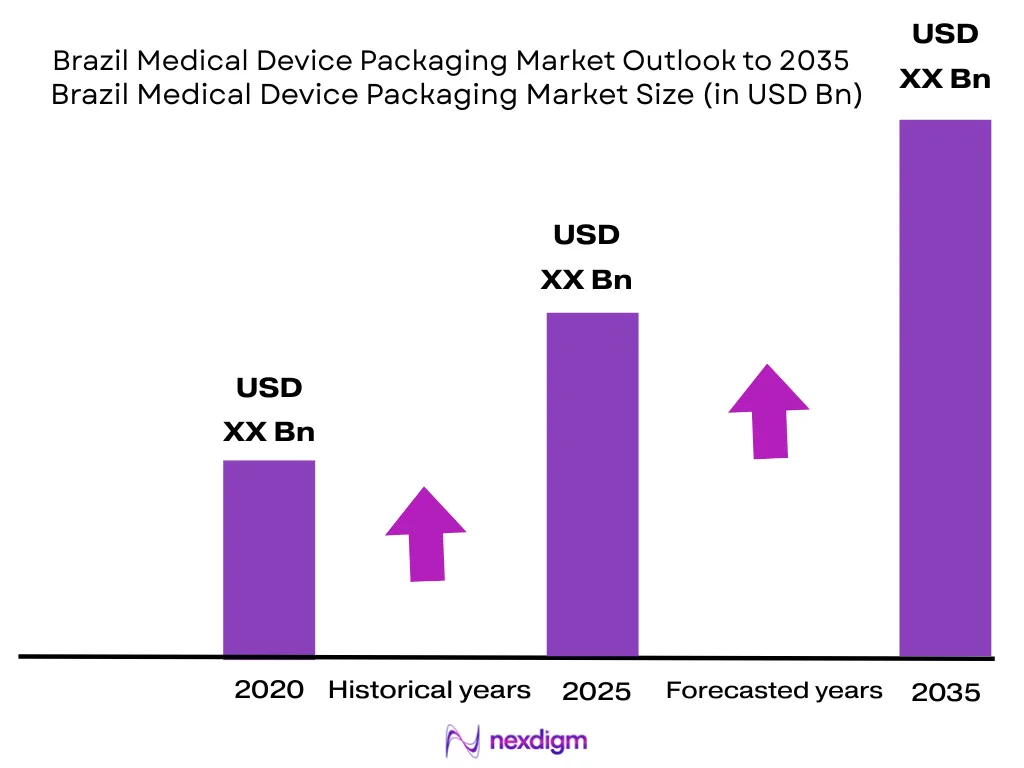
The Brazil medical device packaging market is valued at approximately USD ~ billion, compared with USD ~ billion in the preceding annual period. No audited public source isolates the country’s medical-device-packaging revenue, so the values require primary validation. Demand is supported by Brazil’s USD 15.28 billion medical-device sector, alongside medical-device exports of USD 1.17 billion and imports approaching USD 9.79 billion, which create substantial requirements for sterile barriers, trays, pouches, labels and transit packaging. São Paulo, Minas Gerais, Rio de Janeiro, Paraná, Santa Catarina and Rio Grande do Sul dominate the Brazil medical device packaging market because they combine medical-technology manufacturers, hospitals, packaging converters, laboratories, sterilization providers and logistics infrastructure. São Paulo is particularly influential because it contains the country’s largest industrial and healthcare ecosystem. Southern and southeastern clusters also offer access to polymer processing, printing, thermoforming, cleanroom conversion and export channels required for regulated medical-device packaging.
Market Segmentation
By Packaging Format
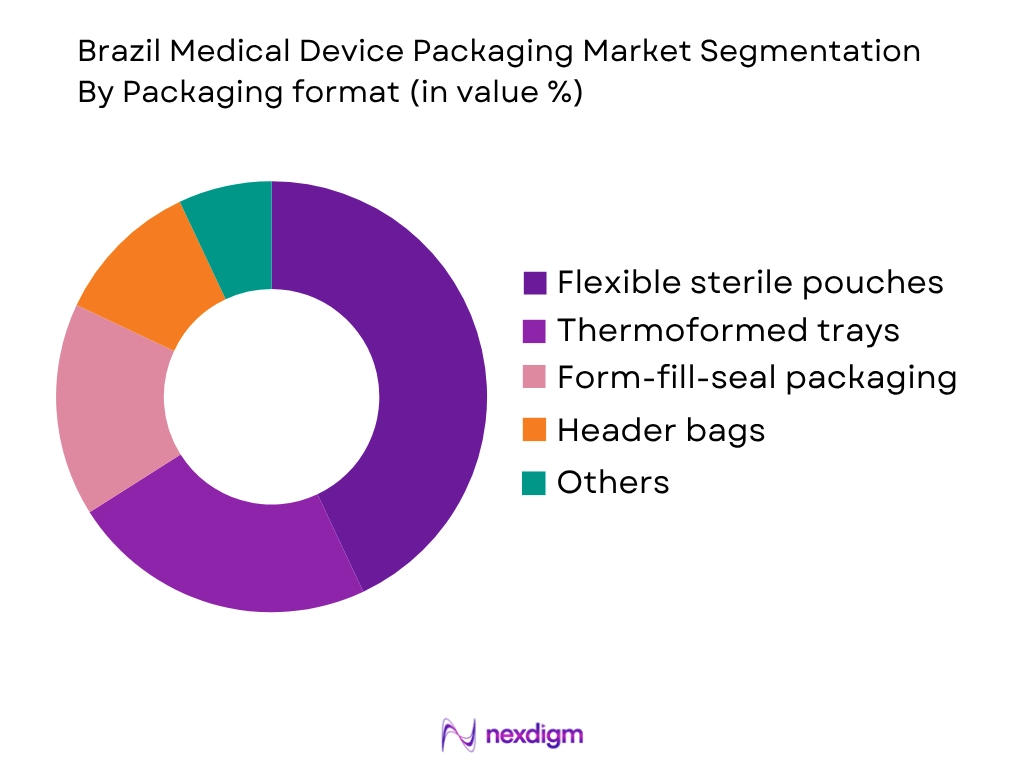
The Brazil medical device packaging market is segmented into flexible sterile pouches, thermoformed trays, form-fill-seal packs, header bags, blister packs, rigid containers and other protective packaging. Flexible sterile pouches hold the dominant market position because they can serve a broad range of catheters, dressings, syringes, surgical accessories, dental products and diagnostic consumables. Medical-grade paper, film and spun-bonded polyolefin structures can be adapted to ethylene oxide, irradiation and other sterilization processes while providing controlled peel opening. Pouches are also lighter and less space-intensive than rigid packaging, supporting lower storage and distribution requirements across Brazil’s large territory. Thermoformed trays remain critical for implants, orthopedic devices and instruments requiring immobilization, puncture resistance or double sterile barriers. Form-fill-seal systems are important for standardized, high-volume disposable products, while rigid containers are used for fragile, reusable or complex devices. The following distribution is a report placeholder pending supplier and converter validation.
By Packaging Material
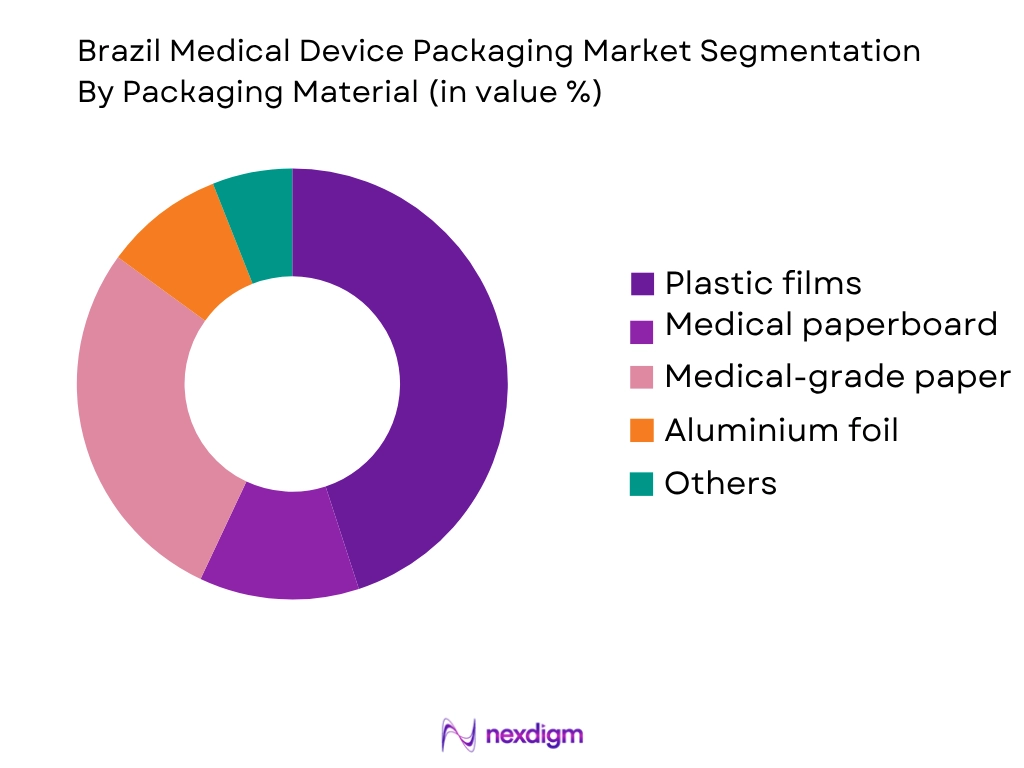
The Brazil medical device packaging market is segmented into plastic films and thermoforming sheets, medical-grade paper, spun-bonded polyolefin, paperboard, aluminium laminates and other specialist substrates. Plastic films and thermoforming sheets dominate because polyethylene, polypropylene, PETG, APET, polyamide and multilayer structures provide sealability, clarity, puncture resistance, dimensional stability and moisture protection. These materials can be converted into pouches, tray bottoms, blisters and rollstock for automated packaging systems. Medical-grade paper remains important for breathable ethylene-oxide-compatible packs and cost-sensitive disposable products. Spun-bonded polyolefin serves higher-performance sterile-barrier applications requiring low linting, microbial resistance and durability. Aluminium structures address products requiring strong moisture, oxygen or light protection, although their multilayer composition can complicate recycling. Brazil’s imported specialty-material exposure means suppliers with local inventory, qualified alternative substrates and formal change-control procedures have a competitive advantage. The shares below are placeholders requiring primary market validation.
Competitive Landscape
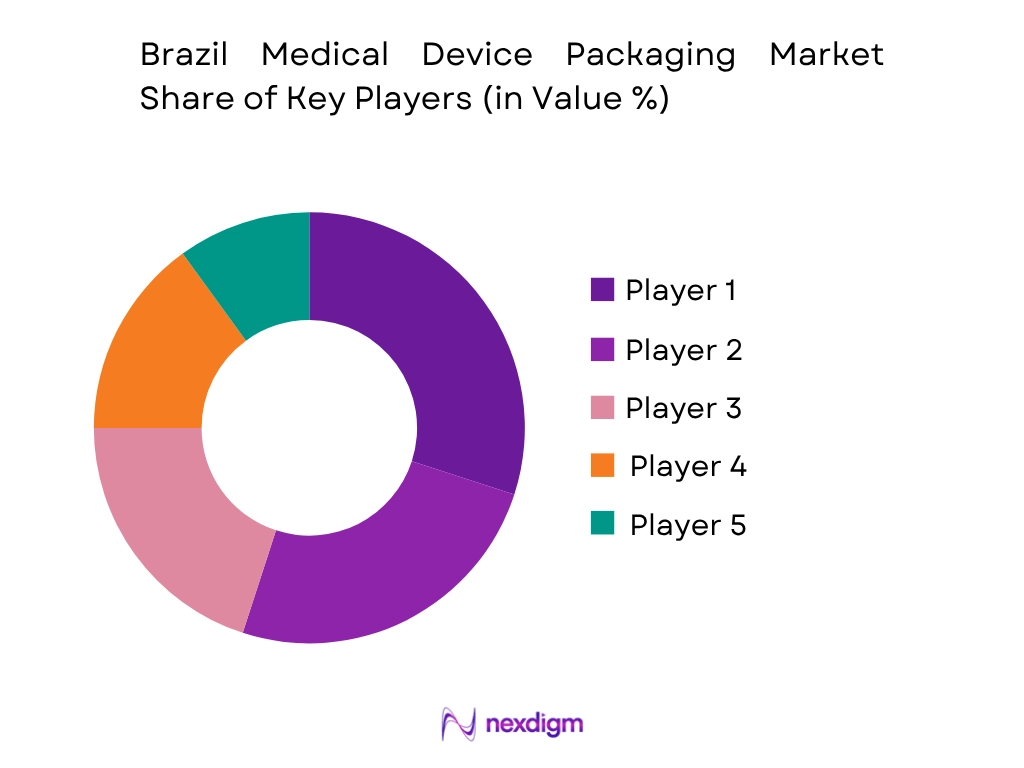
The Brazil medical device packaging market includes multinational flexible-packaging groups, specialty polymer suppliers, sterile-barrier specialists and domestic converters. Competition is shaped by cleanroom capability, ANVISA-compliant quality systems, sterilization compatibility, technical-documentation support and proximity to medical-device manufacturing clusters. Amcor, DuPont, TekniPlex Healthcare, Klöckner Pentaplast and Berry Global have relevant material or converting capabilities, while local operations and distributors remain important for shorter lead times, customization and regulatory coordination.
| Company | Establishment year | Headquarters | Core packaging formats | Material capabilities | Sterilization compatibility | Validation support | Brazil relevance | Sustainability capability |
| Amcor | 1860 | Zurich, Switzerland | ~ | ~ | ~ | ~ | ~ | ~ |
| DuPont | 1802 | Wilmington, United States | ~ | ~ | ~ | ~ | ~ | ~ |
| TekniPlex Healthcare | 1967 | Wayne, United States | ~ | ~ | ~ | ~ | ~ | ~ |
| Klöckner Pentaplast | 1965 | Heiligenroth, Germany | ~ | ~ | ~ | ~ | ~ | ~ |
| Berry Global | 1967 | Evansville, United States | ~ | ~ | ~ | ~ | ~ | ~ |
Brazil Medical Device Packaging Market Analysis
Growth Drivers
Expansion of Domestic Health-Industry Manufacturing
Brazil’s effort to expand domestic health-industry production is increasing demand for sterile pouches, thermoformed trays, medical-grade lidding, protective inserts, labels and validated transit packaging. The federal government allocated BRL 4.2 billion in 2024 through the New Growth Acceleration Program to modernize and expand the national health industrial complex. In 2025, a further BRL 2.4 billion was directed toward the acquisition of more than 10,000 healthcare equipment units for primary care and surgical services. These programmes create packaging demand because locally produced instruments, diagnostic devices, hospital equipment and disposable products require documented protection during assembly, sterilization, storage and distribution. Brazil also recorded 1,758 medical-device registrations within a federal technical assessment released in 2025, indicating a broad and continuously developing regulated product base. The macroeconomic platform supports manufacturing investment: World Bank data placed Brazil’s GDP at USD 2.186 trillion, GDP per capita at USD 10,310.5, and population at 211,998,573 in 2024. Medical-device packaging suppliers benefit when domestic production replaces imported finished products because packaging design, qualification, sealing, labelling and sterilization coordination are performed closer to Brazilian manufacturing plants. Demand is particularly relevant for Class III and Class IV products, which generally require more complex sterile-barrier validation and lifecycle documentation than basic non-sterile devices.
Regulatory Control and Higher Sterile-Barrier Requirements
ANVISA regulation is driving demand for technically controlled medical-device packaging by requiring manufacturers and importers to document device classification, materials, sterilization, labelling, manufacturing controls and shelf-life performance. Brazil’s regulatory framework classifies devices across 4 risk classes, creating different levels of registration and technical-documentation burden. Higher-risk implants, cardiovascular devices, surgical systems and diagnostic products require packaging capable of maintaining sterility until clinical use and withstanding distribution across Brazil’s 8.5 million square kilometres. This favours qualified pouches, rigid trays, double sterile barriers and validated seal systems over basic commodity packaging. Federal records referenced 1,758 registered medical devices in a 2025 technical assessment, demonstrating the number of product programmes requiring controlled commercial packaging. The broader economy generated USD 2.186 trillion in output in 2024, with GDP expanding by 3.4 units for every 100 units, giving manufacturers a substantial base for investment in cleanrooms, sealing lines and laboratory testing. Regulatory control also increases the value of suppliers capable of providing resin traceability, lot certificates, formal change notifications and compatibility evidence for ethylene oxide, gamma irradiation, electron beam or steam sterilization. Any change involving a medical-grade paper, polymer film, coating, adhesive or manufacturing site may require risk assessment and additional testing. Regulation therefore expands the market by increasing the engineering, documentation and validation content associated with every qualified package.
Market Challenges
Imported Material and Equipment Dependence
Brazil’s medical-device packaging sector remains exposed to imported medical-grade substrates, sterilization-compatible films, specialised coatings, precision tooling and automated inspection equipment. Domestic converters can produce paper, plastic films and thermoformed components, but higher-performance spun-bonded polyolefin, multilayer barrier structures, medical-grade adhesives and integrity-testing systems frequently depend on international suppliers. The exposure is significant because Brazil’s currency depreciated by 27.9 units for every 100 units against the U.S. dollar during 2024 before appreciating by 11.1 units in 2025. Exchange-rate movement can alter procurement conditions for imported materials and machinery even when medical-device orders remain stable. The World Bank recorded national GDP of USD 2.186 trillion and GDP per capita of USD 10,310.5 in 2024, while the IMF reported that Brazil’s economy remained resilient but faced tighter financial conditions and inflationary pressure. Medical packaging suppliers must therefore maintain larger safety stocks of qualified substrates, because replacing an unavailable film or coated paper is not a routine purchasing decision. A substitution may require seal-window studies, accelerated aging, sterilization trials, package-integrity testing and regulatory documentation. The challenge is magnified for low-volume implant or cardiovascular-device packages, where tooling and validation expenditure must be recovered across relatively limited production runs. Import dependence consequently affects lead times, working capital, qualification risk and supply continuity throughout the Brazilian medical-device packaging value chain.
Technical Validation and Specialist Workforce Constraints
Medical-device packaging requires capabilities that extend beyond ordinary film conversion or carton production. Packaging engineers must evaluate device geometry, sharp edges, mass distribution, sterilization exposure, microbial barriers, seal strength, peel behaviour and transportation hazards before commercial release. Brazil’s regulated product base includes at least 1,758 medical-device registrations referenced in a 2025 federal assessment, creating a wide range of device-specific validation programmes. The technical burden increases when products use double sterile barriers, multi-component procedure kits or implant-retention trays. Packaging lines must be supported by installation qualification, operational qualification and performance qualification, followed by aging and distribution testing. Brazil’s manufacturing and healthcare economy is large—the country had 211,998,573 residents and generated USD 2.186 trillion in output in 2024—but the number of specialists with combined expertise in polymers, cleanroom operations, sterilization and ANVISA documentation is substantially narrower than the overall labour pool. Workforce limitations can delay tooling approval, seal-process development, failure analysis and supplier qualification. Geographic concentration adds another challenge because much of the technical ecosystem is located in São Paulo and the South-Southeast industrial corridor, while device demand extends across the entire national territory. Contract packagers operating outside these clusters may have limited access to accredited laboratories, sterilization capacity or experienced validation personnel. The shortage therefore affects package-development timelines, equipment utilization, regulatory submissions and the commercial scalability of locally produced medical devices.
Market Opportunities
Automated Inspection and Digital Packaging Validation
Automation and digital quality systems create a major opportunity because Brazil’s expanding regulated-device portfolio requires higher process consistency and traceability. Federal documentation referenced 1,758 medical-device registrations, while government industrial policy allocated BRL 4.2 billion to strengthen the health industrial complex. These current indicators support investment in automated sealing, robotic loading, machine vision and non-destructive package-integrity testing. Connected sealing equipment can record temperature, pressure, dwell time and line speed for every production batch. Vision systems can identify wrinkles, particulate contamination, incomplete seals and tray-lid misalignment before devices enter sterilization. Vacuum-decay and high-voltage leak-detection systems can improve inspection sensitivity while reducing reliance on destructive testing. Brazil’s GDP reached USD 2.186 trillion in 2024, and manufacturing-linked healthcare investment continued through the acquisition programme covering more than 10,000 equipment units in 2025. This scale provides a commercial base for packaging technology suppliers, cleanroom contractors and validation laboratories. Digital records are particularly valuable for ANVISA-regulated production because they connect device lots, material batches, machine settings, operators and inspection results. Automation also helps address limited specialist labour by allowing engineers to supervise multiple lines using standardized process data. Future growth is therefore likely in smart sealers, digital batch records, automated defect detection, rapid tooling and integrated validation platforms that shorten development timelines while improving package reliability.
Localized Production and International Supply Partnerships
International collaboration and localized manufacturing can reduce Brazil’s dependence on imported sterile-barrier materials while improving access to advanced packaging technology. Brazil’s economy produced USD 2.186 trillion in 2024 and supported a population of 211,998,573, giving global packaging companies a large domestic healthcare market. Federal programmes have allocated BRL 4.2 billion to health-industry modernization and BRL 2.4 billion for more than 10,000 healthcare equipment units, creating demand for packaging capacity aligned with local device assembly. Partnerships between Brazilian converters and international material or machinery suppliers can support local coating, pouch conversion, thermoforming, cleanroom packaging and integrity testing. Such agreements allow foreign companies to contribute medical-grade substrates, process knowledge and validated technologies, while Brazilian partners provide regulatory familiarity, manufacturing locations and customer access. The opportunity is strongest in São Paulo, Minas Gerais, Paraná, Santa Catarina and Rio Grande do Sul, where device manufacturing, polymer conversion, logistics and healthcare infrastructure are concentrated. Localizing final conversion can reduce lead times for Tyvek-compatible pouches, PETG trays, coated medical paper and form-fill-seal rollstock without requiring immediate domestic production of every raw material. Brazil’s 2024 GDP growth of 3.4 units per 100 units and continued industrial-policy support strengthen the case for these partnerships. International collaboration can therefore expand packaging capacity, transfer technical knowledge and improve the resilience of Brazil’s regulated medical-device supply chain.
Future Outlook
The Brazil medical device packaging market is forecast to expand at approximately ~% CAGR during the forecast period. No authoritative public forecast isolates the country’s medical-device-packaging segment, so the rate should be validated through converter revenues, medical-device output and packaging-unit demand. Growth will be supported by medical-device localization, diagnostic demand, surgical activity, home healthcare and continuing dependence on imported advanced devices. The underlying medical-device industry provides a substantial packaging demand base. Brazil’s medical-device market was valued at USD 15.28 billion, while exports reached USD 1.17 billion and imports approached USD 9.79 billion. Export growth also demonstrates increasing international recognition of locally manufactured devices, each of which requires packaging that can withstand sterilization, storage and cross-border distribution. Flexible sterile pouches will remain widely used for disposable and lower-profile devices because they offer material efficiency and automated sealing compatibility. Thermoformed trays will continue to serve orthopedic implants, cardiovascular devices, dental systems and surgical instruments requiring secure retention. Device miniaturization and procedure-kit adoption will increase demand for customized cavities, protective inserts and sequential-opening systems.
Major Players
- Amcor
- TekniPlex Healthcare
- DuPont
- Berry Global
- Sealed Air
- Sonoco Products Company
- Klöckner Pentaplast
- Constantia Flexibles
- Wipak Group
- Oliver Healthcare Packaging
- Nelipak Healthcare Packaging
- SteriPack Group
- ProAmpac
- West Pharmaceutical Services
- Bemis Company / Dixie Toga
Key Target Audience
- Medical device packaging manufacturers and sterile-barrier converters
- Medical device and diagnostic equipment manufacturers
- Contract development and manufacturing organizations
- Contract packaging and sterilization service providers
- Medical-grade polymer, paper and barrier-material suppliers
- Packaging machinery, testing and inspection equipment providers
- Investments and venture capitalist firms
- Government and regulatory bodies
Research Methodology
Step 1: Identification of Key Variables
The first phase constructs an ecosystem map covering medical-device manufacturers, packaging converters, substrate suppliers, contract packagers, sterilization providers and testing laboratories. Critical variables include device output, packaging units per device, package format, substrate consumption, sterilization method, cleanroom capacity, import dependence and average packaging realization. Definitions separate primary sterile barriers from protective, secondary and tertiary packaging.
Step 2: Market Analysis and Construction
Historical market demand is evaluated using medical-device production, imports, exports, converter revenues, material consumption and installed packaging capacity. A top-down model converts device-category output into estimated packaging-unit requirements. The bottom-up model aggregates sterile-pouch, tray, lidding, rollstock, protective-packaging and contract-packaging revenues before reconciling the results through material weight and conversion-yield checks.
Step 3: Hypothesis Validation and Expert Consultation
Initial hypotheses are validated through computer-assisted telephone interviews with medical-device manufacturers, packaging engineers, converters, sterilization companies and regulatory personnel. Interviews assess material selection, line utilization, qualification periods, package failures, supplier concentration and outsourcing behaviour. Responses are classified by device risk, packaging format, sterilization method and company scale to improve comparability.
Step 4: Research Synthesis and Final Output
The final phase combines regulatory publications, trade data, company disclosures and primary research. Market size is triangulated across packaging revenue, unit shipments, device production and material demand. Forecast assumptions account for medical-device growth, import substitution, contract packaging, material lightweighting and regulatory requirements. Competitive positioning is validated against cleanroom capacity, product portfolios and customer qualification.

- Executive Summary
- Research Methodology (Market Definitions and Assumptions, Medical Device Packaging Taxonomy, Abbreviations, Market Sizing Approach, Top-Down Analysis, Bottom-Up Converter Revenue Aggregation, Medical Device Production Mapping, Packaging Units per Device Assessment, Demand-Side Evaluation, Supply-Side Capacity Mapping, Import–Export Reconciliation, Primary Industry Interviews, Data Triangulation, Forecasting Framework, Scenario Analysis, Limitations and Future Conclusions)

- Definition and Scope
- Market Evolution and Industry Genesis
- Timeline of Major Industry Developments
- Medical Device Packaging Business Cycle
- Packaging Demand Linkage with Medical Device Manufacturing
- Medical Device Classification and Packaging Requirement Mapping

- Growth Drivers (Expansion of Domestic Medical Device Production, Increasing Surgical Procedure Volumes, Growth of Single-Use Medical Devices, Expansion of Brazil’s Unified Health System Procurement, Rising Diagnostic Testing Demand, Growth of Minimally Invasive Devices, Medical Technology Localization and Higher Infection-Control Requirements)
- Market Challenges (ANVISA Registration Complexity, Medical-Grade Material Import Dependence, Sterilization Capacity Constraints, Long Packaging Qualification Cycles, Exchange-Rate Exposure, Packaging Seal Failure Risk, Skilled Packaging Engineering Shortages and Sustainability–Sterility Trade-Offs)
- Market Opportunities (Localized Sterile Barrier Production, PVC-Free Medical Packaging, Recyclable Healthcare Packaging, Custom Implant Trays, Packaging for Home Healthcare Devices, Contract Packaging Expansion, Automated Package Integrity Testing and Regional Packaging-Sterilization Hubs)
- Market Trends (Medical-Grade Paper–Film Pouches, Thermoformed Tray Optimization, Double Sterile Barrier Systems, Down-Gauged Films, Digital Package Prototyping, Human-Factors-Led Opening Design, Automated Seal Inspection and Cleanroom Packaging Outsourcing)
- SWOT Analysis
- Porter’s Five Forces Analysis
- PESTLE Analysis

- By Market Value (2020-2025)
- By Packaging Units (2020-2025)
- By Medical-Grade Material Consumption (2020-2025)

- By Packaging Format (In Value %)
Flexible Sterile Pouches
Thermoformed Trays
Header Bags
Form-Fill-Seal Packaging
Blister Packs - By Packaging Material (In Value %)
Medical-Grade Paper
Spun-Bonded Polyolefin and Tyvek
Polyethylene Films
Polypropylene Films
Polyethylene Terephthalate Films and Sheets
PETG Thermoforming Materials - By End-User Organization (In Value %)
Large Medical Device Manufacturers
Domestic Medical Technology Companies
Multinational Medical Device Subsidiaries
Contract Development and Manufacturing Organizations
Original Equipment Manufacturers
Hospital and Health-System Sterile Processing Units - By Geographic Market (In Value %)
Southeast Brazil
South Brazil
Northeast Brazil
Central-West Brazil
North Brazil

- Market Share of Major Players
- Cross Comparison Parameters (Sterile Barrier Product Portfolio, Medical-Grade Material Expertise, Cleanroom Manufacturing Footprint, Sterilization Compatibility Coverage, Packaging Validation and Testing Capability, Brazil Medical Device Customer Coverage, Custom Tooling and Prototyping Capability, Sustainable Healthcare Packaging Portfolio)
- SWOT Analysis of Major Players
- Detailed Profiles of Major Companies
Amcor
TekniPlex Healthcare
DuPont
Berry Global
Sealed Air
Sonoco Products Company
Klöckner Pentaplast
Constantia Flexibles
Wipak Group
Oliver Healthcare Packaging
Nelipak Healthcare Packaging
SteriPack Group
ProAmpac
West Pharmaceutical Services
Bemis Company / Dixie Toga

- Packaging Demand and Utilization Assessment
- Medical Device Manufacturer Procurement Criteria
- Packaging Supplier Qualification Process
- Packaging Engineer Decision-Making Process
- Regulatory and Quality Team Requirements
- Large Medical Device Manufacturer Analysis

- By Market Value (2026-2035)
- By Packaging Units (2026-2035)
- By Medical-Grade Material Consumption (2026-2035)


 Request a Sample
 Ask for Customization
 Get a Quote
 Enquire Now