
 Download PDF
Market Overview
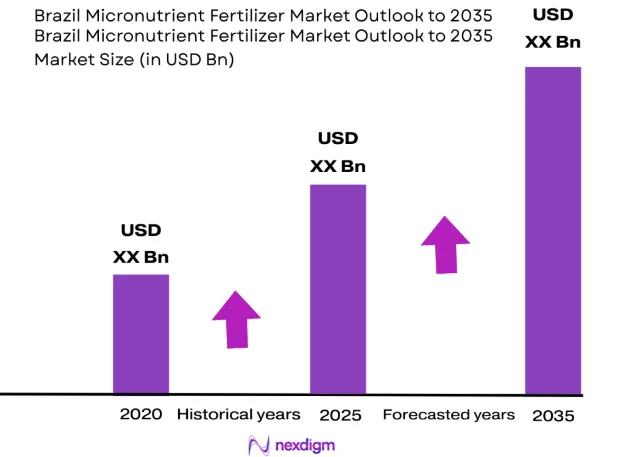
The Brazil micronutrient fertilizer market was valued at approximately USD ~ billion in 2024, compared to nearly USD ~ billion in 2023, based on industry assessments from fertilizer associations, trade statistics, and leading agricultural input databases. Growth is primarily supported by Brazil’s position as the world’s largest soybean exporter, producing over 147 million metric tons of soybeans and more than 120 million metric tons of corn across extensive cultivated acreage. Continuous nutrient depletion in tropical soils, particularly deficiencies of zinc, boron, manganese, and copper, has increased demand for micronutrient fertilizers. Rising adoption of precision agriculture, higher crop productivity targets, and expansion of export-oriented farming continue to strengthen market demand across major agricultural regions.
Market Segmentation
By Nutrient Type
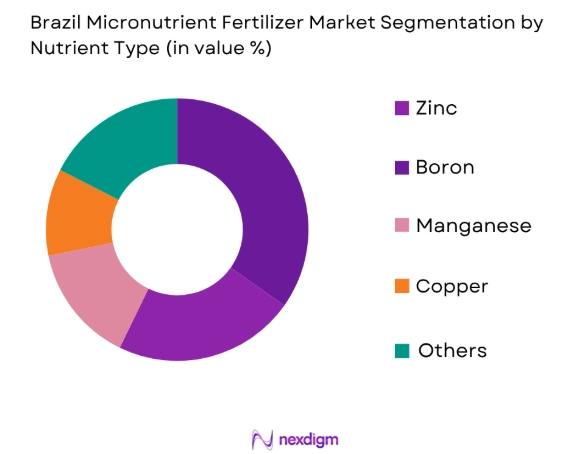
Brazil micronutrient fertilizer market is segmented into zinc fertilizers, boron fertilizers, manganese fertilizers, copper fertilizers, iron fertilizers, molybdenum fertilizers, and others. Recently, zinc fertilizers have held the dominant market share due to widespread zinc deficiencies in Brazil’s highly weathered tropical soils, particularly across soybean, corn, and cotton-growing regions. Zinc plays a crucial role in enzyme activation, plant metabolism, and yield enhancement, making it one of the most frequently applied micronutrients. Major fertilizer companies continue to integrate zinc into granular blends, liquid formulations, and seed treatment products. The expansion of high-yield soybean cultivation in Mato Grosso and Paraná has further strengthened demand. Additionally, precision agriculture programs increasingly recommend zinc supplementation based on soil testing, reinforcing its dominance across commercial farming operations.
By Crop Type
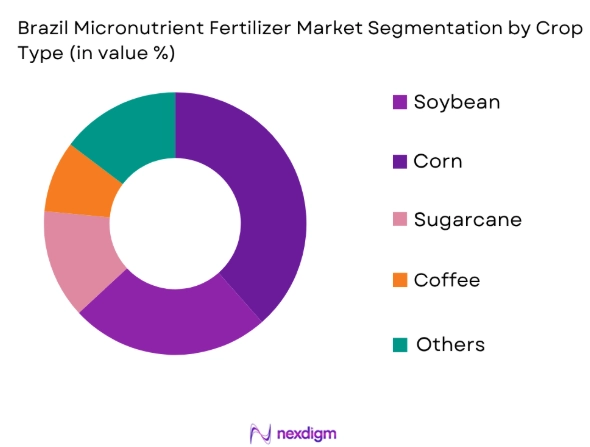
Brazil micronutrient fertilizer market is segmented into soybean, corn, sugarcane, coffee, cotton, fruits & vegetables, and others. Recently, soybean cultivation has accounted for the largest market share due to Brazil’s position as the world’s largest soybean producer and exporter. Soybean production occupies a substantial proportion of Brazil’s cultivated land and requires balanced micronutrient management, particularly zinc, manganese, molybdenum, and boron, to maximize yields. Commercial soybean producers increasingly use precision nutrient management systems and crop-specific fertilizer programs to optimize productivity. The expansion of double-cropping systems, particularly soybean-corn rotations, has intensified nutrient extraction from soils, further increasing micronutrient requirements. Continuous growth in export demand and the importance of soybeans within Brazil’s agricultural economy ensure that this segment remains the primary driver of micronutrient fertilizer consumption.
Competitive Landscape
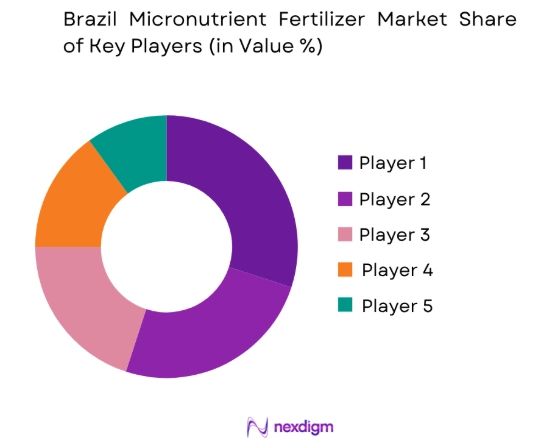
The Brazil micronutrient fertilizer market is moderately consolidated and led by multinational nutrient companies alongside regional specialty fertilizer manufacturers. Companies compete through advanced nutrient technologies, crop-specific solutions, precision agriculture integration, extensive dealer networks, and localized manufacturing capabilities. The market is characterized by strong investment in chelated micronutrients, liquid formulations, and customized nutrient blends designed for Brazil’s unique tropical soil conditions.
| Company | Establishment Year | Headquarters | Micronutrient Portfolio | Local Manufacturing | Distribution Reach | Precision Agriculture Integration | Key Group Focus | Product Form Strength |
| The Mosaic Company | 2004 | ~ | ~ | ~ | ~ | ~ | ~ | ~ |
| Nutrien Ltd. | 2018 | ~ | ~ | ~ | ~ | ~ | ~ | ~ |
| Yara International | 1905 | ~ | ~ | ~ | ~ | ~ | ~ | ~ |
| ICL Group | 1968 | ~ | ~ | ~ | ~ | ~ | ~ | ~ |
| Compass Minerals Plant Nutrition | 2014 | ~ | ~ | ~ | ~ | ~ | ~ | ~ |
 Brazil Micronutrient Fertilizer Market Analysis
Growth Drivers
Rising Micronutrient Deficiencies Across Major Crop-Producing Regions
The increasing prevalence of micronutrient deficiencies in U.S. agricultural soils is a major driver for the micronutrient fertilizer market. According to the USDA, the United States planted 91.5 million acres of corn and 86.1 million acres of soybeans during the latest crop cycle, creating substantial nutrient demand across large farming areas. Zinc, boron, iron, and manganese deficiencies are increasingly reported in intensive row-crop systems where continuous cultivation accelerates nutrient depletion. The USDA Economic Research Service also notes that fertilizer remains one of the most important crop production inputs, accounting for 33 to 44 units of every 100 units of corn operating costs and 34 to 45 units of every 100 units of wheat operating costs, highlighting the importance of nutrient management in maintaining productivity. Furthermore, USDA fertilizer datasets continue to track micronutrient consumption alongside primary nutrients due to growing agronomic relevance. Large-scale cultivation of corn, soybean, cotton, wheat, fruits, vegetables, and nuts requires balanced nutrient programs to sustain yields and crop quality. As nutrient removal from harvested crops continues to increase across millions of acres, growers are increasingly adopting zinc sulfate, boron formulations, chelated iron, and manganese products, creating strong demand for micronutrient fertilizers across U.S. agriculture.
Expansion of Precision Agriculture and High-Value Crop Production
The rapid adoption of precision agriculture technologies across the United States is significantly supporting micronutrient fertilizer usage. The United States remains one of the largest commercial farming economies globally, with agricultural production spread across more than 900 million acres of farmland. Precision agriculture tools including soil mapping, GPS-guided nutrient application, drone-based monitoring, and variable-rate technologies are enabling farmers to identify field-specific micronutrient deficiencies and optimize fertilizer use. According to USDA crop reports, U.S. corn production exceeded 15 billion bushels, while soybean production surpassed 4.4 billion bushels, demonstrating the scale of nutrient demand within the agricultural sector. High-value specialty crops including almonds, citrus, grapes, berries, vegetables, and tree nuts require consistent micronutrient supplementation to maintain quality standards and export competitiveness. Furthermore, the IMF estimates U.S. GDP above USD 29 trillion, supporting continued investment in advanced agricultural technologies and input optimization. The combination of precision nutrient management, increasing productivity requirements, and strong commercial farming infrastructure continues to accelerate micronutrient fertilizer adoption across major agricultural regions.
Market Challenges
Volatility in Agricultural Input Costs and Farmer Profitability
One of the primary challenges affecting the U.S. micronutrient fertilizer market is volatility in overall agricultural input costs. USDA data indicates fertilizer remains among the largest operating expenses for crop producers. Recent USDA and Reuters reports highlight that farmers continue facing rising costs for fertilizers, seeds, fuel, and crop protection products while managing fluctuating commodity prices. U.S. farmers planned approximately 95.3 million acres of corn and 84.7 million acres of soybeans in the latest planting intentions report, with planting decisions increasingly influenced by input economics. When commodity margins tighten, growers often prioritize macronutrient applications and may delay adoption of specialty micronutrient products. In addition, large grain supplies and lower crop prices have reduced profitability across several farming regions. The challenge becomes particularly evident for smaller farming operations that must balance nutrient requirements against operating budgets. Although micronutrients improve nutrient-use efficiency and crop performance, economic uncertainty can slow purchasing decisions and limit penetration into price-sensitive segments of the market.
Complex Soil Variability and Micronutrient Management Requirements
The United States possesses highly diverse soil conditions spanning the Corn Belt, Great Plains, Southeast, Pacific Coast, and specialty crop regions. This variability creates challenges in accurately identifying and correcting micronutrient deficiencies. Different soil pH levels, organic matter content, moisture conditions, and crop rotations influence micronutrient availability. For example, zinc deficiencies are commonly observed in high-pH soils, while boron deficiencies frequently occur in sandy soils with lower organic matter. USDA datasets covering national fertilizer consumption and nutrient applications indicate increasing complexity in nutrient management practices. Farmers must rely on soil testing, tissue analysis, and precision agriculture technologies to determine proper micronutrient application rates. Misapplication can reduce nutrient efficiency or fail to correct deficiencies adequately. Furthermore, the increasing adoption of high-yield crop genetics places greater demand on soil nutrient reserves. The technical expertise required to implement crop-specific micronutrient programs remains a challenge, particularly among growers transitioning from conventional fertilizer programs toward advanced nutrient management systems.
Market Opportunities
Expansion of Biological and Chelated Micronutrient Solutions
A significant opportunity exists in the increasing adoption of biological and advanced chelated micronutrient products. U.S. agriculture continues to move toward sustainable nutrient management and improved nutrient-use efficiency. The United States maintains one of the world’s most technologically advanced agricultural systems, producing more than 15 billion bushels of corn and over 4 billion bushels of soybeans, requiring efficient nutrient delivery mechanisms. Chelated micronutrients offer enhanced availability under varying soil conditions, while biological nutrient solutions improve nutrient uptake and root development. Additionally, USDA conservation initiatives and regenerative agriculture programs are encouraging practices that improve soil health and nutrient efficiency. High-value specialty crop sectors including fruits, vegetables, nuts, and horticultural crops increasingly demand premium nutrient formulations that minimize environmental losses while maximizing productivity. As growers seek greater return from every acre, advanced micronutrient technologies represent a substantial growth opportunity for manufacturers and distributors operating within the U.S. market.
Increasing Adoption of Precision Nutrient Management Systems
Precision agriculture adoption across the United States continues to create opportunities for micronutrient fertilizer suppliers. The country remains a global leader in precision farming technologies, supported by strong digital infrastructure, large-scale commercial farms, and advanced equipment utilization. USDA acreage data indicates cultivation across tens of millions of acres for corn, soybean, wheat, cotton, and specialty crops, creating substantial demand for field-specific nutrient recommendations. Precision tools including satellite imagery, soil sensors, GPS-guided machinery, drone monitoring, and variable-rate application systems allow farmers to identify micronutrient deficiencies with greater accuracy. This supports targeted use of zinc, boron, iron, manganese, copper, and molybdenum fertilizers. Additionally, continued investment in agricultural technology is supported by the broader U.S. economy, with GDP exceeding USD 29 trillion according to IMF estimates. As growers increasingly focus on productivity optimization, sustainability, and nutrient-use efficiency, precision nutrient management will remain a major opportunity driving adoption of specialized micronutrient fertilizer products across U.S. agriculture.
Future Outlook
The Brazil micronutrient fertilizer market is expected to witness substantial expansion through the forecast period, supported by increasing agricultural intensification, rising demand for export crops, and broader adoption of precision farming technologies. Nutrient management is becoming increasingly important as growers seek higher productivity from existing farmland. Continued expansion of soybean, corn, cotton, and sugarcane cultivation will strengthen demand for zinc, boron, manganese, and copper fertilizers. The market is also expected to benefit from advancements in chelated micronutrient formulations, biological nutrient technologies, fertigation systems, and sustainability-focused agricultural practices. Growing awareness regarding soil health management and nutrient-use efficiency will further accelerate market development.
Major Players
- Yara International
- Mosaic Company
- Nutrien Ltd.
- ICL Group
- Compass Minerals Plant Nutrition
- EuroChem Group
- UPL Ltd.
- Haifa Group
- Tradecorp
- Rovensa Next
- K+S Aktiengesellschaft
- Koch Agronomic Services
- Helena Agri-Enterprises
- AgroLiquid
- Produquímica (Compass Minerals Plant Nutrition)
Key Target Audience
- Micronutrient Fertilizer Manufacturers
- Specialty Crop Nutrition Companies
- Agricultural Cooperatives
- Large Commercial Farming Enterprises
- Agrochemical and Crop Input Distributors
- Precision Agriculture Technology Providers
- Investments and Venture Capitalist Firms
- Government and Regulatory Bodies
Research Methodology
Step 1: Identification of Key Variables
The initial phase involves constructing an ecosystem map covering micronutrient fertilizer manufacturers, distributors, agricultural cooperatives, commercial farms, regulatory authorities, and nutrient technology providers. Extensive secondary research is conducted using trade databases, government publications, fertilizer consumption statistics, and industry reports. The primary objective is to identify the variables influencing demand, supply, pricing, and nutrient adoption trends.
Step 2: Market Analysis and Construction
This stage focuses on analyzing historical market performance, fertilizer consumption trends, crop acreage, nutrient deficiency incidence, and import-export dynamics. Both volume and value assessments are conducted using a bottom-up methodology. Regional demand patterns and crop-specific nutrient requirements are evaluated to construct market estimates.
Step 3: Hypothesis Validation and Expert Consultation
Market assumptions and forecasts are validated through structured interviews with fertilizer manufacturers, agronomists, distributors, cooperatives, and commercial growers. Expert consultations provide insights into product adoption, nutrient management trends, regulatory developments, and emerging market opportunities.
Step 4: Research Synthesis and Final Output
The final stage integrates primary and secondary research findings to develop a comprehensive market assessment. Data triangulation techniques are employed to verify market sizing, segmentation, competitive positioning, and future projections. This ensures a reliable and industry-validated view of the Brazil micronutrient fertilizer market.

- Executive Summary
- Research Methodology (Market Definitions and Assumptions, Abbreviations, Market Sizing Approach, Bottom-Up Market Assessment, Top-Down Validation Framework, Primary Research Interviews with Fertilizer Manufacturers and Distributors, Demand-Side Assessment, Supply-Side Analysis, Data Triangulation, Limitations and Future Conclusions)

- Definition and Scope
- Market Evolution and Industry Genesis
- Timeline of Major Industry Developments
- Business Cycle Analysis
- Supply Chain and Value Chain Analysis

- Growth Drivers (Expansion of Soybean and Corn Cultivation, Increasing Soil Micronutrient Deficiencies, Precision Agriculture Adoption, Rising Yield Optimization Focus, Growth in Export-Oriented Agriculture)
- Market Challenges (Import Dependence for Raw Materials, Volatility in Global Nutrient Supply Chains, Counterfeit Fertilizer Products, Climatic Variability, Limited Farmer Awareness in Certain Regions)
- Opportunities (Bio-Based Micronutrients, Customized Crop-Specific Formulations, Digital Agronomy Platforms, Fertigation Expansion, Sustainable Nutrient Management Programs)
- Market Trends (Chelated Micronutrient Adoption, Integration with Precision Farming Technologies, Liquid Fertilizer Penetration, Multi-Nutrient Blended Products, Carbon-Smart Agriculture Practices)
- Government Regulation (MAPA Registration Framework, Fertilizer Law Compliance, National Fertilizer Plan, Environmental Licensing Requirements, Product Quality Standards)
- SWOT Analysis
- Stakeholder Ecosystem
- Porter’s Five Forces Analysis
- Competition Ecosystem
- PESTLE Analysis

- By Market Value (2020-2025)
- By Volume Consumption (2020-2025)
- By Average Selling Price (2020-2025)

- By Nutrient Type (In Value %)
Zinc Fertilizers
Boron Fertilizers
Manganese Fertilizers
Iron Fertilizers
Copper Fertilizers
Molybdenum Fertilizers
Others (Cobalt, Nickel, Chlorine) - By Crop Type (In Value %)
Soybean
Corn
Sugarcane
Coffee
Cotton
Fruits & Vegetables
Others - By Form Type (In Value %)
Chelated Micronutrients
Sulfate-Based Micronutrients
Oxide-Based Micronutrients
EDTA-Based Micronutrients
Granular Micronutrients
Liquid Micronutrients - By Application Method (In Value %)
Soil Application
Foliar Spray Fertigation
Seed Treatment
In-Furrow Application - By Farming Practice (In Value %)
Conventional Farming
Precision Agriculture
Organic Farming
Regenerative Agriculture

- Market Share of Major Players (Market Share by Value, Volume, Nutrient Portfolio, Crop Coverage, Distribution Reach, Regional Penetration)
- Cross Comparison Parameters (Product Portfolio Strength, Micronutrient Portfolio Breadth, Chelated Product Offering, Local Manufacturing Capacity, Distribution Network Reach, Crop-Specific Solutions, Precision Agriculture Integration, Regulatory Registration Portfolio)
- SWOT Analysis of Major Players
- Pricing Analysis Basis SKUs (Zinc Sulfate, Boric Acid, Sodium Borate, Manganese Sulfate, Ferrous Sulfate, Copper Sulfate, Sodium Molybdate, Chelated Zinc EDTA, Chelated Iron EDTA, Liquid Multi-Micronutrient Blends)
- Detailed Profiles of Major Companies
Yara International
Mosaic Company
Nutrien Ltd.
ICL Group
K+S Aktiengesellschaft
Compass Minerals
Helena Agri-Enterprises
Koch Agronomic Services
AgroLiquid
Tradecorp
Haifa Group
Rovensa Next
UPL Ltd.
EuroChem Group
Produquímica (Compass Minerals Plant Nutrition)

- Crop Nutrient Demand Assessment
- Farmer Purchasing Power and Fertilizer Spending Patterns
- Micronutrient Adoption Rates by Farm Size
- Yield Improvement Expectations
- Agronomic Advisory and Decision-Making Process
- Nutrient Management Practices
- Brand Awareness and Product Preference Analysis
- Farmer Pain Points and Adoption Barriers

- By Market Value (2026-2035)
- By Volume Consumption (2026-2035)
- By Average Selling Price (2026-2035)


 Request a Sample
 Ask for Customization
 Get a Quote
 Enquire Now