

 Download PDF
 Download PDF
Market Overview
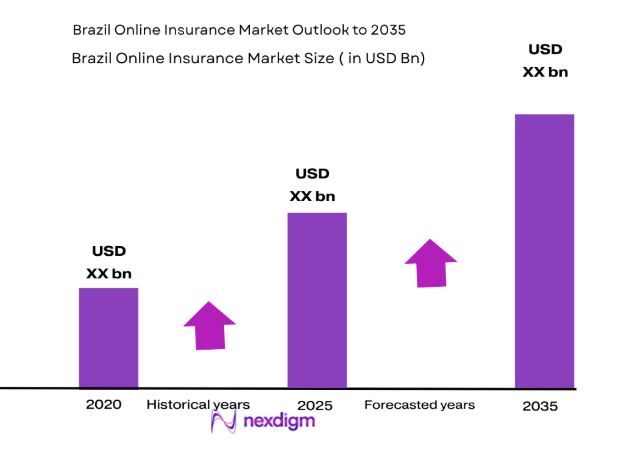
The Brazil Online Insurance market has seen substantial growth, with the market size reaching approximately USD ~ billion in gross written premiums. This growth is largely driven by the increasing adoption of digital platforms, as more consumers turn to online channels for purchasing insurance. The market is further supported by the rising demand for mobile-first solutions, advanced digital payment methods, and AI-powered underwriting processes. Regulatory advancements, such as the implementation of the Open Insurance framework, have also contributed to market expansion, ensuring better integration and transparency within the financial ecosystem.
Brazil’s major urban centers, including São Paulo, Rio de Janeiro, and Brasília, dominate the online insurance market due to their well-established digital infrastructures, high financial service penetration, and strong demand for technology-driven solutions. The market benefits from Brazil’s growing mobile internet usage, increasing digital literacy, and the widespread adoption of fintech services, further accelerating online insurance adoption across the country.
Market Segmentation
By Product Type:
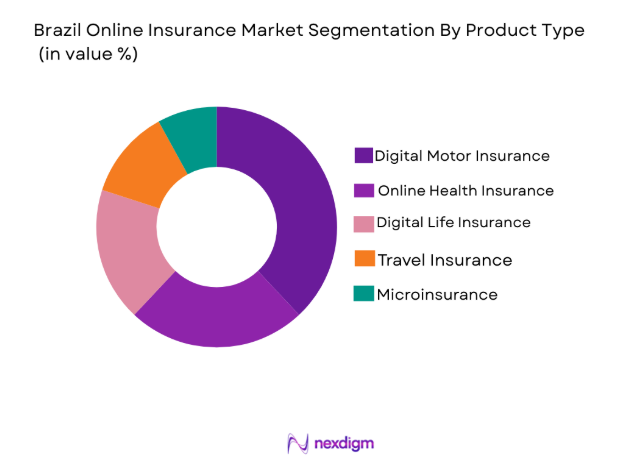
Brazil Online Insurance market is segmented by product type into Digital Motor Insurance, Online Health Insurance, Digital Life Insurance, Travel Insurance, and Microinsurance. Digital Motor Insurance dominates the market due to factors such as mandatory vehicle coverage, higher urban vehicle ownership, telematics adoption, and insurer partnerships with digital aggregators. The standardized nature of motor policies, regulatory compulsion, and frequent renewals make them easier to digitize. AI-driven underwriting and fraud analytics improve pricing accuracy and efficiency. Partnerships with ride-hailing platforms further boost digital distribution, maintaining motor insurance as the leading online product in Brazil’s urban areas.
By Platform Type:
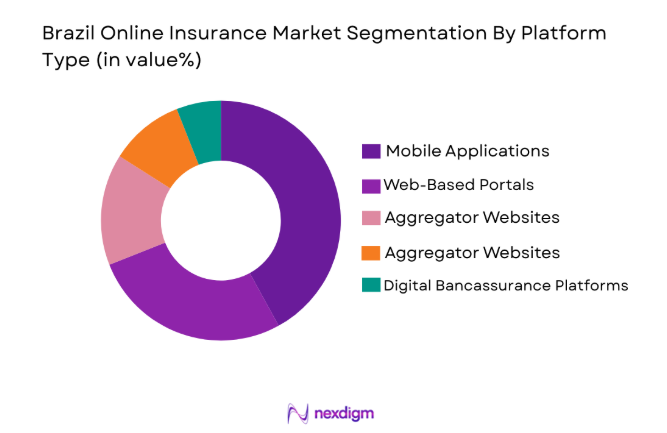
Brazil Online Insurance market is segmented by platform type into Web-Based Portals, Mobile Applications, Aggregator Websites, Embedded Insurance APIs, and Digital Bancassurance Platforms. Mobile Applications dominate due to high smartphone penetration, consumer preference for app-based services, seamless integration with digital wallets, and real-time policy management. They offer instant premium calculations, biometric authentication, and mobile claims submission. Fintech super apps embed insurance within digital ecosystems, boosting visibility. As a result, Mobile Applications lead as the primary digital distribution channel in Brazil’s online insurance market.
Competitive Landscape
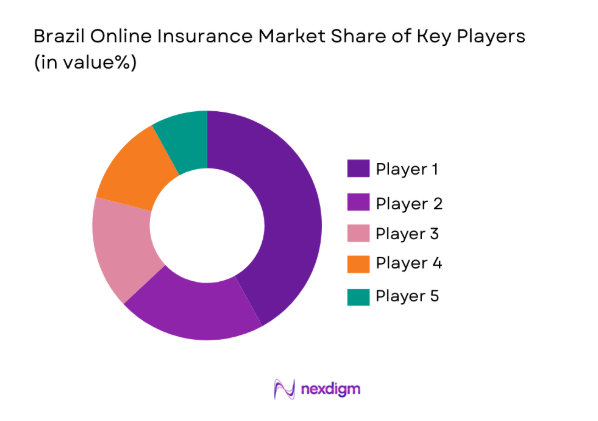
Brazil Online Insurance market exhibits moderate consolidation, with established insurers expanding digital capabilities while insurtech startups intensify competition through innovative underwriting and app-based distribution. Traditional players leverage brand trust and capital strength, whereas digital-first entrants focus on agile product design and embedded partnerships.
| Company Name | Establishment Year | Headquarters | Technology Focus | Market Reach | Key Products | Revenue | Digital Distribution Strength |
| Porto Seguro | 1945 | São Paulo | ~ | ~ | ~ | ~ | ~ |
| Bradesco Seguros | 1935 | São Paulo | ~ | ~ | ~ | ~ | ~ |
| SulAmérica | 1895 | Rio de Janeiro | ~ | ~ | ~ | ~ | ~ |
| Allianz Seguros Brasil | 1890 | São Paulo | ~ | ~ | ~ | ~ | ~ |
| Mapfre Seguros | 1933 | São Paulo | ~ | ~ | ~ | ~ | ~ |
Brazil Online Insurance Market Analysis
Growth Drivers
Regulatory Implementation of Open Insurance Framework:
The structured rollout of Brazil’s Open Insurance framework has significantly enhanced interoperability between insurers, fintech firms, and digital platforms, enabling secure data sharing and standardized APIs across the financial ecosystem. This regulatory modernization fosters competition by allowing consumers to port insurance data seamlessly between providers, increasing transparency and encouraging price comparison through online channels. Digital onboarding processes have become faster due to regulatory clarity around electronic signatures and digital identity verification, reducing friction in policy issuance. Insurers are investing heavily in API-based infrastructure to comply with regulatory mandates, accelerating digital transformation initiatives across legacy systems. The framework supports embedded insurance models within ecommerce and banking applications, expanding distribution reach beyond traditional brokers. Consumer confidence has strengthened due to standardized disclosure norms and enhanced data protection enforcement under Brazil’s data privacy legislation. As insurers integrate real-time underwriting and automated claims systems within compliant digital ecosystems, operational efficiency improves significantly. This regulatory catalyst not only stimulates innovation but also establishes a structured digital marketplace, positioning online insurance as a central growth engine within Brazil’s broader financial services transformation.
Expansion of Fintech and Digital Banking Ecosystems:
The rapid expansion of Brazil’s fintech landscape, supported by widespread digital banking adoption, has fundamentally reshaped the distribution architecture of online insurance products. Digital banks and payment platforms increasingly integrate insurance offerings directly into their mobile interfaces, creating embedded purchasing pathways that reduce customer acquisition costs and enhance conversion rates. Consumers accustomed to managing investments, credit, and payments digitally demonstrate greater openness to purchasing insurance online, reinforcing behavioral shifts toward app-based financial management. Fintech partnerships allow insurers to leverage advanced analytics for risk profiling, personalized pricing, and targeted cross-selling strategies. The interoperability between instant payment systems and insurance platforms facilitates automated premium collection and renewal management, improving retention metrics. Data-driven personalization enhances user engagement through customized dashboards and predictive coverage recommendations. Younger demographics entering the workforce show strong preference for digital-first financial services, further amplifying demand for online insurance. As fintech ecosystems expand across urban and semi-urban Brazil, online insurance benefits from increased digital trust, scalable distribution networks, and continuous innovation in user experience design.
Market Challenges
Data Privacy Compliance and Cybersecurity Vulnerabilities:
The enforcement of Brazil’s data protection legislation imposes stringent compliance requirements on online insurance providers, requiring substantial investment in encryption, secure data storage, and governance frameworks. Insurers must maintain transparent consent mechanisms and audit trails for customer data usage, increasing operational complexity and administrative overhead. Cybersecurity threats, including phishing attacks and data breaches, pose reputational risks that can erode consumer trust in digital-only insurance platforms. The interconnected nature of Open Insurance APIs increases exposure points, demanding continuous monitoring and advanced threat detection systems. Smaller insurtech startups may struggle with the financial burden of implementing enterprise-grade cybersecurity infrastructure. Regulatory penalties for non-compliance can be significant, intensifying risk management requirements across digital ecosystems. Consumer concerns regarding misuse of personal and financial data can slow adoption of fully automated underwriting models. Consequently, balancing innovation with rigorous data protection remains a structural challenge shaping the pace of online insurance expansion in Brazil.
Low Insurance Penetration in Informal and Rural Economies:
Despite rapid digital growth in urban centers, significant portions of Brazil’s population remain underinsured due to income volatility and limited financial literacy. Informal workers often lack stable documentation required for traditional underwriting processes, complicating digital onboarding procedures. Rural regions may experience inconsistent broadband connectivity, restricting access to app-based insurance services. Cultural reliance on cash transactions and limited familiarity with digital financial products further constrain market expansion beyond metropolitan hubs. Insurers face difficulties designing affordable microinsurance products that maintain sustainable underwriting margins. Distribution partnerships in remote areas require collaboration with telecom operators and local fintech agents, increasing logistical complexity. Trust barriers toward online-only insurers may persist among older demographics in non-urban regions. These structural constraints moderate overall market penetration and require targeted product innovation to achieve inclusive digital insurance growth.
Opportunities
Embedded Insurance within Ecommerce and Mobility Platforms:
The rapid expansion of ecommerce, ride-hailing, and delivery platforms across Brazil creates significant opportunities for embedded insurance models integrated directly at the point of transaction. Consumers purchasing electronics, booking travel, or arranging mobility services can be offered contextual insurance products within the same digital interface, reducing friction and increasing policy attachment rates. API-driven integrations allow insurers to automate underwriting based on transaction data, enabling dynamic pricing and real-time coverage activation. Ecommerce marketplaces benefit from ancillary revenue streams while enhancing customer trust through protection offerings. Mobility platforms can bundle accident and liability coverage for drivers and passengers, expanding reach among gig economy participants. The scalability of digital ecosystems allows insurers to access millions of users without traditional distribution costs. Behavioral analytics derived from transaction histories enable tailored coverage suggestions, improving conversion efficiency. As digital commerce penetration deepens nationwide, embedded insurance represents a structurally scalable growth channel for Brazil Online Insurance providers.
AI-Driven Personalized Underwriting and Claims Automation:
Advances in artificial intelligence and machine learning present transformative opportunities for Brazil Online Insurance by enhancing risk assessment accuracy and operational efficiency. AI-driven underwriting engines can analyze behavioral, transactional, and telematics data to produce highly personalized premium calculations in real time. Automated claims processing using image recognition and natural language processing reduces turnaround time and administrative costs. Fraud detection algorithms identify anomalous patterns, mitigating loss ratios and improving insurer profitability. Personalized dashboards powered by predictive analytics enable proactive coverage recommendations and policy adjustments. Customer engagement improves through chatbot-based support and automated renewal reminders integrated within mobile applications. Continuous learning systems refine pricing models based on aggregated claims experience, strengthening competitiveness. By leveraging AI infrastructure within compliant regulatory frameworks, insurers can differentiate through speed, transparency, and customization, positioning technology as a central pillar of long-term market expansion.
Future Outlook
Brazil Online Insurance market is expected to witness sustained digital acceleration over the next five years, driven by continued Open Insurance integration, fintech expansion, and consumer migration toward mobile-first financial services. Technological advancements in AI underwriting and embedded APIs will deepen platform interoperability. Regulatory supervision is likely to reinforce transparency and cybersecurity resilience. Demand-side growth will be supported by urbanization, digital literacy improvements, and rising acceptance of app-based insurance management.
Major Players
- Porto Seguro
- Bradesco Seguros
- SulAmérica
- Tokio Marine Seguradora
- Allianz Seguros Brasil
- Mapfre Seguros
- Zurich Seguros Brasil
- Liberty Seguros Brasil
- HDI Seguros
- AXA Seguros Brasil
- Sompo Seguros
- Youse Seguros
- Pier Seguradora
- Neon Seguros
- Nubank Vida
Key Target Audience
- Insurance companies
- Digital banks
- Ecommerce platforms
- Fintech startups
- Investments and venture capitalist firms
- Government and regulatory bodies
- Telecom operators
- Mobility platform operators
Research Methodology
Step 1: Identification of Key Variables
Key performance indicators including gross written premiums, digital penetration rates, platform adoption metrics, regulatory frameworks, and consumer behavior variables were identified. Both demand-side and supply-side determinants were mapped. Secondary databases and regulatory filings were examined to establish baseline parameters.
Step 2: Market Analysis and Construction
Market size was constructed using top-down premium aggregation and bottom-up digital channel analysis. Segmentation estimates were derived from insurer disclosures and platform usage data. Cross-validation ensured consistency across product and platform categories.
Step 3: Hypothesis Validation and Expert Consultation
Industry experts including underwriting professionals, fintech executives, and regulatory specialists were consulted. Assumptions were stress-tested against operational realities and compliance frameworks. Divergent viewpoints were reconciled through iterative validation.
Step 4: Research Synthesis and Final Output
Quantitative findings were integrated with qualitative insights to produce structured forecasts and competitive benchmarking. Data triangulation ensured reliability. Final outputs were compiled with analytical rigor and consistency checks.

- Executive Summary
- Research Methodology (Definitions, Scope, Industry Assumptions, Market Sizing Approach, Primary & Secondary Research Framework, Data Collection & Verification Protocol, Analytic Models & Forecast Methodology, Limitations & Research Validity Checks)

- Market Definition and Scope
- Value Chain & Stakeholder Ecosystem
- Regulatory / Certification Landscape
- Sector Dynamics Affecting Demand
- Strategic Initiatives & Infrastructure Growth

- Growth Drivers
Rapid smartphone penetration and mobile internet usage expansion
Increasing adoption of digital payments and fintech ecosystems
Regulatory push toward open insurance frameworks in Brazil
Rising consumer preference for contactless financial services
Expansion of ecommerce and embedded insurance models - Market Challenges
Data privacy and cybersecurity risks in digital policy issuance
Low insurance penetration in rural and informal sectors
Complex regulatory compliance and licensing requirements
Consumer distrust toward fully digital claims settlement
Legacy system integration constraints for traditional insurers - Market Opportunities
Expansion of microinsurance through mobile platforms
Growth of embedded insurance within ecommerce and ride-hailing platforms
Partnerships between insurers and fintech ecosystems - Trends
Usage-based motor insurance through telematics
AI-driven claims automation and fraud analytics
Rise of digital-only insurance startups
Expansion of API-based open insurance ecosystems
Personalized policy pricing through advanced analytics - Government Regulations & Defense Policy
Implementation of Open Insurance regulations by SUSEP
Data protection compliance under Brazil’s LGPD framework
Digital transformation initiatives in financial services regulation
SWOT Analysis
Stakeholder and Ecosystem Analysis
Porter’s Five Forces Analysis
Competition Intensity and Ecosystem Mapping

- By Market Value, 2020-2025
- By Installed Units, 2020-2025
- By Average System Price, 2020-2025
- By System Complexity Tier, 2020-2025

- By System Type (In Value%)
Motor Insurance Platforms
Online Health Insurance Portals
Travel Insurance Aggregator Platforms
Life Insurance Direct-to-Consumer Platforms
Microinsurance Mobile Platforms - By Platform Type (In Value%)
Web-Based Insurance Portals
Mobile Application-Based Platforms
API-Integrated Embedded Insurance Platforms
Aggregator and Comparison Websites
Digital Broker Platforms - By Fitment Type (In Value%)
Standalone Online Policy Issuance
Embedded Insurance within Ecommerce
Bank-Integrated Digital Insurance
Super App Integrated Insurance Modules
Telecom Bundled Digital Insurance - By EndUser Segment (In Value%)
|Individual Retail Customers
Small and Medium Enterprises
Gig Economy Workers
Corporate Clients
Rural and Low-Income Consumers - By Procurement Channel (In Value%)
Direct Insurer Websites
Online Aggregator Portals
Digital Bancassurance Channels
Mobile Wallet and Fintech Apps
Third-Party Digital Brokers - By Material / Technology (in Value %)
Based Underwriting Engines
Cloud-Based Policy Administration Systems
Blockchain-Based Smart Contracts
API-Driven Open Insurance Frameworks
Telematics and IoT Integration

- Market structure and competitive positioning
Market share snapshot of major players
(Product Portfolio Diversity, Digital Platform Capability, Underwriting Automation Level, Claims Processing Efficiency, Embedded Insurance Partnerships, Regulatory Compliance Strength, Distribution Network Reach, Customer Acquisition Cost, Technology Infrastructure Scalability)
SWOT Analysis of Key Competitors
Pricing & Procurement Analysis - Key Players
Porto Seguro
Bradesco Seguros
SulAmérica
Tokio Marine Seguradora
Allianz Seguros Brasil
Mapfre Seguros
Zurich Seguros Brasil
Liberty Seguros Brasil
HDI Seguros
AXA Seguros Brasil
Sompo Seguros
Youse Seguros
Pier Seguradora
Neon Seguros
Nubank Vida

- Urban millennials driving demand for mobile-first insurance platforms
- SMEs adopting digital insurance for cost efficiency and faster onboarding
- Gig workers seeking flexible, on-demand coverage models
- Corporates integrating embedded insurance within digital commerce channels

- Forecast Market Value, 2026-2035
- Forecast Installed Units, 2026-2035
- Price Forecast by System Tier, 2026-2035
- Future Demand by Platform, 2026-2035


 Request a Sample
 Ask for Customization
 Get a Quote
 Enquire Now