
 Download PDF
Market Overview
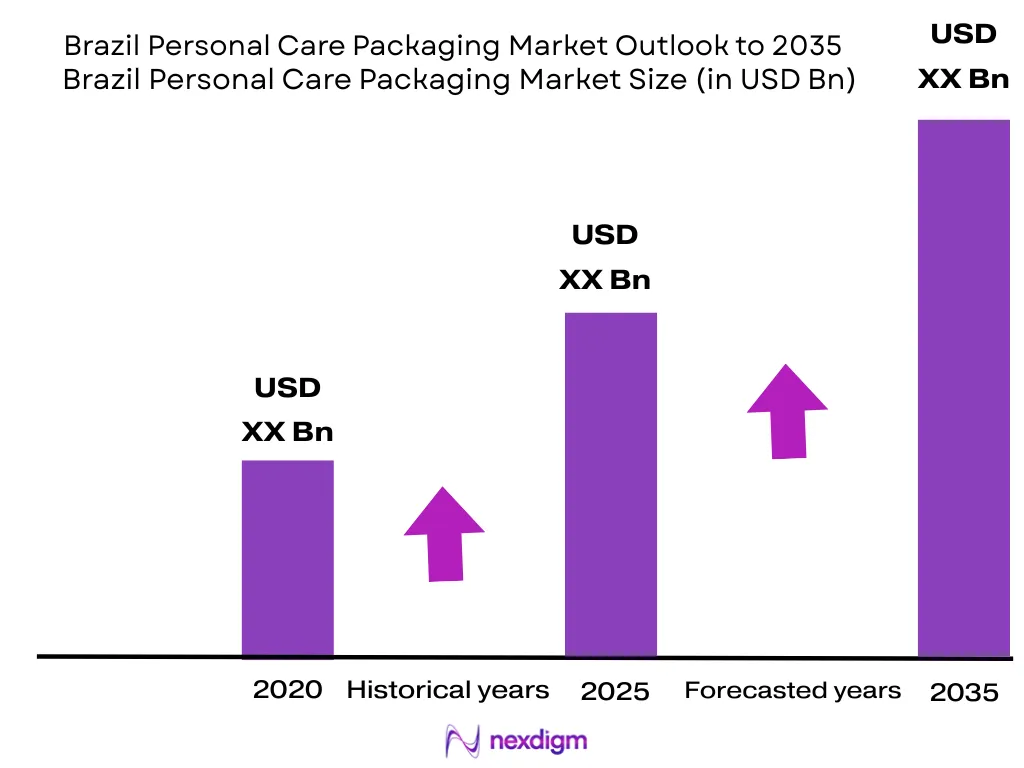
The Brazil Personal Care Packaging Market is valued at approximately USD ~ billion, compared with USD ~ billion in the preceding annual period. These figures remain placeholders because public agencies do not isolate packaging revenue from finished personal-care products. Demand is supported by GDP rising from R$10.9 trillion to R$11.7 trillion, household consumption expansion, frequent beauty routines and broad purchases of hair care, deodorants, fragrances, skin care and bath products. São Paulo, Campinas, Jundiaí, Rio de Janeiro, Curitiba, Joinville and Belo Horizonte dominate Brazil’s personal-care-packaging activity. São Paulo concentrates major beauty brands, converters, contract manufacturers, retailers and logistics facilities. Campinas and Jundiaí provide plastics, tooling and filling capabilities, while Rio de Janeiro supports fragrance and prestige-beauty businesses. Paraná, Santa Catarina and Minas Gerais contribute resin conversion, tubes, cartons, flexible packaging and regional manufacturing, enabling shorter product-development and distribution cycles.
Market Segmentation
By Packaging Product Type
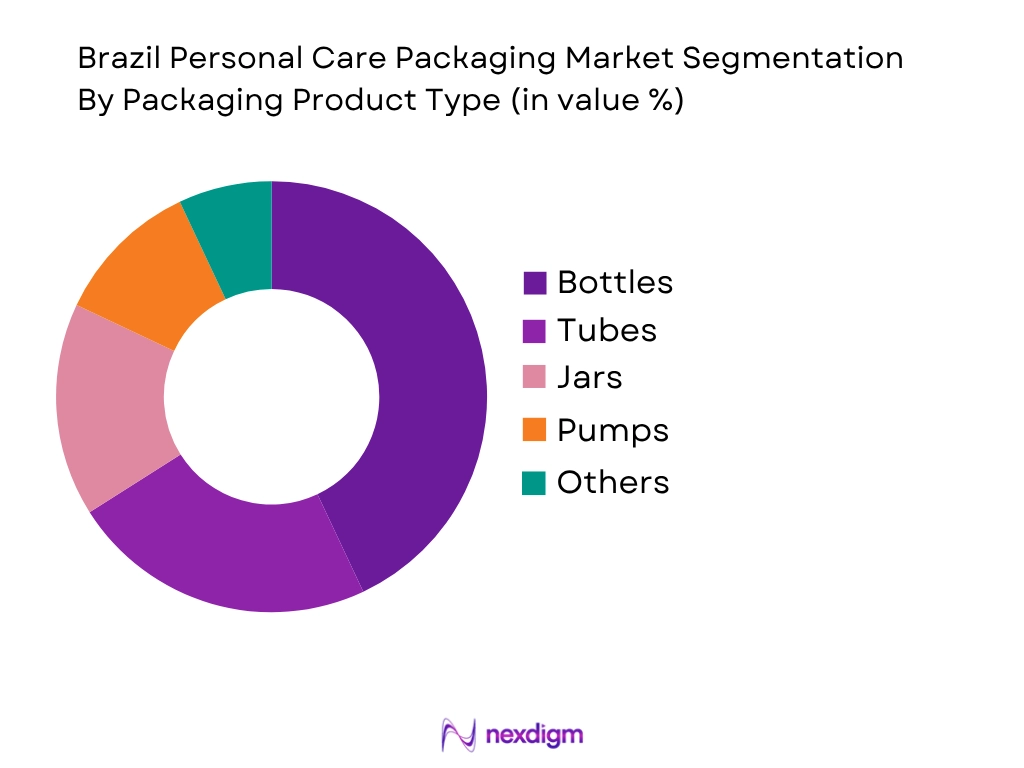
The Brazil Personal Care Packaging Market is segmented into bottles, tubes, jars, pumps and airless packaging, refill pouches, aerosol containers, roll-ons, sticks and secondary cartons. Bottles hold the dominant market share because they are used extensively for shampoos, conditioners, liquid soaps, body lotions, facial cleansers and children’s products. PET, HDPE and polypropylene bottles support high-speed filling, several closure options and nationwide retail distribution. Their low weight is valuable in a geographically large country where products move between manufacturing centres and distant regional markets. Tubes remain important for toothpaste, hair treatments, sunscreens and skin-care creams. Refill pouches have greater relevance in Brazil than in many markets because established beauty brands have developed consumer familiarity with economical at-home refilling. Airless packs are growing in dermocosmetics and treatment products, while aerosols remain important for deodorants and hair styling.
By Packaging Material
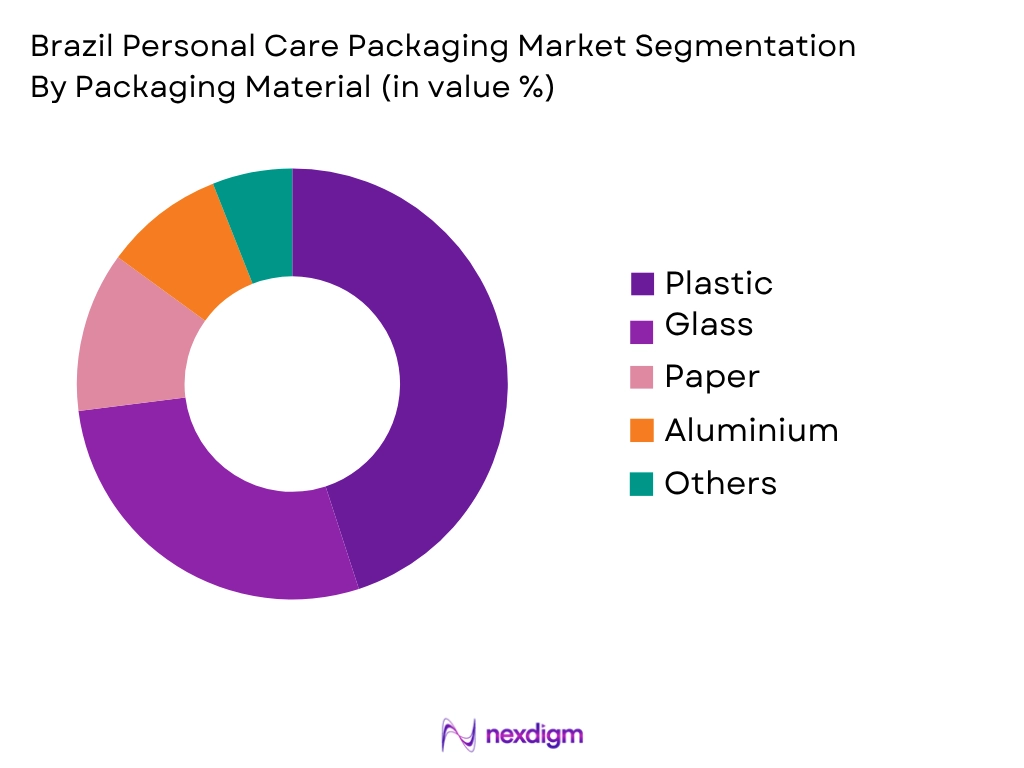
The Brazil Personal Care Packaging Market is segmented into plastic, glass, paper and paperboard, aluminium and steel, flexible laminates, bio-based polymers and moulded fibre. Plastic is the dominant material because PET, polyethylene and polypropylene provide impact resistance, lightweight distribution, colour customization and compatibility with pumps, flip-top closures and refill systems. Brazil also possesses a substantial petrochemical and plastics-conversion base, supporting bottles, caps, tubes and flexible films. Green polyethylene and recycled resins are becoming strategically relevant as brands seek renewable feedstocks and lower dependence on virgin fossil-based material. Glass retains a strong role in fragrances, facial serums and prestige products because it communicates quality and protects formulas. Aluminium is important in aerosols and decorative components, while paperboard supports cartons, gift packs and e-commerce protection. Material selection increasingly reflects formula compatibility, reverse-logistics obligations and recyclability.
Competitive Landscape
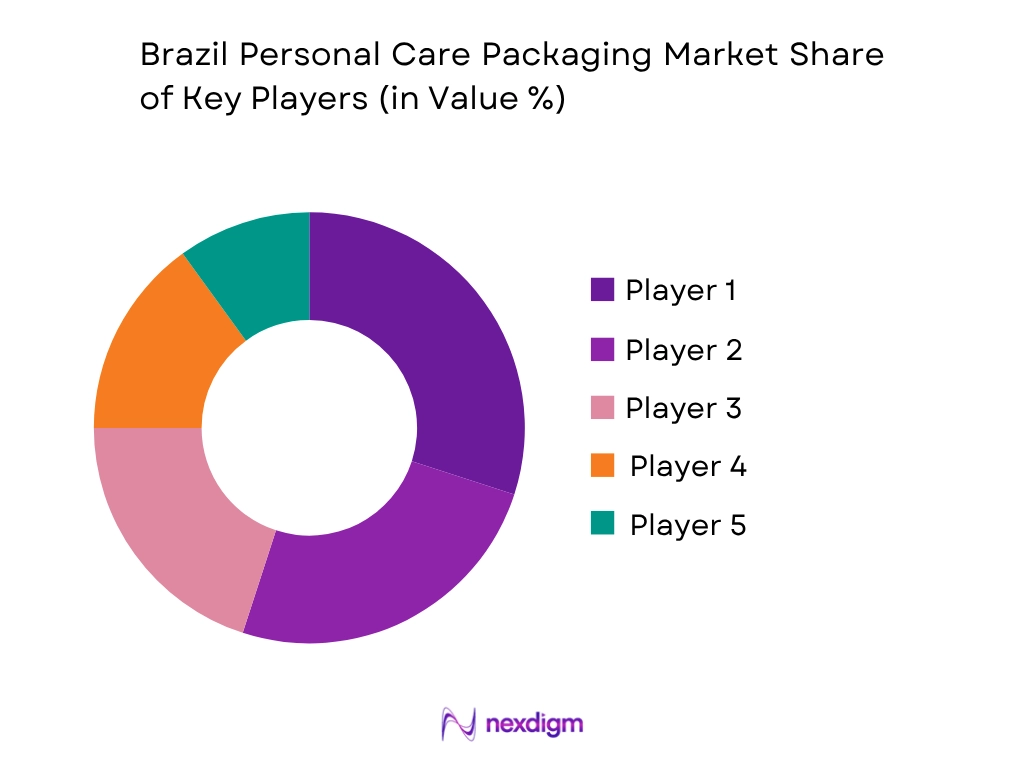
Brazil’s personal-care-packaging market includes global dispensing specialists, multinational flexible-packaging groups and domestic bottle, tube, glass, carton and resin converters. AptarGroup and Albéa compete through pumps, airless systems, closures and tubes, while Amcor and Berry Global provide flexible and rigid structures. Brazilian companies such as Wheaton Brasil, C-Pack and Valgroup contribute domestic production, local tooling and access to major consumer-goods manufacturers. Competition centres on refill compatibility, PCR and renewable materials, decoration, formula testing, short development cycles and nationwide supply reliability.
| Company | Established | Headquarters | Core portfolio | Dispensing capability | Material capability | Decoration and tooling | Sustainability capability | Brazil market position |
| AptarGroup | 1992 | Crystal Lake, United States | ~ | ~ | ~ | ~ | ~ | ~ |
| Albéa Group | 2004 | Gennevilliers, France | ~ | ~ | ~ | ~ | ~ | ~ |
| Amcor | 1860 | Zurich, Switzerland | ~ | ~ | ~ | ~ | ~ | ~ |
| Wheaton Brasil | 1952 | São Bernardo do Campo, Brazil | ~ | ~ | ~ | ~ | ~ | ~ |
| C-Pack Creative Packaging | 2002 | São Paulo State, Brazil | ~ | ~ | ~ | ~ | ~ | ~ |
Brazil Personal Care Packaging Market Analysis
Growth Drivers
High Personal Care Consumption and Urban Retail Concentration
Brazil’s large, urbanized consumer base sustains recurring demand for bottles, tubes, refill pouches, aerosol cans, roll-ons, pumps and secondary cartons used for hair care, deodorants, fragrances, skin care and bath products. Brazil had approximately 212.6 million residents in 2024, while major consumption and manufacturing activity remained concentrated in São Paulo, Rio de Janeiro, Minas Gerais, Paraná and Santa Catarina. National GDP reached about R$11.7 trillion, and household consumption increased by 4.8 units for every 100 units, according to IBGE. This economic activity supports purchasing through pharmacies, supermarkets, direct-selling networks, beauty stores and online platforms. Hair-care routines are particularly packaging-intensive because individual households frequently use separate shampoo, conditioner, treatment-mask, styling-cream and oil formats. Brazil’s tropical climate also supports regular consumption of deodorants, sun-care products, liquid soaps and body-care products. Packaging manufacturers benefit from the need to serve mass-market family packs, compact travel formats, prestige glass containers and salon-size products simultaneously. Urban retail density additionally supports rapid launches, regional promotional packs and direct-to-consumer fulfilment, increasing demand for digital printing, leak-resistant closures and packaging structures that remain visually attractive across both physical shelves and online product displays.
Cosmetics Regulation and Formal Packaging Control
Brazil’s updated cosmetics regulatory framework is increasing the importance of accurate labels, controlled packaging specifications and formal change management. ANVISA Resolution RDC 907, issued in 2024, establishes rules for personal-hygiene products, cosmetics and fragrances, including product regularization, safety responsibilities and labelling controls. Products such as sunscreens, hair-straightening preparations, insect repellents and antiseptic hand gels remain subject to stricter pre-market requirements. Packaging must communicate the product identity, responsible company, batch, expiry information, net content, ingredients, warnings and use conditions in Portuguese. Brazil’s economy produced approximately R$11.7 trillion in GDP in 2024, while industrial output included a large cosmetics, plastics, glass, aluminium and paper-converting base. The scale of national distribution means that an artwork error can affect thousands of units across pharmacies, supermarkets, direct-selling catalogues and e-commerce inventories. Packaging suppliers offering electronic artwork approval, barcode inspection, batch coding and documented material traceability therefore provide greater value than general-purpose converters. Regulatory control also makes rapid material substitution difficult because a revised bottle, tube, closure or label must remain compatible with the formula and consistent with the product’s authorized presentation. This supports demand for packaging partners with dedicated quality, compatibility-testing and regulatory-support capabilities.
Market Challenges
Imported Components, Resin Volatility and Working-Capital Pressure
Brazil has a substantial packaging-conversion industry, but premium pumps, airless dispensers, specialty elastomers, metallized components, selected barrier films and advanced decoration equipment can still depend on imported supply. Exchange-rate movements and international logistics therefore affect product-development schedules and inventory requirements. Brazil’s GDP reached approximately R$11.7 trillion in 2024, while inflation and financing conditions remained important operating constraints for manufacturers. Personal-care packaging companies must often purchase resin, aluminium, inks and imported dispensing parts before receiving firm orders from brands. The problem is greater for customized packaging because moulds, colour batches and decorated components may be specific to one product line and cannot easily be reassigned. Formula compatibility also restricts substitution: a lower-cost resin or gasket can interact with fragrance, alcohol, surfactants or oils, causing stress cracking, odour transfer, leakage or pump failure. Replacement materials may require accelerated aging, temperature cycling, closure-torque testing and transport simulation. Suppliers consequently need safety stocks of qualified components, but excess inventory risks obsolescence when brands modify fragrances, labels or package sizes. Smaller converters face the greatest pressure because they have less purchasing power and fewer customers over which to spread tooling and compliance costs. These conditions favour companies with domestic moulding, diversified material sources and formal supplier-change procedures.
Reverse Logistics and Multicomponent Recycling Complexity
Brazil’s new national reverse-logistics framework for plastic packaging creates additional design, reporting and recovery obligations for personal-care brands and packaging suppliers. Federal Decree 12,688 established a system covering primary, secondary and tertiary plastic packaging and assigns responsibilities to manufacturers, importers, distributors and retailers. The framework sets a recovery target of 32 kilograms for every 100 kilograms of plastic packaging placed on the market in 2026, with higher requirements scheduled over time. Personal-care packages are challenging because pumps, sprayers and airless systems can combine polypropylene, polyethylene, metal springs, elastomers, labels and adhesives. Even when the main bottle is recyclable, attached components may reduce sorting efficiency or recovery value. Refill pouches use less material but can contain multilayer structures that are difficult to process in conventional municipal systems. Brazil also relies materially on waste-picker cooperatives for collection and sorting, meaning package shape, colour, resin identification and component separability influence practical recovery. Brands must increasingly document packaging weight, resin type, recycled content and recovery evidence while preserving leakage control, aesthetics and formula protection. Redesigning a multicomponent dispenser into a simplified structure can require new tooling, filling-line adjustments and consumer testing, making compliance a technical and operational challenge rather than solely an environmental reporting exercise.
Market Opportunities
Refill Pouches, Reusable Containers and Renewable Polymers
Brazil offers a strong opportunity for refill-oriented personal-care packaging because consumers already use refill pouches for liquid soaps, shampoos, conditioners and other household products. A refill system allows brands to retain a durable pump bottle while replacing only the product-containing pouch or cartridge, reducing rigid-material consumption and shipment weight. The opportunity is reinforced by the federal reverse-logistics framework, which sets a plastic-packaging recovery requirement of 32 kilograms per 100 kilograms in 2026. Packaging suppliers can respond with mono-material refill films, improved spouts, detachable pumps and reusable outer containers. Brazil also has a strategic advantage in renewable-feedstock polymers, including sugarcane-derived polyethylene, which can be processed using established bottle and closure equipment. National GDP of approximately R$11.7 trillion and household-consumption expansion of 4.8 units per 100 units in 2024 provide a sizeable current demand base for future refill adoption. The most commercially viable systems will avoid complicated cleaning and return procedures; at-home pouches, concentrated refills and replaceable cartridges are therefore likely to outperform infrastructure-heavy refill stations. Suppliers that combine lifecycle assessment, renewable or recycled materials, leak testing and consumer-friendly dispensing can help brands meet environmental obligations while preserving convenience, shelf appearance and formula integrity.
Digital Decoration, Traceability and Regional Brand Expansion
Digital printing, smart labels and flexible contract-packaging services create a future growth opportunity in Brazil’s fragmented personal-care industry. Regional brands, direct-selling businesses and emerging dermocosmetic companies frequently require smaller production runs than multinational manufacturers, but still need professional decoration and regulatory accuracy. Digital printing allows converters to produce localized labels, limited editions, promotional kits and multiple fragrance variants without creating separate printing plates for each design. QR codes can provide Portuguese-language instructions, ingredient details, authenticity verification, disposal guidance and direct reordering. This capability is increasingly relevant under ANVISA’s 2024 cosmetics framework and the federal plastic-packaging reverse-logistics system, both of which require better control of product and packaging information. Brazil’s population of approximately 212.6 million and GDP of about R$11.7 trillion provide a broad base of consumers and regional brands across the Southeast, South, Northeast and Central-West. Contract packagers can combine stock bottles, tubes, closures, digital labels, filling and e-commerce fulfilment, reducing the capital required for smaller companies to launch products. Smart batch coding also supports complaint investigation and targeted recalls. Packaging suppliers can therefore generate revenue from design, data management, regulatory coordination and short-run production rather than competing only on the price of bottles or cartons.
Future Outlook
The Brazil Personal Care Packaging Market is forecast to expand at approximately ~% CAGR during the 2026–2035 period. The rate remains a placeholder because no official Brazilian source publishes a separate packaging-market forecast. Growth will be supported by frequent personal-care consumption, refill adoption, direct selling, pharmacy retail, e-commerce, natural ingredients and increasingly formal plastic-packaging recovery obligations. Brazil’s GDP reached R$11.7 trillion after expanding by 3.4 units for every 100 units, while industry and services also advanced. Household consumption remained a central economic contributor, creating a supportive base for frequently purchased packaged goods. Brazil’s population and geographic scale will continue favouring lightweight, damage-resistant packaging. The World Bank reports approximately 205.3 million residents and real GDP per capita of USD 10,616, making Brazil Latin America’s largest national consumer economy. Hair-care packaging will remain one of the most important application areas. Brazil’s diverse hair textures support extensive portfolios of shampoos, conditioners, masks, oils, styling creams and professional treatments. This creates demand for bottles, jars, tubes, pumps and family-size packs across mass, salon and premium price positions. Refill pouches will expand because consumers already understand the format in soaps, shampoos, conditioners and household products. Brands can retain a durable bottle and sell lighter replacement packs, lowering transport weight and packaging material per purchase. Future innovation will focus on stronger spouts, cleaner pouring and mono-material film structures. Airless dispensers will gain relevance in facial skin care, sun care and dermocosmetics. These systems limit product exposure to air, improve dose control and increase evacuation of higher-value formulas. Suppliers that can localize pump production and provide refillable cartridges will reduce dependence on imported premium components.
Major Players
- AptarGroup
- Albéa Group
- Berry Global
- Amcor
- Silgan Dispensing Systems
- Gerresheimer
- Quadpack
- HCP Packaging
- Wheaton Brasil
- C-Pack Creative Packaging
- Valgroup
- Igaratiba Indústria e Comércio
- Zaraplast
- Grupo Baumgarten
- Copobras
Key Target Audience
- Personal care packaging manufacturers
- Cosmetics, fragrance and toiletries manufacturers
- Contract manufacturing and filling companies
- Pumps, closures and dispensing-system suppliers
- Resin, glass, aluminium and paperboard suppliers
- Beauty retailers, pharmacies and e-commerce platforms
- Investments and venture capitalist firms
- Government and regulatory bodies (Agência Nacional de Vigilância Sanitária, Ministry of the Environment and Climate Change, National Secretariat for Urban Environment and Environmental Quality, Brazilian Institute of Environment and Renewable Natural Resources, Ministry of Development, Industry, Trade and Services and National Consumer Secretariat)
Research Methodology
Step 1: Identification of Key Variables
The first phase constructs an ecosystem map covering personal-care brands, converters, component suppliers, contract fillers, retailers, recyclers and waste-picker cooperatives. Key variables include packaged-product volume, package units per product, material mix, dispensing-system penetration, average package size, refill usage, channel mix and decoration intensity.
Step 2: Market Analysis and Construction
Historical demand is analysed through cosmetics production, consumer expenditure, converter revenues, resin consumption and packaging shipments. The top-down model converts personal-care product output into package units. The bottom-up model aggregates bottle, tube, jar, pump, pouch, glass-container, carton and decoration revenues before reconciling results through material yields.
Step 3: Hypothesis Validation and Expert Consultation
Market hypotheses are validated through computer-assisted telephone interviews with brand owners, converters, contract manufacturers, dispensing suppliers and recycling organizations. Interviews assess packaging-format penetration, component values, formula compatibility, refill adoption, procurement behaviour, e-commerce failures and reverse-logistics obligations.
Step 4: Research Synthesis and Final Output
The final phase integrates ANVISA requirements, IBGE indicators, environmental regulation, company disclosures and primary interviews. Market size is triangulated across revenue, unit demand, material consumption and dispensing-component shipments. Forecast assumptions incorporate consumption, premiumization, refill formats, e-commerce, recycled content, direct selling and regulatory compliance.

- Executive Summary
- Research Methodology (Market Definitions and Assumptions, Personal Care Packaging Taxonomy, Abbreviations, Market Sizing Approach, Top-Down Personal Care Product Consumption Analysis, Bottom-Up Packaging Supplier Aggregation, Packaging Units per Finished Product, Demand-Side Assessment, Supply-Side Capacity Mapping, Import–Export Reconciliation, Retail Channel Analysis, Primary Industry Interviews, Data Triangulation, Forecasting Framework, Scenario Analysis, Limitations and Future Conclusions)

- Definition and Scope
- Personal Care Packaging Market Evolution and Industry Genesis
- Timeline of Major Packaging and Regulatory Developments
- Personal Care Packaging Business Cycle
- Packaging Demand Linkage with Cosmetics, Toiletries and Fragrance Manufacturing
- Mass, Masstige, Prestige and Professional Packaging Ecosystem

- Growth Drivers (High Frequency of Personal Care Consumption, Strong Hair-Care and Fragrance Culture, Expansion of Direct Selling, Growth of Pharmacies and E-Commerce, Product Premiumization, Demand for Refill Formats, Natural-Ingredient Innovation and Regional Brand Expansion)
- Market Challenges (Resin and Aluminium Volatility, Complex Multicomponent Recycling, High Custom Tooling Costs, Short Product-Launch Cycles, Packaging Compatibility Failures, E-Commerce Leakage, Informal Waste Collection Dependence, Tax Complexity and Reverse Logistics Compliance)
- Market Opportunities (Airless Dispensing, Refillable Prestige Packaging, Green Polyethylene, Mono-Material Pumps, Post-Consumer Recycled Resin, Smart Packaging, Short-Run Digital Decoration, Waterless Product Packaging and Contract Packaging for Emerging Brands)
- Market Trends (Minimalist Packaging, Clinical Aesthetics, Premium Dispensing, Refill Pouches, Aluminium Components, Paper-Based Secondary Packaging, PCR Resin, Biodiversity-Led Design, Gender-Neutral Packaging and Omnichannel Formats)
- SWOT Analysis
- Porter’s Five Forces Analysis
- PESTLE Analysis

- By Market Value (2020-2025)
- By Packaging Units (2020-2025)
- By Packaging Material Consumption (2020-2025)

- By Packaging Product Type (In Value %)
Bottles
Jars
Tubes
Pouches
Sachets
Cans and Tins
Compacts and Palettes
Sticks - By Packaging Material (In Value %)
Polyethylene
Polypropylene
Polyethylene Terephthalate
Recycled Polyethylene Terephthalate
High-Density Polyethylene
Low-Density Polyethylene
Post-Consumer Recycled Polyolefins - By Sales and Distribution Channel (In Value %)
Supermarkets and Hypermarkets
Drugstores and Pharmacies
Mass Merchandisers
Department Stores
Specialty Beauty Retailers
Cash-and-Carry Retailers
Convenience Stores - By Geographic Market (In Value %)
Southeast Brazil
South Brazil
Northeast Brazil
Central-West Brazil
North Brazil

- Market Share of Major Players
- Cross Comparison Parameters (Personal Care Packaging Portfolio Breadth, Dispensing-System Technology, Brazil Manufacturing Footprint, Sustainable Material and PCR Capability, Custom Moulding and Decoration Capability, E-Commerce Packaging Performance, Refill and Reuse Packaging Portfolio, Brazilian Personal Care Brand Customer Coverage)
- SWOT Analysis of Major Players
- Detailed Profiles of Major Companies
AptarGroup
Albéa Group
Berry Global
Amcor
Silgan Dispensing Systems
Gerresheimer
Quadpack
HCP Packaging
Wheaton Brasil
C-Pack Creative Packaging
Valgroup
Igaratiba Indústria e Comércio
Zaraplast
Grupo Baumgarten
Copobras

- Packaging Attribute Preference Assessment
- Convenience and Dispensing Preference
- Premium versus Functional Packaging Preference
- Refillable Packaging Acceptance
- Recycled-Content Packaging Perception
- Glass versus Plastic Preference

- By Market Value (2026-2035)
- By Packaging Units (2026-2035)
- By Packaging Material Consumption (2026-2035)


 Request a Sample
 Ask for Customization
 Get a Quote
 Enquire Now