

 Download PDF
Market Overview
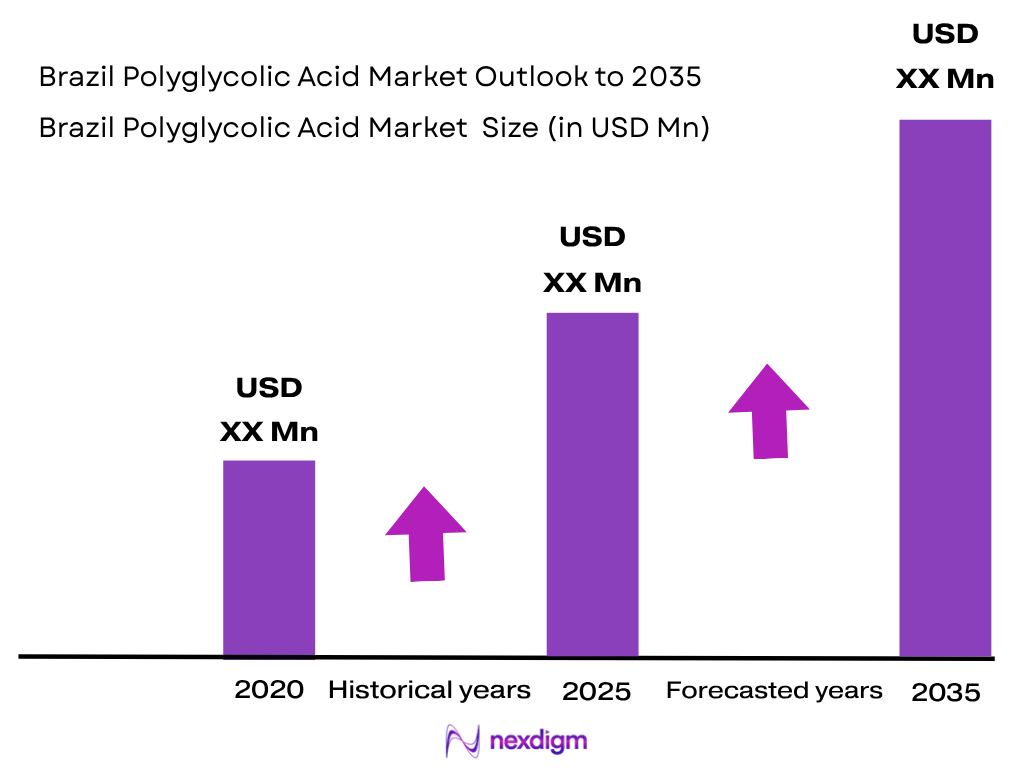
The Brazil Polyglycolic Acid Market is valued at approximately USD ~XX million, based on historical demand analysis. The market is supported primarily by absorbable surgical sutures, bioresorbable medical devices, pharmaceutical biomaterials and emerging high-barrier polymer applications. Brazil’s medical-device exports increased from approximately USD0.94 billion to USD1.17 billion, while the latest national economy generated approximately USD2.19 trillion in GDP, providing a large healthcare and advanced-manufacturing base for PGA-consuming applications.
São Paulo, Campinas and the wider Southeast region represent Brazil’s strongest commercial concentration for PGA-related medical and specialty-material applications due to dense healthcare infrastructure, medical-device distribution, industrial conversion and regulatory-facing operations. São Paulo city operates 479 basic health units and 32 emergency-care units, compared with 456 and 24 in the preceding reporting period. The city also hosted a major healthcare exhibition involving more than 1,200 exhibitors from 30 countries, reinforcing its role as Brazil’s primary health-technology commercialization hub.
Market Segmentation
By Grade
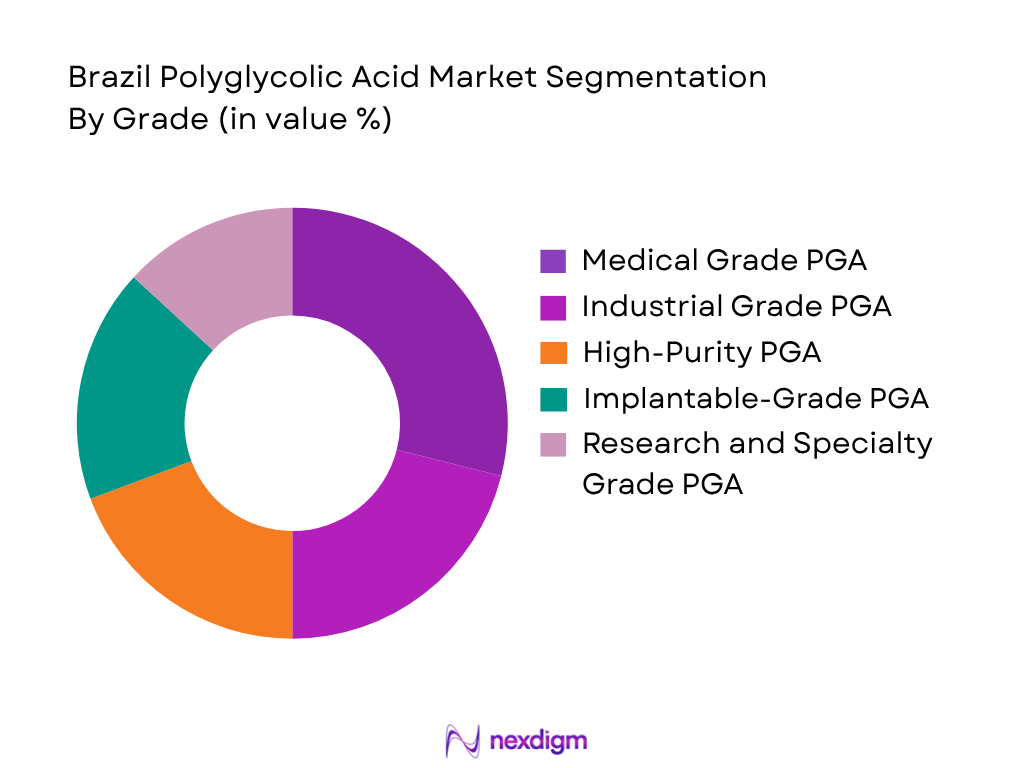
The Brazil Polyglycolic Acid Market is segmented by grade into medical-grade PGA, industrial-grade PGA, high-purity PGA, implantable-grade PGA and research/specialty-grade PGA. Medical-grade PGA holds the dominant position because Brazil’s most established commercial PGA uses are associated with absorbable surgical products and bioresorbable medical materials. PGA is particularly suited to absorbable sutures because its hydrolytic degradation allows temporary mechanical support without requiring permanent implantation. Brazil’s regulatory framework explicitly encompasses sutures, threads, prostheses and other implantable devices within the medical-device category, requiring manufacturers to demonstrate essential safety and performance characteristics. ANVISA’s current framework also requires medical devices to comply with essential safety and performance principles throughout the device lifecycle. This favors established medical-grade polymers with controlled purity, molecular weight, degradation behavior and documented biocompatibility. Industrial-grade PGA has comparatively greater exposure to emerging high-barrier packaging and specialty polymer applications, where commercialization remains less mature than the established medical-use pathway.
By Application Type
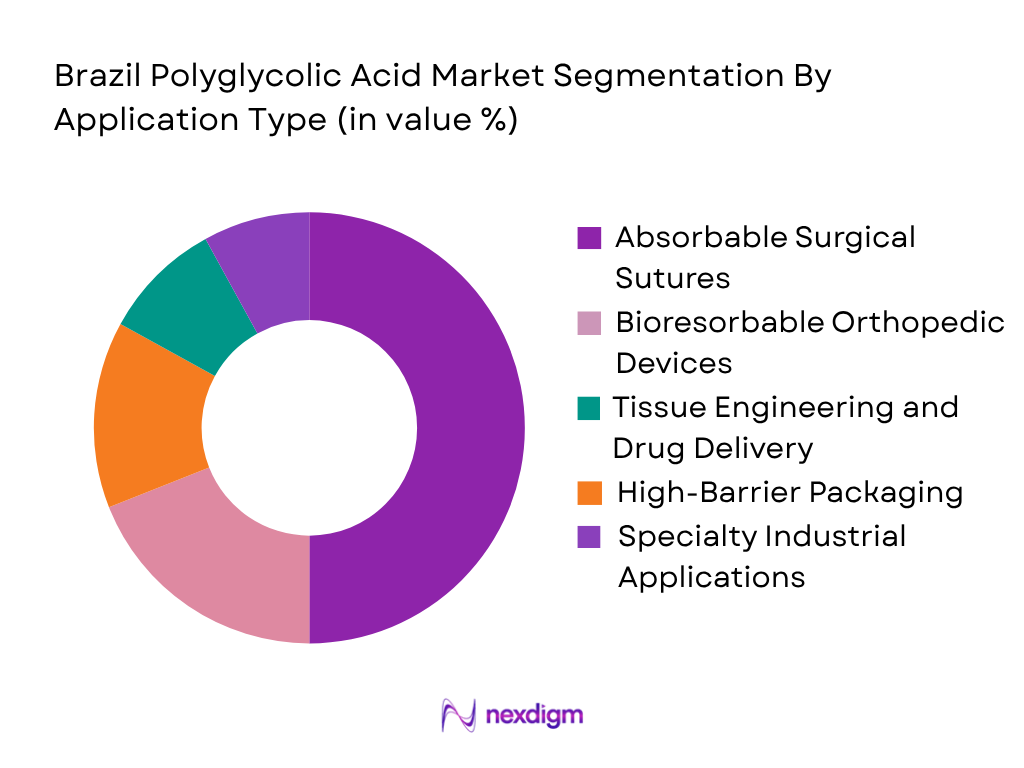
The Brazil Polyglycolic Acid Market is segmented into absorbable surgical sutures, bioresorbable orthopedic devices, tissue-engineering and drug-delivery systems, high-barrier packaging, and industrial/specialty applications. Absorbable surgical sutures are the dominant application, reflecting PGA’s long-established use in temporary wound closure and Brazil’s extensive surgical and hospital ecosystem. The material provides high initial tensile performance while gradually losing strength through hydrolysis, making it suitable where permanent sutures are undesirable. Brazil also has a large medical-device import and distribution network that facilitates availability of specialized medical products and biomaterials. ANVISA specifically recognizes sutures, threads and implantable products within its medical-device regulatory framework, while its current requirements emphasize lifecycle safety and performance. Bioresorbable orthopedic and tissue-engineering applications represent technologically advanced extensions of the same material platform but require more complex device engineering and qualification. High-barrier packaging represents a different growth pathway, supported by PGA’s gas-barrier properties and Brazil’s increasing policy emphasis on circular material systems.
Competitive Landscape
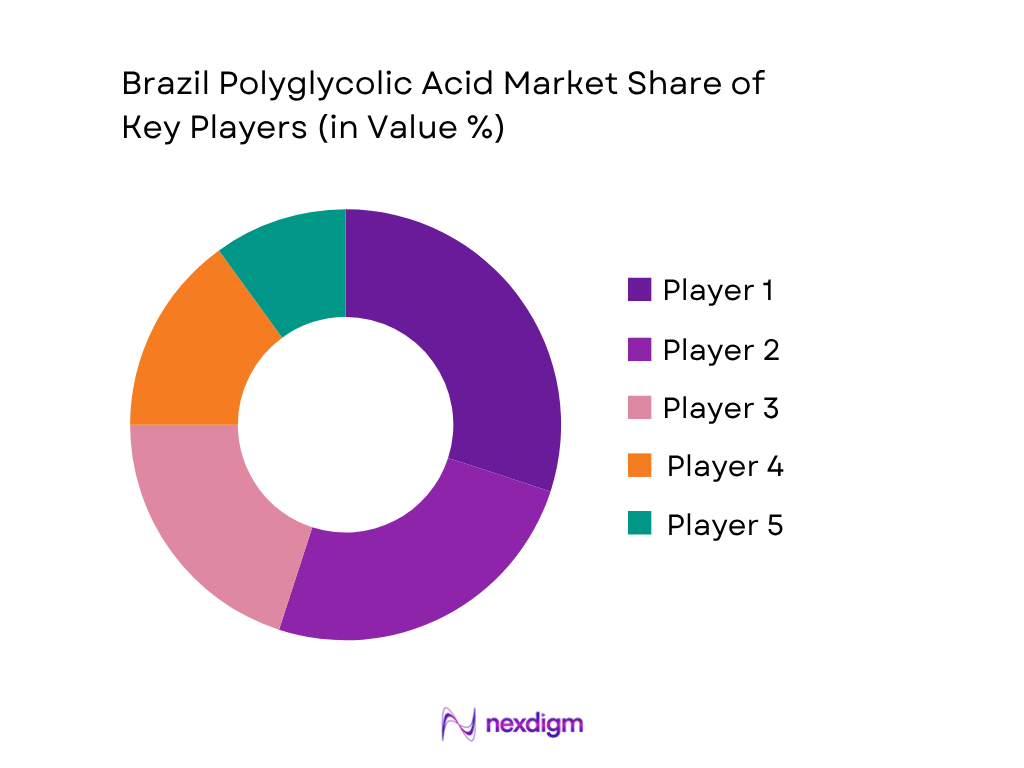
The Brazil Polyglycolic Acid Market is characterized by a specialized international supplier structure combined with downstream medical-device manufacturers and distributors. Competition is differentiated by polymer purity, molecular-weight control, degradation predictability, medical-device documentation, suture-processing expertise, barrier-performance technology and access to Brazilian regulatory and distribution channels. Kureha has particular relevance in high-performance PGA resin, while Evonik and Corbion participate strongly in medical biomaterials. Ethicon and Teleflex represent downstream medical-device competitors with extensive surgical-product expertise.
| Major Player | Establishment Year | Headquarters | PGA / Biomaterial Position | Major Application Focus | Medical-Grade Capability | Industrial PGA Capability | Brazil Market Relevance | Technical Differentiation |
| Kureha Corporation | 1944 | Tokyo, Japan | ~ | ~ | ~ | ~ | ~ | ~ |
| Evonik Industries AG | 2007 | Essen, Germany | ~ | ~ | ~ | ~ | ~ | ~ |
| Corbion N.V. | 1919 | Amsterdam, Netherlands | ~ | ~ | ~ | ~ | ~ | ~ |
| Johnson & Johnson MedTech / Ethicon | 1915 | New Jersey, USA | ~ | ~ | ~ | ~ | ~ | ~ |
| Teleflex Incorporated | 1943 | Pennsylvania, USA | ~ | ~ | ~ | ~ | ~ | ~ |
Brazil Polyglycolic Acid Market Analysis
Growth Drivers
Expansion of Surgical Procedures and Bioresorbable Medical Applications
Brazil’s large and expanding surgical-care ecosystem is a direct demand driver for polyglycolic acid used in absorbable sutures, temporary wound-closure products and other bioresorbable medical applications. The Ministry of Health reported that more than 1 million surgeries were completed through the SUS surgical-access initiative through October 2024, supported by BRL 1.2 billion allocated to reduce surgical waiting lists. Brazil’s public healthcare system also operates approximately 48,000 Basic Health Units, performs about 4 billion healthcare procedures annually, and completed approximately 30,000 organ and tissue transplants in 2024. These volumes create a substantial clinical environment for absorbable surgical materials requiring controlled tensile retention and predictable hydrolytic degradation. The National Registry of Health Establishments records 6,955 hospitals, further demonstrating the breadth of institutions capable of consuming surgical products. The macroeconomic base is also sizeable: World Bank data place Brazil’s 2024 GDP at USD 2.19 trillion, GDP per capita at USD 10,310.5, and population at 211,998,573. Together, expanding procedure volumes, hospital infrastructure and healthcare manufacturing capabilities reinforce demand conditions for medical-grade PGA and PGA-based surgical products.
Strengthening Medical-Device Manufacturing and Regulatory Infrastructure
Brazil’s regulated medical-device ecosystem supports PGA consumption because medical-grade polymer suppliers can serve manufacturers producing absorbable sutures, surgical meshes, temporary implants and related bioresorbable devices. ANVISA’s 2024 regulatory activity demonstrates the scale and maturity of oversight: the agency concluded 120 medical-device investigation dossiers, handled 65 administrative proceedings related to medical devices, identified 134 medical-device health violations, conducted 10 techno-surveillance inspections, and published 394 risk communications across health-surveillance activities. The national analytical infrastructure was also strengthened through accreditation of 27 new laboratories, expanding capabilities relevant to product testing, material characterization and regulatory compliance. Such infrastructure is important for PGA because medical applications require validated biocompatibility, controlled molecular weight, sterilization compatibility, degradation consistency and manufacturing traceability. Brazil’s 2024 macroeconomic environment provides further industrial support, with GDP of USD 2.19 trillion, GDP per capita of USD 10,310.5, GNI of approximately USD 2.105 trillion, and a population of 211,998,573, according to World Bank datasets. These factors strengthen Brazil’s ability to support specialized biomaterial imports, local medical-device conversion and higher-value manufacturing of PGA-based products.
Market Challenges
Dependence on Imported PGA Resin and Specialized Medical-Grade Inputs
Brazil lacks a comparably large domestic production base for high-molecular-weight PGA resin, making the market dependent on imported specialty polymer grades, glycolide-derived biomaterials and international technical support. This dependence is particularly relevant for medical applications because PGA used in absorbable sutures and implants requires tight specifications for purity, residual monomer content, molecular weight and degradation behavior. Brazil’s import framework reflects the complexity of bringing medical-device materials and components into the country. In December 2024, ANVISA updated procedures associated with RDC 860/2024 and RDC 939/2024 for importers and storage operators handling medical-device components, while Siscomex separately identified medical devices and components under administrative treatment category 082. The need to navigate these regulatory channels adds qualification and documentation requirements for PGA converters using imported materials. Brazil’s macroeconomic scale does not eliminate this exposure: World Bank data show 2024 GDP of USD 2.19 trillion, GDP per capita of USD 10,310.5, GNI of USD 2.105 trillion, and population of 211,998,573. Consequently, manufacturers remain dependent on overseas resin availability, logistics continuity, regulatory documentation and specialized supplier qualification for critical PGA grades.
Stringent Product Qualification and Processing-Control Requirements
PGA’s material characteristics create a significant commercialization challenge because the polymer is sensitive to moisture and hydrolytic molecular-weight reduction, requiring controlled drying, storage, extrusion and medical-device processing. For Brazil, this technical burden is reinforced by a rigorous health-surveillance environment. ANVISA’s 2024 management data show 134 identified health violations involving medical devices, 65 medical-device administrative proceedings, 120 investigation dossiers concluded, 10 techno-surveillance inspections, and 15 investigative or support inspections involving state surveillance authorities. These enforcement figures highlight the importance of traceability, quality systems, sterilization validation and consistent manufacturing controls for materials intended for surgical use. The agency also analyzed 101 petitions involving laboratory accreditation and added 27 new laboratories to its analytical network, strengthening product-testing capacity. For PGA manufacturers and converters, these requirements translate into the need for controlled resin handling, documented degradation profiles and reproducible finished-device performance. Brazil’s 2024 GDP stood at USD 2.19 trillion, GDP per capita at USD 10,310.5, and population at 211,998,573, demonstrating a large end-market but also a demanding national healthcare environment where quality failures can restrict commercialization of specialty bioresorbable polymers.
Market Opportunities
Localization of PGA-Based Absorbable Medical Products
Brazil has a strong opportunity to increase domestic conversion of imported medical-grade PGA into absorbable sutures, surgical meshes, temporary fixation products and other bioresorbable devices. Current healthcare activity provides a substantial foundation for future localization. The Ministry of Health reported more than 1 million surgeries completed through its specialist-access initiative through October 2024, supported by BRL 1.2 billion devoted to reducing surgical waiting lists. The SUS network includes approximately 48,000 Basic Health Units and performs about 4 billion healthcare procedures annually, while approximately 30,000 organ and tissue transplants were carried out in 2024. The National Registry of Health Establishments also records 6,955 hospitals, indicating a broad institutional base for surgical-product procurement. These existing volumes can support manufacturers seeking to convert PGA locally rather than rely entirely on imported finished devices. Brazil’s economic capacity adds further support: World Bank figures show 2024 GDP of USD 2.19 trillion, GDP per capita of USD 10,310.5, and population of 211,998,573. The opportunity therefore lies in building validated domestic processing, sterilization, braiding and device-manufacturing capabilities around imported PGA resin while progressively strengthening local biomaterial expertise.
Expansion into High-Barrier and Circular Packaging Applications
Brazil’s evolving plastics-management framework creates an opportunity for PGA to develop beyond medical applications into high-barrier multilayer packaging and specialty biodegradable structures. The country established its National Circular Economy Strategy through Decree 12,082 of 2024, introducing a federal framework for resource efficiency, waste minimization, material circulation and investment in circular technologies. This direction was reinforced through Decree 12,688 of 2025, which created a nationwide reverse-logistics system for plastic packaging covering manufacturers, importers, distributors and retailers. Brazil already has substantial operational infrastructure for polymer recovery: the national pesticide-packaging reverse-logistics system processed 68,589 tonnes of empty agricultural packaging in 2024 through 411 receiving units, comprising 308 collection posts and 103 central facilities, alongside 4,057 itinerant collection actions. These figures demonstrate national experience with large-scale polymer collection and traceability. PGA’s high oxygen and carbon-dioxide barrier performance creates potential for use as a functional layer in specialty packaging where material efficiency is important. Brazil’s 2024 GDP of USD 2.19 trillion and population of 211,998,573 provide a large downstream consumer and industrial base for future packaging innovation incorporating advanced biodegradable and high-performance polymers
Future Outlook
The Brazil Polyglycolic Acid Market is expected to expand at an indicative ~XX% CAGR during 2026-2035, driven by greater adoption of bioresorbable medical materials, localization of surgical-product manufacturing, specialty biomaterial development and new high-barrier packaging applications. Medical uses should continue to form the commercial foundation of demand, while industrial PGA applications broaden gradually through polymer conversion and application-development partnerships.
Brazil’s large healthcare ecosystem provides significant headroom for PGA-based absorbable products. National medical-device exports reached USD1.17 billion, with products reaching more than 190 countries, highlighting Brazil’s existing ability to manufacture and commercialize regulated healthcare products internationally. The regulatory framework is also becoming more structured. ANVISA requires medical devices to comply with lifecycle safety and performance requirements under RDC No. 848/2024. For PGA manufacturers and device converters, this places greater importance on reproducible resin purity, predictable hydrolysis, sterilization stability, validation documentation and supplier traceability.
Major Players
- Kureha Corporation
- Evonik Industries AG
- Corbion N.V.
- Johnson & Johnson MedTech / Ethicon
- Medtronic
- B. Braun
- Teleflex Incorporated
- Meta Biomed Co., Ltd.
- Samyang Biopharmaceuticals Corporation
- BMG Incorporated
- Shanghai Pujing Chemical Technology Co., Ltd.
- Danhua Chemical Technology Co., Ltd.
- Shenzhen Polymtek Biomaterial Co., Ltd.
- Huizhou Foryou Medical Devices Co., Ltd.
- Polysciences, Inc.
Key Target Audience
- Polyglycolic Acid Resin and Specialty Biopolymer Manufacturers
- Absorbable Suture and Surgical Closure Product Manufacturers
- Bioresorbable Medical Device and Implant Manufacturers
- Pharmaceutical and Drug Delivery Companies
- High-Barrier Packaging and Specialty Polymer Converters
- Specialty Chemical Importers and Biomaterial Distributors
- Investments and Venture Capitalist Firms
- Government and Regulatory Bodies (Agência Nacional de Vigilância Sanitária, Ministry of Health, Ministry of Development, Industry, Trade and Services, Brazilian Health Regulatory System)
Research Methodology
Step 1: Identification of Key Variables
The initial stage constructs a detailed ecosystem map for the Brazil Polyglycolic Acid Market encompassing PGA resin manufacturers, glycolide and intermediate suppliers, medical-device producers, suture manufacturers, specialty distributors, packaging converters and healthcare procurement organizations. Variables including PGA grade, molecular weight, material purity, degradation characteristics, application category, processing technology, import dependency and regulatory qualification are identified through structured secondary research and industry databases.
Step 2: Market Analysis and Construction
Historical market activity is assessed using both top-down and bottom-up modelling. The top-down framework evaluates Brazil’s medical-device, specialty polymer, surgical-product and packaging ecosystems, while the bottom-up framework estimates PGA consumption across absorbable sutures, bioresorbable medical components, industrial materials and barrier applications. Import dependence, distributor activity, local conversion capability and end-use consumption are reconciled to construct the underlying market framework.
Step 3: Hypothesis Validation and Expert Consultation
Initial market hypotheses are validated through computer-assisted telephone interviews with biomaterial suppliers, medical-device manufacturers, specialty polymer distributors, surgical-product companies and packaging converters. Primary consultations examine procurement volumes, grade requirements, import origins, qualification processes, technical specifications and application trends. These insights are used to validate segment structures and identify discrepancies between supply-side availability and downstream consumption.
Step 4: Research Synthesis and Final Output
The final phase integrates secondary evidence, primary interviews, company information and regulatory analysis into a consolidated Brazil Polyglycolic Acid Market model. Top-down estimates are cross-checked against application-level bottom-up calculations and supplier accessibility. Competitive positioning is assessed according to PGA portfolio, medical-grade capability, polymer-processing expertise, Brazilian distribution reach, regulatory positioning and application-development strength to produce the final strategic outlook.

- Executive Summary
- Research Methodology (Market Definition and Scope, Brazil Polyglycolic Acid Classification, Glycolide-to-PGA Value Chain Mapping, Medical-Grade and Industrial-Grade Assessment, Demand-Side Consumption Analysis, Supply-Side PGA Availability Assessment, Import and Distribution Mapping, Application-Level Consumption Assessment, Primary Industry Interviews, Top-Down Market Sizing, Bottom-Up Demand Validation, Data Triangulation, Forecasting Framework, Regulatory Assessment, Limitations and Future Conclusions)

- Definition and Scope
- Brazil Polyglycolic Acid Industry Evolution and Development of Bioresorbable and Biodegradable Polymer Ecosystem
- Polyglycolic Acid Chemistry, Glycolide Polymerization and Material Performance Structure
- Brazil Polyglycolic Acid Value Chain Analysis
- Brazil Polyglycolic Acid Supply Chain Analysis
- Glycolic Acid, Glycolide, PGA Resin, Specialty Biomaterial, Medical Device and Polymer Conversion Ecosystem Analysis

- Growth Drivers (Expansion of Brazilian Medical Device Manufacturing, Increasing Use of Absorbable Surgical Sutures, Development of Implantable Bioresorbable Devices, Growth of Advanced Healthcare Procedures, Expansion of Specialty Polymer Processing, Increasing Demand for Functional Packaging Materials)
- Market Challenges (Limited Domestic PGA Polymerization Capacity, Dependence on Imported Medical-Grade PGA, High Glycolide Purity Requirements, Moisture-Induced Hydrolysis, Narrow Melt Processing Window, Medical Device Qualification Requirements, Specialized Resin Storage and Handling)
- Market Opportunities (Localization of PGA-Based Surgical Products, Bioresorbable Orthopedic Device Manufacturing, High-Barrier Sustainable Packaging, PGA-Based Polymer Compounding, Controlled Drug Delivery Systems, Tissue Engineering Materials, Specialty Oil and Gas Applications)
- Market Trends (Expansion of Bioresorbable Medical Materials, PGA Suture Localization, High-Purity Biomaterial Adoption, Multilayer Barrier Packaging Development, PGA/PLA Polymer Blending, Advanced Implantable Polymer Development, Sustainable Packaging Innovation)
- Regulatory and Standards Landscape (ANVISA Medical Device Registration, ANVISA Implantable Device Requirements, Brazilian Health Regulatory Framework, Food-Contact Material Requirements, ABNT Technical Standards, Import and Medical Product Compliance)
- SWOT Analysis
- Porter’s Five Forces Analysis
- PESTLE Analysis
- Stakeholder Ecosystem
- Competition Ecosystem

- By Market Value (2020-2025)
- By PGA Consumption Volume (2020-2025)
- By Medical-Grade PGA Consumption Volume (2020-2025)
- By Industrial-Grade PGA Consumption Volume (2020-2025)
- By Imported PGA Resin Volume (2020-2025)
- By Domestic PGA Conversion Volume (2020-2025)
- By PGA-Based Medical Product Consumption Volume (2020-2025)

- By Grade (In Value %)
Medical Grade PGA
Industrial Grade PGA
High-Purity PGA
Implantable-Grade PGA
Research and Specialty Grade PGA - By Product Form (In Value %)
PGA Pellets and Granules
PGA Powder
PGA Fibers and Filaments
PGA Films and Sheets
PGA-Based Compounds and Blends
PGA Preforms and Semi-Finished Materials - By Application Type (In Value %)
Absorbable Surgical Sutures
Bioresorbable Orthopedic Devices
Tissue Engineering Scaffolds
Drug Delivery Systems
Wound Closure and Surgical Mesh Applications
High-Barrier Packaging Films
Multilayer Food and Beverage Packaging
Dissolvable Industrial Components
Biodegradable Polymer Blends
Specialty Fibers and Technical Applications - By End-Use Industry (In Value %)
Hospitals and Healthcare
Medical Device Manufacturing
Pharmaceutical and Drug Delivery
Food and Beverage Packaging
Flexible and Rigid Packaging
Specialty Polymer Compounding
Industrial Manufacturing
Oil and Gas Services
Biotechnology and Biomaterials - By Polymer Configuration (In Value %)
Neat PGA
PGA/PLA Blends
PGA/PBAT Blends
PGA/PHA Blends
PGA/PLGA-Based Medical Polymer Systems
PGA-Based Multilayer Barrier Structures
PGA Reinforced Biodegradable Composites
Customized PGA Copolymers and Compounds - By Processing Technology (In Value %)
Fiber Spinning
Injection Molding
Film Extrusion
Multilayer Co-Extrusion
Compression Molding
Thermoforming
Solvent Processing
Braiding and Suture Processing
Medical Implant Fabrication - By Distribution Channel (In Value %)
Direct Manufacturer Supply
Specialty Polymer Distributors
Medical Biomaterial Suppliers
Authorized Chemical Distributors
Importers and Trading Companies
Medical Device OEM Procurement
Specialty Polymer Compounders
Research Material Suppliers - By Region (In Value %)
Southeast Brazil
South Brazil
Northeast Brazil
Central-West Brazil
North Brazil

- Market Share of Major Players (By PGA Supply Volume, Medical-Grade Portfolio, Industrial-Grade Portfolio, Absorbable Suture Presence, Bioresorbable Device Applications, Distribution Reach, End-Use Application, Customer Segment)
- Cross Comparison Parameters (PGA Grade Portfolio Breadth, High-Molecular-Weight PGA Capability, Medical-Grade and Implantable Biomaterial Capability, Absorbable Suture and Bioresorbable Device Expertise, Industrial and Barrier Packaging Application Coverage, Brazil and Latin America Distribution Reach, Polymer Processing and Technical Support Capability, Regulatory and Application Development Strength)
- SWOT Analysis of Major Players
- Competitive Positioning Matrix
- Pricing and PGA Grade Category Benchmarking
- Detailed Profiles of Major Companies
Kureha Corporation – Kuredux PGA Resin, High-Molecular-Weight PGA, Barrier Packaging and Industrial Applications
Evonik Industries AG – RESOMER Bioresorbable Polymers, Medical Device Biomaterials and Implantable Polymer Solutions
Corbion N.V. – Resorbable Biomaterials, Medical Polymer Platforms and Drug Delivery Applications
Johnson & Johnson MedTech / Ethicon – PGA-Based Absorbable Sutures, Surgical Closure Products and Healthcare Applications
Medtronic – Absorbable Surgical Materials, Medical Devices and Advanced Surgical Applications
B. Braun – Absorbable Sutures, Surgical Products and Medical Biomaterial Applications
Teleflex Incorporated – PGA-Based Absorbable Surgical Products and Medical Device Applications
Meta Biomed Co., Ltd. – PGA Absorbable Sutures, Surgical Biomaterials and Medical Polymer Products
Samyang Biopharmaceuticals Corporation – Bioresorbable PGA Materials, Absorbable Sutures and Medical Biomaterial Solutions
BMG Incorporated – Medical-Grade PGA, Bioresorbable Polymer Materials and Biomedical Applications
Shanghai Pujing Chemical Technology Co., Ltd. – PGA Resin, Industrial-Grade Polyglycolic Acid and Polymer Materials
Danhua Chemical Technology Co., Ltd. – Industrial PGA Resin, Glycolic Acid Integration and Polymer Production
Shenzhen Polymtek Biomaterial Co., Ltd. – Medical-Grade PGA, Bioresorbable Polymer Materials and Implant Applications
Huizhou Foryou Medical Devices Co., Ltd. – PGA Medical Materials, Absorbable Sutures and Surgical Products
Polysciences, Inc. – High-Purity Polyglycolide, Specialty PGA and Biomedical Research Materials

- Medical Device Manufacturer Procurement Assessment
- Absorbable Suture Manufacturer Requirement Analysis
- Hospital and Surgical Procurement Assessment
- Orthopedic Device Manufacturer Material Requirement Analysis
- Pharmaceutical and Drug Delivery Developer Assessment
- Packaging Converter Requirement Assessment
- Polymer Compounder Demand Assessment
- PGA Supplier Selection Criteria
- Medical-Grade versus Industrial-Grade PGA Adoption Assessment

- By Market Value (2026-2035)
- By PGA Consumption Volume (2026-2035)
- By Medical-Grade PGA Consumption Volume (2026-2035)
- By Industrial-Grade PGA Consumption Volume (2026-2035)
- By Absorbable Suture Application Volume (2026-2035)
- By Bioresorbable Medical Device Consumption Volume (2026-2035)
- By High-Barrier Packaging Application Volume (2026-2035)
- By PGA Compound and Blend Consumption Volume (2026-2035)


 Request a Sample
 Ask for Customization
 Get a Quote
 Enquire Now