
 Download PDF
Market Overview
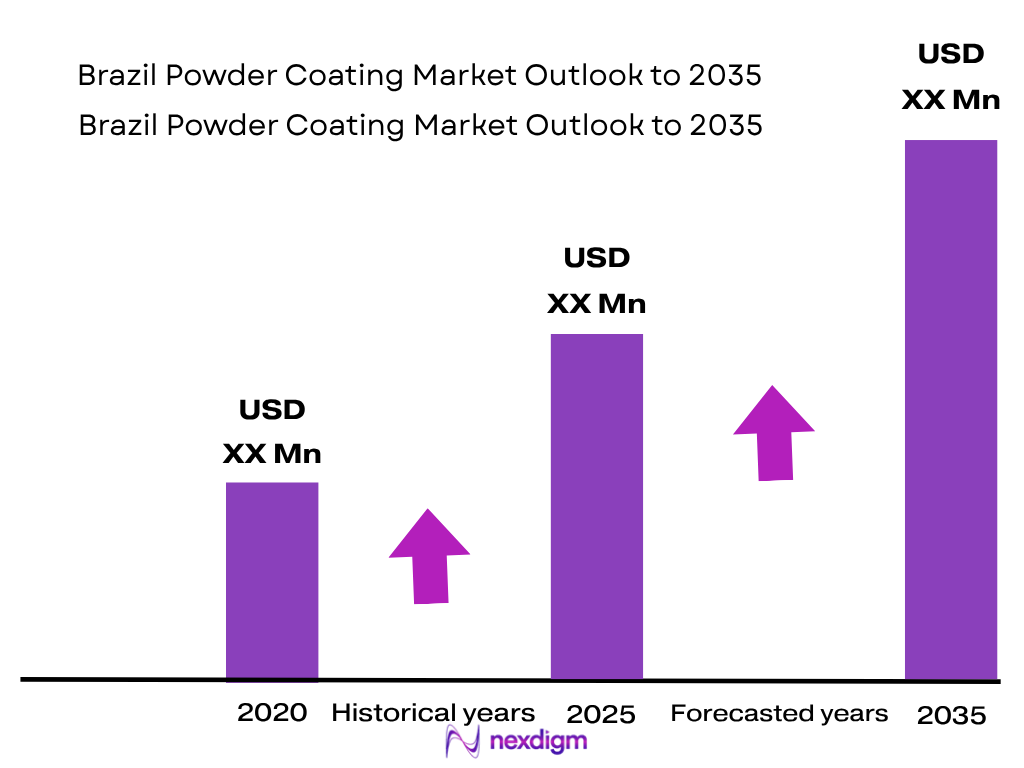
The Brazil Powder Coating Market is valued at USD ~ million in the latest annual reference, supported by demand from appliances, automotive manufacturing, fabricated metals, architecture and general industry. In the preceding annual cycle, Brazil produced 2.325 million vehicles, rising to approximately 2.55 million vehicles in the latest cycle. This expanding industrial throughput increases the addressable surface area requiring polyester, epoxy, hybrid and specialty powder-coating systems.
São Paulo and the broader Southeast dominate the Brazil Powder Coating Market because they concentrate automotive assembly, auto-component production, appliance manufacturing, metal fabrication and established coatings infrastructure. Southern manufacturing centers, particularly Santa Catarina and Paraná, are also strategically important because of machinery, electrical-equipment and industrial production. National industry moved from only 0.1 growth points in the preceding annual cycle to an industrial production index expansion of 3.1 points in the latest cycle, strengthening downstream coating activity.
Market Segmentation
By Resin Chemistry
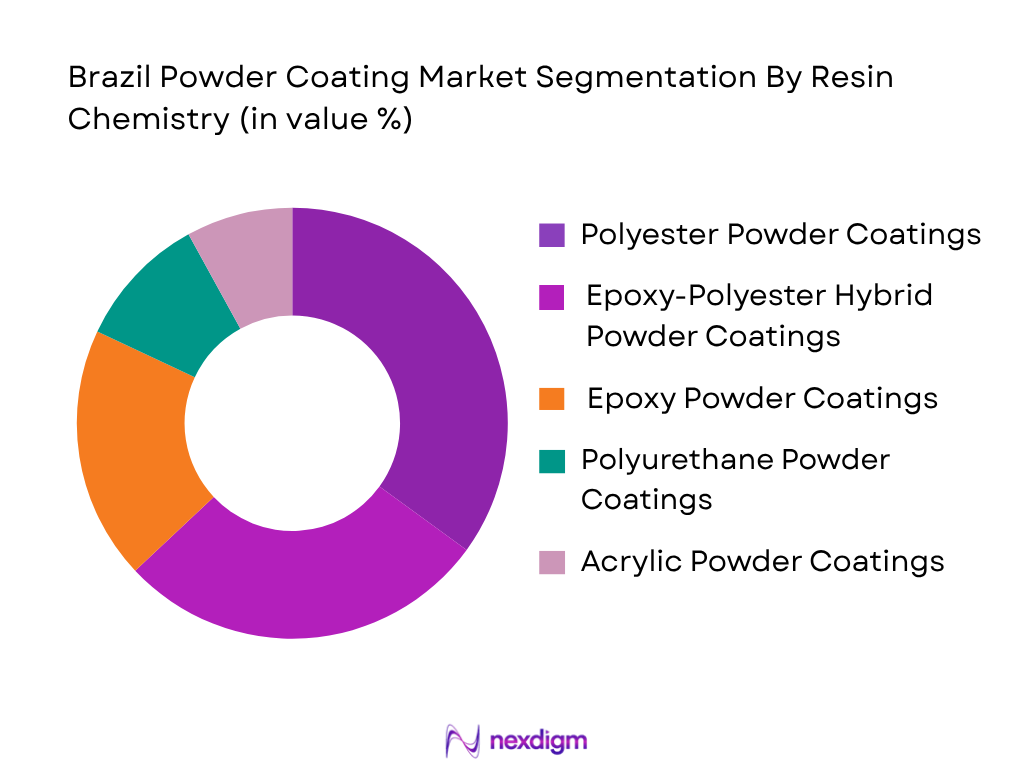
The Brazil Powder Coating Market is segmented into polyester, epoxy-polyester hybrid, epoxy, polyurethane and acrylic powder coatings. Polyester represents the dominant subsegment because Brazilian powder demand is strongly exposed to exterior and durable applications, including automotive components, architectural aluminium, agricultural machinery, metal furniture and industrial equipment. Polyester systems provide comparatively strong weathering resistance, color retention and flexibility, making them particularly suitable for Brazil’s high-UV and humid operating environments. Brazil-specific industry analysis also identifies polyester as the leading revenue-generating resin category, while epoxy-polyester hybrid systems have been identified as a rapidly developing chemistry. Local product availability reinforces this position: WEG’s Brazilian Politherm portfolio includes conventional polyester systems and architectural polyester formulations with improved weathering and yellowing resistance. Hybrids remain important for indoor appliances, cabinets and industrial equipment, while epoxy coatings serve applications requiring chemical and corrosion resistance but limited exterior weatherability.
By End-Use Industry
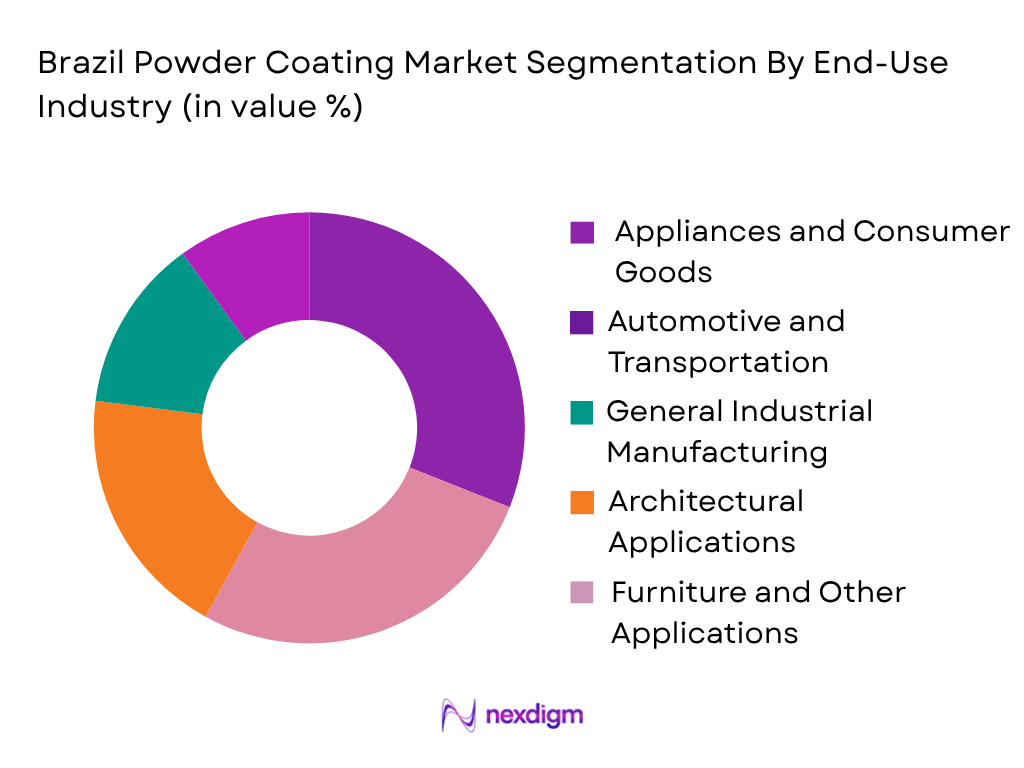
The Brazil Powder Coating Market is segmented into appliances and consumer goods, automotive and transportation, general industrial manufacturing, architectural applications, furniture and other applications. Appliances and automotive together form the most commercially important demand pools, although the precise leadership can vary according to dataset definitions. Appliance and consumer-goods demand benefits from powder coating’s suitability for refrigerator panels, washing-machine bodies, cooking appliances and electrical cabinets, while automotive consumption includes wheels, springs, seat structures, brackets and other metal components. Brazil’s industrial data demonstrates the strength of both applications: production of household appliances expanded substantially in the latest annual cycle, while vehicle manufacturing reached approximately 2.55 million units. Fabricated metal products, furniture, electrical machinery and general equipment also recorded stronger production activity, widening the potential powder-consumption base beyond transportation. Powder’s durability, automated application capability and reusable overspray make it particularly suited to these high-volume manufacturing environments.
Competitive Landscape
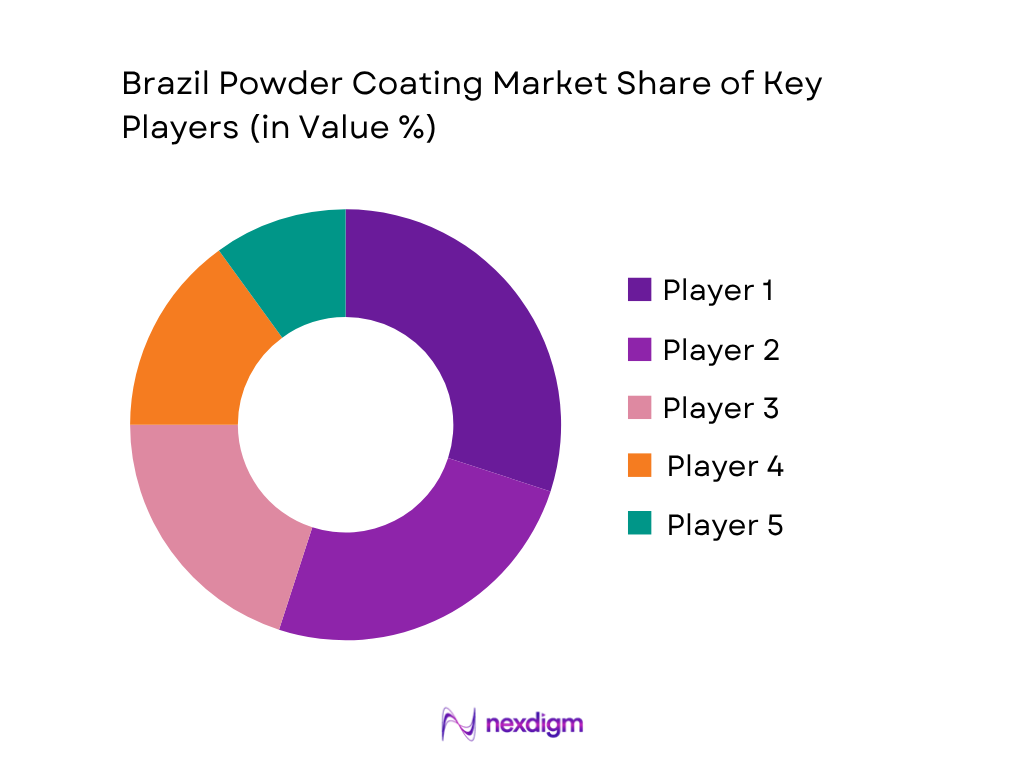
The Brazil Powder Coating Market features a combination of domestic industrial-coatings manufacturers and multinational powder specialists. WEG has a particularly differentiated position through local powder technology and its broader Brazilian industrial-equipment ecosystem, while PPG, AkzoNobel, Axalta and Sherwin-Williams bring international product platforms, OEM relationships and application expertise. Competition extends beyond powder price to resin breadth, low-temperature curing, architectural durability, corrosion protection, custom color development, technical service and local manufacturing. PPG’s Sumaré facility illustrates the importance of localized capacity: its recent expansion increased powder production capacity by 40%.
| Company | Establishment Year | Headquarters | Key Powder Chemistries | Brazil Manufacturing / Supply Position | Automotive Capability | Architectural / Exterior Capability | Low-Cure / Efficiency Capability | Technical & Color Support |
| WEG Tintas | 1961 | Jaraguá do Sul, Brazil | ~ | ~ | ~ | ~ | ~ | ~ |
| PPG Industries | 1883 | Pittsburgh, USA | ~ | ~ | ~ | ~ | ~ | ~ |
| AkzoNobel – Interpon | 1792 heritage | Amsterdam, Netherlands | ~ | ~ | ~ | ~ | ~ | ~ |
| Axalta Coating Systems | 1866 heritage | Philadelphia, USA | ~ | ~ | ~ | ~ | ~ | ~ |
| Sherwin-Williams | 1866 | Cleveland, USA | ~ | ~ | ~ | ~ | ~ | ~ |
Brazil Powder Coating Market Analysis
Growth Drivers
Automotive and Auto-Component Manufacturing Base
Brazil’s automotive industry is a major demand engine for powder coatings because wheels, suspension parts, seat structures, brackets, chassis components, battery housings and other metal assemblies require corrosion-resistant and mechanically durable finishes. According to Brazil’s Ministry of Development, Industry, Commerce and Services, national vehicle production reached 2.55 million units in 2024, while new vehicle registrations reached 2.635 million units. This scale provides a substantial recurring substrate base for polyester, epoxy-polyester hybrid and epoxy powder systems used by OEMs and component suppliers. The importance of this downstream base is reinforced by the wider economy: World Bank data place Brazil’s 2024 GDP at USD 2,185.822 billion, making it the world’s tenth-largest economy in nominal terms, while manufacturing value added reached USD 269.826 billion. Powder-coating demand benefits from this combination of vehicle assembly, Tier-1 and Tier-2 component manufacturing and metal-processing capability. Automotive customers also require consistent film thickness, adhesion, corrosion resistance, edge coverage and batch-to-batch color performance, supporting demand for technically qualified powder systems rather than purely decorative commodity coatings.
Large Industrial, Appliance and Electrical Manufacturing Ecosystem
Brazil’s diversified manufacturing base supports powder-coating consumption beyond automotive applications, particularly across appliances, electrical cabinets, motors, transformers, furniture, industrial machinery and fabricated metal products. The Energy Research Office recorded 197,565 GWh of industrial electricity consumption in 2024, within total national electricity consumption of 560,219 GWh, illustrating the physical scale of industrial activity requiring surface-finishing processes. World Bank data show that Brazil generated USD 269.826 billion of manufacturing value added in 2024, while industry including construction generated USD 464.830 billion. Powder coatings are particularly relevant to this industrial structure because high-throughput manufacturing lines can coat appliance bodies, control panels, motor housings, shelving, furniture frames and machinery components through automated electrostatic systems. The large industrial electricity requirement also reflects the presence of energy-using manufacturing processes such as pretreatment, drying and thermal curing that form part of powder-coating operations. For suppliers, Brazil’s broad industrial composition reduces reliance on one application and supports polyester, hybrid, epoxy, low-bake and functional powders across multiple customer groups.
Market Challenges
Dependence on Imported Epoxy Resins and Pigment Inputs
Brazil’s powder-coating formulators remain exposed to imported raw materials, particularly epoxy resins and specialty pigment-related inputs required for corrosion-resistant, decorative and functional formulations. World Bank WITS trade data show that Brazil imported exactly 39,590,100 kilograms of epoxide resins in primary forms in 2024. China supplied 11,041,600 kilograms, while Italy supplied 4,755,850 kilograms, Other Asia supplied 8,674,050 kilograms, South Korea supplied 5,079,810 kilograms, and the United States supplied 2,586,700 kilograms. Brazil also imported 16,903,500 kilograms of titanium oxides, of which China accounted for 16,085,500 kilograms. These physical import volumes matter directly to powder manufacturers because epoxy chemistry is widely used for primers, hybrids, electrical applications and corrosion-protection systems, while titanium-based materials are important to white and light-colored formulations. The exposure exists within a manufacturing economy that generated USD 269.826 billion of value added in 2024, according to the World Bank. Consequently, supply interruptions, longer replenishment cycles or shortages in qualified imported inputs can complicate formulation continuity, inventory management and color consistency for Brazilian OEM and job-coating customers.
Energy-Intensive Thermal Curing Requirements
Conventional powder coating requires pretreatment, drying, electrostatic application and thermal curing, making the availability and efficient use of industrial electricity and process heat important to Brazilian applicators. The Energy Research Office recorded 197,565 GWh of electricity consumption by Brazil’s industrial sector in 2024, compared with 188,268 GWh in 2023, while national consumption reached 560,219 GWh. December alone accounted for 47,138 GWh of electricity consumption across the economy. These large energy requirements underline why cure temperature, oven residence time, conveyor utilization and line loading are commercially important variables for powder users operating continuous or batch ovens. Brazil’s industrial base generated USD 464.830 billion of value added in 2024, according to World Bank data, meaning powder coating serves a sizeable manufacturing ecosystem in which energy efficiency directly influences operational decisions. The challenge is particularly relevant for thick-gauge steel components, agricultural machinery, metal furniture and large fabricated assemblies that require substantial oven capacity. This environment increases pressure on suppliers to provide powders capable of reliable curing at lower temperatures or shorter dwell times without compromising adhesion, hardness, corrosion protection or finish consistency.
Market Opportunities
Electrified Vehicle and Localized Component Coating Applications
Brazil’s expanding electrified-vehicle production infrastructure creates a future opportunity for powder suppliers serving battery enclosures, chassis components, motor housings, structural brackets, electrical assemblies and charging-equipment cabinets. Government information shows that a new vehicle plant inaugurated in Iracemápolis in 2025 began with installed production capacity of 30,000 vehicles per year, supported by more than 100 registered local suppliers and approximately 900 jobs connected to the operation. In Bahia, state government data reported 3,000 additional workers being recruited for the Camaçari electrified-vehicle industrial complex in 2026, reinforcing the localization of a new automotive supply chain. These current industrial indicators sit within an economy that the World Bank valued at USD 2,185.822 billion in 2024, with manufacturing value added of USD 269.826 billion. For powder-coating suppliers, localization expands the potential specification base from conventional wheels and chassis parts toward aluminium battery structures, electrical insulation applications, corrosion-protection primers and durable exterior components. Companies able to qualify coatings for electrified platforms can therefore participate in a broader set of automotive finishing requirements as domestic component sourcing deepens.
Architectural Aluminium and Durable Exterior Coating Expansion
Brazil’s aluminium-processing ecosystem provides a strong future opportunity for polyester and super-durable powder coatings used on architectural profiles, windows, doors, façades, railings, solar structures and exterior fabricated products. Brazilian aluminium-industry data recorded a historic 1.9 million tonnes of aluminium-product consumption in 2024, while imports reached 615,000 tonnes. The sector supported approximately 141,000 direct jobs, demonstrating the scale of extrusion, transformation, fabrication and downstream aluminium activity available to surface-finishing suppliers. Aluminium is especially relevant to powder coatings because extruded architectural sections are commonly finished using polyester systems designed for UV exposure, humidity resistance, gloss retention and color stability. The broader industrial environment is also substantial: World Bank data place Brazil’s 2024 industry-and-construction value added at USD 464.830 billion, providing a large construction and manufacturing base for coated aluminium and fabricated metal products. These current operating indicators create future scope for suppliers offering TGIC-free polyester, super-durable exterior systems, metallic finishes and low-temperature technologies. Growth opportunities are particularly attractive where architectural fabricators require standardized color matching, repeatable film build and enhanced weathering performance for exterior applications exposed to Brazil’s demanding climatic conditions.
Future Outlook
The Brazil Powder Coating Market is expected to maintain steady expansion through the forecast horizon, with an indicative 2026–2035 CAGR of ~5.5% used as a report placeholder. The growth direction is supported by manufacturing modernization, automotive localization, recovering durable-goods production, architectural aluminium demand and increasing adoption of solvent-free industrial finishing technologies. Future competition will increasingly focus on total applied-coating productivity rather than simply material supply. Low-temperature curing, high-transfer-efficiency powder, thin-film formulations, super-durable polyester systems and rapid color-change technologies can reduce curing demand, material losses and coating-line downtime. PPG already markets high-transfer-efficiency powder systems capable of first-pass transfer rates of up to 85%, demonstrating the direction of productivity-oriented product development.
Brazil should also provide a larger addressable opportunity for functional powder coatings as electrification expands. Battery housings, motors, electrical cabinets, charging infrastructure and power equipment can require dielectric, corrosion-resistant and thermally relevant coatings. Automotive production and the country’s substantial electrical-equipment manufacturing base create a foundation for these applications. The market will simultaneously benefit from powder coating’s environmental attributes. Powder formulations are typically solvent-free, while overspray can be recovered and reused where application systems are configured appropriately. This aligns with manufacturers’ efforts to increase material utilization and reduce solvent-related emissions and waste generation.
Major Players
- WEG Tintas
- PPG Industries Brasil
- AkzoNobel Brasil – Interpon
- Axalta Coating Systems Brasil
- The Sherwin-Williams Company Brasil
- Renner Coatings
- Arpol Red Spot
- Pulverit do Brasil
- Protech Group / Oxyplast
- TIGER Coatings / TIGER Drylac
- Jotun
- Kansai Paint
- Nippon Paint
- IGP Pulvertechnik
- Teknos Group
Key Target Audience
- Powder Coating Manufacturers and Formulators
- Automotive OEMs and Auto-Component Manufacturers
- Appliance and Consumer-Durable Manufacturers
- Agricultural Machinery and Industrial Equipment Manufacturers
- Architectural Aluminium Extruders and Industrial Job Coaters
- Resin, Pigment, Additive and Powder Application Equipment Suppliers
- Investments and Venture Capitalist Firms
- Government and Regulatory Bodies (Ministry of Development, Industry, Commerce and Services; IBAMA; CONAMA; ABNT; INMETRO)
Research Methodology
Step 1: Identification of Key Variables
The initial stage involves developing an ecosystem map for the Brazil Powder Coating Market covering powder manufacturers, resin and additive suppliers, distributors, job coaters, application-equipment suppliers, automotive manufacturers, appliance OEMs, aluminium processors and general industrial users. Desk research is then used to identify resin mix, coating consumption, application throughput, film-build requirements, curing technology and relevant downstream production indicators that influence market demand.
Step 2: Market Analysis and Construction
Historical market development is constructed through parallel top-down and bottom-up approaches. The top-down assessment evaluates the Brazilian coatings industry and powder-coating-intensive manufacturing sectors, while the bottom-up model estimates powder consumption across automobiles, appliances, architectural aluminium, furniture and general industry. Local production, imported material, application volumes, resin chemistry and end-use demand are reconciled to establish a coherent market structure.
Step 3: Hypothesis Validation and Expert Consultation
Market hypotheses are validated through CATIs and structured discussions with powder manufacturers, industrial distributors, raw-material suppliers, job coaters, OEM procurement teams and application specialists. Interviews test assumptions regarding polyester leadership, hybrid-powder demand, coating-line utilization, custom-color requirements, cure temperatures, powder recovery, OEM qualification periods and purchasing behavior. Operational findings are used to refine and corroborate the secondary-data analysis.
Step 4: Research Synthesis and Final Output
The final stage triangulates manufacturer-side supply information with end-user consumption indicators and industry production statistics. Powder volume estimates are reconciled with application intensity across key downstream manufacturing categories to reduce double counting. Competitive positioning, product technologies, resin preferences and future-market assumptions are subsequently reviewed together, producing an integrated assessment of the Brazil Powder Coating Market and its commercial opportunities.

- Executive Summary
- Research Methodology (Market Definition and Scope, Brazil Powder Coating Taxonomy, Thermoset and Thermoplastic Powder Classification, Resin Chemistry Mapping, Functional and Decorative Powder Classification, Substrate Mapping, Surface Pretreatment Assessment, Electrostatic Application Technology Assessment, Cure Technology Assessment, Film Thickness Assessment, Powder Recovery and Reclaim Assessment, Market Sizing Framework)

- Definition and Scope
- Brazil Powder Coating Industry Evolution and Technology Development
- Powder Coating Manufacturing and Formulation Process
- Powder Coating Value Chain Analysis
- Brazil Powder Coating Supply Chain Analysis
- Resin, Pigment, Additive and Filler Ecosystem Analysis
- Brazil Powder Coating Import Dependency and Localization Assessment
- OEM Powder Coating Application Architecture and Job-Coater Solution Framework

- Growth Drivers (Large Automotive and Auto Component Manufacturing Base, Expansion of Agricultural Machinery Production, Growth of Appliance and White Goods Manufacturing, Architectural Aluminum Demand, Increasing Industrial Metal Fabrication, Infrastructure Development, Liquid-to-Powder Conversion, Increasing Demand for Corrosion-Resistant Finishes)
- Market Challenges (Dependence on Imported Specialty Resins and Additives, Raw Material Supply Volatility, Industrial Energy Requirements, Energy-Intensive Cure Requirements, Pretreatment Quality Variation, Fragmented Job-Coater Ecosystem, Price Competition from Imported Powders, Skilled Applicator Constraints)
- Market Opportunities (Super-Durable Architectural Powders, Low-Bake and Fast-Cure Powders, EV Battery and Electrical Insulation Powders, Agricultural Machinery Powder Coatings, Antimicrobial Powder Coatings, Automated Powder Application Systems, Localized Specialty Powder Manufacturing, Liquid-to-Powder Line Conversion)
- Market Trends (TGIC-Free Polyester Adoption, Low-Bake Fast-Cure Systems, Super-Durable Architectural Powders, Metallic and Textured Finishes, Functional Powder Coatings, Robotic Powder Application, Powder Recovery Systems, Sustainable Solvent-Free Finishing)
- Regulatory and Standards Landscape (CONAMA Environmental Requirements, IBAMA Environmental Compliance Requirements, ABNT Technical Standards, Ministry of Labor Occupational Safety Requirements, Chemical Handling and Hazardous Substance Requirements, Industrial Waste Management Requirements, Architectural Coating Performance Standards, ASTM and ISO Powder Coating Test Standards)
- SWOT Analysis
- Porter’s Five Forces Analysis
- PESTLE Analysis
- Stakeholder Ecosystem
- Competition Ecosystem

- By Market Value (2020-2025)
- By Powder Coating Consumption Volume (2020-2025)
- By Coated Surface Area (2020-2025)
- By Domestic Production Volume (2020-2025)
- By Import Volume (2020-2025)
- By Export Volume (2020-2025)
- By Average Selling Price (2020-2025)
- By Thermoset Powder Consumption (2020-2025)
- By Thermoplastic Powder Consumption (2020-2025)

- By Resin Chemistry (In Value %)
Pure Polyester Powder Coatings
TGIC Polyester Powder Coatings
TGIC-Free Polyester Powder Coatings
Super-Durable Polyester Powder Coatings
Epoxy Powder Coatings
Epoxy-Polyester Hybrid Powder Coatings
Polyurethane Powder Coatings
Acrylic Powder Coatings
Fluoropolymer Powder Coatings
Silicone Polyester Powder Coatings
Nylon Powder Coatings
Polyethylene Powder Coatings
Other Specialty Thermoplastic Powders - By Coating Technology (In Value %)
Thermosetting Powder Coatings
Thermoplastic Powder Coatings
Low-Temperature Cure Powder Coatings
Low-Bake Fast-Cure Powder Coatings
Ultra-Low-Bake Powder Coatings
UV-Curable Powder Coatings
Thin-Film Powder Coatings
High-Temperature Resistant Powder Coatings - By Functional Performance (In Value %)
Decorative Powder Coatings
Corrosion-Resistant Powder Coatings
Super-Durable Architectural Powders
High-Temperature Powder Coatings
Electrical Insulation and Dielectric Powders
Antimicrobial Powder Coatings
Anti-Graffiti Powder Coatings
Scratch-Resistant Powder Coatings
Chemical-Resistant Powder Coatings
Heavy-Duty Corrosion-Protection Powders
Fire-Retardant Powder Coatings
Fusion-Bonded Epoxy Powders
Rebar Powder Coatings
Zinc-Rich and Zinc-Free Powder Primers - By End-Use Industry (In Value %)
Automotive and Auto Components
Agricultural Machinery and Equipment
Appliances and White Goods
Architectural Aluminum and Building Products
General Industrial Manufacturing
Electrical and Electronics
Furniture and Metal Fabrication
HVAC and Refrigeration Equipment
Industrial Machinery and Equipment
Infrastructure and Construction
Oil and Gas Equipment
Mining and Heavy Equipment
Renewable Energy Equipment
Telecommunication Equipment - By Distribution Channel (In Value %)
Direct Powder Manufacturer-to-OEM Sales
Direct Manufacturer-to-Job Coater Sales
Authorized Powder Coating Distributors
Industrial Paint and Coating Distributors
Regional Stocking Warehouses
Dealer and Reseller Networks
Equipment and Powder Bundled Distribution
Project-Specific Supply Contracts
Online B2B Industrial Platforms
Custom Color and Small-Batch Channels - By Region (In Value %)
Southeast Brazil
São Paulo
Minas Gerais
Rio de Janeiro
Espírito Santo
South Brazil
Paraná
Santa Catarina
Rio Grande do Sul
Central-West Brazil
Goiás
Mato Grosso
Northeast Brazil
Bahia
Pernambuco
North Brazil

- Market Share of Major Players (By Revenue, Volume, Resin Chemistry, Powder Technology, End-Use Industry, Application Type, Market Type, Distribution Channel)
- Cross Comparison Parameters (Resin Chemistry and Powder Technology Breadth, Brazil and Latin America Supply Footprint, Low-Temperature and Fast-Cure Technology Capability, Automotive and Agricultural Machinery Powder Portfolio Strength, Super-Durable Architectural Powder Portfolio Strength, Functional and High-Performance Powder Capability, Custom Color Matching and Technical Application Support, Sustainable and TGIC-Free Low-Energy Powder Portfolio)
- SWOT Analysis of Major Players
- Pricing and Distribution Network Benchmarking
- Detailed Profiles of Major Companies
WEG Tintas
PPG Industries Brasil
AkzoNobel Brasil – Interpon
Axalta Coating Systems Brasil
The Sherwin-Williams Company Brasil
Renner Coatings
Arpol Red Spot
Pulverit do Brasil
Protech Group / Oxyplast
TIGER Coatings / TIGER Drylac
Jotun
Kansai Paint
Nippon Paint
IGP Pulvertechnik
Teknos Group

- Buyer Segmentation
- OEM Procurement Behaviour
- Supplier Selection Criteria
- Buyer Pain Points
- Technology Adoption Assessment
- Replacement and Repurchase Behaviour

- By Market Value (2026-2035)
- By Powder Coating Consumption Volume (2026-2035)
- By Coated Surface Area (2026-2035)
- By Domestic Production Volume (2026-2035)
- By Import Volume (2026-2035)
- By Export Volume (2026-2035)
- By Average Selling Price (2026-2035)
- By Thermoset Powder Consumption (2026-2035)
- By Thermoplastic Powder Consumption (2026-2035)


 Request a Sample
 Ask for Customization
 Get a Quote
 Enquire Now