

 Download PDF
Market Overview
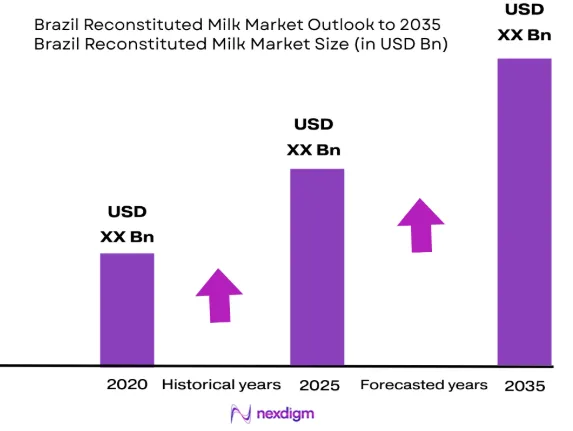
The Brazil Reconstituted Milk Market is valued at USD ~ billion, based on the published country-level reconstituted milk market trajectory. Demand is driven by UHT milk, leite em pó use, dairy manufacturing, bakery and confectionery applications, foodservice consumption and shelf-stable milk formats. Brazil’s dairy base supports this market, with milk production reported at 25 million metric tons in the latest USDA annual outlook, while the prior base stood below this level. Minas Gerais, São Paulo, Paraná, Goiás, Santa Catarina and Rio Grande do Sul dominate Brazil Reconstituted Milk Market activity because they combine milk collection, UHT plants, powdered milk facilities, supermarket demand and strong dairy cooperative networks. Brazil’s inspected raw milk acquisition reached 25.4 billion liters, while the leading dairy processors collected 10.8 billion liters. São Paulo and Minas Gerais are especially important because they link large consumer markets with dairy processing, retail distribution and food manufacturing demand.
Market Segmentation
By Source
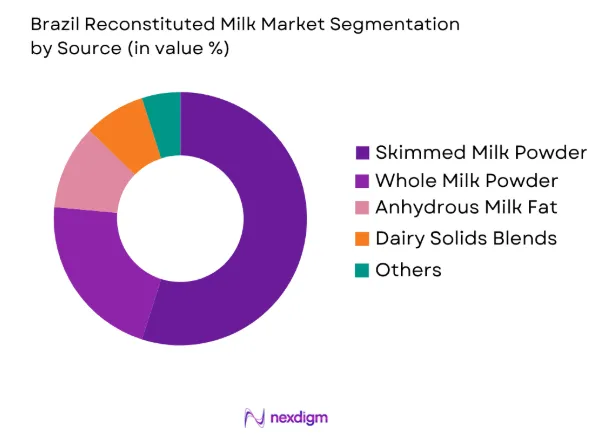
Brazil Reconstituted Milk Market is segmented by source into whole milk powder based reconstituted milk, skimmed milk powder based reconstituted milk, anhydrous milk fat based recombined milk, milk protein concentrate and dairy solids blends, and unsalted frozen butter or butterfat based recombined milk. Whole milk powder based reconstituted milk holds the dominant market share because Brazil has a strong household and industrial relationship with leite em pó integral. Whole milk powder is widely used by households for pantry storage and by processors for UHT milk, dairy beverages, desserts, bakery fillings and recombined dairy formulations. It is also preferred in price-sensitive regions where ambient dairy formats are easier to distribute than chilled milk. The segment benefits from Brazil’s large supermarket, atacarejo and traditional grocery networks, where powdered milk remains a familiar dairy format for family consumption and food preparation.
By Application
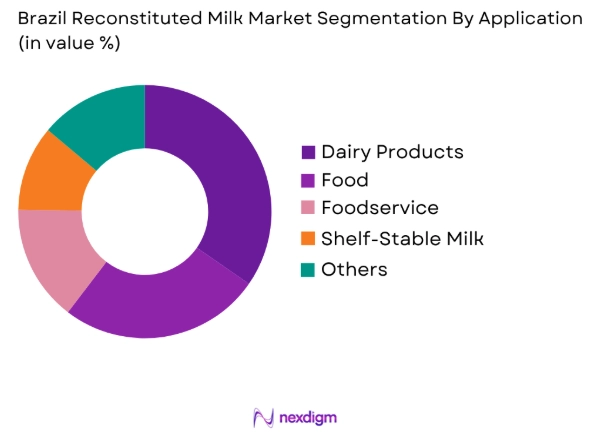
Brazil Reconstituted Milk Market is segmented by distribution channel into UHT and shelf-stable milk, dairy products manufacturing, food and beverage processing, foodservice and HoReCa, institutional procurement and household reconstitution. UHT and shelf-stable milk dominates the market because Brazilian consumers are highly accustomed to long-life milk, aseptic cartons and ambient dairy storage. This makes reconstitution commercially relevant for processors that need standardized milk solids, stable fat composition and long-distance distribution. UHT milk also fits Brazil’s regional logistics structure, where cold-chain intensity varies between the Southeast, South, Northeast and North. Processors use powder-based inputs to balance seasonal raw milk availability, support shelf-stable milk output and serve supermarkets, cash-and-carry retailers, foodservice operators and institutions. The segment’s dominance is also reinforced by Brazil’s broad retail footprint and strong household reliance on convenient dairy formats.
Competitive Landscape
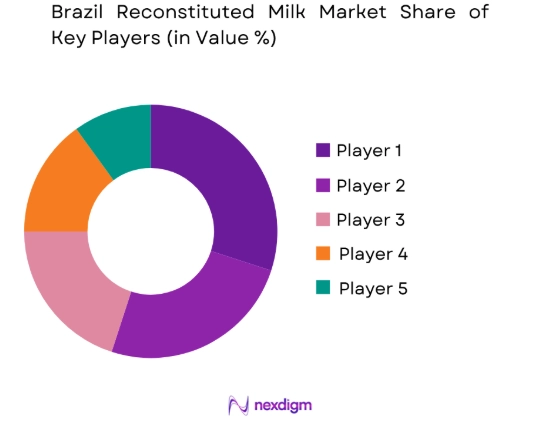
Brazil Reconstituted Milk Market is led by large dairy processors, cooperatives and multinational food companies with strong access to milk collection, UHT processing, milk powder supply, retail brands and foodservice distribution. Lactalis Brasil, Piracanjuba, Itambé, Nestlé Brasil and Italac are among the most influential players because they operate across long-life milk, powdered milk, dairy beverages, cheese, yogurt and value-added dairy. Competition is shaped by regional sourcing, Mercosur import exposure, private-label capability, lactose-free portfolios and control over formal milk collection.
| Company | Establishment Year | Headquarters | Milk Collection / Sourcing Strength | Reconstituted Milk Linkage | UHT / Aseptic Capability | Milk Powder Portfolio | Channel Strength | Strategic Positioning |
| Lactalis Brasil | 1933 | Laval, France / São Paulo operations | ~ | ~ | ~ | ~ | ~ | ~ |
| Grupo Piracanjuba | 1955 | Goiás, Brazil | ~ | ~ | ~ | ~ | ~ | ~ |
| Itambé Alimentos | 1949 | Belo Horizonte, Brazil | ~ | ~ | ~ | ~ | ~ | ~ |
| Nestlé Brasil | 1921 | São Paulo, Brazil | ~ | ~ | ~ | ~ | ~ | ~ |
| Italac | 1996 | Goiás, Brazil | ~ | ~ | ~ | ~ | ~ | ~ |
Brazil Reconstituted Milk Market Analysis
Growth Drivers
Strong Domestic Milk Base Supports Powder Reconstitution and UHT Supply
Brazil Reconstituted Milk Market is supported by a large domestic dairy base that gives processors raw material for UHT milk, whole milk powder, skimmed milk powder, recombined milk and industrial dairy solids. Brazil recorded 35.7 billion liters of cow milk production, while inspected establishments acquired 25,366,095 thousand liters and processed 25,334,686 thousand liters, creating a formal supply base for reconstitution-oriented dairy plants. IBGE also reported 15.1 million milked cows, showing productivity-led supply even with fewer animals. USDA FAS placed Brazil’s cow milk production at 25,000 thousand metric tons, with 17,300 thousand cows in milk, supporting powder and fluid-milk balancing. Macroeconomic demand is reinforced by Brazil’s 205.3 million people and real GDP per capita of USD 10,616, supporting national-scale dairy consumption through supermarkets, atacarejo, foodservice and institutions.
UHT and Packaged Dairy Demand Benefits from Urban Scale and Food Manufacturing
Brazil Reconstituted Milk Market is driven by the country’s urban consumer base and large formal food-processing ecosystem, where shelf-stable dairy formats are commercially important. World Bank data shows Brazil had 205.3 million people and real GDP per capita of USD 10,616, giving dairy processors a broad household and institutional customer base. USDA FAS recorded 11,000 thousand metric tons of fluid domestic consumption and 16,600 thousand metric tons of factory-use consumption, indicating strong downstream use of milk in processed dairy and food manufacturing. IBGE reported 25,334,686 thousand liters of milk processed by inspected establishments, which directly supports UHT milk, powdered milk reconstitution, dairy desserts, bakery ingredients, recombined dairy and foodservice formulations. This scale favors processors that can use powder hydration, homogenization, UHT sterilization and aseptic packaging to distribute dairy products beyond cold-chain-intensive regions.
Market Challenges
Import Dependence on Milk Powder Creates Sourcing Risk for Reconstitution
Brazil Reconstituted Milk Market faces sourcing pressure because reconstitution depends on stable access to milk powders, while Brazil remains exposed to imported dry dairy ingredients. World Bank WITS data shows Brazil imported 39,522,900 kg of milk and cream in solid forms with fat content not exceeding 1.5, including 21,780,000 kg from Argentina and 11,599,100 kg from Uruguay. This matters for reconstituted milk because skimmed powder and nonfat solids are core inputs for recombined milk, UHT dairy, bakery dairy bases and institutional formulations. Domestic milk output is large, with 35.7 billion liters of cow milk production, but formal acquisition reached 25,366,095 thousand liters, leaving processors dependent on collection efficiency, regional availability and import flows. The challenge is intensified by Brazil’s large consumer base of 205.3 million people, which requires consistent dairy supply across multiple regions.
Regional Milk Concentration and Logistics Complexity Affect Reconstituted Dairy Supply
Brazil Reconstituted Milk Market faces operational challenges because milk production and processing are regionally concentrated, while demand is national. IBGE reported 35.7 billion liters of cow milk production, with Castro producing 484.4 million liters, Carambeí 293.1 million liters and Patos de Minas 226.9 million liters, showing the importance of specific dairy clusters. At the same time, inspected milk acquisition stood at 25,366,095 thousand liters and processed milk reached 25,334,686 thousand liters, which means processors rely heavily on inspected collection networks before converting milk into UHT, powder or recombined dairy. World Bank data shows Brazil has 205.3 million people across a federal country with 26 states and the Federal District, creating a distribution challenge for shelf-stable and reconstituted milk companies. This favors large processors but pressures smaller regional players on transport, storage, regulatory compliance and powder availability.
Market Opportunities
Powder-Based Dairy Can Expand in Underserved and Long-Distance Retail Channels
Brazil Reconstituted Milk Market has a strong opportunity in shelf-stable and powder-based dairy because the country’s geography, urban scale and inspected dairy-processing base support wider distribution beyond fresh-milk logistics. Brazil recorded 205.3 million people, while World Bank reported GDP per capita at USD 10,310.5 in current U.S. dollars, creating a large packaged-food and household dairy base. IBGE recorded 25,334,686 thousand liters of processed milk through inspected establishments and 35.7 billion liters of total cow milk production, giving processors enough domestic milk flows to support UHT and reconstituted formats. The opportunity is also supported by imports of 39,522,900 kg of low-fat solid milk and cream, which can be used for powder-based formulations when local solids are insufficient. Companies can use aseptic cartons, sachets, pouches and bulk sacks to serve supermarkets, atacarejo, foodservice distributors and remote-region retail.
Food Manufacturing and Institutional Dairy Use Create Value-Added Reconstitution Potential
Brazil Reconstituted Milk Market has an opportunity in food manufacturing, dairy products, public procurement and foodservice because reconstituted milk can be standardized for protein, fat, solids, lactose-free and fortified applications. USDA FAS recorded 16,600 thousand metric tons of factory-use consumption and 11,000 thousand metric tons of fluid domestic consumption, showing that milk is used both as a beverage and as an industrial input. IBGE reported 25,334,686 thousand liters of processed milk and 27,513,720 thousand liters of acquired milk in the following annual dataset, indicatingn an expanding formal processing base. Brazil’s macroeconomic demand platform is large, with 205.3 million people and real GDP per capita of USD 10,616, which supports packaged dairy, school feeding, hospitals, bakery, confectionery, desserts and UHT milk. Reconstituted milk producers can capture this opportunity through whole milk powder, skimmed powder, butterfat and dairy-solids blends tailored to processors and institutions.
Future Outlook
Brazil Reconstituted Milk Market is expected to expand steadily as processors rely more on powder-based milk solids, UHT formats, lactose-free dairy, fortified milk and food manufacturing applications. The market’s forecasted CAGR for the 2026–2035 period is benchmarked at 3.7% under the long-horizon global reconstituted milk forecast, while Brazil is expected to outperform many mature markets because Latin America is identified as the fastest-growing regional cluster and Brazil leads the regional country outlook. Growth will be supported by stronger UHT adoption, supermarket and atacarejo expansion, rising demand for shelf-stable milk and the use of whole milk powder in household and industrial dairy formulations. Opportunities are strongest in value-added reconstituted milk, lactose-free long-life milk, fortified family dairy products, bakery and confectionery inputs, institutional nutrition programs and B2B dairy ingredients. However, imported milk powder restrictions, producer concerns and state-level regulations in Paraná and Goiás may reshape sourcing models, encouraging processors to rely more on domestic milk solids and formal Brazilian milk collection.
Major Players
- Lactalis Brasil
- Grupo Piracanjuba
- Itambé Alimentos
- Nestlé Brasil
- Italac
- Danone Brasil
- Vigor Alimentos
- Tirol
- Frimesa
- Castrolanda
- CCGL
- Embaré
- Betânia Lácteos
- Selita
- Laticínios Bela Vista
Key Target Audience
- Dairy processors and laticínios
- Milk powder manufacturers and dairy ingredient suppliers
- UHT milk and aseptic packaging companies
- Food and beverage processing companies
- Supermarket, atacarejo and modern retail chains
- Foodservice distributors and HoReCa procurement teams
- Investments and venture capitalist firms
- Government and regulatory bodies (Ministério da Agricultura e Pecuária, ANVISA, CONAB, State Agricultural Defense Agencies, Mercosur dairy trade authorities)
Research Methodology
Step 1: Identification of Key Variables
The initial phase involves constructing an ecosystem map for the Brazil Reconstituted Milk Market, covering dairy farmers, cooperatives, laticínios, milk powder importers, UHT processors, foodservice buyers and retail channels. The objective is to define variables such as milk collection, powder availability, UHT penetration, institutional demand and regional processing capacity.
Step 2: Market Analysis and Construction
This phase compiles historical and current data on milk production, inspected milk acquisition, milk powder trade, UHT consumption, dairy processing and distribution channels. The market is constructed using a top-down dairy balance sheet and a bottom-up model based on processor output, product mix, channel demand and powder-to-liquid conversion.
Step 3: Hypothesis Validation and Expert Consultation
Market hypotheses are validated through structured interviews with dairy processors, powder importers, retail buyers, foodservice distributors, packaging suppliers and institutional procurement stakeholders. These interviews help verify segment assumptions, application-level demand, raw-material sourcing patterns, regulatory impact and channel-level product movement.
Step 4: Research Synthesis and Final Output
The final phase integrates secondary research, primary interviews, company benchmarking and triangulated market modelling. The output is validated through cross-checking published market values, dairy production indicators, company collection data, regulatory developments and segment-level demand patterns to provide a reliable assessment of the Brazil Reconstituted Milk Market.

- Executive Summary
- Research Methodology (Market definitions and assumptions, reconstituted milk classification, leite reconstituído scope, leite recombinado scope, UHT milk inclusion logic, milk powder-to-fluid milk conversion, bottom-up processor validation, top-down dairy balance sheet approach, primary interviews with laticínios and distributors, retail audit across modern trade, foodservice procurement checks, import-export triangulation, limitations and validation framework)

- Definition and Scope
- Market Genesis and Evolution
- Role of Reconstituted Milk in Brazil’s Dairy Industry
- Business Cycle and Seasonality
- Supply Chain and Value Chain Analysis

- Growth Drivers (UHT penetration, powdered milk consumption, supermarket expansion, dairy processing investments, institutional nutrition demand, shelf-stable logistics)
- Market Challenges (Milk powder import exposure, raw milk seasonality, quality control, consumer preference, regulatory scrutiny, logistics cost)
- Opportunities (Lactose-free UHT milk, fortified milk, affordable powder packs, private label, B2B dairy ingredients, institutional tenders)
- Trends (Aseptic packaging, premium powder formats, protein enrichment, lactose-free products, clean-label dairy, cooperative consolidation)
- SWOT Analysis
- PESTLE Analysis
- Porter’s Five Forces

- By Value (2020-2025)
- By Volume (2020-2025)
- By Average Realization Price (2020-2025)

- By Product Type (In Value %)
Whole Reconstituted Milk
Skimmed Reconstituted Milk
Recombined Milk
Fortified Reconstituted Milk - By Distribution Channel (In Value %)
Supermarkets and Hypermarkets
Atacarejo and Cash-and-Carry
Traditional Grocery and Neighborhood Stores
Foodservice Distribution
Institutional Tender Supply - By End User (In Value %)
Households
Dairy Processors
Food and Beverage Manufacturers
Foodservice Operators
Public and Private Institutions - By Region (In Value %)
Southeast
South
Northeast
Central-West
North

- Market Share of Major Players (Value share, volume share, milk collection-linked share, powder-equivalent share, UHT-linked share)
- Cross Comparison Parameters (Milk collection footprint, milk powder sourcing model, UHT and aseptic capability, leite em pó portfolio, regional distribution strength, institutional tender exposure, private label manufacturing capability, Mercosur import linkage)
- SWOT Analysis of Major Players
- SKU and Price Benchmarking
- Detailed Profiles of Major Companies
Lactalis Brasil
Piracanjuba
Itambé Alimentos
Nestlé Brasil
Italac
Danone Brasil
Vigor Alimentos
Tirol
Frimesa
Castrolanda
CCGL
Embaré
Betânia Lácteos
Selita
Laticínios Bela Vista

- Household Consumer Analysis
- Dairy Processor Analysis
- Foodservice Operator Analysis
- Institutional Buyer Analysis
- Food Manufacturer Analysis

- By Value (2026-2035)
- By Volume (2026-2035)
- By Average Realization Price (2026-2035)


 Request a Sample
 Ask for Customization
 Get a Quote
 Enquire Now