

 Download PDF
Market Overview
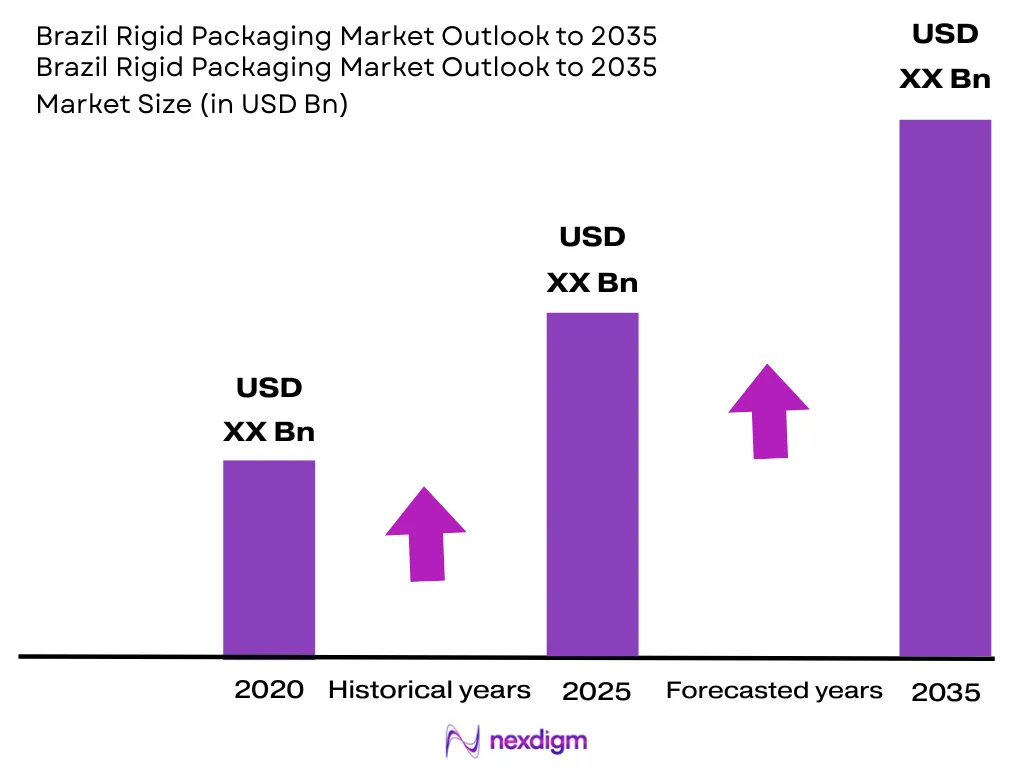
The Brazil Rigid Packaging Market was valued at USD ~ Billion in 2024 and is anticipated to expand at a CAGR of ~% during 2026–2035. The market is primarily driven by the country’s substantial carbonated beverage, beer, and pharmaceutical industries, which continue to rely on rigid formats for their structural strength, pressure resistance, and sterility assurance, alongside continued innovation in PET lightweighting and recycled content adoption. The Brazil Plastic Packaging Market, of which rigid formats represent a substantial share, was valued at USD 17.25 billion in 2025 and is projected to reach USD 18.56 billion by 2030, according to Mordor Intelligence, while rigid plastic packaging accounted for approximately 67.12% of 2025 revenue across the broader South America Plastic Packaging Market, driven by beverage bottles, food trays, and household-chemical containers requiring structural strength and tamper-evident features. The Brazil Plastic Bottles Market alone is projected to grow from USD 320.77 million in 2025 to USD 379.32 million by 2030, at a CAGR of 3.41%, while the Brazil Liquid Packaging Market, in which rigid formats held a 60.47% revenue share in 2024, reached USD 5,293.2 million and is projected to reach USD 6,943.3 million by 2030. Brazil’s National Solid Waste Policy, established under Lei 12.305, obliges producers to collect or offset 22% of plastic sold by 2025 and 55% by 2030, shaping demand across beverage, food, pharmaceutical, and personal care rigid packaging applications.
Market Segmentation
By Material
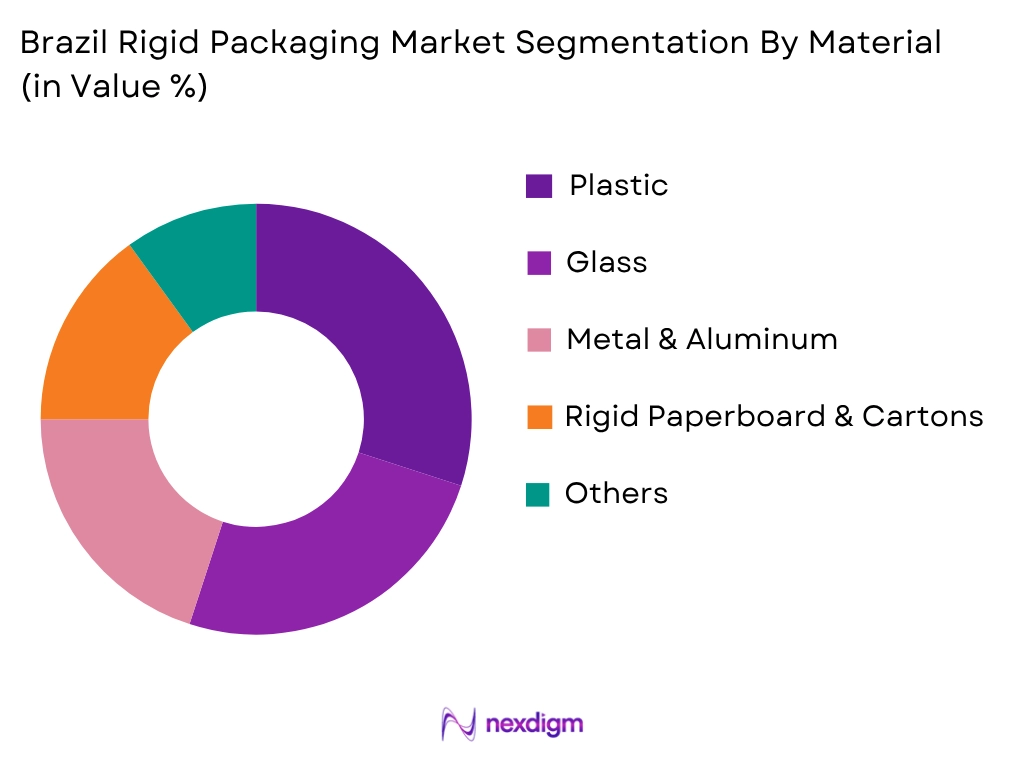
Among these, Plastic, encompassing PET, HDPE, and PP, dominates the Brazil Rigid Packaging Market, with polyethylene alone holding 32.32% of the broader Brazil plastic packaging market in 2024, anchored in versatile film and bottle applications. Polyethylene terephthalate (PET) leads growth at a 4.78% CAGR through 2030, propelled by expanding recycling infrastructure and food-grade post-consumer recycled content approvals equivalent to international standards. Glass retains a substantial and distinctive share of the market, led by Vidroporto S.A., a genuinely Brazilian glass packaging company founded in 1977 in Porto Ferreira, São Paulo, which serves the world’s leading beer brands alongside soft drinks, wines, spirits, and food producers, holding an estimated 20-25% share of the Brazilian glass container market for beverages following its 2018 acquisition of the IVN glassmaking facility in Sergipe. Velaplast, founded in 2012 in Lorena, São Paulo, has carved a specialized niche manufacturing single and multi-layer blow-moulded plastic gallons and bottles for Brazil’s substantial agrochemical, chemical, and oils industries, reflecting the diversity of rigid packaging demand beyond conventional food and beverage applications.
By Application
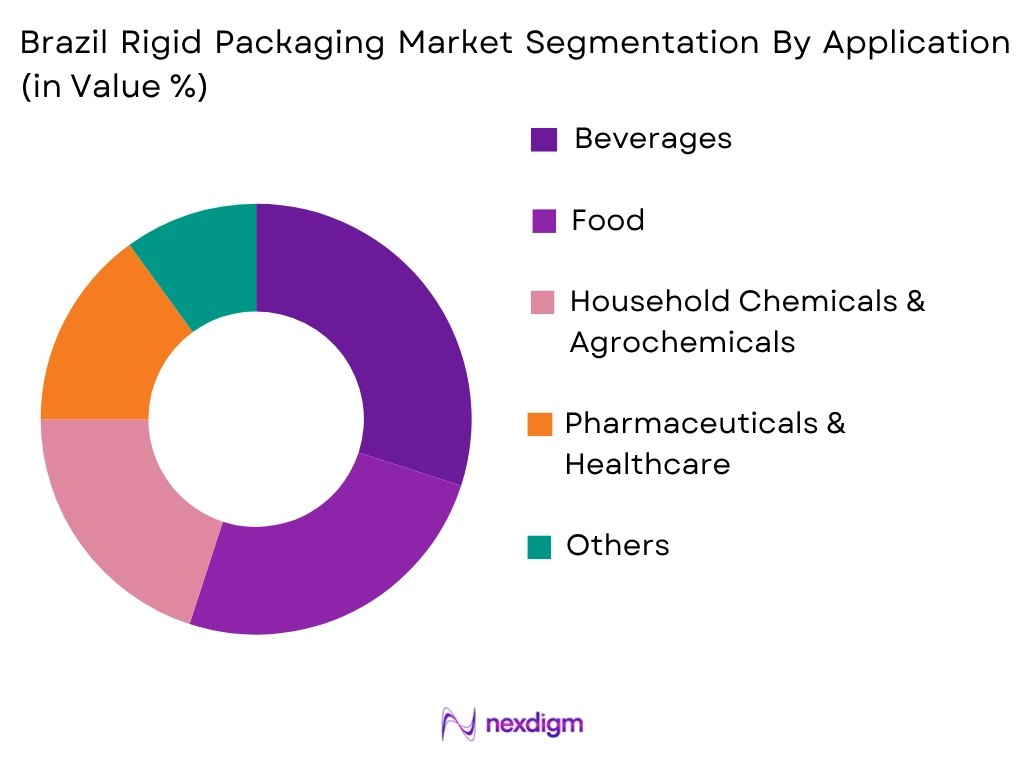
The Beverages segment, encompassing beer, carbonated drinks, and wine, holds the largest share of the Brazil Rigid Packaging Market, as rigid formats continue to dominate categories where internal pressure and oxygen barrier requirements exceed current flexible laminate capabilities. Vidroporto’s extensive glass bottle portfolio serving beer, soft drinks, wine, and spirits producers across Brazil’s southeast and northeast regions exemplifies the beverage industry’s sustained reliance on rigid packaging for premium positioning and product integrity. Injection-stretch-blow PET technology has improved wall distribution, allowing beverage bottle weights to decrease from 33 grams to 28 grams without compromising top-load strength, while ALPLA’s May 2024 introduction of a recyclable PET wine bottle weighing just one-eighth of a traditional glass bottle, cutting carbon footprint by up to 50%, illustrates the ongoing innovation within this dominant application segment. The Household Chemicals & Agrochemicals segment represents a significant and growing category, supported by Velaplast’s specialized high-technology blow-moulded packaging solutions serving Brazil’s large agricultural and industrial chemical sectors.
Competitive Landscape
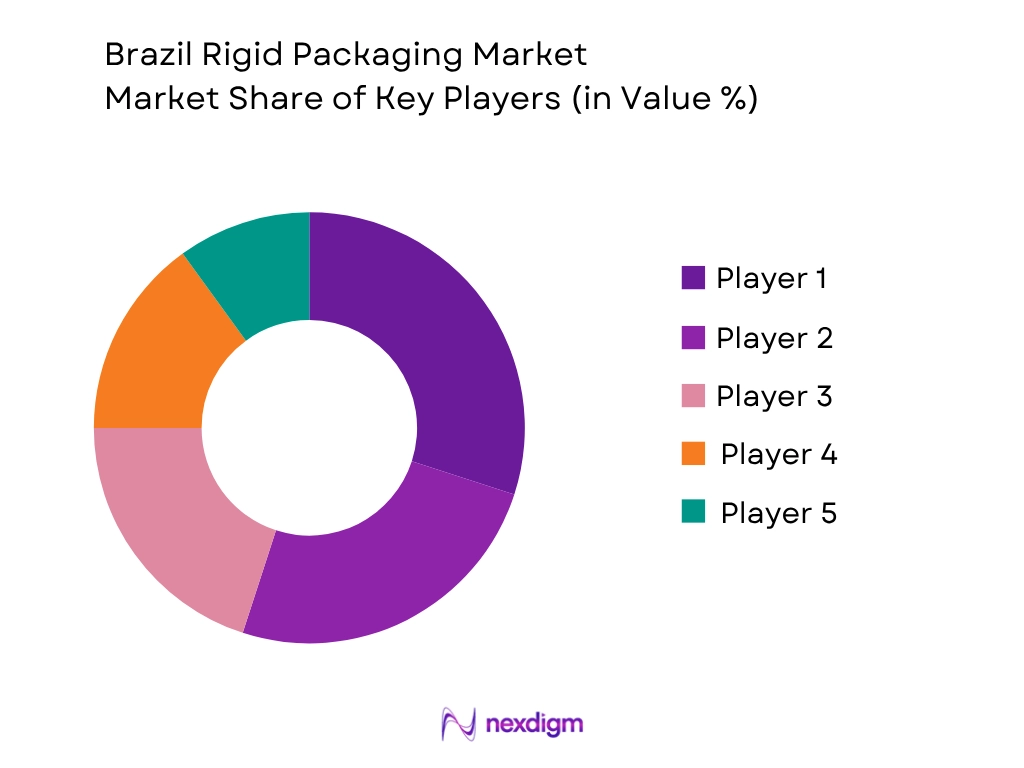
The Brazil Rigid Packaging Market is moderately consolidated, with established domestic glass and specialty plastics manufacturers competing alongside multinational rigid packaging conglomerates that maintain substantial manufacturing operations within the country. Competition is primarily based on manufacturing capacity, glass furnace and blow-moulding technology, recycled content integration, regulatory compliance with Brazil’s National Solid Waste Policy, and the ability to serve Brazil’s substantial beverage, pharmaceutical, and agrochemical industries. Vidroporto, a genuinely national glass packaging company founded in 1977 and now part of the Spanish Vidrala Group, operates strategically located plants across Brazil’s southeast and northeast regions, employing more than 900 people and continuously investing in glass cullet recycling infrastructure through its Recicla Vidro program. Velaplast has built a specialized reputation in high-technology multi-layer plastic packaging for agrochemicals and industrial chemicals since its 2012 founding in Lorena, São Paulo. International players including ALPLA, Amcor, and Berry Global continue to compete on the strength of their global PET lightweighting technology, recycled content innovation, and long-standing relationships with Brazil’s major beverage and consumer goods brands.
| Company | Established | Headquarters | Primary Product Portfolio | Rigid Packaging Portfolio | Manufacturing Presence | Major End-Use Industries | Key Strategic Focus | Certifications & Compliance |
| Vidroporto S.A. | 1977 | ~
|
~ | ~ | ~ | ~ | ~ | ~ |
| Velaplast | 2012 | ~
|
~ | ~ | ~ | ~ | ~ | ~ |
| ALPLA Werke Alwin Lehner | 1955 | ~
|
~ | ~ | ~ | ~ | ~ | ~ |
| Amcor plc | 1860 | ~ | ~ | ~ | ~ | ~ | ~ | ~ |
| Berry Global Inc. | 1967 | ~
|
~ | ~ | ~ | ~ | ~ | ~ |
Brazil Rigid Packaging Market Analysis
Growth Drivers
Carbonated Beverage and Beer Industry Reliance on Rigid Glass and PET
The Brazil Rigid Packaging Market is experiencing sustained growth due to the country’s substantial carbonated beverage, beer, and spirits industries, which continue to rely predominantly on rigid glass and PET packaging formats where internal pressure and oxygen barrier requirements exceed current flexible laminate capabilities. Vidroporto, founded in 1977, serves the world’s leading beer brands alongside soft drinks, wines, spirits, and food producers from its strategically located plants across Brazil’s southeast and northeast regions, reflecting the beverage industry’s sustained dependence on rigid glass packaging for both functional performance and premium brand positioning. Rigid formats still dominate the carbonated drinks and dairy industries specifically due to these structural requirements, ensuring continued baseline demand for glass and PET rigid packaging even as flexible alternatives continue gaining share in other packaging categories across Brazil.
PET Lightweighting and Recycled Content Innovation
Continued innovation in PET lightweighting and recycled content adoption remains a significant driver of the Brazil Rigid Packaging Market. Rigid-pack producers are actively light-weighting preforms, shaving 1.8 grams per 2-liter PET bottle without compromising top-load strength, while injection-stretch-blow PET technology has enabled beverage bottle weights to decrease from 33 grams to 28 grams. ALPLA’s May 2024 introduction of a recyclable PET wine bottle made entirely from recycled PET, weighing just one-eighth of a traditional glass bottle and cutting carbon footprint by up to 50% while offering cost savings of up to 30%, exemplifies this innovation trajectory. Amcor’s April 2024 unveiling of a one-liter carbonated soft drink bottle crafted entirely from post-consumer recycled PET further demonstrates how leading rigid packaging manufacturers continue to align lightweighting and sustainability innovation with Brazil’s evolving regulatory and consumer expectations.
Market Challenges
Naphtha and Resin Price Volatility
The Brazil Rigid Packaging Market faces significant challenges from naphtha and resin price volatility that continue to pressure manufacturer margins. Brent crude oscillated between USD 70 and USD 90 per barrel in 2024, translating into polyethylene spot price swings of USD 1,050 to USD 1,350 per ton in Brazil, while Braskem invoked force majeure clauses on some long-term agreements after naphtha prices rose 18% sequentially in the third quarter of 2024. Because pass-through clauses often lag 60 to 90 days, rigid packaging converters suffer significant margin compression when resin prices spike mid-contract, prompting brand owners to respond with take-or-pay deals that secure volume and price ceilings, reducing spot market liquidity available to smaller rigid packaging processors across Brazil.
National Solid Waste Policy EPR Compliance Costs
Brazil’s National Solid Waste Policy, established under Lei 12.305, obliges rigid packaging producers to collect or offset 22% of plastic sold by 2025, rising to 55% by 2030, creating substantial compliance costs across the Brazil Rigid Packaging Market. Reverse-logistics consortia have emerged, pooling container makers, brand owners, and recyclers to share transport costs for post-consumer materials, yet recycling infrastructure development remains uneven across material types. While paper converters meet recovery targets through well-established cartonboard recovery streams, flexible-film reclaim lags significantly at 18%, illustrating the varying pace of recycling infrastructure maturity that rigid packaging manufacturers must navigate as they work to meet Brazil’s escalating collection targets.
Market Opportunities
Recycled Glass and Cullet Circular Economy Investment
Growing investment in glass cullet recycling infrastructure presents substantial opportunities for rigid packaging manufacturers operating in the Brazil Rigid Packaging Market. Vidroporto’s Recicla Vidro program has revitalized glass collection points across Porto Ferreira and neighboring cities, establishing a dedicated logistics fleet and expanded collection network that streamlines recycling and reduces reliance on virgin raw materials such as sand and limestone. Every 10% increase in recycled glass used in Vidroporto’s furnaces reduces the company’s carbon dioxide emissions by 5%, illustrating the direct sustainability benefits available to manufacturers that invest in circular glass packaging infrastructure, creating meaningful opportunities for companies capable of scaling similar cullet recycling and collection programs across Brazil’s broader glass packaging value chain.
Specialty Rigid Packaging for Agrochemicals and Industrial Chemicals
Brazil’s substantial agribusiness and industrial chemical sectors present significant opportunities for specialty rigid packaging manufacturers capable of developing high-technology, multi-layer blow-moulded containers. Velaplast’s specialized focus on single and multi-layer plastic packaging solutions for agrochemicals, chemicals, and oils, requiring a high degree of technical sophistication, demonstrates the substantial demand potential within this specialized segment beyond conventional food and beverage rigid packaging applications. As Brazil’s position as one of the world’s largest agricultural producers continues to drive demand for crop protection chemicals and industrial inputs, rigid packaging manufacturers capable of meeting the stringent containment, chemical resistance, and safety requirements of these specialized applications are well positioned to capture growing demand across the country’s expanding agrochemical and industrial chemical sectors.
Future Outlook
The Brazil Rigid Packaging Market is expected to witness sustained expansion over the forecast period, supported by continued reliance on rigid glass and PET packaging across the beverage and pharmaceutical industries, ongoing innovation in PET lightweighting and recycled content adoption, and growing demand for specialty rigid packaging serving Brazil’s agrochemical and industrial chemical sectors. Continued investment in glass cullet recycling infrastructure and post-consumer recycled PET capacity is expected to strengthen the market’s sustainability credentials and support compliance with Brazil’s escalating National Solid Waste Policy collection targets. The market is also likely to benefit from continued premiumization of spirits, wine, and beer packaging, supporting long-term growth across beverage, food, pharmaceutical, and industrial chemical rigid packaging applications.
Major Players
- Vidroporto S.A.
- Velaplast
- ALPLA Werke Alwin Lehner
- Amcor plc
- Berry Global Inc.
- Silgan Holdings Inc.
- Sidel Group
- Plastipak Holdings Inc.
- Owens-Illinois (O-I Glass)
- Crown Holdings Inc.
- Braskem S.A.
- Sonoco Products Company
- Mondi Group
- Grupo Tecnicasa (Vidrala)
- Rigesa Celulose, Papel e Embalagens
Key Target Audience
- Rigid Packaging Manufacturers and Converters
- Beverage Companies (Beer, Wine, Spirits & Carbonated Drinks)
- Food and Pharmaceutical Companies
- Personal Care and Cosmetics Companies
- Agrochemical and Industrial Chemical Companies
- Recycling and Waste Management Companies
- Investment and Venture Capitalist Firms
- Government and Regulatory Bodies (Ministério do Meio Ambiente, Agência Nacional de Vigilância Sanitária (ANVISA), Associação Brasileira de Embalagem (ABRE))
- Raw Material Suppliers and Resin Manufacturers
Research Methodology
Step 1: Identification of Key Variables
The research process begins with identifying the complete ecosystem of the Brazil Rigid Packaging Market, including raw material suppliers, glass and plastic packaging manufacturers, converters, beverage and pharmaceutical companies, and regulatory authorities. Extensive secondary research is conducted using company annual reports, government publications, trade associations, customs statistics, industry journals, and proprietary databases to determine the variables influencing market demand, pricing, production, consumption, and technological developments.
Step 2: Market Analysis and Construction
Historical market information is collected and analyzed to estimate market size, production volumes, import-export activity, application-wise demand, and pricing trends. A combination of top-down and bottom-up approaches is used to estimate market revenues and validate segment-level performance. Consumption patterns across beverages, food, pharmaceuticals, and industrial chemicals are evaluated to establish an accurate representation of the industry.
Step 3: Hypothesis Validation and Expert Consultation
The preliminary findings are validated through Computer-Assisted Telephone Interviews (CATIs) and structured discussions with rigid packaging manufacturers, procurement managers, converters, beverage industry executives, regulatory experts, and senior executives operating within the Brazilian packaging industry. These interviews help verify market assumptions, competitive developments, technology adoption trends, pricing dynamics, and future investment opportunities while refining the overall market estimates.
Step 4: Research Synthesis and Final Output
The final stage integrates insights obtained from primary interviews with quantitative information collected through secondary sources. Data triangulation techniques are applied to reconcile differences between supply-side and demand-side estimates, ensuring robust market forecasting. The report is then reviewed through multiple quality assurance checkpoints to deliver a comprehensive analysis covering market size, segmentation, competitive landscape, future outlook, and strategic recommendations for industry stakeholders.

- Executive Summary
- Research Methodology (Market Definitions and Assumptions, Abbreviations, Market Sizing Approach, Top-Down Analysis, Bottom-Up Analysis, Demand-Side Assessment, Supply-Side Assessment, Primary Industry Interviews, Secondary Research Validation, Data Triangulation, Forecasting Framework, Limitations and Future Conclusions)

- Definition and Scope
- Market Evolution and Industry Genesis
- Timeline of Major Industry Developments
- Rigid Packaging Industry Value Chain Analysis
- Supply Chain Analysis

- Growth Drivers (Explosive E-Commerce Growth, Regulatory and Retailer-Driven Shift to Sustainable Materials, Growth of Social Commerce and Premium Unboxing, Expansion of Automotive and Industrial Manufacturing, Rising Electronics and Appliance E-Commerce Sales, Growth of Cross-Regional Distribution Networks)
- Market Challenges (Vast Geographic Distances and Climate Variability, Fragmented Regulatory Landscape Across Municipal and Federal Levels, High Logistics Costs Across Multileg Distribution Chains, Raw Material and Energy Cost Volatility, Currency Fluctuation Impacting Imported Components, Infrastructure Gaps in Northeast and Amazonia Regions)
- Market Opportunities (Automation and Right-Sizing Technology Investment, Premium Unboxing and Digital Printing for Social Commerce, Moisture-Barrier Innovation for Humid Climate Regions, Eucalyptus Fiber and Sustainable Material Innovation, Regional Distribution Hub Expansion, Public-Private Sustainability Partnerships)
- Market Trends (Automated Right-Sizing Pack Stations, Growth of Eucalyptus Fiber and Recyclable Kraftliner, Moisture-Barrier Coating Innovation, Digital Printing for Branded Unboxing Experiences, Rise of E-Commerce-Dedicated Packaging Marketplaces, Growing Use of Crush-Resistant Board Grades)
- Government Regulations (National Solid Waste Policy (PNRS) Reverse Logistics Obligations, ANVISA Food-Contact Packaging Requirements, São Paulo and Rio de Janeiro Single-Use Plastic Reduction Decrees, Green Seal Program Certification, INMETRO Packaging Standards, State-Level Environmental Licensing Requirements)
- Import and Export Analysis (Trade Volume, Major Import Sources, Export Destinations, HS Code Analysis, Trade Balance)
- Raw Material Availability Analysis (Domestic Eucalyptus Pulp and Kraftliner Production, Recovered Fiber and Recycled Paper Availability, Imported Plastic Resin Feedstocks, Foam and Polyurethane Feedstocks, Regional Pulp and Paper Mill Capacity)
- Technology Landscape (Automated Right-Size Packaging Systems, Corrugated Board Manufacturing Technology, Molded Pulp Production Technology, Digital Printing for Personalization, Moisture-Barrier Coating Technology)
- Sustainability Assessment (Recyclable and Compostable Material Adoption, Eucalyptus Fiber Sourcing Initiatives, Carbon Footprint Reduction in Long-Haul Distribution, Reduced Single-Use Plastic Adoption, Circular Economy Alignment)
- PESTLE Analysis
- SWOT Analysis
- Porter’s Five Forces Analysis
- Stakeholder Ecosystem
- Competition Ecosystem

- By Market Value (2020-2025)
- By Volume Consumption (2020-2025)
- By Average Selling Price (2020-2025)

- By Material (In Value %)
Plastic (PET, HDPE & PP)
Glass
Metal & Aluminum
Rigid Paperboard & Cartons - By Product Type (In Value %)
Bottles & Jars
Trays & Containers
Caps & Closures
Cans - By Application (In Value %)
Beverages (Beer, Carbonated Drinks & Wine)
Food
Pharmaceuticals & Healthcare
Personal Care & Cosmetics
Household Chemicals & Agrochemicals
Industrial & Automotive - By Region (In Value %)
Southeast Brazil
South Brazil
Northeast Brazil
Central-West & North Brazil

- Market Share of Major Players (By Value, Volume, Material Type, End-Use Industry, Distribution Reach)
- Cross Comparison Parameters (Recyclable/Sustainable Portfolio Breadth, Automation and Right-Sizing Capability, Moisture-Barrier Technology Portfolio, Application Technical Support, Manufacturing Capacity, Regulatory Compliance & Certifications, Customer Base, Innovation & New Product Launch Frequency)
- SWOT Analysis of Major Players
- Pricing Analysis by Product Category and Format
- Production Capacity Analysis
- Manufacturing Footprint Analysis
- Distribution Network Analysis
- Innovation Benchmarking
- Detailed Profiles of Major Companies
Vidroporto S.A.
Velaplast
ALPLA Werke Alwin Lehner
Amcor plc
Berry Global Inc.
Silgan Holdings Inc.
Sidel Group
Plastipak Holdings Inc.
Owens-Illinois (O-I Glass)
Crown Holdings Inc.
Braskem S.A.
Sonoco Products Company
Mondi Group
Grupo Tecnicasa (Vidrala)
Rigesa Celulose, Papel e Embalagens

- Consumption Pattern Analysis (Order Volume Intensity, Parcel Size Distribution, End-Use Industry Penetration, Seasonal and Peak-Period Demand, Multileg Distribution Impact)
- Purchasing Criteria (Crush Resistance, Moisture-Barrier Performance, Cost Efficiency, Regulatory Compliance, Recyclability, Brand Customization Capability)
- Procurement and Supplier Selection Analysis
- Sustainable and Recyclable Packaging Adoption Assessment
- Premium Branded vs Standard Protective Packaging Demand
- Product Attribute Preference Analysis (Crush Resistance, Moisture-Barrier Performance, Dimensional Efficiency, Print and Brand Customization, Ease of Assembly, Recyclability)
- Sustainability & ESG Influence on Procurement Decisions
- Pain Point Analysis
- Decision-Making Process

- By Market Value (2026-2035)
- By Volume Consumption (2026-2035)
- By Average Selling Price (2026-2035)


 Request a Sample
 Ask for Customization
 Get a Quote
 Enquire Now