
 Download PDF
 Download PDF
Market Overview
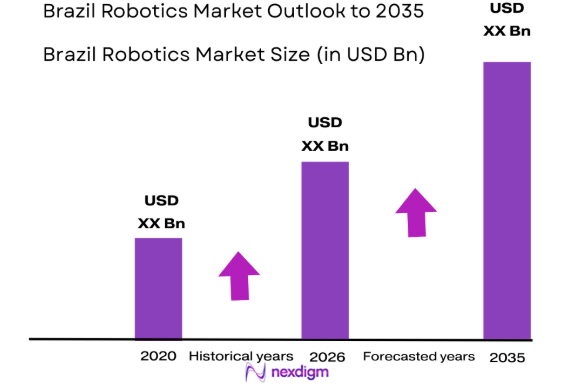
The Brazil Robotics market is experiencing substantial growth, driven by the increasing adoption of automation technologies in sectors such as manufacturing, healthcare, and logistics. Based on a recent historical assessment, the market size is projected to reach approximately USD ~ billion, reflecting a significant rise in demand for robotics solutions. This growth is primarily attributed to advancements in artificial intelligence, machine learning, and robotic process automation, enhancing productivity and operational efficiency in various industries.
Brazil remains a dominant player in Latin America’s robotics sector, driven by its vast industrial base and increasing technological infrastructure. São Paulo and Rio de Janeiro stand out as key cities with substantial investments in automation. The growing presence of multinational companies and government initiatives to support industrial modernization have contributed significantly to the region’s leadership. Furthermore, Brazil’s strategic role as an industrial hub in South America further strengthens its position in the robotics market.
Market Segmentation
By System Type
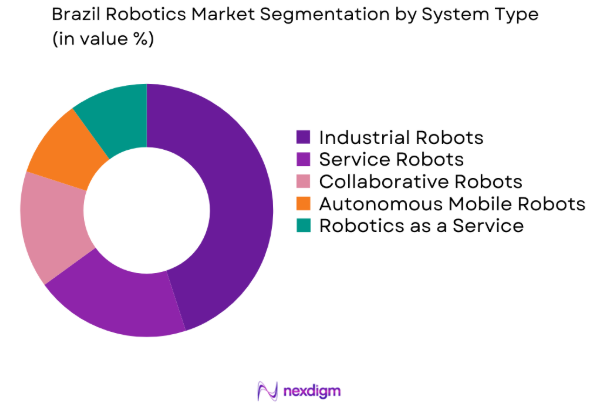
The Brazil Robotics market is segmented by system type into industrial robots, service robots, collaborative robots, autonomous mobile robots, and robotics as a service. Recently, industrial robots have dominated the market due to the large-scale implementation in manufacturing, automotive, and electronics sectors. The high demand for automation to improve efficiency, reduce operational costs, and enhance productivity in industries has been the driving factor. Furthermore, the robustness and versatility of industrial robots in handling repetitive and hazardous tasks have made them a preferred choice in large-scale production lines.
By End User Segment
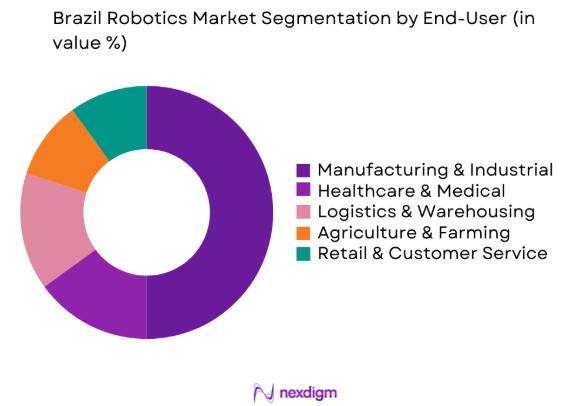
The Brazil Robotics market is segmented by end-user into manufacturing & industrial, healthcare & medical, logistics & warehousing, agriculture & farming, and retail & customer service. Recently, the manufacturing and industrial sectors have been the dominant end-users, with a significant increase in the adoption of robotics to streamline production lines and reduce manual labor. The need for precision, speed, and the ability to work in hazardous environments has increased the reliance on robotics for manufacturing tasks. As Brazil continues to expand its industrial base, the demand for robotics in these sectors is expected to grow.
Competitive Landscape
The Brazil Robotics market is highly competitive, with several multinational and local players vying for market share. Leading companies have consolidated their positions through technological innovation, partnerships, and strategic acquisitions. The rise of automation across industries such as manufacturing and healthcare has intensified the competition, pushing companies to develop more advanced robotics solutions. Major players in the market are also focusing on expanding their operations in Brazil, given its position as a key manufacturing hub in Latin America. The competition is expected to grow as new technologies such as AI-driven robots and collaborative robots gain traction.
| Company Name | Establishment Year | Headquarters | Technology Focus | Market Reach | Key Products | Revenue (USD) | Market-Specific Parameter |
| ABB Robotics | 1988 | Zürich, Switzerland | ~ | ~ | ~ | ~ | ~ |
| KUKA Robotics | 1898 | Augsburg, Germany | ~ | ~ | ~ | ~ | ~ |
| FANUC Corporation | 1956 | Oshino, Japan | ~ | ~ | ~ | ~ | ~ |
| Universal Robots | 2005 | Odense, Denmark | ~ | ~ | ~ | ~ | ~ |
| Mitsubishi Electric Corporation | 1921 | Tokyo, Japan | ~ | ~ | ~ | ~ | ~ |

Brazil Robotics Market Analysis
Growth Drivers
Automation Advancements
Automation advancements are a key driver in Brazil’s robotics market, particularly in the manufacturing and industrial sectors. The integration of AI, machine learning, and robotics has significantly boosted operational efficiency, resulting in cost reductions. By automating production processes, companies can achieve faster production speeds, higher quality outputs, and reduced human error, all of which are crucial for maintaining competitiveness in a global market. Robotics also enhances safety by performing hazardous tasks, while increasing throughput and minimizing downtime. These benefits have contributed to the widespread adoption of robotics in industries such as automotive, electronics, and logistics, driving substantial growth across Brazil’s robotics market.
Government Support for Robotics
Brazil’s government has been instrumental in driving robotics adoption by offering incentives, grants, and creating policies that support robotics research and development. Its emphasis on modernizing infrastructure and enhancing industrial productivity has created an environment conducive to technological advancements in sectors like manufacturing and healthcare. Additionally, the government’s strategic focus on promoting innovation through public-private partnerships has attracted substantial investments into the robotics sector. These efforts are not only fostering technological adoption but also encouraging the development of cutting-edge solutions across industries, further fueling the growth of robotics in Brazil. This supportive government approach continues to propel the market, positioning Brazil as a leader in robotics in Latin America.
Market Challenges
High Initial Investment Costs
The high initial investment required for robotic systems is a major challenge in Brazil’s robotics market. The cost of industrial robots, coupled with the necessary infrastructure, creates a significant barrier for smaller companies looking to adopt these technologies. Although robotics offer long-term benefits like labor cost savings and improved productivity, the upfront expenses deter many businesses from making the leap. Additionally, companies are often hesitant to invest due to uncertainties surrounding return on investment (ROI) and ongoing operational costs. This reluctance to invest in new technologies, driven by financial concerns, slows down the broader adoption of robotics across various sectors in Brazil.
Lack of Skilled Workforce
As robotics technology advances, the demand for highly skilled professionals to operate, program, and maintain complex robotic systems in Brazil is rising. However, there is a significant shortage of workers with the necessary expertise, hindering the widespread adoption of robotics. The lack of specialized training programs and the fast pace of technological change make it challenging for the workforce to stay up-to-date with the latest innovations. This skills gap not only limits the effective deployment of robotics in various sectors but also impacts the overall growth of the robotics market in Brazil. The shortage of skilled professionals remains a critical barrier to maximizing the potential of robotics technology in the country.
Opportunities
Healthcare Robotics
The healthcare sector in Brazil offers a significant growth opportunity for robotics, driven by the aging population and rising healthcare demands. Robots are increasingly being adopted in surgery, rehabilitation, and patient care to improve precision, enhance patient management, and reduce recovery times. The COVID-19 pandemic further accelerated the need for contactless medical services, fostering the adoption of robotic solutions in healthcare settings. With advancements in robotic-assisted surgery and remote patient monitoring, the healthcare sector presents vast potential for growth. Additionally, government initiatives to modernize the healthcare infrastructure provide a favorable environment for robotics companies, making this sector a key area for expansion and innovation in Brazil’s robotics market.
Agricultural Robotics
Agriculture is a key sector in Brazil’s economy, and the adoption of robotics in this field presents a growing opportunity. Robotic systems for tasks such as planting, harvesting, and crop monitoring help address labor shortages and increase operational efficiency. The rise of precision agriculture, fueled by advancements in sensors and AI, is driving the demand for agricultural robots. These technologies enable farmers to optimize crop yields, monitor field conditions in real-time, and reduce costs. With the Brazilian government’s support for smart farming initiatives, the agricultural robotics market is expected to expand significantly. This growth presents valuable opportunities for robotics manufacturers to innovate and meet the rising demand for automation in Brazil’s agricultural sector.
Future Outlook
The future of the Brazil Robotics market looks promising, with a strong emphasis on technological innovation and increasing investments. Over the next five years, the demand for robotics across industries such as manufacturing, healthcare, and logistics is expected to grow significantly. Key trends such as the rise of collaborative robots, AI integration, and automation in agriculture will drive market growth. Moreover, government support for robotics research and development, coupled with advancements in artificial intelligence, is likely to spur further adoption, contributing to the overall expansion of the market.
Major Players
- ABB Robotics
- KUKA Robotics
- FANUC Corporation
- Universal Robots
- Mitsubishi Electric Corporation
- Yaskawa Electric Corporation
- Omron Corporation
- Kawasaki Robotics
- Epson Robots
- Teradyne
- Denso Robotics
- Siemens Robotics
- Rockwell Automation
- AUBO Robotics
- Stäubli Robotics
Key Target Audience
- Investments and venture capitalist firms
- Government and regulatory bodies
- Robotics system integrators
- Industrial manufacturing companies
- Healthcare institutions
- Agriculture technology providers
- Logistics and warehousing firms
- Automation solution providers
Research Methodology
Step 1: Identification of Key Variables
Identify key market drivers, challenges, and technological trends that influence the robotics market in Brazil.
Step 2: Market Analysis and Construction
Analyze historical data, industry reports, and market forecasts to construct the overall market model.
Step 3: Hypothesis Validation and Expert Consultation
Validate hypotheses through expert consultations and primary research with key industry players.
Step 4: Research Synthesis and Final Output
Synthesize the findings and present them in a comprehensive market report, highlighting key insights and forecasts.

- Executive Summary
- Research Methodology (Definitions, Scope, Industry Assumptions, Market Sizing Approach, Primary & Secondary Research Framework, Data Collection & Verification Protocol, Analytic Models & Forecast Methodology, Limitations & Research Validity Checks)

- Market Definition and Scope
- Value Chain & Stakeholder Ecosystem
- Regulatory / Certification Landscape
- Sector Dynamics Affecting Demand
- Strategic Initiatives & Infrastructure Growth

- Growth Drivers
Increasing Adoption of Robotics in Manufacturing
Technological Advancements in AI and Automation
Government Support for Robotics Innovation - Market Challenges
High Initial Investment Costs
Technological Integration and Compatibility Issues
Lack of Skilled Workforce - Market Opportunities
Growth in Healthcare Robotics
Robotic Automation in Agriculture
Adoption of Robotics in Retail - Trends
Rise of Autonomous Mobile Robots
Increased Use of AI in Robotics
Growth of Robotics as a Service - Government Regulations
- SWOT Analysis of Key Competitors
- Porter’s Five Forces

- By Market Value, 2020-2025
- By Installed Units, 2020-2025
- By Average System Price, 2020-2025
- By System Complexity Tier, 2020-2025

- By System Type (In Value%)
Industrial Robots
Service Robots
Collaborative Robots
Autonomous Mobile Robots
Robotics as a Service - By Platform Type (In Value%)
Mobile Platforms
Stationary Platforms
Integrated Platforms
Modular Platforms
Robotic Arms - By Fitment Type (In Value%)
On-premise Solutions
Cloud-based Solutions
Hybrid Solutions
Modular Solutions
Integrated Solutions - By End User Segment (In Value%)
Manufacturing & Industrial
Healthcare & Medical
Logistics & Warehousing
Agriculture & Farming
Retail & Customer Service - By Procurement Channel (In Value%)
Direct Procurement
Government Tenders
Private Sector Procurement
Online Bidding Platforms
Third-party Distributors

- Market Share Analysis
- Cross Comparison Parameters (System Type, Platform Type, Procurement Channel, End User Segment, Fitment Type, Geographic Region, Technological Advancements, Product Lifecycle, Application Areas, Market Adoption Rates)
- SWOT Analysis of Key Competitors
- Pricing & Procurement Analysis
- Key Players
ABB Robotics
KUKA Robotics
FANUC Corporation
Yaskawa Electric Corporation
Universal Robots
Intuitive Surgical
iRobot
Mitsubishi Electric Corporation
Omron Corporation
Kawasaki Heavy Industries
Autonomous Solutions Inc.
Boston Dynamics
Cyberdyne
SICK AG
Denso Robotics

- Increased Demand from Industrial Manufacturers
- Healthcare Providers Investing in Robotic Technologies
- Logistics Firms Integrating Robotics Solutions
- Agricultural Sectors Adopting Precision Robotics

- Forecast Market Value, 2026-2035
- Forecast Installed Units, 2026-2035
- Price Forecast by System Tier, 2026-2035
- Future Demand by Platform, 2026-2035


 Request a Sample
 Ask for Customization
 Get a Quote
 Enquire Now