
 Download PDF
 Download PDF
Market Overview
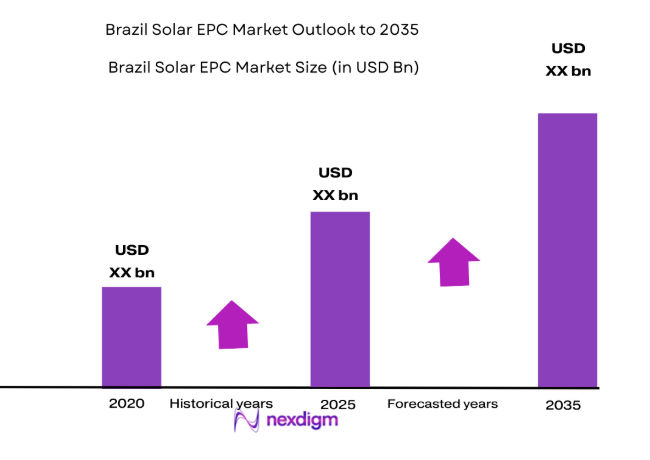
The Brazil Solar EPC market is valued at USD ~ billion, driven by increasing investments in renewable energy projects, government incentives, and favorable regulatory frameworks. The market is growing as Brazil seeks to expand its renewable energy capacity, with solar energy being a key focus due to its abundant natural resources and the country’s commitment to meeting energy demands through sustainable solutions. The government’s focus on clean energy technologies and solar power installations continues to fuel market expansion.
Brazil’s solar EPC market is dominated by key regions like São Paulo, Minas Gerais, and Bahia, which have seen the most significant investments and developments in solar projects. These areas benefit from favorable solar radiation levels and government support for infrastructure, making them attractive for solar energy installations. Additionally, these regions have well-established industrial sectors, facilitating easy access to equipment and skilled labor.
Market Segmentation
By Product Type
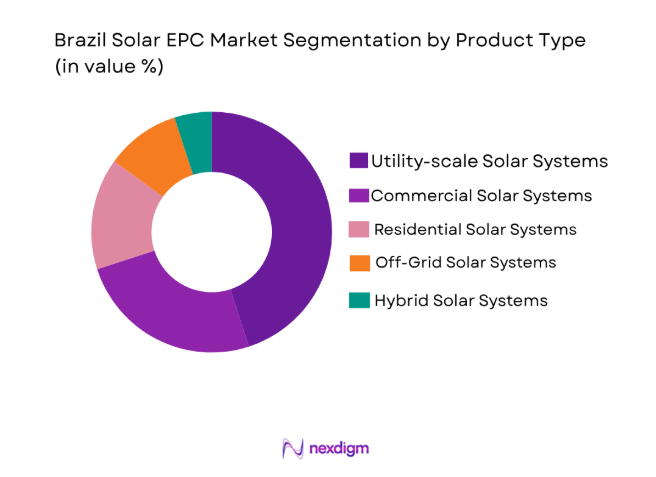
Brazil Solar EPC market is segmented by product type into utility-scale, commercial, residential, off-grid, and hybrid solar systems. The utility-scale solar systems segment is dominating the market share due to factors such as large-scale government projects and high demand from industrial sectors. The increasing need for sustainable energy generation at a large scale, along with the decreasing costs of solar power, has made utility-scale solar systems an attractive choice for energy providers and investors.
By Platform Type
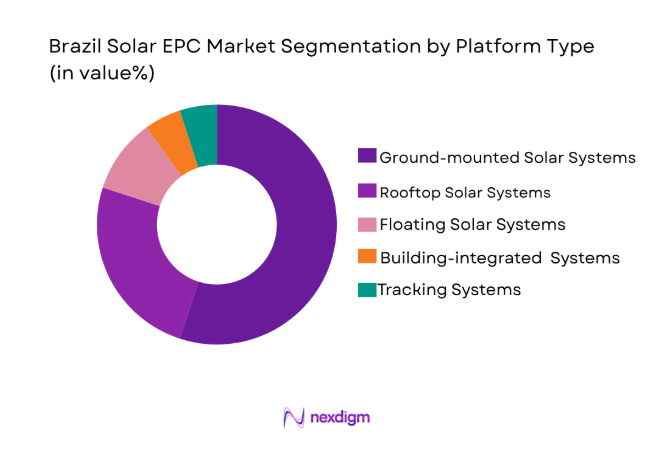
Brazil Solar EPC market is segmented by platform type into ground-mounted, rooftop, floating, building-integrated, and tracking systems. Ground-mounted solar systems have the largest market share due to their scalability and efficiency for utility-scale projects, making them the preferred choice for large-scale solar farms. Their adaptability to various terrains and favorable long-term economic returns make them a solid investment for both public and private entities.
Competitive Landscape
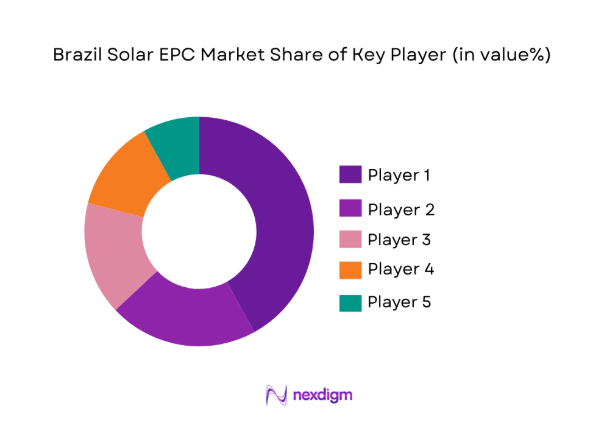
The competitive landscape in Brazil’s Solar EPC market is characterized by consolidation, with major international and domestic players actively involved in large-scale solar projects. Leading players like Enel Green Power and First Solar are key drivers of market growth, contributing through innovations, technological advancements, and large infrastructure projects. The market is increasingly competitive, with companies focusing on reducing costs through technological improvements and expanding their portfolio of solar installations.
| Company Name | Establishment Year | Headquarters | Technology Focus | Market Reach | Key Products | Revenue (USD Billion) | Market-Specific Parameter |
| Enel Green Power | 2008 | Italy | ~ | ~ | ~ | ~ | ~ |
| First Solar | 1999 | USA | ~ | ~ | ~ | ~ | ~ |
| Neoenergia | 1997 | Brazil | ~ | ~ | ~ | ~ | ~ |
| Trina Solar | 1997 | China | ~ | ~ | ~ | ~ | ~ |
| Canadian Solar | 2001 | Canada | ~ | ~ | ~ | ~ | ~ |
Brazil Solar EPC Market Analysis
Growth Drivers
Government Support for Renewable Energy
The Brazilian government’s robust commitment to renewable energy adoption is a primary growth driver for the solar EPC market. Through various initiatives and incentives, including tax breaks, subsidies, and long-term energy purchase agreements, the government has actively encouraged investments in solar power projects. With the goal to fulfill 45% of the country’s energy needs through renewable sources, the government continues to strengthen the market position by offering economic incentives and regulatory frameworks. This support has significantly lowered the cost barriers associated with solar power adoption, making it more feasible for businesses and consumers to transition to solar energy. Government policies aimed at reducing carbon emissions, combined with international pressure to meet sustainability goals, have further stimulated market demand. As the government remains committed to expanding clean energy capacity, it is expected to foster increased investments in solar EPC projects, resulting in accelerated market growth. The long-term vision for the country’s energy transition continues to fuel confidence among stakeholders, creating a positive ecosystem for solar energy development in Brazil.
Technological Advancements in Solar Power
Technological innovations in solar panel efficiency and energy storage are playing an integral role in the growth of the solar EPC market in Brazil. Recent advancements in photovoltaic cell technologies have contributed to increased efficiency, resulting in lower costs and improved performance of solar systems. These innovations have made solar power more economically viable, helping it compete against traditional energy sources, which are becoming increasingly expensive and environmentally unsustainable. Additionally, energy storage systems are gaining traction as they provide a reliable means to store excess energy generated during the day, making it available during the night or cloudy periods. This enhances the overall system reliability, making it more attractive for commercial and industrial sectors. As the technology behind solar power continues to improve, it is expected that the costs of installations will continue to decrease while performance increases, making solar energy an even more competitive and attractive solution. Moreover, ongoing research in improving storage solutions promises a future where solar power can be efficiently harnessed 24/7, further solidifying its position in Brazil’s energy mix.
Market Challenges
High Initial Capital Investment
One of the major challenges faced by the Brazil Solar EPC market is the significant upfront capital required for solar installations. Despite the promise of long-term savings and environmental benefits, the initial cost for solar power systems, including equipment, installation, and integration with the grid, can be a substantial barrier. For smaller businesses and residential consumers, the high capital investment required remains a critical hurdle, especially in areas where access to financing options is limited. While financing mechanisms such as loans and government incentives are available, the costs still pose challenges, particularly for those in less economically developed regions of Brazil. These financial obstacles prevent a larger portion of the population from adopting solar power solutions, slowing the overall market growth. This issue is further exacerbated by the need for skilled labor and infrastructure to install solar systems, adding to the overall project costs. The high initial cost of solar power systems continues to be a significant barrier to widespread adoption, particularly in rural and underserved areas.
Regulatory and Policy Uncertainty
Despite the Brazilian government’s efforts to incentivize solar power development, regulatory and policy uncertainty remains a significant challenge for the market. Inconsistent policies and frequent changes to regulations, such as alterations to import duties, tax incentives, and permitting processes, can disrupt the smooth execution of solar projects. This unpredictability raises costs and extends project timelines, leading to a lack of confidence among developers and investors. The complexity of navigating through multiple regulatory bodies and compliance standards further complicates the situation, creating delays and inefficiencies in the project development process. In some regions, limited governmental oversight and support in enforcing regulations can hinder the timely approval and execution of solar energy projects. Without consistent policy frameworks and clearer regulatory guidelines, the growth of Brazil’s solar EPC market could be impeded, delaying the country’s transition to renewable energy and reducing its attractiveness to international investors.
Opportunities
Expansion in Rural Areas
Brazil’s rural areas present a significant growth opportunity for the solar EPC market, primarily due to the lack of reliable access to the national grid. Many remote communities in the country continue to rely on diesel generators or other non-renewable energy sources, which are expensive and environmentally harmful. Solar EPC projects focused on off-grid solar systems provide an effective and sustainable energy solution, particularly in rural areas with abundant solar radiation. The Brazilian government’s emphasis on energy decentralization and rural electrification further supports the expansion of solar energy in these underserved regions. As these areas lack the infrastructure to connect to the national grid, off-grid solar installations become a reliable and cost-effective alternative for meeting energy demands. Solar power offers a cleaner, more affordable energy option that can help improve the living conditions of rural communities, reduce energy costs, and contribute to the country’s renewable energy goals. Furthermore, rural solar projects align with the global push for more sustainable energy solutions and have the potential to attract international investments and partnerships, driving further growth in the solar EPC market.
Solar-Powered Storage Solutions
As the demand for stable and reliable energy continues to grow, solar-powered storage solutions represent a promising opportunity for the solar EPC market in Brazil. The integration of energy storage systems with solar power offers a solution to the intermittent nature of solar energy generation. These systems store excess energy produced during the day, allowing businesses and residential users to use it during periods of low sunlight, such as nighttime or cloudy days. The increasing demand for consistent energy access, particularly in remote or off-grid areas, makes solar-powered storage systems a highly attractive option. Additionally, with technological advancements, the cost of energy storage solutions is gradually decreasing, making them more accessible to a wider range of consumers. In Brazil, where grid stability can sometimes be an issue, solar-powered storage is becoming an essential part of energy infrastructure. The growing interest in battery storage, coupled with falling prices, is expected to lead to rapid market expansion. As Brazil looks to modernize its energy infrastructure, solar storage solutions will play a crucial role in ensuring energy security and meeting the country’s renewable energy goals.
Future Outlook
The Brazil Solar EPC market is expected to experience substantial growth over the next five years, driven by supportive government policies, technological advancements, and increasing demand for sustainable energy solutions. Technological developments in solar panel efficiency and energy storage will make solar installations more cost-competitive and accessible, encouraging both large-scale and residential solar adoption. Additionally, Brazil’s commitment to expanding its renewable energy capacity aligns with global sustainability goals, making solar power a critical component of the country’s future energy strategy.
Major Players
- Enel Green Power
- First Solar
- Neoenergia
- Trina Solar
- Canadian Solar
- JinkoSolar
- SunPower
- Siemens Gamesa
- LONGi Solar
- Hanergy
- Soltec
- ABB
- Fronius
- SMA Solar Technology
- Q CELLS
Key Target Audience
- Investments and venture capitalist firms
- Government and regulatory bodies
- Energy developers and EPC contractors
- Utility companies
- Financial institutions
- Residential property developers
- Commercial real estate companies
Research Methodology
Step 1: Identification of Key Variables
We identify and define the key market variables that are critical to understanding the solar EPC market dynamics.
Step 2: Market Analysis and Construction
We analyze the market structure and segmentation, evaluating factors like market value, product types, and regional trends to construct an accurate market model.
Step 3: Hypothesis Validation and Expert Consultation
We validate market hypotheses through consultation with industry experts, focusing on technological trends, regulatory frameworks, and market behavior.
Step 4: Research Synthesis and Final Output
We synthesize findings from primary and secondary research, culminating in the development of actionable market insights and forecasts for the solar EPC market.

- Executive Summary
- Research Methodology (Definitions, Scope, Industry Assumptions, Market Sizing Approach, Primary & Secondary Research Framework, Data Collection & Verification Protocol, Analytic Models & Forecast Methodology, Limitations & Research Validity Checks)

- Market Definition and Scope
- Value Chain & Stakeholder Ecosystem
- Regulatory / Certification Landscape
- Sector Dynamics Affecting Demand
- Strategic Initiatives & Infrastructure Growth

- Growth Drivers
Government Incentives for Renewable Energy
Declining Solar System Costs
Technological Advancements in Solar Panels - Market Challenges
High Initial Capital Investment
Regulatory and Policy Uncertainties
Integration with Existing Grid Infrastructure - Market Opportunities
Emerging Demand in Rural Areas
Expansion of Distributed Generation Models
Growth in Solar-Powered Storage Solutions - Trends
Rise in Hybrid Solar Solutions
Increase in Utility-Scale Solar Installations - Government Regulations
- SWOT Analysis
- Porter’s Five Forces

- By Market Value, 2020-2025
- By Installed Units, 2020-2025
- By Average System Price, 2020-2025
- By System Complexity Tier, 2020-2025

- By System Type (In Value%)
Utility-Scale Solar Systems
Commercial Solar Systems
Residential Solar Systems
Off-Grid Solar Systems
Hybrid Solar Systems - By Platform Type (In Value%)
Ground-Mounted Solar Systems
Rooftop Solar Systems
Floating Solar Systems
Building-Integrated Photovoltaics
Tracking Systems - By Fitment Type (In Value%)
On-Grid Solutions
Off-Grid Solutions
Hybrid Solutions
Modular Solutions - By End User Segment (In Value%)
Commercial Sector
Residential Sector
Industrial Sector

- Market Share Analysis
- Cross Comparison Parameters (System Type, Platform Type, Fitment Type, End User Segment, Region, Procurement Channel, Pricing Strategy)
- SWOT Analysis of Key Competitors
- Pricing & Procurement Analysis
- Key Players
Enel Green Power
Neoenergia
Iberdrola
EDP Renováveis
Solar Brasil
First Solar
SunPower
Siemens Gamesa
Trina Solar
JinkoSolar
Canadian Solar
Sungrow Power
Hanergy
LONGi Solar
JA Solar

- Commercial Sector Driving Large-Scale Projects
- Residential Market Growth in Suburban Areas
- Urban Commercial Adoption of Rooftop Solutions
- Growing Demand in Industrial Applications

- Forecast Market Value, 2026-2035
- Forecast Installed Units, 2026-2035
- Price Forecast by System Tier, 2026-2035
- Future Demand by Platform, 2026-2035


 Request a Sample
 Ask for Customization
 Get a Quote
 Enquire Now