

 Download PDF
Market Overview
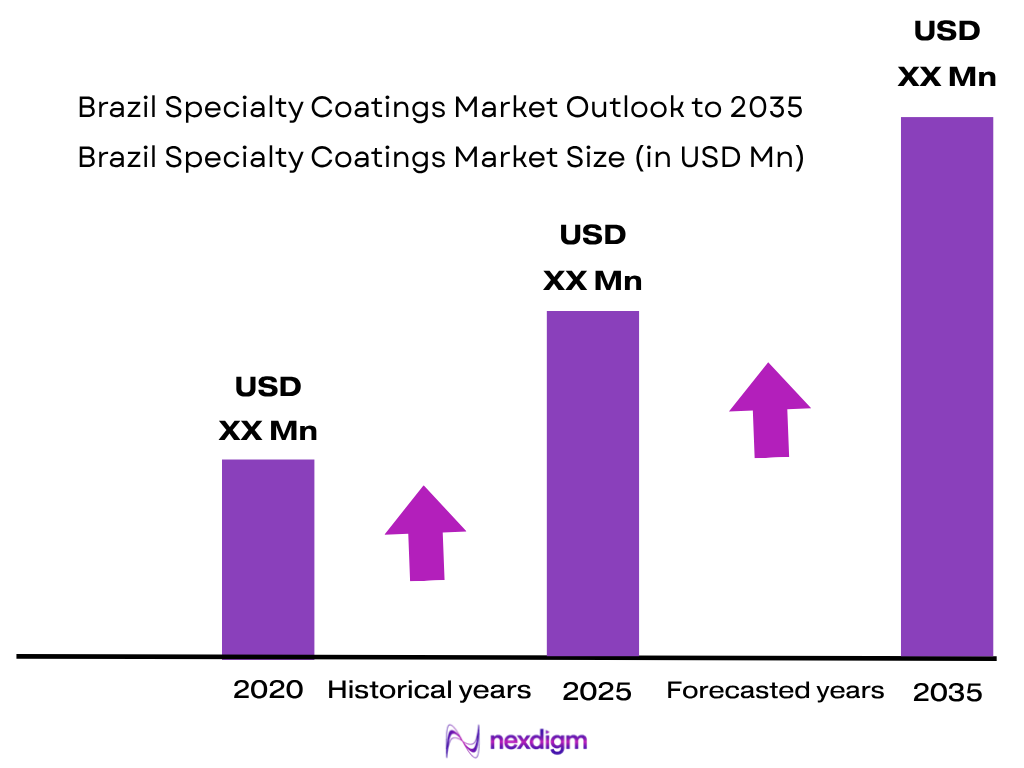
The Brazil Specialty Coatings Market is valued at approximately ~USD X.X billion, supported by a national coatings industry whose production increased from 1.871 billion liters to 1.983 billion liters across the latest two reported annual periods. Industrial coatings alone reached 382 million liters in the latter period, while automotive OEM coatings reached 36 million liters, highlighting strong specialty demand from manufacturing, infrastructure, transportation, corrosion protection, and industrial maintenance applications.
Dominant Industrial Locations: São Paulo and its industrial belt dominate specialty-coating consumption through automotive, machinery, metal fabrication and OEM manufacturing, while Rio de Janeiro is critical for offshore oil, gas and marine protection. Minas Gerais provides substantial mining and heavy-industry demand, while Guaramirim and the wider Santa Catarina manufacturing corridor support industrial and powder coatings. Vehicle production increased from roughly 2.32 million to 2.55 million units, while national oil output moved from 3.402 million to 3.358 million barrels per day, sustaining high-performance coating requirements.
Market Segmentation
By Coating Type
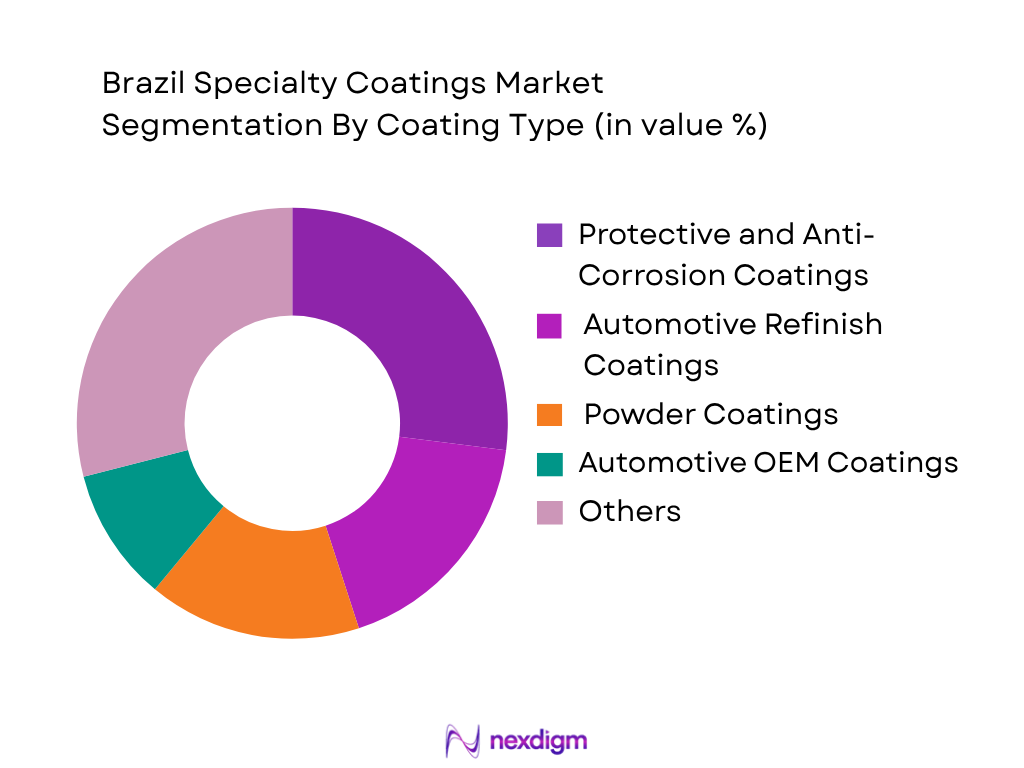
The Brazil Specialty Coatings Market is segmented by coating type into protective and anti-corrosion coatings, marine and offshore coatings, automotive OEM coatings, automotive refinish coatings, powder coatings, industrial wood coatings, industrial floor coatings, packaging coatings, fire-protective coatings, and high-temperature and chemical-resistant coatings. Protective and anti-corrosion coatings represent the dominant specialty category because Brazil maintains large offshore petroleum assets, mining operations, steel structures, pipelines, refineries, ports and industrial plants exposed to humidity, salt spray, chemical attack and abrasion. The country’s offshore petroleum system is particularly important because pre-salt production represents the majority of national petroleum output, requiring coating systems for atmospheric, splash-zone, immersion and process-equipment protection. Mining operations in Minas Gerais and Pará further support epoxy, polyurethane, zinc-rich and abrasion-resistant technologies. Brazil’s infrastructure investment pipeline and maintenance requirements also favor coatings that extend asset life and reduce shutdown frequency.
By Resin Type
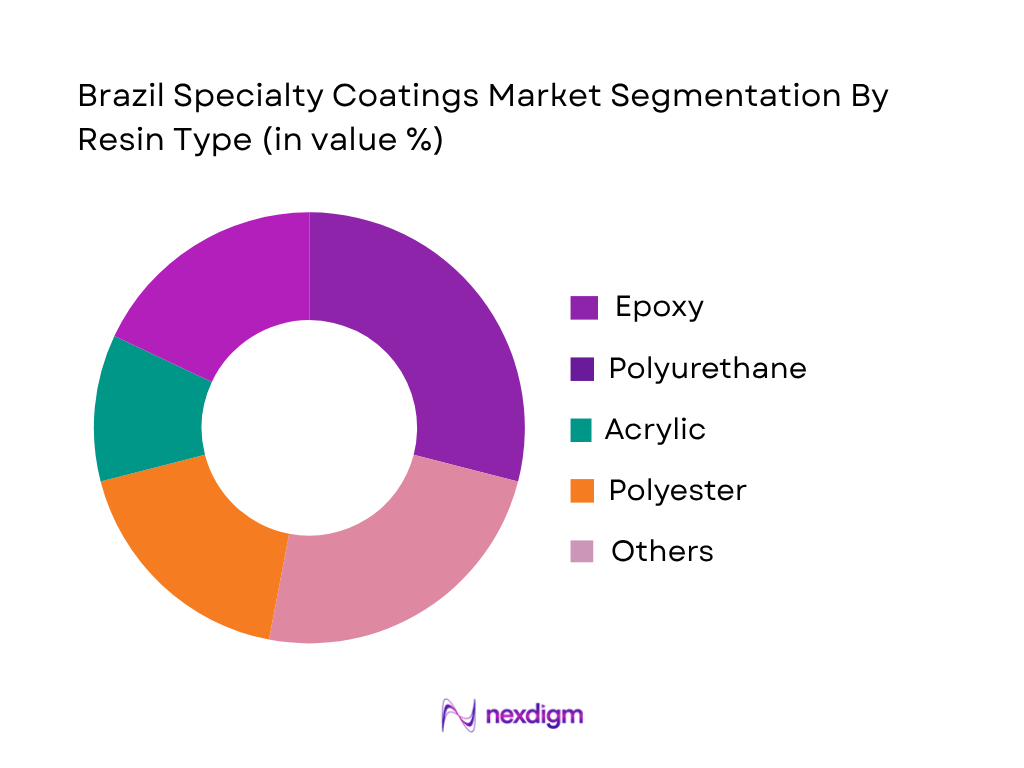
The Brazil Specialty Coatings Market is segmented by resin type into epoxy, polyurethane, acrylic, polyester, alkyd, polysiloxane, fluoropolymer/PVDF, silicone, vinyl and other high-performance resin systems. Epoxy represents the leading specialty resin category, particularly in protective and industrial applications, because of its adhesion, barrier properties, chemical resistance and compatibility with high-build coating systems. Epoxy systems are extensively suited to steel structures, pipelines, storage tanks, mining installations, floors and offshore assets where substrate protection is more important than decorative performance. Polyurethane remains especially important for UV-resistant topcoats, automotive refinishing and applications requiring gloss retention and abrasion resistance. Polyester chemistry is closely linked to powder coatings, while polysiloxanes and fluoropolymers occupy higher-value niches requiring extended weatherability. Protective-coatings research for Brazil also identifies epoxy as the largest resin family within that performance-intensive market.
Competitive Landscape
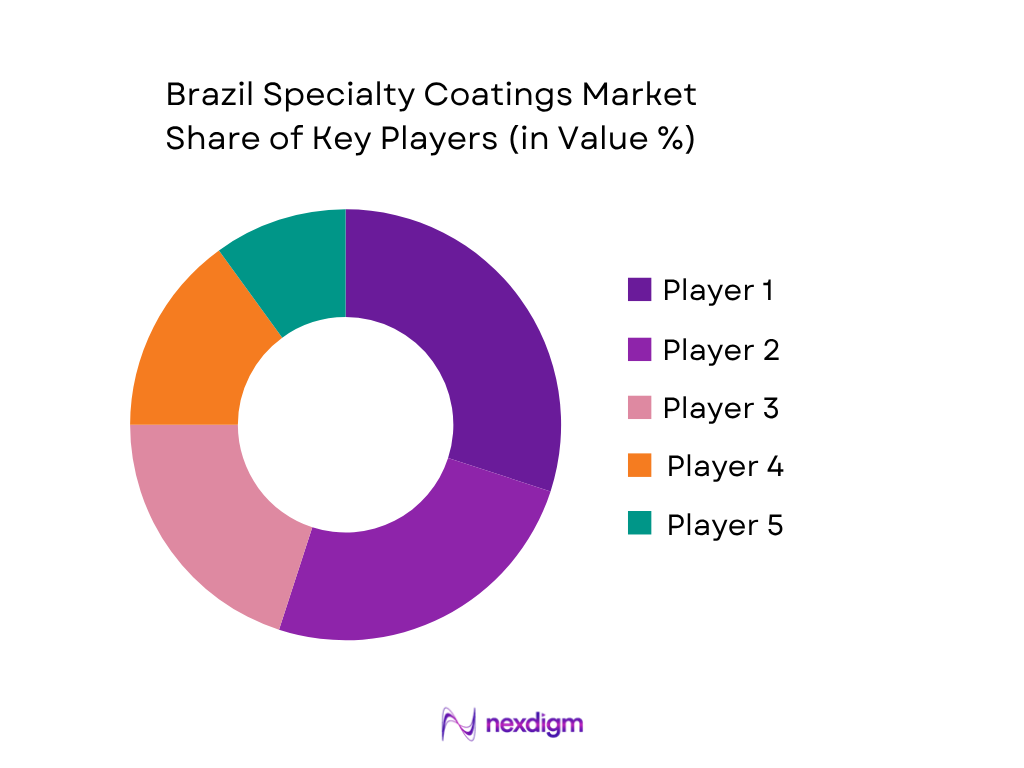
The Brazil Specialty Coatings Market combines large multinational coating groups with technically capable domestic manufacturers. AkzoNobel, Sherwin-Williams, PPG and Axalta compete through global automotive, protective, industrial and specialty technologies, while WEG Tintas has a particularly significant domestic industrial footprint. Competition is determined less by retail visibility and more by OEM approvals, coating-system performance, local manufacturing, specification acceptance, technical service, applicator relationships and regional logistics. Brazil’s coatings industry consequently rewards companies able to combine formulation technology with localized customer support.
| Company | Establishment Year | Headquarters | Brazil Manufacturing Footprint | Key Specialty Technologies | Protective/Marine Capability | Automotive Capability | Powder Coatings Capability | Major End-Use Exposure |
| AkzoNobel | 1994* | Amsterdam, Netherlands | ~ | ~ | ~ | ~ | ~ | ~ |
| Sherwin-Williams | 1866 | Cleveland, USA | ~ | ~ | ~ | ~ | ~ | ~ |
| PPG Industries | 1883 | Pittsburgh, USA | ~ | ~ | ~ | ~ | ~ | ~ |
| Axalta Coating Systems | 2013** | Philadelphia, USA | ~ | ~ | ~ | ~ | ~ | ~ |
| WEG Tintas | 1983 | Guaramirim, Brazil | ~ | ~ | ~ |
Brazil Specialty Coatings Market Analysis
Growth Drivers
Expansion of Oil, Gas, Mining and Heavy-Industrial Asset Base
Brazil’s specialty coatings demand is strongly supported by the scale and operating intensity of petroleum, mining, metals and heavy-industrial assets that require continuous corrosion, abrasion, chemical and weathering protection. The World Bank records Brazil’s 2024 GDP at USD 2.18582 trillion, GDP per capita at USD 10,310.5, and population at approximately 205.3 million people, providing the macroeconomic foundation for one of Latin America’s largest industrial production ecosystems. The coatings opportunity is especially visible in petroleum operations. Brazil’s National Agency of Petroleum, Natural Gas and Biofuels recorded average crude-oil production of 3.358 million barrels per day during 2024 and average natural-gas production of 153 million cubic metres per day. Combined oil and gas production reached 4.322 million barrels of oil equivalent per day. Such operating volumes translate into extensive fleets of offshore production units, pipelines, subsea installations, process equipment, storage facilities, terminals and associated steel infrastructure that face saltwater, humidity, hydrocarbons and aggressive atmospheric exposure. The same structural requirement exists in mining. Brazil’s National Mining Agency reported production of 447.202 million tonnes of beneficiated iron ore in 2024 and documented Brazilian proved and probable iron-ore reserves of 58.2 billion tonnes.
Automotive Manufacturing and Industrial Production Supporting High-Performance Coating Consumption
Brazil’s automotive manufacturing base is another major demand driver because vehicle production requires technically specified coating systems across body shells, components, wheels, chassis, plastics and repair applications. Against a 2024 national GDP of USD 2.18582 trillion and GDP per capita of USD 10,310.5, the country maintained manufacturing scale capable of supporting dedicated OEM paint shops, component suppliers, refinish networks and industrial coating lines. The Brazilian vehicle manufacturers’ association recorded total production of 2,549,595 vehicles in 2024, including 2,380,594 light vehicles. December alone accounted for 190,131 assembled vehicles, illustrating the continuous throughput that coating suppliers must support with electrodeposition coatings, primers, basecoats, clearcoats, sealants and component coatings. The importance for specialty coatings extends beyond complete vehicles. Every assembled vehicle includes coated steel, aluminium, polymer and component surfaces, while suppliers of wheels, brake components, underbody parts, chassis structures and fabricated assemblies use powder, liquid, electrophoretic and corrosion-protection technologies. The government’s industrial policy environment is also pushing greater technological complexity in local vehicle manufacturing. The Ministry of Development, Industry, Commerce and Services reported that announced investments in the automotive and parts industry had reached BRL 130 billion, while the Mover industrial program established BRL 19.5 billion in tax credits through its policy framework to encourage innovation, energy efficiency and lower-carbon vehicle technologies.
Market Challenges
Dependence on Complex Raw-Material and Chemical Supply Chains
The Brazil Specialty Coatings Market faces a structural supply-chain challenge because high-performance formulations depend on a broader and more technically demanding raw-material basket than conventional coatings. Brazil’s 2024 economy generated USD 2.18582 trillion of GDP and served a population of approximately 205.3 million, but large domestic economic scale does not eliminate exposure to internationally sourced epoxy intermediates, isocyanates, specialty curing agents, functional additives, corrosion inhibitors, fluorinated chemistries, performance pigments and selected resin technologies. Specialty coating manufacturers must maintain formulation continuity while supplying industrial sectors operating at very high physical volumes. ANP data show petroleum production averaging 3.358 million barrels per day and natural-gas production averaging 153 million cubic metres per day during 2024, while the National Mining Agency records 447.202 million tonnes of beneficiated iron-ore production. These end markets cannot easily tolerate coating-system disruption because coating materials are tied to shutdown schedules, fabrication sequences, inspection programs and asset commissioning. A shortage of a particular curing agent, corrosion pigment or resin can therefore affect an entire specified coating system rather than merely a single SKU. Logistics complexity adds to the problem. Brazil covers approximately 8.5 million square kilometres and includes more than 5,500 municipalities, according to the World Bank, while specialty-coating demand is dispersed across offshore bases in Rio de Janeiro and Espírito Santo, mining clusters in Minas Gerais and Pará, automotive and industrial centres in São Paulo and southern Brazil, and energy projects in northeastern states.
Application Complexity, Qualification Requirements and Large Geographic Service Footprint
Specialty coatings in Brazil face a second challenge in the technical execution required between formulation and actual field performance. The World Bank places Brazil’s 2024 population at approximately 205.3 million people, spread across an 8.5 million square-kilometre territory and more than 5,500 municipalities, while GDP reached USD 2.18582 trillion. This geographic scale matters because demanding applications occur in widely separated industrial clusters and frequently under different climatic and operating conditions. An offshore maintenance project near Rio de Janeiro, a mining installation in Pará, an automotive paint line in São Paulo and a renewable-energy project in Bahia require different application systems, technical-service capabilities and qualification procedures. Specialty-coating performance depends on factors such as abrasive blasting, surface cleanliness, salt contamination, substrate profile, ambient temperature, humidity, dry-film thickness, induction time, mixing ratio and curing conditions. These execution requirements become more consequential as industrial throughput increases. Brazil produced 2,549,595 vehicles in 2024, meaning OEM coating suppliers must maintain repeatable line performance across millions of bodies and components while controlling appearance, corrosion protection and curing. Petroleum operations handled average production of 3.358 million barrels of crude per day and 153 million cubic metres of natural gas per day, requiring coating work on assets where failure can cause expensive maintenance interruptions. Mining facilities processed 447.202 million tonnes of beneficiated iron ore, creating extreme abrasion and corrosion exposure across conveyors, crushers, loading systems and fabricated steel.
Market Opportunities
Renewable-Energy and Electrical Infrastructure Creating New Protective-Coating Applications
Brazil’s rapid build-out of electricity-generation infrastructure creates a substantial future opportunity for specialty-coatings suppliers because today’s installed equipment establishes a long-lived base of assets requiring initial coating, repair and lifecycle protection. The opportunity is supported by current operating data rather than future capacity assumptions. The World Bank records Brazil’s 2024 GDP at USD 2.18582 trillion, GDP per capita at USD 10,310.5, and population at approximately 205.3 million, providing the economic scale needed to support large power-generation and transmission networks. The Ministry of Mines and Energy reported that Brazil added 10.9 GW of electricity-generation capacity during 2024, the highest annual addition recorded since the current expansion series began. A total of 301 new power plants entered operation across 16 states, including 147 solar photovoltaic plants providing 5,629.69 MW, 121 wind plants providing 4,260.57 MW, 22 thermal plants providing 906.70 MW, 9 small hydroelectric plants providing 51.80 MW, and 2 hydro generating facilities providing another 4.60 MW. Each of these categories creates distinct coatings requirements. Wind towers require high-durability corrosion-protection systems for large fabricated-steel structures, nacelles and internal surfaces; coastal and northeastern wind farms expose coated structures to salt, ultraviolet radiation, temperature cycling and humidity.
Infrastructure Modernization, Offshore Development and Localization of High-Performance Coating Systems
Brazil presents a future opportunity for specialty-coatings manufacturers to expand localized high-performance production around infrastructure, offshore petroleum, transportation and industrial-maintenance applications. The case is supported by the present size of the underlying physical asset base rather than by speculative future market statistics. Brazil’s GDP stood at USD 2.18582 trillion in 2024, with GDP per capita of USD 10,310.5 and a population of approximately 205.3 million, according to the World Bank. Public infrastructure activity is creating additional surfaces requiring corrosion-resistant and durable coating systems. The Brazilian Development Bank’s 2024 infrastructure portfolio included the Rio–São Paulo highway concession program with plans involving approximately 600 kilometres of additional lanes and duplication of 80 kilometres along Rio-Santos, while another highway program included 444 kilometres of duplication work. A separate federal concession lot covered 426 kilometres of highway. These are important indicators for specialty coatings because transport infrastructure creates requirements across bridges, guardrails, steel structures, maintenance equipment, signage structures, terminals and fabricated components. Offshore energy adds a more technically demanding opportunity.
Future Outlook
The Brazil Specialty Coatings Market is expected to expand at a forecast CAGR of approximately ~X.X% during the forecast period, supported by offshore oil and gas development, industrial asset maintenance, vehicle manufacturing, mining, renewable energy and infrastructure investment. Demand is expected to migrate progressively toward high-solids, powder, waterborne and longer-life coating systems. Performance requirements related to corrosion resistance, shorter curing cycles, lower VOC content and reduced maintenance downtime will increasingly influence product specifications. Protective coatings should remain strategically important as Brazil expands and maintains offshore assets, ports, pipelines, processing facilities, mining equipment and energy infrastructure. National petroleum production remains heavily offshore, and pre-salt production represented 78.8% of total domestic petroleum production in the reported period, creating a structurally important addressable market for corrosion-control technologies.
Automotive coatings should also benefit from Brazil’s established vehicle manufacturing base. Industry production reached approximately 2.55 million vehicles, while automotive OEM coating volumes reached 36 million liters, indicating the scale of substrate treatment, electrodeposition, primer, basecoat, clearcoat and component-coating demand. Sustainability will reshape technology selection. Waterborne, powder and high-solids formulations are increasingly relevant where buyers seek lower solvent consumption and improved application efficiency. Brazil’s chemical-management framework under Law No. 15,022 establishes a national inventory of chemical substances and obligations applicable to producers and importers, increasing the strategic importance of formulation compliance and raw-material traceability.
Major Players
- AkzoNobel
- Sherwin-Williams
- PPG Industries
- Axalta Coating Systems
- WEG Tintas
- Jotun Brasil
- Renner Herrmann
- Renner Sayerlack
- Montana Química
- Kansai Helios / WEILBURGER Brasil
- Killing Tintas e Adesivos
- Iquine
- Resicolor Tintas
- Revprol
- Tekno
Key Target Audience
- Specialty Coatings Manufacturers
- Industrial Resin, Pigment, Additive and Specialty Chemical Suppliers
- Automotive OEMs and Automotive Component Manufacturers
- Oil & Gas, Mining, Marine, Energy and Heavy-Industrial Asset Owners
- EPC Contractors, Industrial Applicators and Specialty Coatings Distributors
- Investments and Venture Capitalist Firms
- Government and Regulatory Bodies (Ministry of Development, Industry, Commerce and Services; Ministry of Environment and Climate Change; IBAMA; ANP; INMETRO)
- Corporate Strategy, Business Development and Mergers & Acquisitions Teams
Research Methodology
Step 1: Identification of Key Variables
The first stage involves constructing the Brazil Specialty Coatings Market ecosystem across coating manufacturers, resin suppliers, additive producers, OEMs, industrial asset owners, distributors and applicators. Secondary research is used to identify variables including industrial coatings consumption, automotive output, offshore assets, mining activity, formulation technology, raw-material dependency and coating selling prices. These variables establish the analytical boundary and segmentation framework for the market.
Step 2: Market Analysis and Construction
Historical market construction combines top-down and bottom-up approaches. Top-down analysis assesses Brazil’s overall coatings industry and isolates industrial, automotive, marine, protective and other performance-driven categories. Bottom-up analysis evaluates coating consumption across automobiles, offshore infrastructure, mining equipment, industrial structures and manufacturing assets using coated surface area, film thickness, coating consumption per unit, maintenance intervals and average selling prices.
Step 3: Hypothesis Validation and Expert Consultation
Initial market hypotheses are validated through CATI-based discussions and structured interviews with coating manufacturers, raw-material suppliers, distributors, industrial applicators, OEM procurement teams and asset owners. Interviews assess resin usage, technology conversion, pricing, customer qualification cycles, specification practices and demand by end-use sector. Responses are cross-checked against trade statistics, company disclosures and industry-association data to identify inconsistencies and refine market assumptions.
Step 4: Research Synthesis and Final Output
The final stage triangulates supply-side revenue, demand-side coating consumption and application-level estimates. Market shares are validated against production footprints, product portfolios, channel presence and major industrial accounts. Forecasts incorporate automotive production, offshore development, mining investment, infrastructure activity, regulatory changes, technology substitution and price movement, producing a consolidated market model supported by scenario and sensitivity analysis.

- Executive Summary
- Research Methodology (Market Definition and Scope, Brazil Specialty Coatings Taxonomy, Coating Chemistry Classification, Functional Performance Mapping, Market Sizing Framework, Top-Down Analysis, Bottom-Up Analysis, Domestic Production Assessment, Import Dependency Assessment, Demand-Side Assessment, Supply-Side Assessment, End-Use Application Mapping, Industrial Consumption Assessment, Primary Industry Interviews, Trade-Flow Validation, Data Triangulation, Forecasting Framework, Scenario Analysis, Assumptions and Limitations)

- Definition and Scope
- Brazil Specialty Coatings Industry Evolution and Technology Development
- Specialty Coatings Manufacturing and Formulation Process
- Specialty Coatings Value Chain Analysis
- Brazil Specialty Coatings Supply Chain Analysis
- Specialty Coatings Raw Material Ecosystem Analysis
- Brazil Specialty Coatings Import Dependency and Localization Assessment
- Specialty Coatings Performance and Application Architecture

- Growth Drivers (Offshore Oil and Gas Investment, Mining and Mineral Processing Expansion, Automotive Manufacturing Growth, Infrastructure Modernization, Industrial Maintenance Demand, Renewable Energy Capacity Expansion, Corrosion Protection Requirements, Low-VOC Coating Adoption)
- Market Challenges (Imported Specialty Raw-Material Dependency, Epoxy and Polyurethane Feedstock Volatility, BRL Exchange Rate Fluctuation, OEM Qualification Requirements, Skilled Applicator Constraints, Surface Preparation Quality Issues, VOC and Chemical Compliance Costs, Specialty Formulation Complexity)
- Market Opportunities (Offshore Protective Coatings, Mining Wear-Resistant Coatings, Waterborne Industrial Coatings, High-Performance Powder Coatings, High-Solids Epoxy Systems, Infrastructure Protective Coatings, Premium Automotive Refinish, Renewable-Energy Protective Coatings, Advanced Functional Coatings)
- Market Trends (Waterborne Conversion, High-Solids Technology Adoption, Powder Coating Penetration, Low-VOC Formulation, Polysiloxane Adoption, Functional Surface Coatings, Fast-Cure Systems, Longer-Life Corrosion Protection)
- Regulatory and Standards Landscape (National Chemical Substances Inventory Requirements, GHS and SDS Compliance, Hazardous Chemical Management, VOC and Solvent Management, Product Labeling Requirements, Environmental Licensing, Hazardous Waste Management, Worker Safety Standards)
- SWOT Analysis
- Porter’s Five Forces Analysis
- PESTLE Analysis

- By Market Value (2020-2025)
- By Coating Consumption Volume (2020-2025)
- By Domestic Production Volume (2020-2025)
- By Import Volume (2020-2025)
- By Export Volume (2020-2025)
- By Industrial Coatings Consumption Volume (2020-2025)
- By Specialty Coatings Production Capacity (2020-2025)
- By Average Realized Selling Price (2020-2025)
- By Application Revenue (2020-2025)

- By Coating Type (In Value %)
Protective and Anti-Corrosion Coatings
Marine and Offshore Coatings
Automotive OEM Coatings
Automotive Refinish Coatings
Powder Coatings
Packaging and Can Coatings
Industrial Wood Coatings
Industrial Floor Coatings
Fire-Protective and Intumescent Coatings
High-Temperature and Chemical-Resistant Coatings - By Resin Type (In Value %)
Epoxy
Polyurethane
Acrylic
Polyester
Alkyd
Fluoropolymer and PVDF
Silicone
Polysiloxane
Epoxy-Polyester Hybrid
Other High-Performance Resin Systems - By Technology (In Value %)
Waterborne Coatings
Solvent-Borne Coatings
Powder Coatings
High-Solids Coatings
UV-Cured Coatings
Two-Component Coatings
Moisture-Cured Coatings
Advanced Functional Coatings - By End-Use Industry (In Value %)
Oil and Gas
Mining and Mineral Processing
Automotive Manufacturing
Marine, Shipbuilding and Offshore
Infrastructure and Construction
Steel and Metal Fabrication
Power and Renewable Energy
Pulp and Paper
Aerospace
Machinery and General Industrial - By Substrate (In Value %)
Carbon Steel
Galvanized Steel
Aluminium
Stainless Steel
Concrete
Wood and Engineered Wood
Plastics and Engineering Polymers
Composite Materials
Metal Packaging Substrates - By Sales Channel (In Value %)
Direct-to-OEM Sales
Direct Industrial Project Sales
Specialty Coating Distributors
Marine and Protective Coating Distributors
Automotive Refinish Distributors
Industrial Applicators and Contractors
EPC and Specification Sales
Dealer and Specialist Retail Networks

- Market Share of Major Players (By Revenue, Volume, Coating Type, Resin Type, Technology, Application, End-Use Industry, Distribution Channel)
- Cross Comparison Parameters (Specialty Coating Portfolio Breadth, Brazil Manufacturing and Localization Capability, Resin and Technology Coverage, Protective and Offshore Specification Approval Depth, Automotive OEM and Refinish Penetration, Mining and Industrial Project Presence, Local Technical Service and Applicator Support Capability, Distribution and Regional Reach)
- SWOT Analysis of Major Players
- Competitive Positioning Matrix
- Product and Technology Portfolio Benchmarking
- Pricing and Distribution Network Benchmarking
- Detailed Profiles of Major Companies
AkzoNobel
Sherwin-Williams
PPG Industries
Axalta Coating Systems
WEG Tintas
Jotun Brasil
Renner Herrmann
Renner Sayerlack
Montana Química
Kansai Helios / WEILBURGER Brasil
Killing Tintas e Adesivos
Iquine
Resicolor Tintas
Revprol
Tekno

- Buyer Segmentation
- Procurement Behaviour
- Supplier Selection Criteria
- Buyer Pain Points
- Technology Adoption Assessment
- Replacement and Repurchase Behaviour

- By Market Value (2026-2035)
- By Coating Consumption Volume (2026-2035)
- By Domestic Production Volume (2026-2035)
- By Import Volume (2026-2035)
- By Export Volume (2026-2035)
- By Industrial Coatings Consumption Volume (2026-2035)
- By Specialty Coatings Production Capacity (2026-2035)
- By Average Realized Selling Price (2026-2035)
- By Application Revenue (2026-2035)


 Request a Sample
 Ask for Customization
 Get a Quote
 Enquire Now