
 Download PDF
Market Overview
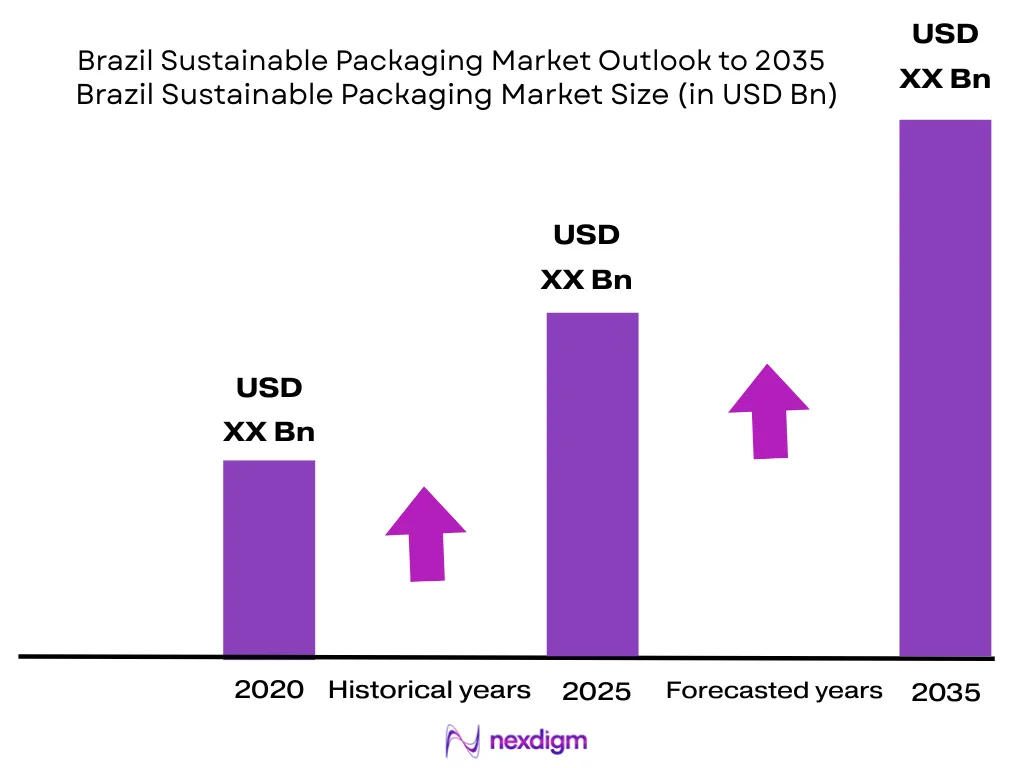
The Brazil Sustainable Packaging Market is valued at approximately USD ~ billion and is forecast to expand at a CAGR of % during 2026–2035. Brazil’s gross domestic product increased from BRL 10.9 trillion to BRL 11.7 trillion, while industrial output expanded by 3.1%. The market is driven by food and beverage production, e-commerce, renewable fiber availability, packaging reverse logistics, recycled-content requirements, lightweighting, and growing demand for recyclable, reusable, and bio-based formats. São Paulo, Paraná, Santa Catarina, Rio Grande do Sul, Minas Gerais, Rio de Janeiro, Bahia, Pernambuco, Goiás, and Amazonas dominate the Brazil Sustainable Packaging Market. São Paulo contained 45,973,194 residents, Paraná 11,824,665, and Santa Catarina 8,058,441, supporting high packaging consumption and conversion activity. These states combine food, beverage, personal-care, pharmaceutical, agribusiness, pulp, plastics, metal, glass, retail, export, and reverse-logistics infrastructure.
Market Segmentation
By Material Type
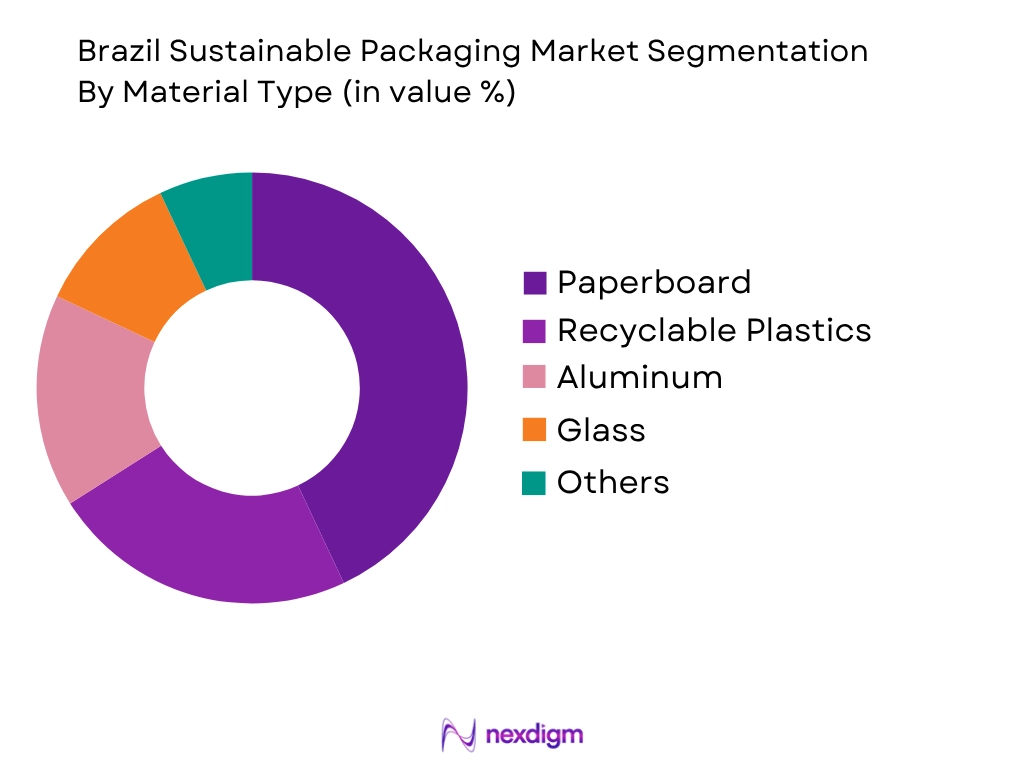
The Brazil Sustainable Packaging Market is segmented into paper and paperboard, recycled and recyclable plastics, metals, glass, bio-based and compostable materials, wood, and sustainable multi-material structures. Paper and paperboard hold the dominant market position because Brazil has an established pulp, containerboard, corrugated-box, industrial-sack, and folding-carton manufacturing base supported by eucalyptus forestry and recycled-fiber collection. Corrugated packaging is widely used for food, beverages, fruit, poultry, industrial goods, e-commerce, household products, and agricultural exports. Fiber packaging is also increasingly used to replace selected plastic trays, inserts, wraps, and serviceware. Klabin identifies itself as Brazil’s largest paper manufacturer and exporter and supplies renewable, recyclable, and biodegradable packaging across multiple industries. Plastics remain important where lightweighting, moisture resistance, transparency, puncture strength, and high-speed filling are essential. Aluminum and glass benefit from established material value and collection systems, while compostable formats remain constrained by limited processing infrastructure.
By End-Use Industry
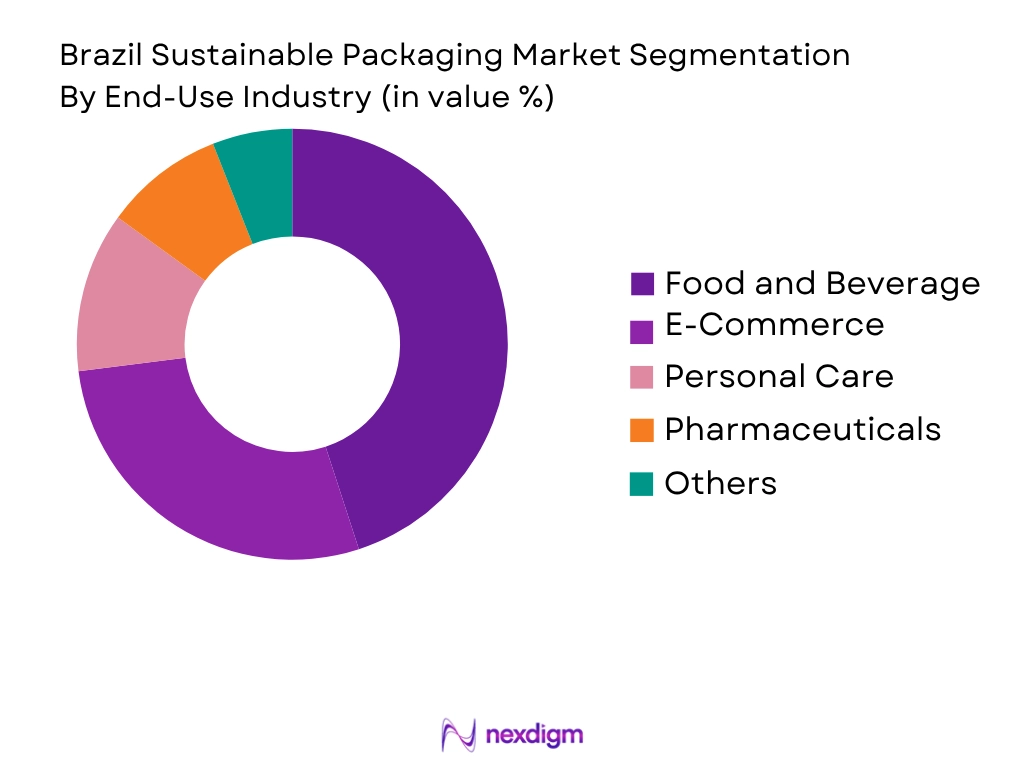
The Brazil Sustainable Packaging Market is segmented into food and beverage, personal and household care, e-commerce and retail, healthcare and pharmaceuticals, foodservice, agribusiness, industrial goods, and electronics. Food and beverage hold the dominant position because Brazil has extensive processed-food, beverage, meat, poultry, dairy, coffee, confectionery, fresh-produce, beer, and export-oriented agricultural industries. These products require cartons, pouches, bottles, cans, glass containers, corrugated cases, trays, sacks, labels, and transport packaging. Sustainability strategies include lightweighting, returnable beverage bottles, higher recycled content, fiber substitution, mono-material films, refill pouches, and improved component separability. E-commerce and retail create additional demand for right-sized boxes, recyclable mailers, paper void fill, and protective fiber structures. Personal-care and household brands are expanding refill formats and recycled-resin bottles, while pharmaceutical conversion remains slower because product integrity, migration, tamper evidence, traceability, and regulatory validation remain primary considerations.
Competitive Landscape
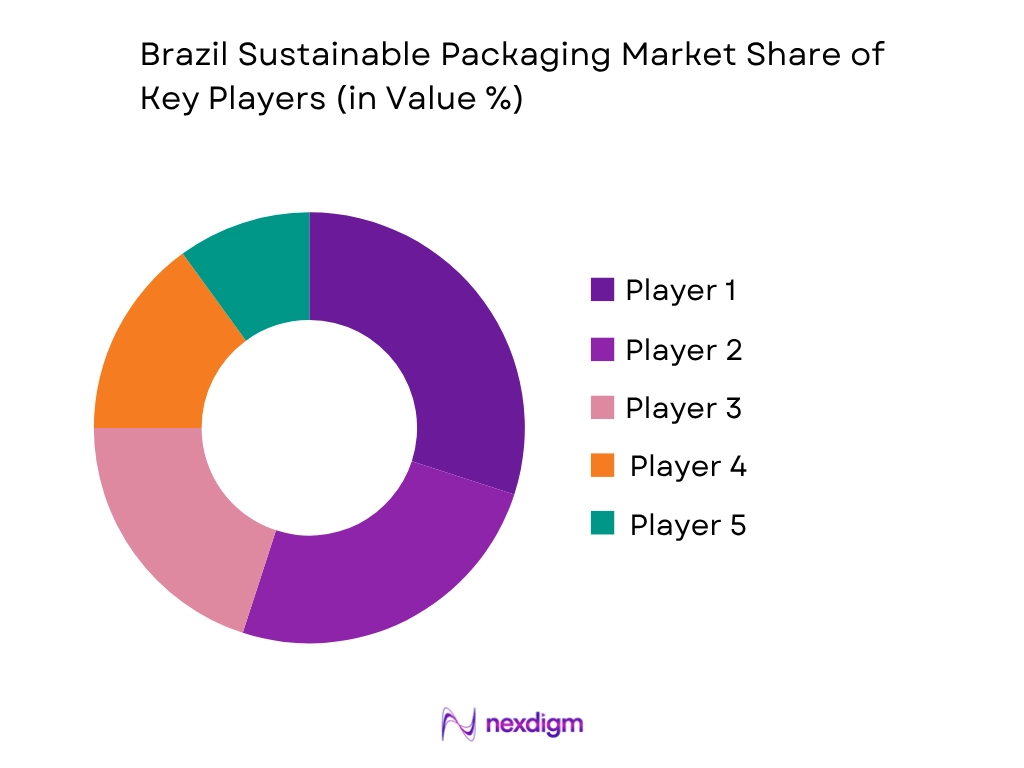
The Brazil Sustainable Packaging Market includes domestic pulp and paper leaders, global packaging converters, plastics and renewable-polymer producers, metal and glass container companies, and carton specialists. Klabin and Suzano benefit from Brazil’s renewable-fiber base, while Braskem is differentiated through petrochemical resins and sugarcane-derived polyethylene. Valgroup operates across rigid and flexible plastic packaging and recycling, while Tetra Pak participates in beverage cartons and post-consumer collection partnerships. Competition increasingly depends on recycled-content integration, renewable feedstocks, design for recycling, manufacturing reach, food-contact compliance, reverse-logistics capability, cooperative partnerships, and product commercialization speed.
| Company | Establishment Year | Headquarters | Core Sustainable Portfolio | Principal End Uses | Material Capabilities | Brazil Operating Model | Circularity Capability | Strategic Differentiation |
| Klabin | 1899 | São Paulo, Brazil | ~ | ~ | ~ | ~ | ~ | ~ |
| Suzano | 1924 | São Paulo, Brazil | ~ | ~ | ~ | ~ | ~ | ~ |
| Braskem | 2002 | São Paulo, Brazil | ~ | ~ | ~ | ~ | ~ | ~ |
| Valgroup | 1976 | São Paulo, Brazil | ~ | ~ | ~ | ~ | ~ | ~ |
| Tetra Pak | 1951 | Lund, Sweden | ~ | ~ | ~ | ~ | ~ | ~ |
Brazil Sustainable Packaging Market Analysis
Growth Drivers
Consumer Concentration and Packaging-Intensive Retail Demand
Brazil’s large consumer base and concentrated urban economy support recurring demand for corrugated boxes, folding cartons, recyclable bottles, aluminum cans, returnable glass, flexible pouches, molded-fiber trays, paper mailers, and refill packaging. The Brazilian Institute of Geography and Statistics estimated the national population at 212,583,750 residents in 2024, distributed across 5,570 municipalities. São Paulo alone contained 45,973,194 residents, followed by Minas Gerais with 21,322,691, Rio de Janeiro with 17,219,679, Bahia with 14,850,513, and Paraná with 11,824,665. These five states represented more than 111 million consumers, creating dense demand corridors for food, beverages, household products, personal care, pharmaceuticals, takeaway meals, and e-commerce shipments. Brazil’s gross domestic product reached BRL 11.7 trillion in 2024, compared with BRL 10.9 trillion in 2023, while household consumption expanded alongside national economic activity. Retail trade closed 2025 with an additional 1.6 points of volume growth, showing continued movement of packaged consumer products through supermarkets, pharmacies, marketplaces, convenience outlets, and digital channels. For packaging producers, concentration around Greater São Paulo, Campinas, Curitiba, Belo Horizonte, Rio de Janeiro, Porto Alegre, Recife, Salvador, and Goiânia improves plant utilization and enables shorter delivery routes to major brand owners. Urban retail formats also place greater emphasis on packaging visibility and disposal convenience because consumers directly handle primary packs, e-commerce mailers, takeaway containers, and delivery materials. Corrugated and paperboard packaging benefit from household familiarity and established fiber recovery, while aluminum cans and returnable glass maintain relevance in beverage systems. Refill pouches and concentrated products reduce the quantity of rigid material transported per use, particularly in household cleaning and personal care. E-commerce increases demand for dimensional optimization, reduced void fill, recyclable protective components, and return-ready packaging. Sustainable packaging adoption is therefore supported not merely by population growth, but by the combination of 212.6 million residents, more than BRL 11 trillion in annual economic output, concentrated state markets, and extensive retail distribution. These factors encourage packaging redesign that lowers material intensity while preserving product protection, shelf life, branding, transport efficiency, and consumer convenience.
Manufacturing Expansion and Reverse-Logistics Regulation
Brazil’s industrial growth and increasingly specific reverse-logistics rules are turning sustainable packaging from a voluntary positioning tool into a manufacturing and compliance requirement. National gross domestic product increased by 3.4 points in 2024, while manufacturing industries expanded by 5.3 points, supporting higher production of packaged food, beverages, chemicals, pharmaceuticals, cosmetics, machinery, and consumer goods. Industrial activity generated approximately BRL 2.5 trillion in value during the year, while the national investment rate increased from 16.4 points in 2023 to 17.0 points in 2024. These indicators are relevant because packaging conversion requires extrusion, corrugating, coating, molding, printing, filling-line adaptation, recycled-material testing, and recycling infrastructure. Regulatory development reinforces this investment cycle. Brazil’s Decree No. 12,688, issued in October 2025, established a national reverse-logistics framework for primary, secondary, and tertiary plastic packaging. The government subsequently reported that the system raised the applicable recycling target from 22 points to 32 points and connected recovery requirements with traceability, recycled content, returnable formats, and participation by waste-picker organizations. The framework also provides that each 5-point increase in collected returnable plastic packaging can reduce the applicable recovery target by 1 point, creating an incentive for reuse models rather than relying only on single-use recycling. Under the Recycling Incentive Law, the Ministry of the Environment approved BRL 665 million for 303 projects by early 2026, with funding directed toward waste recovery, selective collection, recycling, and support for waste pickers. A separate BRL 8 million public call launched in 2024 targeted cooperatives and associations engaged in collection, sorting, processing, and organic-waste recycling. These measures expand demand for packaging-level material data, verified recovery certificates, design-for-recycling services, post-consumer resin, cooperative contracts, and reverse-logistics management. Manufacturers are consequently simplifying multilayer structures, reducing dark pigments, redesigning closures and labels, increasing recycled content, and evaluating returnable or refillable systems. Fiber producers are developing repulpable coatings and molded formats, while plastics converters are investing in polyethylene- and polypropylene-dominant structures. Regulation therefore drives market growth through both direct compliance and industrial modernization, linking packaging design with recovery performance, data reporting, cooperative inclusion, and verified end markets.
Market Challenges
Uneven Collection, Sorting, and Recycled-Feedstock Quality
Brazil’s sustainable packaging market is constrained by the uneven ability of municipalities, cooperatives, sorting centres, and recyclers to convert post-consumer packaging into consistent industrial feedstock. The country contains 5,570 municipalities and more than 212 million residents, meaning collection systems must operate across dense metropolitan regions, medium-sized cities, remote rural communities, the Amazon region, and long-distance logistics corridors. Packaging recovery is therefore not uniform. Corrugated board and aluminum benefit from recognizable material value and established markets, whereas flexible films, small-format plastics, laminated pouches, coated papers, black plastics, pumps, closures, and mixed-material components are more difficult to collect and separate. Material quality is also variable. Recycled plastic may contain food residue, labels, adhesives, pigments, incompatible polymers, moisture, odour, or degraded resin. Recovered paper can be affected by oil, wax, wet-strength treatments, plastic laminates, and organic contamination. Glass recovery is restricted by breakage, colour separation, transport weight, and distance from beneficiation plants. Even when packaging is technically recyclable, the recovered output must meet requirements for melt flow, colour, mechanical strength, odour, cleanliness, and regulatory suitability before it can return to demanding food, beverage, cosmetics, or pharmaceutical applications. Government programs illustrate the scale of infrastructure still required. The Ministry of the Environment launched BRL 8 million in initial support during 2024 for waste-picker cooperatives and associations, covering selective collection, sorting, processing, composting, equipment, and organizational strengthening. By 2026, federal reporting identified 25,458 registered waste pickers, including 11,998 women, within the relevant national systems. These workers are fundamental to packaging recovery, but many organizations still require warehouses, balers, conveyors, protective equipment, transport vehicles, digital scales, traceability systems, and working capital. Regional imbalance creates additional complications for converters. A plant in São Paulo may have better access to recovered PET or paper than a manufacturer in the North or Northeast, while material collected in smaller municipalities may need aggregation before transport becomes practical. The result is competition for high-quality post-consumer resin and fiber, particularly when brand owners increase recycled-content targets simultaneously. Brazil has a large volume of discarded packaging, but availability alone does not guarantee usable secondary material. The central challenge is developing collection, sorting, documentation, quality control, and end-market capacity capable of supplying predictable feedstock to packaging plants throughout the country.
Material Performance and Fragmented Compliance Requirements
Sustainable packaging conversion remains technically difficult because packaging must satisfy environmental objectives while continuing to protect food, beverages, medicines, cosmetics, chemicals, electronics, and agricultural products. A move from multilayer film to a mono-material structure may improve recyclability but weaken oxygen, moisture, aroma, or puncture protection. Replacing a plastic tray with molded fiber can alter rigidity, sealing, grease resistance, microwave performance, and product shelf life. Higher post-consumer resin content may affect colour, odour, transparency, impact strength, processing stability, and contact safety. Lightweighting can reduce material use but also create bottle paneling, carton compression failure, can denting, seal defects, or transport damage. These issues require packaging engineers, polymer specialists, paper technologists, food-contact experts, tooling engineers, quality teams, and production operators capable of conducting extrusion trials, filling-line tests, shelf-life validation, migration assessment, compression testing, drop testing, and recyclability evaluation. Brazil’s manufacturing industries expanded by 5.3 points in 2024, but industrial growth also increases competition for qualified technical personnel and capital equipment. Compliance complexity adds to the challenge. Producers must interpret the National Solid Waste Policy, Decree No. 11,413 on recycling credits, Decree No. 12,688 on plastic-packaging reverse logistics, food-contact requirements, state-level reverse-logistics systems, labelling rules, and environmental-claim obligations. The 2025 plastic-packaging decree covers primary, secondary, and tertiary packaging and requires traceable recovery through individual or collective systems. Producers operating across São Paulo, Paraná, Minas Gerais, Rio de Janeiro, and other states may also face different reporting procedures, management entities, documentation practices, and local enforcement expectations. Environmental claims such as recyclable, biodegradable, compostable, renewable, or made with recycled content need substantiation. A package may be recyclable under laboratory conditions but lack access to collection or suitable reprocessing in many municipalities. Compostable packaging may comply with a technical standard but still be rejected by local facilities. Reuse systems require documented return rates, washing controls, container-life data, and reverse logistics. These demands can be managed by large multinational brands with dedicated sustainability and regulatory teams, but smaller manufacturers frequently depend on converters and management entities for technical guidance. Market development is therefore slowed by the need to coordinate material science, manufacturing performance, national and state regulation, recovery evidence, and truthful consumer communication across thousands of packaging specifications.
Market Opportunities
Renewable Materials, Advanced Recycling, and Smart Packaging Design
Brazil has a strong opportunity to combine its renewable-resource base with advanced material design, post-consumer recycling, digital traceability, and automated sorting. The country’s manufacturing output expanded by 5.3 points in 2024, gross domestic product reached BRL 11.7 trillion, and the investment rate increased to 17.0 points, providing a broad industrial platform for new coating lines, molded-fiber equipment, recycled-resin processing, digital printing, and packaging laboratories. Brazil is particularly well positioned in eucalyptus fiber and sugarcane-derived polymers. Fiber producers can develop lighter corrugated grades, molded pulp, high-strength paperboard, nanocellulose reinforcement, grease-resistant papers, and aqueous barriers intended to replace selected laminated or plastic formats. Sugarcane ethanol can serve as a feedstock for renewable polyethylene used in bottles, closures, films, pouches, and personal-care packaging without requiring converters to abandon conventional polyethylene-processing equipment. Recycling technologies create another pathway. Optical sorters, artificial intelligence, digital watermarks, wash-off labels, improved adhesives, advanced washing, deodorization, filtration, and pelletizing can increase the quantity and quality of recovered plastic and fiber. Smart packaging design software can reduce material before production by optimizing wall thickness, carton dimensions, pallet patterns, and package-to-product ratios. These technologies are relevant to a country with 212.6 million consumers and large distances between factories and end markets because lighter, stronger formats can reduce freight intensity while maintaining protection. Digital traceability can also connect recovered packaging to certificates and producer obligations. Each bale, shipment, cooperative, recycler, or packaging lot can be documented through weights, invoices, geographic origin, material category, and end-market destination, reducing double counting in recycling-credit systems. Federal investment provides an immediate base for such projects: BRL 665 million was approved for 303 recycling-related initiatives, while the national plastic-packaging framework increased demand for verified recovery and recycled content. Opportunity also exists in flexible packaging, where polyethylene- or polypropylene-dominant structures can replace incompatible laminates while maintaining sealing and barrier properties. Compostable formats may gain targeted adoption in foodservice and organics-collection environments, while reusable packaging can expand in beverage distribution, industrial transport, e-commerce, and household refills. Brazil’s advantage lies in integrating renewable feedstocks, recycling technology, converter capacity, and regulatory traceability rather than relying on one universal substitute material.
Cooperative Integration and Regional Circular Supply Chains
The formal integration of waste-picker cooperatives into producer-funded recovery systems creates a distinctive opportunity for Brazil’s sustainable packaging market. Cooperatives already collect, sort, bale, and sell significant quantities of paper, cardboard, PET, polyethylene, polypropylene, aluminum, steel, and glass, but their capacity differs widely by municipality. Federal policy increasingly treats these organizations as central infrastructure rather than peripheral participants. The 2025 plastic-packaging reverse-logistics decree gives priority to cooperatives, associations, and other waste-picker organizations within recovery systems, while the national Citizen Selective Collection Program allows qualified organizations registered in SINIR to collect recyclable materials generated by federal public entities. By 2026, the relevant national systems included 25,458 registered waste pickers, of whom 11,998 were women. Federal support also included BRL 8 million launched in 2024 for cooperative projects and BRL 665 million approved across 303 initiatives under the Recycling Incentive Law. These current figures support future growth by creating a platform for investment in sorting lines, balers, warehouses, vehicles, digital scales, occupational safety, material testing, and traceability. Packaging companies can enter long-term supply agreements with cooperatives, provide equipment, establish quality specifications, and purchase recovered feedstock through verified channels. Brand owners can support closed-loop programs for PET bottles, paperboard, aluminum cans, detergent containers, and personal-care packaging. Regional hubs can aggregate material from smaller municipalities and send it to specialized recyclers or mills, improving logistics economics. This model is especially relevant outside São Paulo and the South, where individual municipalities may not generate sufficient volume to sustain advanced processing plants. Hub-and-spoke systems can consolidate packaging from public collection, retailers, commercial generators, and cooperative networks. Reverse-logistics management entities can coordinate reporting, certification, transport, and end-market verification across multiple producers. Reuse systems offer an additional opportunity through returnable beverage bottles, pooled agricultural crates, industrial pallets, reusable foodservice containers, and refill packaging. These models create local jobs in collection, washing, inspection, repair, and redistribution while reducing dependence on single-use material. Cooperative integration can also improve consumer communication by linking separation campaigns with visible local organizations and recovery outcomes. The opportunity is not simply social inclusion. It is the creation of a more reliable national supply chain for secondary materials, supported by producer funding, federal registration, auditable recovery evidence, and long-term industrial demand.
Future Outlook
The Brazil Sustainable Packaging Market is expected to expand during 2026–2035 as reverse logistics, recycled-content requirements, brand commitments, renewable-material development, and recovery infrastructure increasingly shape packaging procurement. Growth will involve redesigning packaging systems rather than simply replacing plastic with paper. Material reduction, product protection, collection access, traceability, reuse, recycled content, and realistic end markets will become central evaluation criteria. Brazil’s regulatory framework is becoming more specific. Decree No. 11,413 established instruments including the Reverse Logistics Recycling Credit Certificate and the General Packaging Structuring and Recycling Certificate. These mechanisms allow verified recovery and recycling activity to support reverse-logistics compliance while creating demand for traceability, third-party verification, cooperative participation, and reliable documentation.
Major Players
- Klabin
- Suzano
- Irani Papel e Embalagem
- Amcor
- Valgroup
- Braskem
- Tetra Pak
- SIG Group
- Smurfit Westrock
- International Paper
- Ball Corporation
- Crown Holdings
- O-I Glass
- Papirus
- Antilhas Embalagens
Key Target Audience
- Packaging material producers and converters
- Food, beverage, and consumer-goods brand owners
- Retailers, marketplaces, and e-commerce operators
- Recycling companies, reverse-logistics entities, and waste-picker cooperatives
- Packaging distributors and contract packagers
- Investments and venture capitalist firms
- Private-equity and strategic packaging investors
- Government and regulatory bodies
Research Methodology
Step 1: Identification of Key Variables
The initial phase involves constructing an ecosystem map covering pulp, resin, metal and glass producers, packaging converters, brand owners, retailers, reverse-logistics entities, waste-picker cooperatives, recyclers, and regulators. Desk research identifies variables including material type, package weight, recycled content, renewable feedstock, end-use requirements, recovery access, converter capacity, and regulatory obligations.
Step 2: Market Analysis and Construction
Historical market information is compiled by material, format, end-use industry, packaging level, sustainability strategy, and region. The bottom-up model evaluates converter shipments, package volume, material consumption, recycled-content integration, and customer adoption. The top-down model reviews industrial production, packaging trade, pulp and resin availability, company revenues, and end-market activity.
Step 3: Hypothesis Validation and Expert Consultation
Preliminary hypotheses are validated through computer-assisted telephone interviews with packaging engineers, converters, sustainability executives, procurement managers, recyclers, cooperative leaders, material suppliers, and reverse-logistics specialists. These discussions examine qualification cycles, feedstock quality, material switching, reverse-logistics documentation, packaging performance, and regional infrastructure.
Step 4: Research Synthesis and Final Output
Supply-side and demand-side findings are triangulated to reconcile converter production, material shipments, customer procurement, and recovery data. Segment shares and forecasts are tested against package weights, unit volumes, recycled-content assumptions, production capacity, regulatory requirements, and expert feedback. The final output provides an internally consistent market and opportunity assessment.

- Executive Summary
- Research Methodology (Market Definitions and Assumptions, Sustainable Packaging Inclusion and Exclusion Criteria, Abbreviations, Market Sizing Approach, Top-Down Analysis, Bottom-Up Analysis, Packaging-Volume Conversion Model, Material Flow Analysis, Demand-Side Assessment, Supply-Side Assessment, Converter Capacity Assessment, Primary Industry Interviews, Data Triangulation, Regulatory Scenario Modelling, Forecasting Framework, Limitations and Future Conclusions)

- Definition and Scope
- Market Evolution and Industry Genesis
- Transition from Conventional Packaging to Circular Packaging Systems
- Development of Packaging Reverse Logistics in Brazil
- Evolution of Source Reduction and Packaging Lightweighting
- Development of Recycled-Content Packaging
- Expansion of Renewable Fiber-Based Packaging

- Growth Drivers (National Solid Waste Policy, Packaging Reverse Logistics, Brand Circularity Commitments, E-Commerce Growth, Food and Beverage Production, Renewable Fiber Availability, Aluminum Can Recovery and Consumer-Goods Lightweighting)
- Market Challenges (Uneven Municipal Collection, Informal and Formal System Coordination, Recycled Feedstock Quality, Flexible Packaging Recovery Gaps, Composting Infrastructure Limitations, Regional Logistics, Green-Claim Risk and Capital-Intensive Conversion)
- Market Opportunities (Eucalyptus Fiber Packaging, Sugarcane-Based Bioplastics, High-PCR Packaging, Mono-Material Flexible Structures, Cooperative-Based Collection, Reusable Beverage Systems, Molded Fiber Replacement and Closed-Loop Brand Partnerships)
- Market Trends (Paperization, Lightweighting, Refill Pouches, Returnable Bottles, High-PCR Packaging, Renewable Polyethylene, Wash-Off Labels, Fiber-Based Barriers, Smart Sorting and Packaging Circularity Disclosure)
- SWOT Analysis
- Porter’s Five Forces Analysis
- PESTLE Analysis

- By Market Value (2020-2025)
- By Packaging Volume (2020-2025)
- By Packaging Unit Shipments (2020-2025)

- By Material Type (In Value %)
Paper and Paperboard
Corrugated Board
Molded Fiber
Recycled Plastic
Bio-Based Plastic
Compostable Plastic
Aluminum - By End-Use Industry (In Value %)
Food and Beverage
Personal Care and Cosmetics
Household Care
Healthcare and Pharmaceuticals
E-Commerce - By Distribution Channel (In Value %)
Direct Sales to Brand Owners
Packaging Distributors
Contract Packaging Companies
Digital Packaging Platforms
Industrial Wholesalers - By Region (In Value %)
Southeast
South
Northeast
Central-West
North

- Market Share of Major Players (By Value, Packaging Volume, Material Type, Packaging Format, End-Use Industry and Region)
- Cross Comparison Parameters (Sustainable Material Portfolio Breadth, Post-Consumer Recycled Content Capability, Renewable Fiber and Bio-Based Polymer Integration, Design-for-Recycling and Lightweighting Expertise, Brazilian Manufacturing and Conversion Footprint, Reverse Logistics and Cooperative Partnership Capability, End-Use Industry Coverage, Packaging Innovation and Commercialization Speed)
- SWOT Analysis of Major Players
- Detailed Profiles of Major Companies
Klabin
Suzano
Irani Papel e Embalagem
Amcor
Valgroup
Braskem
Tetra Pak
SIG Group
Smurfit Westrock
International Paper
Ball Corporation
Crown Holdings
O-I Glass
Papirus
ntilhas Embalagens

- Food and Beverage Brand Analysis
- Retailer and Marketplace Analysis
- E-Commerce Company Analysis
- Foodservice Operator Analysis
- Consumer Packaged Goods Analysis

- By Market Value (2026-2035)
- By Packaging Volume (2026-2035)
- By Packaging Unit Shipments (2026-2035)


 Request a Sample
 Ask for Customization
 Get a Quote
 Enquire Now