
 Download PDF
Market Overview
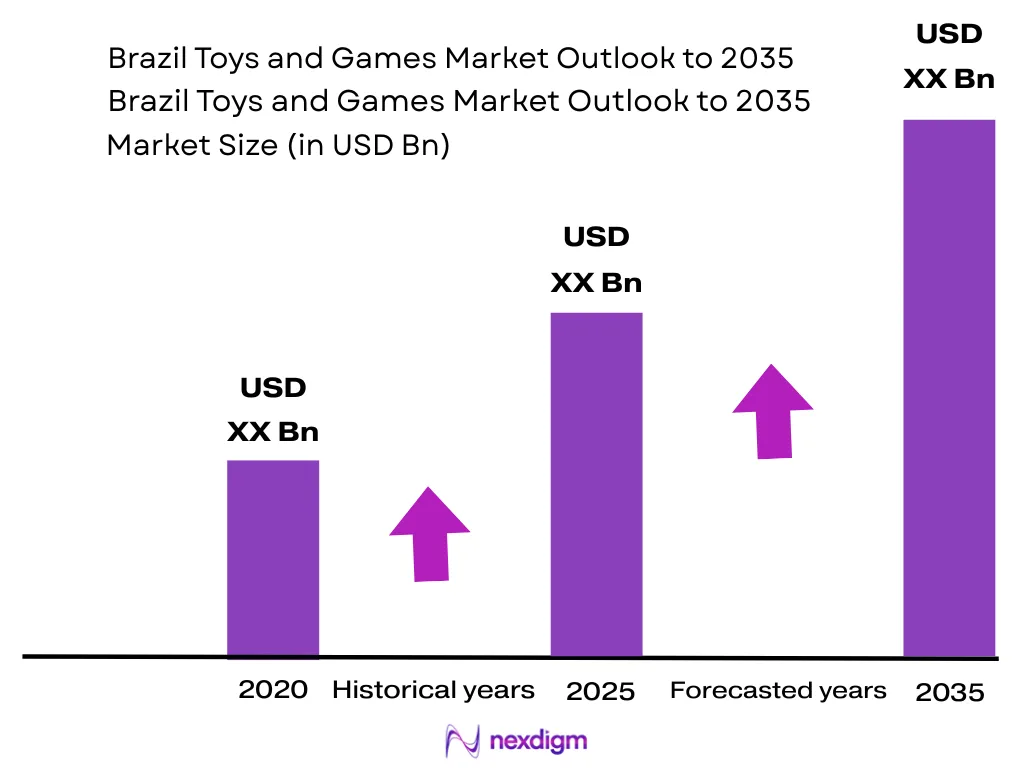
Brazil Toys and Games Market is valued at USD ~ billion, after the toys and games retail market recorded USD ~ billion in the preceding annual cycle across action figures, activity toys, dolls, games, infant toys, plush, puzzles, ride-ons and toy vehicles. Demand is driven by Children’s Day, Christmas, licensed characters, domestic brands, e-commerce and educational play. Brazil’s GDP reached USD ~ trillion, supporting a large formal consumer economy.
São Paulo, Rio de Janeiro, Minas Gerais, Paraná and Rio Grande do Sul dominate because they combine population density, toy manufacturing, import distribution, specialty retail, e-commerce fulfilment and higher modern retail penetration. Brazil’s population reached ~ million, with São Paulo holding 46 million residents, Minas Gerais ~ million and Rio de Janeiro ~ million. São Paulo also hosts ABRIN, Latin America’s largest toy fair, reinforcing its role as the industry’s sourcing and trade hub.
Market Segmentation
By Product Category
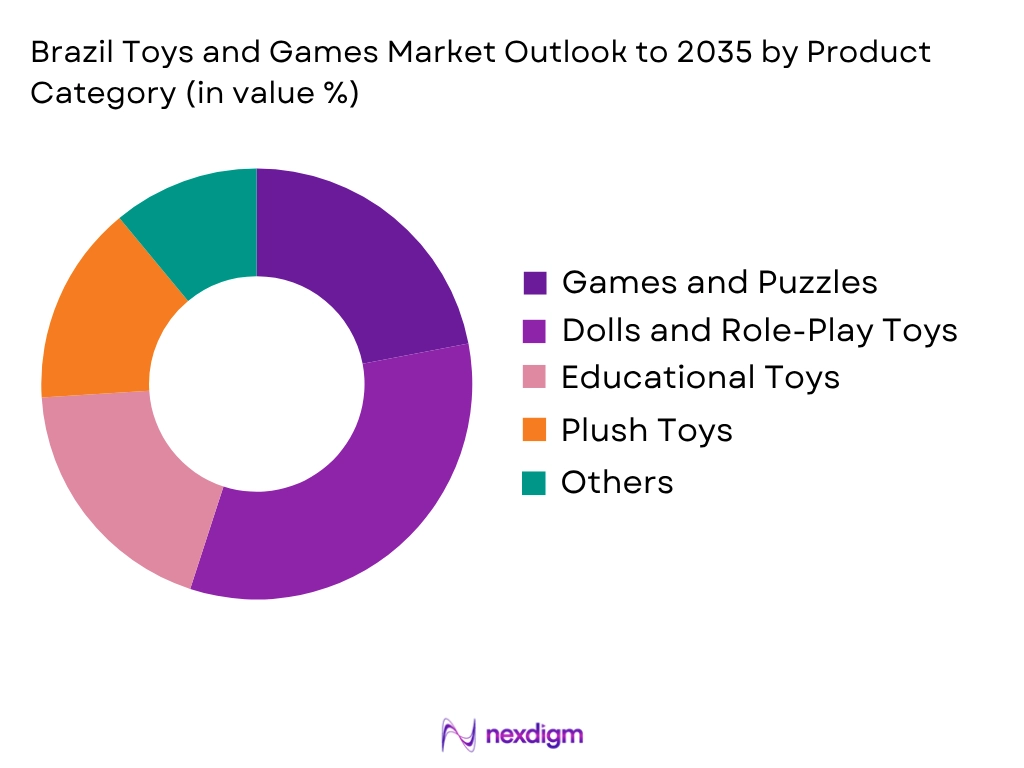
Brazil Toys and Games Market is segmented by product category into dolls, plush toys, infant and preschool toys, action figures, building sets, games and puzzles, educational and STEM toys, outdoor toys, arts and crafts, electronic toys, vehicles and collectibles. Recently, dolls and role-play toys have a dominant market share in Brazil under the product category segmentation, due to the strength of domestic doll manufacturers, parent-led gifting occasions, licensed characters and strong relevance among preschool and early elementary children. Brazilian companies such as Cotiplás, Roma Brinquedos and Estrela have helped localize doll formats across baby dolls, fashion dolls, accessories and role-play sets. Dolls also perform well during Children’s Day and Christmas because they are easy gift choices across different price tiers. Games and puzzles follow closely because Brazil has established family-game brands such as Grow, Estrela, Nig, Pais & Filhos and Toyster, while educational toys are gaining relevance through screen-free learning and preschool development needs.
By Distribution Channel
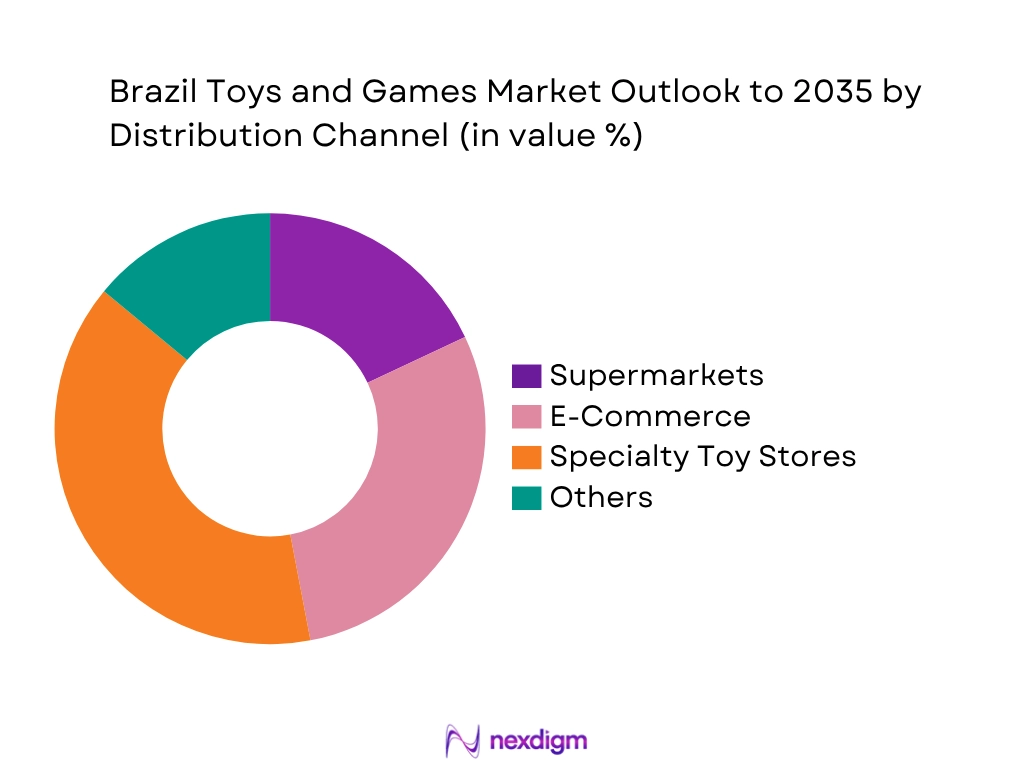
Brazil Toys and Games Market is segmented by distribution channel into toy specialty stores, supermarkets and hypermarkets, department stores/general merchandise retailers, e-commerce marketplaces, wholesale distributors, bookstores/stationery stores and brand-owned channels. Recently, toy specialty stores have a dominant market share in Brazil under the distribution channel segmentation because toy buying remains highly gift-led and experience-led, particularly during Children’s Day, Christmas and birthday occasions. Chains such as Ri Happy and PBKids provide dedicated toy assortment depth, licensed brands, premium products, trained store staff and seasonal merchandising that general retailers cannot fully replicate. E-commerce marketplaces such as Mercado Livre, Amazon Brazil, Shopee, Magalu and Americanas are growing quickly because Brazilian consumers compare prices and discover imported toys online. Supermarkets and hypermarkets are important during Children’s Day and Christmas because they provide value toys, impulse purchases and seasonal aisles, but specialty retail remains stronger for branded toys, educational toys, dolls, board games and licensed merchandise.
Competitive Landscape
Brazil Toys and Games Market is competitive across domestic manufacturers, multinational toy companies, licensed distributors, marketplace sellers and specialty retailers. Domestic brands such as Estrela, Grow, Xalingo, Cotiplás and Candide have strong relevance because they understand Brazilian gifting calendars, local price tiers, Inmetro certification requirements, Portuguese packaging, regional distribution and product formats suited to Brazilian households. Multinational brands such as Mattel, Hasbro and LEGO compete through global IP, licensed products, premium ranges and e-commerce visibility. The market’s structure is shaped by local manufacturing, imported toy availability, compliance capability, Children’s Day inventory planning, and access to specialty retail and marketplaces.
| Company | Establishment Year | Headquarters | Core Toy Portfolio | Local/Imported Mix | Channel Strength | Compliance Position | Consumer Focus | Strategic Advantage |
| Estrela | 1937 | São Paulo, Brazil | ~ | ~ | ~ | ~ | ~ | ~ |
| Grow Jogos e Brinquedos | 1972 | São Paulo, Brazil | ~ | ~ | ~ | ~ | ~ | ~ |
| Xalingo Brinquedos | 1947 | Santa Cruz do Sul, Brazil | ~ | ~ | ~ | ~ | ~ | ~ |
| Cotiplás | 1982 | Laranjal Paulista, Brazil | ~ | ~ | ~ | ~ | ~ | ~ |
| Candide Brinquedos | 1968 | São Paulo, Brazil | ~ | ~ | ~ | ~ | ~ | ~ |
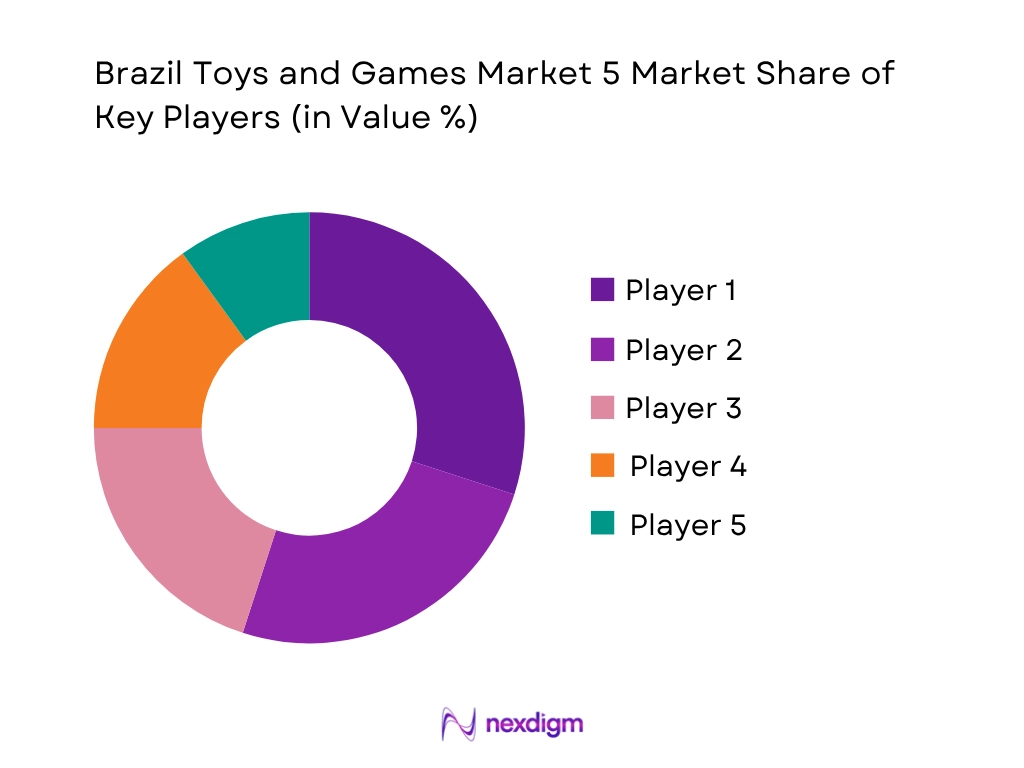
Brazil Toys and Games Market
Growth Drivers
Large Child Population Supporting Core Toy Demand
Brazil Toys and Games Market is supported by a large child user base that directly sustains demand for dolls, plush toys, preschool products, board games, puzzles, outdoor toys, vehicles, action figures, licensed toys and educational play products. The World Bank records Brazil’s population aged 0–14 at 41,689,815 persons in 2024, giving toy manufacturers and retailers a broad age-graded consumer base for infant, toddler, preschool and early elementary categories. Brazil’s total population reached 212.6 million residents in 2024, according to IBGE, which also makes the country one of the largest family-consumption markets in Latin America. The World Bank records Brazil’s GDP at USD 2.19 trillion and GDP per capita at USD 10,310.5 in 2024, supporting a sizeable formal consumer economy for children’s gifting, school-linked learning products and branded toys. IMF records Brazil’s country population at 214.083 million in 2026, reinforcing continued demand relevance for toy companies. This demographic base supports Children’s Day, Christmas, birthday purchases, educational toys, local-brand dolls, board games and value toys sold through specialty stores, supermarkets and e-commerce channels.
Digital Retail Readiness Expanding Toy Discovery and Omnichannel Sales
Brazil Toys and Games Market is driven by digital retail readiness because parents, gift buyers and collectors increasingly discover toys through marketplaces, retailer apps, online reviews, influencer content and seasonal promotional campaigns. IBGE records 168.0 million internet users among persons aged 10 and over in 2024, while World Bank-linked data records Brazil’s internet usage at 84.46347 individuals per 100 people in 2024. This is directly relevant to toys because e-commerce supports broader access to licensed character toys, anime collectibles, board games, puzzles, STEM kits, dolls, plush and imported products beyond large urban specialty stores. The U.S. International Trade Administration reports 94 million Brazilians expected to make online purchases in 2025, up by 3 million compared with 2024, showing continued expansion of online buyer reach. Brazil’s GDP of USD 2.19 trillion and GDP per capita of USD 10,310.5 in 2024 support a large formal retail environment where online toy search, marketplace assortment and omnichannel delivery influence purchase decisions. The opportunity is strongest for brands with Inmetro-compliant listings, Portuguese product content, marketplace ads and seasonal toy bundles.
Market Challenges
Inmetro Certification and Compliance Burden for Toy Suppliers
Brazil Toys and Games Market faces a compliance challenge because toys sold in the country must meet compulsory Inmetro safety and conformity rules before commercialization. Inmetro Ordinance No. 302 of July 12, 2021, approved the consolidated technical regulation and conformity assessment requirements for toys, and the rule entered into force on August 2, 2021. The requirement is market-specific because dolls, plush toys, building sets, electronic toys, infant toys, vehicles, puzzles, board games and imported licensed toys must pass certification, labelling and safety controls before being sold through formal retail. Certification protects consumers, but it also increases the operating burden for importers, marketplace sellers, domestic manufacturers and licensors managing high-SKU toy portfolios. The compliance burden is commercially significant because Brazil has 41,689,815 children aged 0–14 in 2024, according to the World Bank, and a total population of 212.6 million residents according to IBGE. Toy sellers must therefore scale certification discipline across a large consumer base. GDP of USD 2.19 trillion also indicates that compliance is tied to a major formal retail economy rather than a niche segment.
Geographic Scale and Regional Retail Fragmentation
Brazil Toys and Games Market is challenged by the country’s territorial scale and regional retail fragmentation, which complicate toy distribution during Children’s Day, Christmas, birthdays, back-to-school and movie-franchise launch windows. The World Bank records Brazil’s surface area at 8,510,420 sq. km, while IBGE states that the country has 5,570 municipalities and 15 municipalities with more than 1 million residents. These figures matter for toys because large SKU portfolios must be moved from import points, manufacturers and distributor warehouses to specialty stores, supermarkets, marketplace fulfilment centres, wholesalers and smaller interior-city retailers. Logistics complexity is more severe for bulky items such as ride-ons, outdoor toys, dollhouses, playsets and plastic preschool products. IBGE records 42.7 million residents living in the largest municipalities, showing that demand is concentrated in major cities, while the remaining population is spread across a broad geography. The World Bank records GDP per capita at USD 10,310.5 in 2024, meaning toy companies must balance national distribution costs with consumer purchasing capacity. This challenge pushes brands toward regional wholesalers, marketplace logistics and selective assortment planning. Sources: World Bank, IBGE.
Market Opportunities
Educational, Preschool and Developmental Toy Expansion
Brazil Toys and Games Market has a future growth opportunity in educational, preschool and developmental toys because Brazil combines a large child base with rising attention to early learning, school readiness and screen-free play. World Bank records 41,689,815 children aged 0–14 in 2024, creating a broad demand base for preschool toys, puzzles, sensory play, building blocks, science kits, math games, coding toys and board games. IBGE records that Brazil’s population reached 212.6 million residents in 2024, while IMF records 214.083 million people in 2026, showing continued scale for household and institutional demand. The World Bank records GDP at USD 2.19 trillion and GDP per capita at USD 10,310.5 in 2024, supporting a formal consumer economy where parents can prioritize toys with learning, motor-skill and cognitive-development benefits. This opportunity is specific to Brazil because domestic brands such as Grow, Xalingo, Nig and Toyster already have credibility in games, puzzles and educational products, while specialty stores and marketplaces can expand certified learning toys across regions. Future growth can come from Inmetro-certified STEM kits, bilingual learning products, preschool classroom packs and parent-trusted developmental toy lines.
Marketplace-Led Reach for Licensed Toys and Collectibles
Brazil Toys and Games Market has a future growth opportunity in marketplace-led distribution for licensed toys, anime collectibles, plush, dolls, puzzles, board games, trading-card products, STEM kits and kidult-oriented merchandise. IBGE records 168.0 million internet users among persons aged 10 and over in 2024, while World Bank-linked data records 84.46347 internet users per 100 people in 2024. The U.S. International Trade Administration reports 94 million online buyers expected in 2025, up by 3 million compared with 2024, supporting broader national reach for toy sellers beyond São Paulo, Rio de Janeiro, Minas Gerais and Paraná. This matters because online platforms can carry longer-tail SKUs that are difficult for physical toy stores to stock, including anime figures, licensed plush, premium board games, building sets and limited collector items. Brazil’s GDP of USD 2.19 trillion and GDP per capita of USD 10,310.5 in 2024 support a large formal market for omnichannel retail. Future growth will depend on certified listings, authentic product control, fast fulfilment, Portuguese-language product pages, age-grade visibility and seasonal campaigns for Children’s Day and Christmas.
Future Outlook
Brazil Toys and Games Market is expected to expand through Children’s Day gifting, Christmas purchases, educational toys, local brand modernization, licensed character products, e-commerce marketplaces and kidult collectibles. The market is forecast to grow at 4.2% CAGR during 2024–2035, with long-term demand shaped by Brazil’s large child population, urban retail base and continued digital commerce adoption. Domestic manufacturers will continue to compete with imported toys by emphasizing local brand trust, Portuguese packaging, Inmetro compliance and price-tier flexibility. The market’s future will also be shaped by sustainable toys, safer certified products, premium collectibles, STEM learning kits, classic board games and direct-to-consumer product launches.
Major Players
- Estrela
- Grow Jogos e Brinquedos
- Xalingo Brinquedos
- Cotiplás
- Candide Brinquedos
- Elka Brinquedos
- Brinquedos Bandeirante
- Roma Brinquedos
- Nig Brinquedos
- Pais & Filhos
- Toyster Brinquedos
- Mattel Brazil
- Hasbro Brazil
- LEGO Brazil
- Sunny Brinquedos
Key Target Audience
- Toy manufacturers and brand owners
- Toy importers and licensed merchandise distributors
- Specialty toy retail chains
- E-commerce marketplaces and omnichannel retailers
- Supermarkets, hypermarkets and department store toy category teams
- Licensing companies and entertainment IP owners
- Investments and venture capitalist firms
- Government and regulatory bodies, including Instituto Nacional de Metrologia, Qualidade e Tecnologia, Receita Federal do Brasil, Secretaria de Comércio Exterior, Ministério do Desenvolvimento, Indústria, Comércio e Serviços, Secretaria Nacional do Consumidor
Research Methodology
Step 1: Identification of Key Variables
The initial phase involves constructing an ecosystem map of Brazil Toys and Games Market, covering manufacturers, importers, distributors, toy retailers, e-commerce marketplaces, licensors, certification bodies and consumer cohorts. The main variables include product category, age group, licensing, Inmetro certification, retail channel, regional demand, price tier, seasonality and local-versus-imported supply.
Step 2: Market Analysis and Construction
In this phase, historical and current data is compiled from published market benchmarks, company profiles, public macroeconomic indicators, retail checks, online marketplace listings and compliance references. The market is constructed across dolls, plush, games, puzzles, preschool toys, educational toys, action figures, building sets, outdoor toys, collectibles and licensed products.
Step 3: Hypothesis Validation and Expert Consultation
Market hypotheses are validated through computer-assisted interviews with toy manufacturers, specialty retailers, distributors, importers, e-commerce sellers, licensors and certification professionals. These interviews validate product category dominance, channel performance, Children’s Day and Christmas demand, local brand strength, import exposure and Inmetro compliance requirements.
Step 4: Research Synthesis and Final Output
The final phase integrates top-down market sizing with bottom-up SKU, company and channel intelligence. This synthesis validates market segmentation, competitive landscape, growth outlook and strategic recommendations. The final output supports manufacturers, retailers, importers, licensors, investors and regulatory stakeholders assessing Brazil Toys and Games Market.

- Executive Summary
- Research Methodology (Market Definitions and Assumptions, Abbreviations, Market Sizing Approach, Top-Down Retail Sales Assessment, Bottom-Up SKU and Channel Mapping, Import and Local Production Triangulation, Retail Shelf Audits, E-Commerce Assortment Checks, Primary Interviews with Manufacturers/Distributors/Retail Buyers/Licensors, Compliance Review, Limitations and Forecast Assumptions)

- Definition and Scope
- Market Genesis
- Business Cycle
- Supply Chain and Value Chain Analysis

- Growth Drivers (Children’s Day Gifting, Christmas Seasonality, Domestic Toy Manufacturing, Licensed Character Demand, E-Commerce Adoption, Educational Toy Demand, Kidult Trend, Outdoor Play Demand)
- Market Challenges (Inflation Pressure, Currency Fluctuation, Import Duties, Informal and Counterfeit Toys, Inmetro Certification Cost, Retail Fragmentation, Logistics Gaps, Short Product Life Cycles)
- Opportunities (Premium Licensed Toys, Educational Toys, STEM Kits, Sustainable Toys, Kidult Collectibles, Local Brand Modernization, E-Commerce D2C, Export Potential within Latin America)
- Market Trends (Kidult Demand, Licensed Toys, Board Game Revival, Educational Play, Marketplace Growth, Local Brand Nostalgia, Value Toys, Sustainable Materials, Inmetro-Approved Imports)
- Government Regulation (Inmetro Toy Certification, Ordinance 302, MERCOSUR Toy Safety Rules, Labelling, Age Grading, Chemical Limits, Small Parts, Battery Safety, Import Compliance)
- Supply Chain and Import Analysis
- Stakeholder Ecosystem
- Porter’s Five Forces Analysis
- PESTLE Analysis

- By Value (2020-2025)
- By Volume (2020-2025)
- By Average Selling Price (2020-2025)

- By Product Category (In Value %)
Dolls and Accessories
Plush Toys
Infant, Toddler and Preschool Toys
Action Figures and Playsets
Building Sets - By Age Group (In Value %)
Infants and Toddlers
Preschool Children
Early Elementary Children
Tweens and Teens
Adults and Kidults - By Distribution Channel (In Value %)
Toy Specialty Stores
Supermarkets and Hypermarkets
Department Stores and General Merchandise Retailers
E-Commerce Marketplaces - By Region (In Value %)
Southeast
South
Northeast
Center-West
North

- Market Share of Major Players (Value Share, Volume Share, Category Share, Retail Channel Share, E-Commerce Share, Licensed Toy Share, Domestic Production Share)
- Cross Comparison Parameters (Product Portfolio Dolls/Plush/Games/Outdoor/STEM/Collectibles/Preschool/Action Figures; Local Manufacturing Capability Plastic Injection/Printing/Assembly/Moulding/Packaging; Licensed IP Strength: Global Characters/Gaming/Anime/Local IP/Sports; Channel Presence Ri Happy/PBKids/Supermarkets/Mercado Livre/Amazon/Shopee/Magalu; Compliance Capability: Inmetro Certification/Labelling/Age Grading/Recall Readiness; Import and Sourcing Network: China/Latin America/Domestic Suppliers/Customs Handling; Regional Distribution Reach: Southeast/South/Northeast/North/Center-West; Innovation Capability: Educational Toys/Sustainable Materials/Digital Tie-Ins/Collector Editions)
- SWOT Analysis of Major Players
- Pricing Analysis Basis SKUs
- Detailed Profiles of Major Companies
Estrela
Grow Jogos e Brinquedos
Xalingo Brinquedos
Cotiplás
Candide Brinquedos
Elka Brinquedos
Brinquedos Bandeirante
Roma Brinquedos
Nig Brinquedos
Pais & Filhos
Toyster Brinquedos
Mattel Brazil
Hasbro Brazil
LEGO Brazil
Sunny Brinquedos

- Parent and Household Buyer Analysis
- Child Demand Analysis
- Grandparent and Gift Buyer Analysis
- Kidult and Collector Analysis
- Educator and Daycare Buyer Analysis

- By Value (2026-2035)
- By Volume (2026-2035)
- By Average Selling Price (2026-2035)


 Request a Sample
 Ask for Customization
 Get a Quote
 Enquire Now