
 Download PDF
Market Overview
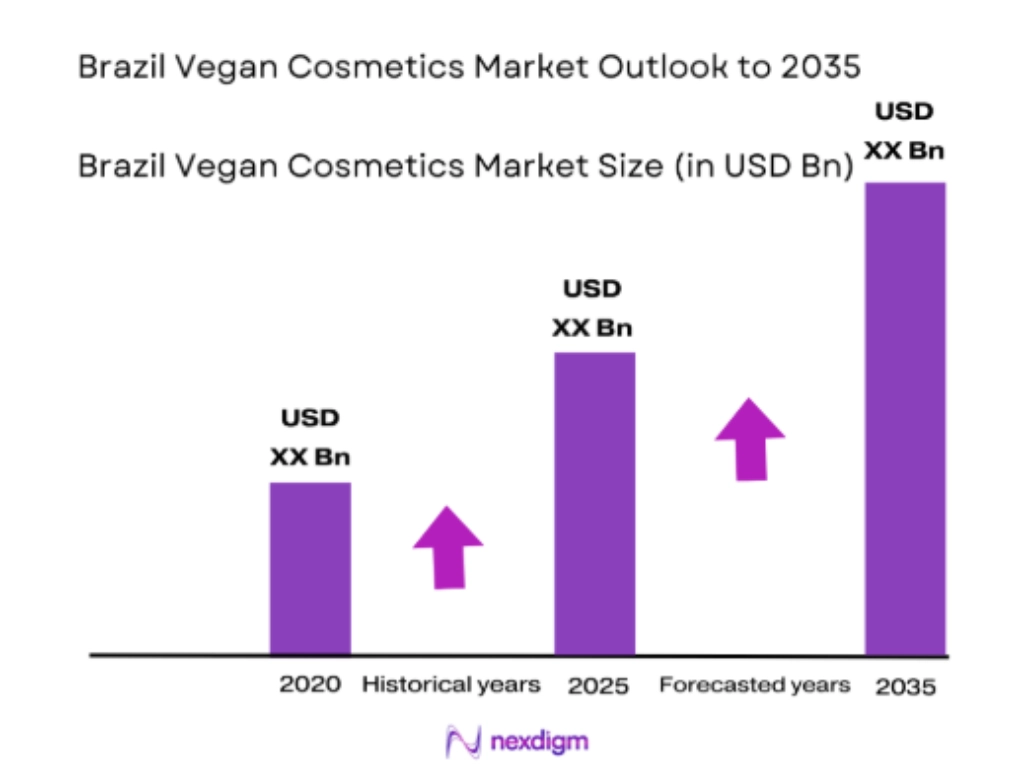
The Brazil Vegan Cosmetics market is valued at USD~billion, based on a five-year historical analysis. In 2023, the market stood at USD~billion and expanded to USD~billion, reflecting sustained demand for cruelty-free, plant-based, and clean-label beauty formulations. Growth is driven by rising ethical consumerism, increasing preference for botanical ingredients, and expansion of dermocosmetic vegan product lines across skincare and haircare categories. Strong penetration of e-commerce and pharmacy retail channels has further accelerated accessibility and product diversification across urban and semi-urban regions.
The Brazil Vegan Cosmetics market is concentrated in São Paulo, Rio de Janeiro, and Belo Horizonte, which dominate due to high urbanization, elevated beauty expenditure, and strong retail infrastructure. São Paulo leads due to its role as the commercial and manufacturing hub for personal care brands and innovation clusters. Rio de Janeiro supports demand through tourism-driven premium consumption, while Belo Horizonte benefits from growing natural beauty adoption and expanding pharmacy-led distribution networks and wellness-focused consumer behavior.
Market Segmentation
By Product Type
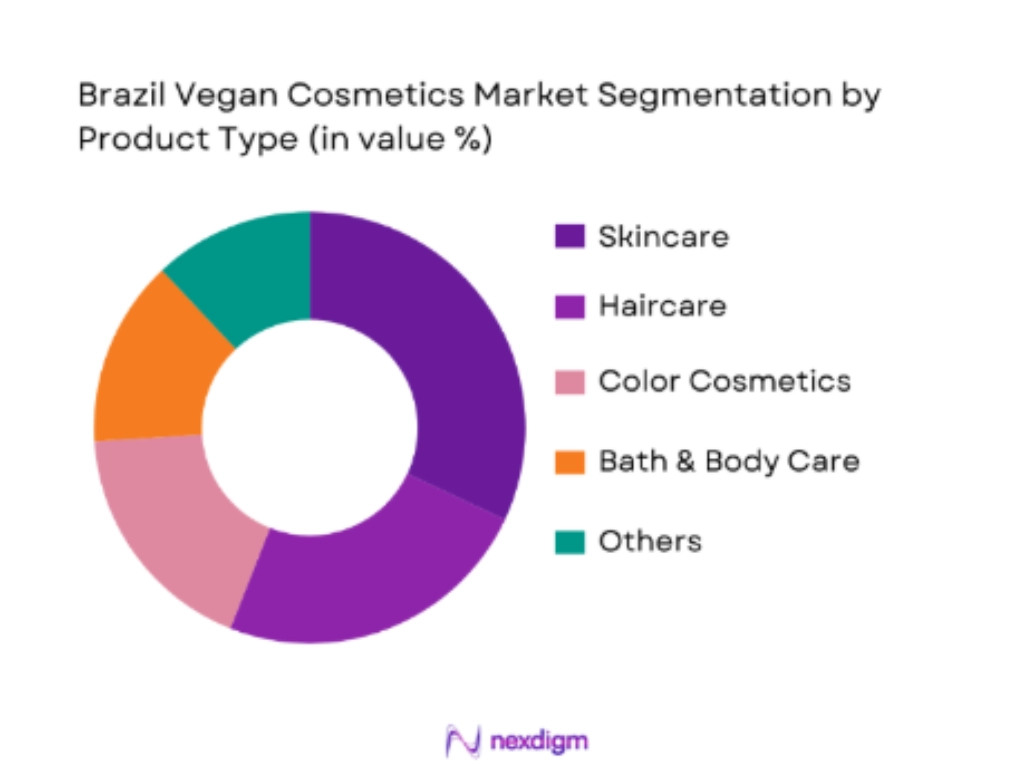
Brazil Vegan Cosmetics market is segmented by product type into skincare, haircare, color cosmetics, bath & body care, fragrances, and others. Skincare holds the dominant market share due to strong consumer focus on dermatological health, acne control, hydration, and anti-aging solutions. Brazil’s tropical climate accelerates skin-related concerns, increasing demand for vegan moisturizers, sunscreens, and serums. Additionally, dermatology-backed vegan skincare products have gained trust among consumers, while pharmacy chains heavily promote dermocosmetic vegan lines, further strengthening skincare dominance across both premium and masstige categories.
By Distribution Channel
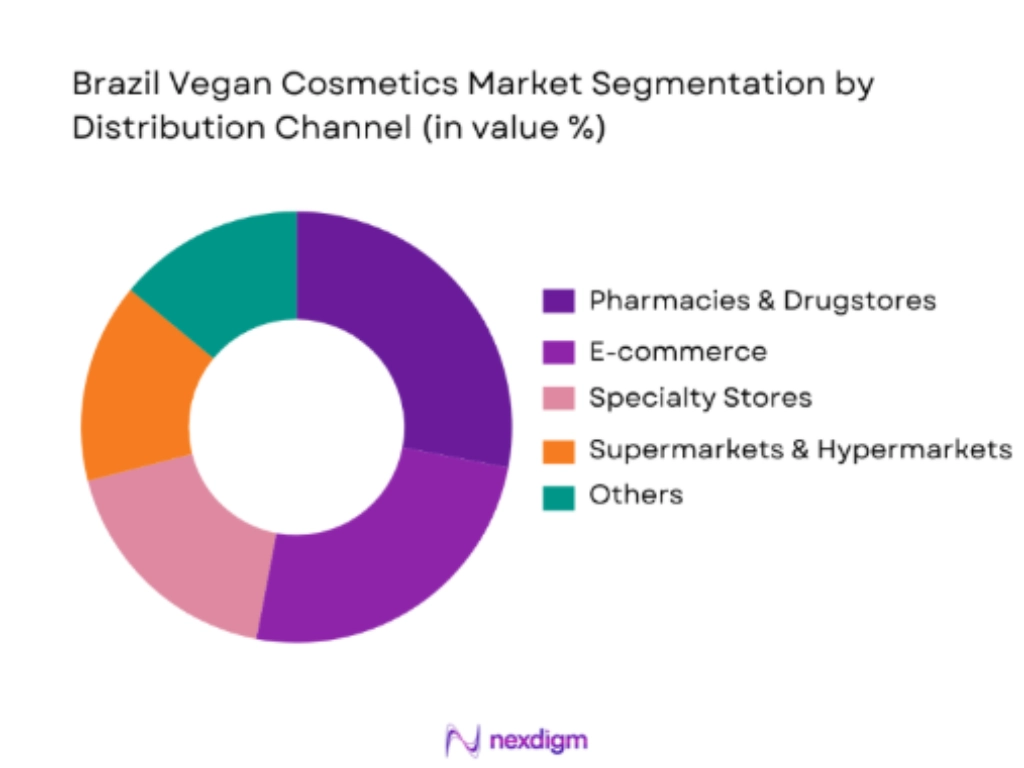
Brazil Vegan Cosmetics market is segmented by distribution channel into e-commerce, pharmacies & drugstores, specialty stores, supermarkets & hypermarkets, direct selling, and others. Pharmacies & drugstores dominate the market due to high consumer trust in dermocosmetic recommendations, widespread urban penetration, and strong alignment with vegan skincare positioning. Chains such as Droga Raia and Drogasil influence purchasing behavior through dermatologist-endorsed product placement. Meanwhile, e-commerce is rapidly growing due to influencer-led marketing and direct-to-consumer vegan beauty brands expanding reach beyond metropolitan areas.
Competitive Landscape
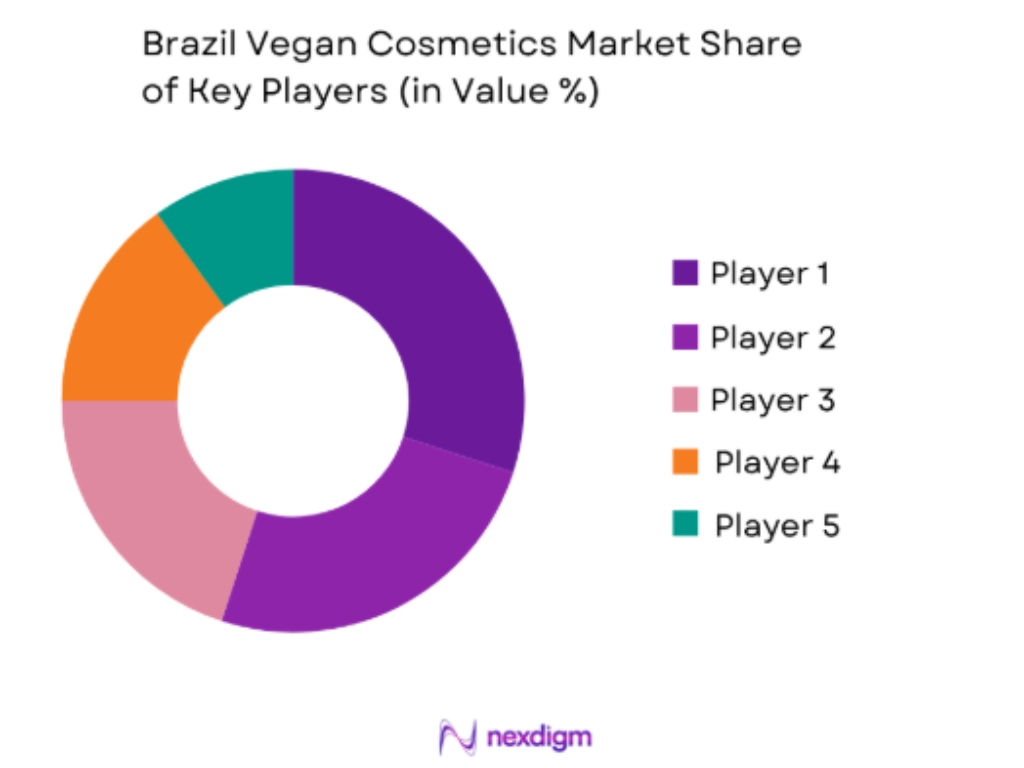
The Brazil Vegan Cosmetics market is moderately consolidated, with strong dominance from domestic beauty conglomerates and emerging indie vegan brands. Large multinational cosmetic companies compete with Brazilian clean beauty startups focusing on sustainability, cruelty-free certifications, and Amazonian biodiversity-based formulations. The competitive intensity is driven by product innovation, certification credibility, influencer marketing, and omnichannel retail penetration. Brand differentiation is increasingly defined by ingredient transparency, refill systems, and dermatological validation rather than traditional advertising.
| Company | Establishment Year | Headquarters | Product Focus | Vegan Certification Presence | Key Distribution Channel | Key Strength | Market Strategy |
| Natura | 1969 | São Paulo, Brazil | ~ | ~
|
~
|
~
|
~
|
| Sallve | 2019 | São Paulo, Brazil | ~ | ~
|
~
|
~
|
~
|
| Lola From Rio | 2011 | Rio de Janeiro, Brazil | ~
|
~
|
~
|
~
|
~
|
| Simple Organic | 2015 | Brazil | ~ | ~
|
~
|
~
|
~
|
| Surya Brasil | 1995 | São Paulo, Brazil | ~
|
~
|
~
|
~
|
~
|
Brazil Vegan Cosmetics Market Analysis
Growth Drivers
Rising Ethical Consumption
Brazil’s vegan cosmetics demand is being reinforced by a large, urban, digitally connected consumer base that can discover, compare, and repurchase ethics-led beauty products quickly. Brazil’s population reached 212.6 million, with 42.7 million people concentrated in just 15 municipalities with more than 1 million residents, including São Paulo, Rio de Janeiro, Brasília, Fortaleza, and Salvador. That metropolitan concentration matters for vegan cosmetics because premium beauty distribution, dermatology networks, specialty retail, and influencer-led launches are densest in those cities. Brazil also had GDP of USD 2.19 trillion and GDP per capita of USD 10,310.5, while inflation stood at 4.4, preserving a consumption environment where higher-value personal care categories could still expand. On the access side, internet was present in 74.9 million households, equal to 93.6% of households, and mobile phone ownership reached 97.0% of households. For vegan cosmetics, that digital reach directly supports ingredient-checking behavior, claims scrutiny, social-commerce discovery, and faster migration toward cruelty-free and plant-based routines. Retail demand conditions were also supportive: overall retail trade sales in Brazil increased 4.7, and the pharmaceutical, medical, orthopedic and perfumery articles category posted a 16.1 increase against the same month a year earlier, showing that beauty-adjacent and perfumery-linked channels were already operating with strong sell-through momentum. These conditions make ethical consumption commercially actionable rather than only aspirational in Brazil’s cosmetics market.
Premiumization of Clean and Conscious Beauty
Premiumization in Brazil vegan cosmetics is being sustained by a combination of purchasing power concentration, strong specialty and pharmacy retail performance, and the formalization of product standards. Brazil’s economy recorded GDP of USD 2.19 trillion in 2024, GDP per capita of USD 10,310.5, and GDP growth of 3.4, creating a macro backdrop that supports trading-up in discretionary personal care, especially in metropolitan markets. Population concentration also favors premium beauty: São Paulo alone had 11,895,578 residents, Rio de Janeiro 6,729,894, Brasília 2,982,818, and Belo Horizonte 2,416,339. These cities host the deepest mix of pharmacies, perfumarias, dermatology clinics, shopping centers, and premium omnichannel fulfillment. On the demand side, the retail category covering pharmaceutical, medical, orthopedic and perfumery articles rose 16.1 year on year in October, while total retail sales in Brazil increased 4.7 over the year, indicating that higher-frequency wellness and beauty channels outperformed broad retail. Premiumization is also supported by better digital merchandising: 74.9 million households had internet access, 43.4% of households had paid video streaming services, and 13.5 million connected households already had some type of smart device, all of which expand exposure to ingredient-led education, refill narratives, dermatologist content, and prestige product launches. In vegan cosmetics, premiumization is therefore not only about higher price points; it is tied to better claims architecture, cleaner ingredient stories, clinically positioned formulations, and stronger channel environments able to sell efficacy-led conscious beauty.
Market Challenges
Ingredient Sourcing Volatility
Ingredient sourcing volatility remains a real constraint for Brazil vegan cosmetics because many formulations depend on globally traded vegetable oils, botanical extracts, specialty actives, and imported intermediates whose availability and cost structure move with international commodity cycles and trade conditions. The World Bank’s Commodity Markets Outlook shows that soybean oil prices were forecast to ease by 3 in 2025 and 2 in 2026, while palm oil prices were forecast to increase by 2 in 2025, underscoring that key oil-based inputs do not move uniformly and can pressure formulation planning, procurement contracts, and margin discipline across vegan skincare, haircare, and color cosmetics. Broader commodity volatility also persisted: the World Bank stated that global commodity prices were projected to fall 7 in 2025 and another 7 in 2026, reflecting unstable global demand and policy conditions rather than a smooth raw-material environment. For Brazil, this matters because the cosmetics and fragrance ecosystem is not fully insulated from imported content and trade flows. Industry trade-balance figures sourced from ComexStat/MDIC show Brazilian exports of cosmetics, toiletries, and fragrances at USD 884.0 million and imports at USD 927.3 million in 2024, evidencing continued dependence on cross-border supply for part of the category. At the same time, Brazil’s consumer inflation was 4.4 in 2024, which adds pressure when brands attempt to absorb ingredient swings without damaging affordability. In a vegan cosmetics market built on plant-derived inputs, sustainability claims, and sensory performance, volatility in oils, extracts, and packaging-linked feedstocks can delay launches, narrow gross-margin room, and complicate consistent replenishment of hero SKUs.
Claim Verification and Consumer Confusion
Claim verification is a structural challenge in Brazil vegan cosmetics because regulatory product classification, notification, and approval pathways are more detailed than many consumers realize, while “vegan,” “cruelty-free,” “natural,” and “clean” are often interpreted as interchangeable in the marketplace. ANVISA states that the general regulation for personal hygiene products, cosmetics, and fragrances is RDC 907/2024, and only the products listed in Article 34 are subject to pre-marketing approval, including sunscreens, hair straighteners, wavy hair products, topical insect repellents, and antiseptic gels for hands. Products outside that list are generally subject to notification, but companies still need a valid AFE authorization to manufacture, import, export, store, or distribute regulated products in Brazil. That layered framework raises the burden on brands to communicate clearly what is legally regularized, what is certified, and what is merely marketed through branding language. Consumer confusion becomes more consequential in a country with 74.9 million internet-connected households and 97.0% household mobile-phone ownership, where product discovery is heavily digital and misinformation can scale quickly. The challenge also intensified as Brazil advanced animal-testing restrictions: Law 15.183/2025 prohibited the use of live vertebrate animals in tests for cosmetics, perfumes, and personal hygiene products and their ingredients, raising the importance of precise compliance communication. In practice, brands that fail to distinguish regulatory regularization from ethical certification risk consumer mistrust, product delisting, or weaker conversion, especially in pharmacy and dermocosmetic channels where efficacy and compliance expectations are higher.
Market Opportunities
Vegan Dermocosmetics
Vegan dermocosmetics represent one of the clearest expansion opportunities in Brazil because the country already combines a large beauty-consuming population, strong pharmacy-channel momentum, and an established regulatory route for higher-attention cosmetic categories. Brazil had 212.6 million residents in 2024, with 42.7 million people living in 15 municipalities above 1 million inhabitants, giving dermocosmetic brands dense urban clusters where dermatology clinics, chain pharmacies, and premium wellness retail are already embedded. Channel performance supports the opportunity directly: IBGE reported that pharmaceutical, medical, orthopedic and perfumery articles increased 16.1 versus the same month a year earlier, making that one of the strongest retail groupings in the country. ANVISA’s current framework also matters. Under RDC 907/2024, categories such as sunscreens, hair straighteners, topical insect repellents, antiseptic gels for hands, and certain capillary products require pre-marketing approval, while other cosmetics follow notification pathways. That structure tends to reward brands able to combine compliance discipline with efficacy-led positioning. Vegan dermocosmetics fit this gap well because they translate ethical demand into clinically framed use cases such as acne management, barrier repair, sensitive-skin hydration, anti-pollution care, and daily photoprotection. The digital layer is equally favorable: internet access reached 74.9 million households, fixed broadband 88.9% of connected households, and smart devices were present in 13.5 million connected households, improving education around ingredients, routines, and dermatologist-backed content. For Brazil, the opportunity is not abstract; it sits at the intersection of compliant category architecture, strong pharmacy sell-through, and a consumer base increasingly willing to reward efficacy plus ethics in one product proposition.
Vegan Hair Repair and Scalp Care
Vegan hair repair and scalp care is a high-potential opportunity in Brazil because hair is a central personal-care routine in the country, while the regulatory and retail environment already supports specialized capillary products. ANVISA’s cosmetics framework specifically lists hair straighteners and wavy hair products among the categories requiring pre-marketing approval, which signals the importance of capillary applications within Brazil’s broader cosmetics system. That regulatory visibility creates room for more sophisticated vegan repair masks, bond-building treatments, scalp serums, anti-breakage lines, and post-chemical-care products that emphasize safety, performance, and ingredient transparency. The commercial context is favorable. Brazil’s retail sales increased 4.7 in 2024, while the pharmaceutical, medical, orthopedic and perfumery articles group rose 16.1 year on year in October, indicating strong throughput in channels that increasingly stock treatment-led haircare rather than only basic cleansing products. Urban concentration further supports this niche: São Paulo had 11.9 million residents, Rio de Janeiro 6.7 million, and Belo Horizonte 2.4 million, all markets with dense salon ecosystems, pharmacy chains, and strong beauty-content circulation. Digital infrastructure deepens the opportunity because 74.9 million households had internet access and 97.0% of households owned mobile phones, enabling tutorial-led adoption of scalp-care regimens, ingredient education, and repeat purchase through DTC and marketplace channels. For vegan brands, hair repair and scalp care offers a future-facing growth lane because it converts Brazil’s established haircare culture into higher-function, treatment-oriented, and ethically positioned product baskets without depending on speculative future demand assumptions
Future Outlook
Over the next period, the Brazil Vegan Cosmetics market is expected to experience strong expansion driven by rising ethical consumption, premiumization of skincare routines, and increased adoption of plant-based formulations. Growth will also be supported by digital commerce expansion, regulatory tightening on product claims, and rising demand for biodiversity-based ingredient innovation. The market will continue shifting toward high-performance vegan dermocosmetics, refillable packaging systems, and clinically validated botanical formulations across both mass and premium segments.
Major Players in the Brazil Vegan Cosmetics Market
- Natura
- Sallve
- Simple Organic
- Lola From Rio
- Surya Brasil
- Cativa Natureza
- Baims
- Bioart
- Feito Brasil
- Herbia
- Alva Personal Care
- Boni Natural
- Livealoe
- Inoar
- Weleda
Key Target Audience
- Vegan Cosmetic Manufacturers and Formulators
- Beauty and Personal Care Brand Owners
- E-commerce Beauty Platforms and Aggregators
- Pharmacy and Drugstore Chains (Droga Raia, Drogasil)
- Retail and Specialty Beauty Distributors
- Raw Material Suppliers and Botanical Extract Producers
- Investments and Venture Capitalist Firms (Kinea Investimentos, Monashees, Kaszek Ventures)
- Government and Regulatory Bodies (ANVISA – Agência Nacional de Vigilância Sanitária, Ministério da Saúde do Brasil)
Research Methodology
Step 1: Identification of Key Variables
The initial phase involves mapping Brazil’s vegan cosmetics ecosystem, including manufacturers, ingredient suppliers, retail channels, and certification bodies. Secondary databases, trade publications, and regulatory filings are analyzed to identify key variables such as product segmentation, channel structure, and consumer adoption drivers. This establishes the foundational structure for the market model.
Step 2: Market Analysis and Construction
This phase involves compiling historical market performance data for vegan cosmetics in Brazil, including revenue generation across skincare, haircare, and makeup categories. Channel-wise penetration and brand-level sales distribution are analyzed. The objective is to construct a structured baseline model of market size and demand distribution.
Step 3: Hypothesis Validation and Expert Consultation
Market assumptions are validated through structured interviews with industry stakeholders including brand managers, retail executives, and supply chain experts. Computer-assisted telephonic interviews (CATIs) are used to validate pricing trends, consumer adoption behavior, and certification impact on purchasing decisions.
Step 4: Research Synthesis and Final Output
Final synthesis integrates bottom-up brand-level analysis with top-down macroeconomic validation. Product-level performance, channel economics, and consumer insights are consolidated to finalize market sizing, segmentation structure, and growth projections for the Brazil vegan cosmetics industry.

- Executive Summary
- Research Methodology (Market Definitions and Assumptions, Abbreviations, Currency Conversion Framework, Inflation Normalization Logic, Primary Interview Universe, Secondary Source Triangulation, Top-to-Bottom Market Estimation Approach, Bottom-to-Top Brand-Channel Build-Up Approach, Forecasting Framework, Data Validation and Sensitivity Testing, Limitations and Risk Flags)

- Definition and Scope
- Market Genesis and Evolution of Vegan Beauty in Brazil
- Category Boundary Mapping: Vegan vs Cruelty-Free vs Natural vs Organic vs Clean Beauty
- Brazil Beauty and Personal Care Industry Linkage to Vegan Cosmetics
- Value Chain Analysis
- Supply Chain Architecture
- Raw Material and Active Ingredient Ecosystem
- Amazonian and Brazilian Biodiversity Ingredient Relevance
- Manufacturing and Outsourcing Landscape
- Import Dependency vs Domestic Formulation and Filling
- Route-to-Market Structure
- Regulatory and Compliance Landscape
- Labeling, Claims, and Certification Landscape
- Taxation, Trade, and Pricing Implications
- Innovation and Product Launch Landscape
- Retail and Omnichannel Transformation
- Consumer Adoption Curve
- Stakeholder Ecosystem
- Porter’s Five Forces Analysis
- Industry Risk Assessment

- Growth Drivers (Rising Ethical Consumption, Premiumization of Clean and Conscious Beauty, Skincare and Haircare Regimen Expansion, Biodiversity-Led Product Innovation, Growth in DTC, Social Commerce, and Marketplace Beauty, Expansion of Pharmacy and Specialty Retail Assortment, Ingredient Transparency and Label Literacy, Refill and Sustainable Packaging Adoption)
- Market Challenges (Ingredient Sourcing Volatility, Claim Verification and Consumer Confusion, Premium Pricing vs Mass Affordability Gap, Scale Constraints for Indie Vegan Brands, Shelf Competition Against Conventional Beauty Giants, Certification Cost and Compliance Burden, Trade Tax Complexity and Margin Pressure)
- Market Opportunities (Vegan Dermocosmetics, Vegan Hair Repair and Scalp Care, Men’s Vegan Grooming, Baby-Safe and Family-Safe Vegan Care, Vegan Sun Protection, Refill-Led Loyalty, Models, Pharmacy-Grade Vegan Skincare, Amazonian Ingredient Premium Lines)
- Key Trends( Skinimalism with Efficacy Claims, High-Performance Vegan Actives, Barrier Repair and Sensitive Skin Formulas, Solid and Water-Less Formats, Vegan Makeup with Skincare Benefits, Hair Wellness and Scalp Microbiome Narratives, Refill Ecosystems and Circular Packaging, Community-Led Product Co-Creation)
- Regulatory and Certification Assessment (ANVISA Product Regularization Pathways, Labeling and Composition Disclosure Requirements, Claims Governance for Vegan and Cruelty-Free Positioning, Animal Testing Regulation Impact, Certification Bodies and Seal Relevance)
- SWOT Analysis (PESTLE Analysis, Opportunity Attractiveness Matrix, Risk-Return Matrix)

- By Value (2020-2025)
- By Volume (2020-2025)
- By Average Selling Price
- By Unit Consumption (2020-2025)
- By Online vs Offline Sales Mix (2020-2025)
- By Domestic vs Imported Sales Mix (2020-2025)

- By Product Type (In Value%)
Skincare
Haircare
Color Cosmetics / Makeup
Bath and Body Care
Fragrances
Oral Care
Men’s Grooming
Sun Care
Mother and Baby Care
Intimate Care - By Consumer Need-State / Benefit Platform (In Value%)
Hydration and Nourishment
Anti-Acne and Oil Control
Anti-Aging and Firming
Sensitive Skin and Hypoallergenic Care
Brightening and Spot Correction
Hair Repair and Frizz Control
Scalp Wellness and Hair Growth Support
Sun Protection and After-Sun Care - By Ingredient Platform (In Value%)
Amazonian and Native Brazilian Botanicals
Aloe and Herbal Extract-Based Formulations
Essential Oil-Based Formulations
Clinical Vegan Actives
Mineral-Based Formulations
Hybrid Botanical-Clinical Formulations - By Distribution Channel (In Value%)
Brand-Owned E-commerce / DTC
Online Marketplaces
Pharmacies and Drugstore Chains
Perfumarias and Beauty Specialty Retail
Supermarkets and Hypermarkets
Natural and Health Stores
Brand-Owned Physical Stores
Beauty Salons and Professional Channels
Direct Selling / Social Selling - By Price Tier (In Value%)
Mass
Masstige
Premium
Prestige / Luxury - By Certification and Claim Platform (In Value%)
Vegan-Certified
Cruelty-Free Positioned
Natural and Vegan
Organic and Vegan
Clean Beauty and Vegan
Dermatologically Tested Vegan
Refillable / Low-Waste Vegan - By Packaging Format (In Value%)
Bottles
Tubes
Jars
Pumps and Dispensers
Sticks and Solids
Refill Packs
Glass Packaging
Mono-Material / Recyclable Packs - By Region (In Value%)
Southeast
South
Northeast
Central-West
North

- Market Share Analysis of Major Players (By Value, By Volume, By Product Type Presence, By Channel Presence, By Price Tier Presence)
- Competitive Positioning Matrix (Brand Equity, Clinical Efficacy Positioning, Biodiversity Storytelling, Premiumization Level, Sustainability Credentials, DTC Maturity, Retail Penetration, Loyalty Strength)
- Cross Comparison Parameters (Brazil Vegan Cosmetics Revenue Exposure, Vegan SKU Count in Brazil, Share of Certified Vegan SKUs, Average Realized Price per Hero SKU, DTC-to-Retail Sales Mix, Pharmacy/Perfumaria/Marketplace Reach, Refill or Recyclable Packaging Penetration, Amazonian or Native Botanical Ingredient Intensity)
- Pricing Benchmarking Analysis (Hero SKU Pricing, Price per ml/g, Entry Ticket, Bundle Economics, Promotional Intensity)
- New Product Development and Launch Analysis (Launch Frequency, Claim Innovation, Format Innovation, Seasonal Drops, Collaboration Strategy)
- Digital Shelf and Consumer Engagement Analysis (Website Traffic Orientation, Social Commerce Activation, Review Density, Influencer Reliance, Community Co-Creation)
- Detailed Profiles of Major Companies
Natura
Sallve
Simple Organic
Cativa Natureza
Lola From Rio
Surya Brasil
Baims
Bioart
Feito Brasil
Herbia
Alva Personal Care
Boni Natural
Livealoe
Inoar
Weleda

- Consumer Demographic Profile
- Consumer Psychographic Profile
- Urban vs Non-Urban Adoption Behavior
- Gen Z, Millennial, Gen X, and Mature Consumer Analysis
- Gender-Based Demand Assessment
- First-Time Buyer vs Repeat Buyer Behavior
- Purchase Occasion Mapping
- Consumer Pain Points and Unmet Needs
- Ingredient Awareness and Label-Decoding Behavior
- Brand Trust and Certification Influence
- Price Sensitivity and Premiumization Thresholds
- Review, Influencer, and Community Impact on Conversion
- Repurchase and Subscription Potential
- Consumer Journey Funnel Analysis

- By Value (2026-2035)
- By Volume (2026-2035)
- By Average Selling Price (2026-2035)
- By Online vs Offline Sales Mix (2026-2035)
- By Domestic vs Imported Sales Mix (2026-2035)


 Request a Sample
 Ask for Customization
 Get a Quote
 Enquire Now