
 Download PDF
Market Overview
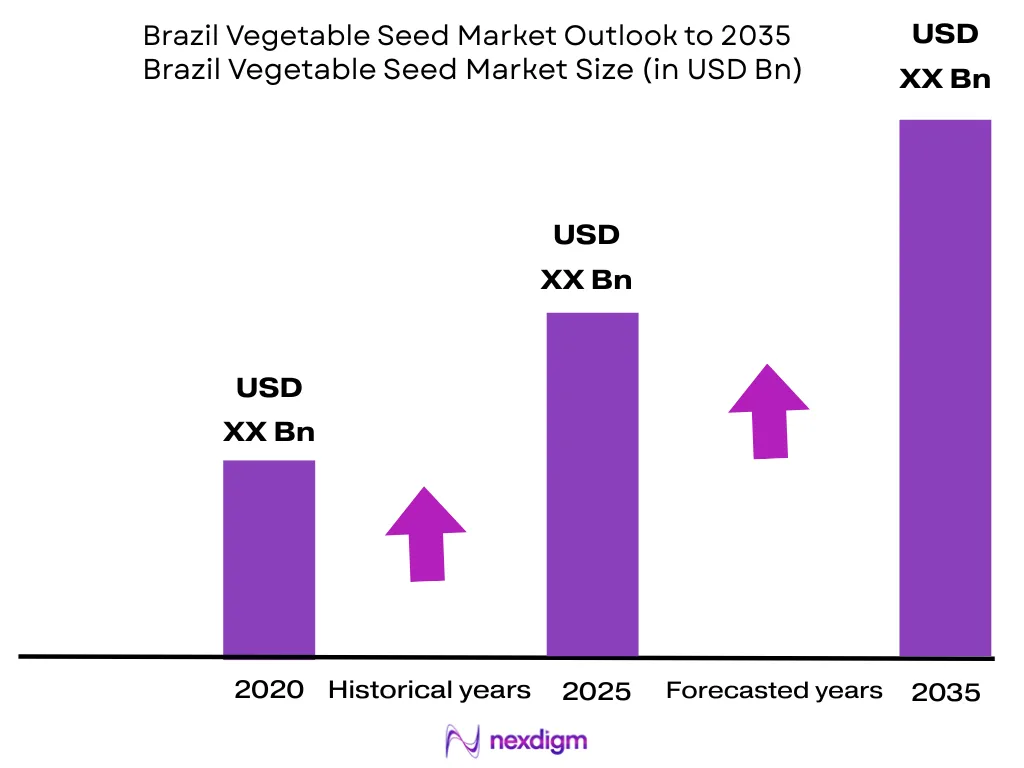
The Brazil Vegetable Seed Market is valued at R$ ~ billion, based on the sector value reported for Brazil’s vegetable-seed industry by ABCSEM and cited by Embrapa/Abrates. Demand is driven by high-value horticulture, hybrid seeds, modern cultivars and short-cycle crops. Brazil’s vegetable chain covers around 1 million hectares, while tomato alone reached around 4.7 million tonnes of harvested production, making seed quality central to productivity, disease tolerance and crop uniformity. São Paulo, Minas Gerais, Goiás, Bahia, Rio Grande do Sul, Paraná and Pernambuco dominate Brazil Vegetable Seed Market demand because they combine vegetable acreage, irrigated belts, seedling nurseries, CEASA wholesale channels and protected cultivation. São Paulo and Minas Gerais lead fresh vegetables and hydroponics, Goiás is central to processing tomato, Bahia and Pernambuco support irrigated onion, melon and watermelon, while Rio Grande do Sul and Paraná are strong in onion, brassicas and temperate vegetable systems.
Market Segmentation
By Breeding Technology
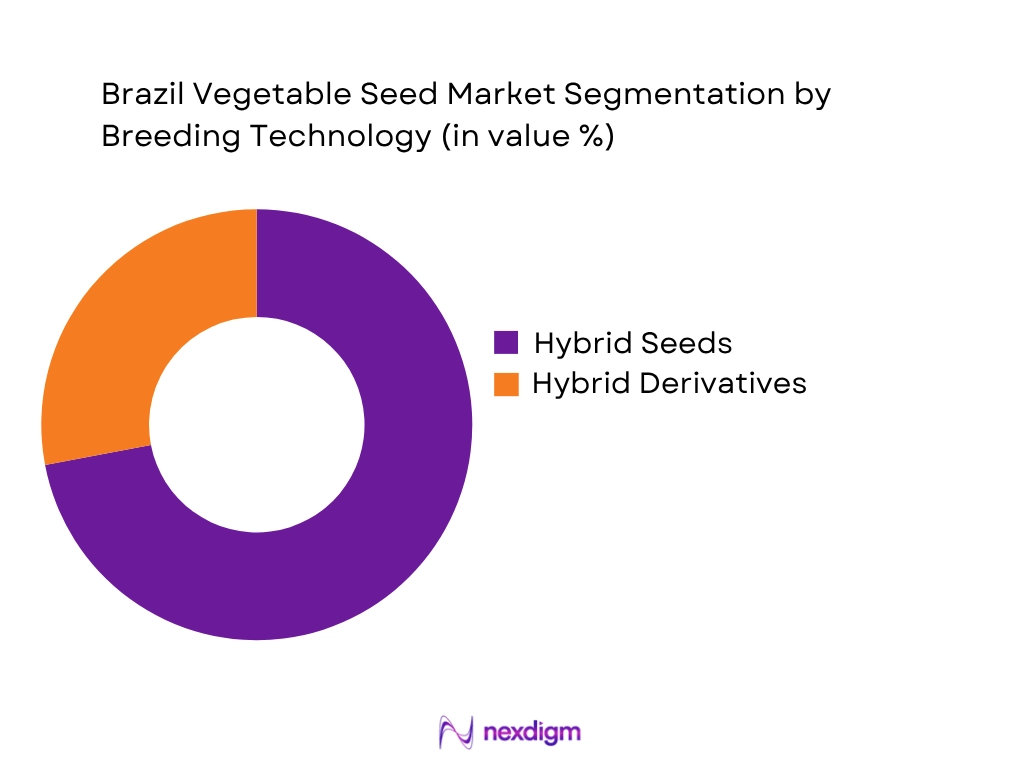
Brazil Vegetable Seed Market is segmented by breeding technology into hybrid seeds and open-pollinated varieties with hybrid derivatives. Hybrid seeds hold the dominant market share because commercial growers increasingly require uniform maturity, consistent fruit shape, disease resistance, heat tolerance and stronger marketable yield across tropical and subtropical production belts. Brazil’s horticulture system is exposed to whitefly pressure, begomovirus, Fusarium, bacterial wilt, downy mildew and high humidity, which makes resistance traits commercially important in tomato, pepper, lettuce, onion, cucurbits and brassicas. Hybrid adoption is also supported by supermarkets, CEASA wholesalers and processing buyers that demand consistency in size, shelf life and transportability. Open-pollinated varieties remain relevant for smallholders, local markets, agroecology and home gardening, but their commercial role is smaller because they offer lower uniformity and weaker trait packages than premium hybrids. South America vegetable-seed data shows hybrids as the leading breeding-technology segment, supporting Brazil’s hybrid-led market structure.
By Cultivation Mechanism
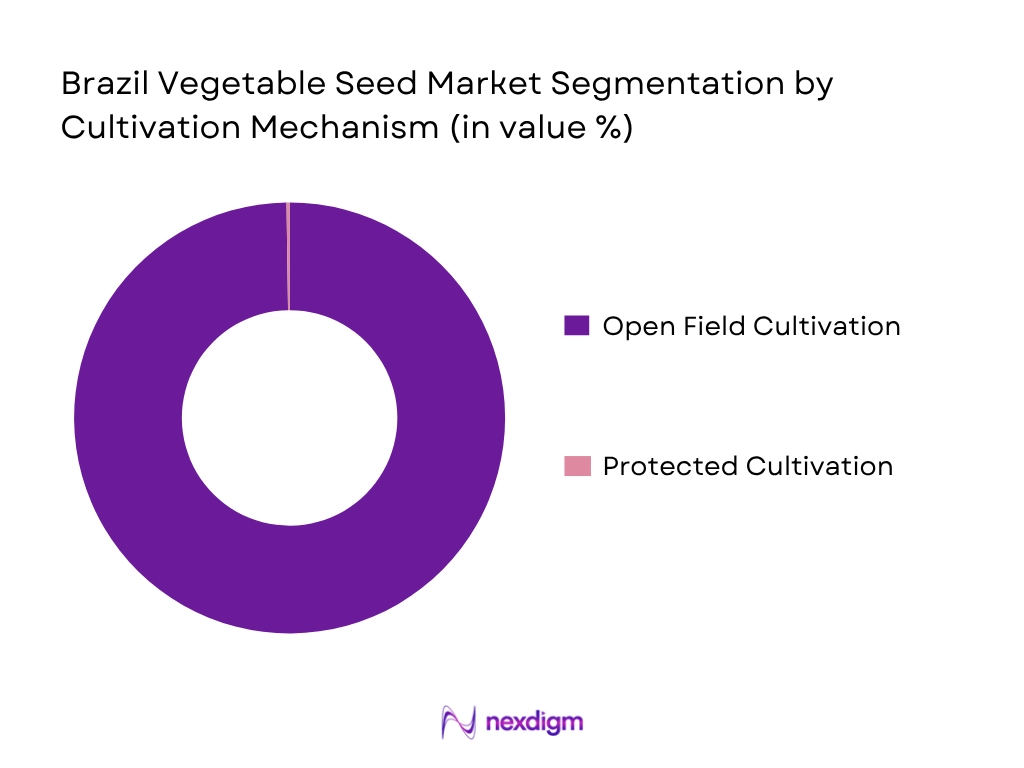
Brazil Vegetable Seed Market is segmented by cultivation mechanism into open field cultivation and protected cultivation. Open field cultivation dominates because most Brazilian vegetable acreage is still planted in field systems across tomato, onion, watermelon, melon, pumpkin, carrot, beetroot, cabbage, lettuce and pepper. These crops are produced across irrigated, rainfed and peri-urban belts, with demand supported by continuous replanting and short production cycles. Goiás processing tomato farms, São Francisco Valley irrigated horticulture, São Paulo fresh vegetable belts and Southern onion-producing states all rely heavily on field-based seed demand. Protected cultivation is smaller but strategically important because greenhouse, hydroponic and high-tunnel growers need specialized lettuce, tomato, cucumber, pepper, arugula, basil and herb seed varieties. Its growth is driven by urban fresh-produce demand, yield control and quality consistency, but open-field production remains dominant because it serves larger cultivated areas and broader wholesale supply chains.
Competitive Landscape
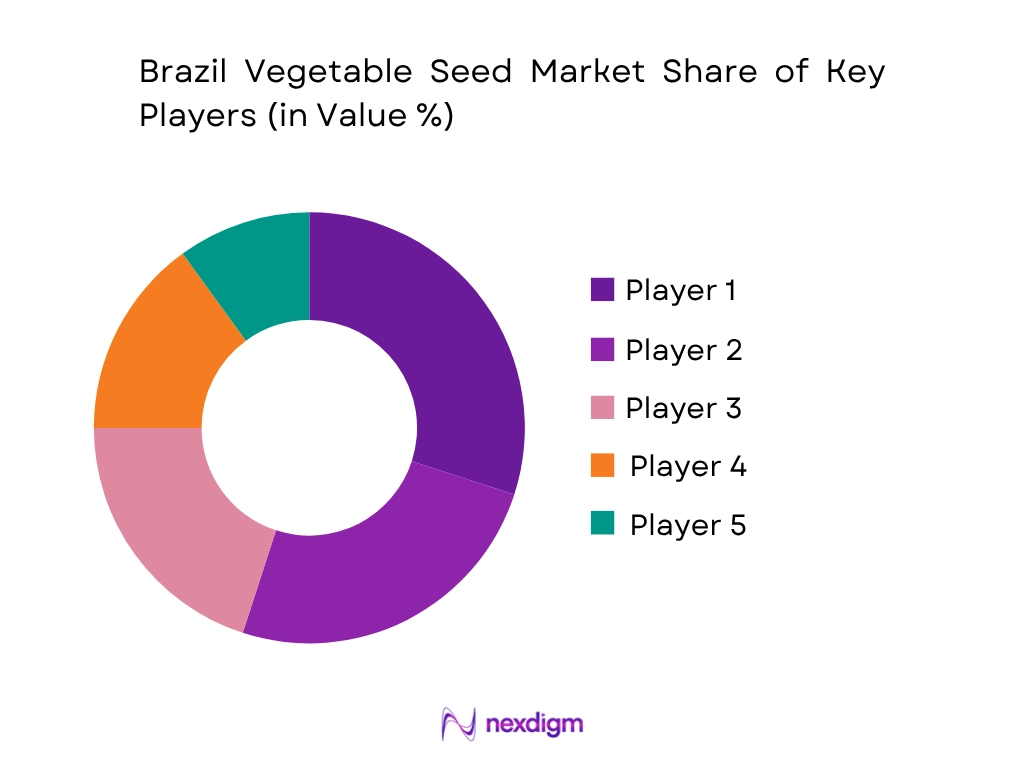
Brazil Vegetable Seed Market is dominated by multinational vegetable-seed companies and strong domestic seed houses. Bayer/Seminis, Syngenta, BASF/Nunhems, Sakata and HM.CLAUSE influence premium hybrid categories through breeding pipelines, protected-crop portfolios, distributor reach and disease-resistance packages. Local players such as Feltrin, Isla, Horticeres and Agristar/Topseed remain important in retail packets, open-pollinated varieties, smallholder channels and Brazil-adapted product lines. Syngenta’s acquisition of Feltrin strengthened its vegetable-seed portfolio in Brazil and Argentina, reflecting consolidation in the category.
| Company | Establishment Year | Headquarters | Key Vegetable Seed Brands | Priority Crop Families in Brazil | Channel Strength | Protected Cultivation Portfolio | Disease/Climate Trait Focus | Brazil Market Positioning |
| Bayer AG | 1863 | Leverkusen, Germany | ~ | ~ | ~ | ~ | ~ | ~ |
| Syngenta Group | 2000 | Basel, Switzerland | ~ | ~ | ~ | ~ | ~ | ~ |
| BASF SE | 1865 | Ludwigshafen, Germany | ~ | ~ | ~ | ~ | ~ | ~ |
| Sakata Seed Corporation | 1913 | Yokohama, Japan | ~ | ~ | ~ | ~ | ~ | ~ |
| Groupe Limagrain | 1965 | Saint-Beauzire, France | ~ | ~ | ~ | ~ | ~ | ~ |
Brazil Vegetable Seed Market Analysis
Growth Drivers
Tomato and Irrigated Vegetable Clusters Support Hybrid Seed Replacement
Brazil Vegetable Seed Market is supported by intensive tomato and irrigated vegetable clusters that require recurring use of hybrid, disease-resistant and heat-tolerant seeds. IBGE reported Goiás with 1.3 million tonnes of tomato production, São Paulo with 1.0 million tonnes, and Minas Gerais with 531.2 thousand tonnes, making these states critical demand centers for tomato hybrids, seedling nurseries and processing-oriented varieties. Brazil’s broader agricultural base also supports seed demand, with IBGE reporting 97.3 million hectares planted across surveyed crops and 96.5 million hectares harvested. The World Bank reports Brazil’s real GDP per capita at USD 10,616 and population at 205.3 million people, supporting large domestic vegetable consumption and commercial horticulture investment.
Large Domestic Food Economy Supports Fresh Vegetable Seed Demand
Brazil Vegetable Seed Market benefits from a large domestic food economy where fresh vegetables, roots and short-cycle crops require continuous replanting. IBGE’s agricultural survey reported 292.5 million tonnes of grain crops and 97.3 million hectares planted across all surveyed crops, reflecting the scale of Brazil’s production infrastructure, input distribution and grower base. Tomato demand remains especially seed-relevant, with IBGE-linked reporting showing Brazil harvested around 4.7 million tonnes of tomatoes. The World Bank identifies Brazil as Latin America’s largest country, with 8.5 million km² of territory, 205.3 million people, and real GDP per capita of USD 10,616, supporting diverse regional seed demand across São Paulo, Goiás, Minas Gerais, Bahia, Pernambuco, Paraná and Rio Grande do Sul.
Market Challenges
Climate Volatility Creates Production Risk for Vegetable Seed Planning
Brazil Vegetable Seed Market faces climate-linked uncertainty because vegetable production depends on precise planting windows, irrigation availability and stable field conditions. IBGE reported that El Niño caused severe and prolonged drought in Brazil’s Center-North, Southeast and part of Paraná, affecting crop performance. IBGE also recorded 292.5 million tonnes of grain crops and 96.5 million hectares harvested, showing the scale at which climate shocks affect agricultural input planning. For vegetable seed suppliers, drought, heavy rainfall and heat stress alter grower decisions on tomato, onion, lettuce, melon, watermelon, pepper and brassica varieties. The IMF also linked Brazil’s economic outlook to the Rio Grande do Sul flood calamity and agricultural normalization, while reporting Brazil’s population at 214.083 million.
Seed Import Authorization and Regulatory Compliance Add Operational Complexity
Brazil Vegetable Seed Market is constrained by regulatory and phytosanitary requirements because imported seed lots, breeding lines and propagation material require formal approval. MAPA states that importation of any quantity of seeds or seedlings must be authorized by the Ministry of Agriculture, Livestock and Food Supply, and all plant propagation material is legally treated as seed or seedling. This affects hybrid vegetable seed suppliers that depend on imported parent lines, treated seeds, pelleted lettuce seed and specialty greenhouse genetics. Brazil’s seed commercialization also interacts with RNC cultivar registration and RENASEM participation. The World Bank reports Brazil spans 8.5 million km², creating a large but administratively complex distribution geography for compliant seed movement, dealer registration and regional product launches.
Market Opportunities
Processing Tomato and High-Yield Vegetable Systems Create Scope for Specialized Hybrids
Brazil Vegetable Seed Market has a clear opportunity in specialized hybrids for processing tomato, fresh tomato and irrigated vegetable systems. IBGE-linked reporting shows Brazil harvested around 4.7 million tonnes of tomatoes, while Goiás, São Paulo and Minas Gerais remain core production states, with IBGE reporting 1.3 million tonnes, 1.0 million tonnes, and 531.2 thousand tonnes respectively in major tomato production estimates. These volumes create demand for seeds with uniform maturity, high soluble solids, heat tolerance, bacterial wilt resistance, virus resistance and machine-harvest suitability. Brazil’s macro base strengthens the opportunity: the World Bank reports 205.3 million people and real GDP per capita of USD 10,616, supporting a large domestic market for fresh and processed vegetable supply chains.
Organic, Untreated and Traceable Seeds Gain Relevance Under MAPA Oversight
Brazil Vegetable Seed Market has an opportunity in organic-compliant, untreated and traceable vegetable seeds as formal organic oversight expands. MAPA’s Cadastro Nacional de Produtores Orgânicos provides the national list of organic producers across Brazil and notes that CNPO data is generally updated on the 5th, 15th and 25th days of each month. MAPA’s open-data portal also lists the CNPO dataset with an update timestamp of 19 February 2026, showing active administrative maintenance of organic producer records. This supports demand for vegetable seed lots that can meet documentation needs for lettuce, tomato, herbs, brassicas, cucumber and root vegetables. Brazil’s 205.3 million population creates a sizeable fresh-food base for organic and residue-sensitive channels.
Future Outlook
Brazil Vegetable Seed Market is expected to expand at a 4.96% CAGR during the forecast period, using the Brazil-specific growth benchmark reported within the South America vegetable seed outlook. Growth will be supported by hybrid adoption, irrigated horticulture, protected cultivation, tropical disease-resistance breeding and high-value fresh produce demand. Over the next phase, Brazil’s vegetable-seed industry will increasingly shift toward seeds designed for heat, humidity, pest pressure and high-input commercial farming. Processing tomato in Goiás, irrigated onion and melon in the Northeast, hydroponic lettuce near metropolitan centers and greenhouse tomato and pepper cultivation will support premium seed demand. Domestic seed companies will continue serving open-pollinated, smallholder and retail-packet channels, while multinationals will focus on hybrid genetics, protected-crop lines and disease-resistant varieties. Seed treatment, pelleting, priming and biological coating will become more important as producers seek better germination, nursery efficiency and transplant uniformity.
Major Players
- Bayer CropScience / Seminis
- Syngenta Vegetable Seeds
- BASF Vegetable Seeds / Nunhems
- Sakata Seed Sudamerica
- HM.CLAUSE Brasil
- Enza Zaden Brasil
- Rijk Zwaan Brasil
- Bejo Sementes do Brasil
- Hazera Seeds
- Takii do Brasil
- East-West Seed
- Feltrin Sementes
- Isla Sementes
- Horticeres Sementes
- Topseed Premium / Agristar do Brasil
Key Target Audience
- Vegetable Seed Manufacturers
- Hybrid Vegetable Seed Breeding Companies
- Commercial Vegetable Producers
- Protected Cultivation and Hydroponic Farming Operators
- Seedling Nurseries and Transplant Producers
- Agro-Input Distributors and Rural Retail Chains
- Investments and Venture Capitalist Firms
- Government and Regulatory Bodies
Research Methodology
Step 1: Identification of Key Variables
The initial phase involves constructing an ecosystem map for the Brazil Vegetable Seed Market, covering breeders, seed importers, domestic seed houses, distributors, nurseries, vegetable producers and regulators. The objective is to identify critical variables such as crop family, breeding technology, seed treatment, protected cultivation, seed replacement frequency and regional production clusters.
Step 2: Market Analysis and Construction
In this phase, historical data is compiled for vegetable acreage, crop production, seed import dependence, hybrid penetration, open-field cultivation and protected-crop adoption. The model links crop-specific seed usage with commercial acreage, planting cycles, seed pack formats, distributor channels and grower types to build the market structure.
Step 3: Hypothesis Validation and Expert Consultation
Market hypotheses are validated through interviews with vegetable-seed companies, distributors, crop specialists, seedling nurseries, hydroponic producers and commercial growers. These consultations support assumptions on hybrid adoption, seed pricing bands, crop-wise demand, regional sales concentration and resistance-trait preference.
Step 4: Research Synthesis and Final Output
The final phase integrates secondary data, primary insights, company portfolio mapping and bottom-up crop modelling into a validated market report. The synthesis checks consistency across market size, segmentation, competitive landscape and future outlook to produce an investor- and business-focused view of the Brazil Vegetable Seed Market.

- Executive Summary
- Research Methodology (Market Definitions and Assumptions, Vegetable Seed Taxonomy, Commercial Seed Boundary, Hybrid/Open-Pollinated/Heirloom/Organic/Untreated Seed Classification, Market Sizing Approach, Top-Down Seed Revenue Validation, Bottom-Up Crop Acreage-to-Seed Requirement Model, Primary Interviews with Breeders/Distributors/Producers/Greenhouse Operators, RNC/RENASEM Validation, Trial Network Mapping, Limitations and Future Conclusions)

- Definition and Scope
- Overview Genesis
- Evolution of Vegetable Breeding in Brazil
- Timeline of Major Players
- Business Cycle

- Growth Drivers (Hybrid Adoption, Irrigated Vegetable Expansion, Urban Fresh Produce Demand, Protected Cultivation, Seed Replacement)
- Market Challenges (Seed Import Dependency, Phytosanitary Delays, Price Sensitivity, Climate Variability, Informal Seed Use, Disease Outbreaks)
- Opportunities (Protected Cultivation Genetics, Domestic Breeding, Organic Seeds, Seed Enhancement, Digital Agronomy, Regional Variety Positioning)
- Trends (Hybridization, Tropicalization of Breeding, CEA Adoption, Dealer Technical Support, Biological Seed Treatments, Digital Catalogs)
- SWOT Analysis
- Porter’s Five Forces
- PESTLE Analysis

- By Value (2020-2025)
- By Volume (2020-2025)
- By Average Realization per Kilogram/Thousand Seeds (2020-2025)

- By Crop Family (In Value %)
Tomato Seeds
Onion Seeds
Lettuce Seeds
Pepper and Chili Seeds
Cucurbit Seeds - By Distribution Channel (In Value %)
Direct-to-Grower Sales
Regional Distributors
Agro-Input Retailers
Cooperatives and Producer Associations - By End User (In Value %)
Commercial Vegetable Producers
Processing Vegetable Growers
Protected-Crop Operators
Hydroponic Producers
Organic Growers - By Region (In Value %)
Southeast
South
Northeast
Midwest/Cerrado
North

- Market Share of Major Players (Commercial Vegetable Seed Revenue, Crop-Family Share, Hybrid Share, Regional Presence)
- Cross Comparison Parameters (Tropical Hybrid Portfolio Breadth, Crop Disease-Resistance Depth, RNC-Registered Cultivar Base, RENASEM-Compliant Distribution Network, Protected-Cultivation Variety Portfolio, Organic and Untreated Seed Availability, Seed Treatment/Pelleting Capability, Regional Trial and Technical Agronomy Support)
- SWOT Analysis of Major Players
- Detailed Profiles of Major Companies
Bayer CropScience / Seminis
Syngenta Vegetable Seeds
BASF Vegetable Seeds / Nunhems
Sakata Seed Sudamerica
HM.CLAUSE Brasil
Enza Zaden Brasil
Rijk Zwaan Brasil
Bejo Sementes do Brasil
Hazera Seeds
Takii do Brasil
East-West Seed
Feltrin Sementes
Isla Sementes
Horticeres Sementes
Topseed Premium / Agristar do Brasil

- Commercial Fresh Vegetable Producer Analysis
- Processing Vegetable Grower Analysis
- Protected-Crop Producer Analysis
- Hydroponic Producer Analysis
- Organic and Agroecological Grower Analysis

- By Value (2026-2035)
- By Volume (2026-2035)
- By Average Realization per Kilogram/Thousand Seeds (2026-2035)


 Request a Sample
 Ask for Customization
 Get a Quote
 Enquire Now