

 Download PDF
 Download PDF
Market Overview
Based on a recent historical assessment, Brazil’s wealth management market oversees approximately USD ~ trillion in assets under management, as reported by the Brazilian Securities Commission and Central Bank disclosures for regulated asset managers and private banking institutions. The market is driven by rising participation in capital markets, expanding high net worth individual wealth pools, and structural shifts toward diversified financial products beyond traditional fixed income instruments, supported by digital advisory platform penetration.
São Paulo and Rio de Janeiro dominate Brazil’s wealth management ecosystem due to their concentration of financial institutions, stock exchange activity, and corporate headquarters, supported by B3’s exchange infrastructure and major private banking hubs. São Paulo serves as the core asset management and brokerage center, while Rio de Janeiro hosts significant family office structures and energy sector wealth, enabling these cities to attract both domestic and offshore capital flows within Brazil’s regulated financial framework.
Market Segmentation
By Product Type
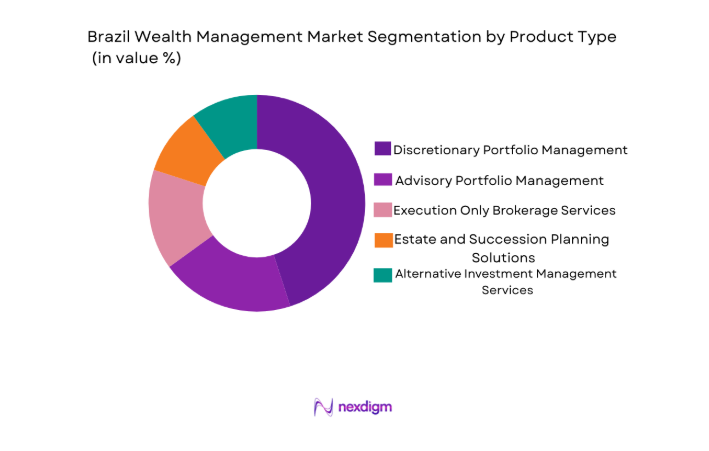
Brazil Wealth Management market is segmented by product type into discretionary portfolio management, advisory portfolio management, execution only brokerage services, estate and succession planning solutions, and alternative investment management services. Recently, discretionary portfolio management has a dominant market share due to rising demand for professional asset allocation, increasing complexity of investment products, broader access to global equities and alternative assets, and the preference of high net worth individuals for delegated decision making within regulated advisory frameworks.
By Platform Type
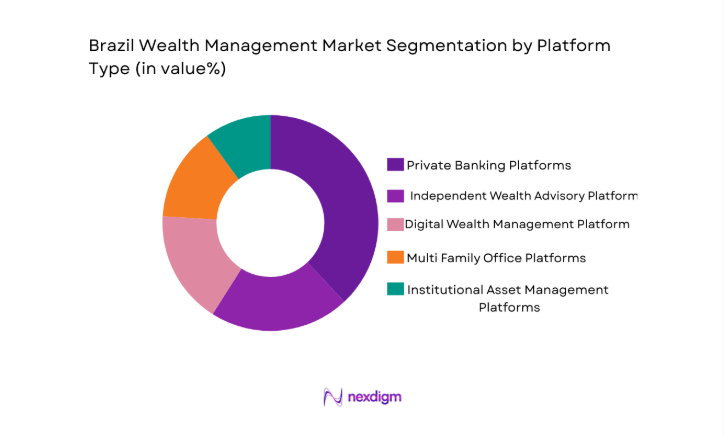
Brazil Wealth Management market is segmented by platform type into private banking platforms, independent wealth advisory platforms, digital wealth management platforms, multi family office platforms, and institutional asset management platforms. Recently, private banking platforms have a dominant market share due to established client relationships, integrated banking and investment solutions, cross selling capabilities, and strong brand credibility among ultra high net worth individuals seeking comprehensive financial planning and capital preservation services.
Competitive Landscape
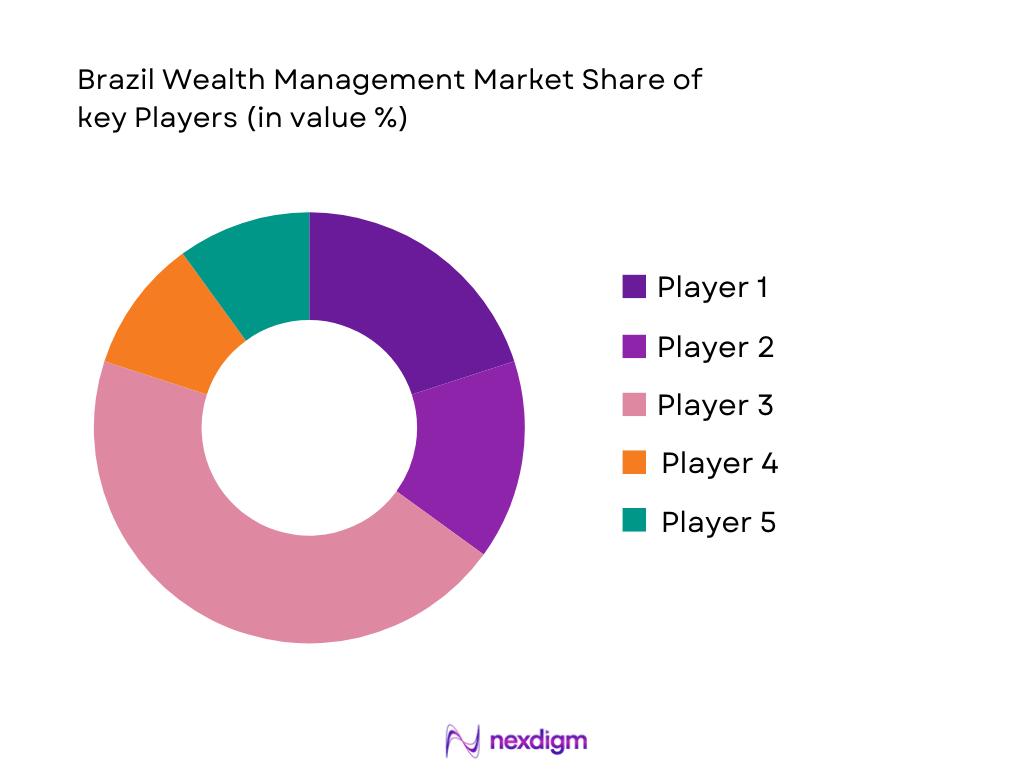
Brazil Wealth Management market remains moderately consolidated, led by large domestic banking groups and established private banking divisions that leverage extensive branch networks and digital ecosystems. Independent advisory firms and fintech driven platforms are expanding, yet major players continue to influence pricing, product innovation, and distribution strength through integrated banking and asset management operations.
| Company Name | Establishment Year | Headquarters | Technology Focus | Market Reach | Key Products | Revenue | Assets Under Management |
| Itaú Private Bank | 1945 | São Paulo | ~ | ~ | ~ | ~ | ~ |
| Bradesco Private Bank | 1943 | Osasco | ~ | ~ | ~ | ~ | ~ |
| BTG Pactual Wealth Management | 1983 | São Paulo | ~ | ~ | ~ | ~ | ~ |
| XP Private Bank | 2001 | São Paulo | ~ | ~ | ~ | ~ | ~ |
| Safra Private Banking | 1955 | São Paulo | ~ | ~ | ~ | ~ | ~ |
Brazil Wealth Management Market Analysis
Growth Drivers
Rising High Net Worth Individual Population and Capital Market Participation
Brazil has witnessed a sustained expansion in the number of affluent and high net worth individuals driven by entrepreneurship, agribusiness expansion, financial market liberalization, and increasing equity market participation, which has structurally strengthened the demand for professional wealth advisory services across urban financial centers. The growing sophistication of investors has accelerated allocations toward diversified portfolios including equities, structured products, and global assets, thereby increasing reliance on regulated wealth managers. Expansion of domestic capital markets through B3 has improved liquidity and broadened product availability. Institutional reforms have enhanced investor protection and transparency, fostering greater trust in managed solutions. Digital onboarding processes have simplified account access, enabling wealth managers to attract emerging affluent clients. Growing intergenerational wealth transfer has also stimulated estate planning and structured advisory demand. Increased exposure to international markets has further encouraged professional portfolio oversight. The combination of demographic shifts, financial innovation, and regulatory strengthening continues to expand assets under management.
Digital Transformation and Open Finance Integration
The rapid integration of digital advisory platforms and open finance frameworks has significantly enhanced accessibility, personalization, and cost efficiency within Brazil’s wealth management ecosystem, encouraging broader participation across affluent and mass affluent segments. Digital platforms now provide algorithmic portfolio construction, automated risk profiling, and real-time performance analytics, improving client engagement. Open finance regulations have enabled data portability across institutions, intensifying competition and improving product transparency. Lower distribution costs have allowed institutions to scale services profitably. Increased smartphone penetration has supported mobile investment activity. Fintech collaboration has accelerated innovation cycles within traditional banks. Clients now expect seamless digital experiences alongside human advisory support. This technological evolution continues to redefine competitive dynamics and strengthen long-term market growth.
Market Challenges
Macroeconomic Volatility and Currency Instability
Brazil’s wealth management market is significantly influenced by macroeconomic cycles, inflationary pressures, fiscal uncertainties, and exchange rate fluctuations that directly impact portfolio valuations and investor confidence across asset classes. Periods of currency depreciation can erode returns for domestically concentrated portfolios, prompting sudden reallocations. Inflation volatility complicates long-term financial planning strategies. Interest rate adjustments alter fixed-income attractiveness and equity valuations. Political uncertainty may delay investment decisions among affluent individuals. External shocks in commodity markets influence domestic capital flows. Regulatory changes responding to economic conditions can increase compliance burdens. Wealth managers must continuously rebalance portfolios under uncertain macro conditions. Sustained volatility may constrain consistent asset accumulation trends.
Regulatory Complexity and Compliance Costs
The evolving regulatory framework governed by the Brazilian Securities Commission and Central Bank imposes stringent compliance, reporting, and transparency requirements that increase operational complexity for wealth management firms. Frequent updates to suitability standards and disclosure norms demand system upgrades and staff training. Anti-money laundering protocols require enhanced due diligence procedures. Cross-border investment structures must comply with international reporting standards. Compliance technology investments raise cost structures, especially for smaller advisory firms. Penalties for non-compliance may damage reputational standing. Regulatory harmonization under open finance creates transitional implementation challenges. High administrative overhead may reduce margin flexibility. Continuous regulatory evolution requires adaptive governance frameworks across institutions.
Opportunities
Expansion of ESG and Sustainable Investment Mandates
Increasing awareness of environmental, social, and governance considerations among Brazilian investors presents a significant opportunity for wealth managers to develop thematic portfolios aligned with sustainability objectives and global capital flows. Institutional investors are integrating ESG screening into asset allocation decisions. Corporate transparency initiatives enhance the availability of sustainability metrics. Green bonds and impact funds are expanding within domestic exchanges. Younger investors demonstrate preference for responsible investment strategies. Regulatory encouragement for sustainable finance frameworks supports product development. International partnerships enable access to global ESG funds. Asset managers can differentiate offerings through measurable impact reporting. Structured ESG advisory services may attract long-term capital commitments.
Cross Border Wealth Structuring and Global Diversification Services
Growing demand among high-net-worth Brazilian clients for geographic diversification and currency risk mitigation creates opportunities for firms to offer cross-border structuring, offshore investment vehicles, and international tax planning solutions within compliant frameworks. Clients seek exposure to developed market equities and alternative assets. Offshore custody solutions enhance asset protection strategies. Regulatory transparency has simplified foreign asset reporting. Partnerships with global custodians strengthen service breadth. Currency hedging instruments provide portfolio stability. Wealth managers can design customized global allocation models. Advisory expertise in international estate planning increases client retention. Enhanced global connectivity supports scalable cross-border advisory growth.
Future Outlook
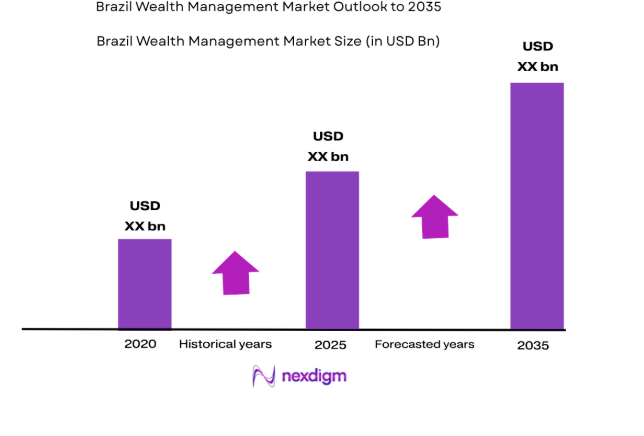
Brazil Wealth Management market is expected to experience sustained expansion driven by continued capital market participation and structural wealth accumulation. Technological innovation in digital advisory platforms will further enhance operational efficiency and client engagement. Regulatory support for open finance will intensify competition and transparency. Demand for diversified global portfolios and sustainable investment products is likely to strengthen advisory sophistication. Over the next five years, consolidation and strategic partnerships may reshape competitive positioning.
Major Players
- Itaú Private Bank
- Bradesco Private Bank
- Banco do Brasil Private Banking
- XP Private Bank
- BTG Pactual Wealth Management
- Safra Private Banking
- Santander Private Banking Brazil
- Genial Investimentos
- Guide Investimentos
- Órama Investimentos
- Modalmais
- Vinci Partners
- BB DTVM
- Rio Bravo Investimentos
- JGP Gestão de Recursos
Key Target Audience
- Private banks
- Asset management firms
- Brokerage houses
- Family offices
- Investment and venture capitalist firms
- Government and regulatory bodies
- Fintech platforms
- Institutional investors
Research Methodology
Step 1: Identification of Key Variables
The study identifies macroeconomic, regulatory, demographic, and financial variables influencing Brazil Wealth Management market performance. Primary financial disclosures and regulatory filings are reviewed to establish consistent benchmarks and segmentation logic.
Step 2: Market Analysis and Construction
Data from regulated asset managers and financial institutions are aggregated to construct market size and segmentation models. Comparative benchmarking and triangulation ensure data reliability and structural consistency.
Step 3: Hypothesis Validation and Expert Consultation
Industry experts, portfolio managers, and regulatory analysts are consulted to validate structural assumptions. Qualitative insights refine segmentation dominance and competitive positioning assessments.
Step 4: Research Synthesis and Final Output
Quantitative findings and expert validations are synthesized into a comprehensive analytical framework. The final output integrates market sizing, segmentation, competitive landscape, and forward outlook insights.

- Executive Summary
- Research Methodology (Definitions, Scope, Industry Assumptions, Market Sizing Approach, Primary & Secondary Research Framework, Data Collection & Verification Protocol, Analytic Models & Forecast Methodology, Limitations & Research Validity Checks)

- Market Definition and Scope
- Value Chain & Stakeholder Ecosystem
- Regulatory / Certification Landscape
- Sector Dynamics Affecting Demand
- Strategic Initiatives & Infrastructure Growth

- Growth Drivers
Rising number of high-net-worth individuals in Brazil driven by capital market expansion and entrepreneurial activity
Increasing penetration of digital investment platforms improving accessibility for mass affluent investors
Growing demand for diversified global asset allocation strategies among domestic investors
Expansion of private banking services by large financial institutions
Tax and regulatory reforms encouraging formal financial asset allocation - Market Challenges
Macroeconomic volatility and currency fluctuations impacting portfolio stability
High concentration of assets in traditional fixed income products
Regulatory compliance complexity under Brazilian financial supervision authorities
Limited financial literacy among emerging affluent segments
Intense competition from digital first fintech wealth platforms - Market Opportunities
Expansion of ESG focused investment portfolios aligned with global sustainability trends
Development of tailored advisory services for technology entrepreneurs and startup founders
Cross border wealth structuring solutions for globally mobile Brazilian investors - Trends
Acceleration of robo advisory adoption among younger investors
Shift toward alternative assets including private equity and real estate funds
Integration of open finance frameworks into wealth advisory models
Increased use of data driven risk profiling tools
Consolidation among independent wealth advisory firms - Government Regulations & Defense Policy
Oversight by the Brazilian Securities Commission governing asset management and advisory services
Central Bank regulations promoting transparency in financial product distribution
Implementation of open banking and open finance standards to enhance competition - SWOT Analysis
- Stakeholder and Ecosystem Analysis
- Porter’s Five Forces Analysis
- Competition Intensity and Ecosystem Mapping

- By Market Value, 2020-2025
- By Installed Units, 2020-2025
- By Average System Price, 2020-2025
- By System Complexity Tier, 2020-2025

- By System Type (In Value%)
Discretionary Portfolio Management
Advisory Portfolio Management
Execution Only Brokerage Services
Estate and Succession Planning Solutions
Alternative Investment Management Services - By Platform Type (In Value%)
Private Banking Platforms
Independent Wealth Advisory Platforms
Digital Wealth Management Platforms
Multi Family Office Platforms
Institutional Asset Management Platforms - By Fitment Type (In Value%)
Onshore Investment Structures
Offshore Investment Structures
Hybrid Advisory Structures
Open Architecture Platforms
Closed Architecture Platforms - By End User Segment (In Value%)
High Net Worth Individuals
Ultra High Net Worth Individuals
Mass Affluent Investors
Family Offices
Institutional Clients - By Procurement Channel (In Value%)
Direct Relationship Managers
Independent Financial Advisors
Digital Direct Platforms
Broker Dealer Networks
Corporate Tie Ups and Partnerships - By Material / Technology (in Value %)
Algorithmic Portfolio Construction Tools
Artificial Intelligence Based Advisory Systems
Big Data Analytics Platforms
Cloud Based Wealth Management Systems
Blockchain Enabled Custody Solutions

- Market structure and competitive positioning
Market share snapshot of major players - Cross Comparison Parameters (Assets Under Management, Client Segment Focus, Advisory Model, Digital Platform Capability, Product Diversification)
- SWOT Analysis of Key Competitors
- Pricing & Procurement Analysis
- Key Players
Itaú Private Bank
Bradesco Private Bank
Banco do Brasil Private Banking
XP Private Bank
BTG Pactual Wealth Management
Safra Private Banking
Santander Private Banking Brazil
Genial Investimentos Wealth
Guide Investimentos
Órama Investimentos
Modalmais Wealth
Vinci Partners Wealth Management
BB DTVM Asset Management
Rio Bravo Investimentos
JGP Gestão de Recursos

- High net worth individuals prioritizing capital preservation and global diversification
- Ultra high net worth families demanding bespoke succession and estate planning services
- Mass affluent investors increasingly adopting digital advisory platforms
- Institutional clients focusing on risk adjusted returns and regulatory compliance

- Forecast Market Value, 2026-2035
- Forecast Installed Units, 2026-2035
- Price Forecast by System Tier, 2026-2035
- Future Demand by Platform, 2026-2035


 Request a Sample
 Ask for Customization
 Get a Quote
 Enquire Now