

 Download PDF
Market Overview
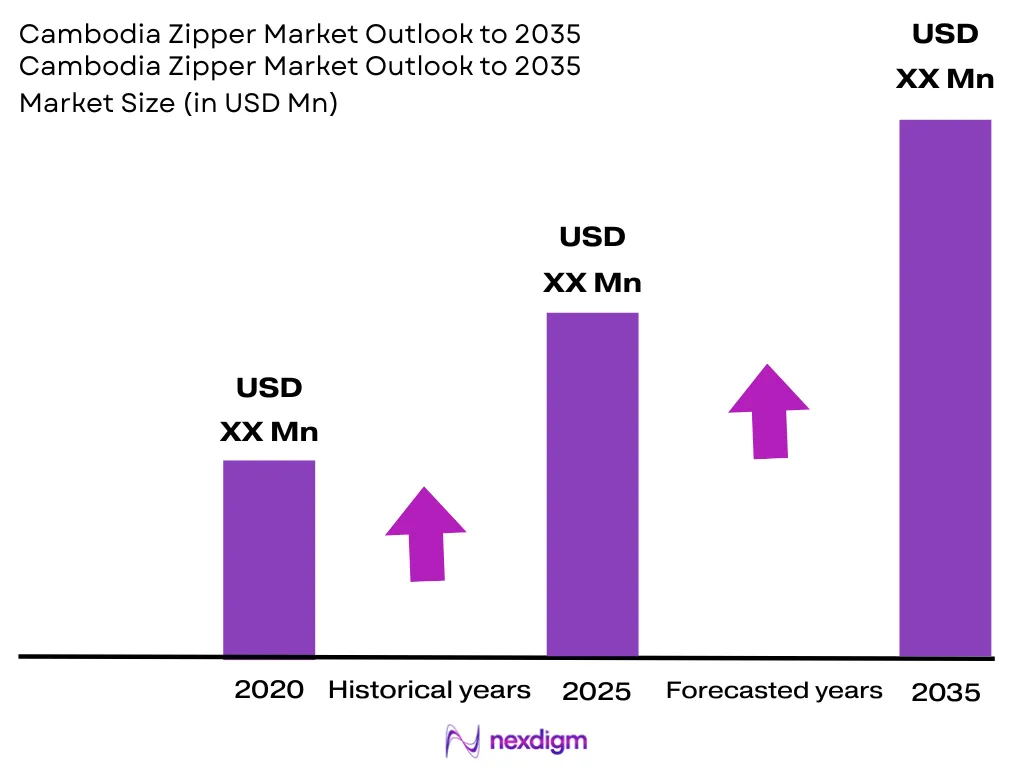
The Cambodia Zipper Market was valued at USD ~ Million in 2024 and is anticipated to expand at a CAGR of ~% during 2026-2035, tracking growth in Cambodia’s garment, footwear, and travel goods (GFT) sector, which recorded a record USD 12.8 billion in exports in 2022 and remains the country’s largest export industry, contributing over 40% of national GDP and employing more than 840,000 workers across approximately 600 factories registered with the Garment Manufacturers Association in Cambodia (GMAC). As a Least Developed Country, Cambodia benefits from duty-free, quota-free access to major export markets, with approximately 85% of garment exports qualifying for preferential treatment under the European Union’s Everything But Arms (EBA) scheme and the United States’ Generalized System of Preferences (GSP), sustaining strong underlying demand for zippers and other trims consumed across the country’s export-oriented apparel, footwear, and bag manufacturing base. Cambodia’s zipper market remains structurally shaped by the country’s predominantly cut-make-trim (CMT) production model, under which the substantial majority of raw materials and accessories, including zippers, are supplied by buyers or imported by intermediaries rather than manufactured domestically at scale.
Market Segmentation
By Product Type
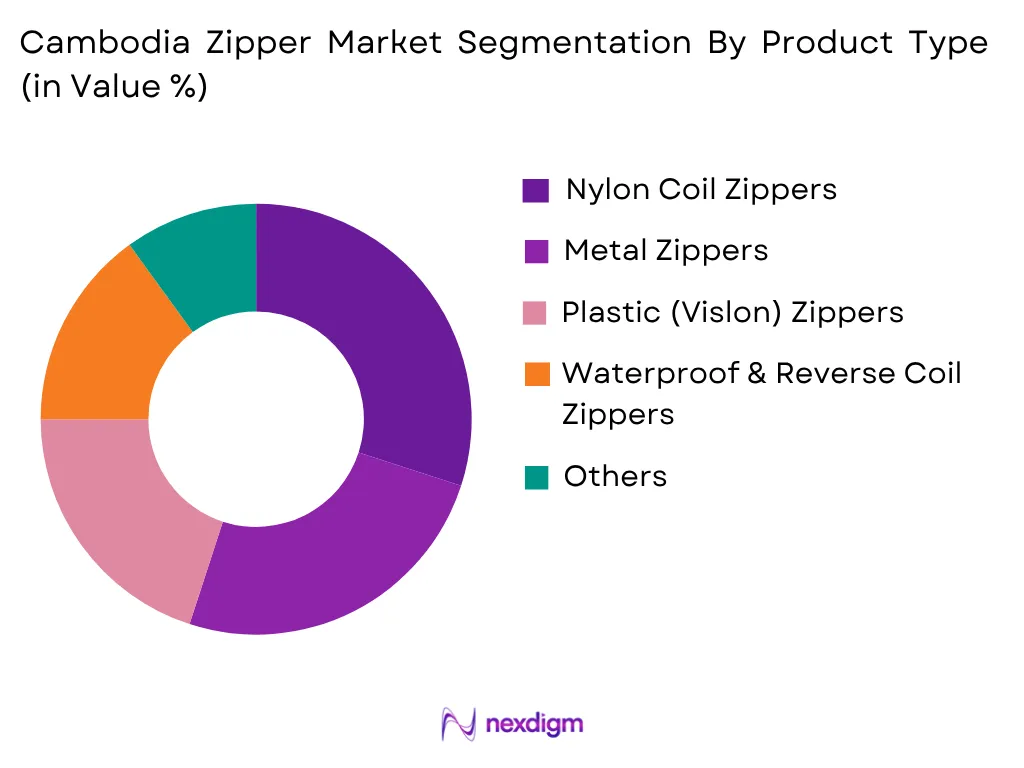
Nylon Coil Zippers hold the largest share of the Cambodia Zipper Market, reflecting their widespread use across the country’s dominant woven and knit apparel export categories, where lightweight, flexible coil zippers remain the preferred trim for jackets, trousers, and casualwear destined for European and American buyers. Metal Zippers retain an important niche within premium denim and outerwear categories, where brand specifications frequently call for metal hardware to convey a premium finish. Plastic (Vislon) Zippers continue to expand alongside Cambodia’s growing outerwear and workwear export segments, valued for their durability in heavier-weight garments. Waterproof & Reverse Coil Zippers represent a fast-growing category, driven by the expansion of Cambodia’s footwear, bag, and travel goods manufacturing base, which reached a combined export value exceeding USD 1 billion for travel goods alone in 2021, requiring more technically demanding zipper specifications than conventional apparel trims.
By Application
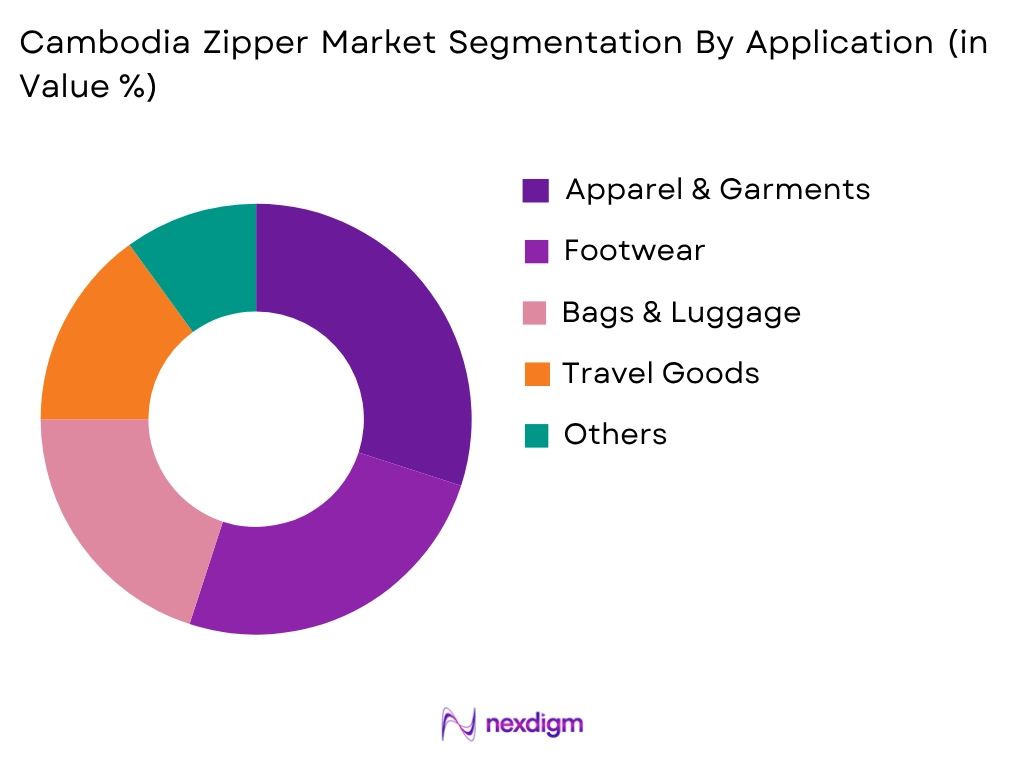
Apparel & Garments represent the dominant application segment in the Cambodia Zipper Market, directly reflecting the sector’s position as the country’s largest export industry and largest source of manufacturing employment. Footwear represents a significant and growing application, with Cambodia’s footwear exports reaching approximately USD 1.3 billion in 2021, requiring durable, higher-specification zippers for boots, athletic shoes, and casual footwear increasingly manufactured within the country’s expanding footwear factory base. Bags & Luggage and Travel Goods together constitute an increasingly important application category, as Cambodia’s travel goods exports surpassed USD 1 billion in export value in 2021, requiring heavy-duty, weather-resistant zipper specifications distinct from the lighter-weight trims used in conventional apparel. Home Textiles remain a comparatively smaller application category, though continued diversification of Cambodia’s export base is expected to gradually expand demand across this segment as well.
Competitive Landscape
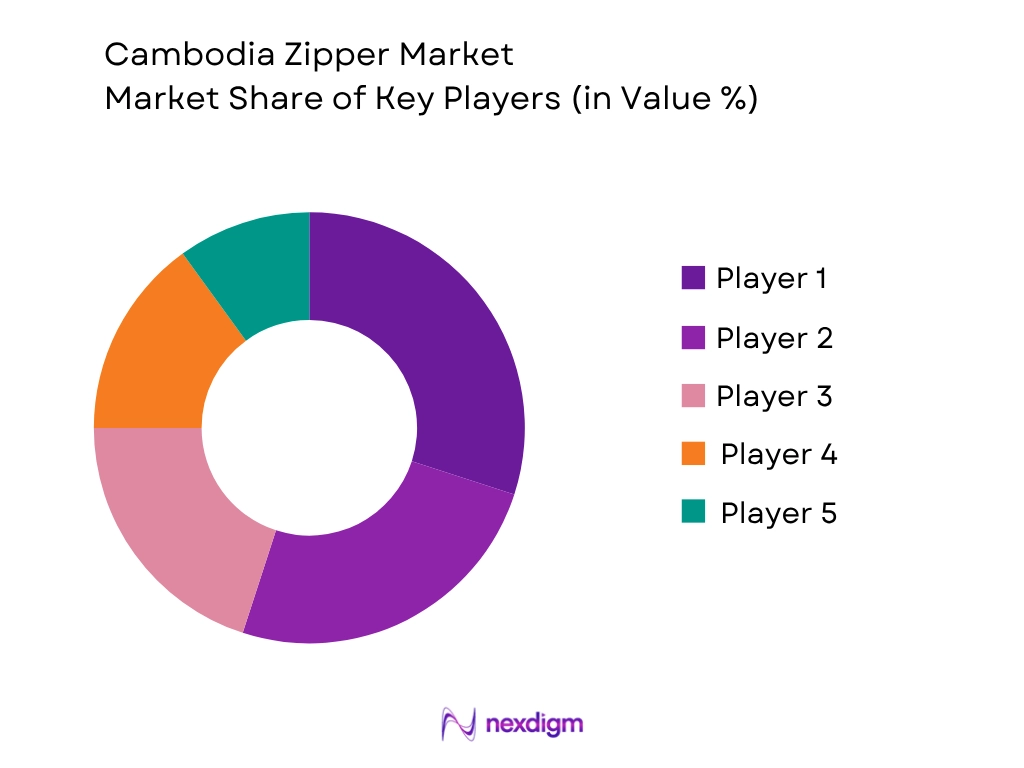
The Cambodia Zipper Market is dominated by global zipper majors operating through regional supply chains and trading networks rather than large-scale domestic manufacturing, reflecting Cambodia’s predominantly import-dependent, cut-make-trim production structure. YKK Corporation, the world’s largest zipper manufacturer, serves Cambodia’s garment industry substantially through its established regional production base in Vietnam, from which the company exports zippers and related trims to Cambodia and Myanmar, alongside direct trading relationships serving Cambodian garment factories. SBS Zipper Group maintains a dedicated Cambodia-facing commercial presence, positioning itself as a competitive alternative to YKK across nylon, metal, and plastic zipper categories for Cambodia’s export-oriented garment sector. Competition in the Cambodia market is primarily based on lead time, price competitiveness, brand compliance credentials, and the ability to service buyer-mandated trim specifications across Cambodia’s largely foreign-owned factory base, of which Chinese-owned factories represent approximately 90%. As Ken Loo, GMAC’s secretary-general, has publicly noted, genuine free-on-board (FOB) production capable of sourcing trims and accessories domestically remains limited in Cambodia, reinforcing the continued dominance of established international zipper suppliers over nascent local production initiatives.
| Company | Established | Headquarters | Primary Product Portfolio | Zipper Portfolio | Manufacturing/Trading Presence | Major End-Use Industries | Key Strategic Focus | Certifications & Compliance |
| YKK Corporation | 1934 | ~
|
~ | ~ | ~ | ~ | ~ | ~ |
| SBS Zipper Group | 1988 | ~
|
~ | ~ | ~ | ~ | ~ | ~ |
| Riri SA | 1936 | ~
|
~ | ~ | ~ | ~ | ~ | ~ |
| Talon International | 1893 | ~
|
~ | ~ | ~ | ~ | ~ | ~ |
| IDEAL Fastener Corporation | 1926 | ~
|
~ | ~ | ~ | ~ | ~ | ~ |
Cambodia Zipper Market Analysis
Growth Drivers
Booming Garment, Footwear and Travel Goods Export Sector
Cambodia’s zipper market is experiencing sustained growth due to the continued expansion of the country’s garment, footwear, and travel goods export sector, which recorded a record USD 12.8 billion in exports in 2022 and employs more than 840,000 workers across approximately 600 factories registered with GMAC. In January 2024, Cambodia’s exports of apparel, footwear, bags, and travel-related items reached approximately USD 846 million, a 30% increase over the same month the previous year, signaling renewed momentum following a challenging 2023. As a Least Developed Country, Cambodia benefits from duty-free, quota-free market access to major export destinations, with approximately 85% of garment exports qualifying for preferential treatment under the EU’s Everything But Arms scheme and the US Generalized System of Preferences, sustaining Cambodia’s position as a cost-competitive sourcing destination for global apparel and footwear brands. This sustained export growth across apparel, footwear, and travel goods categories continues to directly drive demand for zippers and related trims consumed by Cambodia’s export-oriented manufacturing base.
China+1 Diversification and Rising Foreign Direct Investment
Cambodia continues to benefit from global apparel brands’ ongoing diversification of sourcing away from China, a trend that has directed substantial foreign direct investment toward Cambodia’s garment manufacturing sector, where Chinese-owned factories themselves represent approximately 90% of the country’s garment production base. Cambodia’s Industrial Transformation Map for the Textile and Apparel Industry 2023-2024, unveiled on March 17, 2023, reflects government efforts to strengthen this vital economic sector and position Cambodia favorably within evolving global sourcing patterns. Cambodia’s status as the world’s eighth-largest exporter of apparel and footwear, combined with its comparatively low labor costs relative to more developed regional garment hubs, continues to attract new factory investment and capacity expansion. As global brands continue seeking geographically diversified, cost-competitive sourcing bases beyond China and increasingly saturated markets such as Vietnam and Bangladesh, Cambodia’s garment sector, and the zipper and trims demand it generates, is well positioned to continue benefiting from this structural sourcing diversification trend.
Market Challenges
Heavy Import Dependency Under the CMT Production Model
Cambodia’s zipper market remains fundamentally constrained by the country’s predominantly cut-make-trim production model, under which garment factories assemble products from fabric and accessories, including zippers, that are supplied directly by international buyers or imported through intermediaries rather than sourced from domestic manufacturers. GMAC’s own leadership has publicly characterized the prospect of Cambodia developing genuine free-on-board production capability, in which factories would independently source and finance their own raw materials and trims, as unlikely in the near term. This CMT-dominant structure means that the addressable market for genuinely Cambodia-based zipper manufacturing remains narrow, with the substantial majority of zipper volume consumed by Cambodian factories entering the country as imports controlled by buyers, sourcing agents, or their designated trim suppliers rather than through open competitive procurement by Cambodian factories themselves. This structural characteristic continues to limit opportunities for new entrants seeking to establish local zipper manufacturing capacity, as demand remains largely captive to buyer-specified international suppliers such as YKK and SBS Zipper.
Political and Trade Relationship Uncertainty
Cambodia’s garment sector, and the zipper and trims demand it generates, remains exposed to periodic political and trade relationship uncertainty that can affect international buyer sentiment. GMAC has previously written directly to international bodies seeking continued support for Cambodia’s garment sector amid concerns that foreign buyers might reduce sourcing from Cambodia due to perceived political developments, with GMAC leadership specifically expressing concern about potential misunderstandings among United States and European Union stakeholders regarding domestic political decisions. Because Cambodia’s garment exports remain heavily concentrated toward the European Union and United States, which together absorb the substantial majority of the country’s apparel, footwear, and travel goods output, any deterioration in trade relationships or preferential access arrangements with these markets would directly affect factory order volumes and, correspondingly, downstream demand for zippers and other trims. This sensitivity to international buyer sentiment and preferential trade arrangement stability represents an ongoing structural risk factor for suppliers serving Cambodia’s zipper market.
Market Opportunities
Government-Backed Upstream Accessories Localization
The Cambodian government continues to encourage investment in developing an upstream textiles and accessories manufacturing base, aiming to help Cambodia compete more effectively with regional garment production hubs that maintain more vertically integrated supply chains. International machinery suppliers, including Italian button-making machine manufacturer Bonetti Srl, have publicly indicated their expectation that Cambodia will increase local production of garment inputs over time, reflecting growing industry confidence in the country’s potential to develop upstream manufacturing capability. Cambodia’s Industrial Transformation Map for the Textile and Apparel Industry 2023-2024 reflects a formalized government strategy to strengthen the sector’s position within the value chain, potentially creating longer-term opportunity for zipper manufacturers willing to establish dedicated Cambodia-based production facilities rather than relying solely on imports or regional trading relationships. As Cambodia’s garment sector continues to mature and diversify beyond basic CMT operations, zipper suppliers that establish early local production or finishing capability may be well positioned to capture preferential positioning as government incentives increasingly favor domestic input manufacturing.
Growth in Footwear and Travel Goods-Driven Zipper Demand
Cambodia’s diversification beyond conventional apparel into footwear and travel goods manufacturing creates meaningful opportunity for zipper suppliers offering more technically demanding, higher-margin product specifications. Cambodia’s footwear exports reached approximately USD 1.3 billion in 2021, while travel goods exports surpassed USD 1 billion in the same year, both requiring more durable, weather-resistant, and heavy-duty zipper specifications than those typically used in conventional woven and knit apparel. As global footwear and luggage brands continue expanding their Cambodia-based manufacturing footprint alongside the country’s established apparel sector, zipper suppliers capable of providing validated, technically robust waterproof and reverse coil zipper specifications are well positioned to capture growing demand from this diversifying segment. YKK’s own global emphasis on sustainability innovation, including zipper sliders capable of carrying digital product passports to support circularity initiatives, further signals the direction of product innovation that Cambodia-focused suppliers may need to adopt as international brands increasingly embed sustainability and traceability requirements into their trim specifications across footwear, bag, and apparel categories alike.
Future Outlook
The Cambodia Zipper Market is expected to witness steady expansion over the forecast period, supported by continued growth in Cambodia’s garment, footwear, and travel goods export sector, sustained China+1 sourcing diversification benefiting Cambodia’s manufacturing base, and gradual government-backed efforts to localize upstream accessories production. The market’s growth trajectory will remain closely tied to the health of Cambodia’s broader export relationships with the European Union and United States, given the sector’s continued reliance on preferential trade access under the EBA and GSP schemes. The market is also likely to benefit from Cambodia’s ongoing diversification into footwear and travel goods manufacturing, which continues to generate demand for more technically sophisticated zipper specifications beyond conventional apparel trims.
Major Players
- YKK Corporation
- SBS Zipper Group
- Riri SA
- Talon International
- IDEAL Fastener Corporation
- Zhejiang Meida Zipper Co., Ltd.
- Weixing Industrial (Zhejiang) Co., Ltd.
- CIDELI Zipper Co., Ltd.
- Coats Group plc
- YCC Zipper Co., Ltd.
- Jasip Enterprise Co., Ltd.
- Fujian Fuda Zipper Co., Ltd.
- Wangjunhe Zipper
- SIMEI Zipper
- Nexus Zipper Co., Ltd.
Key Target Audience
- Zipper Manufacturers and Trading Companies
- Garment Manufacturers (CMT & FOB Factories)
- Footwear Manufacturers
- Bag, Luggage & Travel Goods Manufacturers
- International Buying Houses & Sourcing Agents
- Investment and Venture Capitalist Firms
- Government and Regulatory Bodies (Garment Manufacturers Association in Cambodia (GMAC), Ministry of Commerce, Council for the Development of Cambodia (CDC))
- Raw Material Suppliers and Regional Trim Distributors
Research Methodology
Step 1: Identification of Key Variables
The research process begins with identifying the complete ecosystem of the Cambodia Zipper Market, including raw material suppliers, zipper manufacturers and trading companies, garment and footwear factories, buying houses, and regulatory authorities. Extensive secondary research is conducted using company annual reports, government publications, trade associations, customs statistics, industry journals, and proprietary databases to determine the variables influencing market demand, pricing, production, consumption, and technological developments.
Step 2: Market Analysis and Construction
Historical market information is collected and analyzed to estimate market size, production volumes, import-export activity, application-wise demand, and pricing trends. A combination of top-down and bottom-up approaches is used to estimate market revenues and validate segment-level performance. Consumption patterns across apparel, footwear, bags, and travel goods applications are evaluated to establish an accurate representation of the industry.
Step 3: Hypothesis Validation and Expert Consultation
The preliminary findings are validated through Computer-Assisted Telephone Interviews (CATIs) and structured discussions with zipper manufacturers, trading company representatives, garment factory procurement managers, buying house sourcing specialists, and senior executives operating within the Cambodian garment and trims industry. These interviews help verify market assumptions, competitive developments, technology adoption trends, pricing dynamics, and future investment opportunities while refining the overall market estimates.
Step 4: Research Synthesis and Final Output
The final stage integrates insights obtained from primary interviews with quantitative information collected through secondary sources. Data triangulation techniques are applied to reconcile differences between supply-side and demand-side estimates, ensuring robust market forecasting. The report is then reviewed through multiple quality assurance checkpoints to deliver a comprehensive analysis covering market size, segmentation, competitive landscape, future outlook, and strategic recommendations for industry stakeholders.

- Executive Summary
- Research Methodology (Market Definitions and Assumptions, Abbreviations, Market Sizing Approach, Top-Down Analysis, Bottom-Up Analysis, Demand-Side Assessment, Supply-Side Assessment, Primary Industry Interviews, Secondary Research Validation, Data Triangulation, Forecasting Framework, Limitations and Future Conclusions)

- Definition and Scope
- Market Evolution and Industry Genesis
- Timeline of Major Industry Developments
- Zipper Industry Value Chain Analysis
- Supply Chain Analysis

- Growth Drivers (Booming Garment, Footwear & Travel Goods Export Sector, EBA/GSP Duty-Free Market Access, China+1 Diversification & Rising FDI, Growth in Footwear & Travel Goods Exports, Special Economic Zone Expansion, Rising Global Apparel Brand Sourcing)
- Market Challenges (Heavy Import Dependency Under CMT Production Model, Political & Trade Relationship Uncertainty, Rising Minimum Wage & Labor Cost Pressure, Limited Domestic Accessories Manufacturing Base, High Energy Costs, Buyer Sentiment Sensitivity to Sourcing Risk)
- Market Opportunities (Government-Backed Upstream Accessories Localization, Growth in Footwear & Travel Goods-Driven Zipper Demand, Foreign Machinery Supplier Investment, Vertical Integration by Global Zipper Majors, Sustainable & Recycled Zipper Innovation, Regional Supply Chain Integration with Vietnam)
- Market Trends (Shift Toward FOB & Full-Package Production Models, Growth in Recycled Nylon Zipper Adoption, Digital Product Passport Integration, Automation in Garment Trim Attachment, Regional Sourcing Hub Consolidation, Brand-Driven Sustainability Requirements)
- Government Regulations (Cambodia Industrial Transformation Map for Textile & Apparel Industry, Special Economic Zone Investment Incentives, Least Developed Country (LDC) Trade Preference Compliance, Import Tariff & Customs Procedures, Labor Law & Minimum Wage Regulations, Rules of Origin Requirements)
- Import and Export Analysis (Trade Volume, Major Import Sources, Export Destinations, HS Code Analysis, Trade Balance)
- Raw Material Availability Analysis (Imported Nylon Resin, Imported Polyester Yarn, Imported Brass & Metal Stock, Imported Aluminum Stock, Recycled Fiber Feedstock)
- Technology Landscape (Zipper Chain Extrusion Technologies, Automated Slider Assembly Technologies, Digital Product Passport & Traceability Platforms, Dyeing & Finishing Technologies, Quality Testing & Tensile Strength Equipment)
- Sustainability Assessment (Recycled Nylon & Polyester Adoption, Water & Energy Use Reduction, Circular Product Design, Brand-Led Supplier Sustainability Audits, Renewable Energy Manufacturing Integration)
- PESTLE Analysis
- SWOT Analysis
- Porter’s Five Forces Analysis
- Stakeholder Ecosystem
- Competition Ecosystem

- By Market Value (2020-2025)
- By Volume Consumption (2020-2025)
- By Average Selling Price (2020-2025)

- By Product Type (In Value %)
Nylon Coil Zippers
Metal Zippers
Plastic (Vislon) Zippers
Invisible Zippers
Waterproof & Reverse Coil Zippers - By Material (In Value %)
Nylon
Polyester
Brass & Metal Alloys
Aluminum
Recycled & Sustainable Materials - By Application (In Value %)
Apparel & Garments
Footwear
Bags & Luggage
Travel Goods
Home Textiles - By Distribution Channel (In Value %)
Direct Sales to Garment Factories
Import Trading Agents & Distributors
Buying House-Mediated Procurement
Online B2B Platforms - By Region (In Value %)
Phnom Penh
Kandal Province
Kampong Speu Province
Svay Rieng Province (Special Economic Zones)
Other Provinces

- Market Share of Major Players (By Value, Volume, Product Type, Application Industry, Distribution Channel)
- Cross Comparison Parameters (Product Portfolio Breadth, Regional Supply Chain Integration, Sustainability Certification Coverage, Application Technical Support, Distribution & Lead-Time Capability, Brand Compliance Credentials, Garment Factory Customer Base, Innovation & New Product Launch Frequency)
- SWOT Analysis of Major Players
- Pricing Analysis by Product Category and Grade
- Regional Distribution Capacity Analysis
- Supply Chain Footprint Analysis
- Distribution Network Analysis
- Innovation Benchmarking
- Detailed Profiles of Major Companies
YKK Corporation
SBS Zipper Group
Riri SA
Talon International
IDEAL Fastener Corporation
Zhejiang Meida Zipper Co., Ltd.
Weixing Industrial (Zhejiang) Co., Ltd.
CIDELI Zipper Co., Ltd.
Coats Group plc
YCC Zipper Co., Ltd.
JasZip Enterprise Co., Ltd.
Fujian Fuda Zipper Co., Ltd.
Wangjunhe Zipper
SIMEI Zipper
Nexus Zipper Co., Ltd.

- Consumption Pattern Analysis (Factory Scale, Order Volume, Product Category Penetration, Seasonal & Buyer-Driven Demand, Reformulation Activity)
- Purchasing Criteria (Brand Compliance Requirements, Cost Efficiency, Lead Time, Tensile Strength & Durability, Colorfastness, Sustainability Certification)
- Procurement and Supplier Selection Analysis
- Recycled-Content Adoption Assessment
- CMT vs FOB Production Model Sourcing Demand
- Product Attribute Preference Analysis (Slider Smoothness, Chain Strength, Corrosion Resistance, Colorfastness, Recyclability, Brand Traceability)
- Buyer Compliance & Brand Sourcing Influence on Procurement
- Pain Point Analysis
- Decision-Making Process

- By Market Value (2026-2035)
- By Volume Consumption (2026-2035)
- By Average Selling Price (2026-2035)


 Request a Sample
 Ask for Customization
 Get a Quote
 Enquire Now