
 Download PDF
Market Overview
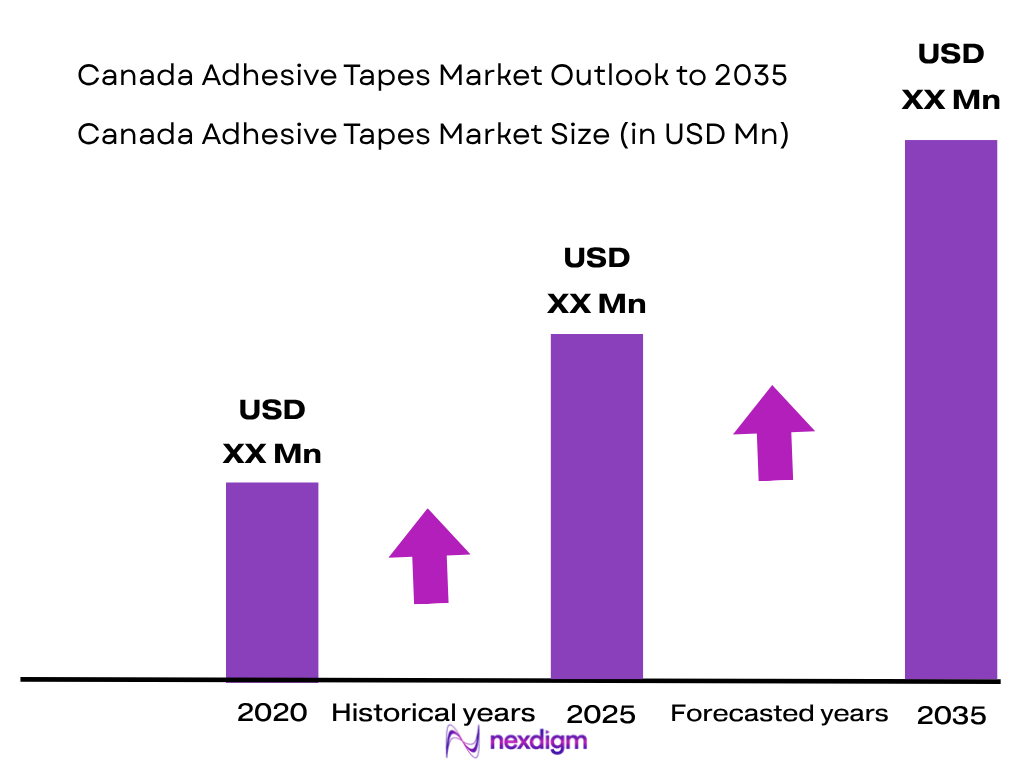
The Canada Adhesive Tapes Market is valued at approximately USD ~billion, based on the requested historical market framework. Public industry benchmarks confirm packaging tapes as the largest pressure-sensitive tape category in Canada, while acrylic systems remain the leading adhesive chemistry. Canadian imports of self-adhesive plastic tape in rolls reached 29.12 million kilograms, valued at USD 260.32 million, with the United States supplying 16.37 million kilograms, demonstrating the market’s substantial consumption base and integration with North American manufacturing supply chains.
Ontario and Quebec form the principal demand centres for the Canada Adhesive Tapes Market because they concentrate automotive manufacturing, aerospace production, packaging conversion, construction activity and industrial distribution. Western Canada, particularly Alberta and British Columbia, is important for construction, energy, HVAC and industrial maintenance tapes. Canada’s cross-border supply architecture reinforces Ontario and Quebec because manufacturing corridors are closely connected with US suppliers. Intertape Polymer Group maintains Canadian operations spanning Quebec, Ontario, British Columbia and Nova Scotia, while 3M Canada’s headquarters and historical manufacturing presence are located in London, Ontario.
Market Segmentation
By Product Type
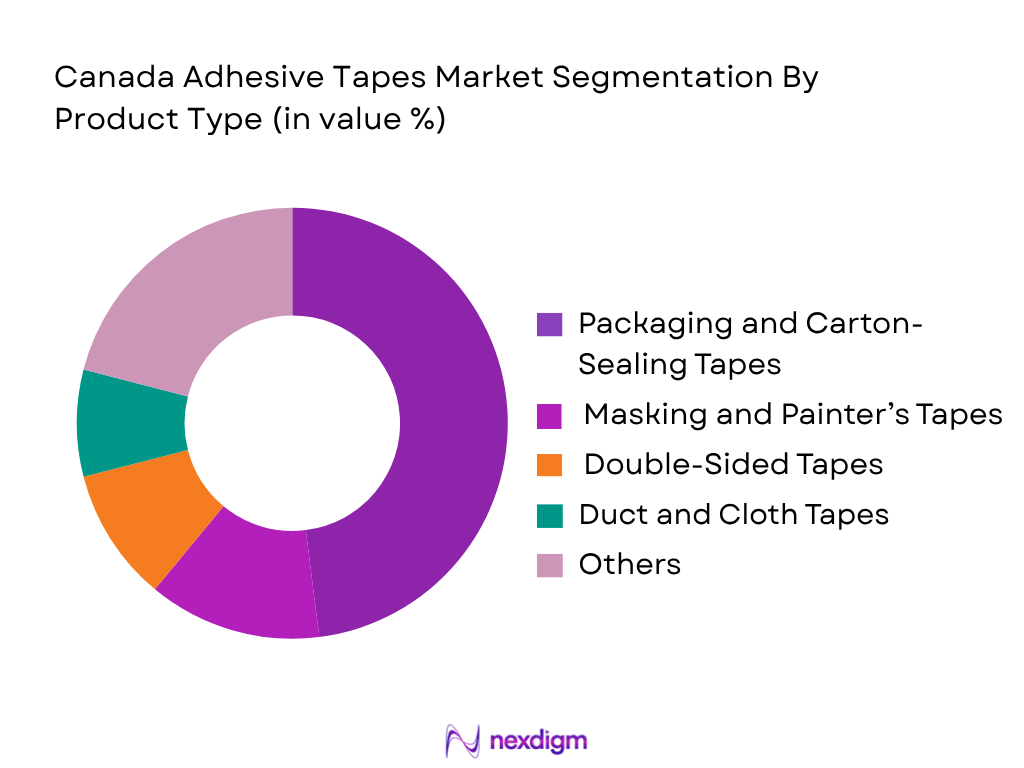
The Canada Adhesive Tapes Market is segmented by product type into packaging and carton-sealing tapes, masking and painter’s tapes, double-sided tapes, duct and cloth tapes, electrical and insulation tapes, foam and high-bond tapes, medical tapes and other specialty tapes. Packaging and carton-sealing tapes dominate the product-type segmentation because Canada has an extensive retail, industrial shipping, food-and-beverage distribution and e-commerce fulfilment ecosystem requiring recurring carton closure and unit-load stabilization. Pressure-sensitive tape research covering Canada identifies carton sealing as a core product class, while the latest Canada pressure-sensitive tape benchmark identifies packaging tapes as the largest revenue-producing segment. Packaging tape consumption is structurally recurring because every shipment or corrugated container can generate new tape demand, whereas many industrial bonding applications are linked to manufacturing output or installation cycles. Polypropylene-backed pressure-sensitive tapes are particularly suited to Canadian distribution networks because they combine tensile strength, moisture resistance, automated case-sealing compatibility and efficient high-volume converting. Specialty tapes nevertheless represent the higher-performance portion of the market, serving automotive, aerospace, medical, construction, electrical and industrial applications requiring more advanced chemistries and engineered backing materials.
By Adhesive Chemistry
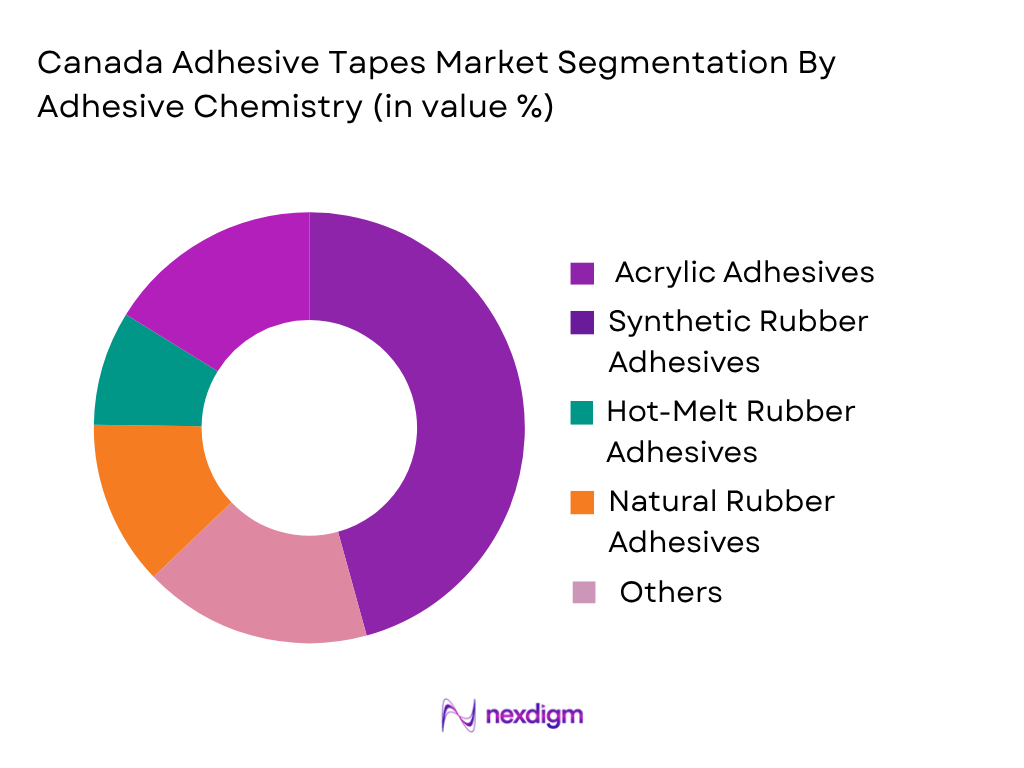
The Canada Adhesive Tapes Market is segmented by adhesive chemistry into acrylic, natural rubber, synthetic rubber, hot-melt rubber, silicone and other hybrid or specialty pressure-sensitive systems. Acrylic adhesives dominate this segmentation because of their broad balance of UV resistance, ageing stability, clarity, temperature performance and adhesion across packaging, automotive, construction, electronics and medical applications. Current Canada-specific adhesive-tape datasets identify acrylic as the largest revenue-generating resin chemistry, while specialty-tape and medical-tape datasets also identify acrylic as the leading chemistry. This cross-application suitability gives acrylic systems a wider addressable base than silicone, which is concentrated in demanding temperature and medical applications, or rubber systems, which are frequently selected when strong initial tack and economical packaging performance are priorities. Canada’s cold weather further increases the importance of carefully formulated acrylic and modified acrylic systems because manufacturers must engineer tack, peel strength and long-term holding power across seasonal temperature cycles. The movement toward durable, high-performance and lower-VOC bonding systems is expected to reinforce acrylic technology’s strategic importance.
Competitive Landscape
The Canada Adhesive Tapes Market combines multinational adhesive-technology companies with a significant Canadian packaging-tape manufacturing and converting base. 3M, Intertape Polymer Group, tesa, Nitto and Avery Dennison are among the most influential suppliers because they combine broad adhesive technologies with access to North American OEMs, industrial distributors and specialist converters. Competition increasingly depends on technical performance, application engineering, die-cutting capability, cold-weather adhesion, sustainable products and reliable Canadian inventory rather than product breadth alone.
| Company | Establishment Year | Headquarters | Key Tape Portfolio | Adhesive Chemistry Capability | Major Canadian End Uses | Canada / North America Footprint | Specialty Tape Capability | Converting / Application Support |
| 3M | 1902 | Maplewood, Minnesota, US | ~ | ~ | ~ | ~ | ~ | ~ |
| Intertape Polymer Group | 1981 | Montréal, Quebec / Sarasota, Florida | ~ | ~ | ~ | ~ | ~ | ~ |
| tesa | 2001 as independent tesa SE; heritage exceeds 125 years | Norderstedt, Germany | ~ | ~ | ~ | ~ | ~ | ~ |
| Nitto Denko | 1918 | Osaka, Japan | ~ | ~ | ~ | ~ | ~ | ~ |
| Avery Dennison | 1935 | Mentor/Glendale, United States | ~ | ~ | ~ | ~ | ~ |
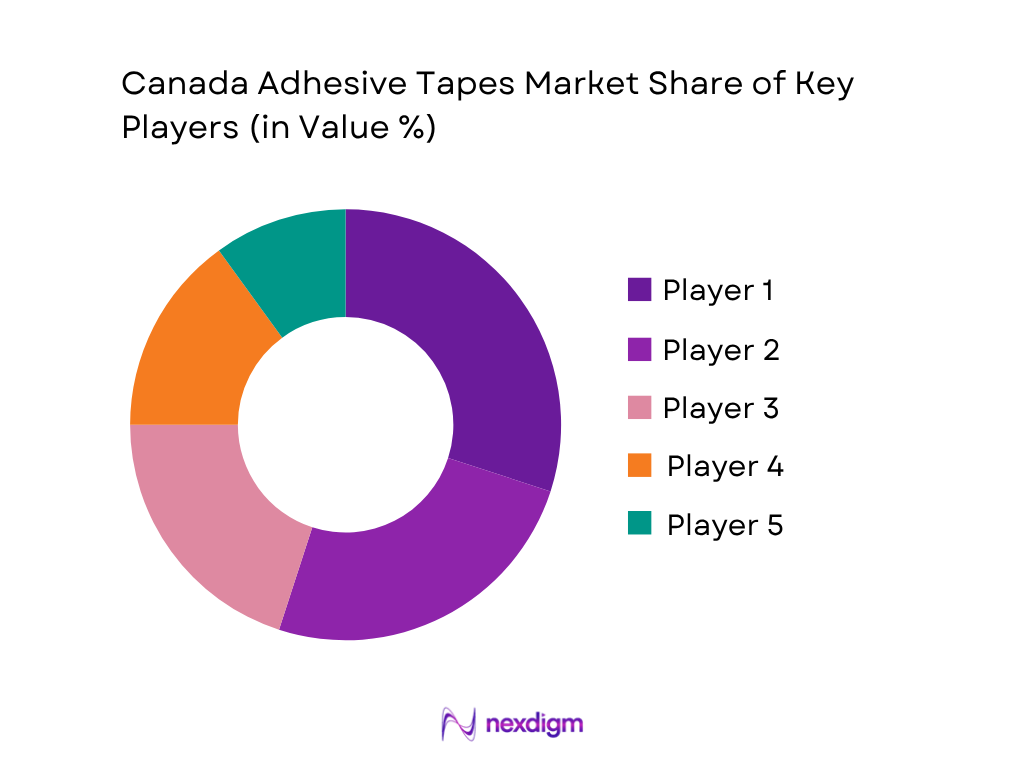
Canada Adhesive Tapes Market Analysis
Growth Drivers
Expansion of E-Commerce, Retail Distribution and Packaging Activity
Canada’s expanding retail and digital-commerce ecosystem is strengthening demand for carton-sealing tapes, BOPP packaging tapes, filament tapes, reinforced tapes and pressure-sensitive packaging solutions used across fulfilment centres, warehouses and distribution networks. Statistics Canada reported CAD 865.2 billion in total retail operating revenue during 2024, including CAD 73.7 billion generated through retail e-commerce, demonstrating the scale of goods requiring packaging, consolidation and shipment. Canadian retailers separately recorded CAD 803.1 billion in retail sales during 2024, creating substantial throughput for corrugated cartons and secondary packaging. Canada’s manufacturing sector generated CAD 874.6 billion in manufactured-goods revenue, including CAD 160.7 billion from food manufacturing, CAD 33.1 billion from paper manufacturing, and CAD 9.0 billion from printing and related activities. These industries repeatedly consume adhesive tapes for carton closure, bundling, pallet stabilization, temporary fixation and finished-goods distribution. The World Bank recorded Canada’s 2024 GDP at USD 2.24 trillion and GDP per capita at USD 54,340.3, demonstrating the scale of the underlying consumption economy. Packaging tape demand benefits from this combination of manufacturing output, retail distribution and digital fulfilment because each additional physical shipment generates requirements for carton sealing and secondary packaging. Automated fulfilment operations also favour machine-applied tapes with controlled unwind, consistent adhesion and dependable carton-fibre bonding.
Automotive and Aerospace Manufacturing Supports High-Performance Tape Consumption
Canada’s transportation manufacturing ecosystem generates application-specific demand for acrylic foam tapes, masking tapes, wire-harness tapes, double-sided products, surface-protection films, electrical tapes and specialty aerospace constructions. Statistics Canada recorded 1,918,861 new motor vehicles sold during 2024, while Canada had approximately 26.8 million registered road motor vehicles. Domestic motor-vehicle manufacturing generated CAD 55.1 billion, while motor-vehicle-parts manufacturing generated another CAD 33.7 billion. Adhesive tapes are required throughout these supply chains for paint masking, trim attachment, wire management, insulation, surface protection and noise-and-vibration control. Aerospace provides an additional high-performance application base. Canadian aerospace product and parts production generated approximately CAD 31.1 billion, with Quebec accounting for CAD 18.4 billion, Ontario CAD 7.6 billion, and Manitoba approximately CAD 2.0 billion. Canada also exported approximately CAD 12.1 billion of aircraft during 2024. The World Bank recorded national GDP of approximately USD 2.24 trillion and GDP per capita of USD 54,340.3. These large automotive and aerospace production clusters support demand for technically qualified tapes offering controlled peel adhesion, shear strength, temperature resistance, clean removal and substrate compatibility, moving Canadian tape consumption toward higher-performance constructions rather than only general-purpose packaging products.
Canada Adhesive Tapes Market Challenges
Large Manufacturing Input Requirements and Cross-Border Supply Exposure
Canada’s adhesive-tape industry operates within a manufacturing system requiring substantial quantities of films, polymers, chemicals, foams, papers, release liners and other intermediate materials. Statistics Canada reported approximately CAD 874.6 billion in manufactured-goods revenue during 2024. Chemical manufacturing alone generated approximately CAD 70.1 billion, paper manufacturing generated CAD 33.1 billion, and petroleum and coal product manufacturing generated approximately CAD 94.2 billion. These industries form important upstream and adjacent supply chains for pressure-sensitive adhesives, polymer films, treated papers and specialty tape constructions. Canadian Industry Statistics also reports CAD 2.6 billion in 2024 imports across paint, coating and adhesive manufacturing, illustrating the broader sector’s exposure to international material flows. Canada’s industrial structure is particularly integrated with the United States, meaning adhesive-tape producers and converters must manage cross-border availability of specialty substrates, resins and finished products. The World Bank recorded Canada’s 2024 GDP at USD 2.24 trillion, demonstrating the size of the industrial economy competing for chemical and polymer inputs. Tape manufacturers therefore need diversified sourcing arrangements for BOPP, PET, PVC, acrylic systems, synthetic rubber, tackifiers, foams and release liners. Supply interruptions can be especially difficult for automotive, aerospace and construction products because customers frequently specify particular adhesive formulations, backing thicknesses and performance characteristics that cannot immediately be replaced with alternative materials without additional qualification.
Demand Volatility Across Automotive Manufacturing Creates Product-Mix and Capacity Challenges
Canadian adhesive-tape suppliers serving automotive and transportation customers face fluctuations in production schedules because tape consumption is directly linked to vehicle assembly, component manufacturing, model transitions and plant retooling. Statistics Canada reported CAD 55.1 billion in motor-vehicle manufacturing output during 2024, while motor-vehicle-parts manufacturing generated CAD 33.7 billion. Transportation-equipment manufacturing represented a much broader industrial base, encompassing automotive, aerospace, rail and other transportation products. Canada simultaneously recorded 1,918,861 new motor vehicles sold, while approximately 26.8 million road motor vehicles were registered nationally. Adhesive-tape manufacturers serving these industries often produce customer-specific products involving specialized widths, liners, foam densities, backing thicknesses, adhesive coat weights and performance specifications. Such products cannot always be redirected to packaging, construction or general industrial customers when vehicle-production schedules change. Aerospace provides diversification but also introduces demanding qualification requirements, with Canadian aerospace production reaching approximately CAD 31.1 billion. Canada’s overall manufactured-goods revenue stood at CAD 874.6 billion, while the World Bank recorded USD 2.24 trillion in national GDP during 2024. Tape suppliers consequently need flexible coating, slitting and converting operations capable of shifting capacity between automotive, aerospace, packaging and industrial applications. Broader end-market exposure reduces dependence on individual vehicle programs while helping converters maintain utilization when automotive assembly plants undergo retooling or production adjustments.
Canada Adhesive Tapes Market Opportunities
Electric-Vehicle Adoption Creates Scope for Advanced Electrical and Battery Tape Solutions
Canada’s existing electric-vehicle ecosystem creates a foundation for future expansion of dielectric tapes, flame-resistant tapes, battery-protection films, thermal-management materials, high-bond foam tapes and wire-management products. Statistics Canada recorded 270,985 new zero-emission vehicle registrations during 2024, within a national market that recorded 1,918,861 new motor vehicles sold. Canada also had approximately 26.8 million registered road vehicles, including roughly 24.6 million light-duty vehicles, demonstrating the scale of the transportation system into which electrified platforms are being introduced. The domestic manufacturing base provides additional support for localization of EV-related adhesive solutions: motor-vehicle manufacturing generated CAD 55.1 billion, motor-vehicle-parts manufacturing generated CAD 33.7 billion, and transportation-equipment production extends into batteries, components and related assemblies. Canada’s macroeconomic environment also supports advanced manufacturing investment, with the World Bank recording USD 2.24 trillion in GDP and USD 54,340.3 GDP per capita during 2024. These current indicators provide a substantial addressable industrial base for adhesive-tape suppliers seeking future growth from battery-cell insulation, module attachment, busbar protection, cable management, thermal interfaces, pack sealing and lightweight vehicle bonding. The opportunity is particularly attractive for suppliers capable of providing flame-retardant PET tapes, dielectric films, acrylic foam constructions and precision die-cut adhesive components rather than conventional electrical-tape rolls alone.
Building-Envelope and Energy-Efficient Construction Applications Create Specialty Tape Expansion Potential
Canada’s construction ecosystem creates significant future potential for air-barrier tapes, vapour-barrier tapes, window-flashing products, HVAC foil tapes, sheathing tapes, double-sided mounting products and low-temperature pressure-sensitive adhesives. Statistics Canada reported approximately CAD 253.8 billion in building-construction investment during 2024, demonstrating the large installed flow of residential and non-residential projects requiring sealing, insulation and weather-protection materials. December construction investment alone reached approximately CAD 21.8 billion, comprising CAD 15.1 billion in residential construction and CAD 6.7 billion in non-residential construction. Multi-unit residential investment accounted for approximately CAD 7.7 billion during the month, while commercial construction represented approximately CAD 3.3 billion. Canada’s broader economic foundation remained substantial, with the World Bank recording USD 2.24 trillion in GDP and USD 54,340.3 GDP per capita during 2024. These current activity levels create a strong platform for future penetration of specialized pressure-sensitive tapes used for airtightness, moisture control, window installation, insulation continuity, HVAC sealing and exterior-envelope assembly. Canadian climatic conditions make this opportunity particularly market-specific because construction tapes frequently need to adhere to wood sheathing, membranes, metals, foams and window systems under low-temperature and moisture-intensive conditions. Suppliers developing products with strong initial tack, freeze-thaw durability, UV resistance and compatibility with modern air-barrier systems can therefore target higher-performance applications beyond conventional general-purpose construction tapes.
Future Outlook
The Canada Adhesive Tapes Market is expected to expand at approximately ~X% CAGR during 2026-2035. Over the forecast period, demand is expected to move progressively toward specialty pressure-sensitive tapes as automotive electrification, aerospace manufacturing, building-envelope performance requirements, medical technologies and industrial automation increase the technical requirements placed on bonding materials. Packaging will remain the market’s primary volume foundation, while high-bond acrylic foam, electrical insulation, die-cut components, medical tapes and cold-weather construction tapes are expected to provide increasingly attractive value-added opportunities.
Canadian market development will be influenced by deeper adoption of adhesive tapes as alternatives to rivets, screws, clips and liquid adhesives. Double-sided and high-bond tapes can support lightweight assembly, distribute stress across bonded surfaces and simplify production processes. This is particularly relevant in vehicle interiors, exterior trim, appliances, signs, transportation equipment and prefabricated building components. Sustainability will become equally important. Packaging companies are evaluating paper-based tapes, lower-plastic constructions and products designed to work more effectively with corrugated recycling systems. Manufacturers are also developing water-based, hot-melt and solvent-reduced adhesive technologies to address environmental and workplace requirements.
Major Players
- 3M Canada Company
- Intertape Polymer Group
- tesa tape Canada
- Nitto Canada
- Avery Dennison Performance Tapes
- Saint-Gobain Tape Solutions
- Shurtape Technologies
- Mativ / Scapa Industrial
- ORAFOL Canada
- Lohmann
- Berry Global / Adchem / Polyken
- Pro Tapes & Specialties
- MPI Matco
- LINTEC Corporation
- Mactac
Key Target Audience
- Adhesive Tape Manufacturers and Pressure-Sensitive Adhesive Coaters
- Adhesive Tape Converters and Precision Die-Cutting Companies
- Packaging, Corrugated Box and E-Commerce Fulfilment Companies
- Automotive, Aerospace and Transportation Equipment Manufacturers
- Construction Material, Building-Envelope and HVAC Companies
- Raw Material and Specialty Chemical Manufacturers
- Investments and Venture Capitalist Firms
- Government and Regulatory Bodies (Environment and Climate Change Canada, Health Canada, Innovation, Science and Economic Development Canada, Competition Bureau Canada, Canadian Centre for Occupational Health and Safety, Transport Canada)
Research Methodology
Step 1: Identification of Key Variables
The initial stage involves creating a detailed ecosystem map of the Canada Adhesive Tapes Market covering adhesive formulators, backing-material suppliers, tape manufacturers, converters, die-cutters, distributors, OEMs and industrial users. Secondary research is used to identify variables such as coated surface area, adhesive chemistry, backing material, domestic production, imports, exports, product mix and application intensity. The market definition is standardized before sizing to prevent overlap between pressure-sensitive tapes, protective films, labels and liquid adhesive products.
Step 2: Market Analysis and Construction
Historical demand is analyzed through both top-down and bottom-up approaches. The bottom-up framework assesses manufacturer output, Canadian converting activity, imports, exports and distributor sales, while the top-down model maps adhesive-tape consumption against packaging shipments, automotive assembly, aerospace activity, construction, healthcare and industrial manufacturing. Product-level consumption patterns are reconciled to estimate the relative contribution of commodity packaging tapes and higher-value specialty pressure-sensitive products.
Step 3: Hypothesis Validation and Expert Consultation
Initial market hypotheses are validated through structured interviews with tape manufacturers, converters, industrial distributors, packaging companies, automotive suppliers and specialty-material users. Discussions focus on product penetration, adhesive chemistry preferences, cold-temperature performance, supplier qualification requirements, import dependency, substitution with mechanical fasteners and adoption of sustainable products. These interviews are used to identify inconsistencies between apparent supply, distributor movement and actual end-use consumption.
Step 4: Research Synthesis and Final Output
The final phase triangulates primary findings with customs data, corporate disclosures, industry publications, government information and secondary databases. Market estimates are reconciled by product type, adhesive chemistry, backing material, end-use sector and distribution channel. Forecast assumptions incorporate packaging demand, automotive electrification, aerospace requirements, construction activity, specialty-tape penetration, sustainable product adoption and Canadian converting capability to develop a validated long-term outlook.

- Executive Summary
- Research Methodology (Market Definition and Scope, Canada Adhesive Tapes Taxonomy, Pressure-Sensitive Adhesive Tape Classification, Commodity and Specialty Tape Classification, Adhesive Chemistry Mapping, Backing Material Assessment, Tape Construction Framework, Adhesive Coating Technology Assessment, Application Mapping, Raw Material Assessment, Sustainable Tape Technology Evaluation, Market Sizing Framework)

- Definition and Scope
- Canada Adhesive Tapes Industry Evolution and Pressure-Sensitive Adhesive Technology
- Development
- Adhesive Tape Manufacturing and Coating Process
- Adhesive Tape Value Chain Analysis
- Canada Adhesive Tapes Supply Chain Analysis
- Adhesive Resin, Backing Material and Release-Liner Ecosystem Analysis
- Canada Adhesive Tapes Import Dependency and Localization Assessment
- OEM Adhesive Tape Application Architecture and Specialty Tape Solution Framework

- Growth Drivers (Expansion of E-Commerce Packaging Volumes, Increasing Lightweight Automotive Bonding, Growth of Aerospace Manufacturing and MRO, Expansion of Building Envelope Sealing Applications, Rising Industrial Automation, Mechanical Fastener Replacement, Increasing Medical Adhesive Applications, Growth of High-Performance Pressure-Sensitive Adhesive Adoption)
- Market Challenges (Raw Material Price Volatility, Imported Specialty Tape Dependency, Cold-Temperature Adhesion Requirements, Complex Substrate Compatibility, Long OEM Qualification Cycles, Recycling Compatibility Challenges, Fragmented Converter Ecosystem, Cross-Border Supply Chain Dependence)
- Market Opportunities (EV Battery Assembly Tapes, Aerospace Composite Processing Tapes, Cold-Weather Construction Tapes, Recyclable Packaging Tapes, Medical Wearable Adhesives, Low-VOC Adhesive Systems, Precision Die-Cut Adhesive Components, High-Bond Structural Tape Substitution)
- Market Trends (High-Bond Acrylic Foam Tapes, Linerless Tape Development, Paper-Based Packaging Tapes, Low-Temperature Adhesive Formulations, Solvent-Free and Water-Based Adhesive Systems, Precision Die-Cut Adhesive Components, Lightweight Bonding Solutions, Sustainable Backing Material Adoption)
- Regulatory and Standards Landscape (Canadian Environmental Protection Act Requirements, Chemicals Management Plan Requirements, WHMIS Hazard Communication Requirements, VOC and Solvent Compliance Requirements, Health Canada Medical Device Requirements, CSA Electrical and Product Safety Standards, Provincial Extended Producer Responsibility Requirements, Packaging Sustainability and Recyclability Requirements)
- SWOT Analysis
- Porter’s Five Forces Analysis
- PESTLE Analysis
- Stakeholder Ecosystem
- Competition Ecosystem

- By Market Value (2020-2025)
- By Adhesive Tape Consumption Volume (2020-2025)
- By Coated Surface Area (2020-2025)
- By Domestic Production Volume (2020-2025)
- By Import Volume (2020-2025)
- By Export Volume (2020-2025)
- By Average Selling Price (2020-2025)
- By Commodity Adhesive Tape Consumption (2020-2025)
- By Specialty Adhesive Tape Consumption (2020-2025)

- By Product Type (In Value %)
Packaging and Carton Sealing Tapes
Masking and Painter’s Tapes
Double-Sided Tapes
Transfer Tapes
Duct and Cloth Tapes
Electrical and Insulation Tapes
Foam Tapes
Filament and Strapping Tapes
Medical and Healthcare Tapes
Automotive Adhesive Tapes
Construction and Building Tapes
HVAC and Foil Tapes
Protective Films and Surface Protection Tapes
Splicing Tapes
Specialty High-Performance Industrial Tapes - By Adhesive Chemistry (In Value %)
Acrylic Adhesives
Natural Rubber Adhesives
Synthetic Rubber Adhesives
Hot-Melt Rubber Adhesives
Silicone Adhesives
Hybrid Adhesive Systems
Bio-Based and Renewable-Content Adhesive Systems - By Backing Material (In Value %)
Polypropylene Film
Polyethylene Film
Polyvinyl Chloride Film
Polyethylene Terephthalate Film
Paper
Cloth and Fabric
Aluminum Foil
Copper Foil
Foam
Nonwoven Materials
Polyimide Film
Glass Cloth
Unsupported and Carrier-Free Constructions - By End-Use Industry (In Value %)
Packaging and E-Commerce
Automotive and Mobility
Building and Construction
Electrical and Electronics
Medical and Healthcare
Aerospace and Defense
Appliances
HVAC and Refrigeration
General Industrial Manufacturing
Paper, Printing and Converting
Renewable Energy
Transportation and Rail
Signs and Graphics
Retail and Consumer Applications - By Distribution Channel (In Value %)
Direct Manufacturer-to-OEM Sales
Authorized Industrial Distributors
Adhesive Tape Converters
Packaging Distributors
Electrical and Electronics Distributors
Construction Supply Distributors
Medical Material Converters and Distributors
Automotive Tier Supplier Channels
Industrial MRO Distributors
Online B2B Platforms - By Region (In Value %)
Ontario
Greater Toronto Area
Windsor-Essex
Hamilton
Kitchener-Waterloo
Quebec
Greater Montreal
Quebec City
Estrie
Western Canada
Alberta
British Columbia
Saskatchewan
Manitoba
Atlantic Canada
Nova Scotia
New Brunswick
Newfoundland and Labrador
Prince Edward Island

- Market Share of Major Players (By Revenue, Volume, Product Type, Adhesive Chemistry, Backing Material, End-Use Industry, Market Type, Distribution Channel)
- Cross Comparison Parameters (Adhesive Chemistry Breadth, Backing and Carrier Technology Breadth, Canada Coating and Converting Footprint, Cold-Temperature Performance Portfolio, High-Performance Specialty Tape Capability, Precision Die-Cutting and Custom Converting Capability, Sustainable and Low-VOC Tape Portfolio, End-Use Industry Coverage)
- SWOT Analysis of Major Players
- Competitive Positioning Matrix
- Product and Technology Portfolio Benchmarking
- Pricing and Distribution Network Benchmarking
- Market Entry Strategy Assessment
- Detailed Profiles of Major Companies
3M Canada Company
Intertape Polymer Group
tesa tape Canada
Nitto Canada
Avery Dennison Performance Tapes
Saint-Gobain Tape Solutions
Shurtape Technologies
Mativ / Scapa Industrial
ORAFOL Canada
Lohmann
Berry Global / Adchem / Polyken
Pro Tapes & Specialties
MPI Matco
LINTEC Corporation
Mactac

- Buyer Segmentation
- OEM Procurement Behaviour
- Supplier Selection Criteria
- Buyer Pain Points
- Technology Adoption Assessment
- Replacement and Repurchase Behaviour

- By Market Value (2026-2035)
- By Adhesive Tape Consumption Volume (2026-2035)
- By Coated Surface Area (2026-2035)
- By Domestic Production Volume (2026-2035)
- By Import Volume (2026-2035)
- By Export Volume (2026-2035)
- By Average Selling Price (2026-2035)
- By Commodity Adhesive Tape Consumption (2026-2035)
- By Specialty Adhesive Tape Consumption (2026-2035)


 Request a Sample
 Ask for Customization
 Get a Quote
 Enquire Now