

 Download PDF
Market Overview
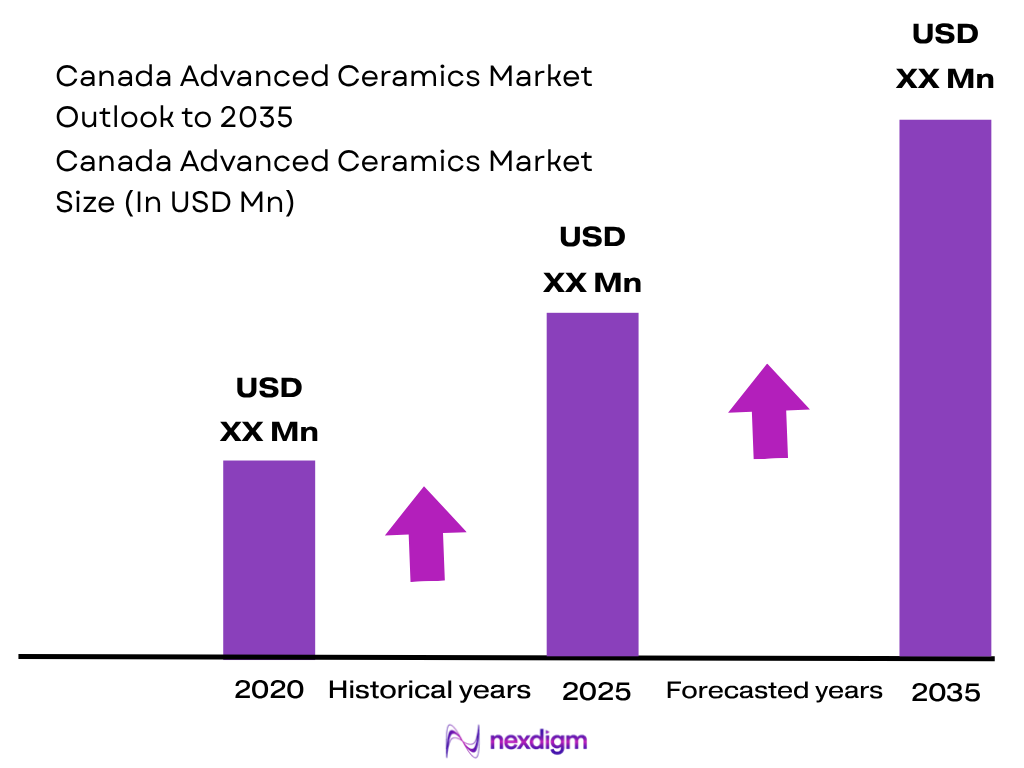
The Canada Advanced Ceramics Market is valued at ~USD million, supported by demand for alumina, zirconia, silicon carbide, silicon nitride, electronic ceramics and bioceramics. A leading published country study places the market at USD 415.6 million in its latest reporting period. Demand is reinforced by Canadian aerospace manufacturing, where goods sold increased from USD 27.0 billion-equivalent scale to USD 30.3 billion-equivalent scale across the two latest annual observations, strengthening requirements for heat-, wear- and corrosion-resistant components.
Quebec and Ontario form the most important Canadian demand centres because they concentrate aerospace, transportation, medical technology, electronics and precision-manufacturing activity. Quebec’s aerospace manufacturing goods revenue reached CAD 18.4 billion, while Ontario generated CAD 7.6 billion in the latest Statistics Canada release; the preceding national aerospace manufacturing revenue was CAD 27.0 billion. Montreal-Mirabel also hosts NRC aerospace manufacturing infrastructure for additive manufacturing, advanced material processing, precision robotics and next-generation production technologies.
Market Segmentation
By Material Type
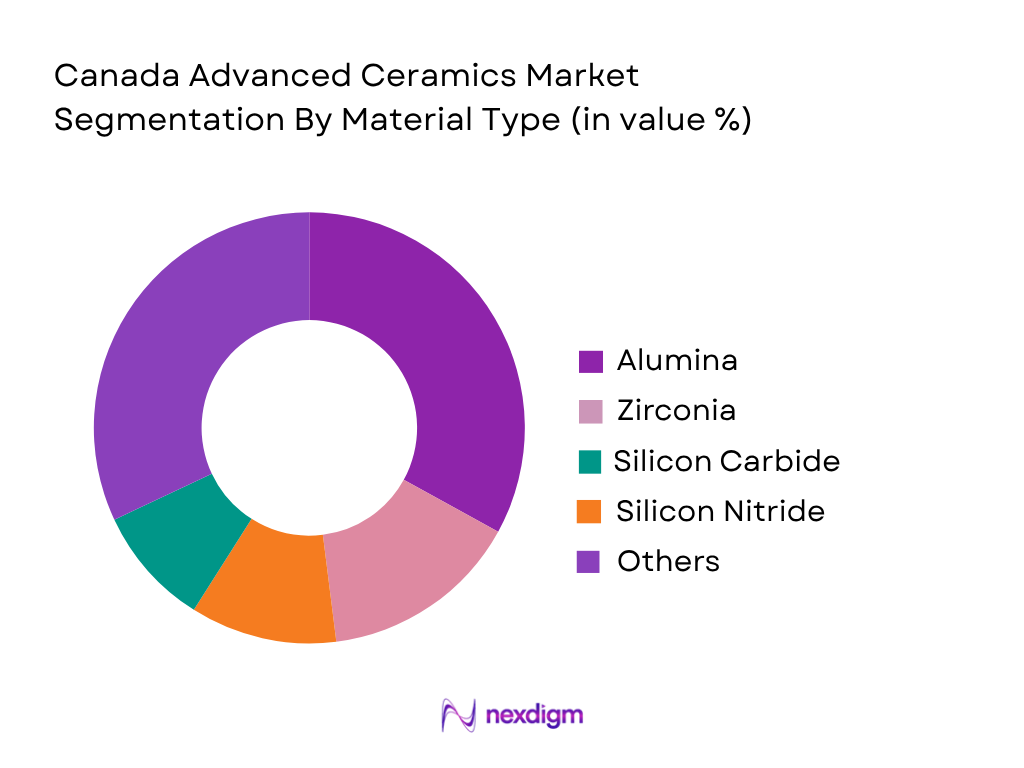
The Canada Advanced Ceramics Market is segmented by material type into alumina, zirconia, silicon carbide, silicon nitride, aluminum nitride, titanate and other advanced ceramics. Alumina ceramics hold the dominant market share because of their comparatively broad combination of electrical insulation, hardness, wear resistance, temperature stability, chemical resistance and manufacturing maturity. Alumina can consequently address electrical substrates and insulators, seals, wear components, industrial machinery, medical equipment and precision-engineered parts without the application limitations associated with more specialized ceramic compositions. Canadian aerospace, industrial equipment, electrical and advanced-manufacturing customers also create demand for technically mature materials that can be manufactured across multiple component geometries. Major suppliers maintain extensive alumina portfolios alongside zirconia, SiC and Si₃N₄, reinforcing alumina’s commercial accessibility. As Canadian manufacturers increase automation, electrification and high-performance component requirements, alumina remains a foundational advanced ceramic rather than a niche specialty material.
By End-Use Industry
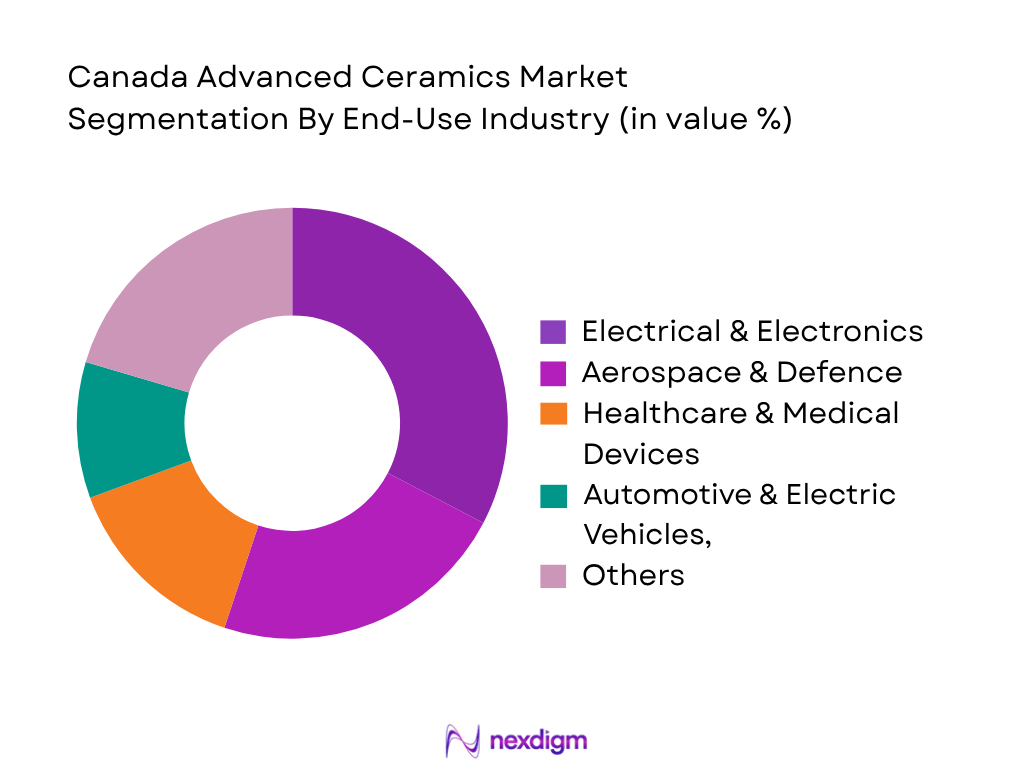
The Canada Advanced Ceramics Market is segmented by end-use industry into electrical & electronics, aerospace & defence, healthcare & medical devices, automotive & electric vehicles, industrial machinery, energy & power, mining & mineral processing and other specialized applications. Electrical & electronics represents a leading demand segment, supported by advanced ceramics’ essential roles in electrical insulation, substrates, sensors, electronic packaging, thermal management and high-reliability components. Published Canada-specific research identifies electronic devices as the country’s largest advanced-ceramics application in its reported base period.
The segment’s position is supported by the functional rather than purely structural nature of advanced ceramics. Alumina, aluminum nitride, titanates and related electroceramics provide dielectric behaviour, thermal conductivity, dimensional stability and temperature resistance required in increasingly compact electronic systems. Aerospace electronics, EV power electronics, industrial automation, telecommunications equipment and high-performance sensors further broaden Canadian demand. Ceramic suppliers also commercialize AlN, Si₃N₄, alumina and ZTA substrates specifically for electronic applications, illustrating the increasing specialization of the segment.
Competitive Landscape
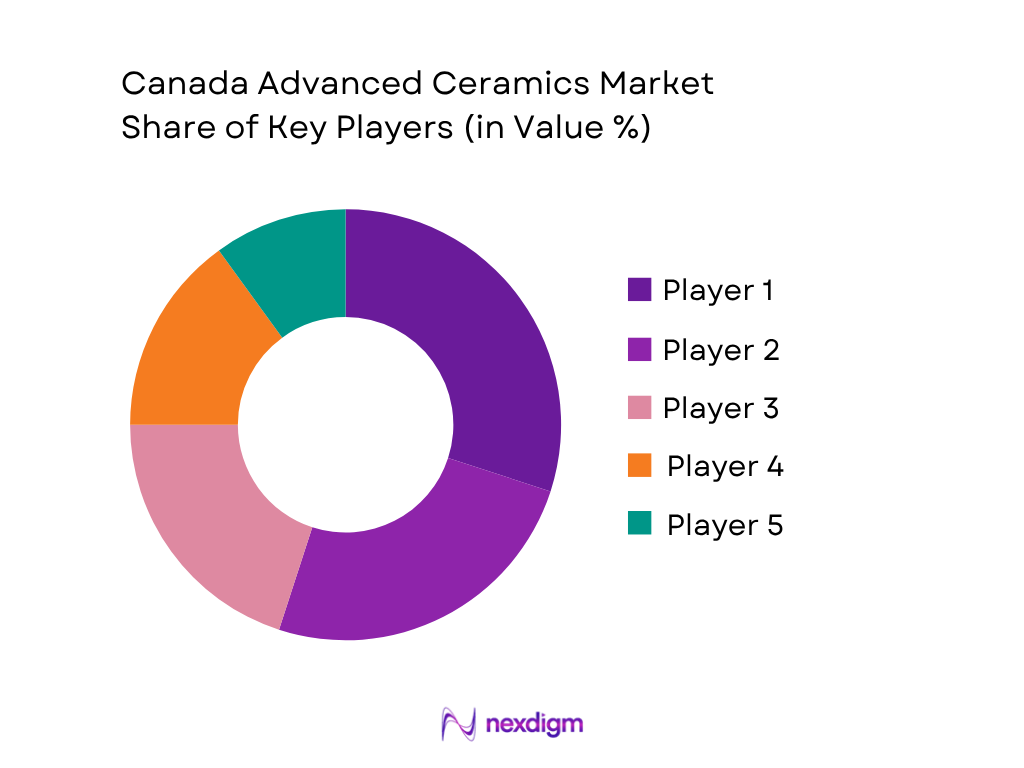
The Canada Advanced Ceramics Market combines large multinational technical-ceramic manufacturers with specialized component producers supplying Canadian OEMs and industrial users. Competition is based less on commodity pricing and more on material formulation expertise, component design capability, precision tolerances, sintering technology, machining capability, application qualification and customer co-development. CoorsTek, CeramTec, Kyocera, Morgan Advanced Materials and Saint-Gobain are among the internationally established suppliers identified across advanced-ceramics industry studies.
| Company | Establishment | Headquarters | Key Ceramic Materials | Major Product Capability | Major End Markets | Precision Manufacturing | High-Temperature Capability | Canadian Market Relevance |
| CoorsTek | 1910 | Golden, Colorado, USA | ~ | ~ | ~ | ~ | ~ | ~ |
| CeramTec | 1903* | Plochingen, Germany | ~ | ~ | ~ | ~ | ~ | ~ |
| Kyocera | 1959 | Kyoto, Japan | ~ | ~ | ~ | ~ | ~ | ~ |
| Morgan Advanced Materials | 1856 | Windsor, United Kingdom | ~ | ~ | ~ | ~ | ~ | ~ |
| Saint-Gobain | 1665 | Courbevoie, France | ~ | ~ | ~ | ~ | ~ | ~ |
Canada Advanced Ceramics Market Analysis
Growth Drivers
Aerospace, Defence and High-Performance Engineering Demand
Canada’s advanced ceramics market is being strongly supported by the scale and technical sophistication of the country’s aerospace and defence manufacturing base, where alumina, silicon carbide, silicon nitride, zirconia and ceramic-matrix materials are relevant for electrical insulation, bearings, seals, wear components, thermal barriers, sensors, radar systems and severe-temperature assemblies. Canadian aerospace product and parts manufacturers generated CAD 30.3 billion in goods sold in 2024, while the wider aerospace industry contributed CAD 34.2 billion to Canadian GDP and supported 225,000 jobs. Of this activity, Quebec generated CAD 18.4 billion in aerospace manufacturing goods and Ontario generated CAD 7.6 billion, giving advanced-ceramic suppliers a concentrated customer base around Montreal, Mirabel and Ontario’s aerospace-industrial corridors. Canada’s macroeconomic capacity further supports high-value manufacturing: World Bank data place Canadian GDP at USD 2.24 trillion in 2024 and GDP per capita at USD 54,340.3, providing a large industrial economy capable of absorbing specialized engineered materials. Defence is adding another application pathway. Canada allocated CAD 2.1 billion in fiscal 2025–26 specifically to strengthen the domestic defence industry, alongside CAD 1 billion for emerging military capabilities and CAD 2 billion for diversification of defence partnerships. In 2026, the National Research Council announced more than CAD 900 million for defence and dual-use innovation. These industrial conditions are directly relevant to advanced ceramics because Canadian aerospace and defence systems increasingly require materials that maintain mechanical strength, dimensional stability and electrical performance under high temperatures, abrasion, corrosive environments and demanding qualification regimes. Advanced ceramics are consequently positioned as engineering-enabling materials within Canada’s expanding high-performance manufacturing ecosystem rather than as conventional commodity ceramic products.
Expansion of Electrification, Electronics and Advanced Manufacturing Applications
Electrification and technologically intensive manufacturing are widening the addressable application base for advanced ceramics in Canada because power electronics, electrical equipment, sensors, semiconductor assemblies, automation systems and electric drivetrains require electrically insulating materials capable of simultaneously managing heat and mechanical stress. Statistics Canada reported CAD 875 billion in revenue from goods manufactured in 2024, demonstrating the scale of the domestic industrial base into which engineered ceramic components can be integrated. More recent manufacturing indicators show the continuing relevance of ceramic-consuming industries: seasonally adjusted Canadian aerospace product and parts manufacturing sales reached CAD 2.917 billion in one reported 2025 month, computer and electronic product manufacturing reached CAD 1.635 billion, and electrical equipment, appliance and component manufacturing reached CAD 1.312 billion. Transportation electrification is also creating demand conditions for aluminum nitride substrates, alumina insulators, silicon nitride bearing components and ceramics used in high-voltage systems. Transport Canada recorded 65,733 new zero-emission vehicle registrations during the second quarter of 2024 and 81,205 registrations during the fourth quarter, including 61,795 battery-electric vehicles in that fourth-quarter dataset. These figures matter for advanced ceramics because increasing numbers of electric drivetrains and charging, inverter and power-control systems increase the installed base of equipment requiring high dielectric strength, thermal management and high-reliability insulation. Canada’s broader macroeconomic foundation remains substantial, with World Bank data reporting USD 2.24 trillion of GDP in 2024 and USD 54,340.3 GDP per capita, supporting capital-intensive electronics, transportation and industrial modernization. The National Research Council’s active advanced-manufacturing initiative additionally covers additive manufacturing for complex parts, digital production technologies and manufacturing automation. Ceramic additive manufacturing and near-net-shape processing can directly benefit from this ecosystem by enabling geometries difficult to obtain through conventional pressing, sintering and machining, strengthening advanced ceramics’ relevance across Canadian electronics, mobility and automated industrial equipment.
Market Challenges
Import Dependence and Limited Domestic Advanced-Ceramic Supply Depth
The Canadian advanced ceramics industry faces a structural supply-chain challenge because the domestic non-metallic mineral manufacturing base is substantially smaller than the broad industrial sectors that consume high-performance ceramics, making Canada dependent on international suppliers for many specialty powders, substrates, finished components and precision-engineered ceramic parts. Innovation, Science and Economic Development Canada reports that the Canadian non-metallic mineral product manufacturing sector recorded CAD 7.4 billion of imports in 2024 compared with CAD 3.2 billion of exports. Although this statistical category is broader than advanced ceramics, it demonstrates the import-heavy structure surrounding Canadian ceramic and non-metallic material supply. The narrower “other non-metallic mineral product manufacturing” grouping recorded CAD 1.4 billion of imports and CAD 1.2 billion of exports in 2024, further illustrating the importance of cross-border sourcing for specialized mineral-based manufactured products. The supply challenge becomes more significant when compared with the scale of downstream industries. Canada’s aerospace industry alone supported 225,000 jobs and contributed CAD 34.2 billion to GDP in 2024, while national manufacturing generated CAD 875 billion in manufactured-goods revenue. The overall Canadian economy stood at USD 2.24 trillion in 2024, according to World Bank data, meaning domestic technical-ceramic suppliers operate inside a very large, technically demanding manufacturing economy. Advanced ceramic components used in aerospace, medical systems, electronics and defence frequently require high-purity powders, controlled grain structures, specialist sintering, metallization, tight-tolerance grinding and extensive certification, capabilities that cannot be substituted easily if an overseas supplier is disrupted. This creates procurement lead-time and qualification risks for Canadian OEMs. The challenge therefore is not simply obtaining ceramic material; it is developing sufficient domestic depth across powder preparation, forming, firing, finishing, inspection and application engineering to support high-reliability Canadian industrial customers without excessive dependence on overseas technical-ceramic ecosystems.
Fragmented Manufacturing Capacity and High Qualification Requirements
Canada’s advanced-ceramic suppliers operate within a manufacturing environment characterized by a large number of relatively small establishments and a limited pool of very large production facilities, creating challenges when customers require scalable output, dedicated qualification lines, precision processing and repeatable high-volume manufacturing. Innovation, Science and Economic Development Canada identifies 2,201 employer establishments and 1,453 non-employer or indeterminate establishments in Canadian non-metallic mineral product manufacturing in 2025. Within employer establishments, only 5 facilities employed 500 or more people, while 94 establishments employed 100–499 people, 1,559 employed 5–99 people, and 543 employed 1–4 people. The classification is broader than advanced ceramics, but it illustrates the fragmented industrial base from which specialized ceramic manufacturing capabilities must emerge. This matters because aerospace, medical, defence and electronic ceramics require expensive process control, powder handling, sintering, precision grinding, dimensional inspection and customer-specific qualification. The downstream Canadian aerospace sector alone generated CAD 30.3 billion of manufactured goods in 2024, with Quebec contributing CAD 18.4 billion and Ontario CAD 7.6 billion, meaning ceramic suppliers pursuing this segment must meet requirements established by sophisticated multinational OEMs and Tier-1 manufacturers. The challenge is amplified by the scale of Canada’s wider economy, with World Bank data showing USD 2.24 trillion of GDP and USD 54,340.3 of GDP per capita in 2024; advanced manufacturing customers in such an economy typically compete within global supply chains and therefore procure against international quality benchmarks. The need for controlled densification, consistent microstructure, near-zero defect rates and precision finishing makes capacity expansion more complicated than simply adding conventional ceramic production equipment. Canadian suppliers must therefore bridge the gap between a fragmented non-metallic manufacturing structure and the stringent production, traceability and qualification expectations of advanced-ceramic end users.
Market Opportunities
Advanced Ceramics for Mining, Mineral Processing and Severe-Service Industrial Equipment
Canada’s mining and mineral-processing economy creates a substantial future opportunity for advanced ceramics because alumina, silicon carbide, zirconia and related engineered materials can extend component life in highly abrasive, erosive, corrosive and high-temperature operating environments. Natural Resources Canada reports that the country produced more than 60 minerals and metals with a production value of CAD 64.3 billion in 2024, operating almost 200 mines together with approximately 6,500 sand, gravel and stone quarries. Metals production represented CAD 38.4 billion, non-metals represented CAD 16.3 billion, and coal represented CAD 9.7 billion. Canada’s mineral sector directly employed 438,000 people in 2024, while domestic mineral and metal exports reached CAD 153 billion. Mineral exploration activity added another CAD 4.1 billion of investment. These operating conditions generate an installed equipment base involving slurry handling, pumping, conveying, hydrocyclones, mineral separation, grinding, crushing and material-transfer systems, where abrasion and erosion are persistent engineering concerns. Ceramic liners, nozzles, valve components, pump parts, mechanical seals, wear plates and ceramic-metal composite assemblies can address such operating environments because their hardness and chemical resistance allow them to withstand conditions that rapidly degrade conventional metallic components. Canada’s macroeconomic scale supports continued industrial investment, with World Bank data recording USD 2.24 trillion of GDP in 2024 and GDP per capita of USD 54,340.3. The opportunity for suppliers is therefore broader than raw ceramic material sales: engineering companies can develop application-specific wear packages, retrofit solutions, shaped ceramic liners and custom components optimized for Canadian ore bodies and processing systems. A mining economy spanning nearly 200 active mines provides a dispersed but significant industrial customer base, particularly in Ontario, Quebec, British Columbia, Saskatchewan and northern mining regions. Suppliers able to combine material selection, component geometry, installation engineering and condition-specific ceramic formulations can use Canada’s existing mineral-processing scale as a foundation for expanding advanced-ceramic penetration.
Defence Localization, Dual-Use Technologies and Domestic Advanced-Material Manufacturing
Canada’s move toward greater defence-industrial sovereignty creates a forward-looking opportunity for advanced ceramics used in armour systems, aerospace components, electronic protection, radomes, sensors, high-temperature assemblies, electrical insulation and other dual-use applications. The opportunity is supported by current government commitments rather than speculative future market figures. Budget measures committed CAD 6.6 billion over five years beginning in fiscal 2025–26 to strengthen Canada’s defence industry, with CAD 4.6 billion allocated to initial measures focused on access to capital, research, innovation, supply-chain resilience and strategic stockpiles. The framework includes CAD 68.2 million over three years for the Bureau of Research, Engineering and Advanced Leadership in Innovation and Science and CAD 1 billion in fiscal 2025–26 for a Defence and Security Business Mobilization Program. In 2026, the federal government further announced more than CAD 900 million in National Research Council investment for defence and dual-use technologies. Additional programs include CAD 244 million for small and mid-sized businesses pursuing defence and dual-use technology, CAD 105 million for a Drone Innovation Hub and CAD 460 million for new research and development platforms. These commitments are relevant to advanced ceramics because Canada’s defence strategy explicitly identifies advanced materials as an area where domestic capability can strengthen strategic autonomy and supply resilience. Canada’s broader economic capacity, represented by USD 2.24 trillion of GDP in 2024 according to the World Bank, provides a substantial industrial platform for translating government-funded research into specialized manufacturing. Advanced-ceramic companies can target lightweight armour, thermal protection, sensor housings, electrically insulating components, wear systems, aerospace propulsion components and ceramic-enabled electronic systems. The clearest opportunity lies in localization: Canadian producers and processors that can qualify components domestically, protect intellectual property and collaborate with defence OEMs could become part of a supply chain increasingly designed around sovereign capability rather than unrestricted dependence on foreign sourcing.
Future Outlook
The Canada Advanced Ceramics Market is forecast to expand at a ~ % CAGR during 2026-2035. Growth is expected to shift progressively toward higher-value applications rather than conventional ceramic components. Aerospace modernization, defence localization, electrification, semiconductor-related electronics, medical ceramics, industrial automation, nuclear and clean-energy technologies and advanced manufacturing are expected to strengthen the addressable market.
Aerospace should remain particularly important. Canada’s aerospace product and parts manufacturers generated CAD 30.3 billion from goods sold in the latest Statistics Canada reporting period, placing the country among the world’s major aerospace exporters. Advanced ceramics have application potential in propulsion, bearings, sensors, antenna systems, electronics, optical systems and severe-service components.
Major Players
- CoorsTek
- CeramTec
- Morgan Advanced Materials
- Kyocera Corporation
- Saint-Gobain Ceramics
- 3M Canada
- NGK Insulators
- MARUWA
- Ferrotec
- McDanel Advanced Ceramic Technologies
- Elan Technology
- Ortech Advanced Ceramics
- Precision Ceramics
- Advanced Ceramic Materials
- Ceramic Pro Canada / Nanoshine Group
Key Target Audience
- Advanced Ceramic Manufacturers and Component Producers
- Aerospace, Defence and Space OEMs and Tier-1 Suppliers
- Electrical, Electronics, Semiconductor and Power-Electronics Manufacturers
- Medical Device, Dental and Biomedical Component Manufacturers
- Automotive, Electric Vehicle and Mobility Component Manufacturers
- Mining, Energy, Nuclear and Industrial Equipment Companies
- Investments and Venture Capitalist Firms
- Government and Regulatory Bodies (Innovation, Science and Economic Development Canada; National Research Council Canada; Department of National Defence; Health Canada; Natural Resources Canada; Canadian Nuclear Safety Commission)
Research Methodology
Step 1: Identification of Key Variables
The initial phase involves constructing the Canada Advanced Ceramics Market ecosystem across ceramic powder suppliers, component manufacturers, precision machining companies, distributors, OEMs and end users. Secondary research identifies variables including ceramic material consumption, import dependency, domestic manufacturing capacity, component pricing, application penetration, end-use demand and manufacturing technologies. Published government, company and industry sources are mapped to establish the analytical framework.
Step 2: Market Analysis and Construction
Historical market demand is analyzed through a combination of top-down and bottom-up methods. The top-down model evaluates advanced-manufacturing, aerospace, electronics, medical, automotive, energy and industrial activity, while the bottom-up model evaluates supplier revenues, ceramic volumes, application-level consumption and average selling prices. Material-level demand for alumina, zirconia, silicon carbide, silicon nitride and other advanced ceramics is subsequently reconciled.
Step 3: Hypothesis Validation and Expert Consultation
Initial market hypotheses are validated through structured interviews and CATIs with ceramic manufacturers, distributors, material specialists, component engineers, procurement professionals and end-use industry participants. Interviews focus on material substitution, pricing, capacity utilization, import dependence, qualification requirements, customer concentration and application growth. Conflicting observations are triangulated against trade, corporate and government information before inclusion in the market model.
Step 4: Research Synthesis and Final Output
The final phase integrates primary research with secondary evidence to produce market sizing, segmentation, competitive benchmarking and long-term forecasts. Demand-side results are cross-checked against supplier-side revenues and shipment assumptions to reduce double counting across distributors and component manufacturers. Scenario analysis incorporates aerospace production, electrification, medical adoption, defence procurement, advanced manufacturing and ceramic-material substitution to develop the final Canada Advanced Ceramics Market outlook.

- Executive Summary
- Research Methodology (Market Definition and Scope, Canada Advanced Ceramics Market Classification, Oxide and Non-Oxide Ceramic Demand Assessment, Advanced Ceramic Component Consumption Mapping, Domestic Manufacturing Capacity Assessment, Import Dependency Analysis, Ceramic Powder and Feedstock Assessment, Forming and Sintering Technology Mapping, Application-Level Demand Assessment, End-Use Industry Demand Mapping, Primary Industry Interviews, Top-Down Market Sizing, Bottom-Up Company Revenue and Volume Assessment, Trade Flow Analysis, Data Triangulation, Pricing Assessment, Forecasting Framework)

- Definition and Scope
- Canada Advanced Ceramics Industry Evolution and Development of Technical Ceramics, Bioceramics, Electroceramics and High-Performance Ceramic Ecosystem
- Advanced Ceramic Powder, Component Manufacturing, Precision Machining, Coating and Integration Industry Structure
- Canada Advanced Ceramics Value Chain Analysis
- Canada Advanced Ceramics Supply Chain Analysis
- Ceramic Raw Material Supplier, Powder Processor, Ceramic Component Manufacturer, Precision Machining Provider, Coating Specialist, Distributor, OEM and End-User Ecosystem Analysis
- Advanced Ceramic Manufacturing Integration Across Aerospace, Defence, Medical, Electronics, Automotive, Energy, Mining and Industrial Applications

- Growth Drivers (Expansion of Canadian Aerospace and Defence Manufacturing, Growth of Medical Device and Dental Applications, Electrification and EV Power Electronics Demand, Rising Semiconductor and Electronics Requirements, Mining Equipment Wear-Resistance Demand, Renewable and Nuclear Energy Investment, Industrial Equipment Modernization, Demand for Lightweight High-Temperature Materials, Growth of Advanced Manufacturing and Additive Manufacturing)
- Market Challenges (Dependence on Imported High-Purity Ceramic Powders, Limited Domestic Large-Scale Ceramic Manufacturing Capacity, High Sintering and Energy Costs, Long Qualification Cycles in Aerospace and Medical Applications, Precision Machining Cost, Brittleness and Complex Component Design Limitations, Competition from US, European and Asian Suppliers, Skilled Technical Labour Requirements, Supply Risk for Specialty Ceramic Feedstocks)
- Market Opportunities (Ceramic Components for EV Power Electronics, Aluminum Nitride Thermal Management Substrates, Silicon Carbide Components for High-Temperature Applications, Ceramic Matrix Composites for Aerospace, Bioceramics and Dental Zirconia, Advanced Ceramic Armour, Ceramic Additive Manufacturing, Wear-Resistant Solutions for Canadian Mining Operations, Nuclear and Clean-Energy Ceramic Components, Semiconductor Processing Components, Domestic Ceramic Supply Chain Localization)
- Market Trends (High-Purity Alumina Adoption, Zirconia Medical and Dental Expansion, Silicon Carbide and Silicon Nitride Penetration, Ceramic Additive Manufacturing, Ceramic Matrix Composite Development, Miniaturized Electronic Ceramics, Advanced Thermal Management Materials, Lightweighting, Near-Net-Shape Ceramic Manufacturing, Precision Ceramic Machining Automation, Localization of Strategic Advanced Materials)
- Regulatory and Standards Landscape (Health Canada Medical Device Requirements, Canadian Aviation and Aerospace Qualification Requirements, Controlled Goods and Defence Procurement Requirements, Canadian Export Controls for Advanced Ceramic and Ceramic-Matrix Materials, ISO Advanced Ceramics Testing Standards, ASTM Ceramic Material Standards, CSA Electrical and Industrial Requirements, Environmental and Occupational Requirements for Ceramic Powder Processing)
- SWOT Analysis
- Porter’s Five Forces Analysis
- PESTLE Analysis
- Stakeholder Ecosystem
- Competition Ecosystem

- By Market Value (2020-2025)
- By Advanced Ceramic Consumption Volume (2020-2025)
- By Domestic Advanced Ceramic Production Value (2020-2025)
- By Domestic Advanced Ceramic Production Volume (2020-2025)
- By Advanced Ceramic Import Value (2020-2025)
- By Advanced Ceramic Import Volume (2020-2025)
- By Advanced Ceramic Export Value (2020-2025)
- By Average Selling Price (2020-2025)

- By Material Type (In Value %)
Alumina (Al₂O₃)
Zirconia (ZrO₂)
Zirconia-Toughened Alumina (ZTA)
Aluminum Nitride (AlN)
Silicon Carbide (SiC)
Silicon Nitride (Si₃N₄)
Boron Nitride (BN)
Titanium Diboride and Other Borides
Piezoelectric Ceramics
Ferrites and Magnetic Ceramics
Hydroxyapatite and Calcium Phosphate Ceramics
Ceramic Matrix Composites and Other Advanced Ceramics - By Ceramic Class (In Value %)
Oxide Ceramics
Non-Oxide Ceramics
Electroceramics
Bioceramics
Piezoelectric Ceramics
Transparent Ceramics
Ceramic Matrix Composites
Ultra-High-Temperature Ceramics - By Application Type (In Value %)
Wear and Abrasion Resistance
Electrical Insulation
Electronic Packaging and Substrates
Thermal Management
High-Temperature Structural Applications
Corrosion and Chemical Resistance
Cutting and Machining Applications
Medical Implant and Dental Applications
Ballistic Protection
Mechanical Sealing and Bearing Applications
Filtration and Membrane Applications
Sensors, Actuators and Piezoelectric Applications - By End-Use Industry (In Value %)
Aerospace and Defence
Healthcare, Medical Devices and Dental
Electrical and Electronics
Semiconductor and Microelectronics
Automotive and Electric Vehicles
Energy and Power Generation
Mining and Mineral Processing
Oil, Gas and Petrochemicals
Industrial Machinery and Manufacturing
Telecommunications and Photonics
Environmental and Water Treatment
Research, Nuclear and High-Technology Applications - By Sales Channel (In Value %)
Direct OEM Supply
Tier-1 and Tier-2 Component Supply
Specialized Ceramic Distributors
Industrial Material Distributors
Engineering and System Integrators
Medical and Dental Distribution
Electronic Component Distribution
Online and Catalogue-Based Technical Distribution

- Market Share of Major Players (By Canada Revenue, Advanced Ceramic Sales Volume, Material Portfolio, Product Portfolio, End-Use Industry, Manufacturing Technology, Canadian Manufacturing and Distribution Footprint, Customer Segment Distribution)
- Cross Comparison Parameters (Canada Advanced Ceramics Revenue, Oxide and Non-Oxide Ceramic Material Portfolio Breadth, Precision Ceramic Manufacturing and Machining Capability, Aerospace and Defence Qualification Capability, Medical and Electronic Ceramic Application Coverage, High-Purity and High-Temperature Ceramic Technology Capability, Canadian Manufacturing and Distribution Footprint, Ceramic Additive Manufacturing and Advanced Processing Capability)
- SWOT Analysis of Major Players
- Competitive Positioning Matrix
- Advanced Ceramic Material and Product Portfolio Benchmarking
- Pricing and Ceramic Material Category Benchmarking
- Manufacturing, Sintering and Precision Machining Technology Assessment
- End-Use Industry and Customer Application Exposure Assessment
- Domestic Manufacturing Versus Import Supply Positioning
- Detailed Profiles of Major Companies
CoorsTek
CeramTec
Morgan Advanced Materials
Kyocera
Saint-Gobain Ceramics
3M Canada
NGK Insulators
MARUWA
Ferrotec
McDanel Advanced Ceramic Technologies
Elan Technology
Ortech Advanced Ceramics
Precision Ceramics
Advanced Ceramic Materials
Ceramic Pro Canada / Nanoshine Group

- Aerospace and Defence OEM Advanced Ceramic Procurement Assessment
- Medical Device Manufacturer Bioceramic Requirement Analysis
- Dental Laboratory and Dental Restoration Zirconia Adoption Assessment
- Electronics Manufacturer Technical Ceramic Component Requirement Analysis
- Semiconductor and Microelectronics Ceramic Substrate Assessment
- Automotive and EV Manufacturer Ceramic Component Procurement Assessment
- Mining Equipment Manufacturer Wear-Resistant Ceramic Requirement Analysis
- Energy and Power Generation Ceramic Component Assessment
- Oil and Gas Equipment Manufacturer Corrosion and Wear Ceramic Assessment
- Industrial Machinery OEM Advanced Ceramic Procurement Analysis

- By Market Value (2026-2035)
- By Advanced Ceramic Consumption Volume (2026-2035)
- By Domestic Advanced Ceramic Production Value (2026-2035)
- By Domestic Advanced Ceramic Production Volume (2026-2035)
- By Advanced Ceramic Import Value (2026-2035)
- By Advanced Ceramic Import Volume (2026-2035)
- By Advanced Ceramic Export Value (2026-2035)
- By Average Selling Price (2026-2035)


 Request a Sample
 Ask for Customization
 Get a Quote
 Enquire Now