

 Download PDF
Market Overview
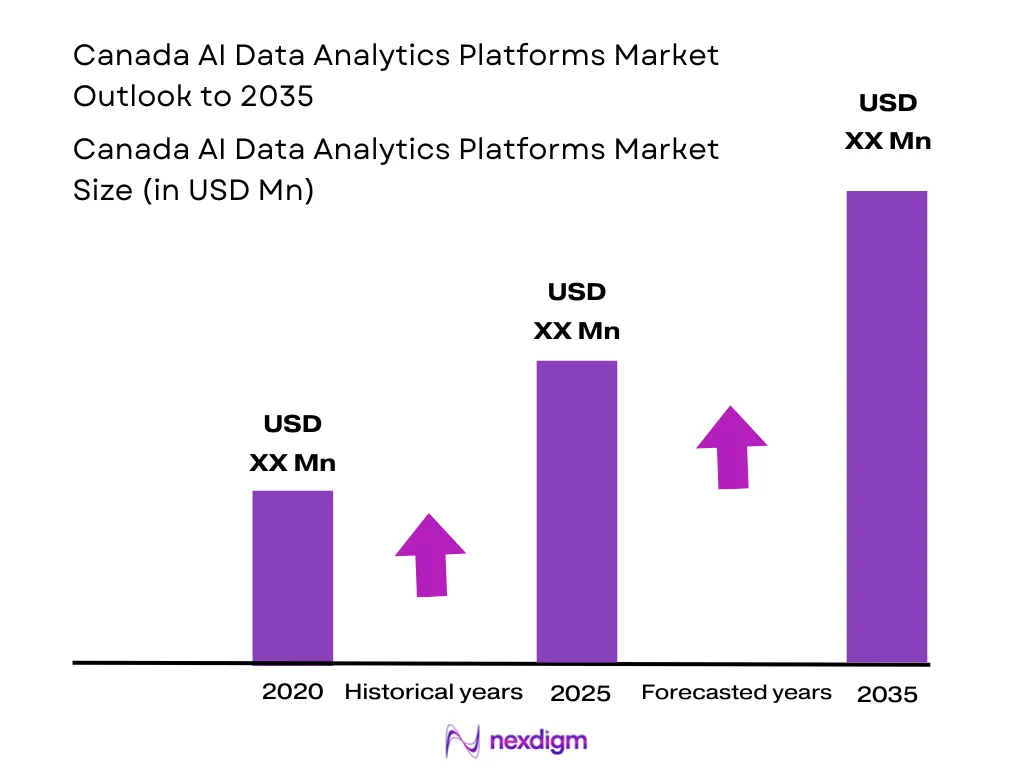
Canada’s AI data analytics platforms market is best anchored to public country-level data analytics benchmarks, because fully disaggregated Canada-only “AI data analytics platform” revenue is rarely published in open sources. Nexdigm places the Canada data analytics market at USD ~ million in 2025, while its historical series runs through 2018–2023. On the demand side, 7% of Canadian businesses with five or more employees used AI software or hardware in 2023, and 6.1% of businesses reported using AI to produce goods or deliver services in the next public survey cycle, showing that monetization is being driven by a widening installed base of enterprise AI and analytics workloads.
The market is concentrated in Toronto, Montreal, Edmonton, Calgary, and Quebec, rather than being evenly distributed across the country. Toronto benefits from the Vector Institute’s network of 962 researchers and faculty and Azure’s Canada Central presence; Montreal combines Mila’s 140+ professors with IBM’s Montreal multizone region; Edmonton is strengthened by Amii as one of Canada’s three national AI institutes; and Calgary has gained relevance through AWS’s Canada West region. These hubs dominate because enterprise AI platform buying follows talent density, hyperscale cloud availability, data-sovereignty readiness, and strong university-commercialization linkages.
Market Segmentation
By Deployment Model
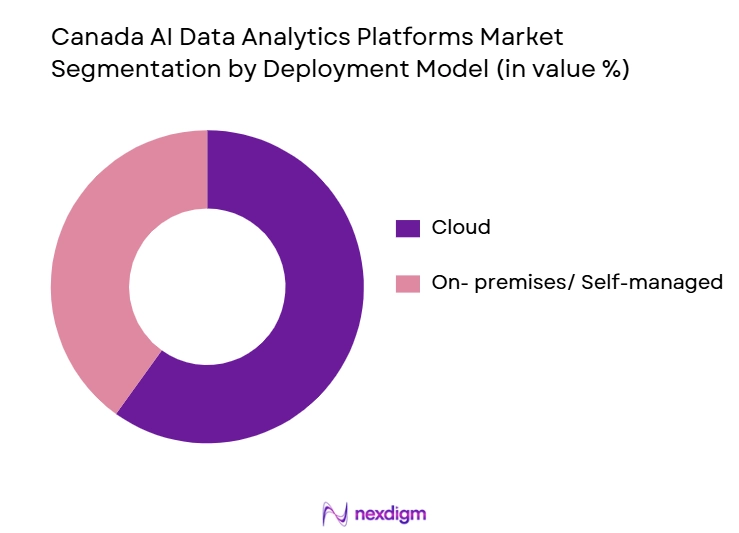
Canada AI data analytics platforms market is segmented by deployment model into cloud and on-premises / self-managed environments. Recently, cloud deployment has held the dominant market share in Canada under this segmentation, because platform buyers increasingly want scalable compute, faster model training, lower time-to-deployment, easier connector integration, and in-country resiliency. Public data from Market Research Future values the cloud deployment portion of Canada’s data analytics market at USD 3.23 billion in 2024, making it the largest disclosed deployment bucket. That dominance also fits the broader Canadian enterprise environment, where AWS now offers both Canada (Central) and Canada West (Calgary), Azure operates Canada Central and Canada East, and IBM has expanded Toronto and Montreal infrastructure for regulated AI and analytics workloads. In practice, cloud wins because Canadian buyers want to keep data in-country while still accessing elastic analytics, AI services, and faster procurement cycles.
By Analytics Type
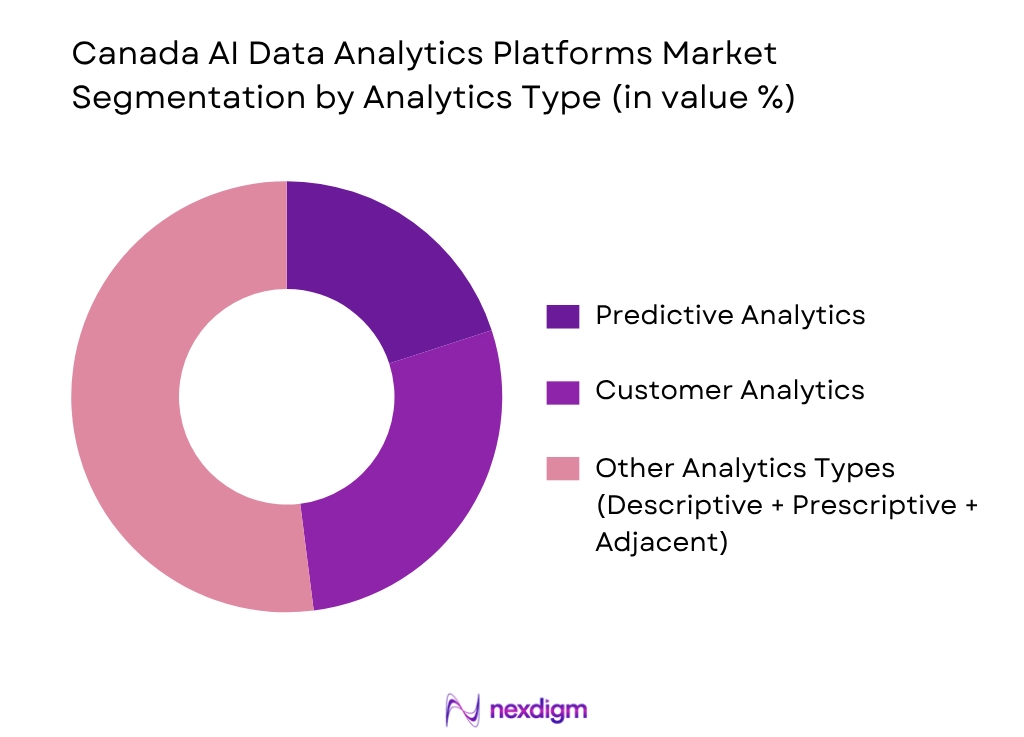
Canada AI data analytics platforms market is segmented by analytics type into predictive analytics, customer analytics, and other analytics types including descriptive and prescriptive analytics. Recently, customer analytics and predictive analytics have both been important revenue pools, but predictive analytics remains the dominant named sub-segment in public Canada-specific reporting because it directly supports forecasting, fraud detection, risk scoring, operational planning, and decision automation in sectors such as finance, retail, healthcare, and telecom. Market Research Future values predictive analytics at USD 1.08 billion in 2024 and customer analytics at USD 1.51 billion; however, the same source still identifies predictive analytics as the largest named category because descriptive and prescriptive workloads are grouped more broadly in open disclosure. In the Canadian context, predictive tools stay central because businesses are adopting AI for data analytics, recommendation systems, planning, and process decisions rather than only for dashboarding or retrospective reporting.
Competitive Landscape
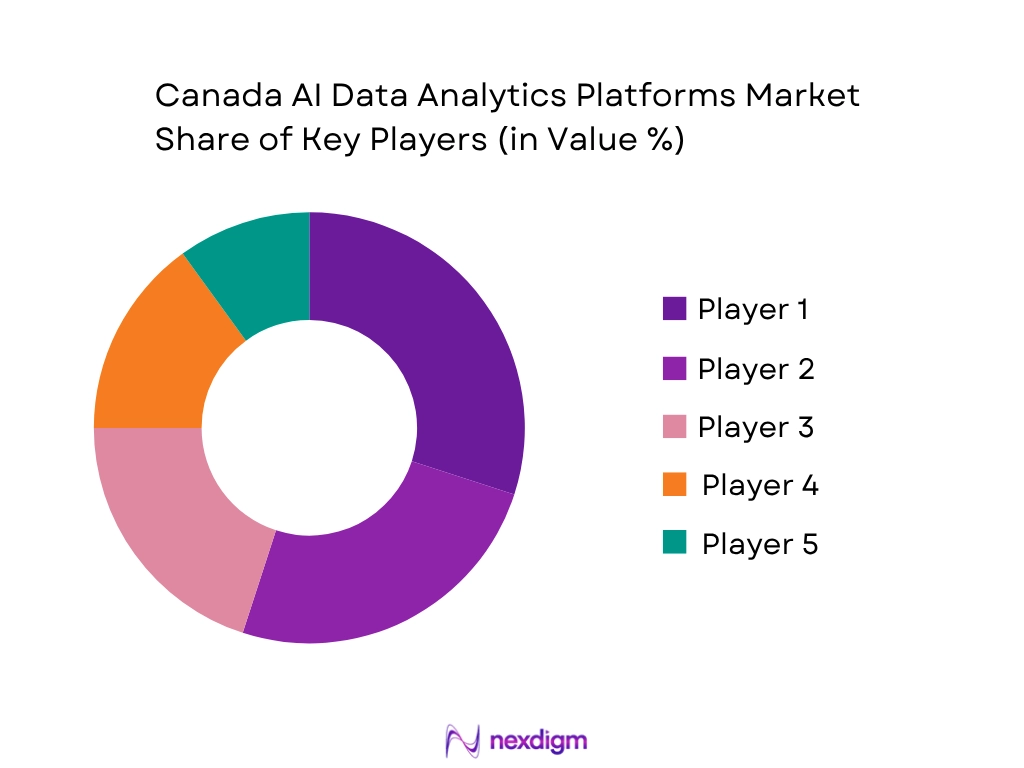
The Canada AI data analytics platforms market is led by a concentrated mix of hyperscaler-linked platforms and enterprise analytics incumbents. Public market overviews consistently identify vendors such as Microsoft, IBM, Oracle, SAP, Snowflake, Databricks, Qlik, SAS, Tableau/Salesforce, and Alteryx among the leading competitive set. The market is competitive, but not fragmented in the way commodity software markets are, because winning vendors typically combine cloud infrastructure access, unified data governance, AI tooling, strong partner ecosystems, and the ability to satisfy Canadian residency and compliance expectations.
| Company | Establishment Year | Headquarters | Core Platform Positioning | Canada Market Relevance | Primary Buyer Verticals | Deployment Orientation | AI / Analytics Strength | Ecosystem Route |
| Microsoft | 1975 | Redmond, Washington, U.S. | – | – | – | – | – | – |
| Databricks | 2013 | San Francisco, California, U.S. | – | – | – | – | – | – |
| Snowflake | 2012 | Menlo Park, California, U.S. | – | – | – | – | – | – |
| IBM | 1911 | Armonk, New York, U.S. | – | – | – | – | – | – |
| Oracle | 1977 | Austin, Texas, U.S. | – | – | – | – | – | – |
Canada AI Data Analytics Platforms Market Analysis
Growth Drivers
Rising Enterprise AI Adoption Across High-Usage Sectors
Enterprise AI adoption is becoming a measurable demand engine for AI data analytics platforms in Canada. Statistics Canada reported that 12.2% of businesses used AI to produce goods or deliver services in the second quarter of 2025, up from 6.1% a year earlier. Adoption is concentrated in analytics-intensive sectors: information and cultural industries at 35.6%, professional, scientific and technical services at 31.7%, and finance and insurance at 30.6%. These are precisely the sectors that buy analytics, model monitoring, semantic-layer, and governance tools at scale. The macro backdrop remains supportive rather than recessionary: Canada’s GDP was US$2.24 trillion in 2024, GDP per capita was US$54,340.3, and the population was 41 million, giving enterprises both scale and digital spending capacity to expand AI-led analytics use cases across customer, risk, and operations workflows.
Migration from Legacy BI and On-Prem Analytics Estates
Migration demand is rising because AI deployment in Canada increasingly requires workflow redesign, cloud resources, and modern data handling that legacy BI stacks struggle to support. Among Canadian businesses using AI in 2025, 40.1% said they had developed new workflows, 25.7% had purchased cloud services or cloud storage, and 18.5% had changed data collection or data management practices. Those figures were 35.2%, 16.1%, and 20.9% respectively in 2024, showing a clear pivot from static reporting systems toward re-engineered, cloud-connected operating environments. At the same time, Statistics Canada reported cloud computing use at 48% of businesses in 2023, with 81% penetration in information and cultural industries, indicating that the installed digital base for migrating away from on-prem analytics has already become large. In a US$2.24 trillion economy, that migration pressure directly supports platform demand for cloud warehouses, lakehouses, orchestration, and governance layers.
Market Challenges
Fragmented Data Estates Across Cloud, SaaS, and Legacy Systems
Fragmentation remains a structural challenge because Canadian firms are layering AI onto pre-existing estates rather than rebuilding from scratch. Statistics Canada reported that among AI-using businesses in 2025, 25.7% purchased cloud services or storage, 18.5% changed data collection or management practices, and 18.2% relied on vendors for installation or integration. This combination suggests that data is often spread across cloud platforms, business applications, and older systems that require re-plumbing before analytics can scale cleanly. The broader digital base is already mixed: 48% of businesses used cloud computing in 2023, while only 7% used AI technologies, showing cloud maturity is ahead of AI maturity. That gap makes connector sprawl, duplicated pipelines, inconsistent semantics, and governance fragmentation common pain points in Canada’s AI analytics platform deployments.
High Migration and Optimization Complexity
Even when firms commit to modernization, the migration burden is material. In 2025, 40.1% of AI-using Canadian businesses reported developing new workflows, 38.9% trained staff, 25.7% purchased cloud services, and 17.9% bought computing power or specialized equipment. Those are not superficial changes; they imply process redesign, retraining, infrastructure changes, and operating-model updates that lengthen platform deployment cycles. Complexity also shows up in labour-market conditions: total Canadian job vacancies were still 524,300 in the first quarter of 2025, while average offered hourly wages for vacant positions reached C$28.90. In other words, enterprises are modernizing in a labour market where digital transformation capacity is finite and integration resources are costly to secure, making optimization and migration projects slower than software vendors often assume.
Market Opportunities
BFSI Risk, Fraud, and AML Analytics Platform Expansion
Financial services remain one of the clearest growth opportunities for AI data analytics platforms in Canada because the regulatory burden and fraud intensity are both high. Statistics Canada reported 30.6% AI use in finance and insurance in 2025, up from 10.9% in 2024, making it one of the country’s most AI-active sectors. FINTRAC generated more than 6,200 financial intelligence disclosure packages from more than 2,700 unique disclosures in 2024–25, and said its intelligence contributed to more than 200 complex investigations. OSFI simultaneously supervises about 400 federally regulated financial institutions, all subject to technology and cyber expectations. These figures create a large near-term opportunity for platforms that combine transaction monitoring, anomaly detection, model risk controls, graph analytics, and explainable AI for fraud, AML, sanctions, and compliance workloads in Canada’s BFSI sector.
Healthcare and Life Sciences Data Platform Modernization
Healthcare is a major opportunity because Canada has already digitized large parts of the clinical record base, but data interoperability and cross-provider sharing still lag. CIHI reported that 93% of primary care physicians used electronic medical records in 2022, up from 73% in 2015. Yet only 39% of Canadians reported checking their health information online between 2021 and 2023, and only 29% of physicians reported sharing patient information electronically with providers outside their practice in 2024. CIHI also notes that nurses and pharmacists reported electronic exchange rates of 24% and 52% respectively. This gap between digitization and connected data flow creates a strong market opportunity for governed health-data platforms, interoperability layers, clinical analytics environments, and privacy-preserving AI tools that can modernize care coordination, population analytics, and administrative decision support across Canada.
Future Outlook
Over the next several years, the Canada AI data analytics platforms market is expected to expand rapidly as enterprise budgets shift from standalone BI tools toward unified data-plus-AI environments. Demand will likely be shaped by stronger cloud residency options in Canada, broader use of AI for analytics and recommendation engines, and rising pressure on enterprises to operationalize governance, explainability, and cost control. The platform winners will be those that can combine lakehouse or warehouse scalability with business-user accessibility, vertical accelerators, and compliance-friendly deployment models.
Major Players
- Microsoft
- Amazon Web Services
- Google Cloud
- Databricks
- Snowflake
- IBM
- Oracle
- SAP
- SAS
- Salesforce
- Cloudera
- Informatica
- Qlik
- Teradata
- Palantir Technologies
Key Target Audience
- Chief Data Officers and Chief Analytics Officers
- Chief Information Officers and Enterprise Architecture Heads
- Heads of Data Engineering, BI, and AI Platforms
- Banking, Insurance, and Capital Markets Technology Leaders
- Healthcare and Life Sciences Digital Transformation Leaders
- Investments and Venture Capitalist Firms
- Government and Regulatory Bodies
- Public Sector Digital and Data Modernization Agencies
Research Methodology
Step 1: Identification of Key Variables
The first step maps the Canada AI data analytics platforms ecosystem across hyperscalers, data-platform vendors, BI providers, governance vendors, system integrators, and enterprise buyers. Secondary research is used to identify the main decision variables, including deployment model, analytics type, cloud-region availability, regulatory fit, and enterprise use-case intensity. This stage establishes the market boundaries used in the report.
Step 2: Market Analysis and Construction
The next phase compiles public country-level market values, segment disclosures, and historical market references from Canada-focused data analytics sources. These are then cross-checked against Statistics Canada evidence on AI usage by business and sector adoption behavior to ensure that the market narrative reflects actual enterprise demand conditions in Canada rather than a generic North American software view.
Step 3: Hypothesis Validation and Expert Consultation
Market hypotheses are then validated against operational realities: which platform categories dominate named revenue pools, why cloud is leading, why Toronto–Montreal–Alberta matter, and which sectors are driving AI analytics spend. In a full consulting engagement, this step would be refined through interviews with CIOs, cloud partners, analytics leaders, and regulated-industry practitioners to test commercial assumptions and procurement behavior.
Step 4: Research Synthesis and Final Output
The final step synthesizes the top-down market value view with bottom-up commercial signals, including cloud-region expansion, vendor positioning, and sector-level AI adoption. The result is a market model designed for business professionals: it emphasizes segment structure, competitive intensity, buyer logic, and future scalability rather than only presenting broad software-growth claims.

- Executive Summary
- Research Methodology (Market Definitions, Platform Inclusion Criteria, Canada-Specific Demand-Side Assessment, Vendor Revenue Mapping, Installed Base Validation, Primary Interviews with CIO/CDO/CTO/Analytics Heads, Channel Partner Inputs, Enterprise Buyer Journey Assessment, Competitive Benchmarking Framework, Forecasting Logic, Assumptions and Limitations)

- Definition and Scope
- Market Taxonomy and Platform Boundary Mapping
- Evolution of Canada’s Data, Analytics, and AI Platform Stack
- Industry Value Chain and Ecosystem Structure
- Buyer–Vendor Operating Model
- Platform Architecture Evolution: Warehouse to Lakehouse to AI-Native Analytics
- Canada Regulatory and Policy Environment Impacting Platform Adoption
- Cloud and Data Residency Landscape in Canada
- M&A, Partnerships, and Ecosystem Expansion Snapshot
- Business Cycle and Decision-Making Flow in Enterprise Platform Procurement

- Growth Drivers
Rising Enterprise AI Adoption Across High-Usage Sectors
Migration from Legacy BI and On-Prem Analytics Estates
Demand for Unified Data + AI + Governance Environments
Expansion of Augmented Analytics and Natural Language Interfaces
Increasing Need for Real-Time, Streaming, and Operational Analytics
Sovereign Compute, Data Residency, and Canada-Hosted Workload Demand
Partner-Led Modernization Programs Across Enterprise Accounts - Market Challenges
Fragmented Data Estates Across Cloud, SaaS, and Legacy Systems
High Migration and Optimization Complexity
Cost Control Challenges in Consumption-Based Models
Skills Shortages in Data Engineering, MLOps, and AI Governance
Data Quality, Metadata, and Semantic Layer Gaps
Procurement Friction in Regulated and Public-Sector Environments
Difficulty Demonstrating ROI Beyond Dashboarding - Market Opportunities
BFSI Risk, Fraud, and AML Analytics Platform Expansion
Healthcare and Life Sciences Data Platform Modernization
Manufacturing and Supply Chain AI Analytics Scaling
Public Sector Responsible AI and Data Platform Modernization
Mid-Market Adoption of Low-Code and Managed Analytics Platforms
Embedded Analytics Within SaaS and Line-of-Business Applications
GenAI Assistant Layers for Business Users and Analysts - Market Trends
Convergence of Data Engineering, BI, and AI on Unified Platforms
Growth in Data Sharing, Clean Rooms, and Collaboration Environments
Rise of Natural Language Query and Conversational BI
Semantic Layer and Metrics Store Standardization
Governance-by-Design and Policy Automation
Demand for Interoperable Multi-Cloud Analytics Stacks - Regulatory and Compliance Landscape
Federal Privacy and Commercial Data Handling Requirements
Quebec Private-Sector Privacy Compliance Implications
Public-Sector Automated Decision and Algorithmic Accountability Requirements
OSFI and Regulated-Industry Technology Risk Expectations
Model Governance, Bias Management, and Auditability Requirements - Demand-Side Buyer Analysis (Budget Ownership, Platform Consolidation Intent, Deployment Preference, Buying Criteria, Renewal Dynamics)
- Technology and Ecosystem Analysis (Hyperscaler Influence, SI Ecosystem, ISV Partnerships, Data Marketplace Maturity, Open Table Format Adoption)
- Porter’s Five Forces Analysis (Vendor Rivalry, Entry Barriers, Buyer Power, Substitute Risk, Ecosystem Dependency)
- SWOT Analysis (Market Maturity, Domestic Innovation Base, Compliance Strength, Talent Constraints, Consolidation Potential)

- By Revenue, 2020-2025
- By Number of Active Enterprise Accounts, 2020-2025
- By Average Annual Contract Value, 2020-2025
- By Average Revenue per Customer, 2020-2025
- By New vs Renewal Platform Spending , 2020-2025

- By Platform Category (In Value %)
Lakehouse and Unified Data Platforms
Cloud Data Warehouse Platforms
BI, Visualization, and Embedded Analytics Platforms
Data Integration, Fabric, and Pipeline Platforms
Augmented Analytics, Decision Intelligence, and AI-Native Analytics Platforms - By Deployment Model (In Value %)
Public Cloud
Hybrid Cloud
Private Cloud
On-Premises / Self-Managed - By Organization Size (In Value %)
Large Enterprises
Mid-Sized Enterprises
Small Enterprises
Government and Public Institutions - By End User Industry (In Value %)
BFSI
Retail and E-Commerce
Healthcare and Life Sciences
Manufacturing
Telecom and Media
Public Sector
Energy and Utilities
Transportation and Logistics - By Use Case (In Value %)
Customer Analytics and Personalization
Fraud, Risk, and Compliance Analytics
Operational Intelligence and Process Analytics
Supply Chain, Demand, and Forecasting Analytics
GenAI-Enabled Analytics Copilots and Natural Language Query
Predictive Maintenance and Asset Analytics
Workforce and Productivity Analytics
Population, Clinical, and Health Data Analytics - By Pricing and Commercial Model (In Value %)
Consumption-Based / Usage Pricing
Subscription / SaaS Pricing
Term License with Support and Maintenance
Platform + Managed Services / Consulting-Led Engagement - By Region (In Value %)
Ontario
Quebec
British Columbia
Alberta
Rest of Canada

- Strategic Positioning of Vendors
- Go-to-Market and Sales Strategy Analysis
- Partnership and Ecosystem Intelligence
- Product and Innovation Benchmarking
- M&A and Investment Intelligence
- Customer Acquisition and Retention Intelligence
- Pricing and Commercial Intelligence
- Deployment and Adoption Intelligence
- Industry-Specific Penetration Intelligence
- Technology Stack and Architecture Intelligence
- AI and GenAI Competitive Intelligence
- Regulatory and Compliance Intelligence
- Customer Perception and Brand Intelligence
- Channel and Distribution Intelligence
- Competitive Threat Analysis
- White Space and Competitive Gaps
- Future Competitive Outlook

- Market Share of Major Players (By Revenue, By Enterprise Accounts, By Deployment Footprint, By Industry Presence)
- Cross Comparison Parameters (Core Platform Architecture, AI/ML/LLM Analytics Capability, Data Integration and Connector Breadth, Data Governance/Security/Privacy Controls, Canadian Data Residency and Cloud Region Support, Industry-Specific Accelerators and Templates, Pricing and Consumption Model Flexibility, Partner Ecosystem and Enterprise Support Strength)
- Competitive Positioning Matrix (Innovation Depth, Enterprise Penetration, Vertical Relevance, Ecosystem Strength, Canadian Market Fit)
- Pricing and Commercial Benchmarking (Consumption Units, Seat Pricing Logic, Compute–Storage Separation, Services Attach, Contract Flexibility)
- SWOT Analysis of Major Players (Canada Footprint, Product Breadth, AI Readiness, Partner Leverage, Vertical Depth)
- Detailed Profiles of Major Companies
Microsoft
Amazon Web Services
Google Cloud
Databricks
Snowflake
IBM
Oracle
SAP
SAS
Salesforce
Cloudera
Informatica
Qlik
Teradata
Palantir Technologies

- Adoption Readiness
- Procurement and Budget Allocation
- Workload Prioritization
- Needs and Pain Point Analysis
- Decision-Making Process
- Vendor Selection Criteria
- Implementation Preferences
- Retention and Expansion Indicators

- By Revenue, 2026-2035
- By Number of Active Enterprise Accounts, 2026-2035
- By Average Annual Contract Value, 2026-2035
- By Average Revenue per Customer, 2026-2035
- By New vs Renewal Platform Spending, 2026-2035


 Request a Sample
 Ask for Customization
 Get a Quote
 Enquire Now