

 Download PDF
 Download PDF
Market Overview
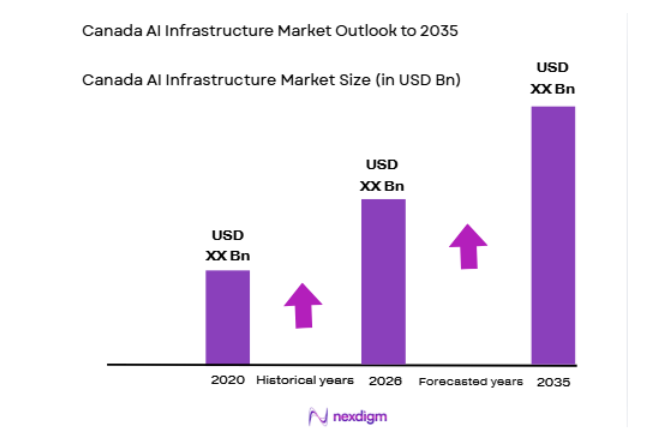
The Canada AI infrastructure market reflects expanding investment in high-performance computing clusters, AI-optimized data centers, and accelerated computing platforms supporting machine learning deployment across enterprises, research institutions, and government digital initiatives. Based on a recent historical assessment, the market size is approximately USD ~ billion, driven by national AI commercialization programs, hyperscale cloud expansion, and enterprise adoption of GPU-based computing for analytics, automation, and generative AI applications across finance, healthcare, and industrial sectors.
Toronto, Montreal, and Vancouver dominate AI infrastructure deployment due to concentration of AI research institutes, hyperscale cloud regions, and technology enterprises requiring large-scale compute resources. Montreal’s leadership in deep learning research and public supercomputing facilities strengthens regional infrastructure density. Toronto’s financial and enterprise technology ecosystem sustains commercial AI compute demand, while Vancouver’s digital media and autonomous systems sectors expand GPU cluster utilization. These innovation clusters anchor national AI infrastructure growth across Canada.
Market Segmentation
By Infrastructure Type
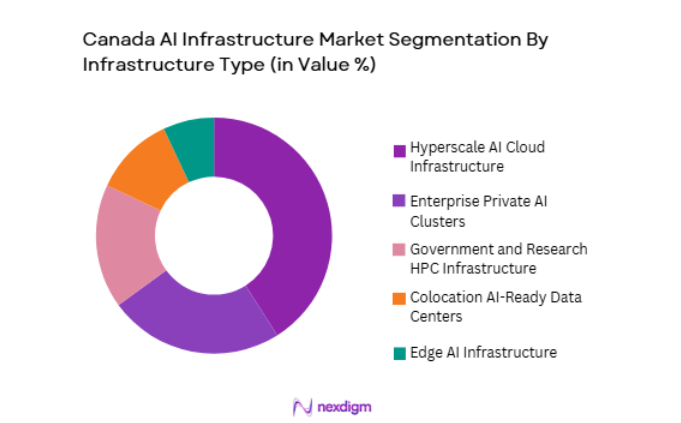
Canada AI Infrastructure Market is segmented by infrastructure type into hyperscale AI cloud infrastructure, enterprise private AI clusters, government and research HPC infrastructure, edge AI infrastructure, and colocation AI-ready data centers. Recently, hyperscale AI cloud infrastructure has a dominant market share due to strong presence of global cloud providers offering scalable GPU clusters, managed AI platforms, and high-performance storage optimized for large-scale model training and inference across enterprises and research organizations. Canadian enterprises increasingly adopt cloud-based AI infrastructure to avoid capital-intensive on-premise deployments while accessing advanced AI tooling and frameworks. Hyperscale providers operate multiple Canadian regions ensuring data residency and regulatory compliance.
By End-Use Industry
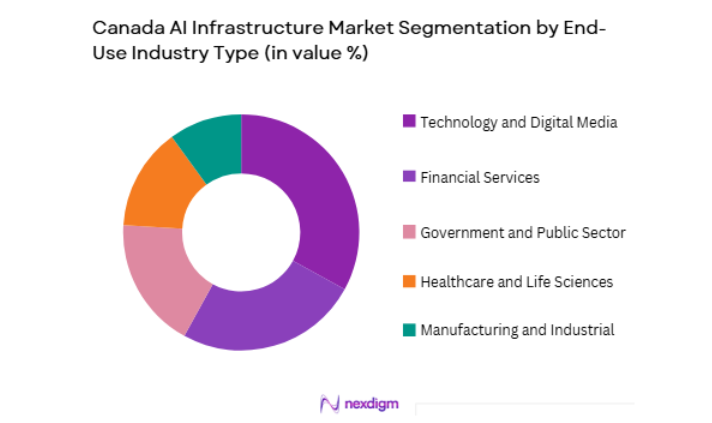
Canada AI Infrastructure Market is segmented by end-use industry into financial services, healthcare and life sciences, technology and digital media, government and public sector, and manufacturing and industrial. Recently, technology and digital media has a dominant market share due to Canada’s strong AI start-up ecosystem, gaming and visual computing industries, and large-scale machine learning deployment across content generation, recommendation systems, and computer vision applications requiring intensive GPU and storage infrastructure. Montreal and Vancouver host major digital media and AI firms driving compute demand. Technology companies continuously train large models requiring scalable clusters. Cloud-native AI companies rely heavily on hyperscale infrastructure. Compared with other sectors, digital media and AI platforms generate sustained high-performance computing workloads.
Competitive Landscape
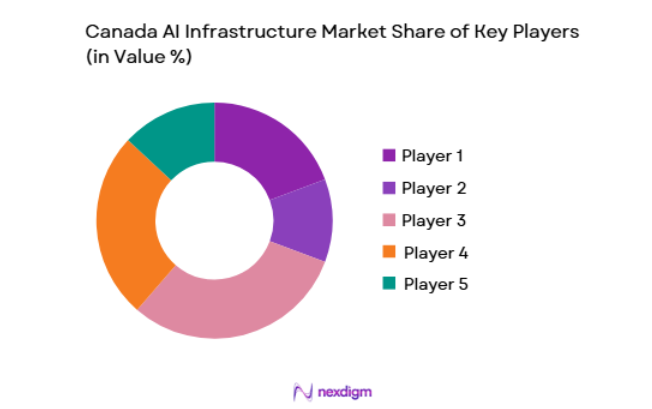
The Canada AI infrastructure market is characterized by hyperscale cloud providers, specialized AI hardware firms, and national HPC infrastructure organizations supporting research and enterprise deployments. Global cloud vendors dominate scalable GPU infrastructure, while domestic AI chip and computing firms contribute specialized platforms. Government-supported supercomputing centers and research networks also shape competitive dynamics across the Canadian AI ecosystem.
| Company Name | Establishment Year | Headquarters | Technology Focus | Market Reach | Key Products | Revenue | AI Infrastructure Role |
| Amazon Web Services | 2006 | Seattle, USA | ~ | ~ | ~ | ~ | ~ |
| Microsoft Azure | 2010 | Redmond, USA | ~ | ~ | ~ | ~ | ~ |
| Google Cloud | 2008 | Mountain View, USA | ~ | ~ | ~ | ~ | ~ |
| NVIDIA | 1993 | California, USA | ~ | ~ | ~ | ~ | ~ |
| IBM | 1911 | New York, USA | ~ | ~ | ~ | ~ | ~ |
Canada AI Infrastructure Market Analysis
Growth Drivers
National AI Strategy Funding and Public Supercomputing Infrastructure Expansion
Canada accelerates AI infrastructure development through coordinated federal and provincial funding programs supporting high-performance computing facilities, research superclusters, and AI commercialization platforms that expand national GPU capacity and data center infrastructure accessible to enterprises, start-ups, and academic institutions across sectors. Public investments strengthen shared HPC centers in Montreal and Toronto enabling large-scale model training. National AI institutes require advanced compute resources driving infrastructure upgrades. Government programs subsidize enterprise AI adoption increasing infrastructure utilization. Public cloud providers co-invest in national AI capacity aligned with policy objectives. Academic research commercialization creates sustained compute demand. AI talent concentration increases infrastructure usage. Regional innovation clusters expand data center ecosystems. Sovereign compute initiatives support domestic AI capability. These coordinated investments drive sustained AI infrastructure growth nationwide.
Enterprise Adoption of Generative AI and Accelerated Computing Platforms
Canadian enterprises across finance, healthcare, manufacturing, and digital media increasingly deploy generative AI, predictive analytics, and automation systems requiring high-performance GPU clusters, distributed storage, and AI-optimized networking infrastructure integrated through cloud and hybrid computing environments across the national digital economy. Financial institutions deploy AI for risk modeling and fraud detection. Healthcare organizations apply AI in diagnostics and drug discovery. Manufacturing firms implement AI-driven automation and quality control. Media companies deploy generative content platforms. Enterprises require scalable inference infrastructure. Hybrid cloud architectures integrate on-premise and cloud GPUs. AI software ecosystems expand infrastructure dependency. Continuous model retraining drives compute demand. These factors accelerate AI infrastructure expansion across Canada.
Market Challenges
High Capital Costs and Limited Domestic AI Hardware Manufacturing Capacity
Canada faces structural challenges in AI infrastructure due to high costs of GPU accelerators, AI servers, and data center deployment combined with limited domestic semiconductor manufacturing capacity, increasing dependence on imported hardware and constraining rapid scaling of national AI compute infrastructure across enterprises and research institutions. AI accelerators require significant capital investment. Import dependence exposes supply chain risk. Currency fluctuations affect procurement costs. Limited domestic chip fabrication restricts local supply. Infrastructure upgrades require large financing. Smaller enterprises face affordability barriers. Public HPC funding remains constrained. Global GPU shortages affect availability. Deployment timelines extend due to hardware lead times. These factors limit AI infrastructure expansion.
Power, Cooling, and Data Center Capacity Constraints in Key Regions
Canadian AI infrastructure deployment depends on high-density data centers requiring substantial power, cooling, and connectivity capacity concentrated in major cities where grid availability, energy costs, and facility development constraints influence AI compute expansion and operational efficiency across national infrastructure networks. GPU clusters require high power density. Cooling systems increase facility costs. Urban data center space is limited. Grid upgrades take time. Renewable energy integration raises complexity. Regional capacity disparities affect deployment. Energy pricing affects operating costs. Environmental regulations shape facility design. Latency considerations require proximity. These constraints affect AI infrastructure scaling.
Opportunities
Sovereign AI Compute and National Research Cloud Infrastructure Development
Canada has significant opportunity to expand sovereign AI infrastructure through nationally controlled GPU cloud platforms, research supercomputing networks, and domestic AI data centers supporting secure government, healthcare, and defense AI workloads aligned with national digital sovereignty and data governance objectives across sectors. Public sector AI adoption requires domestic compute. Healthcare data mandates local processing. Government AI programs need secure infrastructure. National research cloud initiatives expand capacity. Domestic hosting increases resilience. Public-private partnerships support sovereign AI. Canadian AI firms benefit from local access. Exportable sovereign AI platforms emerge. These drivers enable national AI compute expansion.
Edge AI and Distributed Inference Infrastructure Across Industrial and Smart Systems
Growing deployment of AI-enabled sensors, autonomous systems, smart cities, and industrial automation across Canada creates opportunities for distributed edge AI infrastructure integrating regional data centers, telecom networks, and localized GPU inference platforms complementing centralized hyperscale computing across diverse geographic and sectoral environments. Autonomous vehicles require edge inference. Smart cities deploy AI sensors. Industrial IoT expands regional compute. Telecom networks host edge nodes. Remote regions need localized AI. Latency-sensitive applications increase demand. Edge-cloud integration grows. Distributed analytics expands infrastructure. Regional innovation hubs adopt edge AI. These trends support distributed AI infrastructure growth.
Future Outlook
The Canada AI infrastructure market is expected to expand steadily over the next five years, driven by enterprise generative AI adoption, hyperscale cloud investment, and national AI strategy funding. Sovereign compute and research cloud initiatives will strengthen domestic capacity. Edge AI deployment across industries will complement centralized GPU clusters. Regional data center expansion and energy infrastructure planning will shape long-term AI infrastructure growth nationwide.
Major Players
- Amazon Web Services
- Microsoft Azure
- Google Cloud
- NVIDIA
- IBM
- Oracle Cloud
- Dell Technologies
- HPE
- Cisco Systems
- Equinix
- Digital Realty
- CoreWeave
- Lambda Labs
- OVHcloud
- Fujitsu
Key Target Audience
- Enterprises and large corporations
- Financial institutions
- Healthcare and life sciences organizations
- Technology and AI companies
- Manufacturing and industrial firms
- Telecommunications operators
- Investments and venture capitalist firms
- Government and regulatory bodies
Research Methodology
Step 1: Identification of Key Variables
AI infrastructure variables including GPU capacity, data center deployment, cloud AI services, HPC facilities, and regional compute clusters were identified from industry publications, policy documents, and company disclosures. Sectoral AI adoption across finance, healthcare, and technology was mapped to infrastructure requirements. Technology trends in generative AI and edge computing were incorporated.
Step 2: Market Analysis and Construction
Market size and segmentation were constructed using secondary data from cloud provider disclosures, AI infrastructure investments, HPC capacity announcements, and digital economy statistics. Regional infrastructure clusters and deployment models were benchmarked. Segment shares were estimated based on workload distribution and sector AI adoption across Canada.
Step 3: Hypothesis Validation and Expert Consultation
Findings were validated through consultations with AI engineers, cloud architects, HPC specialists, and enterprise IT leaders across Canadian industries. Infrastructure growth assumptions and deployment preferences were refined through expert feedback. Technology adoption trends and compute demand drivers were cross-checked with practitioner insights.
Step 4: Research Synthesis and Final Output
Validated quantitative and qualitative inputs were synthesized into a structured market model integrating AI infrastructure capacity, demand drivers, segmentation shares, and competitive dynamics. Regional and policy influences were incorporated into growth projections. Final outputs were reviewed for consistency with national AI strategy objectives and infrastructure realities.

- Executive Summary
- Research Methodology (Definitions, Scope, Industry Assumptions, Market Sizing Approach, Primary & Secondary Research Framework, Data Collection & Verification Protocol, Analytic Models & Forecast Methodology, Limitations & Research Validity Checks)

- Market Definition and Scope
- Value Chain & Stakeholder Ecosystem
- Regulatory / Certification Landscape
- Sector Dynamics Affecting Demand

- Growth Drivers
Strong national AI research ecosystem and public funding programs
Rising enterprise adoption of AI across finance energy and healthcare sectors
Expansion of sovereign and domestic AI compute infrastructure initiatives - Market Challenges
Dependence on imported advanced semiconductors and AI accelerators
High capital and operational costs of large scale AI infrastructure
Limited domestic hyperscale AI infrastructure ownership - Market Opportunities
Development of sovereign and trusted national AI cloud infrastructure
Growth of AI compute for natural resources and climate analytics
Expansion of AI infrastructure in academic and research collaborations - Trends
Shift toward GPU dense and accelerator rich AI clusters
Adoption of hybrid AI infrastructure combining cloud and on premise
Increasing demand for energy efficient and sustainable AI data centers - Government regulations
Canadian data sovereignty and privacy regulations impacting AI hosting
Federal AI and digital infrastructure funding programs
Energy efficiency and environmental standards for data centers - SWOT analysis
- Porters Five forces

- By Market Value, 2020-2025
- By Installed Units, 2020-2025
- By Average System Price, 2020-2025
- By System Complexity Tier, 2020-2025

- By System Type (In Value%)
AI Training Infrastructure Systems
AI Inference Infrastructure Systems
AI Data Processing and Storage Systems
AI Networking and Interconnect Systems
AI Optimized HPC Infrastructure - By Platform Type (In Value%)
Hyperscale AI Cloud Platforms
Enterprise Private AI Clusters
Research and Academic AI Supercomputers
Edge AI Infrastructure Platforms
Government Sovereign AI Infrastructure - By Fitment Type (In Value%)
On Premise AI Infrastructure
Cloud Hosted AI Infrastructure
Hybrid AI Infrastructure
Modular AI Infrastructure Deployments
Turnkey AI Infrastructure Systems - By End User Segment (In Value%)
Technology and Cloud Providers
Financial Services Institutions
Healthcare and Life Sciences Organizations

- Market Share Analysis
- Cross Comparison Parameters (Compute Performance, Accelerator Integration, Deployment Model, Energy Efficiency, Scalability, Interconnect Bandwidth, Memory Architecture, Cooling Technology, Software Stack Compatibility, Sovereign Deployment Capability)
- SWOT Analysis of Key Competitors
- Pricing & Procurement Analysis
- Key Players
NVIDIA
Advanced Micro Devices
Intel
Hewlett Packard Enterprise
Dell Technologies
Lenovo
IBM
Supermicro
Cisco Systems
Fujitsu
Atos
NEC
Cray
Inspur
Graphcore

- Technology firms scaling AI compute for platform and model development
- Financial institutions deploying AI infrastructure for analytics and risk
- Energy sector adopting AI compute for exploration and optimization
- Universities expanding AI supercomputing and research infrastructure

- Forecast Market Value, 2026-2035
- Forecast Installed Units, 2026-2035
- Price Forecast by System Tier, 2026-2035
- Future Demand by Platform, 2026-2035


 Request a Sample
 Ask for Customization
 Get a Quote
 Enquire Now