

 Download PDF
Market Overview
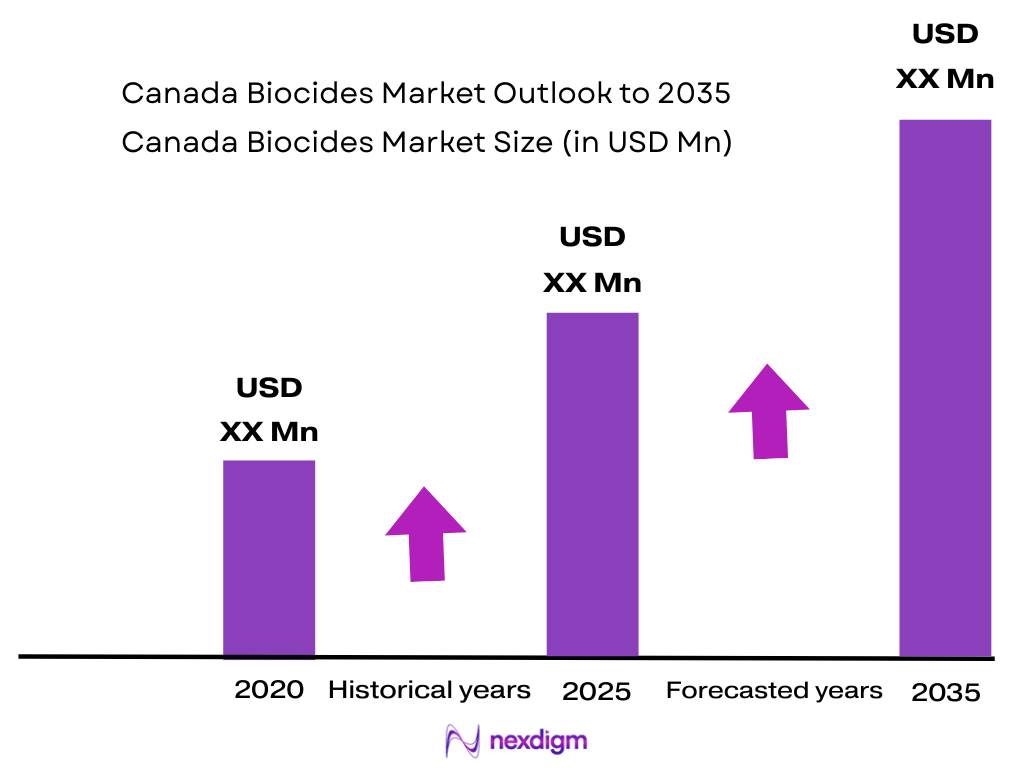
The Canada Biocides Market is valued at ~USD XX million in 2024, with demand linked to municipal and industrial water treatment, pulp and paper, food processing, oil and gas, mining, healthcare sanitation, paints and coatings, and manufacturing. Canada’s GDP was USD 2.24 trillion in 2024, compared with approximately USD 2.14 trillion in 2023, while real GDP growth was 1.6 in 2024. The country’s population reached 41.29 million, creating a large industrial and institutional base requiring recurring microbial-control applications.
Ontario, Quebec, Alberta and British Columbia represent the principal demand centers because they combine large manufacturing, food-processing, pulp and paper, energy, mining, municipal-water and commercial infrastructure. Canada’s manufacturing sector generated CAD 874.59 billion in revenue from goods manufactured in 2024, while food manufacturing generated CAD 160.70 billion, making it the country’s largest manufacturing subsector. Canada’s crude-oil and equivalent production reached 298.8 million cubic metres in 2024, reinforcing demand from energy, refining, pipelines and associated water-treatment operations.
Market Segmentation
By Product Type
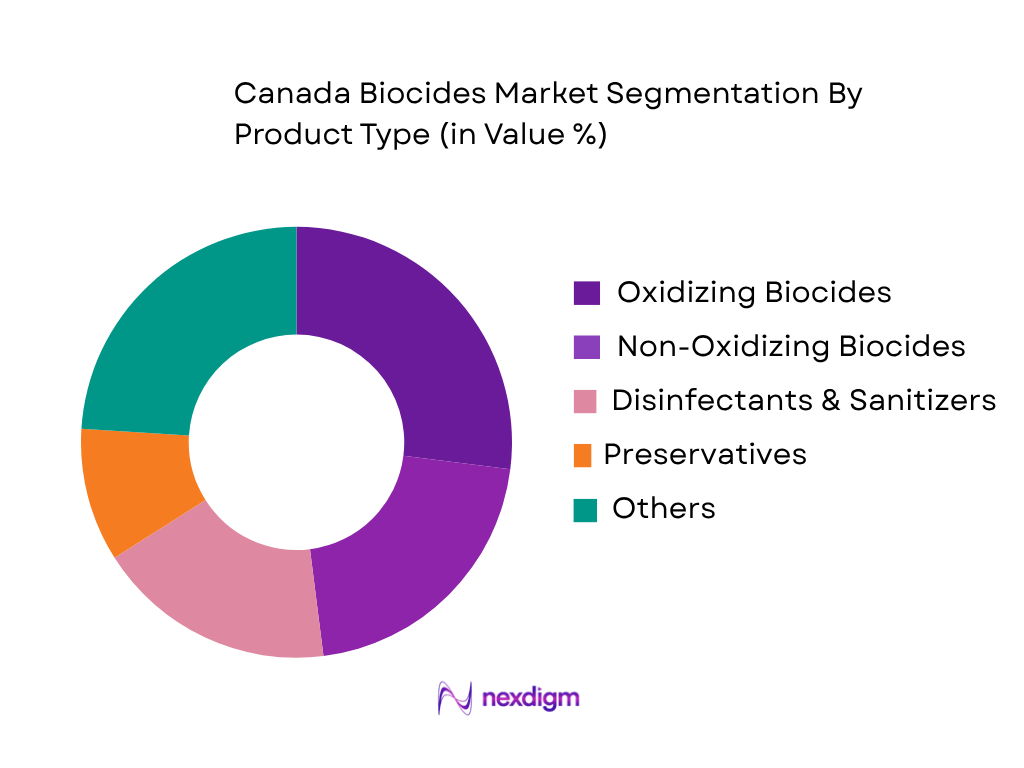
The Canada Biocides Market is segmented by product type into oxidizing biocides, non-oxidizing biocides, disinfectants and sanitizers, preservatives, antimicrobial additives, algaecides, fungicides, biofilm-control agents and antifouling biocides. Oxidizing biocides are expected to represent the dominant segment, with an indicative 2024 market share of XX%, because chlorine-based, bromine-based, chlorine-dioxide, hydrogen-peroxide and peracetic-acid chemistries are widely applicable to water and wastewater treatment, cooling systems, food-processing sanitation and industrial microbial control. Their broad microbial spectrum, rapid action and compatibility with established dosing infrastructure support recurring industrial consumption. The country’s extensive water-treatment requirements further strengthen this position, while energy, food, pulp and paper and manufacturing operations create multiple application points. Statistics Canada reported CAD 160.70 billion of food-manufacturing revenue in 2024, while crude-oil and equivalent production reached 298.8 million cubic metres, illustrating the scale of industrial environments where microbial-control systems are required.
By Application
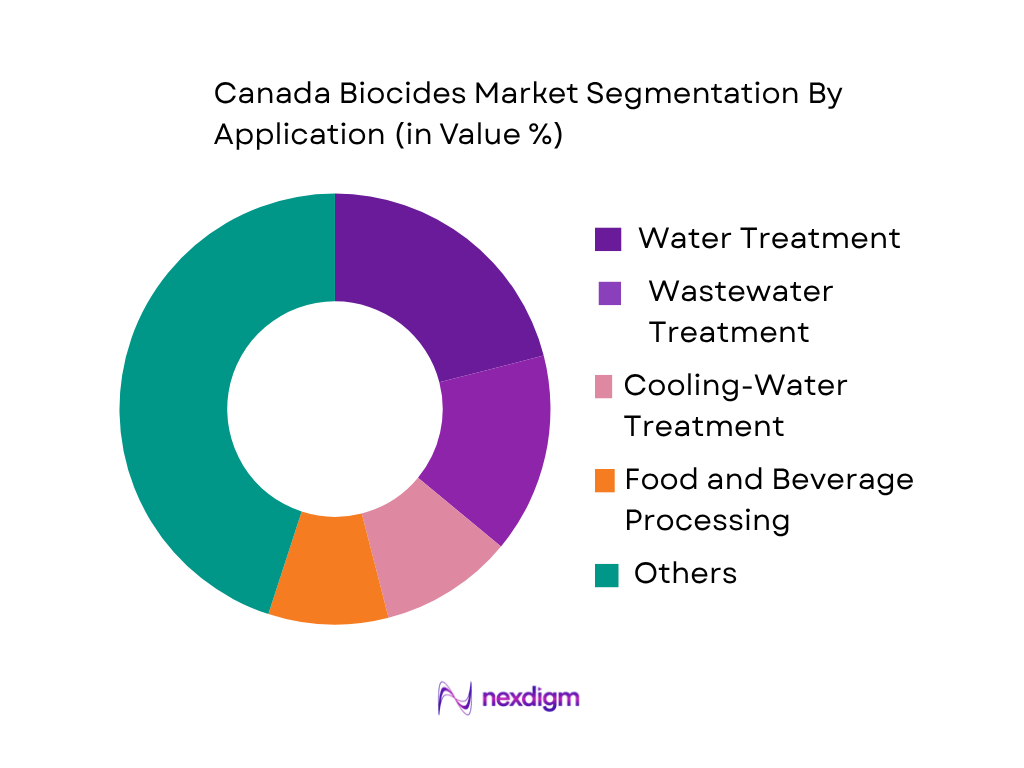
The Canada Biocides Market is segmented by application into water treatment, wastewater treatment, cooling-water treatment, industrial and institutional cleaning, food and beverage processing, oil and gas and petrochemicals, pulp and paper, paints and coatings, wood preservation, mining, pharmaceuticals, agriculture, aquaculture, healthcare and marine applications. Water treatment is expected to remain the leading application, with an indicative 2024 share of XX%, supported by Canada’s large municipal and industrial water infrastructure and the need to control bacteria, algae, fungi and biofilms. Industrial water users in energy, food, chemicals, pulp and paper and mining require continuous microbial management to protect equipment, maintain process efficiency and limit contamination. Canada’s industrial base provides a broad recurring demand pool: food manufacturing generated CAD 160.70 billion in 2024, while petroleum-refining GDP and pharmaceutical manufacturing remain material industrial activities.
Competitive Landscape
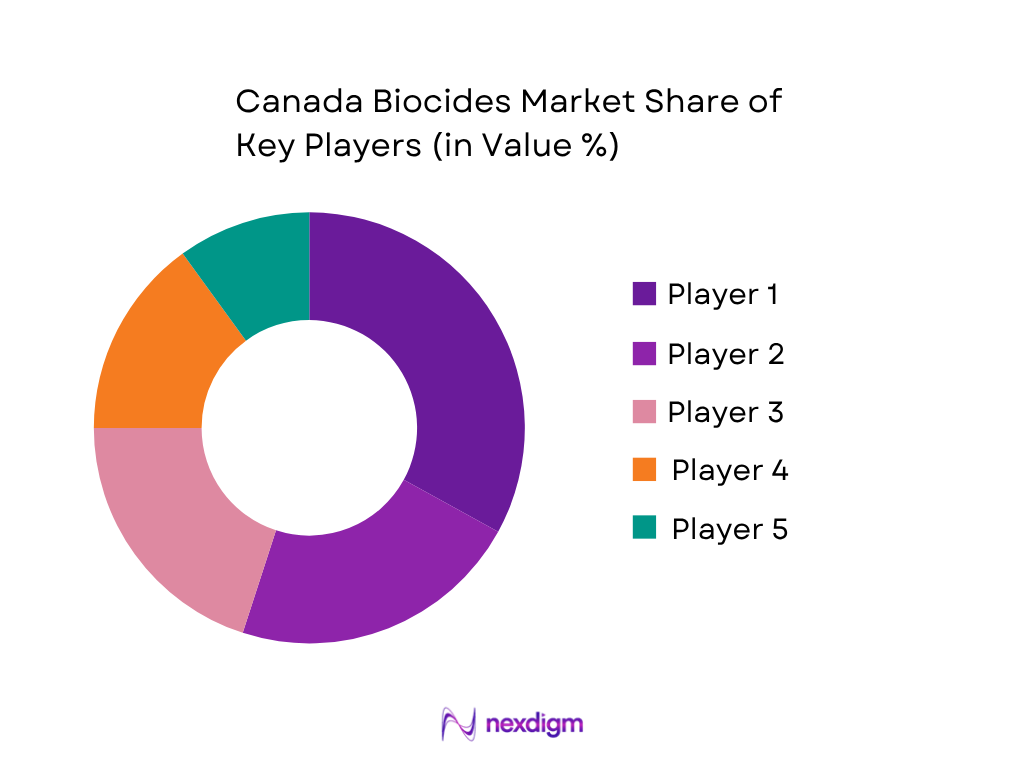
The Canada Biocides Market is characterized by multinational specialty-chemical companies, water-treatment specialists and microbial-control suppliers competing through active-substance portfolios, formulation expertise, application-specific products, technical services and distribution networks. Companies such as LANXESS, BASF, Ecolab, Solenis and Arxada have capabilities spanning industrial water treatment, preservation, disinfection, antimicrobial chemistry and specialty applications. Competitive differentiation increasingly depends on regulatory capability, sustainable chemistry, technical support and the ability to develop application-specific microbial-control programs.
| Company | Establishment | Headquarters | Key Market Focus | Biocide Portfolio | Water Treatment | Industrial Applications | Canadian Reach |
| LANXESS | 2004 | Cologne, Germany | ~ | ~ | ~ | ~ | ~ |
| BASF | 1865 | Ludwigshafen, Germany | ~ | ~ | ~ | ~ | ~ |
| Ecolab | 1923 | St. Paul, USA | ~ | ~ | ~ | ~ | ~ |
| Solenis | 1907 | Wilmington, USA | ~ | ~ | ~ | ~ | ~ |
| Arxada | 2021 | Basel, Switzerland | ~ | ~ | ~ | ~ | ~ |
Canada Biocides Market Analysis
Growth Drivers
Industrial Water Treatment Expansion
Canada’s industrial base creates recurring demand for biocides used in process water, cooling systems, wastewater treatment, membrane protection and microbial-control programs. Statistics Canada reported CAD 874.59 billion in revenue from goods manufactured in 2024, including CAD 160.70 billion from food manufacturing, CAD 94.25 billion from petroleum and coal products, CAD 70.13 billion from chemical manufacturing and CAD 33.06 billion from paper manufacturing. These industries operate water-intensive production systems where bacteria, algae, fungi, slime and biofilm can impair equipment performance and product quality. Canada’s municipal wastewater infrastructure also provides a substantial treatment base: Environment and Climate Change Canada reported that municipal wastewater systems served approximately 37.73 million people in 2023, with approximately 5,795 million m³ of wastewater discharged through municipal systems. The federal wastewater framework is designed to progressively improve treatment performance, with infrastructure upgrades continuing toward 2040. This combination of large industrial water use and continuing municipal-treatment requirements supports recurring demand for oxidizing and non-oxidizing biocides, disinfectants, algaecides and biofilm-control chemistry. The opportunity is particularly relevant to water-intensive manufacturing, food processing, pulp and paper, petroleum, chemicals and municipal wastewater operations.
Pulp and Paper, Food Processing and Energy Activity
Canada’s pulp and paper, food, petroleum and chemical industries provide multiple high-frequency applications for microbial-control products. Statistics Canada recorded CAD 33.06 billion in paper-manufacturing revenue in 2024, compared with CAD 32.81 billion in 2023, while food-manufacturing revenue increased from CAD 157.25 billion to CAD 160.70 billion. Petroleum and coal product manufacturing generated CAD 94.25 billion, while chemical manufacturing generated CAD 70.13 billion. At the resource-extraction level, Canada’s mining, quarrying and oil and gas extraction sector increased its economic activity in 2024, with the sector rising 4.6 and oil and gas extraction increasing 3.7. These industries require microbial management across water circuits, storage systems, process equipment, production environments and wastewater streams. Food processing additionally requires controlled sanitation to manage microbial contamination, while pulp and paper operations use microbial-control chemistry to limit slime formation and biofilm in process-water systems. The breadth of these industrial applications reduces dependence on a single end-use sector and supports demand for application-specific preservatives, disinfectants, oxidizing biocides and non-oxidizing formulations.
Market Challenges
Strict Regulatory Compliance and Active-Ingredient Restrictions
Regulatory compliance represents a significant challenge because Canadian biocide suppliers must manage product classification, active-substance eligibility, efficacy requirements, labelling, safety documentation and environmental considerations. Health Canada’s dedicated Biocides Regulations came into force on May 31, 2025, establishing a regulatory framework for qualifying biocidal products, while products such as certain algaecides, material preservatives and water-use sanitizers can remain subject to other regulatory pathways. This creates additional complexity for manufacturers with portfolios spanning disinfectants, preservatives, water-treatment products and antimicrobial formulations. Companies must maintain documentation supporting product identity, intended use, efficacy and safe application, while regulatory changes can affect the commercial viability of particular active ingredients or claims. Environmental considerations further increase compliance requirements because microbial-control chemicals may enter wastewater streams after application. Canada’s municipal wastewater systems discharged approximately 5,795 million m³ in 2023, demonstrating the scale of water flows potentially relevant to environmental management. Suppliers therefore face pressure to demonstrate effective microbial control while limiting unnecessary chemical discharge and maintaining compliance with applicable federal and provincial requirements. These requirements can increase registration timelines, technical documentation needs and formulation-development complexity, particularly for imported specialty chemicals entering the Canadian market.
Environmental Discharge, Biocide Resistance and Cold-Climate Operating Conditions
Canadian biocide users must balance microbial-control performance with environmental protection, resistance management and operational conditions that can vary substantially across regions. Municipal wastewater systems discharged approximately 5,795 million m³ in 2023, including approximately 215 million m³ of untreated wastewater, highlighting the importance of controlling chemical inputs and treatment performance across wastewater infrastructure. Federal wastewater regulations ultimately target full compliance by 2040, increasing the importance of treatment optimization and environmental management. At industrial sites, repeated use of the same antimicrobial chemistry can encourage microbial adaptation and reduce treatment effectiveness, requiring dosing optimization, monitoring and rotation between mechanisms of action. Canada’s climatic conditions add another operational consideration: industrial and municipal facilities in northern and cold-weather regions must maintain microbial-control performance despite low temperatures, freeze-thaw conditions and seasonal variations in water chemistry. These conditions can affect reaction rates, dosing requirements and treatment-system reliability. Consequently, Canadian customers increasingly require biocide programs that combine reliable efficacy, environmental compatibility and operational flexibility rather than relying exclusively on conventional broad-spectrum products.
Market Opportunities
Advanced Water-Treatment Biocides and Wastewater-Reuse Applications
Canada’s continuing investment and operational requirements in municipal and industrial water treatment create an opportunity for advanced microbial-control technologies. Environment and Climate Change Canada reports that approximately 37.73 million people were served by municipal wastewater systems in 2023, while municipal systems discharged approximately 5,795 million m³ of wastewater. The federal regulatory framework includes infrastructure upgrades extending toward 2040, creating a long-term requirement for improved treatment performance. Industrial users add another large demand base, with Canada’s manufacturing sector generating CAD 874.59 billion in goods-manufacturing revenue in 2024. Advanced biocides can address biofilm, microbial contamination and fouling in cooling-water circuits, wastewater systems, membranes and process-water applications. Particular opportunity exists for formulations designed around lower residual loading, improved compatibility with membrane systems and more precise dosing. Biofilm-specific technologies can also reduce the need for excessive chemical dosing by targeting microorganisms embedded in protective matrices. These characteristics are increasingly relevant as industrial and municipal users seek to improve water efficiency and treatment performance while managing environmental discharge requirements. Suppliers capable of combining antimicrobial efficacy with automated dosing, online monitoring and water-reuse compatibility can therefore differentiate their products in Canada’s increasingly sophisticated water-treatment ecosystem.
Low-Toxicity Formulations, Sustainable Preservation Chemistry and Local Distribution
Opportunities are emerging for biocide products that provide effective microbial control while addressing environmental, regulatory and operational requirements. Canada’s manufacturing sector generated CAD 874.59 billion in revenue from goods manufactured in 2024, while food manufacturing alone generated CAD 160.70 billion and chemical manufacturing generated CAD 70.13 billion. These industries require preservatives, sanitation products, process-water biocides and antimicrobial treatments across multiple production stages. The regulatory environment creates an opportunity for suppliers that can provide well-documented, lower-residual formulations supported by robust efficacy and safety data. Local formulation and distribution can also improve responsiveness to Canadian industrial customers by reducing dependence on long international supply chains and enabling products to be adapted to regional water chemistry and application requirements. The opportunity extends across food processing, pulp and paper, paints and coatings, water treatment, pharmaceuticals and industrial manufacturing. Products combining sustainable chemistry with biofilm control, controlled-release properties and optimized dosing can address both performance and environmental requirements. As Canada’s industrial ecosystem remains diversified across food, energy, chemicals, paper and manufacturing, suppliers with broad application capabilities and strong regulatory support can build recurring demand across several end-use industries rather than relying on a single market vertical.
Future Outlook
Over the forecast period, the Canada Biocides Market is expected to expand through continued demand from water treatment, industrial processing, food manufacturing, energy, mining, healthcare and specialty chemicals. Growth is likely to increasingly favor application-specific microbial-control systems rather than undifferentiated commodity products. Regulatory requirements will encourage suppliers to improve product documentation, efficacy validation and environmental profiles. The market is also positioned for greater adoption of low-residual chemistry, biofilm-specific treatments, automated dosing and water-reuse-compatible formulations.
Major Players
- LANXESS
- BASF
- Ecolab
- Solenis
- Arxada
- Nouryon
- Clariant
- Evonik Industries
- Kemira
- Buckman
- Dow
- Veolia Water Technologies
- SUEZ
- Brenntag
- Univar Solutions
Key Target Audience
- Biocide manufacturers and specialty-chemical producers
- Water and wastewater treatment operators
- Pulp and paper manufacturers
- Oil and gas and petrochemical companies
- Mining and mineral-processing companies
- Food, beverage and pharmaceutical manufacturers
- Investments and venture capitalist firms (Canadian growth-equity investors, private-equity firms and industrial technology investors)
- Government and regulatory bodies (Health Canada, Pest Management Regulatory Agency, Environment and Climate Change Canada, provincial environment ministries)
Research Methodology
Step 1: Identification of Key Variables
The initial phase involves mapping the Canadian biocides ecosystem across active-substance manufacturers, formulators, distributors and end-use industries. Secondary research covers regulatory databases, government statistics, industrial production indicators and trade data. Key variables include active-substance consumption, formulation type, application, end-use industry, import dependency and regulatory status.
Step 2: Market Analysis and Construction
Historical market information is compiled using a combination of top-down industry indicators and bottom-up demand assessment. Industrial activity in water treatment, food processing, oil and gas, mining, pulp and paper, pharmaceuticals and manufacturing is evaluated to identify application-specific biocide demand. Market values are cross-checked against production, import, distribution and end-user consumption indicators.
Step 3: Hypothesis Validation and Expert Consultation
Market hypotheses are validated through interviews with manufacturers, distributors, water-treatment specialists and industrial users. Discussions focus on product selection, microbial-control requirements, active-substance preferences, regulatory changes, procurement practices and emerging formulations. Industry feedback is used to validate demand patterns and refine segment-level assumptions.
Step 4: Research Synthesis and Final Output
The final stage triangulates primary insights with government statistics, regulatory information, industrial indicators and supply-chain evidence. Company-level information is assessed alongside application and end-use demand to develop a consistent market structure. The resulting analysis incorporates market sizing, segmentation, competitive benchmarking, regulatory assessment and future growth opportunities.

- Executive Summary
- Research Methodology (Market Definition and Scope, Biocide Classification Framework, Active-Substance Mapping, Market Sizing Methodology, Top-Down Analysis, Bottom-Up Analysis, Demand-Side Assessment, Supply-Side Assessment, Import-Export Validation, Primary Industry Interviews, Regulatory Assessment, Data Triangulation, Forecasting Framework, Scenario Analysis, Assumptions and Limitations)

- Definition and Scope
- Canada Biocides Industry Structure
- Biocidal Active-Substance Ecosystem
- Biocide Formulation and Manufacturing Landscape
- Evolution of the Canadian Biocides Industry
- Canada Biocides Value Chain Analysis

- Market Growth Drivers (Industrial Water Treatment Expansion, Municipal Water Infrastructure, Pulp and Paper Processing, Food and Beverage Manufacturing, Oil and Gas Activity, Mining and Mineral Processing, Pharmaceutical Manufacturing, Healthcare Hygiene, Advanced Manufacturing)
- Market Challenges (Strict Regulatory Compliance, Active-Ingredient Restrictions, Environmental Discharge Requirements, Imported Specialty-Chemical Dependency, Biocide Resistance, Aquatic Toxicity Concerns, Hazardous-Chemical Handling, Cold-Climate Operating Conditions, Supply-Chain Exposure)
- Market Opportunities (Advanced Water-Treatment Biocides, Wastewater-Reuse Applications, Cooling-Tower Microbial Control, Pulp-and-Paper Biocides, Oilfield Microbial-Control Solutions, Low-Toxicity Formulations, Biofilm-Control Technologies, Marine Biofouling Solutions, Sustainable Preservation Chemistry, Local Formulation and Distribution)
- Market Trends (Low-Residual Biocide Chemistry, Biofilm-Specific Treatment, Sustainable Active Substances, Automated Chemical Dosing, Industrial Water Recycling, Advanced Disinfection, Online Microbial Monitoring, Membrane Protection, Integrated Microbial Management, Reduced-Dosage Formulations)
- Canadian Biocides Regulatory Framework (Health Canada, Natural and Non-prescription Health Products Directorate, Pest Management Regulatory Agency, Food and Drugs Act, Pest Control Products Act, Biocides Regulations)
- SWOT Analysis
- Porter’s Five Forces Analysis
- PESTLE Analysis

- By Market Value (2020-2025)
- By Biocidal Active-Substance Consumption Volume (2020-2025)
- By Formulated Biocide Consumption Volume (2020-2025)
- By Domestic Production (2020-2025)
- By Imports and Exports (2020-2025)
- By Product Type (2020-2025)
- By Application (2020-2025)
- By End-Use Industry (2020-2025)

- By Product Type (In Value %)
Oxidizing Biocides
Non-Oxidizing Biocides
Disinfectants and Sanitizers
Preservatives
Antimicrobial Additives
Algaecides
Fungicides
Biofilm-Control Agents
Antifouling Biocides
Other Microbial-Control Agents - By Active Substance (In Value %)
Chlorine-Based Biocides
Bromine-Based Biocides
Chlorine Dioxide
Hydrogen Peroxide
Peracetic Acid
Glutaraldehyde
Isothiazolinones
Quaternary Ammonium Compounds
DBNPA
Bronopol
Copper-Based Biocides
Organic Acid-Based Biocides
Other Active Substances - By Application (In Value %)
Water Treatment
Wastewater Treatment
Cooling-Water Treatment
Industrial and Institutional Cleaning
Food and Beverage Processing
Oil and Gas and Petrochemicals
Pulp and Paper
Paints and Coatings
Wood Preservation
Mining and Mineral Processing - By End-Use Industry (In Value %)
Municipal Water and Wastewater
Industrial Water Treatment
Pulp and Paper Mills
Food and Beverage Manufacturing
Pharmaceutical Manufacturing
Agriculture and Food Processing
Aquaculture and Fisheries - By Formulation Type (In Value %)
Liquid Biocides
Powder and Granular Biocides
Concentrated Formulations
Ready-to-Use Disinfectants
Water-Soluble Formulations
Emulsion and Dispersion Formulations
Controlled-Release Formulations - By Functional Requirement (In Value %)
Bacterial Control
Fungal Control
Algae Control
Biofilm Control
Slime Control
Disinfection
Preservation
Biofouling Prevention
Membrane Protection
Microbiologically Influenced Corrosion Control

- Market Share of Major Players (By Value, Volume, Product Type, Active Substance, Application, End-Use Industry, Distribution Channel)
- Cross Comparison Parameters (Active-Substance Portfolio Breadth, Formulation Portfolio Breadth, Industrial Water-Treatment Capability, Pulp-and-Paper Capability, Oil-and-Gas Capability, Mining and Mineral-Processing Capability, Local Manufacturing and Formulation Capability, Canadian Distribution and Technical-Service Reach)
- SWOT Analysis of Major Players
- Detailed Profiles of Major Companies
LANXESS
BASF
Arxada
Ecolab
Nouryon
Clariant
Evonik Industries|
Solenis
Kemira
Buckman
Dow
Veolia Water Technologies
SUEZ
Brenntag
Univar Solutions

- Industrial Water-Treatment Demand Assessment
- Pulp and Paper Customer Analysis
- Oil and Gas Customer Analysis
- Mining Customer Analysis
- Food and Beverage Customer Analysis
- Pharmaceutical and Life-Sciences Customer Analysis
- Paints and Coatings Customer Analysis
- Wood Products Customer Analysis
- Agriculture and Animal-Hygiene Customer Analysis

- By Market Value (2026-2035)
- By Biocidal Active-Substance Consumption Volume (2026-2035)
- By Formulated Biocide Consumption Volume (2026-2035)
- By Domestic Production (2026-2035)
- By Imports and Exports (2026-2035)
- By Product Type (2026-2035)
- By Application (2026-2035)
- By End-Use Industry (2026-2035)


 Request a Sample
 Ask for Customization
 Get a Quote
 Enquire Now