

 Download PDF
 Download PDF
Market Overview
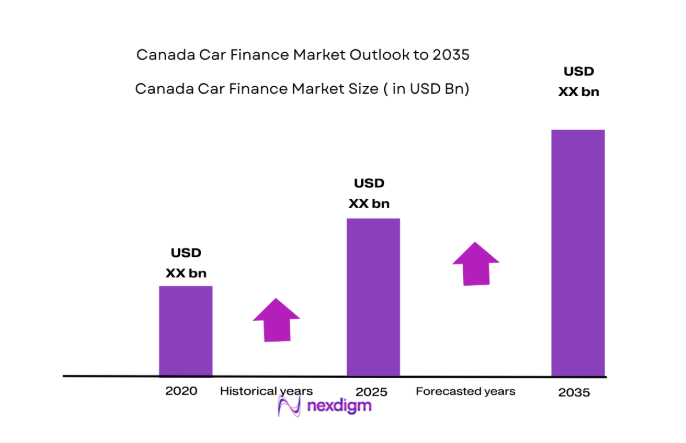
The Canada car finance market is experiencing substantial growth, with a market size estimated at USD ~ billion in recent assessments. This market expansion is driven by a rise in consumer demand for vehicles, along with the availability of affordable financing options from banks and financial institutions. Increased adoption of online platforms and digital financial solutions has also contributed significantly to this growth, facilitating easy access to loans and leasing options for both individuals and businesses. The shift toward electric and hybrid vehicles further amplifies the demand for specialized financing solutions.
Cities like Toronto, Vancouver, and Montreal are driving the market’s dominance due to their economic strength, high population density, and established automotive markets. These cities benefit from well-established financial ecosystems, robust retail sectors, and government policies that encourage consumer financing. Additionally, the growing interest in eco-friendly vehicles in urban areas, supported by government incentives and regulations, is further pushing the demand for automotive financing in these regions. These areas maintain strong market growth due to both their economic and demographic factors.
Market Segmentation
By Product Type
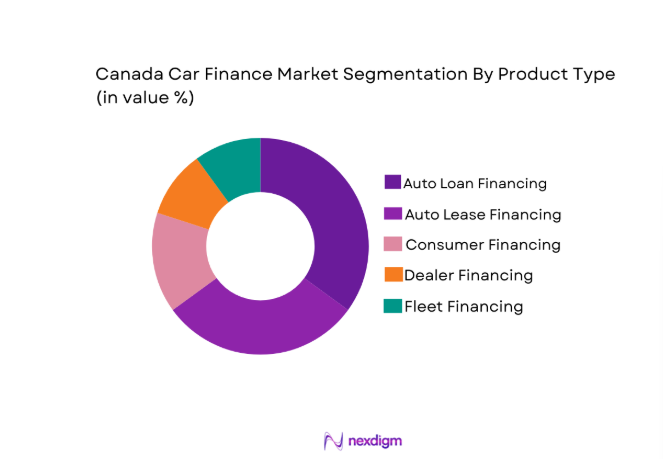
The Canada car finance market is segmented by product type into auto lease financing, auto loan financing, consumer financing, dealer financing, and fleet financing. Auto loan financing has a dominant market share due to factors such as increasing consumer preference for vehicle ownership, flexible loan options, and low-interest rates offered by financial institutions. This product type is also favored by business owners seeking to purchase fleet vehicles, further solidifying its market leadership.
By Platform Type
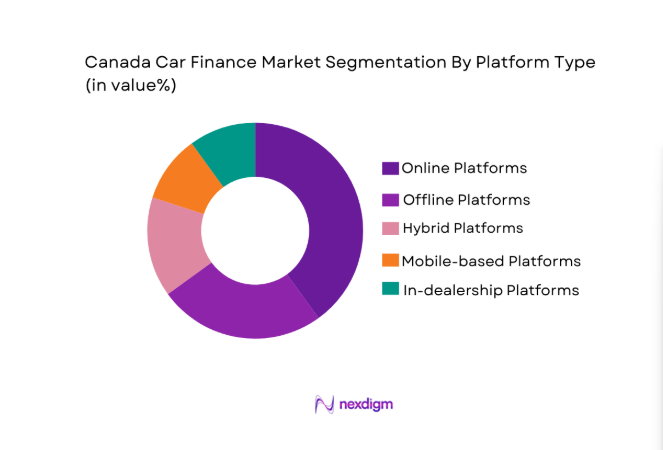
The Canada car finance market is segmented by platform type into online platforms, offline platforms, hybrid platforms, mobile-based platforms, and in-dealership platforms. Online platforms hold the dominant market share due to their convenience and accessibility, allowing consumers to apply for loans and complete transactions digitally, which increases efficiency and transparency.
Competitive Landscape
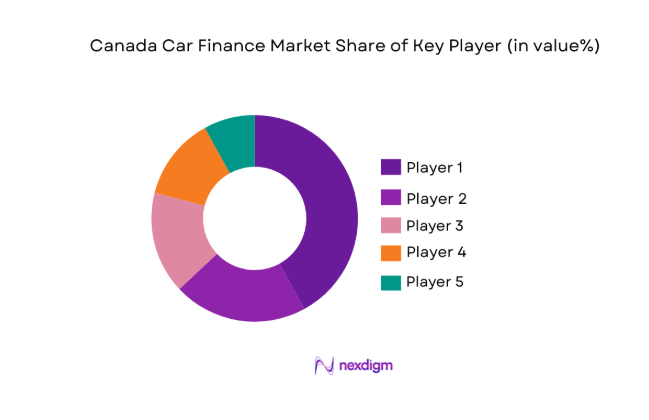
The Canada car finance market is competitive, with major players constantly innovating to cater to the evolving demand for both traditional and digital financial solutions. These companies are consolidating their market positions by offering integrated financing products and collaborating with auto manufacturers. Furthermore, new entrants are leveraging advanced digital platforms to offer faster and more flexible financing options to consumers.
| Company Name | Establishment Year | Headquarters | Technology Focus | Market Reach | Key Products | Revenue | Digital Financing Solutions Focus |
| Royal Bank of Canada | 1864 | Toronto, Canada | ~ | ~ | ~ | ~ | ~ |
| TD Auto Finance | 1955 | Toronto, Canada | ~ | ~ | ~ | ~ | ~ |
| Scotiabank | 1832 | Toronto, Canada | ~ | ~ | ~ | ~ | ~ |
| BMO Financial Group | 1817 | Toronto, Canada | ~ | ~ | ~ | ~ | ~ |
| Honda Financial Services | 1980 | Markham, Canada | ~ | ~ | ~ | ~ | ~ |
Canada Car Finance Market Analysis
Growth Drivers
Technological Advancements in Digital Finance
The rapid adoption of digital financial solutions is a key growth driver in the Canada car finance market. As consumers increasingly demand more convenient and accessible financial services, the rise of online and mobile platforms has revolutionized the way auto financing is provided. Companies are adopting AI and machine learning technologies to offer personalized loan options and improve risk assessment models. These technologies make the financing process quicker, more transparent, and tailored to individual consumer needs, contributing to the overall growth of the market. Furthermore, as more consumers seek digital-first services, financial institutions are investing heavily in the development of user-friendly apps and platforms to meet this demand. In addition, the implementation of blockchain technology in auto financing is set to enhance the security and efficiency of transactions, offering further growth potential. This technological shift enables a wider range of consumers, including those in rural areas, to access financing with ease, thereby expanding the market. With these advancements, the Canada car finance market is expected to continue its upward trajectory, supported by both consumers’ desire for convenience and institutions’ focus on innovation.
Government Support for Eco-friendly Vehicles
Government incentives and policies designed to encourage the adoption of electric and hybrid vehicles have provided a substantial boost to the car finance market in Canada. Subsidies, tax rebates, and favorable loan rates for electric vehicles (EVs) have created a growing demand for financing options tailored to these green vehicles. As environmental concerns continue to rise, Canadian authorities have implemented policies that favor clean energy solutions, including reducing the cost burden on consumers who opt for EVs and hybrids. These policies, along with an increasing number of green vehicle models entering the market, have spurred the demand for specialized financing solutions. Financial institutions are responding by offering auto loans with reduced interest rates and extended repayment terms for eco-friendly vehicles, further driving market growth. The government’s commitment to reducing carbon emissions and encouraging the adoption of green technology has positioned eco-friendly vehicle financing as a key growth sector. In the coming years, as more consumers switch to electric vehicles, the demand for EV-specific financing options is expected to increase, supporting the overall growth of the Canada car finance market.
Market Challenges
High Cost of Vehicle Ownership
One of the key challenges affecting the Canada car finance market is the high cost of vehicle ownership, which includes not only the price of the vehicle but also insurance, taxes, and maintenance expenses. While auto loans and leases make purchasing vehicles more accessible, the total cost of ownership remains a significant barrier for many consumers. Additionally, rising vehicle prices, especially for electric and hybrid models, have made it difficult for a large portion of the population to afford financing. As the cost of living continues to increase, many Canadians are finding it harder to balance the rising expenses of car ownership with their monthly budgets. This challenge is compounded by the fact that some areas of Canada, particularly rural regions, lack sufficient access to financing institutions, making it difficult for consumers to take advantage of available car financing options. To mitigate this, financial institutions are working on creating more flexible loan terms, but the overall affordability issue still remains a significant challenge. The high cost of car ownership continues to be a limiting factor in the widespread adoption of car financing, especially for first-time buyers and those with lower credit scores.
Economic Uncertainty and Consumer Confidence
Economic uncertainty and fluctuating consumer confidence are another challenge that could potentially affect the Canada car finance market. The recent economic volatility, including inflation and rising interest rates, has led to reduced disposable income for many consumers. This has impacted their ability to commit to long-term financial products, including car loans and leases. With increasing costs in the housing and energy sectors, many Canadians are prioritizing essential expenses over discretionary purchases such as new vehicles. Furthermore, rising interest rates have made car loans more expensive, causing many potential buyers to delay or forgo vehicle purchases altogether. Consumer sentiment, which tends to be closely linked with overall economic performance, is often the driving force behind large purchases like cars. In times of economic uncertainty, potential buyers are more cautious, leading to a slowdown in car financing activities. To overcome this challenge, financial institutions must adapt by offering more flexible loan terms and ensuring that financing products remain competitive, despite the economic climate. Additionally, targeted incentives or reduced rates for specific segments, such as first-time buyers or eco-conscious consumers, may help counteract these economic challenges.
Opportunities
Rise of Electric Vehicle Financing
The growing interest in electric vehicles (EVs) presents a significant opportunity for the Canada car finance market. Government incentives aimed at reducing carbon emissions, along with consumer demand for environmentally friendly transportation, are propelling the shift toward electric cars. The rise in EV sales has created a gap in the market for tailored financing solutions that address the unique characteristics of these vehicles. EVs tend to have higher upfront costs compared to traditional gasoline-powered vehicles, making financing options more crucial for potential buyers. Financial institutions are responding by offering attractive loans and lease terms specifically for electric vehicles. As more models enter the market, the financing landscape for EVs is expected to evolve with competitive interest rates, longer repayment periods, and higher loan-to-value ratios. This shift toward EV financing presents an opportunity for both traditional financial institutions and fintech companies to capture new customers who are increasingly conscious of their environmental impact. Furthermore, as charging infrastructure expands, consumers will feel more confident about transitioning to EVs, fueling demand for tailored financing options that can drive the market’s growth in the coming years.
Expansion of Digital Financing Platforms
The growing trend of digital-first services in the auto finance industry presents another key opportunity in the Canada car finance market. Consumers are increasingly seeking convenience and transparency when it comes to their financing options, prompting a surge in the adoption of online platforms that facilitate car loans and leases. These digital platforms enable users to easily compare loan offers, apply for financing, and sign contracts from the comfort of their own homes. The ability to access auto financing services 24/7 has become a major draw for tech-savvy consumers, particularly younger generations who value flexibility and speed. As financial institutions and car dealerships enhance their online platforms, offering instant credit approval and seamless digital transactions, the convenience factor becomes a major selling point. Additionally, the rise of mobile apps and AI-driven recommendation systems that personalize financing options for users is expected to further fuel this growth. With a larger proportion of the population embracing e-commerce and digital solutions, the expansion of digital auto finance platforms will continue to drive the Canada car finance market forward, making it more accessible, competitive, and consumer-friendly.
Future Outlook
The Canada car finance market is poised for continued growth, driven by technological advancements, rising consumer demand for electric vehicles, and supportive government policies. The increasing shift toward digital financing platforms is set to reshape how consumers access auto financing, making it more convenient and accessible. As electric vehicle adoption accelerates, the demand for tailored financing solutions for these eco-friendly vehicles is expected to rise. Regulatory support and incentives for green technologies will play a key role in sustaining market growth. With favorable economic factors, the Canada car finance market is set for a strong performance in the coming years.
Major Players
- Royal Bank of Canada
- TD Auto Finance
- Scotiabank
- BMO Financial Group
- Honda Financial Services
- CIBC
- National Bank of Canada
- Ally Financial
- Ford Credit Canada
- Toyota Financial Services
- Hyundai Capital
- Volkswagen Financial Services
- GM Financial
- LeasePlan Corporation
- Desjardins Group
Key Target Audience
- Investments and venture capitalist firms
- Government and regulatory bodies
- Automotive manufacturers
- Car dealerships
- Auto leasing companies
- Financial institutions
- Insurance companies
- Green vehicle manufacturers
Research Methodology
Step 1: Identification of Key Variables
Identify the major drivers, challenges, and segments of the car finance market in Canada.
Step 2: Market Analysis and Construction
Analyze the current trends, market dynamics, and historical data to estimate market size and segmentation.
Step 3: Hypothesis Validation and Expert Consultation
Consult industry experts and stakeholders to validate market assumptions and refine the analysis.
Step 4: Research Synthesis and Final Output
Synthesize the findings into a final market report with actionable insights and forecasts.

- Executive Summary
- Research Methodology (Definitions, Scope, Industry Assumptions, Market Sizing Approach, Primary & Secondary Research Framework, Data Collection & Verification Protocol, Analytic Models & Forecast Methodology, Limitations & Research Validity Checks)

- Market Definition and Scope
- Value Chain & Stakeholder Ecosystem
- Regulatory / Certification Landscape
- Sector Dynamics Affecting Demand
- Strategic Initiatives & Infrastructure Growth

- Growth Drivers
Government incentives for eco-friendly vehicles
Technological advancements in digital finance solutions
Rising consumer preference for flexible financing options
Increased adoption of e-commerce and online finance platforms
High demand for electric and hybrid vehicle financing - Market Challenges
Regulatory barriers and stringent compliance requirements
Rising interest rates impacting consumer borrowing capacity
Low financial literacy affecting financing adoption
Lack of transparency in the financing process
Economic uncertainty and market fluctuations - Market Opportunities
Increase in demand for electric vehicle financing
Potential for cross-border financing solutions
Strategic partnerships with tech firms to enhance finance accessibility - Trends
Growth in digital-first auto finance solutions
Emergence of AI-powered lending tools
Increase in demand for customizable financing packages
Shift towards eco-friendly vehicle financing
Adoption of data-driven decision-making in auto financing - Government Regulations & Defense Policy
Tighter regulations for vehicle financing
Policies supporting electric vehicle financing
Government funding for clean vehicle financing initiatives - SWOT Analysis
- Stakeholder and Ecosystem Analysis
- Porter’s Five Forces Analysis
- Competition Intensity and Ecosystem Mapping

- By Market Value, 2020-2025
- By Installed Units, 2020-2025
- By Average System Price, 2020-2025
- By System Complexity Tier, 2020-2025

- By System Type (In Value%)
Auto Lease Financing
Auto Loan Financing
Consumer Financing
Dealer Financing
Fleet Financing - By Platform Type (In Value%)
Online Platforms
Offline Platforms
Hybrid Platforms
Mobile-based Platforms
In-dealership Platforms - By Fitment Type (In Value%)
Consumer Financing
Business Financing
Short-term Financing
Long-term Financing
Flexible Payment Financing - By End User Segment (In Value%)
Individual Consumers
Business Owners
Dealerships
Car Rental Companies
Fleet Owners - By Procurement Channel (In Value%)
Direct Procurement
Third-party Financing
Government-backed Financing
Bank/Financial Institution Financing
Peer-to-Peer Financing - By Material / Technology (In Value%)
Loan Origination Software
Customer Relationship Management (CRM) Solutions
AI-based Financing Tools
Blockchain-based Financing Solutions
Fintech Solutions

- Market structure and competitive positioning
Market share snapshot of major players - Cross Comparison Parameters (System Type, Platform Type, Procurement Channel, End User Segment, Fitment Type)
- SWOT Analysis of Key Competitors
- Pricing & Procurement Analysis
- Key Players
Royal Bank of Canada
TD Auto Finance
Scotiabank
National Bank of Canada
Desjardins Group
BMO Financial Group
CIBC
Ford Credit Canada
Toyota Financial Services
Honda Financial Services
Ally Financial
Volkswagen Financial Services
GM Financial
Hyundai Capital
LeasePlan Corporation

- Consumer demand for more accessible loan products
- Business owners exploring flexible financing for fleet purchase
- Dealerships partnering with financial institutions for better offerings
- Increase in fleet financing for car rental and leasing companies

- Forecast Market Value, 2026-2035
- Forecast Installed Units, 2026-2035
- Price Forecast by System Tier, 2026-2035
- Future Demand by Platform, 2026-2035


 Request a Sample
 Ask for Customization
 Get a Quote
 Enquire Now