

 Download PDF
 Download PDF
Market Overview
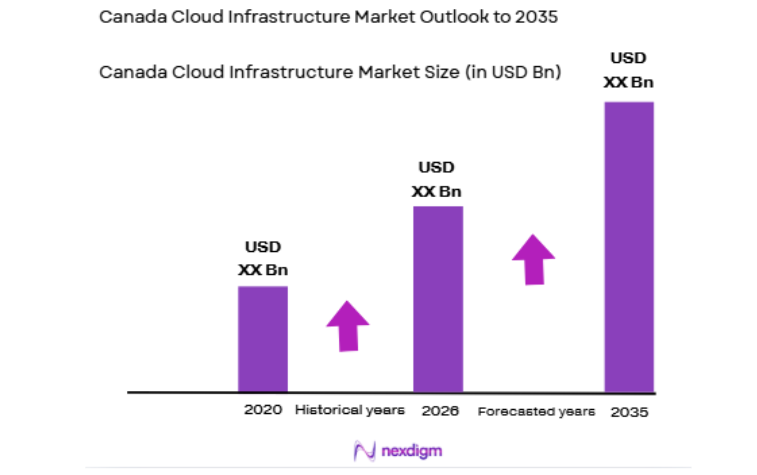
Canada’s cloud infrastructure market reached approximately USD ~ billion based on a recent historical assessment, driven by enterprise digital transformation, hyperscale data center expansion, sovereign cloud investments, and accelerated migration from legacy IT systems. Public and private sector demand for scalable computing, secure storage, and AI-ready infrastructure continues to expand nationwide. Growth is reinforced by rising SaaS adoption, regulatory data residency requirements, and large-scale modernization programs across finance, healthcare, telecommunications, and government institutions.
Toronto, Montreal, and Vancouver dominate Canada’s cloud infrastructure landscape due to dense enterprise concentration, advanced fiber connectivity, renewable energy access, and proximity to cross-border digital trade corridors. Quebec’s low-cost hydropower supports hyperscale data center development, while Ontario anchors financial and enterprise cloud demand. Western Canada’s technology ecosystem and Asia-Pacific connectivity strengthen regional infrastructure investment. Federal digital sovereignty policies and national broadband initiatives further reinforce geographic leadership across major metropolitan regions.
Market Segmentation
By Product Type
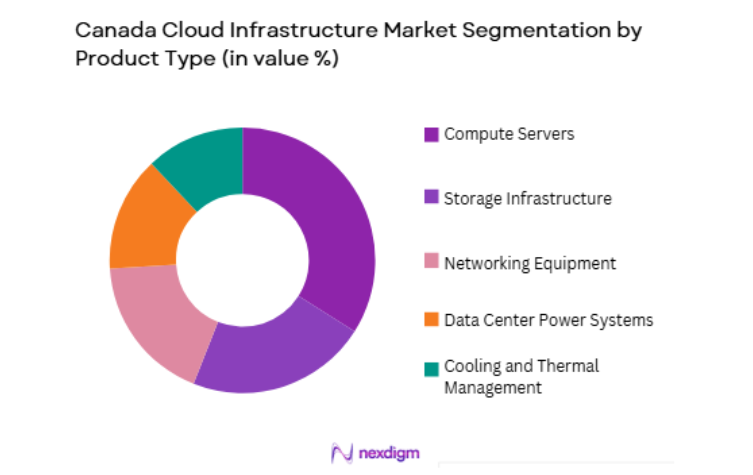
Canada Cloud Infrastructure market is segmented by product type into compute servers, storage infrastructure, networking equipment, data center power systems, and cooling and thermal management systems. Recently, compute servers has a dominant market share due to factors such as demand patterns, brand presence, infrastructure availability, or consumer preference.
By Deployment Model
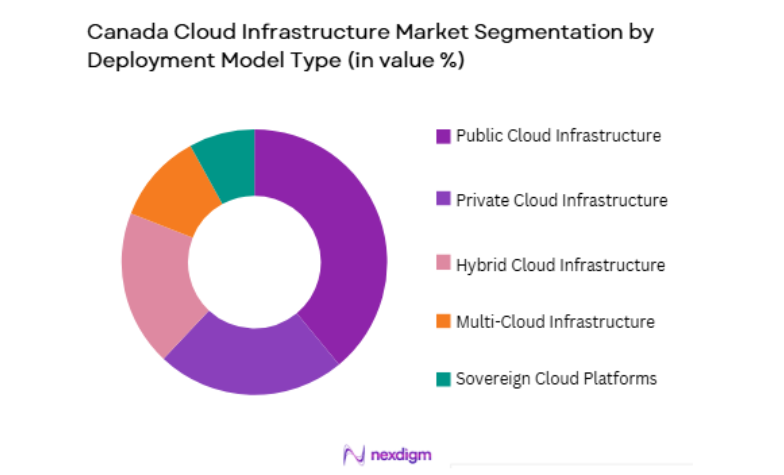
Canada Cloud Infrastructure market is segmented by deployment model into public cloud infrastructure, private cloud infrastructure, hybrid cloud infrastructure, multi-cloud infrastructure, and sovereign cloud platforms. Recently, public cloud infrastructure has a dominant market share due to factors such as demand patterns, brand presence, infrastructure availability, or consumer preference.
Competitive Landscape
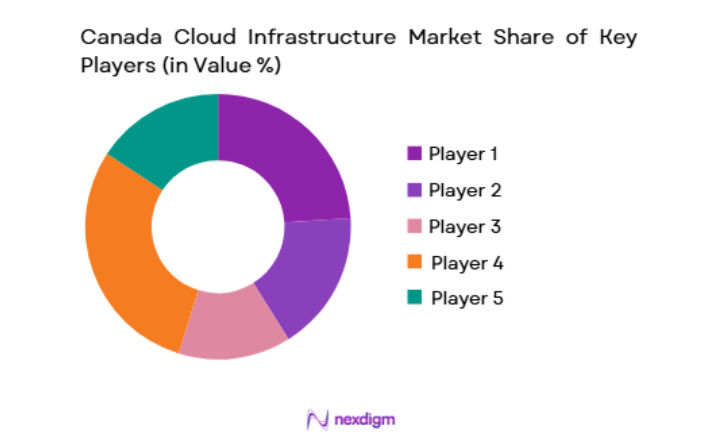
Canada’s cloud infrastructure market is moderately consolidated, dominated by global hyperscale providers and large infrastructure vendors with extensive capital resources and advanced platform ecosystems. Strategic partnerships with telecom operators, colocation firms, and government agencies shape competitive positioning. Market influence is concentrated among firms offering integrated compute, storage, networking, and cloud platform capabilities supported by Canadian data center footprints and compliance-ready sovereign cloud architectures.
| Company Name | Establishment Year | Headquarters | Technology Focus | Market Reach | Key Products | Revenue | Canadian Data Center Presence |
| Amazon Web Services | 2006 | USA | ~ | ~ | ~ | ~ | ~ |
| Microsoft | 1975 | USA | ~ | ~ | ~ | ~ | ~ |
| 1998 | USA | ~ | ~ | ~ | ~ | ~ | |
| IBM | 1911 | USA | ~ | ~ | ~ | ~ | ~ |
| Oracle | 1977 | USA | ~ | ~ | ~ | ~ | ~ |
Canada Cloud Infrastructure Market Analysis
Growth Drivers
Enterprise Digital Transformation and Cloud-Native Adoption
Canadian enterprises across finance, retail, manufacturing, healthcare, and telecommunications are accelerating digital transformation initiatives requiring scalable infrastructure platforms supporting analytics, artificial intelligence workloads, real-time processing, and distributed application architectures nationwide. Migration from legacy on-premise systems toward containerized, microservices-based environments increases demand for elastic compute, high-performance storage, and software-defined networking capabilities delivered through hyperscale and hybrid cloud infrastructure deployments. Organizations are modernizing enterprise resource planning, customer experience platforms, and data lakes, creating sustained infrastructure consumption patterns across public and private cloud environments. Regulatory compliance mandates surrounding cybersecurity, data governance, and operational resilience encourage adoption of secure, certified infrastructure hosted within Canadian jurisdictions. Cloud-native development frameworks, DevOps automation, and platform engineering practices expand infrastructure utilization intensity across enterprises and government agencies. Telecom operators and system integrators enable adoption through managed cloud and migration services tailored to sector-specific requirements. Artificial intelligence integration into business operations significantly increases demand for GPU-enabled compute clusters and high-throughput storage arrays supporting model training and inference. Multi-cloud strategies implemented for resilience and vendor diversification further increase aggregate infrastructure capacity consumption across multiple providers.
Hyperscale Data Center Expansion and Sovereign Cloud Investment
Global cloud providers and colocation operators are investing heavily in hyperscale data centers across Canada driven by renewable energy availability, regulatory stability, and growing enterprise cloud consumption. Quebec and Ontario attract large-scale facilities due to hydropower capacity, fiber connectivity, and proximity to major metropolitan demand centers. Federal and provincial digital sovereignty initiatives encourage localization of sensitive government and regulated industry data within national borders, stimulating sovereign cloud infrastructure deployments. Expansion of hyperscale campuses increases demand for servers, networking fabrics, storage systems, power distribution units, and advanced cooling technologies. Colocation ecosystems supporting interconnection and hybrid architectures expand infrastructure accessibility for enterprises migrating gradually to cloud platforms. Cross-border digital trade with the United States reinforces Canada’s role as a North American data hub requiring large-scale infrastructure capacity. Artificial intelligence and high-performance computing workloads from research institutions and enterprises further drive hyperscale infrastructure requirements. Renewable energy commitments by cloud providers align with Canada’s sustainability policies, accelerating investment approvals and construction timelines.
Market Challenges
High Capital Intensity and Infrastructure Deployment Costs
Cloud infrastructure development in Canada requires substantial capital expenditure due to land acquisition, construction, power provisioning, cooling systems, and advanced hardware procurement necessary for hyperscale and enterprise-grade facilities. Geographic dispersion and climate conditions increase logistics complexity and deployment costs compared with densely populated markets. Power infrastructure upgrades and grid interconnections for large data centers demand significant coordination with utilities and regulators. Imported hardware components expose projects to currency fluctuations and global supply chain volatility affecting investment predictability. Long construction timelines and permitting processes delay infrastructure availability relative to rapidly growing cloud demand. Skilled labor shortages in data center engineering, networking, and electrical infrastructure further increase project costs. Sustainability requirements mandate energy-efficient cooling and renewable power sourcing, adding design complexity and capital intensity. Smaller domestic providers face financing barriers competing against global hyperscale firms with larger balance sheets.
Data Sovereignty, Compliance Complexity, and Cybersecurity Risk
Canadian cloud infrastructure providers must navigate stringent data residency, privacy, and cybersecurity regulations across federal and provincial jurisdictions affecting infrastructure architecture and operational governance. Sector-specific compliance requirements in finance, healthcare, and government impose certification and auditing obligations increasing operational overhead. Sovereign cloud expectations from public institutions require dedicated infrastructure segregated from global platforms, limiting economies of scale. Rising cyber threats targeting critical infrastructure demand continuous investment in security controls, monitoring systems, and resilience capabilities. Cross-border data transfer restrictions complicate multinational enterprise cloud strategies and interoperability architectures. Compliance fragmentation across provinces creates additional complexity for providers operating nationwide infrastructure platforms. Incident response obligations and liability exposure increase risk management costs for infrastructure operators. Security talent shortages challenge continuous protection of hyperscale environments against evolving threat landscapes. These regulatory and cybersecurity pressures increase operational complexity and slow infrastructure deployment and adoption across sensitive sectors.
Opportunities
Artificial Intelligence Infrastructure and High-Performance Computing Demand
Rapid adoption of artificial intelligence across Canadian enterprises, research institutions, and public agencies creates substantial demand for specialized cloud infrastructure including GPU clusters, accelerated storage systems, and high-bandwidth networking fabrics. National AI leadership initiatives and innovation funding programs stimulate development of large-scale computing environments supporting model training and data analytics. Hyperscale providers are expanding AI-optimized regions in Canada to serve domestic and cross-border workloads requiring compliant processing environments. Enterprises integrating generative AI into products and operations increase consumption of scalable compute and storage resources. Research universities and laboratories require high-performance cloud platforms enabling collaborative and distributed computing. Edge-to-cloud AI deployment models generate additional infrastructure demand across regional data centers. AI governance requirements encourage localization of sensitive datasets within Canadian infrastructure environments. Hardware vendors benefit from accelerated adoption of AI-ready servers and networking equipment.
Sovereign Digital Infrastructure and Public Sector Cloud Modernization
Government modernization programs across federal and provincial levels are transitioning legacy IT systems toward secure cloud infrastructure hosted within national jurisdictions to ensure sovereignty, resilience, and service continuity. Public sector demand spans healthcare records, citizen services, taxation platforms, and defense information systems requiring compliant and certified infrastructure environments. National broadband expansion and digital government initiatives increase infrastructure consumption across distributed regions. Partnerships between hyperscale providers and Canadian telecom operators enable sovereign cloud deployment models meeting regulatory requirements. Public procurement frameworks encourage domestic infrastructure investment and data localization capabilities. Smart city and digital public service programs require scalable compute and storage platforms across municipalities. Cybersecurity mandates accelerate migration toward resilient cloud architectures for critical government systems. Government cloud adoption establishes anchor demand supporting broader enterprise ecosystem migration. Public sector modernization therefore creates sustained infrastructure growth opportunities across Canada’s cloud market.
Future Outlook
Canada’s cloud infrastructure market is expected to expand steadily over the next five years supported by hyperscale capacity additions, artificial intelligence computing demand, and sovereign cloud adoption across regulated industries. Government digital modernization and broadband initiatives will strengthen nationwide infrastructure deployment. Renewable energy availability and regulatory stability will continue attracting global cloud providers. Enterprise migration toward hybrid and multi-cloud architectures will sustain infrastructure consumption.
Major Players
- Amazon Web Services
- Microsoft
- IBM
- Oracle
- Equinix
- Digital Realty
- Hewlett Packard Enterprise
- Dell Technologies
- Cisco Systems
- Lenovo
- NVIDIA
- Ericsson
- Bell Canada
- Telus
Key Target Audience
- Investments and venture capitalist firms
- Government and regulatory bodies
- Hyperscale cloud providers
- Telecom network operators
- Data center colocation companies
- Enterprise IT infrastructure buyers
- Financial services institutions
- Healthcare system operators
Research Methodology
Step 1: Identification of Key Variables
Key variables including infrastructure investment levels, hyperscale data center capacity, enterprise cloud adoption rates, regulatory frameworks, and technology deployment trends were identified through secondary research and industry databases.
Step 2: Market Analysis and Construction
Market sizing and segmentation were constructed using vendor revenues, infrastructure shipment data, data center capacity indicators, and cloud adoption metrics across sectors and regions within Canada.
Step 3: Hypothesis Validation and Expert Consultation
Preliminary findings were validated through consultations with infrastructure vendors, cloud providers, telecom operators, and data center specialists to confirm demand drivers, segmentation accuracy, and competitive dynamics.
Step 4: Research Synthesis and Final Output
All validated insights were synthesized into structured analysis covering market dynamics, competitive landscape, segmentation, and outlook to ensure coherent and decision-ready research conclusions.

- Executive Summary
- Research Methodology (Definitions, Scope, Industry Assumptions, Market Sizing Approach, Primary & Secondary Research Framework, Data Collection & Verification Protocol, Analytic Models & Forecast Methodology, Limitations & Research Validity Checks)

- Market Definition and Scope
- Value Chain & Stakeholder Ecosystem
- Regulatory / Certification Landscape
- Sector Dynamics Affecting Demand

- Growth Drivers
Expansion of hyperscale cloud regions across Canadian provinces
Rising enterprise migration to hybrid and multi cloud architectures
Growth in AI and high performance computing infrastructure demand - Market Challenges
High capital and energy costs for large scale data center deployment
Latency and connectivity constraints in remote regions
Regulatory compliance and data sovereignty requirements - Market Opportunities
Development of green and low carbon data center infrastructure
Edge cloud expansion for 5G and IoT applications
Public sector sovereign cloud modernization programs - Trends
Adoption of liquid cooling and high-density rack infrastructure
Shift toward modular prefabricated data center construction - Government Regulations
- SWOT Analysis
- Porter’s Five Forces

- By Market Value, 2020-2025
- By Installed Units, 2020-2025
- By Average System Price, 2020-2025
- By System Complexity Tier, 2020-2025

- By System Type (In Value%)
Compute Servers
Storage Infrastructure Systems
Networking Equipment
Data Center Power Systems
Cooling and Thermal Management Systems - By Platform Type (In Value%)
Hyperscale Cloud Data Centers
Enterprise Private Cloud Infrastructure
Colocation Data Center Infrastructure
Edge Data Center Infrastructure
Government and Sovereign Cloud Platforms - By Fitment Type (In Value%)
New Build Infrastructure
Retrofit and Upgrade Systems
Modular Containerized Data Centers
Integrated Turnkey Deployments - By End User Segment (In Value%)
Cloud Service Providers
Telecom Operators
Government and Public Sector
Large Enterprises

- Market Share Analysis
- Cross Comparison Parameters (Deployment Scale, Energy Efficiency, Infrastructure Density, Cooling Technology, Service Integration, Network Connectivity, Geographic Presence, Compliance & Sovereignty, Scalability & Modularity)
- SWOT Analysis of Key Competitors
- Pricing & Procurement Analysis
- Key Players
Amazon Web Services
Microsoft Azure
Google Cloud
Equinix
Digital Realty
OVHcloud
Oracle Cloud
IBM Cloud
Bell Canada
Rogers Communications
Telus
CyrusOne
Vantage Data Centers
eStruxture Data Centers
QScale

- Cloud providers expanding hyperscale capacity in major metro regions
- Telecom operators integrating edge cloud with 5G networks
- Government agencies prioritizing sovereign and secure cloud adoption
- Enterprises modernizing legacy IT to hybrid cloud environments

- Forecast Market Value, 2026-2035
- Forecast Installed Units, 2026-2035
- Price Forecast by System Tier, 2026-2035
- Future Demand by Platform, 2026-2035


 Request a Sample
 Ask for Customization
 Get a Quote
 Enquire Now